Pages Menu
RssFacebook
Categories Menu

Posted by on Apr 29, 2009

Emmaus: Pre and Post Christian

Emmaus: Pre and Post Christian

The supper at Emmaus' (1958) by Ceri Richards (1903-1970)

The supper at Emmaus' (1958) by Ceri Richards (1903-1970)

My favorite story is the Disciples on the Road to Emmaus (Luke 24: 13-35). Michael Traynor of the Lesscoolthanyou Channel captures the experience of the disciple before the Breaking of the Bread in a way that evokes a very current state of affairs.

Read More

Posted by on Apr 29, 2009

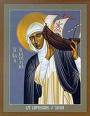
St. Catherine of Siena – April 29

St. Catherine of Siena – April 29

st-catherine-of-siena

April 29 is the feast of St. Catherine of Siena, O.P. Catherine Benincasa was born in 1347 in Siena, Italy. She was the 25th and final child born to her parents. Her father was a wool dyer and her mother was mistress of a large and active household. (Catherine was actually a twin, but her sister died shortly after birth.)

As a girl, when asked who my patron saint was, the only St. Catherine I knew at the time was Catherine of Siena. So I decided to take her as my patroness. That was fine with my mother, since I hadn’t been particularly named with a saint in mind! I didn’t know much about her, but she seemed like a strong, intelligent, interesting woman, so I stuck with her.

As I’ve grown older, I’ve learned much more about her and have become much more impressed with her spunk, her intelligence, her courage and her great faith. She was a woman who took matters into her own hands at a time when parents, and particularly fathers of families, made life-determining choices for their children. She cut her hair rather than get married. She accepted her parents’ decree that she should become a servant of the family if she wouldn’t behave as a daughter was expected to behave. She spent many years devoted to prayer alone in a small room at home. She was a mystic who allowed the love of God to flow forth through her to those in the world around her. She ventured out into a turbulent world, becoming an advisor to popes and other leaders of church and state. She cared for plague victims and organized others to do so as well. For most of her life she couldn’t read or write, but that didn’t stop her. She dictated and sent letters to people great and small. She recorded her insights into the spiritual life in works that are read to this day. Her influence has lasted far beyond her short 33 years.

In 1970, she became one of the first two women honored as Doctor of the Church for her writings.

I asked several people who are familiar with the work of St. Catherine of Siena to share a short idea or two with us about her. These are the responses I received, in order received.

From Susan T. Mahan, Ph.D.
I like the fact that Catherine did not seek to be the center of attention even though she had an exceptional spiritual life. When her family was angry at her for refusing to marry and isolated her; then made her work as a servant and wouldn’t let her out of the house, she totally accepted it and prayed her way through the day. She was not resentful but saw the gift in her circumstances. She also followed her inner discernment as to what the Lord wanted for her and trusted Him. She did not bend to what others expected – her family, her social class, even the Pope.

From Michael Fones, O.P.
What I really admire about Catherine was her ability to cross boundaries and categories that normally would have been off limits to women – and often, even men. She traveled extensively, at a time when travel was unusual and dangerous. Because of her holiness, she was brought in to mediate between factions at odds with one another. She was, as Jesus said of those who are born from above, like the wind; you couldn’t tell where she came from or where she was going. I find her fascinating because of her single-minded devotion to the Blessed Trinity, and the intense personal relationship she had with God, which is so beautifully expressed in her masterpiece, the Dialogue.

From Sr. Barbara Long, O.P.
I think the most interesting things for me are all of her efforts in striving to bring peace to the Church and the warring city states of Italy. At the end of her life, she thought that she was a failure, and yet look what a legacy she has left us.

In these our turbulent times, the example of St. Catherine of Siena is one upon which we should all draw.

Image by Bro. Robert Lentz, OFM

Read More

Posted by on Apr 14, 2009

Easter Monday 2009: The Post Modern Blues

Easter Monday 2009: The Post Modern Blues

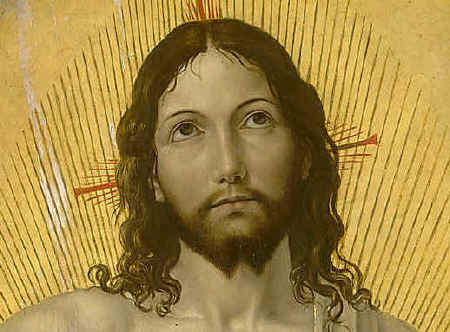
Borgognone 1510

Borgognone 1510

Easter time in the 21st century is a curious season. We are living in a time in which the rationality of the Enlightenment has been obliterated by the irrational violence and deconstruction of the Modern Era which ended with the creation of the atom bomb. In the 20th century we saw the the rise of the irrational as a counter to the idea of reason as the engine of human progress. Advances in science and engineering led to death on a massive scale whether in its industrial production form in the genocide of Jews and other peoples or its explosion from the sky in carpet bombing of Dresden or the incineration of Hiroshima and Nagasaki. The darkness within the brilliance of the human heart and mind was also manifest in the Vietnam War epic movie “Apocalypse Now” based on the theme that facing the horror of one’s evil can only lead to self destruction.

So here we are on the cusp of the third millennium. Human progress seems more of an illusion. In fact, our Post-Modern sensibility is all about the inability of reason and science to get at ultimate truth. Everything is examined and found wanting. Physics has become the study of relativity, uncertainty, and mathematical models. Religion and philosophy are the products of language we create. The scriptures of Christianity are cultural creations which tell us more of the people who wrote them. They are robbed of their revelation.

Human romance and love are reduced to methods for the socio-biological dispersion of one’s genetic load. Religious experience is suspect because there is no way to know whether one is just engaging in psychological projection to create a hideout from the ultimate reality of the purposelessness of human existence. We are here by virtue of  a cosmic accident with a very low probability.

In our world, there is the torture and death of Good Friday but there is no need for a Resurrection or any life beyond our current suffering because it is not possible since we can never know the nature anything beyond nature with any certainty. So here is the greatest event of all human history and our greatest personal hope – the Resurrection and it is a non-event on a beautiful spring day that is to be borne with a grim courage in a time when miracles cannot happen.

The news is too good. Maybe that is why we are stuck on the Friday of Crucifixion. The pain we know is better than risking its loss in the certain joy of Resurrection. As people of the Resurrection we would have to leave too much behind – hurt, anger, fear, and death.

Read More

Posted by on Apr 12, 2009

Resurrection Sunday – 2009: Jesus Did Not Die for Me

Resurrection Sunday – 2009: Jesus Did Not Die for Me

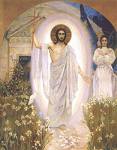
Resurrection of Christ - Mikhail Nesterov (late 1890s)

Resurrection of Christ - Mikhail Nesterov (late 1890s)

Jesús No Murio Por Mi

Jesus Did Not Die for Me

Holy Weekend
The time of customary rituals
Of words spoken a thousand times
A season of the silence of death
Fasting, resolutions, and processions
A time of self-contained euphoria
As it seems sin sees the ending
We already know
and will flood all with life
A shallow season of hypocrisy
“Happy Easter”

A season of churches in a thousand different ways
yet a thousand ways the same
Cannot say other than what they have always said
“Jesus died for our salvation”
But “You know what?”
Jesus didn’t die for me
Jesus died because of cowardice,
greed, arrogance, love of power
by those who did not understand his message
by those afraid of the new
by those who had made a god to their own stature
by those who did not accept his offer of life to the full
not for just a few but for all men and women.
That death did not save anybody
Not even those who believed that they are saved by Jesus.

What saved me and you
And continues to save
Is that Jesus who became a person
Who identified with the people
Who was a baby and cried,
Who was a boy and played
Who grew and worked
Who was called to a mission and took it on
Who paused before the pain of men and women
Who in solidarity of gestures, words, and actions
Who did not silence what had to be said
And who though fearful, moved ahead
out of love, sheer love.

It was not his death, so cruel and unjust.
It was his life!
If death can be salvation
Whan can resurrection mean?
What sense does it make to celebrate Easter?
Death does not save
Even if it scandalizes theology
Life saves.
That is why resurrection is the great cry,
The lead story, the great news of our time
For this the stone rolls aways, the tomb opens
And foot steps are heard in the garden

God raises up Jesus
To condemn death forever
To announce that Life has won out
and that faith in the this Jesus who lives
who conquers the mercenaries of terror
is the faith that saves and
is the faith that makes us free.
What Peter said with such clarity
“This same Jesus whom you crucified
God has made Messiah and Lord”.

Jesus did not die for me.
They killed Jesus!
Jesus died because they tortured him in a blind rage
Because they wanted to shut him up and make him disappear
And because the powerful have always killed Him.

Yes, Jesus was born for me.
He also lived for me,
He taught, healed, pardoned, loved and rose again for me
for you and and for everyone.

Jesus did not die for me
nor for you nor anyone else
Perhaps, some day
We will stop honoring his death
In order to begin celebrating His LIFE.

Gerardo Oberman

translated by Randolfo R. Pozos 2009

Read More

Posted by on Apr 5, 2009

Celibacy – An Unhealty Practice?

Celibacy – An Unhealty Practice?

photo by Rachel J Allen

photo by Rachel J Allen

The following is a substantial excerpt from Franciscan Richard Rohr’s article in the July August 2002 issue of Sojourners Magazine “Beyond Crime and Punishment” dealing with the clerical sex abuse scandal. Fr. Rohr is the founder of the Center for Action and Contemplation and is a contributing editor at Sojourners

“The Myth of Male Celibacy”

THE REVELATIONS OF the last year seem to be the beginning of the end of what some call “the myth of celibacy.” It’s not that male celibacy was always false or deceitful, but it was in great part an artificial construct. Men, with the best of original intentions, found out that they were not the mystics that celibacy demanded. That is exactly the point. Celibacy, at least in the male, is a most rare gift. To succeed, it demands conscious communion with God at a rather mature level, it demands many transitions and new justifications at each stage of life, and it demands a specific creative call besides. Many who have ostensibly “succeeded” at it have often, by the second half of life, actually not succeeded—in the sense of becoming a God lover, a human lover, and a happy man besides.

Practically, however, the demand for celibacy as a prerequisite for ministry is a setup for so many false takers. Not bad men, just men who are still on a journey: young men who need identity; insecure or ambitious men who need status; passionate men who need containment for their passions; men who are pleasing their pious mothers or earning their Catholic father’s approval; men who think “the sacred” will prevent their feared homosexuality, their wild heterosexual hormones, or their pedophilia; men with arrested human development who seek to overcompensate by identification with a strong group; men who do not know how to relate to other people and to women in particular.

None of these are bad men; they are just on a many-staged journey, and we have provided them an attractive way-station that often seems to work—for a while. But then they go on to the next stage and find themselves trapped, searching, conflicted, split, acting out, or repressing in, and often at variance with their now public and professed image.

The process lends itself to a Jekyll-and-Hyde syndrome, even among men who are very honest and humble in other areas. The price is far too high once you have committed your life publicly and sacredly. I know how hard it continues to be for me, my closest priest friends, and many that I have counseled and confessed. Many of us stay in not because we believe the official ideology of celibacy anymore, but because we believe in our work, we love the people, and we also know God’s mercy. But that loss of belief in the very ideology is at the heart of the whole problem now. We cannot prop up with law and social pressure what the Spirit does not appear to be sustaining. The substructure has collapsed. “Unless the Lord builds the house, they labor in vain who build it” (Psalm 127:1).

Add to that a rather large superstructure of ascribed status and security, and we have a system that is set up for collapse. Studies of male initiation say it is dangerous to give ascribed status to a man who has not journeyed into powerlessness. He will likely not know how to handle power, and may even abuse it, as we have now seen.

In general, I think healthy male celibacy is rare, and it probably is most healthy as an “initiation” stage to attain boundaries, discipline, integrity, depth, and surrender to God. In the long run, most men, as the Buddha statues illustrate, need to have one hand touching the earth, the concrete, the physical, the material, the sexual. If they do not, the other hand usually points nowhere.

WE SHOULD MOVE ahead reaffirming our approach to grace, healing, mercy, solidarity with sinners, patience, and transformation—while also cooperating with the social system whenever there are true victims’ rights to be redressed. We should do this generously, magnanimously, and repentantly.

We Catholics should also see celibacy as primarily an intense initiation course of limited (one to 10) years, much like the monks in many Asian countries. Celibacy has much to teach the young male about himself, about real passion, prayer, loving others, and his True Self in God. We dare not lose this wonderful discipline and container. (Who knows, maybe both Jesus and Paul were still in that early period of life?!) It could be a part of most Catholic seminarians’ training, and during that time much personal growth could take place. Some would likely choose it as a permanent state. Most would not.

How differently the entire process of priestly formation would be configured. What a gift to the religious orders (where celibacy is essential). Our precise charism would become clear, although we would surely become much smaller. What an opening to the many fine men who are attracted to a marriage partner. And what focused intensity this could give to spiritual formation during that celibacy period, instead of all of the hoop games, telling the directors what they want to hear, mental reservations, non self-knowledge, acting out, and “submarine” behavior that make many seminaries a haven for unhealth. Seminaries would not drive away sincere spiritual seekers, but would attract them. Not men looking for roles, titles, and uniforms to disguise identity, but men looking for holiness and God through which to express identity.

Male sexuality does not go away. It is not easily sublimated or integrated. It is either expressed healthily or it goes underground in a thousand different ways. Sex is and probably always will be a central issue for most males, and it can never develop honestly inside of a “hothouse” of prearranged final conclusions.

We should not be looking for a system where mistakes can never happen, but just a system that can distinguish health from unhealth and holiness from hiding. Like no other institution, the church should be the most prepared to deal with mistakes. That is our business. The steps to maturity are necessarily immature. Let’s start by mentoring the good and the true, and also surrendering to that mystery of grace, forgiveness, and transformation that is our birthright as Christians. Many priests and seminarians have always done this, and I hope this gives them the courage to know why and how they are both “sons and heirs” of a true wisdom tradition. Such disciplined sons, and only such sons, have earned the authority of “fathers.”

Richard Rohr, OFM, is founder of the Center for Action and Contemplation in Albuquerque, New Mexico.

Read More

Posted by on Apr 3, 2009

Obama at Notre Dame: Why the Catholic Right is Wrong

Obama at Notre Dame: Why the Catholic Right is Wrong

notre-dame-indiana-dome1

The Cardinal Newman Society has launched a petition drive objecting to President Barack Obama’s appearance at Notre Dame University’s commencement this year. Here is another approach to the issue.

George B. York III sent this letter to the National Catholic Reporter. It is presented here by permission of the author.

God and Man at Notre Dame

Notre Dame’s President, Fr. Jenkins, has extended
an invitation to President Obama to speak on
campus; the President has accepted. Some object,
asking, How could the President of Notre Dame
compromise with abortion? Closely observing
Jesus’ behavior in the Gospel of Luke, (7:40 and
following), I find Fr.Jenkins’ position consistent
with Jesus’ behavior, and in no way a compromise
with abortion.

In the story of Jesus’ evening in Simon’s
house an outsider, a woman, washes Jesus’ feet
with her tears and dries them with her hair. Simon
thinks, `Doesn’t he know what kind of woman she
is?’ Knowing what Simon is thinking, Jesus
surprises him by simply pointing to ways in which
Simon did not welcome Jesus; in so doing, Jesus
invites Simon to convert from hypocrisy to a
different way of judging and acting toward fellow
humans. While Jesus is uncompromising toward
misdeeds or sin, isn’t he also uncompromising when
it comes to accepting others, friend and foe alike, in
this case, welcoming the woman and challenging
but not rejecting Simon? Are humans defined only
by their real or supposed misdeeds?

About the strategy of some of his brother
bishops to `make war’ on abortion, South Dakota
Catholic Bishop Cupich told them: `…a prophecy of
denunciation quickly wears thin …what we need is a
prophecy of solidarity, with the community we
serve and the nation that we live in’. (quoted in
Commonweal Editorial, 5/12/08).

The way of implementing a prophecy of
solidarity is indicated by American Jesuit
Cardinal Avery Dulles. In commenting on
envisioning unity among Christians; he says, `The
first condition . . . is that the various Christian
communities be ready to speak and listen to one
another. . . . The process of growth through mutual
attestation will probably never reach its final
consummation within historical time, but it can
bring palpable results. . . . The result to be sought is
unity in diversity.’ (First Things, ’07)

Those are not just a Christian condition and
result; they are fully human. Does experience not
validate a claim that the better way between
different, opposed individuals and groups is one
leading to “unity in diversity”? Are exclusion and
isolation anything but impotent and sterile? Aren’t
Simon and the woman drawn within a more human
process? As a result don’t they depart from their
evening with their ability to hear reason and with
their freedom intact? In fact, is it not credible that
both Simon and the woman are invited, if not
actually drawn, closer not only to Jesus but also to
one another? Finally, to return to Bishop Cupich’s
solidarity, doesn’t `E pluribus unum’ mean unity in
diversity — union, not in sameness, but in
difference?

Such solidarity is impossible when one’s
starting point is that expressed in Simon’s initial
attitude: “Doesn’t Jesus know what kind of woman
she is?” Therefore, I have to wonder, Is it truly
Christian or even human to start, as some seem to
start, with a question like: “Doesn’t Fr. Jenkins
knowwhat kind of man Obama is?”

Isn’t the call to every Christian to put on the
mind of Jesus who Christians believe emptied
himself of power and the ways of power and drew
others neither by compromise with sin nor by
isolating rejection or coercion? To the extent a so-
called `prophecy of denunciation’ expresses a spirit
like that of the Pharisees (Simon’s initial attitude),
isn’t it a betrayal of the mind of Jesus? ? Isn’t such
prophecy animated by a spirit aiming at institutional
control, expressing a desire to force conformity in
the name of real or supposed truth? In the case of
NotreDame, doesn’t it express an ill-advised wish to
forceFr. Jenkins to dis-invite a supposedly unclean
Obama?

To the extent your answer is `Yes’, you see
why I say that Fr. Jenkin’s invitation to Obama
could be called a compromise with abortion only if
Jesus’ firm but friendly challenge to Simon could be
called a compromise with hypocrisy.

George B. York, lives in Denver. His
publication, `Michel de Certeau or Union in
Difference’ (2009, ISBN 978 0 85244 684 3),
concerns Faith in the understanding of a celebrated
French Jesuit historian.

Read More

Posted by on Apr 1, 2009

What’s In a Name?

What’s In a Name?

mikey

The question of names has been on my mind recently. My son and his wife have a new baby. He’s our first grandchild. So naturally, the question arises, “What do you want to be called?”

It’s a question of some import. For the rest of my life, I will be known by the name chosen for this child to use in speaking to me.

Choice of a name would seem relatively straightforward except for a few complexities of life. For example, my mother’s mother wanted to be called “Gammy,” but I was the first grandchild and I couldn’t get that word straight. The closest I could get to it was “Grammy,” so for the rest of her life, she was known as Grammy by her grandchildren and great-grandchildren from four families. So reality number one is that whatever choice I make, what I actually come to be called will depend on whether or not my grandson can say it!

Another reality is that there can be certain traditions within families for naming of grandparents. I think of my own grandmothers and great-grandmother, as well as of the other older women whom we addressed as Grandma. In my family, we had a different name for each of them. It made it easy to know exactly which woman was the subject of our conversations within the family. They all knew each others’ title as well, so communication was very clear.

Then there is the question of which language to use for selecting a name. Both Spanish and English are spoken in our nuclear family. Only English is used in my daughter-in-law’s family. So if one grandmother is to have a Spanish title, I would be the one.

The preference of the parents of the child also enters into the picture. In this case, my son has asked that I use Spanish with his child. So my title would be Abuela or Abuelita. I wonder if Lita would be easier for him, but that’s a step even farther from standard names, so probably not the best choice, though I find I rather like it. I also like Grandmama, but that’s definitely not Spanish!

I find myself thinking that it’s all very much like the reality of some non-industrial societies in which names are given to people but the person to whom the name is given does not tell it to anyone else. If asked, “What is your name?” the response is, “What would you like to call me?”

In a way, that’s really how most of our names work anyway. We don’t choose the names we are given by our parents. The pet names we give each other within the family are not chosen by any of us. Some of them we might prefer would go away – somehow be forgotten forever. The only names we really get to choose are ones that denote a change in identity related to a change in social position. People may change their last names when they marry, for example. Within the Christian community, those old enough to choose for themselves may select a new name for Baptism or Confirmation. Sacramental names don’t carry the force of law in civil society, but they do tell something about the individual who chooses them if selected thoughtfully, with consideration of what the name might signify about one’s new role or calling.

So, unlike the Divine name, which within Jewish tradition no one may speak because no one is allowed to have or claim any control over the Lord and Creator of all, each of us has a name by which others call us. By knowing our name, they have a claim on our attention and care. They can make demands of us. They remind us that we are all part of the same family – whether it is our small nuclear family, or our larger extended families, or the family of all humans in the world. I find myself thinking, I guess I’ll wait and see what I’m called and that will become my new name. It will reflect a new relationship with the world and my community. And that’s OK.

Read More