Thoughtful Reflections on Religious Experience

Archive for June, 2009

Searching for Answers by KathyPozos on Tuesday 23 June 2009 10:31 pm PDT
Simple Gifts

 I have been blessed in many ways. One of the blessings I particularly cherish is that my many nieces , nephews, and younger cousins have welcomed me as a “friend” on Facebook. I’m from a large family and married into a large family, both with overlapping generations, so there are many teens and young adults, some with very young children, as well as my siblings and their spouses and even my parents, who communicate regularly through Facebook.

Periodically, there’ll be an entry such as “X is trying to figure it out” or “Y is looking for the answer” or “Z doesn’t know what to do.” (Substitute a person’s name for the X, Y or Z.) My heart always goes out to that person who is struggling with these great questions that have arisen throughout human history. Who am I? Why am I here? What am I supposed to do in this life? Where do I go next? Why do bad things happen to good people? Is there meaning to it all?

Particularly in difficult economic times, these questions come to the fore and seem to have no good answers. Folks who have “followed the rules,” saved for their retirement, lived frugally, given generously to those in need, never asked for a “hand-out,” suddenly find that their savings have dropped in value, costs have risen dramatically, and the social safety net has developed enormous holes. Illnesses come unexpectedly. Jobs are lost. Children need help getting started. The old answers no longer seem relevant. And that’s just what we of the middle-aged and older generations are experiencing! For those just getting started, it can be a frightening time.

So … what reassurance and advice can I give them?

Often the glib or joking answers come to mind first. “The answer is 42″ (see The Hitch Hiker’s Guide to the Galaxy for the context of this response). “Didn’t anybody tell you babies take a lot of work?” “Welcome to adulthood!” “Quick, tell me your father’s middle name, your brother’s age and your sister’s hair color. See you have some answers!”

These responses are generally well received. They tell the questioner, “You’re not alone and you are loved. I care about you. You’ll be fine.” And that’s the kind of thing “netiquette” allows for posting on public “walls.”

But I always feel there’s so much more to be said. I want to say:

Take time to enjoy life just where you are. Notice the beauty of the sunrise and sunset. See the wild flowers and weeds  – how beautiful they can be. Watch a snail make its way across the garden. Watch how the ants cut up larger insects  to move them back to the hive for food. Listen to the birds and the hum of the bees. Watch for a baby’s smile and the lilt in the cooing and babbling that’s the beginning of language and communication. Live in the here and now, one day at a time. Tomorrow, do the same. Each morning, ask the Holy Spirit to guide your way, to smile through your face, to work through your hands, to speak through your voice. Pray the Our Father and mean it. “Give us this day our daily bread” – trust in God’s ‘just in time financing.’ There are no guarantees that human financial institutions will take care of you or your money. Yes, we need to work and be prudent and take responsibility for helping God provide for us, but God is much bigger than our understandings and plans. God has much more to give us than we can imagine. And as long as we are open to receive God’s gifts, we’ll continually be surprised by life and love and joy.

So don’t waste a lot of time trying to figure things out. Don’t spend time worrying about things that can’t be changed just now or for which there really are no answers at present. Do what you can. Spread a little patience and love. Laugh and sing and dance because that’s what God does through all of creation. Give thanks for what you’ve received already and what’s coming down the road. Know that we grow and learn wisdom only by going through rough times and that we are all called to grow in “wisdom, age and grace.” Each of us is ultimately called to return to union with God. We are called to become saints through the ups and downs of our lives. So try to relax, take one day at a time, and know that when all is done, you’ll shine like fine gold, refined and polished by a master craftsman who really, really loves you.

Ancestral Grace

Orbis Books has published a new work by Irish Catholic priest, Diarmuid O’Murchu, entitled Ancestral Grace. It  offers a challenging new perspective on evolution, environmental bioregionalism, Christian tradition and their reconciliation into a comprehensive and optimistic vision of the future of humanity.

I offer this quote from the book and invite you to consider it with open mind and heart.

Being human is the gateway to access divine meaning. Indeed, ancestral grace thrives on the great story of humans being receptive and responsive to divine initiative over several million years. The humanity of Jesus is the key that unlocks the secrets of divinity, not the opposite, as we have believed for much of the Christian era. The mystery of God becomes transparent in the mystery of the human. . . Jesus is the first disciple of ancestral grace.

~ Diarmuid O’Murchu

The Feast of the Body and Blood of Christ by KathyPozos on Sunday 14 June 2009 9:56 pm PDT
Cyprian Consiglio, OSB Cam

Cyprian Consiglio, OSB Cam

Cyprian Consiglio, OSB Cam. offered some interesting thoughts about the Feast of the Body and Blood of Christ (AKA Corpus Christi) today in his homily and his blog. He has graciously agreed to allow me to share them in a post for this feast.

The Inner Meaning

During this time of year when there are so many of our rites of passage taking place––weddings, graduations, ordinations (even birthdays)––it’s interesting to take a look at the purpose of ritual. Anthropologically speaking, a ritual is a way of expressing and passing on our understanding of reality or of an experience to someone else. So, for instance, a graduation is not about a piece of paper and a cap and gown: it’s weightier, it’s heavy; that’s why tears flow from the eyes of parents as they see their child graduate or get married. The ritual is trying to carry all those memories and meanings, and summarize them in a single gesture: an exchange of rings, the laying on of hands, a birthday card, an embrace, throwing a shovelful of dirt on a coffin: all these rituals mean more than they mean, they carry an almost indescribable load of treasures.

In the Roman rite we celebrate the Solemnity of the Body and Blood of Christ this week, and it’s safe to ask what Jesus was trying to convey to his disciples when he performed this rather odd ritual––not just breaking the bread and passing out the cup, but claiming that it was his very self. What exactly was he asking them to remember when they did it over and over again? I thought of five things, which certainly don’t exhaust the list of possible meanings.

1. First of all, this gesture looks backward and forward at Jesus’own life. Backward in that Jesus’ whole life had been spent being broken and passed out; his whole life had been dedicated to feeding those around him: taking care of their bodily needs through healing and feeding; and also feeding and healing them in a real way with the Wisdom of God, this incredible good news of God’s undying boundless care for every single hair on the head of very single human being from the greatest to––especially––the least. This ritual also looked ahead to the next day when Jesus allowed his body to be broken like bread and his blood poured out like wine––to say that it’s alright: you can survive even this, your real self cannot be annihilated, but like a seed that falls into the earth and dies it will yield a rich harvest of resurrection life.

2. This ritual symbolized––again what Jesus’ whole life symbolized––that Divine Love gives itself to humanity––that’s what God is like! The Divine is present, really present: divine love is offering itself to the world in this ritual meal.

3. This ritual also conveyed (and conveys) that this Divine Mystery is present everywhere, in creation, “in the earth and its produce.” Unfortunately the kind of hosts we use and our ornate chalices can actually hide the fact that this is actually wheat and grapes, real food: “which earth had given,” as we say, “fruit of the earth.” I think that this conveys that all matter is meant to be brought into right relationship with God, and that all matter can reveal and be a vehicle for the Grace of God. St Irenaeus wrote,

    “This is why he took a part of creation, gave thanks and said: This is my body. In the same way he declared that the cup, an element of the same creation as ourselves, was his blood: he taught them that this was the new sacrifice of the new covenant.” (Irenaeus, Against Heresies)

But we add a line to the prayer over the gifts: it’s not just what ”the earth has given,” or “the fruit of the earth”; it’s also the work of human hands. There is a beautiful prayer of Teihard de Chardin:

    I, your priest, will make the whole earth my altar––
    And on it I will offer you all the labors and sufferings of the world…
    I will place on the paten the harvest to be won by labor. . .
    Into my chalice I will pour all the sap which is to be pressed out this day from the Earth’s fruits.

So, the fruit of the earth and the work of our hands all become vehicles for God’s grace, all is meant to be brought into right relationship with God.

4. This ritual is also meant to convey to us that God wants us to participate in the work of creation, and in divinity itself. That’s why we pray that incredible prayer, “by the mystery of the water and wine may we come to share in the divinity of Christ who came to share in our humanity.”

5. And how do we participate? Well, that’s the last thing I want to mention that this ritual is trying to convey (though we could go on and on): it conveys that this divine mystery is especially present whenever and wherever human beings meet and share together, that God is present in every gesture of unselfish love, in every occasion of someone laying down their life for another. That’s why we read the story of the washing of the feet before we celebrate the Mass of the Lord’s Supper on Holy Thursday.

The Hebrews didn’t need another ritual, another sacrifice; we don’t need another ritual; and God certainly didn’t and doesn’t either. The prophets leading up to Jesus kept telling the people how God was sick of their sacrifices and rituals! Jesus himself quotes the prophet Hosea twice saying: “Go and learn the meaning of these words, ‘It is love that I desire, not sacrifice. Knowledge of God rather than burnt offerings.’”

The church, and this ritual, has no other purpose but to communicate and convey and reveal that––the love and knowledge of God that is hidden in the heart of creation and poured into the center of every human being as our very source and our ground. This is what we will be judged on as a church, as individuals, as communities and as a whole: not the forms of our rituals and doctrines, but by the reality of the love and knowledge of God that we manifest.

Bede Griffiths wrote that: “All myth and ritual, all doctrine and sacrament, is but a means to awaken our souls to this hidden mystery, to allow the divine presence to make itself known.”

So: as we participate in this ritual, as we receive the Body and Blood of Christ, and/or when we gaze at the reserved Blessed Sacrament in the Tabernacle or in a monstrance, let’s remember how weighty it is, how much it carries and conveys. And let’s especially pray that it would awaken us to the mystery of the knowledge of God, and the love of God that is poured into our hearts, so that we might make it manifest in our world, so that we might be the body and blood of Christ––that we might be broken and poured out for the sake of the world as Jesus was.

cyprian
14 june 09

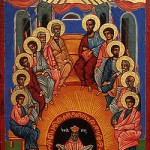
Eastern Orthodox Icon of Pentecost

Eastern Orthodox Icon of Pentecost

The Feast of Pentecost falls 50 days after Easter. Pentecost was originally a celebration of the first harvest and people came to Jerusalem from all over the known world to celebrate the feast.

For people in northern climes, the thought of a first harvest celebration in Spring may sound strange. After all, the snow has barely melted and crops are nowhere near ready to harvest. Even early crops like strawberries and lettuce aren’t ready yet. Nevertheless, in the Middle East, and by extension in that general latitude around the globe, many crops have already been harvested. Just go to a grocery store and you’ll see the fruits of our fields waiting for your table!

Within the Church, we celebrate the outpouring of the Holy Spirit on the disciples – men and women who had been friends, family and followers of Jesus. This outpouring of the Spirit of God, the God Who is Love, gave birth to the Christian community that endures to this day. Jesus’ friends and followers were transformed from frightened “mice” into fearless “lions” who proclaimed boldly that Jesus had been raised from the dead, that He is the long awaited Christ, that God has made Him both Lord and Savior, that a new age has dawned and the Kingdom of God has begun.

These early disciples wasted no time in putting their beliefs into action. They shared what they had. They cared for and healed the sick. They took care of widows and orphans – the powerless ones of their society. They recognized the gifts of women who were leaders in their communities. They spread the Good News of the Lord to all who would listen. And they struggled to understand the implications for themselves and their society of the Good News and the freedom of God’s children. Who were God’s chosen ones? Who could be followers of the Way? What parts of the Law were non-Jews required to obey? How can the pastoral needs of the community be met? Who will look out for the powerless ones in our own communities? How do we choose leaders for our communities? How should Christian family members behave with each other?

For nearly 2000 years we have dealt with these issues as a community. Today we still face many of them, though in a much wider context, as a global, international community that includes peoples of all cultures. More than ever we must count on the continued outpouring of the Spirit to guide us and make us bold witnesses to the Good News.

Much of what we take for granted today is the result of the work of Christians who actively put their beliefs into practice and stepped out to make their part of the world a better place. Institutions such as hospitals, schools for poor and even middle-class children, education for girls, social safety nets, and many others have resulted from the Christian insight that God cares about all humans, even those who traditionally have been excluded.

The Christian belief that all receive the gifts of the Holy Spirit in Baptism and Confirmation also leads to the understanding that all are responsible to share the gifts they have received and bear fruit in their lives. Together we listen to the Spirit and share in the development and shaping of both our Church community and the world.

As we move through these days following Pentecost, we face many challenges. It’s a time of global financial challenges. Governments are moving quickly to try to minimize the harmful effects of the banking crisis on their people. Social service agencies and churches are struggling to offer aid to the increasing numbers of people coming to their doors. Here in California there’s talk of dismantling all state funded social services, including health care programs for children of low income families and the welfare to work programs that helped so many families keep roofs over their heads and food on their tables.

What will we as children of God, brothers and sisters, do to address these challenges in our communities, states and countries? Will we say, as so many do, “It’s not my responsiblity to care for the children of the poor. Why don’t their parents just go get jobs?” Will we say, “Don’t ask me to pay more taxes. I shouldn’t have to cut back my lifestyle to pay for other people’s mistakes.” Will we sit in judgement of people who are losing their homes because they lost their jobs? Will we smugly assume that we’ve saved enough money to keep us safe if we get ill or lose a job? Will we criticize the people who lost their savings to the stock market when the money should have been somewhere safer? I hope not.

This year the time from Pentecost onward can be a time in which we truly listen to the Holy Spirit’s call to build up the Kingdom by caring for the poor, the powerless, those who are ill and who are losing their security (whether as a result of their own errors or those of others). It’s a time to trust that if we give of what we have, share from our abundance or our need, God will make sure that our needs are met. Our ethic of life must include not only the unborn but also those who are here and in need. Womb to tomb includes all those days in-between as well. Let’s not forget that as a Church community.

Late Term Abortion: A Mother’s Story by RandyPozos on Tuesday 2 June 2009 9:41 pm PDT

parents

Robin Young of National Public Radio’s “Here and Now” interviewed one of the patients of murdered late-term abortion provider, Dr. George Tiller.

“We speak with a former patient of late-term abortion provider Dr. George Tiller, the Wichita, Kansas doctor who was murdered on Sunday. She explains why the procedure was so necessary for her.”

Abortions past the 20 week “age of viability” are difficult to justify by pro-choice advocates. How could the loss of one of the three physicians who performs these procedures, which are less than 1% of abortions, represent any moral or clinical loss? The implications for the physical and mental health of families becomes evident in this interview. The values presented in this story are about the desire and wonder of having children, the anguish of carrying a doomed child, the inability of doctors to present the couple with any real alternatives.

An earlier ban on late term or “partial birth” abortions provides an exception for the health of the mother. Aren’t these just cavalier acts of barbarism by selfish women?

What would you do with a child that you wanted very much but who would not survive birth? What would be the most loving and caring thing to do? This is a very compelling story that should give us pause when we want to throw the first stone.

My Late-Term Abortion
President Bush’s attempt to ban partial-birth abortions threatens all late-term procedures. But in my case, everyone said it was the right thing to do — even my Catholic father and Republican father-in-law.
This article provides another instructive example from 2004 published in the Boston Globe.

In this second case, the situation seems to be less clear cut since the birth of this child would have meant a short and very unacceptable quality of life for the child as judged by the parents.

In both cases there were voices which opposed the choices made by the parents. Reviewing both cases is useful in terms of gaining a more nuanced perspective on the ethical and moral issues involved and the struggles of these couples.

Categories

  • Angels (3)
  • atonement (16)
  • Bio-Ethics (3)
  • Christian Unity/Ecumenism (3)
  • Communion of Saints (8)
  • Conversion (32)
  • Doctor of the Church (22)
  • Edith Stein (2)
  • Eucharist (7)
  • Ever Ancient / New (58)
  • everyday revelation (94)
  • Faith and Public Policy (6)
  • Faith and Reason (63)
  • Faith in Action (120)
  • Fathers of the Church (10)
  • Feasts – liturgical (67)
  • Festive recipes (4)
  • Forgiveness (16)
  • God in All Things (48)
  • Gratitude (19)
  • Holocaust (3)
  • Incarnation (26)
  • It's to laugh (2)
  • Jewish / Christian Relations (3)
  • Korean Martyrs (1)
  • Liturgical year (59)
  • love (39)
  • Marriage (7)
  • Ministry (4)
  • Miracles (14)
  • Missions (10)
  • Mother Teresa (4)
  • Mystics (13)
  • Pagan/Christian Relations (3)
  • Pope John Paul II (3)
  • Pope John XXIII (2)
  • Pope Paul VI (1)
  • Prayer (2)
  • problem of evil (11)
  • Sacraments (9)
  • Saints (123)
  • Salvation (29)
  • Second Vatican Council (5)
  • Site logistics (4)
  • Social Justice (39)
  • spiritual growth (71)
  • spirituality (62)
  • St. Augustine (1)
  • St. Faustina Kowalska (1)
  • St. Francis of Assisi (2)
  • St. Ignatius Loyola (3)
  • St. Jerome (1)
  • St. John Chrysostom (1)
  • St. Joseph of Cupertino (1)
  • St. Matthew (1)
  • St. Robert Bellarmine (3)
  • St. Therese of Lisieux (3)
  • St. Vincent De Paul (1)
  • St.Thomas of Villanova (1)
  • Theodicy (3)
  • Thomas Merton (1)
  • Uncategorized (10)
  • Virgin Mary (11)
  • Vocation (3)
  • Yom Kippur (1)
  • Youth Ministry (3)
  • Monthly Archives

  • March 2010
  • February 2010
  • January 2010
  • December 2009
  • November 2009
  • October 2009
  • September 2009
  • August 2009
  • July 2009
  • June 2009
  • May 2009
  • April 2009
  • March 2009
  • February 2009
  • January 2009
  • December 2008
  • November 2008
  • October 2008
  • September 2008
  • August 2008
  • July 2008
  • June 2008
  • May 2008
  • April 2008
  • March 2008
  • February 2008
  • January 2008
  • December 2007
  • November 2007
  • October 2007
  • September 2007
  • August 2007
  • July 2007
  • Recent Posts

    Recent Comments

    RSS Subscription

    Subscribe by Email

    Enter your Email


    Preview | Powered by FeedBlitz

    Visitors

    Locations of visitors to this page

    Creative Commons LICENSE

    This work is licensed under a Creative Commons License.