Pages Menu
RssFacebook
Categories Menu

Posted by on Apr 23, 2010

St. George and The Dragons Within

St. George and The Dragons Within

St. George - 15th Century icon from Novgorod

April 23 is the feast of St. George. George was a Roman soldier in the third century, during the time of the Emperor Diocletian. He was from a Christian family and his father was an army officer. As a young man, he also entered the service of the Empire and rose to the rank of Tribune, enjoying a position of trust with the Emperor. When Diocletian turned against Christians and ordered the arrest of Christian soldiers, George went to him and protested the action. The Emperor was not swayed by George’s appeal and instead ordered him to renounce his Christian beliefs. George refused, was tortured and eventually was beheaded.

Most of the stories of St. George are non-verifiable legends. At least some of them seem to be confusions with the stories of others named George or others who had similar positions or histories.

The stories with which he is most often identified have him in the role of Dragon-slayer. They are found in many countries and cultures, even crossing religious lines between Christian and Muslim worlds. In most stories St. George slays the dragon. In some, he subdues the dragon.

I like the idea of subduing the dragon. I first came across it when my sons were young and attending Waldorf school. For the Feast of Michaelmas, in September, the second graders performed a play in which St. Michael faces a dragon that has been terrorizing a village. The play has a character more like St. George who is supported by St. Michael. In this particular version of the story, the dragon is tamed and provides energy to run the mill so the villagers can grind the wheat they have grown to make flour for their bread.

Dragons come in many sizes and shapes in stories from cultures all over the world. In China, dragons are respected and seen in a much more positive light than in Western European stories. In fact, when my first son was born, my Mother’s cousin who was a priest in Hong Kong sent a gift of a red dragon to us in celebration. The Dragon Wars stories of novelist Laurence Yep are some of my favorites. Written for middle school and older children, they present Chinese folklore in a very engaging way. Dragons are to be respected, held in awe and definitely not destroyed. Their presence and the gifts of passion and energy they bring are necessary for all of creation.

I like to think of dragons in these more Chinese terms. Having been born in a “Year of the Dragon” myself, and being somewhat choleric in nature, I have had to come to terms with the passionate, powerful energy within myself that can burst out in good ways and in not-so-good ways. That “dragonish” energy can bring forth wonderful things. It can also blast potentially wonderful things to smithereens if released inappropriately. I’m sure sometimes God winces in dismay as a carefully set up pattern of events that would lead to something really good gets derailed by such blasts. (Not to say that God can’t still bring something good out of it, but it’s so much more bother!)

So when I think of the feast of St. George and the stories of dragons slain or subdued or celebrated, I pray that the dragonish power within me – the Greek “dunamis” or power, potential, capacity – will be focused by the Holy Spirit for service of the Kingdom. I hope that will be your prayer as well.

Read More
Posted by on Apr 21, 2010

Quote of the Day – St. Anselm of Canterbury

Quote of the Day – St. Anselm of Canterbury

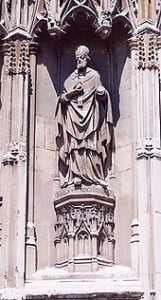
St. Anselm of Canterbury

April 21 is the feast of St. Anselm of Canterbury, Doctor of the Church and the first scholastic philosopher of Christian theology. For Anselm faith and reason were not mutually exclusive. In fact, they went hand in hand. The following quote sets forth his approach to faith and its exploration.

“Nor do I seek to understand that I may believe, but I believe that I may understand. For this, too, I believe, that, unless I first believe, I shall not understand.”

Read More

Posted by on Apr 15, 2010

Tax Day 2010 – We’re All In This Together

April 15 is the deadline for Americans who have received income from any source in the prior year to pay any taxes due on that income. Needless to say, it is not the favorite time of year for most people. Generally there is a certain amount of hullaballoo about the whole thing. People complain about how much is taken from their wages, how people who don’t work still get help from the government, that they never personally agreed to the taxation, that people should be responsible for taking care of themselves, that some other generation is not doing its share or being appropriately responsible finacially, and so forth. The list of complaints goes on and on.

I’d like to offer a quick thought about the whole issue of taxation.

I seem to recall stories from our Judeo-Christian tradition in which the question “Am I my brother’s keeper?” arise in one form or another. Again and again, the response from God has been, “Yes, you are.”

From the earliest days of our tradition, through the Law and the prophets, to the days of Jesus and the early Church and up to the present day, we hear again and again, “We are all in this together.” We are to look out for each other. Yes, we are to do our best to take care of ourselves and those personally entrusted to us (spouses, parents, children, siblings), but we are also to take care of the widows and orphans among us (i.e., those who don’t have family or identity within the society). That means we are responsible for those who can’t work, even if they seem able-bodied, those who may not have proper legal documents allowing them to be here but who have had the misfortune to get sick or injured, those whose parents can’t earn enough to buy food, clothing, books, or health care for them, those elderly who have no children with whom they can live or who could afford to pay for shelter, food, and medical care for them, those for whom there is no job. Again, the list goes on and on.

We also share responsibility to pay the cost of keeping our communities safe, our roads, buildings and bridges safe, our educational systems safe and effective, our environment healthy, and those whose work is to serve the larger community paid a decent living wage, with access to health care and time off to renew their spirits and raise their families.

Some of us have been blessed with more resources. Some of us receive money for work done by others (parents, grandparents, etc.). Some have investments that provide income without the necessity of doing any physical or mental labor. Some have barely enough income to keep simple shelter overhead and food on the table. Some have enough for a comfortable lifestyle, without much left for the frills.

Whoever we are, whatever our circumstances, we are all responsible for each other. We’re all in this together.

So let’s pray for the grace to be willing to give of what we have. Some will receive more than they have paid in taxes as a refund this year. Believe me, when that happens to an ordinary family, they really need the money. They haven’t had a great year financially. It’s truly a gift from God to have enough income to have to pay taxes. There are so many deductions from taxable income, so many credits to help families and business owners, that if we still owe some tax, generally speaking, we have been blessed. It doesn’t always feel that way, but in the big picture, we have been blessed.

So today, as we send in our checks and our forms, let’s ask a blessing for ourselves and each other, a blessing for our country and our world, and a word of thanks to the Lord for the rich blessings of opportunity, environment and loving community that we have received.

Read More

Posted by on Apr 9, 2010

Great Love or Great Suffering – Two Paths to Non-duality

Great Love or Great Suffering – Two Paths to Non-duality

Richard Rohr, OFM

Recently I’ve been listening to Fr. Richard Rohr’s three CD set, Exploring and Experiencing The Naked Now, a recording of two webcasts in which he talks about his work on non-dual thinking and the insights of the contemplative/mystic tradition of Christianity. Rohr’s work provides a fine background for the last couple of weeks of Lent and moving into Easter.

A central insight of Rohr’s work is that non-dualistic thinking is central to experiencing the mystery of Christ and the Trinity. God is One, yet we know God as Father, Son and Holy Spirit. The contrast boggles the mind when we try to explain, define or otherwise pin down the mystery. Our minds, trained to make logical distinctions and put all we experience into categories of “this/not that,” find it hard to deal with the “yes/and”  of combining such seemingly irreconcilable statements. Nevertheless, Jesus calls us into the mystery and teaches through example, images and stories that seem to contradict each other. In one place, for example, he says that his followers are to turn the other cheek when someone strikes them. In another, he counsels that it’s time to take swords along to the place where he and is friends planned to spend the night. At yet another, he turns over the tables of the money-changers in the temple and drives them out. Then when the chips are down, he heals the ear of the servant of the High Priest in the Garden of Gethsemane and goes to his death without offering resistance. So which is it? Non-violent always or Violent sometimes? Do we simply choose one meaning – the one that suits what we want to do – or are we supposed to try to make some logical sense of the contrasting statements/actions or must we somehow live in the mystery, without needing to explain it logically. And if we do that, won’t we be seen as somehow immature and childish?

Rohr suggests that a return to the contemplative mindset is essential in the long-run. It is the ultimate goal of the spiritual life. Union with God, a return to the non-duality of the Garden of Eden, is the final goal of our lives and quest. We start non-dualistically as infants and small children. We move away from non-dualism around the age of reason and begin to be able to separate from God, make wrong choices, and, dare I say it, to sin. We learn what is right and what is wrong. We learn to make distinctions. Then we think we’ve got it all set for the rest of our lives. But we’re right smack dab in the middle of a dualistic world and mindset. So everything gets phrased in terms of win/lose or “limited good” (a concept from anthropology) — what is good for you will take something from me. We forget, or perhaps haven’t consciously experienced, that God’s love comes to us like water flowing through a pipeline or electricity flowing down a wire. As long as there’s no blockage, it just keeps coming. The critical thing is to keep the pipe open, the transmission line unbroken. But that gets scary. The “what ifs” start raising their ugly heads. And we fight against anyone or anything that seems to threaten the way things are now, even if it’s not ideal. And so we block the flow, partially or totally.

Rohr argues that the only way we can move beyond dualism in our thinking and again enter non-dualistic reality is through the path of great love or the path of great suffering.  In both situations, the normal ways of coping or experiencing reality fall away.  We don’t have the energy to block the flow. We’re too deeply in the joy or sorrow. “Everything’s coming up roses …” as the song says. Or, alternatively, we cry out, “My God, my God, why have you abandoned me?” Where are you when I need you God? In either condition, we are open to experience the wonder of God’s love and compassion without trying to (or even being capable of) splitting it into dualistic compartments or categories. The experiences are too overwhelming, too all encompasing, too intense to allow for separation and dualism. And then we can grow in wisdom. And we experience redemption – a return to union with our God – set free from the normal ties that hold us bound in worry of losing our “secure” duality.

Meanwhile, “back at the farm,” the troubles and tragedies of world events continue through Holy Week.  A small group of people are arrested for plotting to kill a police officer and then kill more officers at his funeral, all in the name of Christ. What madness is this? Bombs explode in crowded places around the world, in the name of God. What madness is that? How can religious people believe that the creator of all of us and of all of the wonders of the universe could want us to be killing each other? And how could we dare to think we do it in his name, by his authorization? How can Christians be terrorists, as Leonard Pitts notes in a recent column? Is our God really so helpless or so impotent that he could condone such action, such dualistic us/them action?

Jesus went to the cross rather than try to force God’s hand to free his nation from the Romans by inciting a rebellion, as some would have liked. He went to the cross rather than deny the truth that God is more interested in the way we treat each other than in the sacrifices we bring to the altar. He went to the cross rather than run away and deny that he had experienced a very special relationship with his Father, one that the Father wants to share with the rest of us too. And redemption came out of that great passionate love and suffering. Easter came to all the world and our separation from God came to a resounding end.

May each of us move forward in this Easter season in joy and trust, building on the faith of our younger years and beginning to enter into the world of contemplation, of not dividing the “real” from the “ideal,” of really believing the Good News, that love is all that really matters, and love will make all the suffering lead to the peace and deep, deep joy of the children of God.

Read More