Pages Menu
RssFacebook
Categories Menu

Posted by on Mar 25, 2011

The Annunciation – Celebrating Incarnation and a Young Woman’s “Yes” to God

The Annunciation – Celebrating Incarnation and a Young Woman’s “Yes” to God

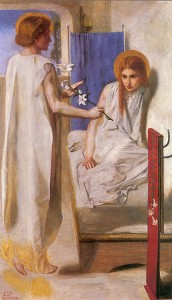
The Annunciation - Dante Gabriel Rossetti, 1850

March 25 is the feast of the Annunciation, the celebration of the visit by the angel Gabriel to a young woman in Nazareth to ask a great favor of her. The Lord of Hosts, Creator of all that is, was and ever will be, requested her consent to becoming the Mother of God (Theotokos or God-bearer), Mother of the Incarnate Word of God, Mother of His Son. The story of this visit is recounted in Christian scriptures (Lk 1:26-38, Mt 1:18-21)  and also in the Qu’ran (Sura 3: 45-51).

With Mary’s courageous decision to consent to the Lord’s request, a new era in the history of human relations with the Lord opened. In a time and place where women were little valued or respected and had fewer rights than men, the consent of a woman who was little beyond childhood and was still unmarried was solicited and respected by the greatest power of all – her creator and ours.

This feast has been celebrated since the earliest days of the Christian community, probably even predating the celebration of Christmas. Celebration of the Annunciation (and therefore of the Incarnation) coincides with the general time frame of the celebration of the Passover and Exodus, events that formed the Jewish community into a nation, beginning their history as a people. With the Annunciation and the Incarnation, the life of a new community began and the history of salvation took a new turn that eventually led to inclusion of all peoples on Earth.

Selection of the date for the celebration was not random. It coincided with the timing of the birth of John the Baptist, conceived following the time of his father’s service within the Holy of Holies on the Feast of Atonement in the fall. The Annunciation took place six months later, putting it in early spring. Based on those dates, John the Baptist’s birth was celebrated in June and Jesus’ birth date came to be set as December 25.

Setting the date of the Annunciation in spring also followed the Jewish tradition of celebrating beginnings and endings on or around the same date. It was known that Jesus’ death and resurrection occurred at Passover time. Setting the beginning of his life, his conception, at the same general time made sense to the early community. The big innovation was that for Christians, his conception marked the beginning of life, rather than his actual physical birth. (The “womb to tomb” tradition thus has ancient roots as well.)

Moving forward a few hundred years, in 525 when the new calendar was introduced by Dionysius Exiguus, the Anno Domini calendar, March 25 was set as the first day of the year. The Christian community considered it to be the beginning of a new era of grace.

May we, as we continue to live out our lives as sharers in the mystery of incarnation, rejoice with the angels and saints, and with Our Lord as well, the great blessing of a young woman’s willingness to trust that her Lord would never ask too much of her.

Let us join with our sisters and brothers in the Eastern Christian churches in rejoicing on this day.

Today is the beginning of our salvation,
And the revelation of the eternal mystery!
The Son of God becomes the Son of the Virgin
As Gabriel announces the coming of Grace.
Together with him let us cry to the Theotokos:
“Rejoice, O Full of Grace, the Lord is with you!”
Read More

Posted by on Mar 16, 2011

Where Two or More Are Gathered … Los Angeles Religious Education Congress

Where Two or More Are Gathered … Los Angeles Religious Education Congress

Los Angeles Religious Education Congress 2011

Tonight and through the weekend, thousands of Catholics and members of other faiths will be converging on the Anaheim, California Convention Center for the largest annual gathering of Catholics in the United States. The Los Angeles Religious Education Congress begins with Youth Day on March 17. The theme for Youth Day is “Godbook: Everyone Invited.” Speakers address topics of interest to teens, including prayer, sharing faith, social justice, and interpersonal relations. Youth Day includes workshops, liturgies at three locations within the Convention Center and and concerts with artists including Jesse Manibusan and Pedro Rubalcava. Several of the workshops also feature music.

Congress for adults begins with Opening Prayer on March 18 and continues through a final liturgy on Sunday afternoon. This year’s theme is “Hold Firm … Trust.” Like Youth Day, the days are filled with opportunities for prayer and learning. Speakers from around the world come to Congress, many with  large groups of fans who look forward to hearing them each year. Workshops are offered in English, Spanish and Vietnamese. Opportunities abound for prayer, reconciliation, learning, sharing, enjoying contemporary music, and just generally enjoying the presence of the Lord in the community of the faithful.

Knowing that many people would like to be among the approximately 40,000 present at Congress but must instead attend to family and work responsibilities elsewhere, Congress planners have arranged for live internet streaming of events on Youth Day and during the rest of the weekend. Naturally, the majority of events will not be available live, but recordings of many presentations can be purchased through the Congress website.

I hope many of you will join in the fun and inspiration of Congress through the internet. I’ll be there too!


Read More

Posted by on Mar 9, 2011

Ash Wednesday: Spiritual R & R – Reconciliation and Renewal

Ash Wednesday: Spiritual R & R – Reconciliation and Renewal

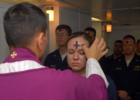
Receiving the Ashes in the Sign of the Cross


Ash Wednesday begins the season of Lent. It tends to be a day when people think about what they are going to give up in preparation for Easter. Fasting can be seen as a convenient type of dieting. Almsgiving can be reduced to cleaning out the closets.

However, prayer, fasting, and almsgiving are ancient practices in societies and religions all across the world. They are ways to produce altered states of consciousness and encounters with the divine. In the Christian tradition they are part of the “via negativa” or negative way. Generally, we tend to see this type of deprivation against the historical backdrop of hermits in the desert rejecting the “flesh” of worldly temptation and indulgence. Of course this conflicts with our consumer culture of comfort and instant gratification. It also conflicts with a more positive psychological model in which the focus on human weakness is replaced with a focus on human self-fulfillment and actualization.

In the secular model of well being, human and social limitations can be overcome by refocusing our attention and modifying our behavior. Hammering down our feeling and emotions – especially sexual ones – is sometimes seen as harming mental health. By denying our interior tensions and conflicts, we can fail to confront the real challenges we should be facing in our psychological development.

Lent itself is an old word for Spring – that time when the world comes to life again. The “via negativa,” the more traditional model of asceticism (an interesting Greek word for athletic training), and the contemporary model of self affirmation are not really opposed. They can actually be healthy correctives. If we focus exclusively on restraining ourselves we not only ignore opportunities for growth, we can also ignore what God is calling us to do. Focusing only on my needs and self-fulfillment can also lead to such an inward narcissistic self-absorbed focus that we cut ourselves off from true happiness.

In subsequent posts, as we journey through Lent, I will share with you some more reflections on being happy, holy, and healthy. This is a wonderful season for reconciliation with ourselves and others and a time of renewal for our call to serve and to engage in the coming of the Kingdom – the age of justice.

So.. what am I going to get for Lent?

Read More