Pages Menu
RssFacebook
Categories Menu

Posted by on Sep 29, 2011

St. Lioba – An Extraordinary Woman in the History of German Christianity
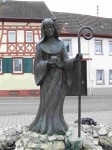
St. Lioba – An Extraordinary Woman in the History of German Christianity


St. Lioba of Tauberbishofsheim - by Kandschwar

Saint Lioba (aka Leoba) was born in Wessex, England in approximately 710. Her given name was Thrutgeba and her surname was Lioba, a name meaning Beloved. According to her biographer, Rudolf of Fulda, her birth to aged and formerly barren parents was foretold to her mother in a dream. Her mother promised that her child would be dedicated to the service of God and so Lioba entered the abbey at Wimborne as a child. In a delightful biography, Rudolf provides details about the abbess Tetta who was responsible for the monastery and the women who lived within its walls, as well as of the sources for his narrative of Lioba’s life. He then goes on to tell of Lioba: her life and accomplishments.

Lioba took full advantage of the opportunity to study and learn within the monastery. Girls were not generally given the opportunity to study in the 8th Century. Nevertheless, within the monastery, Lioba learned to read and study Scripture, as well as learning through observation and practice how to get along with others and manage a large enterprise/household such as an abbey.

A relative of St. Boniface, Apostle to the Germans, as a young woman, Lioba wrote to him, expressing interest in his missionary work in Germany: “To the most reverend Boniface, bearer of the highest dignity and well-beloved in Christ, Lioba, to whom he is related by blood, the least of Christ’s handmaids, sends greetings for eternal salvation.”

Lioba and Boniface corresponded with each other for twenty years before he invited her to come to Germany and establish monasteries for women there. She became abbess of the monastery at Bischofsheim, leading a large number of women in the spiritual life as well as the practical details of earning a living as a community. She never stopped studying and deepening her knowledge of Scripture and the faith. According to Rudolf, “She read with attention all the books of the Old and New Testaments and learned by heart all the commandments of God. To these she added by way of completion the writings of the church Fathers, the decrees of the Councils and the whole of ecclesiastical law.” In addition to her education, she was known for her wisdom and kindness, moderation and compassion, hospitality and humility; she welcomed and gave advice to visitors including bishops who came to seek her counsel. In turn, she was the only woman allowed to enter the monasteries for men to participate in consultations with church leaders on issues related to the rule of monasteries.

Under the advice and guidance of Lioba, nuns from her abbey became leaders of other monasteries as well, continuing the work of evangelization begun by Boniface. Lioba was a friend of Charlemagne’s wife, Hildegard, and a welcome visitor in the court of Pippin III. She was known for her learning and for the depth of her faith. Miracles were attributed to her during her lifetime and following her death. In fact, her remains were moved at least twice to protect them when miracles were reported at the grave sites. Eventually, they were buried in a church in Fulda.

Lioba lived approximately 72 years. She died September 28, 782, so her feast is celebrated to this day on September 28. While not one of the more broadly known saints in today’s church, she is certainly a woman worthy of note and imitation. She was not afraid to read, study, and learn of “holy” topics, nor to share her insights with powerful men (not all of whom would have appreciated her position of leadership and equality in terms of education and influence). Yet she did not neglect the practical necessities of life in community or of the administration of large enterprises. She was well-loved by the women whom she led and respected by both ordinary folks and the powerful leaders of her time. Not a bad role model for us today.

Image by Kandschwar – GNU Free Documentation License


Read More

Posted by on Sep 14, 2011

The Exaltation of the Holy Cross – An Ancient Feast Still Relevant

The Exaltation of the Holy Cross – An Ancient Feast Still Relevant

Feast of the Cross - Russion Icon, 1680

The Feast of the Exaltation of the Holy Cross dates from the fourth century, when according to tradition St. Helena discovered the True Cross on a pilgrimage to Jerusalem. The Church of the Holy Sepulchre was dedicated in 335 AD and the cross was kept inside the church. The dedication of the church was celebrated on September 13 and the cross was carried outside the church for veneration by the faithful on September 14. As part of the celebration, the cross was lifted up so all could see it. This was the reason the feast came to be called the “Exaltation” or “Raising Aloft” of the Holy Cross or the Precious Cross (depending on whether one spoke Latin or Greek). Another,  more recent, translation of the term Exaltatio is “triumph.”

Beyond the physical practice of raising the cross up so that people could see it and venerate it, the triumph of Jesus over death on the cross has been a source of hope for people through the ages. In fact, Jesus told his disciples, “If I am lifted up high I will draw everything to myself.” (Jn 12:32)

In The Dialogue, 26, St. Catherine of Siena describes God’s explanation to her of Jesus’ role as bridge between the divine and the human.

“… Do you know when it [this bridge] was raised up? When my Son was lifted up on the wood of the most holy cross he did not cut off his divinity from the lowly earth of your humanity. So though he was raised so high he was not raised off the earth. In fact, his divinity is kneaded into the clay of your humanity like one bread. …

When my goodness saw that you could be drawn in no other way, I sent him to be lifted onto the wood of the cross. I made of that cross an anvil where this child of humankind could be hammered into an instrument to release humankind from death and restore it to the life of grace. In this way he drew everything to himself: for he proved his unspeakable love, and the human heart is always drawn by love. He could not have shown you greater love than by giving his life for you. …

I said that, having been raised up, he would draw everything to himself. This is true in two ways: First, the human heart is drawn by love, as I said, and with all its powers: memory, understanding, and will. If these three powers are harmoniously united in my name, everything else you do, in fact or in intention, will be drawn to union with me in peace through the movement of my love, because all will be lifted up in the pursuit of crucified love. … For everything you do will be drawn to him when he draws your heart and its powers.”

“His divinity is kneaded into the clay of your humanity” and then all raised up, drawn into the life of the Trinity. What a great gift we have received. We no longer gather in Jerusalem expecting to see Jesus’ cross carried out for our veneration. We celebrate the raising aloft of our lives in union with His gift of life on the cross, drawn by love to that union.

(Image is in the public domain in the United States because its copyright has expired.)

Read More

Posted by on Sep 9, 2011

The Feast of the Nativity of the Mary – September 8

The Feast of the Nativity of the Mary – September 8


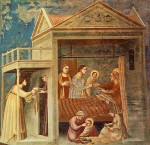
The Birth of the Virgin by Giotto, ca 1305

Since the fifth century AD, beginning in Jerusalem, the feast of the Nativity of Mary has been celebrated in Christian Churches. It is celebrated exactly nine months after the Feast of the Immaculate Conception. This feast and others like it are a reminder that those remembered as holy ones in our community got their start the same way all humans do. They were born of a woman, into a family and a larger community of fallible, imperfect humans, who nevertheless managed to help them grow to adulthood and eventually to sainthood.  This should be a source of great hope to all of us.

Mary was no exception. Her parents, Joachim and Anna, had long awaited the birth of a child. Her coming to them was a great gift from God. According to tradition, she lived with them only three years before they took her to the temple to be dedicated to service there. They visited her regularly at the temple as she was growing up until they passed away when she was about 10 years old.

Most of us will never have children following prophecies or angelic announcements of their coming. Most will not take our children to be raised in the temple or our local church. Most of us will live to see our children as grown adults with families of their own. But we will share in the task of parents such as Joachim and Anna, or Zacharia and Elizabeth, or Joseph and Mary: we will do our best to raise the children who have been entrusted to us, to help other parents to raise their own children, and to love and care for children of those we don’t know in other communities around the world. The love, acceptance, patience, gentleness, and consistency we show them in our day to day contact and care will be the qualities that help shape and mold their view of the world and of God.

On this Feast of the Nativity of Mary, may we be open to see the wonder of God’s love shining through the world’s children today and celebrate the continuation of the great chain of birth and love that unites us all in the Lord, leading us to holiness through the adventure of life as it is here and now.

Read More

Posted by on Sep 5, 2011

Laboring in Love – Blessed Mother Teresa of  Calcutta

Laboring in Love – Blessed Mother Teresa of Calcutta

Blessed Mother Teresa, photo by Túrelio

Blessed Mother Teresa of Calcutta (feast day September 5)  worked for decades in India, first as a teacher in schools run by the Sisters of Loreto and later caring for the homeless and dying on the streets of Calcutta. Though controversies exist regarding her work and her legacy, men and women around the world now share in her mission of care for the poor as Missionaries of Charity, not just the dying but also assisting those living in poverty.

Today, as we celebrate Labor Day in the United States, it is worthwhile to remember Mother Teresa’s perspective on the work we do.

“To show great love for God and our neighbor we need not do great things. It is how much love we put in the doing that makes our offering something beautiful for God.”

May we remember her words as we go about our daily lives; that we may touch those around us with love and God’s presence.


Read More

Posted by on Sep 3, 2011

St. Gregory the Great on the Bible

St. Gregory the Great on the Bible

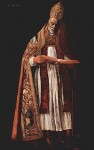
St. Gregory the Great by Zurbarán

St. Gregory the Great  was Pope from 590 to 604, guiding the Church through the ending of the Roman Empire and helping set its course as a stable institution through the Middle Ages. He was responsible for sending the first missionaries to Great Britain, regulating the liturgy, promoting choral music, and many other accomplishments. He is recognized as a Doctor of the Church for his leadership.

His insight into the role of the Bible in the lives of Christians is worth noting:

The Holy Bible is like a mirror before our mind’s eye. In it we see our inner face. … We can learn our spiritual deformities and beauties. And there too we discover the progress we are making and how far we are from perfection.

Read More

Posted by on Sep 2, 2011

Joseph of Arimethea, Nicodemus and the Corporal Acts of Mercy

Joseph of Arimethea, Nicodemus and the Corporal Acts of Mercy

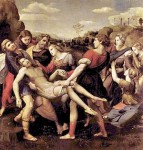
The Deposition - by Raphael, 1507

The joint feast of Joseph of Arimathea and Nicodemus is celebrated on August 31. Both men are named in the Gospels as quiet followers of Jesus who took a public stand on His behalf at the time of His death, requesting the body of Jesus and preparing Him for burial.

Joseph of Arimathea was a rich man, possibly a member of the Sanhedrin, and a secret follower of Jesus. He went to Pilate when Jesus was crucified and requested the body for burial. Roman law allowed members of an executed person’s family to claim the body and bury it in a family tomb. Decisions on claiming a non-family member’s body were on a case-by-case basis, but were not generally granted. Joseph, receiving Pilate’s permission, took Jesus’ body to be buried in a tomb that had been carved out of stone to serve as his own tomb.

Nicodemus was a member of the Sanhedrin who had come to Jesus secretly late one night to talk. (Jn 3:1-21) He was a supporter of Jesus. Once Jesus had died, Nicodemus brought the traditional spices, around 100 pounds of myrrh and aloe, as well as the burial cloths in which to wrap Him. Together with Joseph of Arimathea, Nicodemus prepared Jesus’ body for burial and laid him in that soon-to-be-famous tomb in the garden. They sealed the tomb with a great stone and returned home quickly, because the Sabbath was beginning.

These two men are the patron saints of undertakers and those who care for and prepare the dead for burial. They are also models for all of us of the practice of the Corporal Acts of Mercy.

The Corporal Acts of Mercy are:

  1. To feed the hungry
  2. To give drink to the thirsty
  3. To shelter the homeless
  4. To clothe the naked
  5. To visit and ransom the captive (prisoners)
  6. To visit the sick
  7. To bury the dead

These very practical activities have been seen since the earliest days of the Christian community as the tasks of Jesus’ followers. Jesus Himself told his followers that to the extent they perform these services for any of God’s children, they perform them for Him. (Mt 25:31-46) Burying the dead was not part of the original list Jesus gave in his discourse on the Last Judgement. This final Work of Mercy comes from the Book of Tobit, in which a just man, Tobit, defies the Assyrian conquerors to provide proper burial for fallen Israelites, despite being punished for doing so.

This call to service of people’s physical (corporeal) needs is fundamental to our calling as baptized Christians. The world has been transformed by Christians who have taken this charge seriously. Now it’s our turn to live out that calling.


Read More