Pages Menu
RssFacebook
Categories Menu

Posted by on Jul 31, 2012

Planting Love and Seeing Its Flowering: The Two Ends of Life in a Weekend

Planting Love and Seeing Its Flowering: The Two Ends of Life in a Weekend

Easter Candle

In the life of a Catholic community, all of the events of life are celebrated by gathering for liturgy. Most of us don’t see the ebb and flow of joyful and sorrowful events clearly in our day-to-day lives, though parish staff do. Saturday and Sunday this past weekend, the rhythm was clear for all to experience.

A wonderful, long-term member of the parish was killed in a traffic accident. Blessedly, the three passengers in her vehicle survived, but she died at the scene. Because she had been so involved in the life of our community, most people knew her and her family. The church was as full on Saturday morning for her funeral as for a normal Sunday morning “family” Mass. We cried, laughed, remembered, sang, and prayed with her family for a couple of hours, then joined together for a feast in the hall, courtesy of the Women’s Guild. We all went home afterward with many memories shared and a certain numbness at the way all can change in a instant – the ephemeral quality of our time here on earth, the strength of faith and love shared in family life, and the many ways an individual in her life touches those around her.

Sunday morning, many of us gathered again in the same space for liturgy. This time as we walked in the door, the many visitors were smiling and towels, candles and baptismal oils were waiting near the font from which we take water to bless ourselves as we enter and leave our sacred space. The water was warmed and the Easter candle was again burning. This time, two babies awaited entry to our Catholic family. The love of their families and friends was plain to see, and the joy of the community welcoming them was clear. The joy of their baptisms, after the sadness of the prior day, raised everyone’s spirits.

It’s not often that we see the two ends of life in a community so clearly. The same Easter candle — once welcoming new lives into the community and once reminding everyone of the life lived in faith by one of its members. The same white garments, the same Eucharist shared, the same wish shared that all would live in “the Peace of Christ.”

Jessica Powers’ poem, “The Flower of Love,” spoke to me in this experience. Reflecting on the experience of planting the seed of love in soil that had never seen it, then cultivating and supporting the love that grows, she proclaims:

“Blessed are they who battle jest and scorn
to keep love growing
from embryo immaculately born
to blossom showing.

Primarily for them will petals part
to draw and win them.
It, when the pollen finds their opened hearts,
will bloom within them.”

Poem from, The Selected Poetry of Jessica Powers
Image by Chris Nyborg – GNU Free Documentation License
Read More

Posted by on Jul 21, 2012

The Fruit of the Spirit: A way to live a transformed life

The Fruit of the Spirit: A way to live a transformed life


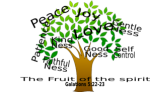
In his letter to the Galatians (5:22-23), Paul speaks of the “Fruit” of the Spirit. He uses this term in the singular, implying there is just one fruit, with nine aspects or expressions. In Galatians, Paul rejects a meticulous observance of multiple laws as a way to be righteous before God. In contrast, the “one fruit” is transformation in the Spirit, which blossoms into many virtues. The word “fruit” probably alludes to the image in the Bible of a person of virtue being like a tree which is rooted in living water and bears fruit (Ps. 1) or to trees that are cut down and burned because they do not bear fruit (Luke 13).

The idea of conversion and transformation is intriguing in our 21st century world. We have an increasingly secular society which presses us to talk about God in empirical ways. If we can’t prove that God exists in a mode measurable by our senses, then God is dismissed as a product of the imagination. Another common interpretation of belief in God is that the image of God is the fulfillment of a psychological need. In this world, the idea that God is attractive or that I would allow God to have control of my life is either inconceivable or not of importance. Transformation or change for most 21st  century people means that I change myself. It could also include help by others, such as a therapist or doctor. The only limitation to change in this world is a lack of will or skill, either on my part or on that of my helpers. There is the sense that given enough time, a solution to all problems can be found within the scope of human means.

From a Christian point of view, there are limitations and forms of harm that cannot be remedied by human effort. Transformation in this context presupposes an experiential relationship with God. It is the opposite of fixing myself. Transformation implies that I accept my limitations and let myself hear the voice of God, both inside myself and externally. The fruits are then part of the dance between God and me. I cannot make myself love heroically, but I can approach that kind of love if I am enlightened and empowered by the Spirit. I may naturally approach life in a positive way, but the basis of hope and courage in the face of great difficulty is God, whether I know it or not.

Interestingly enough, this topic came up in a conversation very recently with a sister in a religious community who told me that at the homeless program where she works in Portland, the people speak often about their experience of God. Many of them feel God’s presence and God’s love for them. They pray often to God and recognize God helping them. They do not feel alone. So, those who are the least fortunate and have very few comforts experience God’s power in their lives and can let God help them. It is so often the case that those we usually judge as the most blessed do not report a sense of closeness or awareness of God. In my seminars for professionals in the corporate world, it is rare to have someone tell me of the comfort of closeness to God in the day to day, even in private conversations we have about faith. Jesus asks us to become open like children and to come to him for help with our burdens. How hard that is.

The Fruit of the Spirit – Image by Terri Holaday – Public Domain

Read More

Posted by on Jul 3, 2012

The Seventh Gift: Awe and Wonder (Fear of the Lord)

The Seventh Gift: Awe and Wonder (Fear of the Lord)

Baby Galaxies in the Night Sky

When I stare at the night sky, especially if I am out in the country, I get almost overwhelmed at the immensity of the universe.  I am in awe of the beauty of the stars and then amazed at a God who can create and manage such an enormous and complex reality and yet be with me personally.  One billion galaxies!  Possibly two billion.

Even if a person does not believe in God as the reality defined in traditional religious terms, the beauty of the night sky, the roar of water down a canyon, the amazing chatter of birds and animals can take the breath away — almost bring one to tears.

The gift of AWE AND WONDER helps us to know and to feel that God is the fulfillment of everything we desire.  That there exists  perfect love — perfect knowledge, goodness, power, action, discretion, justice, healing.  With this gift we perceive the mystery that God is.  We realize that there is an aspect of the Sacred, the transcendent, that we cannot know on this side of death, but that we get glimpses of such majesty and glory.  We see that God can know, interact with, and sustain billions of people.   It’s amazing.  You either believe it or you don’t.  If you believe in such a possibility then it is mind blowing.  My particularities matter.  I am fully known.  Nothing is impossible.

In 1974 When Annie Dillard published Pilgrim at Tinker Creek, it made two inaccessible worlds available to an entirely new audience.  The first world was the natural world known in a scientific way.  All of a sudden cells and their biochemistry, ecosystems, the interdependence of species, and the rhythms of nature were explained in lay terms and could be understood and celebrated.  Secondly, this joy and excitement was not just intellectual but also solidly spiritual.  There was no separation of the secular from the sacred.  The world was whole and we felt whole in it.  How nice!  My body and the whole physical realm was God’s love and creativity writ big in the awesome processes of life in mitochondria,  chloroplasts, T cells, blood, genes, the periodic table, and atomic particles.

Dillard took all the lovely words, images and sounds of a poet like Gerard Manley Hopkinsand showed us the genius of God, down to the most minute details.  Hopkins’ dramatic words: grandeur, greatness, ooze, dearest freshness, dappled, brinded, original, spare, and strange now showed the grandeur of God as Dillard explained the incredible scientific reality of ooze and freshness, dappled and brinded.  She also opened up very wide the whole subject of suffering and death and gave the reader a new perspective on the meaning and purposes of both.  As a spiritually anemic graduate student, I soaked up the theology of Dillard’s book and saw for the first time the consistency of God in the natural and supernatural realms.  How could God have a cycle of growth, disintegration and integration in the natural realm and not have one in the spiritual realm?  What was all that talk of planting, pruning, cultivating and harvesting in the Bible all about if God was not also doing it in society and in my soul? And was God a genius in nature and then mindless and distant in the spiritual world?  No, we can and do find God in the wonder of the universe and in the many parallel things we know in our lives.

Elizabeth Barrett Browning speaks of awe when she says, “Earth’s crammed with heaven, And every common bush afire with God; But only he who sees takes off his shoes.”  Having Awe and Wonder is not automatic.  It is a gift.  We can be so over-indulged or over-stimulated that we miss beauty or grandeur.  Last Sunday morning I saw a small fox trot by a glass door of a building where I was in a meeting.  It was very close.  The sun was shining through its translucent tail all colorful and fluffy.  What a pointy nose and whiskers!  Wonderful round dark  eyes.  Such a lovely animal.  So light on its feet.  I couldn’t dismiss it.  It made my day.  God is near.


Red Fox

The fox looked back at us as he or she trotted on.  I wanted to go with it as it ran into the woods.  In Psalm 139 it says that we are wonderfully made.  Yes, we are.  Sometimes squirrely and difficult;  other times sleek and dolphin-like.  But we are all wonderfully made, “The work of his hands.”   And, awe, wonder and gratitude are our best response.  Hopefully we can at times “Take off our shoes” at the thought of all this splendor.  Maybe we can shake off the darkness of this world a little as we drink in “all this juice and all this joy”!


Image of the fox from wpclipart.com – public domain.
Image of Baby Galaxies from NASA – public domain.

Read More