Pages Menu
RssFacebook
Categories Menu

Posted by on Dec 20, 2012

Las Posadas: Food, Fiesta and Community

Singing echoes through the softly lit streets of the towns, cities, and neighborhoods of Mexico as residents prepare for Christmas, through the para-liturgical tradition of Las Posadas. Processions of townspeople, led by a couple dressed as Mary and Joseph, wind their way through the streets, going from home to home asking for “posada” (shelter). Finally, the procession is welcomed into a home, and the people pray together as the “fiesta” commences.

Las Posadas is a Mexican Catholic Advent tradition that marks the beginning of the Christmas season. Taking place from the 16th-24th of December every year, Las Posadas is a nine day community celebration in preparation for the birthday of Christ; a novena that is a mix of religious devotion and relaxation. Ultimately, Las Posadas is about accepting Christ, the Bread of Life, into one’s home and heart. It functions as an extension of the Eucharist, catalyzed by the fiesta culture. Food, both physical and spiritual, is an important element of the fiesta, because it is nearly impossible to have a Christian festival without food.

Las Posadas is a fiesta; a religious fiesta in the sense that it provides sacred time and space to show a sacred event.  The fiestas of Las Posadas reenact Mary and Joseph’s journey to Bethlehem, a journey that is considered sacred because it directly led to the birth of Christ in Bethlehem. Also, the fiestas gather the community in a ritual that parallels the structure of a Mass, emphasizing two more sacred elements of Las Posadas: the community and the Eucharist.

Evangelization in a New World

Las Posadas began in 1578 in Mexico in the village of San Agustín Acolman. Augustinian missionaries received permission from Pope Sixtus V to celebrate special Masses in order to make Christianity more attractive and  to evangelize the Aztecs. Because of the syncretism that occurred when the missionaries introduced Catholicism to indigenous Americans, Las Posadas resembles the Aztec celebration of the birth of the sun and war god, Huitzilopochitli. The missionaries wanted a way to teach the gospel and extend the Eucharist to a large, illiterate population and needed a way that the Aztecs would accept, so they took advantage of the timing of the birth of Huitzilopochitli to introduce the birthday of their own important, sacred figure, Jesus Christ. In las misas del Aguinaldo (special Masses for the Advent season), they included nativity scenes and lights, sang villancicos (Christmas carols), and broke a piñata. The celebration of Las Posadas grew from these original Masses. Mary and Joseph’s journey to Bethlehem, as told in Luke 2:1-7, is featured in Las Posadas, a celebration that includes elements similar to those of the celebration for Huitzilopochitli. (All night and during the day after Huitzilopochitli’s birthday, people customarily had parties in many houses throughout the town, at which guests delighted in foods and statues of their gods made from blue corn dough.)

Days of Prayer and Celebration

Las Posadas begins on the evening of December 16th and ends on Christmas Eve. These nine days dedicated to prayer are called a “Novena.” Originally, a novena referred to the nine days of prayer before the Feast of Pentecost, but in Las Posadas it also represents the nine months of Mary’s pregnancy. Each night, a young woman and a young man – usually teenagers – dress as Mary and Joseph and go to three different, predetermined houses, asking for posada (shelter). They are accompanied by a candle-lit procession that includes musicians, children dressed as angels and shepherds, and anyone else who would like to join. At the first two houses, the procession of peregrinos (pilgrims) is turned away by groups of people inside the houses, who play the part of the innkeepers who denied Mary and Joseph shelter. The interactions between the peregrinos and the “innkeepers” happen in the form of call-and-response songs. Through several verses, the peregrinos ask for shelter and are denied entry by the innkeepers. The last verse is sung only when the procession is welcomed into the last house.

At the last house, the peregrinos are welcomed and the whole community gathers for prayers and a party. Once all the peregrinos have entered, everyone prays the Act of Contrition, asking for forgiveness for their sins. Often, they will also pray the rosary, and/or hold a short prayer service. This part of the fiesta mirrors the Liturgy of the Word (the first part of a Mass). Soon the prayerful ritual gives way to food, games, and dancing. Nevertheless, ritual that promotes spiritual communion is still present in the fiestas, and parallels the Liturgy of the Eucharist (the second part of a Mass) — sharing a meal and celebrating the forgiveness of sin in the Eucharist. The fiestas grow in excitement with each passing night, but at each are ritual elements, including food and drink, candles, Nativity scenes, and piñatas filled with fruits, nuts, and candies.

Piñatas, Sin and Forgiveness

Traditional piñatas are shaped like stars and have seven points, each point representing a cardinal sin. People swing at the piñata with their eyes covered by blindfolds to signify their true faith in God and His mercy. Thus, when they break the piñata and are showered with sweet candies, the people act out the experience of conquering sin and receiving forgiveness and blessing from God. This is also a dramatization of how everyone’s sins are forgiven during the Eucharist, when Catholics remember how Christ died so that the sins of the world would be forgiven and confess their own sin through the Confiteor. Although perhaps not broken every night, the piñata nevertheless demonstrates the way food is used to teach religion, extend the message of the Eucharist into the home, and catalyze the fiesta spirit.

Sharing Food and Creating Communitas

The fiesta spirit continues through each of the nine days, never seeming to lag. On Christmas Eve, the final stop for the peregrinos is the church, where they celebrate La Misa de Gallo, a Midnight Mass, in which they share in the Body and Blood of Christ – a shorter but still powerful religious fiesta in which a sacred meal is re-enacted. After the Mass, the longest fiesta of Las Posadas commences. Along with a piñata and the small dessert items served at the fiestas on each of the previous nights, people prepare and share their favorite foods at the reception after Mass. Typical foods include tamales, pozole (pork soup), sopa de albóndigas (meat-ball soup), pollo con mole (chicken in mole sauce), bacalao (codfish stew), natillas (a type of thick custard), and buñelos (deep-fried pancakes sprinkled with sugar). Champurado (spiced hot chocolate), atole (a corn based drink), and ponche (punch) are also served. Although these are some of the more traditional foods consumed during the Advent and Christmas seasons, there are no foods that are specifically reserved for Las Posadas. Therefore, it does not matter what food is served, since the sharing of food itself symbolizes and strengthens the community.

Las Posadas makes the Gospel come alive in a cultural experience of spiritual communion in which the people welcome Christ into their homes and lives. This spiritual communion results from the transformation of Jesus’ body, “…the living bread that came down from heaven” (John 6:51), in the Eucharist into spiritual food. The ritual of Las Posadas reflects the mystery of the Eucharist because the people of the community act as living bread through their acts of hospitality and generosity in caring for others. Additionally, the fact that Las Posadas is a religious fiesta, and thus directly tied to Catholic Hispanic fiesta culture, draws the community together and builds the spirit of communitas. Communitas is a deep spirit of community – a spiritual communion where all the members are united in the same consciousness, usually through a ritual. Las Posadas is a way in which Mexican Catholics realize communitas through the Eucharist and fiesta. Thus, the fiesta catalyzes, yet also results from, the ritual of Las Posadas and is thoroughly intertwined with food, both spiritual and physical; physical food is the visceral symbol that gathers the community and provides the base for rituals, in which it is transformed into spiritual food. Therefore, it nourishes the body and the spirit.

Although there are traditions around the world in many different religions that fulfill the same functions, Las Posadas is one of the best examples of the way Mexican Catholics have taken the Eucharist and made it part of their cultural experience through the fiesta. Today, the fiesta spirit is spreading beyond Mexicans and Latinos. In some cases non-Latinos are attracted to the religious and spiritual aspects of Las Posadas. For others, Latinos and non-Latinos, a more secularized version of Las Posadas, in which the prayerful aspects are downplayed or ignored and the focus is on family and community, is more comfortable and attractive. Nevertheless, although those who celebrate a secular version of Las Posadas think that they are leaving Catholicism behind, they cannot escape the fact that even in any secular form, Las Posadas is still a religious fiesta celebrating and strengthening the spiritual connection between community members. Despite dropping all of the prayers, they are living the communitas of the Eucharist in their celebration, since even the secularized ritual parallels the structure of a Mass. Thus, without realizing it, many people are attracted to the religious and spiritual aspect of Las Posadas. What they experience is a community dimension of the Eucharist as seen in the transformation of profane (non-sacred) food into sacred nourishment for the spirit and community. Through that shared experience of celebrating a religious fiesta, people of all cultures strengthen their bond with their communities, uniting community, religion, and food.

Read More

Posted by on Dec 17, 2012

Rejoicing When our Hearts are Breaking

Rejoicing When our Hearts are Breaking

Gaudete!

During the third week of Advent, we are called to rejoice because the Lord’s coming is imminent. The very name of the third Sunday of Advent, Gaudete, comes from the first word of the Entrance Antiphon for the day’s Mass, “Rejoice.” The prayer continues, quoting St. Paul, “Rejoice in the Lord always; again I say rejoice” (Phil 4:4). That little word, “always,” is not to be ignored.

Sometimes terrible things happen in our world. This past week we’ve seen the killing of many innocent children and adults at a school in the United States. In other parts of the world civil wars are raging, religious persecution is taking the lives of people as they gather for worship, girls and women are beaten or shot for daring to seek an education, and more mundanely, people die as a result of accidents, miscarriages, illness, or old age — holiday season or not! We find ourselves asking how a loving God can do that to us. How can God take the lives of innocent people? Where is God when we are hurting?

“Rejoice … Always”

Yet St. Paul is there to remind us with that little word, “always,” that there’s much more going on than we might actually see or recognize. Perhaps we’re not even noticing that it isn’t God who’s doing these terrible things to us. In our pain, with our hearts breaking, we don’t always see God present in the ones who step forward to help, in the ones who risk and sometimes give their own lives to protect the lives of others, in the ones who must help individuals and families pick up the pieces of their lives and continue onward despite the great hole left in their hearts. Yet that is exactly where God is. God is there with each grieving person, present in the friends and family who gather to be with those who have suffered a loss. God is there in the doctors, nurses and other healthcare providers who care for the sick or injured. God is there in those who send flowers because they can’t come in person. God is there. God is here. God is present in the silence of hearts that cannot speak because the pain is too great. God is present — crying with them and holding them close.

So we struggle to trust in God and find ways to give thanks through our tears for God’s presence. We try to rejoice that God notices each life born, each life lived, and each life that reaches its point of transition to new birth into eternity. We sing through our tears at funerals. We gather in family and religious communities to remember those who have passed on and to support and encourage each other in faith. We rejoice for the gift of life, however short, that each person has brought to our world. And we remember another one who died too young, taken in His prime, subjected to terrible torture, and publicly executed on trumped up charges. One whose birth we soon will celebrate. One who was raised up and will never die again — the Firstborn of the dead. And because we remember, we can begin to rejoice even when our hearts are breaking.

May peace and joy return to each of our hearts as we remember God’s great love. May we recognize God present in each other and work to help bring about the changes necessary to reduce the numbers of new people who will have to experience tragic deaths of loved ones and somehow find their way to seeing and rejoicing in God present, Emmanuel, among the ashes of their dreams and hopes.

Photo (Three Candles) by Alice Birkin – public domain

Read More

Posted by on Dec 14, 2012

“The New Translation of the Roman Missal” One Year Later

“The New Translation of the Roman Missal” One Year Later

Roman Missal

A New Translation for a Worldwide Faith Community

On the first Sunday of Advent in November 2011, English speaking Roman Catholics began using the new translation of the Roman Missal, Third Edition. New principles for translation were originally approved in 2001 and many years of work went into the development and distribution of the new Roman Missal. While updates to the Missal and to the book of instructions on how to use the Missal (The General Instruction on the Roman Missal) have occurred on several occasions since the original decision of the bishops at the Second Vatican Council to encourage use of the vernacular (the language of the people) rather than Latin in Roman Catholic worship, this update engendered more controversy than its predecessor.

The reason for the controversy was simple: the guidelines for translation had been changed to emphasize literal translation rather than the more interpretive, idiomatic, inclusive language that the earlier version had favored. As a result, in addition to the need to deal with a change of language patterns, people were being required to change from familiar formulations to newer, sometimes stilted or more ornate, and/or less inclusive ones. For example, in the new version of the Nicene Creed, the phrase “consubstantial with the Father” replaces “one in being with the Father.” When asked how to explain the word “consubstantial” to people in the pews, the response was to explain that it means, “one in being.” Such changes and explanations left many people scratching their heads in puzzled amazement that anyone would think the newer phrase was an improvement.

Nevertheless, the decision was made that a new revision was needed — if for no other reason than to update feasts of saints to include newly canonized ones. So a new revision of the Roman Missal was prepared and promulgated and the People of God began to adapt one year ago.

Perspective of a Translator and Anthropologist

In the interest of transparency, I will note here that as an anthropologist and professional translator, I was not thrilled with the new translation. I do not speak Latin, but I speak Spanish and read enough Latin to recognize familiar prayers and liturgical usages. The new translation, in my professional judgment, is too literal. As a result, its phrasing is sometimes awkward and confusing. The ornate feel of some of the prayers is foreign to our cultural experience, making them almost seem like parodies of an older time and sensibility. As a translator, the works for which I have been most seriously criticized have been those in which I was more literal in my approach. Even technical bio-medical translations, instructions for patients, and informed medical consent forms require a certain degree of  freedom from the literal and conversion into idiomatic, more culturally-based constructions. Pastoral letters, poetry, fiction, and essays require use of poetic and culturally specific phrasing and word selection. In fact, word choice will even vary based on the national dialect of the target audience. An American in Southern California, for example, may well be puzzled at hearing that guests entered the room and were seated on the chesterfield. An individual from Alberta, Canada will immediately know that the item of furniture in question is what the Californian would know as a sofa and someone from Eastern Washington might call a davenport.

The idea that one literal translation will meet the needs of all English speakers in the world, or even of all English speakers in a country the size of the United States, fails to recognize the impossibility of expressing the inexpressible in any one set of words. Of course, no words can really capture the reality of God and our personal relationships with the divine, but literal phrasing can make it more problematic. Since words are both based in cultural understandings of reality and formative of them, words do not always convey the same idea when used in different languages or cultural contexts. The words used may also be indicative of a different emphasis or understanding of the same event from one language to another.

I appreciate the effort to make clearer reference to biblical sources for the prayers of the Mass (e.g. the “Lord, I am not worthy” before Communion is taken from the words of the Centurion whose servant was healed by Jesus [Mt 8:5-13]). However, in this and other instances, the “new” version is a return to the earliest translation we had immediately following the Council. That one was replaced for pastoral reasons: it was too literal, tended to be confusing to the faithful, and was non-inclusive in its gender references at a time when the position and status of women in societies around the world was changing towards greater inclusivity and equality! We have come full circle and the original  version’s limitations have not gone away.

Enough of Theory, What Actually Happened?

Despite the reservations felt by many as the transition date approached, the first day using the new translation arrived in parishes around the world and we all stumbled through the new wordings. We learned new music to go with the new words. We found ourselves reciting the old words when our attention strayed or when we were deeply into the ritual and its mystery. Sometimes the celebrant forgot the new wording. Sometimes we did.

We’ve now had a full year to experience the new translation. How has it gone? I have visited parishes in California, Oregon and Washington state and seen some common patterns.

  1. The first insight is one I originally heard many years ago from Professor George Foster of the Anthropology Department at the University of California, Berkeley. “People are pragmatic.” If we have to learn new words, we might as well start learning them as new songs; and so we did. If there’s an option regarding which prayer to use, we choose the more familiar or the less awkward one. The Apostles’ Creed is now much more commonly used, for example, in the parishes I’ve visited than the Nicene Creed with its “consubstantial with the Father” and “incarnate of the Virgin Mary.”
  2. No one worries if a celebrant or participant in the liturgy gets something wrong. We just smile and go ahead with the celebration.
  3. Perhaps the most reassuring thing I’ve seen is that so very few people have left the community in a huff over the new translation. I remember when we first began to use English. There were a lot of people who left because in their view it was no longer a Church that was faithful and unchanging. What we have learned is that revelation is on-going. Christ is still present in His Body. The Holy Spirit still breathes life into each of us and our communities. And God’s glory shines out into the world as we gather for worship and then go forth in service in our daily vocations. We are, all of us, faithful and faithfully Catholics. Awkward translation or not, we aren’t going away. We’re going forward!

What have you noticed in your parishes? How has the new translation been introduced and put into practice? Are you seeing a deepening of understanding of the liturgy? Have you experienced new efforts to offer classes or workshops to help the people of your community participate more fully in the liturgy? Has there been a resurgence or deepening of faith in your community in the past year?

Please share your experiences here or visit us on Facebook. We’re looking forward to hearing from you as we move into this second year with “the new translation.”


Read More

Posted by on Dec 8, 2012

Does Immaculate Conception Mean Virgin Birth?

Does Immaculate Conception Mean Virgin Birth?


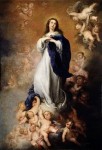
The Immaculate Conception – Murillo

Does Immaculate Conception mean Virgin Birth?

No. These two concepts, Immaculate Conception and Virgin Birth, are frequently confused. Many assume they are one and the same, leading to the notion that Mary’s conception was the result of the same type of divine intervention as that of her son. In fact, the Church has never believed that Mary was conceived without marital relations occurring between her parents. Normal physical relations between a husband and wife are not seen as sinful. They are, in fact, seen as a source of divine grace, a sharing in God’s life of love, a sacramental experience.

What is the Immaculate Conception?

If Immaculate Conception has nothing to do with the notion that our sexual expression is evil, however necessary for the continuation of the species, nor is it some kind of impediment to holiness, then what does the concept mean? To understand the notion, we must start with an ancient story, one of two creation myths found in the Bible: the story of Adam and Eve in the Garden of Eden. This second story of creation begins in the second chapter of the book of Genesis, halfway through the fourth verse. It tells of the creation of a human and then of a garden in Eden in which he would live. The garden was located in the land bordered by four rivers: the Pishon, the Gihon, the Tigris, and the Euphrates. In this garden, there was a tree, the tree of the knowledge of good and evil, from which the man was forbidden to eat the fruit. Knowing the man would be lonesome alone in the garden, God created many animals and birds to accompany him. However, animals and birds were not suitable companions for a human on any long-term scale. So God created another human to be his partner; a human created from the man’s rib to signify equality with him. The man was named Adam (man), a play on words in Hebrew between “man” and “ground.” The new person was called woman because she was formed out of “her man.”

As the story continues, conflict enters. The woman, walking alone in the garden, encounters a serpent who cunningly entices her to taste the forbidden fruit. She gives some to her husband as well, and suddenly they recognize they are naked. They become afraid to see God and hide in the garden from their creator. A separation between God’s overflowing love in creation and the humans created to be part of that creation has occurred. According to the story, the man and woman must leave the garden and now make their way in the great world outside it. The woman was called Eve by her husband “because she became the mother of all the living.”

Enter Original Sin

From this story, told to explain the entry of sin into human experience, the notion of original sin eventually developed. According to this notion, not found in Judaism or Islam, all humans inherit a “fallen nature,” a nature that is not strong enough always to resist sinning (separating from God). We don’t inherit the guilt of Adam and Eve. God’s image is undiminished within us, always calling and helping us to choose life over death. Yet we all fail in the quest to live without sinning through our decisions to act or to fail to act in loving union with God.

How then could God’s Son be born of a human woman without inheriting that fallen nature? It was from this dilemma that the notion of the Immaculate Conception developed. Through the centuries, theologians wrestled with it, especially as the idea of original sin became more and more strongly developed. Originally Mary was seen as like all other humans, a normal woman who played an extraordinary role in salvation history through her total openness to God. By the Middle Ages, however, as we began to focus more on human sinfulness and less on the presence of God within each person, an idea developed that Mary was saved from original sin at the time of her conception to prepare a perfect “new Eve” from whom the long-promised savior would be born. This savior would be the first-born of God’s new creation, of God’s new people.

A Formal Dogma

It wasn’t until the middle of the 19th century that the Immaculate Conception became a formal dogma of the Roman Catholic Church. This feast is celebrated nine months before we celebrate the Nativity of Mary (September 8). The readings for the liturgy celebrating the Immaculate Conception include the story of the encounter between God, the serpent, and Adam and Eve in the Garden of Eden (Gen 3:9-15), Paul’s letter to the Ephesians describing God’s choice to adopt all of us through Jesus (Eph 1:3-6, 11-12), and the story of the visit of the Angel Gabriel  to Mary in which Mary gives her consent to become Jesus’ mother (Lk 1:26-38). Perhaps the confusion between the Immaculate Conception and the Virgin Birth stems from this traditional selection of readings. They are connected only to the extent that God’s grace is needed by all humans to help them make loving choices and help bring the new creation to birth right here, right now!

Read More