Pages Menu
RssFacebook
Categories Menu

Posted by on Nov 23, 2025

Shepherd of a People – A True King’s Role
Shepherd of a People – A True King’s Role

What kinds of qualities do we expect in a King? Historically, kings have been warriors. They have protected the lands they own by use of their armies and in the process the people who live on those lands were also protected. Kings have gone to war and conquered new lands. They have made and enforced the rules, including how much is to be paid in taxes by the people of the land. They make treaties with other rulers. Their children, especially their sons, are expected to follow them as rulers or warriors. Marriages between the children of the kings of different lands serve as the bonds that establish and maintain peace among them. Any who challenge the power of the king will soon find themselves punished, imprisoned, or executed. The king’s power is absolute.

Most modern monarchs are more limited in their ability to command obedience. Many monarchies are parliamentary, giving elected officials a role in making decisions for the country/kingdom. However, these reductions of the power of the ruler were not easily won and are strictly guarded by the people of such nations.

In the early years of Israel’s monarchy, the transition from one king to the next was not predetermined. The King’s son did not automatically inherit the throne. In fact, the Lord had chosen the new king for Israel before the ruler, King Saul, was anywhere near the end of his rule. Saul had not followed the Lord’s instructions and had fallen out of favor as a result. The prophet Samuel, following the Lord’s directions, selected David, the youngest son of a shepherd family in Bethlehem, to be the next king. Samuel anointed David, but the rest of the people had no idea this had occurred.

When Saul died, it took a while for the different factions among the twelve tribes to figure out who should be king of all. Eventually, they decided on David, the shepherd who had killed Goliath and played important roles in many conflicts with enemies of Israel.

Three reasons were given for this choice. First, they were related – all were descendants of Abraham, Isaac, and Jacob. Secondly, David had played important military and leadership roles under King Saul. Thirdly, and most importantly, the Lord had called him: “You shall shepherd my people Israel and shall be commander of Israel.”

David agreed to accept the role and was anointed formally and publicly to serve as King of Israel.

It’s important to note here, that his role was not envisioned initially as being a warrior. He was to continue to be a shepherd. From among the descendants of this shepherd, the Messiah would be born. (2 Sam 5:1-3)

Being human, David was not perfect. He made plenty of mistakes in his years as ruler and suffered the tragic results of many of them. But the original vision of the Lord was not changed. David was to be a shepherd. This was the role the Lord gave as the model for the vocation of king.

On this last Sunday of the liturgical year, we recognize and celebrate Our Lord Jesus Christ, King of the Universe. It’s a big title and a big deal. King of the Universe! That’s a lot more than king of any nation on earth, even a great empire such as Rome! How could a simple carpenter turn out to be King of the Universe?

God’s ways are not always our ways. Just as the Lord chose a shepherd boy to become king of Israel, He became one of us, entered into our human lives and history, as Jesus, the son of a carpenter in a small conquered nation, part of a huge empire. Over the course of three years, Jesus moved from sharing the insights he received at his baptism in the Jordan about the coming of the Kingdom of God with simple fishermen and shepherds to healing the sick, feeding the hungry, preaching and teaching the crowds who hungered for God’s intervention in their lives and the coming of the kingdom.

Many of those who followed expected Jesus to lead a revolution against the Romans. Many were not prepared to hear him speak of forgiveness and mercy. But enough did listen and follow him that the authorities became worried. What would Rome do to them all if this man led a revolution? It would not be a quiet, peaceful, solution.

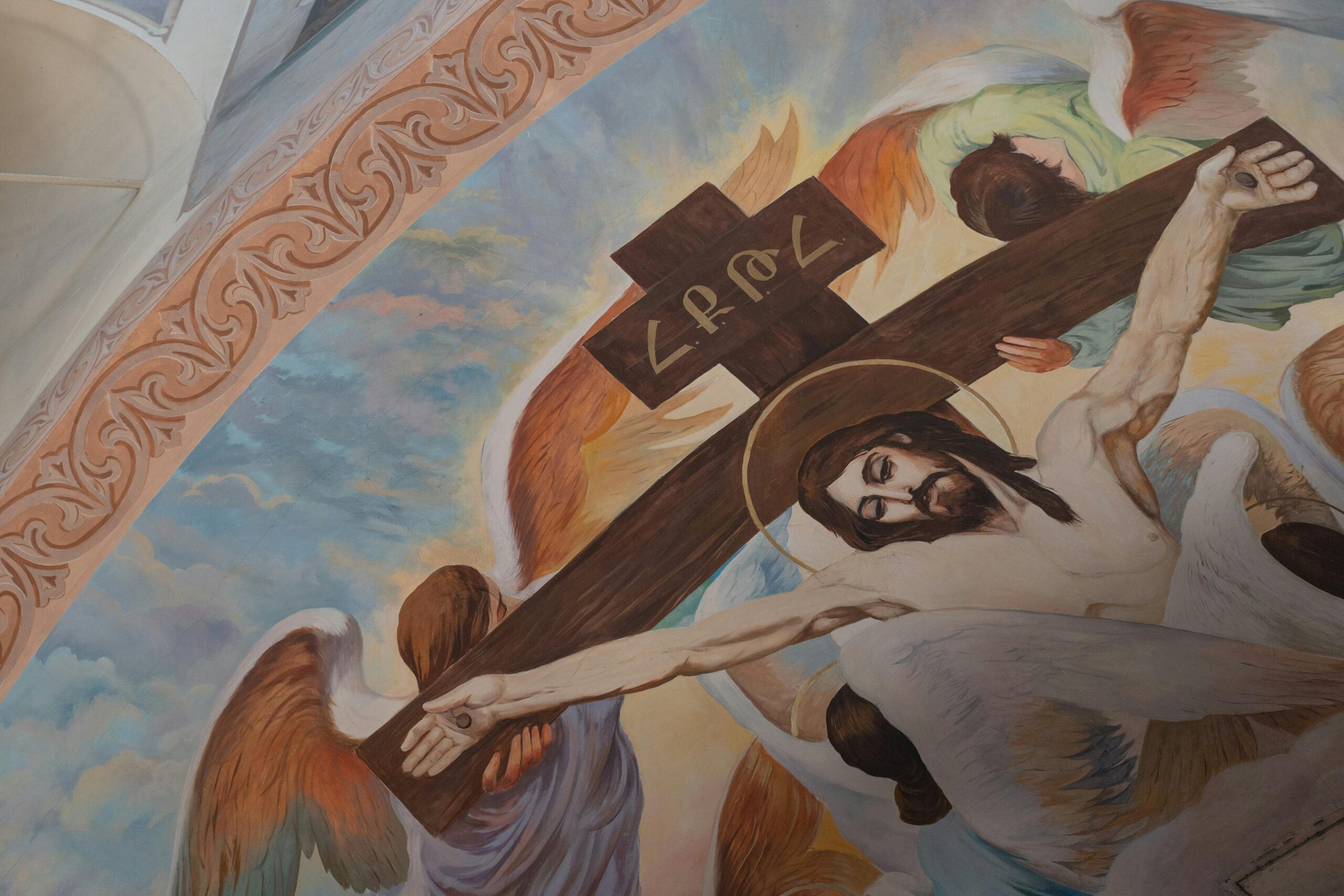
As Jesus hung dying on the cross, a convicted criminal, four different images emerged of his possible role as king. First was the taunting of the rulers of the people who challenged him to prove himself God’s chosen one by coming off the cross by his own power. Second came the soldiers, taunting him. “If you are King of the Jews, save yourself.” Again, it was a question of earthly power. The third image came from one of the men crucified with him. “Are you not the Christ? Save yourself and us.” Again, show and claim earthly power as proof of kingship.

The fourth image was accurate. The other man who had been crucified, Dismas, spoke up, chiding the first who had demanded Jesus save them all. He proclaimed, “this man has done nothing criminal.” Then he spoke words recognizing the position and power, the true kingship of Jesus. “Jesus, remember me when you come into your kingdom.” To this man, Jesus gave a response. “Amen, I say to you, today you will be with me in Paradise.” (Lk 23:35-43)

A king is not saved by his army. A king is not saved by his horse. A king doesn’t work miracles or pull strings to save himself. A true king, an eternal king, is the one who leads with love and forgiveness, bringing others along with him. Like a shepherd caring for his sheep.

In the process, the power of darkness was overcome. Humanity received the inheritance for which we were all created – to join the holy ones in light, forgiven for our wrong choices and failures to love. The Son of the Most High has given himself to lead us into forgiveness and new life.

The beautiful hymn included in the letter to the Colossians reminds us. “He is the image of the invisible God, the firstborn of all creation… before all things, and in him all things hold together… head of the body, the church… the beginning… firstborn of the dead… in him all the fullness was pleased to dwell and through him to reconcile all things for him…” (Col 1:12-20)

It’s a great celebration of the wonders of the gift of Jesus to all of us. A shepherd king for us all. A carpenter who listened to the Spirit’s voice, then shared that good news with us, his sisters and brothers.

As we celebrate today, may we remember who our King is. The shepherd who leads a people dedicated to care for each other, for our earth, for the universe. We feed the hungry, clothe those who need the basics, including winter coats, shoes, warm clothes. We help make sure children can go to school, people who need healthcare can get it, and those who are not able to find work they can do still have the basic necessities. Each of us has unique gifts. May we use these gifts as we follow our King, loving and protecting those in need.

Long Live Christ the King. ¡Viva Cristo Rey!

Readings for the Solemnity of Our Lord Jesus Christ, King of the Universe – Cycle C

A beautiful hymn remembering the words of the crucified thief. Jesus, Remember me.


Read More
Posted by on Nov 24, 2024

What Do We Expect in a King?

What Do We Expect in a King?

Since long before the birth of Jesus and the beginning of what is now called Anno Domini (A.D.) or C.E. (the Common Era), strongmen and sometimes powerful women have ruled over peoples and lands. Typically, these people gained power through violence and then became rich from the trade goods and taxes that flowed through their lands and into their treasuries.

Recently, I have been reading The Silk Roads: A New History of the World, by Peter Frankopan. Published nearly a decade ago, the author reaches back over 4,000 years, to the kingdoms of the Fertile Crescent and the Code of Hammurabi, King of Babylon. Far from Europe being the center of power and influence in the world, the lands from Mesopotamia to China and Mongolia were rich and powerful. Trade, learning, technology, science – all were thriving along the Silk Roads between Asia and Europe. Strongmen led warriors in conquest of neighboring lands again and again, well into the present as newer lands have become the great powers. I haven’t yet finished reading it, but I look forward to continuing to enjoy it.

This all comes to mind as we arrive at the last Sunday of the Christian year, the celebration of Christ the King of the Universe.

What do we expect in a king? Historically, kings were the ones strong enough to conquer and hold lands. When their sons inherited the throne, they too were expected to be warriors, to defend their lands and take lands from others as well whenever possible. They were men to be feared. Their whims were law and their anger deadly. Marriages of rulers were arranged to create alliances between kingdoms. When for any reason the marriage did not work out, or no male heir survived to take over kingship, the kingdom was shaken and many lives were forfeit.

Today we expect someone who will lead and govern justly. Many monarchies share governing power with elected representatives of the people they govern. The British monarchy is an example of this. The king no longer has unbridled power over life and death for his subjects, but they are still called subjects.

Autocratic leaders, often elected by citizens of their nation, are more like the kings of old. Their favor brings power and riches to those who serve them and obey their wishes. Those who oppose them, find themselves in exile or in prison, often for life.

So, if this is what a king is, why would we celebrate Christ as King?

When Jesus was arrested and taken to trial in the Sanhedrin, he was questioned about whether he claimed to be the Son of God and the Messiah. When asked directly, “Are you the Messiah, the Son of the Blessed One?” Jesus answered, “I am; and you will see the Son of Man seated at the right hand of the Power and coming with the clouds of heaven.” (Mk 15:61-62). For this statement, he stood condemned for blasphemy.

Jesus’ words echoed the account of the prophet Daniel as he described the visions he had seen through the night. “I saw one like a Son of man coming, on the clouds of heaven…” This Son of man was presented to the Ancient One and given “dominion, glory, and kingship” over all peoples in the world, an unending, unlimited kingship. (Dn 7:13-14)

Despite having been convicted of blasphemy, Jesus was not to be executed by his own people. Roman authorities had to authorize any execution. However, blasphemy was not a crime that would incur the death penalty, let alone crucifixion.

When the authorities took Jesus to the Procurator, Pontius Pilate, the crime of which he was accused was treason – the claim to be a king. Pilate interrogated Jesus before passing judgement. “Are you the king of the Jews?” Jesus responded by asking whether Pilate wanted to know for himself or only to establish a legal point. Pilate’s rather exasperated response was that it was the chief priests who had handed him over. “What have you done?”

Jesus did not deny being a king, but he pointed out that the kingdom in question was not an earthly one. None of his followers were fighting to protect or rescue him. “Then you are a king?” said Pilate. “You say I am a king,” responded Jesus, a formal way of saying “Yes.” He then explained that he came into the world “to testify to the truth.” (Jn 18:33b-37)

Jesus was condemned. The sign above his head read: “Jesus the Nazorean, The King of the Jews.”

A king whose kingdom is not lands and power but truth and justice. Not justice that punishes those who try to take lands or power from him. Justice that assures the poor have food and shelter and a chance to live their human dignity. Justice that protects children and refugees. Justice that opens hearts to love and accept those who are different than themselves. Justice that welcomes all and cares for the earth and all of creation. Justice that speaks truth to power, as Jesus did to Pilate. Justice that is a testimony to the truth of God’s love for all.

This is the King of the Universe whom we celebrate. The one whom the visions of Revelation acclaim. “Jesus Christ is the faithful witness, the firstborn of the dead and ruler of the kings of the earth.” He is the one “who loves us and has freed us of our sins … made us into a kingdom, priests for his God and Father.” (Rv 1:5-8) He is the one who calls us to live the Beatitudes. The One who himself healed the sick, fed the hungry, comforted the mourning, and gave himself in witness to the truth.

A far cry from what we usually expect in a king. Yet he is the King who chose us and whose example we are called to follow. Thanks be to God.

Readings for the Solemnity of Our Lord Jesus Christ, King of the Universe – Cycle B

En Español


Read More

Posted by on Nov 22, 2024

Christ the King and the Kingdom Not of this World

Christ the King and the Kingdom Not of this World

Christ the King

Today we celebrate the end of the church year. Today is the climax of salvation history. In the Gospel we find Christ Jesus in front of Pontius Pilate affirming that his kingdom was not of this world. In the interrogation, Our Lord says to Pilate, “If I were a king of this world, my followers would have defended me.” This answer puzzled Pilate. This poor Jewish preacher did not behave like the rest of the prisoners. He was not begging for his life. He did not deny the charges. Nor did he lose his dignity. (Jn 18:33b-37)

The kingdom of heaven does not come by violence. It does not come for conquest or slaughter. The Lord’s regime comes to us in power and authority because it does not carry with it evil or vengeance. Our king is crucified as a rebel, as a terrorist. It seems that the forces of evil had finished him off. It seems that his kingdom was an illusion, a dream, something in vain. He died. The sky darkened, there was lightning, and the centurion proclaimed that he was the son of God. That is how our king died.

This feast of Christ the King has a lot of meaning for Mexicans. Viva Cristo Rey was the cry of the movement fighting against the religious oppression of the socialist government. After the Mexican Revolution which lasted from 1910 to 1917, the new government attempted to deny God and impose a social order against religion. There was a strong devotion to the Sacred Heart of Jesus. The struggle against atheism raised the banner of the Sacred Heart as Christ the King – the king of the world and of the heavens.

The persecution of the church included the killings of priests, nuns, and lay leaders. The churches were closed. The resistance did not use the traditional images of the victorious Christ the King with crown and scepter. Instead, Christ the King is represented by his flaming heart full of love and mercy. He is not king of this world. He is a king who suffers for his people to the point of giving his life for them.

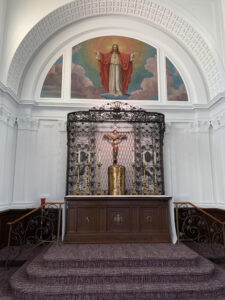
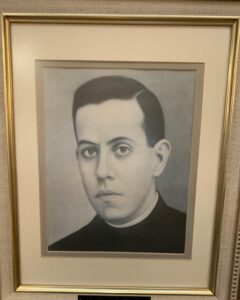
Some Mexican Jesuit seminarians took refuge here in Los Gatos in the novitiate of the Sacred Heart for a year before they obtained asylum in Spain. Before leaving, a Mexican priest who was an artist painted a mural of the Sacred Heart in the chapel above the altar. One of the young Jesuits was Miguel Pro. After his ordination he returned to Mexico and was ministering in secret when he was arrested and sentenced to death. Before he was shot, his last words were “Long live Christ the King!” A photo of the martyr is still kept in the same Jesuit house in Los Gatos where he took refuge. In it we see the deceased young priest with the bullet wound in his heart.

How is it possible to have a kingdom that is always defeated by the forces of the world? How is it possible that the divine regime is frustrated today?

Today’s first reading presents us with some fantastic images of combat in the heavens from the book of Revelation. The whole heavenly order reveals the conquest of the persecutors of the church and of Christ. God comes to judge the living and the dead. Evil and the powers of evil are vanquished. (Dn 7:13-14)

However, we see day after day the tragedies and sufferings of life. Victims of war, victims of famine, victims of epidemics. There are failures of the government and the institutions of justice. Yet inside the darkness burns a flame. It is the light of our faith advancing the kingdom of peace and humility. The terrestrial and heavenly forces of wickedness are defeated. We can say before the Roman procurator Pontius Pilate and the powers of this world that our king and our kingdom is above all and for all.

Our King does not come in violence, he does not come armed, he does not come to kill his enemies. The Sacred Heart, full of peace, mercy, and healing comes through us. It is up to us not so much to venerate the beautiful portrait of the Sacred Heart, but to encounter Christ the King – the Sacred Heart in our daily lives. We are called to proclaim the kingdom of God through peace and humility in our hearts.

Our kingdom is not of this world. Our regime is to proclaim the good news. Support the poor. Encourage the depressed. Feed the hungry. Manifest love, peace, forgiveness, healing, and hope in our difficult times, enduring serious illnesses. The kingdom comes in our homes, jobs, and social relationships. All this and more we acclaim – Your kingdom. Your will be done on earth as it is in heaven.

Long live Christ the King!

Readings for the Solemnity of Our Lord Jesus Christ, King of the Universe – Cycle B


Read More