Pages Menu
RssFacebook
Categories Menu

Posted by on Jun 25, 2011

Realities and Wonders Beyond Our Comprehension – The Feasts of The Holy Trinity and Corpus Christi

The mystery of the Holy Trinity is at the core of our faith as Christians. God is one undivided unity. Yet God is also Father (Mother/Parent), the incarnate Son (Jesus) and the Holy Spirit – all united as one in being and each separate in identity.

Early Church writers spoke of the Trinity in terms of perichoresis, a mutual indwelling and interpenetration of being shared by the members of the Trinity. The word itself comes from Greek roots meaning around and to contain. In some ways it’s akin to a dance in which the dancers and the dance are one. None can be separated from each other because their essence is one, yet each has an individual role and part in the whole.

We experience God as Trinity in our lives. God as parent brings all things into being through love overflowing and keeps us safely in existence – never forgetting us. God our brother Jesus who has shared the joys and sorrows, hopes and fears of human life is truly one of us – 100% human. God the Holy Spirit of love gives us courage to live in love and words to speak of what we have experienced of divine life and love. God as Father, Son and Holy Spirit is the greatest fan each of us will ever have – always hopeful and encouraging us as we forge ahead through life’s challenges.

Following Trinity Sunday, we celebrate the Feast of Corpus Christi – the Body and Blood of Christ. One mystery following on another. How can simple bread and wine be the body and blood of the Lord? Yet that is what Jesus told us he was giving us – his own flesh and blood to eat, as divine food to strengthen us on our journey as we travel back to union with the Trinity. One of our prayers tells us that we become what we eat. As we share in the divine meal, we share in the life of the Trinity and are drawn ever closer into it.

What a gift!

The wonder of all this struck me as I reflected on an experience I had with my young grandson last week. We were at Disneyland on the last day of a trip with my Girl Scout troop. The girls graduated from high school this year and this was our last major outing.

The park was closing early in preparation for a “Grad Night” for local high school seniors, so despite having a young child along, we were there for the fireworks and final show. It was a show with light, water and music telling of a dream Mikey Mouse was having, complete with ominous music and threatening villains. Could Mickey triumph over the evil that threatened by using the power of imagination? Of course he could and did. The show ended with great joy and happy, triumphant music.

What fascinated me was watching our little boy. He quickly lost interest in watching the story and we moved off into a nearby area where there was a short wrought iron fence (about 36 inches tall). As the music, lights and story blared around us, he quite happily climbed up on the bottom cross-piece of the fence and made his way sideways, holding on to the top rail, from one end of the fence to the other. Then he jumped down, clapped his hands, climbed back up onto the fence and went back to his original starting place. He did this through the entire performance – at least four or five trips back and forth along the fence. He’d have continued doing it all night had we allowed it!

I had been concerned that the ominous, scary music, the tone of voice of the villains, the colors of the threatening sections of the show would frighten him. Had he been a few years older, they would have. However, at his young age, he had no negative associations with any of those cues. What we considered scary music was the same to him as the triumphal music or a sweet ballad. The lights that flickered and changed from peaceful pastels to discordant, multi-colored, dark or flaring reddish-orange bursts of color meant nothing to him.  It was all just background to what he was exploring. He was having a wonderful time on the fence.

In thinking about his reaction, I find myself wondering how much we are like this young child – totally enthralled with our own activities in our own little worlds and totally missing the wonder of the dance going on all around us. We live and move and have our being within the loving presence and reality of God, yet we don’t notice most of the time.

I pray that as the coming weeks unfold, I will be ever more aware of the divine presence – Father, Son and Holy Spirit – enveloping me and all of us in the great dance of being. In the words of Jesse Manibusan’s song, “Open my eyes, Lord. Help me to see your face … Help me to hear your voice … Help me to love like you… Help me to love.”

I send the same wish to all who read these words. May the blessings of God who is Father, Son and Holy Spirit descend on you and remain with you forever. Amen.


Read More

Posted by on May 7, 2011

Sharing in Divine Mercy

The second Sunday of Easter is known as Divine Mercy Sunday. The Gospel reading (Jn 20:19-31) tells of Jesus’ appearance to His disciples in the Upper Room on Easter Sunday evening. He appeared among them, wished them Peace, showed them His wounds and asked for something to eat. Then He breathed on them, the breath of the Holy Spirit,  and told them to forgive sins. He told them to continue the work He had begun, taking the Good News of God’s love out to all the world.

When I was growing up, the message of this Gospel’s story of the granting of power to forgive sin was generally presented in terms of the power of priest to forgive sins in the sacrament of Penance (now more often known as Reconciliation). However, as I listened to the Gospel proclamation last Sunday, the Good News I heard was of the gift given to all of us as followers and disciples of Jesus – the power to forgive those who hurt us in some way.

Forgiveness does not come easily to anyone. When hurts come along, it’s often much more satisfying to plot revenge, or bask in a stew of martyred pouting or otherwise hold on to the hurt. But Jesus knew something we often miss. The one most hurt, the one most diminished, the one who suffers most from such behavior is the one who engages in it! Perhaps that is why He was so quick to forgive those who had abandoned and denied Him just a few days earlier.

As we live our calling as followers of Jesus, we share the task of bringing forgiveness, reconciliation and peace to our families, communities, nations and world. Anything that stands in the way of this mission is to be suspect. We can’t forgive through our own power. Some wounds are just too deep for our human ability to heal. But Jesus is with us and He can heal them if we are willing to open them to His touch. And as we receive healing, we are called to pass it on, so that the waves of forgiveness and healing at last embrace all the people of the world. It’s truly a noble calling.

Peace be with you.

Read More

Posted by on Oct 14, 2010

Quote of the Day – M. Shawn Copeland

“If my sister or brother is not at the table, we are not the flesh of Christ. If my sister’s mark of sexuality must be obscured, if my brother’s mark of race must be disguised, if my sister’s mark of culture must be repressed, then we are not the flesh of Christ. For, it is through and in Christ’s own flesh that the ‘other’ is my sister, is my brother; indeed, the ‘other’ is me…”

From Enfleshing Freedom, by M. Shawn Copeland, 2009

Words to consider as we come together in communities for worship.

Who isn’t here? Why not? What do we need to do to be welcoming communities for all of God’s people?

Read More

Posted by on Jun 6, 2010

Corpus Christi: Who’s Feeding on Whom?

Today is the feast of Corpus Christi, the Body and Blood of Christ. We celebrate the great gift of the Eucharist – a feast of thanksgiving. We celebrate that the Lord has given His very being to us to be food for our journey through our lives here and now – from this day to the day of our birth into eternal life in the next here and now.

I’m struck today by the contrast between the Lord’s gift of allowing us to eat of His body and blood, soul and divinity and the way in which those spirits not in union with God, the evil ones, feed on our energies when we choose to welcome them into our lives even for a moment.

It became very clear to me again yesterday how quickly and subtly they will move in and start draining energy away from individuals and families. I received a notice in the mail regarding a challenge we’ve been facing as a result of the problems in the global financial markets hitting “Main Street.” I don’t know what the notice means, but it’s not a great situation and it could be the first step of more challenges coming. On the other hand, it might not mean anything negative at all.

But I was tired and a bit stressed and I found myself fretting about it. Then other things started popping up with their “… and did you remember that he …” and “… can you believe the nerve of …” Nothing huge involved. Nothing to which I would not have agreed. Just that quiet, insidious little voice encouraging me to feel upset, tired, a little resentful, or whatever.

As I got more out of sorts, others in the family also got edgy, including the resident baby.

Finally, my children sent me for a walk with the baby and fixed dinner themselves. On the walk, a relatively quiet activity with a very young child in a stroller, I realized what was happening. I closed the feeding trough to the spirits who had crept in and I asked my Guardian Angel and the Holy Spirit to protect me and us from their influence.

One thing I’ve learned – that kind of prayer is never ignored. I was better immediately and we had a lovely dinner and pleasant evening.

So, how does this relate to Corpus Christi? We can choose to allow the evil spirits to invade. We can feed them. The expression, “What’s eating you?” is absolutely an accurate description of an unseen reality. Or we can keep closing that restaurant when they come around and instead feed on the love of God, the body and blood of our Lord.

The neat thing is this. To the extent we feed on the Lord, we can then help feed those around us in positive ways. Everything becomes manageable again. Problems can be solved. Joy returns.

I still don’t know what that notice means, but whatever it means, all will be well as long as I/we remember Who should feed whom.

Happy Feast of Corpus Christi.

Read More

Posted by on Jun 14, 2009

The Feast of the Body and Blood of Christ

The Feast of the Body and Blood of Christ

Cyprian Consiglio, OSB Cam

Cyprian Consiglio, OSB Cam

Cyprian Consiglio, OSB Cam. offered some interesting thoughts about the Feast of the Body and Blood of Christ (AKA Corpus Christi) today in his homily and his blog. He has graciously agreed to allow me to share them in a post for this feast.

The Inner Meaning

During this time of year when there are so many of our rites of passage taking place––weddings, graduations, ordinations (even birthdays)––it’s interesting to take a look at the purpose of ritual. Anthropologically speaking, a ritual is a way of expressing and passing on our understanding of reality or of an experience to someone else. So, for instance, a graduation is not about a piece of paper and a cap and gown: it’s weightier, it’s heavy; that’s why tears flow from the eyes of parents as they see their child graduate or get married. The ritual is trying to carry all those memories and meanings, and summarize them in a single gesture: an exchange of rings, the laying on of hands, a birthday card, an embrace, throwing a shovelful of dirt on a coffin: all these rituals mean more than they mean, they carry an almost indescribable load of treasures.

In the Roman rite we celebrate the Solemnity of the Body and Blood of Christ this week, and it’s safe to ask what Jesus was trying to convey to his disciples when he performed this rather odd ritual––not just breaking the bread and passing out the cup, but claiming that it was his very self. What exactly was he asking them to remember when they did it over and over again? I thought of five things, which certainly don’t exhaust the list of possible meanings.

1. First of all, this gesture looks backward and forward at Jesus’own life. Backward in that Jesus’ whole life had been spent being broken and passed out; his whole life had been dedicated to feeding those around him: taking care of their bodily needs through healing and feeding; and also feeding and healing them in a real way with the Wisdom of God, this incredible good news of God’s undying boundless care for every single hair on the head of very single human being from the greatest to––especially––the least. This ritual also looked ahead to the next day when Jesus allowed his body to be broken like bread and his blood poured out like wine––to say that it’s alright: you can survive even this, your real self cannot be annihilated, but like a seed that falls into the earth and dies it will yield a rich harvest of resurrection life.

2. This ritual symbolized––again what Jesus’ whole life symbolized––that Divine Love gives itself to humanity––that’s what God is like! The Divine is present, really present: divine love is offering itself to the world in this ritual meal.

3. This ritual also conveyed (and conveys) that this Divine Mystery is present everywhere, in creation, “in the earth and its produce.” Unfortunately the kind of hosts we use and our ornate chalices can actually hide the fact that this is actually wheat and grapes, real food: “which earth had given,” as we say, “fruit of the earth.” I think that this conveys that all matter is meant to be brought into right relationship with God, and that all matter can reveal and be a vehicle for the Grace of God. St Irenaeus wrote,

    “This is why he took a part of creation, gave thanks and said: This is my body. In the same way he declared that the cup, an element of the same creation as ourselves, was his blood: he taught them that this was the new sacrifice of the new covenant.” (Irenaeus, Against Heresies)

But we add a line to the prayer over the gifts: it’s not just what ”the earth has given,” or “the fruit of the earth”; it’s also the work of human hands. There is a beautiful prayer of Teihard de Chardin:

    I, your priest, will make the whole earth my altar––
    And on it I will offer you all the labors and sufferings of the world…
    I will place on the paten the harvest to be won by labor. . .
    Into my chalice I will pour all the sap which is to be pressed out this day from the Earth’s fruits.

So, the fruit of the earth and the work of our hands all become vehicles for God’s grace, all is meant to be brought into right relationship with God.

4. This ritual is also meant to convey to us that God wants us to participate in the work of creation, and in divinity itself. That’s why we pray that incredible prayer, “by the mystery of the water and wine may we come to share in the divinity of Christ who came to share in our humanity.”

5. And how do we participate? Well, that’s the last thing I want to mention that this ritual is trying to convey (though we could go on and on): it conveys that this divine mystery is especially present whenever and wherever human beings meet and share together, that God is present in every gesture of unselfish love, in every occasion of someone laying down their life for another. That’s why we read the story of the washing of the feet before we celebrate the Mass of the Lord’s Supper on Holy Thursday.

The Hebrews didn’t need another ritual, another sacrifice; we don’t need another ritual; and God certainly didn’t and doesn’t either. The prophets leading up to Jesus kept telling the people how God was sick of their sacrifices and rituals! Jesus himself quotes the prophet Hosea twice saying: “Go and learn the meaning of these words, ‘It is love that I desire, not sacrifice. Knowledge of God rather than burnt offerings.’”

The church, and this ritual, has no other purpose but to communicate and convey and reveal that––the love and knowledge of God that is hidden in the heart of creation and poured into the center of every human being as our very source and our ground. This is what we will be judged on as a church, as individuals, as communities and as a whole: not the forms of our rituals and doctrines, but by the reality of the love and knowledge of God that we manifest.

Bede Griffiths wrote that: “All myth and ritual, all doctrine and sacrament, is but a means to awaken our souls to this hidden mystery, to allow the divine presence to make itself known.”

So: as we participate in this ritual, as we receive the Body and Blood of Christ, and/or when we gaze at the reserved Blessed Sacrament in the Tabernacle or in a monstrance, let’s remember how weighty it is, how much it carries and conveys. And let’s especially pray that it would awaken us to the mystery of the knowledge of God, and the love of God that is poured into our hearts, so that we might make it manifest in our world, so that we might be the body and blood of Christ––that we might be broken and poured out for the sake of the world as Jesus was.

cyprian
14 june 09

Read More

Posted by on Oct 31, 2008

The Feast of the Body and Blood of Christ

Marriage and Matrimony – Aren’t they the same thing?

Todd Alan Studio Designs

Todd Alan Studio Designs

In California this election year, we’re asked to vote on a proposed constitutional amendment that claims to be for the “protection of marriage.” The proposition, in fact, is one that would take away the legal right of homosexual men and women to enter into the legal contract of marriage. The right was established earlier this year when the California Supreme Court ruled that laws to the contrary were un-Constitutional because they deprived same sex couples of equal protection under the law. (The Court found that domestic partnerships and civil unions did not provide all of the protections of legal marriage.) Proposition 8 is a constitutional amendment that would require a vote of 3/4 of the Legislature to overturn if at some later date we realize that it was a mistake to enact.

There have been a lot of arguments raised on both sides of the issue. Supporters of the proposition claim that marriage was established by God at the time of Adam and Eve, when they were instructed, in the second story of creation, to cling to each other and become one body. (Gen 2:24) In the first story of creation, the un-named humans were instructed to “Be fertile and multiply …” (Gen 1:28) The fact that the creation stories (two of them) in the book of Genesis were culturally based explanations of how things “came to be,” rather than historical or scientific accounts as we know them today, seems to be beside the point. Somehow, granting a legal right to share a life of committed love – with the rights, responsibilities and protections of marriage – to non-heterosexual couples is seen as a threat to the lives of commited love of heterosexual couples who have married.

I attended a wedding last weekend. It was a lovely ceremony that united a young man, of whom I am extremely fond and proud, with a young woman who has become dear to me as well. One of the things that really struck me about the wedding was the degree to which the legal, contractual nature of the marriage was obvious. As soon as the couple arrived before the sanctuary, the celebrant welcomed the assembled guests and quizzed them regarding potential reasons why the couple might not be legally married. He charged each of the two persons seeking to marry to speak out if either of them knew of any reason why they might not legally do so. Then he asked each individually if they had come freely and of their own will to be joined in marriage. Only once these requirements for entering into a legal contract had been established did he move into the prayers and readings of the service.

The ceremony included prayers and blessings for the couple and promises from the families and friends to help and support them in the life they were choosing to enter. The young man and his bride promised to love and care for each other, through all the ups and downs of life, for as long as they both should live. Only then were they allowed to enter into the sanctuary, offer each other their right hands in symbolic handshake on the contract, and pronounce their vows. They exchanged rings as a sign of their promises to each other. The celebrant blessed them and sent them forth out into the world and a new life together.

For this couple, the marriage ceremony included two elements: the legal, civil contract and the blessing of the church community. For many couples, the ceremony includes only the legal, civil contract. In many countries, couples who seek to marry do so in civil ceremonies. If they wish to receive the blessing of the Church, they then go to the parish and enter into the sacrament of Matrimony in another ceremony.

In the United States, we have allowed the combination of the civil and religious ceremonies into one. That, I believe, is a fundamental part of the confusion that has resulted in such controversy. We call both the legal, civil union of the two individuals and the sacrament of Matrimony by the same name – marriage.

Marriage, from the perspective of a social scientist, is a social arrangement developed by members of a culture to cement alliances between families, establish economic units, and provide for the procreation and nurturing of children. In corporate families (see my explanation of this term in another blog post), the head of the family makes the decision about who will marry whom. Those to be married do not necessarily have any choice in the matter. It is a legal contract between heads of families, not between the individuals to be married.

Christians have traditionally taken a somewhat different approach to the matter. Christian marriage, or Matrimony, is a sacrament of the physical love between a man and woman, the union of their hearts and lives and the image of the relationship between God and humans. It was not a rite that required the blessing of a priest as witness until sometime in the twelfth century. The man and woman are ministers of the sacrament to each other. Because men and women are understood to be equals in the sight of God, women have had more rights within Christian communities, at least in theory. The sacrament of Matrimony cannot be valid unless both parties consent to enter into the union. If there’s any lack of freedom or consent, the sacrament does not happen. The legal contractual aspect is null and void. The parties are free to enter into the sacrament with other parties. If the sacrament is judged to have been valid, the contract is upheld and regardless of what civil authorities might rule, the couple is not free to enter into the sacrament with other parties.

One argument against allowing homosexual marriages is that existing civil arrangements, such as “domestic partnerships” or “civil unions” confer the same protection under the law. In fact, since American law is based on precedents from cases dating back hundreds of years, there is no equivalent body of law supporting and/or establishing the legal protections for these unions that are part and parcel of the laws regarding marriage. Domestic partnerships and civil unions are not legally the same as marriages.

(On a related note – Many Catholics have been married in civil ceremonies when their first marriage, blessed by the Church, ended in legal divorce. Do we deny them the legal protections that come with civil marriage contracts when they again wish to enter a committed, loving life together? Should we offer them domestic partnerships or civil unions as their only option?)

Our American legal system is based on the English laws brought by the first colonists. The fact that so many of them were members of Calvinist religious faiths is also of importance in understanding the conflict surrounding homosexual marriage. John Calvin and his followers dropped most of the sacraments of the Church when they separated from the Roman Catholic Church. They kept only Baptism. Matrimony ceased to exist as a sacrament for them. Marriage became a matter of civil law only. That was the way it came to the United States and was enshrined into the law of the land. As an accommodation to those of other religious traditions, ministers of those faiths are legally allowed to serve as witnesses to the legal, civil contract. However, no one is required to have a minister bless his or her marriage. And equally important, no minister of any religious faith is required to bless, or even serve as witness to, the marriage of someone who does not qualify to marry under the laws of his or her faith tradition. That’s why we have a Justice of the Peace for civil ceremonies.  Yet religious communities rightly feel a responsibility to monitor, support and encourage couples who choose to enter into a married relationship. So even when they don’t recognize the sacrament of Matrimony, they want to establish rules to regulate marriage – mixing theology with legal protections.

The issues surrounding this question are complex. They go far beyond the questions of whether people choose their sexual orientation, whether certain behaviors are inherently sinful and whether the majority of adults are comfortable with sexual behaviors that differ from their own.

Legal systems are developed to protect the members of a society. Ideally they protect those with the least power, the minorities among us, those who are different or who cannot protect themselves – the Biblical “widows and orphans” or “God’s little ones.” As our understanding of human psychology and biology has developed and changed and as we’ve learned more about our universe and our place within it, Church teachings have changed. We no longer believe that slavery is OK. We insist that women and children are not the property of their families. We agree with Galileo that the Sun does not revolve around the Earth. And we are finding more and more evidence that sexual orientation is not a choice but rather is established before birth. If God created people not just as Adam and Eve, but also as Adam and Steve and Anna and Eve, who are we to deny them the same legal protections for their relationships and lives together as we grant to ourselves?

Read More

Posted by on Aug 5, 2008

The Feast of the Body and Blood of Christ

Saint of the Day – St. John Vianney: August 4


St. Jean Baptiste Marie Vianney (1786-1859) was the parish priest of the village of Ars and is known primarily by that title even in English, “The Cure d’Ars”. Canonized in 1925 St. John Vianney is the patron of parish priests. In many respects he is a thoroughly modern saint.

He was born into the midst of the French Revolution and into a devout rural family who worshiped in secret with outlaw priests who refused to become state functionaries. The upheaval of the revolution closed schools, hospitals, and other institutions. For the first time in human history, the state asserted itself without religion as it destroyed the old Catholic order – the Ancien Regime. The “Goddess of Reason” was enthroned in the Cathedral of Notre Dame in Paris. Priests, nuns, and the Catholic nobility were killed, forced into hiding or exiled.

After the revolution subsided, Napoleon attempted to gain complete control of the Church in France and even took control of the Papal States, removing the Pope from Rome and bringing most of the Cardinals to Paris. In 1812 Napoleon’s fall began with the disastrous retreat from Russia in winter. The Industrial Revolution would follow, ending forever the cultural matrix of European Christianity.

St. John Vianney’s 73 years of life would span the trauma of the ending of the Divine Right of Kings to the rise of the rights of the common man. He would become emblematic of a Catholicism redefining itself, as it was torn from the 1,500 years of prerogatives and burdens of its affiliation with the state dating from the reign of the Emperor Constantine.

St. John Vianney began by re-asserting the centrality of God in his own life and supporting those in the parish who still practiced the faith. It is important to note that his vocation was in itself something of a miracle. Due to the upheaval of the times, he had no formal education until he was 20 and had great difficulty with Latin. To make matters worse, he got drafted by Napoleon and ended up as a deserter in hiding. An unlikely amnesty made it possible for him to return to his studies. If there hadn’t been such a severe shortage of priests, it is possible that he would never have been ordained.

His personal example of holiness in terms of his prayer and his charity to all made a deep impression. Sunday had become just another workday. Taverns were places of dissolution and much of the social order had broken down. “Dances” were part of a wild party scene involving promiscuity and adultery. Orphans and the disabled were exploited and left to fend for themselves. Over several decades, he led a movement to remedy these problems and to encourage religious devotion, while promoting service to others.

When the bishop attempted to assign St. John Vianney to other parishes, the community protested until the bishop relented. By our standards, his personal acts of penance and mortification, his meager diet, and short hours of sleep, appear to be excessive and even harsh. Reports that he was assaulted by the Devil at night strike us as bizarre, maybe even pathological. Yet they were witnessed by men in the parish who came when they heard the commotion.

Interestingly, he was not severe with his parishoners or penitents in the confessional. In fact, he was known for having won over a prominent woman who was a Jansenist and led her from a severe and demanding conception of God.

Not all of his fellow priests agreed with his approach or pastoral style. In fact, we might say that his special gifts in his historical circumstances may have created the ideal of the parish priest as a solitary super hero, like the desert fathers or the anchorites of the early Church. This calling is something one can respond to, but it cannot be fabricated and put on like a suit. Fr. John Cihak, in “St. John Vianney’s Pastoral Plan”, helps us understand how his example can guide parish priests today.

There is one major factor that is alluded to in the wonder of St. John Vianney’s life and ministry, but it is especially important for all of us who are parishioners today. God worked extensively in the life and ministry of St. John Vianney through his family, those who sheltered him as a deserter, and the people of Ars. Whether the pastor is single or married, the position is one of the most exposed and the most lonely. In denominations with a married clergy, and in the case of Eastern Rite Catholic priests and Latin Rite Catholic deacons, the spouses and children of clergy have a special opportunity and burden that only we can support by our prayers, understanding, and kindness toward them.

Read More

Posted by on May 24, 2008

The Feast of the Body and Blood of Christ

Corpus Christi: The Body of Christ

Stephen’s bright blue eyes smiled as we said, “Lamb of God, Give us Peace.” According to the rubrics we were now to show each other a sign of peace. Yet with Stephen’s attention deficit disorder, which had already taken him in and out the brief service at least twice, it seemed that a little catechesis might help him be a little more aware of what we were about to do. Stephen is not a little boy. He is a handsome man in his early 30s, with a number of tattoos poking out of the v-neck and short sleeves of his starched jail issued smock.

The readings had been those of Pentecost. The second reading was from First Corinthians 12. “No one can say Jesus is Lord except by the power of the Holy Spirit.” This had struck all four of the men, but had made a special impression on Stephen. “Does that mean that when I pray the Holy Spirit moves my heart?” Stephen had asked. When I answered “Yes” his eyes got wide and he said that since his attention came and went and his thoughts were often jumbled, he thought his prayers were more bothersome and must be irritating. The notion that he is a temple of the Holy Spirit was as novel to him as it was consoling.

Stephen was back now and I shared a few words on the Lamb of God, recounting the Last Supper and the passion, death, and resurrection of the Lord. We do this in His memory as He requested of us. We are invited to the Lord’s table. Stephen and his companions were not new to the faith, but this brief memorial of our Great Memorial brought a renewed awareness to the others and a slack jaw from Stephen. He did not doubt, but could not help but marvel at the wonder of it.

As we shared the wonder of the Blessed Sacrament, our communion was truly a sharing in the Body and Blood of Christ. Bread blessed and broken at the Eucharist, celebrated in the parish, given to all, shared with all, and sent to those in need and to those in prison. The Body of Christ – Corpus Christi – saving us all from our prison of loneliness, our hunger for love, and admitting us to the feast of heaven here and now.

Read More

Posted by on Apr 6, 2008

The Feast of the Body and Blood of Christ

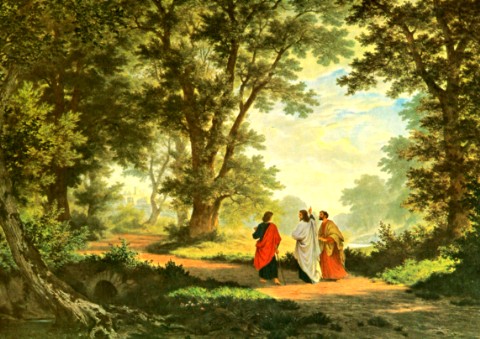
The Encounter at Emmaus

emmaus.jpg

I have been struck by the stories this Resurrection Season because for the first time, they strike me not as eye witness accounts of the Risen Christ, but as the challenge of faith for the disciples and us. The disciples on the way to Emmaus are leaving Jerusalem – returning home, perhaps, – grief stricken, but more importantly, disillusioned. The teacher has failed. The forces of evil have destroyed a very good and wonderful young man.

One way to see this story is to take it as another proof of the Risen Christ as encountered by his disciples. The story does convey this message. However, the story also tells us that we find the Risen Christ when He opens our minds to see the scriptures and when our hearts are opened at the Breaking of the Bread. Look for Him in the scriptures and invite Him in to dinner and your hospitality will be more than repaid.

There is just a glimpse – a flash of recognition and he disappears from our midst. The presence of the Risen Christ is a momentary and ongoing discovery. It is the result of searching, wandering, questing in grief and disillusionment and being open to the challenge of the Stranger.

All of us have moments, years, decades, in which everything we knew and had hoped for is swept away. The disciples had no clue of what was to become of their beloved teacher, but his torture and death threw them into utter grief and confusion. Yet their confusion only increased when they heard that other disciples had found the empty tomb and seen the angels. They were re-grouping, leaving town, trying to get some distance. A Stranger notices their grief and inquires. They listen and reflect on the scriptures and Break Bread.

This is the Christian life – the quest and the encounter in the village of Emmaus – continuing through all generations.

Read More

Posted by on Mar 31, 2008

The Feast of the Body and Blood of Christ

Easter Communion or Condemnation?

holy-communion.jpg

To receive communion during the Easter season has been a long established precept of the Catholic Church. It is a practice that we should examine more closely. To receive Christ in the Holy Eucharist requires one to be in the state of grace – free of serious or mortal sin. We are advised – wisely – to put our souls in order. We are to turn away from sin and return to the community through the grace of absolution. There must be peace and love in our hearts and a definite change in our lives.

Fr. Burke, a Discalced Carmelite from Australia, expands on the notion of communion in terms of our living out the Sacrament of the Holy Eucharist in our shared lives as Catholics and Christians. In his article, “St. Teresa and Two Spiritualities in the Church Today,” at http://www.carmelite.com/, Fr. Burke explains St. Teresa of Avila’s views on legalism as opposed to true and complete union with God and each other. It is well worth reading.

Fr. Burke has put into words what I have been feeling ever since I read selections from the popular blog, Cafeteria Closed, by Gerald Naus, who writes as Gerald Augustinus. Naus came to the United States from Austria in 1997. A former Jehovah Witness, he became a Catholic in 2005. His views are decidedly Restorationist. Unfortunately, they are generally stated in tones of arrogance, condescension, or condemnation. His posts on culture, politics, and religion are inflammatory and provocative, akin to those of Rush Limbaugh and Ann Coulter, except that Catholicism is now the justification for neo-fascism. Naus’s recent post, On the Status of Palestinian Education, uses photos and a few inflammatory lines to libel all young Palestinian men. One might argue that many of Naus’s views are Catholic in the officially regressive sense, but there seems to be little of Christian charity or communion about them. From this narrow point of view anyone who does not agree with him is wrong and should be attacked. As a major blogger, Naus has a large following in which to sow his seeds of dissension.

You will know them by their fruits. (Mt 7:20)

Read More

Posted by on Mar 20, 2008

The Feast of the Body and Blood of Christ

Each Little Light …

western-electric-lantern.jpg

Dr. Megan McKenna uses many stories in her teaching, claiming that all stories are true and some actually happened. She tells this story, one that actually happened, about a community she visited in India. It was a very small village, with an even smaller Catholic community. The community generally gathered in the evening. As dusk fell, her hosts invited her to go outside and look around. In the gathering darkness, she saw the hills around the village come to life with little twinkling lights. The lights began to move across the hills and gradually to converge on the small building which served as their church.

In the middle of the church, there was a large iron contraption, with many arms jutting out from the center. As the people arrived, they hung their family’s lantern on one of the arms. When it became clear that no more people were coming, the contraption, now a chandelier, was hoisted up over the gathered people. It shone over the altar, giving light to the entire community as they celebrated Mass together. Then, when the time came to leave, the chandelier was again lowered and each family took its own lantern. But rather than go home, they went out from their celebration to visit the homes of the members of the community who had not been able to join them that night. They knew exactly who was missing because those lanterns had not been on the chandelier giving light to the community!

A lesson Megan drew from this experience and shared with my parish community is that we aren’t really a community until we know who is missing when we gather to worship.

I thought of this story when, along with many thousands of others, I attended Sunday afternoon liturgy in the Anaheim Arena as part of the Los Angeles Religious Education Congress 2008. The arena was beautifully decorated. The music was outstanding. Cardinal Mahoney was presiding, along with many bishops and priests of the archdiocese. The deacons were there with their wives, entering and leaving in the processions together. It was altogether a wonderful time and place to be.

It happened to be the Sunday when the Gospel is the story of the healing of the man born blind. This is one of the three Sundays when we celebrate “The Scrutinies” as part of the Rite of Christian Initiation for Adults (RCIA). The focus of the second Scrutiny is the ways in which we are blind. The prayer of those preparing for Baptism, Confirmation and/or Eucharist at Easter, as well as of the larger community, is for deliverance from those forms of blindness.

After the homily, when the time came for the Scrutiny, those preparing for the “Easter sacraments” (Baptism, Confirmation and Eucharist), were invited to kneel around the altar in the center of the Arena. Their sponsors stood before them as they knelt there. And we were all invited to pray with them, then raise our hands in prayer over them, asking the Lord’s blessing on them as they left with their catechists to continue reflecting on the Scriptures and preparing for Easter. Then they all rose and left the Arena.

I was sitting in the third tier of seats, so I had a great view of the floor and all the proceedings. It was an impressive sight, because approximately 5 rows of people on both sides of the aisle on the main floor left the room together. There was a huge hole in the middle of the community gathered there for worship. Although I didn’t know any of those people personally, I knew who was missing from that community! Those who will bring their own light of insights and God’s unique presence to our/their communities when they are welcomed into full participation in the Church at the Easter Vigil.

I remembered Megan’s story and also her statement that the gospels were written by the Christian community for those who were becoming new members of the community. They are for the instruction of new Christians, and the gift of the RCIA, and of those preparing to join the community, is the opportunity to see these stories anew and to experience their power to change lives – the lives of new followers of The Way and of those who maybe have begun to take it for granted.

As we celebrate the many liturgies of the next few days, I invite you to look around and see who is missing. Who needs us to reach out in love and ease a burden, or offer a word of hope and consolation? Who is homebound? Who is discouraged? Who has been hurt by our institution or our community? Who have we ourselves hurt? As we reach out in love to those missing, we will experience the Resurrection of Jesus in a deeper way and we will become a sign of love to the world, just as those little lights coming down the hillside were a sign of a loving community in one small Indian village.

Read More

Posted by on Nov 9, 2007

The Feast of the Body and Blood of Christ

Marriage and Divorce – A Reconsideration by Evangelicals?

wedding-band.jpg

For all of us who have ever felt guilty about stressing the importance of grammar, the absence of quotation marks in the Greek New Testament shows that we have not been overly obsessive. David Instone-Brewer, a British evangelical scripture scholar, in the October 5, 2007 cover article of Christianity Today, says that if we place quotation marks in Jesus’ answer regarding divorce (Matthew 19: 13-15), there are more justifications than adultery alone. In “When to Separate What God Has Joined: What Does the Bible Really Teach About Divorce?” Instone-Brewer makes the case that in Matthew’s Gospel, Jesus is being asked if he supports an “any-cause” approach to divorce. According to Instone-Brewer, Jesus’ response is to quote Moses and reaffirm the limited justifications for divorce. Instone-Brewer is a specialist in Jewish thought during the time of Christ and he concludes that there are four reasons for permissible divorce in the Old and New Testaments: adultery, abuse, sexual or emotional abandonment, and neglect.

David Van Biema, in Time (November 6, 2007), reports on Instone-Brewer’s article and also cites the fact that divorce rates are the same or higher for Evangelicals in the United States compared to the national average, this according to the Barna Research Group poll taken in 2001. Van Biema speculates that the reason for publishing Instone-Brewer’s article was to provide Evangelicals with some way to deal with the conflict between the literal words of Jesus and St. Paul in the New Testament and their everyday experience.

This is an interesting example of how the way one approaches scripture affects the understandings gained from its study. A strictly literal approach, without a broader understanding of the culture and thinking of the time, can create unnecessary tensions with our everyday experience. There is an interesting commentary, “Grounds for Divorce in God’s Law,” at BibleGateway.com on Matthew 19: 13-15. Jesus’ teaching on marital commitment should be seen in its relationship to forgiveness – our ability to live in proper relationships with others. According to this commentary, Jesus’ teaching follows his teaching on forgiveness. One who refuses to forgive will tend to look down on weaker people – women and children. This approach is refreshing because it challenges us to see marriage in the context of proper or just relationships with others. What is often seen as an issue of “private” morality occurs in a much broader social matrix of justice.

In many respects, Evangelicals, who are often seen as focusing too narrowly on scripture, may help all of us go beyond the question of whether divorce is permissible for Christians. The broader challenge Jesus puts to us is whether we can live the deeper meaning of marriage as a living witness of peace, justice, and love.

Read More

Posted by on Sep 25, 2007

The Feast of the Body and Blood of Christ

Saint of the Day: St. Elzear & Bl. Delphina – The Happy Couple

Today, an unconsummated marriage would probably not be considered advisable by the Church and mental health experts. St. Elzear and Blessed Delphina were a couple who were married and lived together chastely. They are saints because of their care of the poor and the suffering. This couple is also known for their conscientious exercise of their duties as members of the nobility. Interestingly, they were known and remembered as a happy couple.

Personally, I don’t think that I would have responded by taking a vow of chastity on my wedding night the way St. Elzear did when he found out the Delphina had already made one. We have a contemporary theology of marriage that stresses and endows love making and sex within marriage as sacramental.

Certainly the late Middle Ages (St. Elzear 1286 -1323, Bl. Delphina 1283- 1358) was not a “puritanical” time. In fact, Puritanism would not happen for another 200 years and would never take root in the Mediterranean.

St. Elzear was born at the family castle in Ansouis, Provence, in the south of France. At 23, he became lord of Ansouis and Count of Ariano in the Kingdom of Naples. The Count and Contessa became influential in the court of King Robert of Naples and Elzear was the tutor to the King’s son Charles. He was also the “justiciar” or head of law enforcement and justice for southern Abruzzi under King Robert. St. Elzear died on September 27, 1323 while on a diplomatic mission to Paris to arrange the marriage of Charles to Mary of Valois. Blessed Delphina would survive him for another 35 years and spend the time in continued acts of charity.

As nobles, producing children was a serious responsibility. Even when having children was precluded due to medical reasons, noblemen usually had some illegitimate sons at hand. William the Conqueror was one such son. Since the marriage of the Count and Contessa of Ariano (St. Elzear and Blessed Delphina) was so atypical by the standards of their day and ours, how do we relate to it?

Perhaps it was a marriage of convenience, in the sense that due to their social station they were obliged to marry but would have really preferred monastic vocations. Since their state in life was determined when they were young children of a noble family, they simply found a way around it.

Young children at the ages of 5 -7 were sent as oblates to monasteries and convents. Hildegard of Bingen and St. Thomas Aquinas are two examples. We also know, of course, that many people who found themselves in “enforced” monastic vocations would do their best to bend or break the rules.

Then as now, marriages – especially those among the rich and powerful -were not happy affairs. Eleanor of Aquitaine (1122-1204) and her Church sanctioned marriages to King Louis VII of France and King Henry II of England demonstrates the far from Romantic character of such marriages. In fact, Eleanor of Aquitaine was a major promoter of the troubadour movement. The origins of what we today experience as romantic love originally began as songs of chaste love for the unattainable woman. As we know, the reality of courtly love was far from chaste, but it seemed to provide some fluidity in a tight social structure. That doesn’t mean that it didn’t cause feelings of betrayal and rejection resulting in duels, beatings, and death. The case of King Henry VIII in the early modern period (1491 -1547) provides a window onto the complexity of marriage in Europe in previous centuries.

The Count and Contessa feeding the poor, living as lay Franciscans, and in the case of St. Elzear healing lepers were definitely unusual for the time. What was probably most striking about them is that they were known as a happy couple. Their marriage – even if its lack of consummation might not adhere to the Church’s definition of one – was a partnership for a radical living of the Gospel.

In our own culture and time, can we say as much about our marriages and the joy, happiness and moral guidance they bring to others?

There are two slightly different accounts of these saints, with some inconsistencies. Please see Saint of the Day at AmericanCatholic.org and Catholic Online.

Read More

Posted by on Sep 21, 2007

The Feast of the Body and Blood of Christ

Yom Kippur – The Day of Atonement 2007

Sunset September 21, to Sunset September 22, 2007 is the Jewish Day of Atonement.

This is the day set aside for asking for forgiveness of God and those against whom we have sinned. The “virtual” Talmud – an adaptation of the Jewish tradition of teaching and commentary has an excellent post for today. A key point is that one’s individual wrongdoings are more than a personal matter. They have consequences for our loved ones, communities, and society overall.

Confession of sins, repentance, and turning around appear to the theme of the day not only for Jews.  They also appear to be making a comeback among Catholics, Protestants and Evangelicals. The Wall Street Journal today has an interesting feature on the return of repentance – specifically confessing one’s sins. “Confession Makes a Comeback” (page W1).

Even some Lutherans, whose founder Martin Luther opposed the sale of indulgences (the ability to get one’s time in Purgatory reduced or eliminated), are restoring a sacrament that they say they neglected for too long.

Take some time, tune up your conscience, make that phone call, send that card, forgive and ask to be forgiven. You might get a dose of your own medicine – we all do. Get straight with God and your neighbor. Find peace.

Read More

Posted by on Sep 7, 2007

To Trust the Incarnation: An Interview with Sara Miles

Editor’s Note: Sara Miles, author of Take This Bread: A Radical Conversion took the time to answer three questions which I felt might be useful to our readers. Very often the organized structures of “religion” are put at odds with those of our personal religious experience or “spirituality.” Many church goers are secure in their routine and not really open to the uncontrollable God. Many spiritual people rejoice in a the delights of a life lived far from the annoying humanity of our neighbors and the concerns of those struggling to get by on the margins. Sara Miles’ spiritual memoir challenges us to go beyond religion and spirituality and to live the Divine Mystery.

Randy Pozos: How would you advise parents and godparents to prepare their children for First Communion?

Sarah Miles: I’m probably not the best person to answer this, as I took my own first communion as an unbaptized adult, at the age of 46. My church, St. Gregory of Nyssa Episcopal Church (www.saintgregorys.org) offers communion to everyone, without exception, believing that Jesus welcomes everyone to his Table — and that his chosen sign was eating with outcasts, sinners, the unclean and the unprepared.

I believe that churches can prepare people to be members of churches; they can catechize children and adults to understand church doctrine and practices. But nobody can be “prepared” for the experience of God, because God is here, right now, making all things new: whether you are ready or not.

Randy Pozos: It seems that in your experience there is a direct, almost tangible, relationship between communion and your food pantry ministry of feeding and being fed by others. How would you encourage others to find and celebrate that transcendent experience of Eucharist in other ministries and occupations?

Sara Miles: Eucharist is a Great Thanksgiving: whenever we pour ourselves out, giving not only to our friends and loved ones but to our enemies and to strangers, we participate in Jesus’ feast, and share a “foretaste of the Kingdom” where all will be united in a heavenly banquet.

The connection between Eucharist and daily life is not mysterious: in fact, the liturgy is a reminder that it is precisely the most ordinary things of our lives (eating, drinking, kissing) that are suffused with God’s presence.

Randy Pozos: As a journalist and author, it seemed that you brought a poetic vision of a reality beyond the common sense experience of bread and wine. How can we engender this sensibility in ourselves and others and be ready for this experience of surprise and wonder?

Sara Miles: There’s a wonderful quote from Rowan Williams, now Archbishop of Canterbury, who says, in an essay on the martyr Etty Hillesum, “A religious life is a material life. Forget for a moment the arguments we might have about the definition of the ‘spiritual’; living religiously is a way of conducting a bodily life.”

To trust the Incarnation is to open yourself to God in the “common sense” experiences of human life. This means inevitably opening yourself to more pain, more suffering– and more joy.

Read More