Pages Menu
RssFacebook
Categories Menu

Posted by on Apr 24, 2022

Mercy – A welcoming back into the circle

Mercy – A welcoming back into the circle

Easter is both a day and a season. For fifty days, we bask in and reflect upon the great mystery of the Resurrection. The Sunday after Easter, the Second Sunday of Easter, is also known as Divine Mercy Sunday. We have a chance on this day to notice God’s loving presence in our lives, even when we are not consciously aware of that presence and possibly even actively turning away from it.

Many years ago, I was teaching a group of 5th and 6th graders in our parish religious education program. I had the children for two years at a time, so we got to know each other well. One year I had a girl in the class who was quite bright. She could also be quite impulsive and outspoken. Everyone liked her and she was a natural leader.

I always started class by calling the children into a circle. We recited a verse, sang a prayer, and then prayed for their special intentions before I began to present the topic of that day. One day, she was not feeling ready to begin class when I called them together. We met after school on a Thursday, so they were all tired of school by that time of day. I made class as little like school as possible, to help them enjoy our time of learning together. But she was not ready to stop visiting with her friends and enter into our lesson. Instead, she turned her back to me and commented that she didn’t like what I had just said to her, so she wasn’t going to join us.

There we were. A group of ten to fifteen people in a circle, ready to begin our time together and one person had turned away from us. The other children were astounded at her behavior and clearly wondered what I would do.

What would you do?

Here’s what I did. I spoke to the other children and called their attention to what we were seeing. We were all there together happily, in a circle and ready to begin our activity. One person had turned away. It was a beautiful example of what happens when we choose not to do what the Lord is asking us to do. What happens when we choose to go our own way and refuse to go the Lord’s way. The Lord and the community are still there waiting and inviting us to join the circle. We turn away. As soon as we turn back, we are immediately incorporated back into the group.

When my student realized that she had just given me a perfect example of what we were going to be learning that day, she turned back immediately, filled with apologies to her classmates for giving me a chance to teach them through her example. Of course, all was forgiven and we continued with the lesson. That year we were learning about God, prayer, and sacraments. It was just perfect timing!

The Gospel reading from St. John today speaks of something similar (Jn 20:19-31). It is Easter Sunday evening. The disciples are gathered in the upper room. They don’t really understand what has happened. It’s the first day of the new week, the day after the Sabbath. And here appears Jesus. The first thing he says to them is, “Peace be with you.” To show them he wasn’t a ghost, he showed them his hands and his side, pierced by nails and sword. Again, he spoke to them, “Peace be with you.” Not a word of condemnation or scolding for having run away or denied him. Just Peace.

Then he went even further, breathing on them the power of the Holy Spirit, the Spirit who is love, giving them authority to forgive the sins of other humans. This is pretty amazing stuff. Humans can forgive like God does and on behalf of God?

Thomas wasn’t there that night. He didn’t believe a word of it. No sir, not a word of it. Furthermore, he made clear, he would not believe until he had seen for himself and touched the nail marks and the sword wound in Jesus’ side. A week later, Jesus appeared again and called Thomas to touch his hands and his side, instructing him to believe now. Jesus also spoke words that ring through the centuries to all of us, “Blessed are those who have not seen and have believed.” We are some of those millions and billions of people who have believed without physical evidence of the Lord’s resurrection.

The people of Jerusalem saw the evidence of his resurrection in the community that formed among them, caring for each other and those around them (Acts 5:12-16). They recognized the power of healing that flowed through them and brought the sick out to be seen and healed. Many joined the community because of the love they saw among those who were already followers of the way.

We too see the Lord’s presence in the community around us. We experience it in the actions of other members of our community. We see healing and forgiveness that draw families and communities back together. As the early followers of Jesus were noticed, people who have seen the love within our families and communities have also been drawn to seek the Lord.

On Easter Sunday, the eighth day of creation dawned. A new start for humans and for our relationship with God burst forth. A community came into being that would grow and eventually encircle the globe, a community of love and forgiveness. A community led by “one like a son of man” who is “the first and the last, the one who lives.” The author of the Book of Revelation shares with us this vision he received and the encouragement to continue in faith as a community (Rev1:9-11a, 12-13, 17-19). In obedience, he writes down what he has seen, because it is happening and continues to be happening, not just then, but into our times and into the future. The circle of Divine Love and community is always present. We are free to turn toward the circle or to turn away. Divine mercy waits patiently for each of us to turn back into the circle and rejoin the dance of life.

As we move forward during this season of Easter, how do we welcome those from whom we may have become estranged?  How do we reach out in love and forgiveness? How do we seek reconciliation with those whom we have hurt? How do our communities welcome the stranger or encourage the one who has grown tired and lost hope? How can we be the face of the Lord’s mercy and love? How do we receive it in our own lives?

It’s a new day. Creation is new and our relationship with God is fresh and ready to grow. The Lord is Risen! Mercy is ever-present! Alleluia.

Read More
Posted by on Apr 16, 2022

He Is Risen as He Said!

He Is Risen as He Said!

Our celebration of the Resurrection of Our Lord, Jesus, begins with Easter Vigil, beginning on Holy Saturday evening.

The three days leading to Easter are known as the Triduum – literally “Three Days.” The first of those days, Holy Thursday, we celebrate the gift of the Eucharist and the ministry of service and sacrifice. On Good Friday we recognize the tremendous cost of reconciliation which comes when we humans turn away from God. God goes to unbelievable lengths to bring us back – even to becoming one of us and dying rather than deny the message and example he brought to us.

On Holy Saturday, we sit quietly in the face of loss, the emptiness of the absence of ones we have loved. It’s important to take the time this day to experience quiet, especially as we find ourselves hurrying to prepare for Easter celebrations.

Easter Vigil begins our celebration on Saturday evening. The new day has begun, according to traditional Judeo-Christian measuring of time. We gather in darkness and the new fire is kindled. The Easter candle is lighted and its light shared with all present. The deacon sings a hymn of praise for the light that shines undimmed in the darkness. We enter into the darkened church, bringing the Light of Christ with us.

As part of Easter Vigil, we remember the history of God’s relationship with humanity and all of creation. We read and tell the stories. We sing the ancient psalms. We hear the words of the prophets. Only then, when we have remembered our history and the great deeds of our God, do we sing the Gloria and light the room fully.

We hear a reading from St. Paul’s letter to the Romans and from the writers of the Gospels. Tonight we will hear from St. Luke. They tell of the great good news of the Resurrection, and of the confusion felt by Jesus’ followers as they beheld such an amazingly impossible reality.

New members of our community profess their faith with us as they receive the Sacraments of Initiation: Baptism, Confirmation, and Eucharist. We celebrate our Mass together, then go forth in joy with a final blessing, to share this great gift with all we meet.

The celebration continues Easter morning. Again we gather as a community to celebrate. We hear from the Acts of the Apostles, St. Paul, and the writers of the gospels. There are different sets of readings for different times of the day. So much to tell. So much to celebrate. So much to share.

These few days are the most important days in Christianity. If Jesus had simply said, “Forget it. I’m out of here!” when faced with the mighty power of those who opposed him, we would not likely be celebrating his life, death, and resurrection today. These were the events that changed the history of the world, of our understanding of the relationship between God and humans. At Pentecost, with the coming of the Holy Spirit, the witnesses of the Resurrection received the grace and courage to go out fearlessly and share what they had seen. But first they had to see. They had to experience the great mystery.

We today are called to do the same. Experience the mystery. Then go out into our own worlds and live the reality to which we have been witnesses. Christ is Risen. A new day has begun in creation. We are the ones who will make it real for our world today.

Happy Easter. Christ is Risen, He is Truly Risen! Alleluia.

Read More

Posted by on Apr 15, 2022

Good Friday – Time to celebrate?

Good Friday – Time to celebrate?

Good Friday.

Sometimes it seems that the really hard things aren’t good at all. Why call this Good Friday?

The great mystery of life and love is that sometimes the hardest times are the most important. These are the times of growth, times of stretching. This is when we learn to depend totally on others to help us get through. When the others aren’t there for us, the Other who brought us forth into being from the great Dance of Love of the Trinity is there for us. This Other is not really “other” in the usual sense. This is the source of our deepest life and being. It’s in the deepest realms that we learn the truth of what matters. We learn compassion, patience, endurance. We understand the suffering of others in a new and deeper way. We realize that the easy answers of our childhood may not be the final answer. We grow in wisdom as we grow in age. With God’s help, we grow in grace too, that fundamental sharing of divine life.

Jesus didn’t know that he would rise. In this he was a human like any other one of us. But he was a man of great integrity, faithful to the God he called Abba (Dad), and willing to testify to what had been revealed to him about God’s love for us. He went to his death forgiving those who had condemned him, those who crucified him, those who mocked him, and the thief who was dying beside him. Mercifully, he did not have to suffer long. His Father claimed him quickly. His friends claimed his body and buried him, then returned home for the Sabbath rest.

We know the surprise that awaited them on Sunday morning. But for now, let’s take time to experience the great mystery of unknowing. The mystery of trust in a God we cannot see.  The mystery of life and death.

Happy Good Friday!

Readings for Good Friday

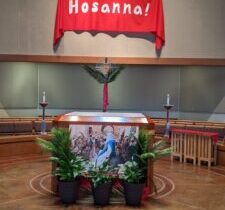
Image is of one side of the altar at St. Patrick Church in Spokane, WA – Artist: Harold Balazs

Read More

Posted by on Apr 10, 2022

Recognizing the Lord when He Comes

Recognizing the Lord when He Comes

Holy Week begins. This is the most important week in our entire year as Christians. The mystery of reconciliation of humans and the divine plays out graphically in the events we celebrate this week.

Sunday of Holy Week is known as Palm Sunday of the Lord’s Passion. Traditionally, we begin our liturgy outside the church building. We gather with palms around our presider and hear the proclamation of the Gospel which tells of Jesus’ triumphal entry into Jerusalem a few days before his arrest. Following the reading, we process into the building and continue with our liturgy, formally opening this week of prayer and celebration of the mystery in which we participate.

The Gospel reading for the blessing of the palms will be from one of the Synoptic Gospels – the three oldest versions of the events of Jesus’ life – as narrated by Matthew, Mark, and Luke.  In Cycle C (which we celebrate in 2022), it is Luke’s account that we will hear.

These accounts all tell of Jesus coming into the city riding a young donkey. Kings and conquering military heroes of his day rode into cities mounted on great war horses, with banners flying, triumphal music playing, and crowds of grateful (or at least cheering) people to welcome them. Coming into town, riding a steed, and attracting a crowd of cheering people speaks to the Jewish dream of a Messiah in those times, a hero who will rescue the nation from captivity to a conquering nation (Rome). This was the kind of hero long-awaited – the kind many hoped Jesus would be.

Jesus, however, came riding a young donkey. One version says it had never been previously ridden by anyone. This is an important detail. In the prophecies of Zechariah, written almost 500 years earlier, there was a statement that the Messiah would come riding a donkey, just as had princes and leaders from before the period of kings in Israel. This person would be a leader who was humble and would bring peace. He would not be a warrior or a conquering hero. The symbolism of this entry riding on a young donkey would not have been lost on the people welcoming Jesus, nor was it lost on the authorities. In fact, they asked him to tell the people to be quiet and go away. They were quite likely afraid of the potential negative Roman response to the commotion. Jesus’ response was that even if the people went away, the very stones would shout out against the injustice of the social structure.

Another detail of interest in Luke’s telling of the tale is the question of palm branches. In Luke’s version of the story, there is no mention of palm branches or fronds having been waved in greeting or salute to Jesus. Palms are there in the other three gospels, but not in Luke.

In Luke, as in the others, the fact that people lay their cloaks out to make a road and that Jesus sat on cloaks that had been placed on the back of the donkey is noted. A cloak was a very valuable possession in those days. It was an outer garment that served as coat when the weather was cold and as a sleeping bag at night, especially for those who were not inside a building for the night. Ordinary folks were putting their coats on the ground for the donkey and any following closely behind to trod. That’s a pretty major commitment. I’m glad I didn’t have to pick my coat up and sleep in it after having a donkey and a large crowd of people walk over it!

Once inside the walls of Jerusalem, Jesus went to the temple. Matthew, Mark, and Luke all tell that Jesus disrupted the markets in the temple, chasing out the money-changers and others who were cheating the poor. He spent time teaching there as well, presumably not immediately after shaking everything up! The point is, he was not a quiet, meek, “what-ever” kind of guy. He had a vision and a mission. He was passionate about following the spirit of the Law and living what he had preached in the years leading to this visit to Jerusalem. He was not a person who could be ignored.

The first and second readings on Palm Sunday of the Lord’s Passion are the same every year, as is the Psalm. Our attention is drawn to the events that followed Jesus’ triumphal entry into Jerusalem.

The first reading is from Isaiah (50:4-7), the Suffering Servant’s declaration of his determination to speak words of hope and encouragement to the people, despite opposition and persecution against him. This is a proclamation of great hope in the face of overwhelmingly negative odds. The prophet declares, “I have set my face like flint, knowing that I shall not be put to shame.”

Psalm 22 is the one Jesus prayed on the cross. The psalms were much like our traditional “prayers” such as the Hail Mary or Our Father. These were prayers that could be offered any time and at any place by anyone. There’s a psalm for just about every situation in life. “My God, my God, why have you abandoned me?” A cry for help when in desperate straits, with a conclusion that declares a joyful recognition of the Lord’s power to overcome all – “I will proclaim your name to my brethren; in the midst of the assembly I will praise you.”

Paul’s letter to the Philippians (2:6-11) includes another ancient hymn. Modern musicians have put it to music for our communities too, celebrating the great mystery of the incarnation. Jesus did not hesitate to become one of us and experience all that we experience, including rejection and death. God raised him up and gave him a name (power and authority) above all others. This is one of the earliest proclamations of our belief – “Jesus Christ is Lord, to the glory of God the Father.”

St. Luke’s telling of the Passion and Death of Jesus is the Gospel reading for Cycle C. It is a powerful story that begins with the narrative of the Last Supper and the gift of Jesus’ body and blood for our Eucharistic celebrations. It continues through the agony in the garden, Jesus’ trial, condemnation, carrying of the cross, and execution. His words of forgiveness and his prayers on the cross speak to us. We close with the quiet sorrow of his death and hasty burial in a borrowed tomb.

We are not called to be saddened by all of this. It is to be a source of great hope, but a hope that is so outrageously improbable and powerful that we are in awe of it. We enter this week with quiet hope for our own lives and the world in which we live. We pray for insight and the ability to see the Lord’s presence in all the times and ways he comes into our lives.

This can be a very busy week. There are liturgies and preparations for Easter. Work and school don’t necessarily take the time off. Yet it is a solemn time too. Liturgies for the blessing of the Holy Oils, Holy Thursday and Good Friday services, Easter Vigil, and then the great feast of Easter all await.

How will I mark this time? What things can wait, what need attention? What do I normally neglect that maybe I should spend some time doing?

May these final days of preparation for Easter be ones of peace and quiet joy, as we trust that through all the ups and downs of life, our God is with us, loving and supporting us each step along the way. Hosanna in the Highest.

Here are links to sample a couple of versions of the song from the Philippians that St. Paul shared with us.
In English, from Ken Canedo
In Spanish, from Pedro Rubalcava

Read More

Posted by on Apr 3, 2022

Doing Something New

Doing Something New

The readings for the Fifth Sunday of Lent in both Cycles C and A all speak of the ways in which God is doing something new. Once again, we have two possible sets of readings. Readings from Cycle A are used for celebrations of Eucharist in which those preparing for the Easter sacraments are present. Those from Cycle C are used for the others.

In the first reading for each cycle, we hear of God stepping in to do something new. In Cycle C,  Isaiah (43:16-21) speaks for the Lord, telling the people that although in the past the waters of the sea were parted so the people could pass through, now something new was going to happen. Forget what happened in the past, pay attention to what I’m doing now, is the essence of the prophecy. “I am doing something new!” There will be a way through the wastelands, rivers will flow in the desert, wild beasts will honor the Lord, and a new people will be formed to announce the praise of the Lord. All will be new again. A fresh start, so to speak.

The Cycle A reading is from the book of Ezekiel (37:12-14). The Lord promises: “I will open your graves and have you rise from them, and bring you back to the land of Israel.” He promises his spirit will settle upon them, so they will recognize their God. They will return and settle on their land once again. Something new is going to happen.

“The Lord has done great things for us; we are filled with joy,” sing the people of God in Psalm 126. We have gone forth from our homes in tears, but we return rejoicing. In Cycle A, the Lord’s mercy is celebrated in Psalm 130. “With the Lord there is mercy and fullness of redemption.” All can and will be forgiven. Call out to the Lord, trust in the Lord, and the Lord in his kindness will redeem Israel.

St. Paul assures both the people of Philippi (3:8-14) (Cycle C) and the people of Rome (8:8-11) (Cycle A) of the love of God and promise of new life for those who have faith in Christ. Sharing in the suffering of Christ, turning away from worldly pleasures and ambitions, the faithful believer will be raised from the dead because the Spirit of the Lord lives within them.

In the Gospels we see different stories, but in each God is doing something new. In Cycle C, we hear from St. John about the time the scribes and Pharisees tried to trap Jesus into breaking either Jewish law or Roman law. They brought a woman accused of adultery to him for judgement (Jn 8:1-11). They told him she had been caught in the act, so was clearly guilty as charged. The Mosaic law imposed the penalty of stoning for this offense. What should be done? The trap was subtle. The Romans did not allow the death penalty to be imposed by local authorities. Only Roman authorities could impose that penalty. If Jesus opted for stoning (in accordance with Mosaic law), he would be breaking Roman law. But would he advocate turning her over to the Romans for punishment? That would be unthinkable. What would he do?

Jesus did something unexpected. He simply bent down and began to write on the ground. The accusers kept insisting on an answer, so finally he spoke. “Let the one among you who is without sin be the first to throw a stone at her.” One by one, the accusers all left. No one condemned her. Jesus then spoke directly to her, “Neither do I condemn you. Go, and from now on do not sin anymore.”

Something new. The possibility of forgiveness for what was seen as a terrible sin. There are several “I wonder” moments in the story. Where was the man who would logically have been present when the woman was seized by the authorities? Was her sin really what we would call adultery, or might she have been the victim of a different crime? If she had been outside her home without a male chaperone, would that culturally have justified an assault on her that could be called or perceived as adultery?

Many possible angles and unknowns in this story. The critical point, however, is that Jesus does not judge as others in his community would have judged the woman. He did not fall into the either/or trap. He did something new and different, something bringing joy to the woman in question and showing the kindness and mercy of God. “Neither do I condemn you.”

We see Jesus doing something new in St. John’s Gospel from Cycle A as well (Jn 11:1-45). Jesus and his friends have gone away from Jerusalem for a while after things got too hot politically. He was in danger of being killed, so he had gotten out of town for a while. Then word came that his good friend Lazarus was dying. The sisters of Lazarus sent word to him, certainly hoping he would come and heal their brother. But Jesus stayed where he was for two more days before traveling to the community near Jerusalem where Lazarus and his sisters lived.

His friends cautioned him that it was dangerous to return to Jerusalem and the nearby towns. But Jesus insisted on returning. Lazarus had died, but Jesus would still heal him. In fact, it would be an even more amazing healing than those performed earlier, so more likely to lead them to belief.

When Jesus meets Martha, Lazarus’ sister, she expresses her belief that Jesus could have saved her brother’s life. She also believes in the resurrection “on the last day.” It is then that Jesus makes an amazing statement. “I am the resurrection and the life; whoever believes in me, even if he dies, will live…” Martha expresses her faith that Jesus is the Christ, the Son of God come into the world.

This was truly a case in which God did something new. The name Lazarus speaks of God coming to the rescue at the last moment. Jesus called Lazarus forth from the tomb four days after Lazarus had died. There was no question about whether or not the man had died. It had been four days. Four days was a legal landmark. The person was not coming back. Possessions could be distributed. All was done and over. But God came to the rescue. Jesus called Lazarus forth from the tomb, ordering, “Untie him and let him go.” And Lazarus lived again.

The Lord has done great things for us too. What is the Lord doing that is new in our lives? What specifically needs healing in my life, in your life? Where will the Lord call us out of a desert into a rich land? Where will we rise from our tombs of anger, frustration, or apathy? When will we receive forgiveness for the wrongs we have done? Will we recognize and accept the kindness of the Lord come to redeem us too?

Lent is nearing its end. New things are coming. Let’s continue in hope and open our eyes to see the beauty of the new life coming.

Read More