Who is Clean Among Us?
 Who is clean among us? What does it mean to be clean? Does it matter? Does it have anything to do with physical cleanliness?
Here’s a somewhat related question – Which bodily organ is the largest? The question is sometimes asked in Biology or Anatomy classes. Typically, people identify one or another internal organ as the largest. However, the correct answer is skin.
Our skin is actually an organ and as such both protects the rest of our body and can be an indicator of overall health or of stress. Our skin can also become infected with/by many different critters, most of whose actions produce a visible change. Sometimes, infections begin at the surface and move inwards – things like an infected pimple. When the protective barrier of the skin is breached, through a cut, scrape, puncture or something similar, infections move inside much more easily.
In ancient times, much less was understood about the cause of infections and the role of the skin. However, it was known that some conditions could be spread by contact. Since there were no treatments for them, those who were infected were often forced to leave the community.
Hansen’s Disease, a.k.a. Leprosy, was one of those conditions. Today we know it is caused by two types of bacteria and it can be treated. In the past, there was no treatment. As the condition progressed, people’s skin became discolored, nerve damage caused loss of feeling in hands or feet, so injuries could lead to loss of fingers or toes, as well as disfigurement of the face or other areas of the body. It was a terrifying disease. Those who contracted any skin condition were assumed to have leprosy and banished from the community. They lived off by themselves in small groups of fellow sufferers and called out a warning to any who approached – “Unclean!” Only a fool would come closer and risk contracting the disease!
The requirement for isolation of people who had skin conditions is encoded in the Mosaic Law. Conditions that caused blotches, itching, sores, or other non-normal appearance of the skin were called leprosy. Not all would have been the disease as we define it today. Some conditions, including eczema, rosacea, vitiligo, or psoriasis, cause changes in the appearance of the skin but are not actually leprosy. Yet any of them could be sufficient to make the person ritually impure – unclean. Anything outside the norm, as understood by the people of the day, was believed to be unclean and therefore to be shunned.
An Army Commander is Healed
Naaman was a commander in the army of Aram, a neighboring country that was trying to take over parts of Israel in ancient times. An Israelite girl who had been captured and taken as a servant for Naaman’s wife told him that Elisha the prophet in Israel would be able to heal his leprosy. With the permission of his king, Naaman traveled to Israel and asked Elisha for healing. Elisha told him to go to the Jordan River and plunge into it seven times and he would be healed.
Fortunately for Naaman, he accepted Elisha’s word and went to the Jordan where he plunged into the water seven times. When he had done as commanded, his skin was healed completely.
Naaman was so grateful that he and his retinue returned to Elisha to thank him. He recognized that the healing was from God but he wanted to give Elisha a generous gift in thanksgiving as well. Elisha, however, would not accept anything. The healing had not been his doing. It was the work of God.
Then Naaman requested something else – “two mule-loads of earth” that he could take back to his home and spread there. As he explained, “I will no longer offer holocaust or sacrifice to any other god except to the Lord.” (Understanding the Lord as a local god of the Israelites, he believed it necessary to worship on soil from the Lord’s land.) (2 Kings 5:14-17)
Isolation, Healing, Gratitude
The isolation of lepers continued into Jesus’ time and beyond. It’s only been very recently that we have learned its cause and have a way to cure the condition. But for thousands of years, this was not the reality of life.
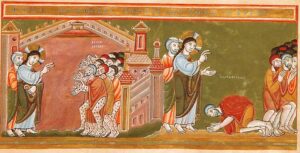
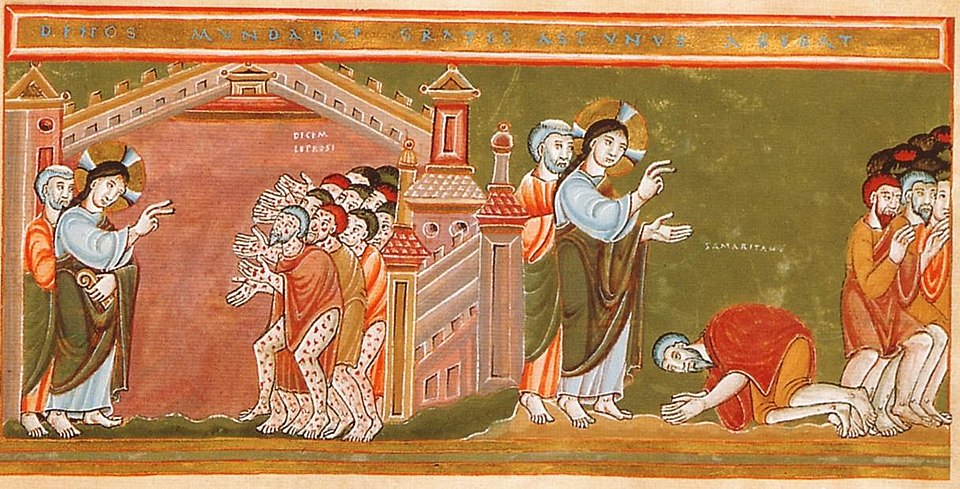
As Jesus and his friends traveled from Galilee on their way to Jerusalem, they met ten lepers near a village. The lepers called out to him, “Jesus, Master! Have pity on us!” It was known that he could heal many conditions. Maybe he could help them too?
Jesus didn’t have to ask what the request meant. They were hoping for healing. He responded, “Go show yourselves to the priests.” In order to be readmitted to the social community, they had to be certified as Clean by the religious authorities – their skin had to have been returned to normal appearance.
The lepers set off to present themselves to the priests and along the way, they were healed. They were now clean, free of the condition that led them to be unclean.
One of those cleansed, upon realizing what had happened, returned to thank Jesus, praising God for this gift. Jesus was happy to see him but asked, “Where are the other nine?” All ten had been cleansed. Only one returned and that one was not a Jew. He was a Samaritan, a foreigner, one of a people despised by Jews for centuries. The rest had all been Jews, but they didn’t come back. Was it because they considered it a given that they would be healed? We’ll never know, but it’s worth asking. Jesus certainly wondered. (Lk 17:11-19)
Who is clean among us? What does that really mean? Whom do we accept as worthy of respect, kindness, welcome? Whom do we assume belongs and whom do we assume should be shunned and turned away? Who are the lepers of our day?
Does It Matter Who is Clean?
St. Paul reminded Timothy that although he himself was at that point a criminal in chains, “the word of God is not chained.” All that Paul and the followers of Jesus must bear because of their choice to follow Jesus is worthwhile, as a witness that will draw others to salvation through Christ Jesus. Whether his followers are faithful to his call in their lives or not, God is faithful to us, “for he cannot deny himself.” (2 Tim 1:6-8, 13-14)
We are called. We sometimes fail to choose the way he leads. But he remains faithful to all of us and to his call.
Will we continue to care for those deemed unclean by our society, by political leaders with their own agenda, by people who fear newcomers or that those from other lands are the cause of their own difficulties in life? Whom will we accept as clean? Will we be clean ourselves if we reach out in loving service to those deemed unclean? What does it mean to be clean today?
As we reflect on the healing of lepers in Scripture, may we remember that there are both physical and spiritual levels of health and illness. Sometimes we are called to deal with both. Sometimes, our actions should be directed and guided more by the figurative meaning of the words and concepts we use.
This week, may we notice with compassion the sufferings of those around us, many of whom suffer in silence or in fear. May we offer a kind word, the gift of understanding of the complexity of life, the patience to wait and find out what they really need. Is it something practical like a blanket to keep them warm at night? Is it a smile that says, “I see you and treasure your presence?”
May we remember always that Christ is present in the least of the people of the world, from wherever they have come. There is something each brings to us, adding richness to our lives and asking only patience and kindness in return.
Who is clean among us? Are we ourselves clean?
Readings for the Twenty-eighth Sunday in Ordinary Time – Cycle C
(More thoughts on this here.)
And a wonderful song from Miriam Therese Winter of the Medical Mission Sisters – Ten Lepers