Temples – Literal and Symbolic – Signs of God’s Presence
 The temple, as a place of worship, has ancient roots. Temples are found in many ancient civilizations, serving as the place where the divine and human meet and interact. The divine being is believed to live in the temple and the people bring their hopes, dreams, and sacrifices to offer there, hoping always for the favor of the god. Yet, more than just physical buildings, temples – literal and symbolic – serve as signs of the presence of the divine among the people.
During the time of the Babylonian captivity, when the temple in Jerusalem had been destroyed and most of the people taken into exile, the prophet Ezekiel spoke of a vision he had received. An angel led him to the new temple. There he saw water flowing from under the threshold of the door which faced to the east. It flowed down the side of the mountain towards the south, into the dry lands along the Jordan River, including the Dead Sea and the lands continuing from there to the Red Sea. This area was known as the Arabah or Aravah, a word meaning dry lands.
The water flowing from the temple was fresh, pure water in which fish could thrive, orchards could grow, and all kinds of creatures could live. As the water from the temple entered the salty water of the dry lands, it also made those waters fresh again. (Ez 47:1-2, 8-9, 12)
The prophecy was fulfilled when the people of Israel returned to their home in Judea. The temple was rebuilt and remained on the holy mountain in Jerusalem until it was destroyed by the Romans in 70 C.E. Jesus, his family, and his followers all worshiped at the temple in Jerusalem and offered sacrifices there.
On one occasion early in Jesus’ public life, he visited the temple in Jerusalem for Passover. Many animals were offered for sale there by merchants who purchased them to re-sell them to the faithful for sacrificial offerings. This wasn’t a time in which transactions all happened with pieces of paper or digital code. Coins and physical objects were exchanged. Animals were purchased and given to the priests for sacrifice to the Most High. Special coins had to be used for these transactions, so money-changers also had booths in the market areas of the outer parts of the temple. It was a noisy, smelly market-like area – not at all like what we associate with a place of worship.
Jesus was outraged by the way the temple had been transformed from a place of worship into what looked very much like any other marketplace, with sellers taking advantage of buyers whenever possible. He made of whip with cords and used it to chase them all out of the temple. “Take these out of here, and stop making my Father’s house a marketplace.”
Needless to say, those in charge confronted him. “What sign can you show us for doing this?” He replied, “Destroy this temple and in three days I will raise it up.” The authorities expressed a very valid skepticism at that: “This temple has been under construction for forty-six years, and you will raise it up in three days?”
The words used to express the idea of temple in Greek took different forms. One referred to the entire building. The other referred to the inner sanctuary, the place where the Most High was present. The word Jesus used to describe the temple of his life and body in St. John’s account of this event was the word for the inner sanctuary. The dwelling of the Most High within him could not be destroyed – it would be raised up again.
When Jesus rose from the dead on the third day, his followers remembered his words and believed the words of the Hebrew Scriptures, the prophecies that foretold his coming. (Jn 2:13-22)
Jesus’ human life became the new temple and from it, life-giving blessings would flow like the river from the temple foreseen by Ezekiel. His followers shared this good news with all they met.
St. Paul reminded the people of Corinth, “You are God’s building.” Paul laid the foundation of the Good News of Jesus, others continued the process, building on that foundation. A new community, a new temple in which the Spirit of God would dwell, arose on that foundation. He explained and promised, “you are the temple of God, … the Spirit of God dwells in you … the temple of God, which you are, is holy.” (1 Cor 3:9c-11, 16-17)
We are the descendants of those early followers of Jesus, called to be temples of God, the One who lives within us. The water that flows out from us to water the land takes the form of care for the poor, the vulnerable, immigrants, children, those who are sick or dying. The Beatitudes express beautifully the waters of loving care we are to send flowing into our own worlds.
Nevertheless, we are not simply symbolic or theoretical beings. We are humans, living in a very real world of very tangible buildings, roads, rivers, mountains, and so forth. We gather together in special places to share our faith and pray together. We’re all in this together, as children of God and the sisters and brothers of Jesus. We share the same Holy Spirit and we together eat the Bread of Life and drink the Cup of Salvation when we gather for Eucharist.
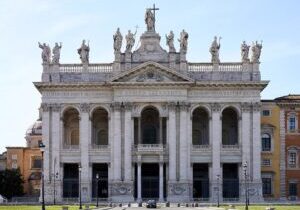
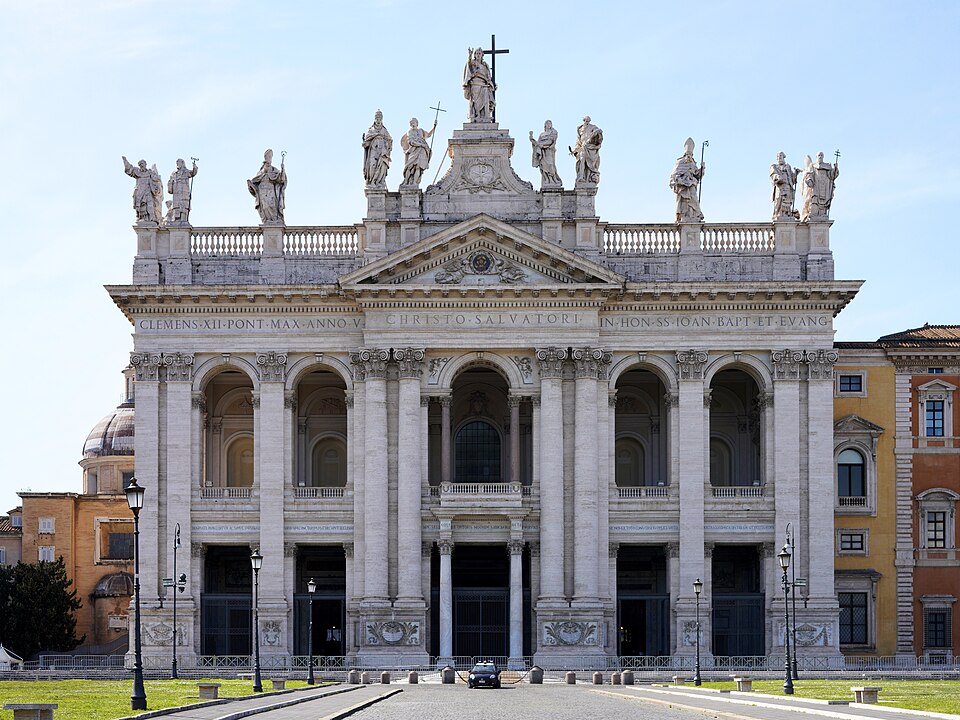
As early as the time of Emperor Constantine, when Christianity became legal in the Roman Empire, one church in Rome has been especially dedicated. Since 324, the Lateran Basilica has been the Cathedral of Rome. A basilica was a large, rectangular building, in which many different functions took place. It was a public area in the city near the forum and temple. The name Lateran comes from the name of the family on whose land it was built. The formal name of the church is Archbasilica of the Most Holy Savior and Saints John the Baptist and John the Evangelist at the Lateran.
The Lateran Basilica is the Pope’s cathedral in Rome. It is outside the walls of Vatican City. The Pope is the Bishop of Rome, as well as head of the Roman Catholic Church.
The Basilica was dedicated on November 9, 324. It has been repaired and rebuilt multiple times since then and is still in use. A temple – literal and symbolic – a sign of God’s presence among us.
As we celebrate the dedication of the Lateran Basilica today, we also celebrate that love, the waters of divine blessing, that flows from the Father, Son, and Holy Spirit through each of us out into our world today.
Readings for the Feast of the Dedication of the Lateran Basilica