Pages Menu
RssFacebook
Categories Menu

Posted by on Jan 5, 2015

Experiencing and Celebrating God-With-Us Through Gifting

Experiencing and Celebrating God-With-Us Through Gifting


Presents-under-the-Christmas-treeby Petr KratochvilGifting, the giving and receiving of gifts during the Christmas season, serves to remind us of God’s great gift in coming to live with us personally. In Jesus, the Word of God, became a human, like us in all things but sin. God chose to enter into the vulnerable, imperfect, uncertain, but wonderful reality of life as a fully human being, starting as a baby with normal human parents, family, and friends in a small village. Through the gift of incarnation and redemption, God healed the division between the divine and the human, giving humans the chance to be re-united with their source.

Christians have celebrated this great gift from the very beginning through their celebrations of the Lord’s Supper, the Eucharist. Sharing of gifts of time, talent, and money has also been a hallmark of the Christian life, not just within the community but also reaching outside to the most vulnerable members of society. The world has never been the same since God entered personally into our human experience, because now God lives as Holy Spirit within each of us and reaches out to make a difference in the lives of those around us.

Diverse gifting traditions

Traditions for giving and receiving gifts vary around the world. In some areas St. Nicholas brings gifts on his feast day, December 6. In others Santa Claus or the Christ Child bring gifts at Christmas. In still others, the gifts arrive at the celebration of the Feast of the Epiphany in early January, when the coming of Jesus was shown forth to the Gentile world as well as to the original children of Israel.

The gifts arrive in different ways as well. Some are placed in shoes, others in stockings. Some are placed under a tree, others arrive carried by family or friends. Some are wrapped, others shine in all their glory to delight children who wake early to find them. Some even come via the postal service and other freight delivery trucks! However they arrive and however they are packaged, they carry love in their wake.

As we have moved through Advent and into the Christmas Season this year, I have also been noticing the ways that traditional holiday foods arrive in or as packages. Many candies and baked goods arrive in lovely containers. The tamales we enjoy at Christmas and New Year’s Day have meat or vegetables seasoned with chili hidden inside the corn dough. Chinese dumplings eaten to celebrate the New Year have a mixture of meat and/or vegetables hidden inside the noodle dough that we see. King cakes have a figurine or other surprise hidden inside. Steamed puddings have nuts and raisins inside. Each of these traditional forms of gifts and food (and others from around the world) is a way that we as humans express the wonder of God’s gift of himself to us through the birth of Jesus.

May the joy of Christmas and the wonder of Epiphany be yours now and into the year we have begun.

 Image by Petr Kratochvil – public domain


Read More

Posted by on Jun 13, 2014

Experiencing and Celebrating God-With-Us Through Gifting

Crepe Paper and Sticks Become a Bird for Pentecost


Feathers all ready for flying

Feathers all ready for flying

The primary image of Pentecost is that of tongues of fire that accompanied the sound of a rushing wind and settled over the heads of the disciples, both men and women, gathered in the upper room of the home in Jerusalem where Jesus had celebrated the Last Supper with his friends and then appeared to them on several occasions after the Resurrection. In this unforgettable moment, the Holy Spirit came upon the disciples and empowered them to witness to what they had seen and heard of the love of God and the coming of God’s Kingdom to the world. The Church was born on that day nearly 2,000 years ago and the Holy Spirit continues to breathe life and love into God’s world through ordinary men, women, and children.

Many ways of celebrating Pentecost exist around the world, beginning with the gathering of the community to celebrate the Lord’s Supper. For children, other activities can make this a special day as well.

Common symbols of the Holy Spirit include a dove, the wind, and a flame. A craft I learned many years ago makes an enjoyable activity for children to celebrate during Easter Season and Pentecost.

Crepe Paper & Stick Birds

Supplies:

2 thin sticks or branches – about 1 1/2 to 2 feet long
String or yarn – 1 foot length
Cellophane tape
Crepe paper – white, yellow, red, orange
Orange ribbon (optional)

Making your bird

Take two sticks of unequal length and tie them together in the form of a cross. Use string or yarn to tie them securely and help hold them in the cross shape.

2012-04-17 17.02.28

Next take a bit of the crepe paper and wrap it around the yarn to help stabilize the bird’s body.

Take the orange ribbon or a bit of orange crepe paper and wrap it around the tip of the shortest end of the sticks. Go around the stick enough times to make a beak and a head for your bird. If you use ribbon, you can use crepe paper to cover the body-end of the beak and build up a head.

2012-04-17 17.07.17

Once the head has been formed and the center stabilized, take a long strip of crepe paper, tape it to the stick or to itself, and begin wrapping it around the sticks.

2012-04-17 17.14.49

Cover both sticks completely with crepe paper. Leave only a little of the beak showing.

Close-up of head

Close-up of bird’s head

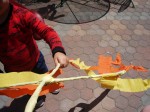
Take strips of whatever color of crepe paper you are using and tape them to the bird’s wings and tail. Some will want to tape them all along the wings. Others will put them only at the tips. Either way works just fine.

Feathers all ready for flying

Feathers all ready for flying

When the feathers have all been attached, the bird will be ready to fly.

Away we go!

Away we go!


This bird can be constructed to celebrate Easter, the Resurrection (as a phoenix), or Pentecost (as a reminder of the Holy Spirit who comes igniting the fires of love and settles like a bird on those called to God’s family).

Come Holy Spirit. Fill our hearts with the fire of your love. Blow where you will in our lives. Strengthen us to respond with the freedom of a bird flying in your love.

Read More

Posted by on May 29, 2014

Savoring the Feast of the Ascension

Savoring the Feast of the Ascension


The Feast of the Ascension is traditionally celebrated on the 10th day before Pentecost. In many places these days it is celebrated on the Sunday before Pentecost so more people can attend Mass.

On this day we remember and celebrate the day, forty days after the Resurrection, that Jesus was taken into heaven, hidden from the disciples’ sight by a cloud. (Acts 1:9) Following His instructions, they returned to Jerusalem and spent the next days in prayer, until the Holy Spirit came upon them at Pentecost.

One traditional way to celebrate the Ascension is to go fishing. Why? An ancient symbol by which Christians identified themselves and each other was a fish. The Greek letters that spelled fish (ΙΧΘΥΣ – ICHTHYS) could also be taken as the first letters for the words, Jesus Christ, God’s Son, Savior.

Going fishing is not always possible, however, so another way to celebrate is through a festive meal. A fish pie is a special treat.

Fish Pie

Ingredients:

Pie crust for a two crust pie.

Sauce:

3 Tbsp. margarine or butter
3 Tbsp. cornstarch
1 Cup water
1/4 Cup white wine or light fruit juice
1/4 Cup onion, minced
1 Tbsp. parsley
Balsamic vinegar to taste (optional)
Salt, pepper, chili powder, thyme, tarragon, savory to taste

Filling:

Tuna or other canned or fresh fish
Potatoes
Vegetables: Carrots, Green Beans, Peas, Corn or others liked by your family

Saute the onion in the melted margarine or butter. Add the cornstarch and stir. Add water and wine. Stir frequently as the mixture heats and thickens. Add the spices and mix well. When the sauce has thickened, add fish, boiled, cubed potatoes, and steamed vegetables.

Put the filling into an unbaked pie crust and cover with a top crust. If desired, cut a fish and some “rays of glory” into the top crust for venting.

Bake at 400º for 35-40 minutes until golden brown.

Serve the pie hot, with a nice salad, a bit of sparkling cider, juice or wine, and a light dessert for a special family celebration of the Ascension.


Read More

Posted by on Feb 2, 2014

Candlemas: Light Candles to Celebrate the Light of the World

Candlemas: Light Candles to Celebrate the Light of the World

On the Feast of the Presentation of the Lord, also known as Candlemas, we remember that Joseph and Mary took their firstborn son to the temple to present him to God, according to the traditions of their faith. An old man and an old woman met them at the temple. Each recognized the baby (only forty days old) as the One who had been promised from of old.

The man, Simeon, who had come “in the Spirit” to the temple, took Jesus in his arms and gave thanks to God, saying, “Now Master, you may let your servant go in peace, according to your word, for my eyes have seen your salvation, which you prepared in the sight of all the peoples: a light for revelation to the Gentiles, and glory for your people Israel.” The old woman, Anna, was a prophetess who lived in the temple. Her words are not recorded, only that she gave thanks to God and spoke to all she met of the child she had seen.

In this feast we see a continuation of a theme begun in Advent and celebrated through the Christmas season. “A light shines in the darkness.” (Jn 1:5) “A people who walked in darkness have seen a great light.” (Is 9:1) “Rise up, Jerusalem, and shine forth” (Is 60:1) “Sing joyfully to the Lord, all you lands.” (Ps 110:1b) “We saw his star at its rising and have come to do him homage.” (Mt 2:2) “This is my beloved Son, with whom I am well pleased.” (Mt 3:17) We hear these strains again and again in the first months of our liturgical year, calling to us to listen and understand what has come to pass.

The Holy Spirit opens our eyes and our hearts to see the coming of the Promised One among us, just as was the case with Simeon, Anna, the Magi, and John the Baptist. When our eyes have been opened, we see the light shining through and overcoming the darkness. It is a light for all peoples; no more “us vs. them”, no more exclusion of anyone simply because he or she is different or a stranger. The Spirit fills Jesus and leads him into his public life. The Spirit fills Simeon and leads him to the temple. The Spirit leads the Magi to notice the star and set out on a journey to find the child it heralds. The same Spirit calls us too. We are to be lights for our world. We receive a candle at our Baptism and we are told to keep it shining brightly until the day the Lord comes for us.

And so we take candles and light them again, as we celebrate the coming of the Light of the World and the presence of the Spirit among us, helping us to recognize His coming.

Read More

Posted by on Nov 2, 2013

Soul Cakes in November

Soul Cakes in November


Pope Francis reminds us that the Feast of All Saints (November 1) is a day to celebrate peacemakers. Pope Francis also tell us to remember on the Feast of All Souls (November 2) that when we die what matters most is how we have treated the poor and those at the margins of society. Many traditions for celebrating these feasts are found around the world. El dia de los Muertos – the Day of the Dead in Mexican culture is an elaborate remembrance of the dead. A northern European tradition is making, giving, and eating of Soul Cakes.

Soul Cakes are small cake-like pastries. Typically they are made with spices including ginger, nutmeg, allspice, cinnamon, and/or cloves. They may have raisins or currents baked into them. They may be frosted or sprinkled with powdered sugar. They may also be made of sweet dough like a sweet roll.

During the Middle Ages, especially in northern Europe, England and Ireland, soul cakes were baked and shared as part of the celebration of All Hallow’s Eve, All Saints Day and All Souls Day. Each cake was marked with a cross. People called “soulers” went from house to house, offering songs and prayers for the dead. They received these cakes as gifts and ate them. Each cake eaten was believed to represent a soul released from Purgatory.

Today, the custom of giving and receiving soul cakes, especially as a way of freeing souls from Purgatory, has fallen by the way. Nevertheless, making and eating soul cakes is an enjoyable way to mark these feasts and celebrate them in family or community.

The recipe for Soul Cakes here is one I have developed from several basic cookie recipes. I like it because it is easy to make and includes pumpkin, for a special seasonal flavor. It doesn’t include raisins or currants, but a handful of either could be added to the dough if you like. Nuts could also be added, but they are not essential.

Pumpkin Soul Cakes

Ingredients:

Wet:
1 C Shortening (Butter or margarine)
1 C Sugar or 3/4 C Honey
1 Egg
1 C Pumpkin (cooked and pureed)

Dry:
3 1/3 C Flour (either white or whole wheat will work – I used whole wheat.)
1 t Salt
1 1/4 t Cinnamon
3/4 t Ginger
1/2 t Baking powder
1/4 – 1/2 t Cloves, Nutmeg and/or Allspice (to taste)

Cream shortening and sugar. Add pumpkin and egg and mix together well. Combine dry ingredients then add gradually to the wet ones, stirring well.

This dough can be chilled and rolled out for cut cookies or it can be baked as drop-cookies. I make them as drop cookies using a teaspoon to scoop about a tablespoon of the dough from the pan and drop it onto a greased baking sheet. Flatten them slightly before baking if you want to put a cross on the top of them.

Bake at 350º for 10-12 minutes.

When cool, frost with a powdered sugar or other icing in the shape of a cross. A little bit of vanilla in the icing adds a nice flavor.

(If not planning to use the cookies as soul cakes, swirl the frosting over the top with a knife or leave them unfrosted. They’re good either way.)

Enjoy with friends and family — and remember to offer a prayer for those who have gone before us.


Read More

Posted by on Aug 6, 2013

Experiencing and Celebrating God-With-Us Through Gifting

Transfiguration: Letting the Glory of God Shine Through


The Transfiguration


The Transfiguration

On the Feast of the Transfiguration (August 6) we celebrate the day when Jesus, having taken three of his disciples to the top of a mountain to pray with him, experienced the presence of God so dramatically that the disciples saw the glory of God shine through his very being. The disciples witnessed Moses and Elijah visiting with Jesus and offered to build three tents so Jesus could stay in his glory with these representatives of the Law and the Prophets. Then a cloud covered the mountain top and those standing on it. The disciples recognized God’s presence in the cloud and heard the Father’s voice proclaim Jesus to be his chosen Son to whom they were to listen. The next moment they were alone again with Jesus. All were left feeling speechless to describe the experience. (Lk 9:28b-36) Only later, after Jesus’ death and resurrection, were the disciples able to speak about what they had seen and experienced that day.

Did it really happen?

Looking back at the event with the perspective of nearly 2,000 years, we might wonder at the description of what happened and question how literally Jesus’ face “changed in appearance” and how his clothing could have become “dazzling white.” This is especially true because such statements are commonly used in apocalyptic literature when describing a Son of man or the Ancient One, as for example we see in the Book of Daniel 7:9-14. Was this simply a literary device to tell an audience familiar with such images that Jesus was truly the chosen one of God? Or is there some literal basis for the narration?

I have to admit that I don’t know which interpretation is factually true. I suspect, however, that what is reported in the gospels actually happened to Jesus pretty much as described. The reality of the divine is so much more vibrant, powerful, encompassing, radiant, loving, compassionate, respectful and gentle than we can imagine that, in a moment when Jesus was facing the probability that things might not go well for him in Jerusalem, the Father’s encouragement and gentle caress might well have such an effect.

Could it happen today?

Often when those who have had a “close encounter” with the divine speak of their experience, their faces shine with the joy of what they experienced. The newly baptized have a glow about them for weeks after their baptismal experience. Jesus himself told us that only those who became like little children would enter the kingdom of his father. The simple joy and wonder with which young children explore and enjoy their world, trusting that all they need will be provided for them, is the attitude presented as the ideal for the child of God. Though ordinarily most of us don’t consciously notice the radiance of the divine shining through each others’ faces and the wonders of creation, at special moments we do sometimes notice something different.

Is the radiance of divine love shining through a human face something that could happen to one who is not a divine person, not a member of the Trinity? I would argue that God’s love is to shine through each one of us. Perhaps not so obviously as it did through Jesus on the mountain top, yet even for Jesus, it was a brief moment that was followed by the return to what quickly became a very difficult reality. In the moments when we act with compassion and generosity to meet the needs of those less fortunate among us, the divine love shines through. In times when we hold the hand of one who is suffering, the divine love shines through. When we visit those who are in prison, or in the hospital, or home-bound, the divine love shines through. When we care for our children or go to our workplace or smile at a passerby, the divine love can shine through us as well. “Whatsoever you do to the least of my brothers, that you do unto me,” we are told.

God smiles in joy whenever love is given and received — and the glory of God shines through into our world!


Image by: JESUS MAFA. Transfiguration, from Art in the Christian Tradition, a project of the Vanderbilt Divinity Library, Nashville, TN. http://diglib.library.vanderbilt.edu/act-imagelink.pl?RC=48307 [retrieved August 7, 2013].


Read More

Posted by on Jun 24, 2013

Experiencing and Celebrating God-With-Us Through Gifting

A Song of Praise as a World Turns — The Benedictus

Zechariah and John the Baptist

Zechariah and John the Baptist


On the Feast of the Nativity of John the Baptist, I find myself reflecting on the song of praise attributed to his father, Zechariah, known by its Latin name, the Benedictus.

Who was Zechariah?

Zechariah was a priest from the family of Aaron. His wife Elizabeth was of the same family line. They were elderly and had no children. According to the Gospel of Luke, one day when Zechariah was serving at the temple in Jerusalem, he was chosen by lot to enter the sanctuary of the Lord to offer sacrifice. This was the most solemn duty for any priest and large numbers of people gathered outside to pray. Suddenly, an angel appeared to him, “standing at the right of the altar of incense.” The angel announced that his prayers and those of his wife for a child would be answered. The child would be a son and was to be named John. The angel explained that this child would be filled with the Holy Spirit while still within his mother’s womb and would bring back many of the sons of Israel to God. He would prepare “a people well-disposed” for the Lord. (Lk 1:5-17)

Zechariah found all of this hard to believe, so he asked the angel for more details about how it could happen — after all, both he and Elizabeth were beyond their normal child-bearing ages. The angel, Gabriel, responded that because he questioned the message, he would remain mute until the birth of the child. Then he would see that the Lord’s promise had been fulfilled. And so it happened. (Lk 1:18-25)

Nine months later, the child was born. Elizabeth’s cousin Mary, who had also been blessed by a visit from Gabriel, had come to help her for a few months and the child within Elizabeth’s womb leaped with the joy of Mary’s coming. (Lk 141) When John was born, all the relatives and neighbors expected that he would be named for his father, Zechariah, but both Elizabeth and Zechariah insisted that the child’s name would be John. With that, Zechariah’s tongue was freed and he spoke, praising God and uttering a prophecy regarding his son’s role in salvation history.

A Prophetic Canticle

Zechariah’s prophetic song is not a statement like that of a fortune teller. Prophecy in Biblical terms refers to speaking on behalf of God of the underlying reality of what God is doing in the lives of the members of the community.

Zechariah begins by blessing God as the God of Israel who visits and ransoms his people. God raises a savior from the House of David, the royal house, as promised in days of old. This savior will rescue the people from the hands of their foes in fulfillment of the covenant established with Abraham, delivering them from fear and freeing them to serve the Lord all the days of their lives. Only after laying out the ancient promises, Zechariah speaks briefly to his own child —  a child who will be called a prophet of the Most High because he will go before the Lord to announce the coming of salvation and to help the people prepare to receive it (the image used is to prepare straight paths for the coming savior). Zechariah concludes by noting that all of this is a work of kindness from the Lord, the Dayspring who in his tender mercy will visit Israel, freeing those who sit in darkness and guiding their feet into the way of peace. (Lk 1:68-79)

A World Turns

In the birth of John the Baptist, the trajectory of history began to turn. The final step of God’s plan to reclaim all of creation and return it to the initial unity with God has been initiated. God does not force this transition or the people involved in it to cooperate. But God persistently works with humans and through human history to bring it about. Zechariah reminds all who hear his voice through the ages that God keeps the covenant, rescues the people, gathers the community, and wants to bring all people back to joyful unity in Love.

The Christian church (community) remembers this song of prayer, praise and promise in the Liturgy of the Hours. As part of Morning Prayer, the People of God around the world recite or sing this canticle daily. Some chant it. Some arrange its words to fit other religious or popular tunes. One of my favorite versions was set to the tune of an English folk song by Ruth Duck. Those who really listen deeply to it find a special joy bubbling into their day as they join Zechariah in praising a God who works such wonders.

 Image from Holy Cross Monastery in Jerusalem

Read More

Posted by on May 31, 2013

Experiencing and Celebrating God-With-Us Through Gifting

Feast of the Visitation – Celebrating Blessings Hidden Within

The Visitation - Mary and Elizabeth meet - Luke 1:39-45

The Feast of the Visitation is a celebration of the meeting of Mary with her cousin Elizabeth when both women are expecting their firstborn children. Mary, a very young woman, has given her consent to become the mother of Jesus in response to God’s request. Elizabeth, a much older woman who has never been able to have a child, has conceived a son miraculously in her old age following the visit of an angel to her husband while he was serving in the temple. Word of Elizabeth’s pregnancy has been offered to Mary as a sign that “nothing is impossible with God.” Knowing how difficult the last months of pregnancy can be, especially for an older mother, Mary hurried to help her cousin.  The joy of their meeting and the song of praise Mary offers to God for the wonders they are experiencing have resonated through history. In fact, Mary’s prayer, known as the Magnificat from its first word in Latin, is part of the daily prayer of the Church, included as part of Evening Prayer in the Liturgy of the Hours.

Celebrating the Feast

This feast is remembered among the Joyful mysteries of the Rosary. Readings and prayers for the Mass celebrated on this feast are all focused on the great joy of the gift of these two improbable pregnancies and of the women themselves, as well as our joy with and for them. The prayers of the Liturgy of the Hours also remind us of the event.

The Magnificat has been set to music by many gifted men and women through the ages. David Haas, John Michael Talbot, and Rory Cooney have composed some of my favorite versions.

One way to celebrate this feast is to make cream puffs and share them with family and friends. Praise God for coming to share life with us through the Incarnation of his son. Give thanks for all the women who have courageously born and raised children, treasuring the wonder of sweetness and life hidden within their wombs.


 JESUS MAFA. The Visitation – Mary and Elizabeth meet, from Art in the Christian Tradition, a project of the Vanderbilt Divinity Library, Nashville, TN. http://diglib.library.vanderbilt.edu/act-imagelink.pl?RC=48279 [retrieved May 31, 2013].


Read More

Posted by on May 26, 2013

Experiencing and Celebrating God-With-Us Through Gifting

A Fundamental Mystery of Our Faith: The Trinity

orion nebula space galaxy

The first Sunday after Easter (the whole season) is Trinity Sunday. We celebrate Jesus’ Resurrection at Easter for fifty days, beginning with Easter Sunday and finishing with Pentecost. Before we move ahead with the counted Sundays known as Ordinary Time, we pause to celebrate the mystery of the interior life of God, the mystery of the Holy Trinity.

With our Jewish and Muslim sisters and brothers, we Christians believe in one God. However, as Christians, we believe that God is a very complex Unity. We speak of God as Father, Son and Holy Spirit: three persons yet still one in being. Efforts to explain this reality in any sort of logical fashion always fall short. God is so much more than we can conceive. Nevertheless, through the centuries, Christians have offered many models and analogies to help each other appreciate the wonder of our God’s life — a life which we are gifted to share. Some early models speak of the Trinity as a dance. Some speak of a God who is Creator, Redeemer, and Sanctifier. Some speak of the Father as knowing “himself” so totally that the divine self-knowledge becomes the Son, with the Father and Son so accepting of their relationship of knowing and being what is known that that acceptance itself becomes the Holy Spirit. We are told that God is Love, with the Holy Spirit then being the Holy Spirit of Love. Add in the notion — a fundamental belief of the Church — that God became a fully human being in Jesus and we have even more to ponder. How can the Divine One become human? What is it to be human and divine? How does divinity make a human even more fully human? How can it happen that through the life and death of the man Jesus, who is fully human and fully divine, God pours out God’s own life into the lives of all humans?

Fr. Ron Shirley suggests that our efforts to understand the Trinity are much like those of the proverbial blind men who try to describe an elephant based on feeling only one aspect of the animal. Each of us has a unique experience of God and brings that experience to the community to share. God is bigger than any one of us can comprehend and none of us can put God into a box and tie it up with a ribbon of satisfied comprehension. God will always burst out from our boxes and surprise us with another facet of the reality of what it is to be God.

For a scholarly consideration of the Trinity, the history of development of our understandings of the Trinity, and the importance of understanding God as a community of being inviting us to enter into the Divine community, Catherine LaCugna’s work, God for Us: The Trinity and Christian Life is well worth reading. For a thought-provoking exploration of the Trinity in the life of individuals today, William P. Young’s novel, The Shack, offers a compelling vision of the Trinity and the divine perspective on human life, death, suffering, and forgiveness. C.S. Lewis’ novels of Narnia offer yet another vision of the relationship between God and all of creation, including the insight that the divine is not tame. Jose Antonio Pagola’s work, Jesus: An Historical Approximation, offers an engaging look at Jesus’ life in the context of his culture and religious tradition, with the contemporary scholar’s eye distinguishing among factors such as known historical facts, the probability of accuracy in quoting Jesus’ words, and the theological reflections that combined to form the Gospels as we know them today.

Regardless of how we try to explain the interior life of God, we are continually invited to enter into that life. May we have the courage to step forward and let ourselves be drawn into the wild dance of Love.

Orion Nebula – Space Galaxay – NASA image


Read More

Posted by on Apr 19, 2013

Experiencing and Celebrating God-With-Us Through Gifting

Forgiveness Requires a Response

Beach at the Sea of Galilee

Beach at the Sea of Galilee

Easter season is a time when we rejoice in Jesus’ Resurrection. We celebrate God’s great love in becoming human, living a totally human life, and being faithful in obedient love even through torture and a shameful death on the cross. We speak of salvation for all resulting from the life, death, and resurrection of Jesus. Yet sometimes we also beat ourselves up for our sinfulness and responsibility for Jesus’ sacrifice and death. But beating ourselves up is not what Jesus wants for us. Jesus comes bearing forgiveness and that forgiveness requires a response. The evidence is clear in Scripture and we need to remind ourselves of it regularly.

Jesus’ disciples did not expect that he would be raised from the dead. In those first hours and days after the crucifixion, they must have been terribly upset with themselves. If only I had …   If only I hadn’t …  We should have …. We should never have allowed him to … What will I say to my family when I go home? I’ve been such a fool. I should have known it was all too good to be true. They all said I was chasing a dream. On and on their thoughts must have raged. When the first reports came in regarding the resurrection, from the women of all people, their response was natural. The women must be hysterical. Such a thing could not happen.

Nevertheless, throughout that first day of the week, the risen Jesus came to them. They did not recognize him at first. He looked like a gardener. He looked like a fellow traveler on the road and potential dinner companion. Once they recognized him, — when he came into the room despite locked doors it was pretty clear who  he was, — but the feared they were seeing a ghost. Always, however, Jesus reassured them. “Peace,” he said to those hiding behind locked doors.  “Do not be frightened,” he said to the women in the garden who first found the empty tomb. “What little sense you have! How slow you are to believe all that the prophets have announced!” he said to the travelers on the road to Emmaus. Then at supper with the travelers, he took the bread, blessed it, broke it and shared it and they knew it was the Lord. Immediately they walked back to Jerusalem to tell the others.

As the days passed, the disciples left Jerusalem and returned to Galilee as he had told them to do, through Mary Magdalene and the other women. They had been fishermen and so they went fishing. Anything to bring some sense of normality again! Yet early in the morning, after fishing without luck all night, a man in seen on the shore. The man calls out to them to cast their nets on the other side of the boat. They do and the nets are filled. “The disciple Jesus loved” told Peter, “It is the Lord” and Peter threw on some clothes and jumped into the water to swim to the Lord. The others brought in the boat with its marvelous catch. Jesus may not have looked like the man with whom they had lived for the past three years, but this time they knew it was he. He cooked breakfast for them and then spoke directly to Peter, three times asking “Do you love me?” Each time Peter responded that he did and Jesus instructed him with slightly different words each time, “Feed my lambs; tend my sheep; feed my sheep.”

Each time Jesus appears, he reassures his friends and he reassures us as well. All is forgiven. All is OK. We need not dwell on the past. We must move ahead and tell others what we have seen and experienced. We are not to beat ourselves up about what we have done wrong or the times we’ve failed to do the right thing. We must recognize those times as having happened and accept forgiveness for them. Forgiveness is always offered to us. Then we must move forward rejoicing — carrying that peace, love, and forgiveness that comes from our Lord God into our world.  There’s plenty of bad news there already. Our job is to carry the Good News, spreading it far and wide through our actions and our words.

Alleluia! He is Risen!


Read More

Posted by on Apr 1, 2013

Experiencing and Celebrating God-With-Us Through Gifting

Rejoice — He is Risen!

Easter_Lily_by_Boston_Public_Library

Christians around the world celebrate the resurrection of Jesus this week. We sing “Alleluia, praise the Lord,” with great gusto. We rejoice in God’s power over death and the promise of new life. We call out to all who will hear, “He is risen.”

In the midst of such celebration, I find myself thinking about the experience of the disciples during the  final hours before Jesus’ passion and the first days following his resurrection. As Catholics, we don’t skip over those experiences in the race to celebrate Easter. Begining with Palm Sunday, we spend an entire week remembering those crucial events of salvation history, as well as the promises and prophecies that were fulfilled during that week so long ago.  From the excitement of seeing Jesus greeted with hosannas and hailed as the one who had been so long expected as he entered Jerusalem in a procession, to the devastation of his death as a condemned criminal in a place of public execution, his followers then and now experience a roller-coaster of emotions. By the time we reach Holy Saturday morning, there is a certain emotional numbness that sets in. What more could there be that will happen?

On Holy Saturday morning, I usually feel a bit detached and quiet. There’s so much to be done before Easter Vigil and then Sunday morning’s celebration. Yet there is that numbness that follows Good Friday’s liturgy and the recognition of what happened to Jesus, as well as what continues to happen to so many who follow his lead in serving the poor and announcing God’s command that we love and care for each other and our world.

Anyone who has experienced the death of a loved one knows the numbness that follows. Whether death was the final moment of a long or painful illness, or release from a period of mental/physical decline, or the peaceful final breath of a person who has lived long and well, those who remain experience a certain emotional pain and numbness to other concerns and activities. When death occurs unexpectedly, through violence or accident, the devastation is extraordinarily powerful. We question how God could let something like that happen. We may yell at God or turn away. We may also turn to each other in faith: giving and receiving support.

For the disciples on that Saturday morning, when they couldn’t even hold a proper funeral for Jesus, I suspect “numb” would not begin to describe the way they felt. Their hopes and expectations had been dashed. They feared for their own lives. They didn’t know how they would ever be able to face their families and friends, many of whom had probably warned them against leaving home and jobs to follow an itinerant preacher around the country. Unlike our experience, based as it is on knowledge of the Easter event, there was no hope of redemption in the suffering they were experiencing or that Jesus had endured.

Yet into the midst of this experience, on the first day of the week, the women took spices to the tomb and discovered that death cannot hold the author of life in its snares. The stone had been rolled away; the tomb was empty; angels asked why they sought the living among the dead; Jesus met them in the garden and sent them to tell the others that he was risen and would meet them in Galilee. The news was greeted with disbelief. The women must be mad with grief, maybe a bit hysterical. The men went to see and discovered for themselves that the women had not been mistaken about the tomb: it was definitely empty. Later that day, Jesus came into the locked room where his disciples were gathered: fear and sorrow had by this point been joined by confused concern about the story told by the women and others who claimed to have seen the Lord. He invited them to touch him. He ate with them. He instructed them about the new reality that had burst forth into their world and all of creation. Life does not end with physical death. God is not defeated. We are children of God who will share in new life forever.

The numbness of loss turns to the numb wonder of gain. Could it really be true? Could God really love us that totally? Can all be forgiven? Does life continue unended? Is death really a passage into newer, more abundant life? Are we really the ones who will bring the good news of this reality to our world?

If all of this is true, and with the early Christians we believe it is, then thankful rejoicing is the most appropriate response. So we move from the rejoicing in a promise of earthly power (Palm Sunday processions), through the mandate to serve each other and feast on the Lord’s own Body and Blood (Holy Thursday), into the mystery of death (Good Friday), and out the other side to the assurance of new, more abundant, unlimited life in the Resurrection. For this we shout, Alleluia! Rejoice and be glad! The Lord is risen, He is ruly risen!

Happy Easter – all fifty days of it!


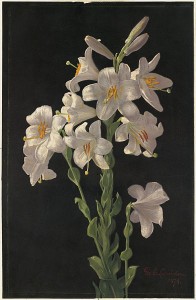
Easter Lily by Boston Public Library – George Cochran Lambdin 1830-1896 (artist); L. Prang & Co. (publisher)


Read More

Posted by on Mar 24, 2013

Experiencing and Celebrating God-With-Us Through Gifting

Singing Leaves Time and Palm Sunday


Palm Sunday Fronds

Palm Sunday– “Singing Leaves”

Faith is passed from generation to generation through simple gestures, songs, foods, and activities. As children live the activities of daily life in the cycles of the year, they notice more than we realize. Life, especially for the little ones, is heavily focused on the present moment, but they too become aware of the changing seasons in our church life and come to look forward to the next celebration.

I was reminded of this yesterday when a sweet four-year-old boy asked me if it were time for the “singing leaves” yet. It took me a moment to realize that he was referring to Palm Sunday. In our parish, as Catholics do in parishes around the world, we all gather in a courtyard outside the church on Palm Sunday. Each person has a palm frond and members of our parish youth group wave large palm branches, leading the congregation out of the church building to hear the story of Jesus’ triumphal entry into Jerusalem on that Sunday morning so long ago. Then, singing “The King of Glory Comes,” we all process back into the church for the Passion Sunday liturgy. (Palm Sunday and Passion Sunday occur on the same day.) This little boy remembered waving the palms last year and the singing as we re-entered the church. He was quite excited when I responded that this was the Sunday for the singing leaves.

As parents, grandparents, aunts, uncles, cousins, godparents, or simply friends, we share our faith best through the examples of our lives. Do we pause to thank God and ask a blessing before we eat? Do we greet the morning with a prayer? Do we remember to give thanks for our day and ask God’s blessing on our families, friends, and activities before we go to sleep at night? Do we gather regularly as a community of faith to celebrate Eucharist? Is Reconciliation (sacramental or simply interpersonal) a part of our lives? Do we pause in times of joy and times of sorrow to call the Lord into our midst? Do we time our holy day activities to match the liturgical timetable, not jumping to celebrate major feasts before their time but rather savoring the periods of anticipation and preparation for the feasts as well? Do we do these things with the children in our lives?

Children learn by observing and imitating. Only in later childhood and early adolescence do children begin to hunger for the meatier reasons for why we believe and do certain things. For a young child, “because that’s what we do now” can explain quite acceptably the timing of an activity. An older child will want to know that we do it “because that’s what Jesus told his friends to do before he died.” As adults, we too have opportunities to learn and grow more deeply in our faith and understanding of it — through both intellectual and spiritual practices. However, to reach our children, we do well to rely on activities, stories, songs, and celebrations.

As we move into this Holy Week and then on into Easter-tide, let’s remember to celebrate each in its own time. Holy Week is a good time to make and enjoy traditional Lenten dishes including Hot Cross Buns. It’s not time yet for Easter eggs or chocolate bunnies!

Mass on Holy Thursday can be a special time to celebrate caring for each other and the gifts of the Eucharist and the priesthood. Have a special meal, enjoy time together on this day, then join with your community to celebrate Eucharist and enter into the mystery of Jesus’ Passion — His great love for us.

Good Friday brings many opportunities to share faith with children. Little ones don’t need to know in great detail of the tortures inflicted on Jesus. They just need to know that Jesus loves them totally. So as we fast and reflect on the events of the day, let’s remember to be patient and peaceful. If the Solemn celebration for Good Friday is going to be too late or too “heavy” for the little children, then do something peaceful and loving at home with them. As they get older, take them with you to enter more deeply into the mystery.

Holy Saturday is a quiet day of preparation and anticipation. Coloring eggs, baking special breads or desserts, getting the house in order for the Easter celebration — all will become part of the faith tradition for our children. Happy memories or sad ones will remain with them based on the love they see through our bustle of activities and the times we stop for reflection or story-telling.

Easter Vigil brings the story of salvation history and its culmination in the Resurrection alive. Children from 3rd or 4th grade and older can appreciate this celebration, particularly if the passages from Scripture are proclaimed in an engaging fashion.

If we remember to celebrate each of these mysteries of Jesus’ Passion, Death, and  Resurrection during this week each year, our children will learn to treasure them as well. They may not always celebrate them as they move through adolescence and into adulthood. There may be times in their lives when they move away from the community and travel their own road to God, but the foundations will be there, always calling them to the Lord.

May this week, from the Singing Leaves to the Alleluias of Easter Vigil be a time of rich blessing for you and for your families and communities.


Read More

Posted by on Jan 9, 2013

Experiencing and Celebrating God-With-Us Through Gifting

Epiphany — The Coming of a Shepherd for All God’s People


The Adoration of the Magic by Murillo

The Adoration of the Magic by Murillo

The readings for the Feast of the Epiphany and the week that follows ring out with joy at the coming of the Lord, not just to the Jewish people, but to all the world. “Rise up in splendor, Jerusalem! Your light has come, the glory of the Lord shines upon you.” (Is 60:1) “… the Gentiles are coheirs, members of the same body, and co-partners in the promise in Christ Jesus through the gospel.” (Eph 3:6) “… behold, magi from the east arrived in Jerusalem, saying, ‘Where is the newborn king of the Jews? We saw his star at its rising and have come to do him homage.” (Mt 2:1-2) “All kings shall pay him homage, all nations shall serve him.” (Ps 72:11)

Yet amidst all of this joy and talk of kings and splendor, the reality of God’s kingdom quietly peeks out. Where has the child been born? Not in Jerusalem, the center of political and religious power. Those in Jerusalem — kings and priests alike — have not heard of the birth of a child to inherit the throne. The priests and teachers remember the prophecy of his birth: “And you, Bethlehem, land of Judah, are by no means the least among the rulers of Judah; since from you shall come a ruler, who is to shepherd my people Israel.” (Mt 2:6) Bethlehem, city of David, home of another child who grew up to replace an earthly king to whom he was not related, is once again to produce such a king! The news was not a source of joy to the rulers of the age; an attempt to thwart the prophecy was duly launched, leading to the massacre of all of the boys aged two and under in Bethlehem and the surrounding area. (Mt 2:16) The birth of a child to be the new king brings terrible suffering to many innocent children and their families.

The king of the prophecy will be different: he will be a shepherd for God’s people, Israel. A shepherd takes a different approach to governing and to leadership. The shepherd will govern with justice, protecting the afflicted ones and bringing peace “til the moon be no more” to the land. (Ps 72:7) The kings of the nations will pay homage to this king and all nations will serve him because this king rescues the poor who cry out for help. He takes pity on everyday people and the poor, rescuing them from all who would oppress or take advantage of them. Such a king would indeed be welcomed and his glory would truly shine forth. This king, blessed by God, will bring glory to Jerusalem — the center of the Lord’s presence among His people.

This great feast of Epiphany, the shining forth of the Lord’s splendor from Israel into the world at large, reminds us of our call as the People of God: a call to care for each other so that the splendor of love in all its practical applications will be a witness everywhere to the presence of the Shepherd, leading us in bringing justice and peace to our world.


Read More

Posted by on Dec 8, 2012

Experiencing and Celebrating God-With-Us Through Gifting

Does Immaculate Conception Mean Virgin Birth?


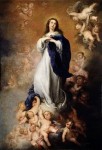
The Immaculate Conception – Murillo

Does Immaculate Conception mean Virgin Birth?

No. These two concepts, Immaculate Conception and Virgin Birth, are frequently confused. Many assume they are one and the same, leading to the notion that Mary’s conception was the result of the same type of divine intervention as that of her son. In fact, the Church has never believed that Mary was conceived without marital relations occurring between her parents. Normal physical relations between a husband and wife are not seen as sinful. They are, in fact, seen as a source of divine grace, a sharing in God’s life of love, a sacramental experience.

What is the Immaculate Conception?

If Immaculate Conception has nothing to do with the notion that our sexual expression is evil, however necessary for the continuation of the species, nor is it some kind of impediment to holiness, then what does the concept mean? To understand the notion, we must start with an ancient story, one of two creation myths found in the Bible: the story of Adam and Eve in the Garden of Eden. This second story of creation begins in the second chapter of the book of Genesis, halfway through the fourth verse. It tells of the creation of a human and then of a garden in Eden in which he would live. The garden was located in the land bordered by four rivers: the Pishon, the Gihon, the Tigris, and the Euphrates. In this garden, there was a tree, the tree of the knowledge of good and evil, from which the man was forbidden to eat the fruit. Knowing the man would be lonesome alone in the garden, God created many animals and birds to accompany him. However, animals and birds were not suitable companions for a human on any long-term scale. So God created another human to be his partner; a human created from the man’s rib to signify equality with him. The man was named Adam (man), a play on words in Hebrew between “man” and “ground.” The new person was called woman because she was formed out of “her man.”

As the story continues, conflict enters. The woman, walking alone in the garden, encounters a serpent who cunningly entices her to taste the forbidden fruit. She gives some to her husband as well, and suddenly they recognize they are naked. They become afraid to see God and hide in the garden from their creator. A separation between God’s overflowing love in creation and the humans created to be part of that creation has occurred. According to the story, the man and woman must leave the garden and now make their way in the great world outside it. The woman was called Eve by her husband “because she became the mother of all the living.”

Enter Original Sin

From this story, told to explain the entry of sin into human experience, the notion of original sin eventually developed. According to this notion, not found in Judaism or Islam, all humans inherit a “fallen nature,” a nature that is not strong enough always to resist sinning (separating from God). We don’t inherit the guilt of Adam and Eve. God’s image is undiminished within us, always calling and helping us to choose life over death. Yet we all fail in the quest to live without sinning through our decisions to act or to fail to act in loving union with God.

How then could God’s Son be born of a human woman without inheriting that fallen nature? It was from this dilemma that the notion of the Immaculate Conception developed. Through the centuries, theologians wrestled with it, especially as the idea of original sin became more and more strongly developed. Originally Mary was seen as like all other humans, a normal woman who played an extraordinary role in salvation history through her total openness to God. By the Middle Ages, however, as we began to focus more on human sinfulness and less on the presence of God within each person, an idea developed that Mary was saved from original sin at the time of her conception to prepare a perfect “new Eve” from whom the long-promised savior would be born. This savior would be the first-born of God’s new creation, of God’s new people.

A Formal Dogma

It wasn’t until the middle of the 19th century that the Immaculate Conception became a formal dogma of the Roman Catholic Church. This feast is celebrated nine months before we celebrate the Nativity of Mary (September 8). The readings for the liturgy celebrating the Immaculate Conception include the story of the encounter between God, the serpent, and Adam and Eve in the Garden of Eden (Gen 3:9-15), Paul’s letter to the Ephesians describing God’s choice to adopt all of us through Jesus (Eph 1:3-6, 11-12), and the story of the visit of the Angel Gabriel  to Mary in which Mary gives her consent to become Jesus’ mother (Lk 1:26-38). Perhaps the confusion between the Immaculate Conception and the Virgin Birth stems from this traditional selection of readings. They are connected only to the extent that God’s grace is needed by all humans to help them make loving choices and help bring the new creation to birth right here, right now!

Read More

Posted by on Aug 15, 2012

Experiencing and Celebrating God-With-Us Through Gifting

Feast of the Assumption – God’s Gift through a Special Woman

Assumption of the Virgin

The Feast of the Assumption is celebrated on August 15. This feast has ancient roots and is celebrated throughout the Christian community. Some speak of the Assumption of Mary, others of the Dormition (going to sleep), the Commemoration, or the Passing of Mary.

In the Roman Church, today’s readings begin with the vision from the Book of Revelation (11:19a; 12:1-6a, 10ab) of the woman clothed in the sun with the moon beneath her feet and a crown of stars on her head who appears in the sky. She is in labor and threatened by a great dragon. The woman gives birth to a boy who is caught up to Heaven to rule the nations, while the woman finds refuge in a safe place in the desert.

The second reading is from the first Letter of St. Paul to the Corinthians. Paul (15:20-27) speaks of Jesus as “the firstfruits of those who have fallen asleep” and notes that the last enemy of God to be conquered by Christ is death itself.

Finally, Luke’s (1:39-56) account of Mary’s visit to Elizabeth treats us to Mary’s hymn to the great love of God, the Magnificat. “My soul proclaims the greatness of the Lord… He has cast down the mighty from their thrones, and has lifted up the lowly. He has filled the hungry with good things, and the rich he has sent away empty…”

Through Mary, God came “to the help of his servant Israel,” remembering his promise of mercy, “the promise he made to … Abraham and his children forever.” Today we honor her for her faithful response to God’s call and pray that we too (descendants in faith of Abraham) may be faithful in our response. Please join me in praying:

Like the woman in the reading from the Book of Revelation, women around the world today and their children face many dangers. May we, like the angels who protected her and her child from the dragon, act to protect women and children from the dragons that threaten them today, including violence, hunger, lack of education, and poor access to health care.

Through the “yes” of a young woman, Jesus came into our world, becoming the one through whom death would be overcome. May we too answer “yes” when God asks us to participate in the works of the Kingdom.

Like Mary, may we receive the courage to believe that God is really in charge when it seems that the desires of the powerful will once again outweigh the needs of the poor and vulnerable — and act accordingly.

As we evaluate the many possible paths into the future that we as a nation may choose, may we listen carefully to the voice of God within our hearts, rejecting fear-based choices and instead choosing to work for the good of all.

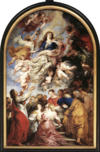
Painting by Peter Paul Rubens, currently in the Cathedral of Our Lady (Antwerp) – Public Domain


Read More