The Raising of Lazarus
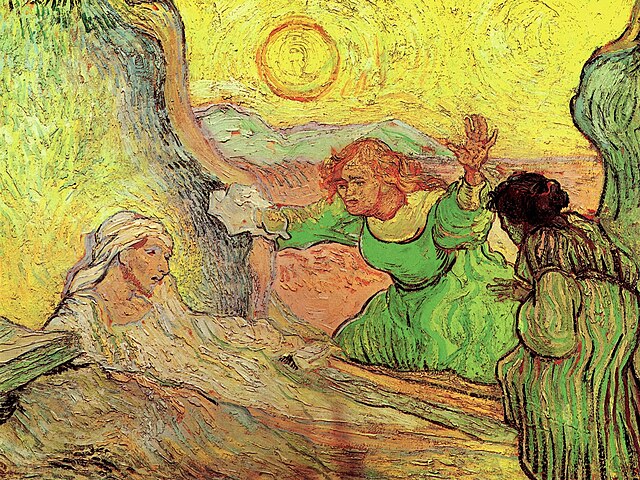 Jesus had close friends beyond his inner circle of the apostles. Martha, Mary, and Lazarus were friends who lived in Bethany not far from Jerusalem.
We know of an earlier time when Jesus had come to visit, and Mary was intently paying attention to Jesus while Martha was trying to get things ready for dinner and needed her sister’s help. I think that we can all relate to having company over for dinner and having family members duck out, leaving you with the whole project. Most of us can remember times when we were young and a brother or sister ran out to play instead of helping with the dishes.
At the time of Jesus, and even today, women are supposed to take care of the men and to be seen but not heard, as if they were children. This continues to be the pattern in the Middle East and most parts of the world. Even in the United States, women are often told to be submissive to their husbands, referring to St. Paul’s letters to the Ephesians (5:22-24) and to the Colossians (3:18). These passages also tell us that men should willing die for their wives. However, this has never been popular with men. As men, we usually ignore it. St. Paul’s message is that husbands and wives are equal in status. They should be submissive to each other and show mutual respect.
So, here is Mary who wants to be with Jesus, and she is breaking two rules. She is not helping her sister, and she is sitting at the foot of the Master with the men. When Martha complains, Jesus does not tell Mary to be a good “little lady” and return to the kitchen. He tells Martha that Mary is doing the better thing. He is implying that breaking these social norms and living on the teachings of the Master are greater nourishment than the food that is being prepared.
Martha, Mary, and Lazarus were his friends and he loved them deeply. It isn’t particularly obvious how deeply until Lazarus dies. Jesus knows that his friend is sick. He knows that the time is limited. His disciple Thomas, whom we know as the doubting Thomas, is as rational and practical as ever. Giving voice to what everyone is thinking, he says that it is suicidal to leave Galilee and return to Judea. All too recently, they had to flee when their lives were threatened. But if the Master is going to go back to Judea, particularly to Bethany, which is so close to Jerusalem, Thomas shows his loyalty and says that they should all go with him to die.
We see the pictures, the statues, and the stained-glass windows and we forget that Jesus and his friends were real people. Yes, he was their teacher, their Rabbi, but he was not lecturing to students in a class called Salvation 101. They were his followers, but he was willing to die for them and for us. They all said that they would die for him, but they disappeared when he was arrested. They did give their lives later, but not when he was the one arrested.
We worship a God who is not a distant powerful entity. We enjoy a special and deep friendship. We are in Christ and Christ is in us. This incredible friendship is something we celebrate when we enter a complete communion, when we receive the Holy Eucharist.
Lazarus is dying but Jesus does not get on the next plane. He doesn’t get in his truck and drive through the night. He waits for two days and tells his disciples that the glory of God will be revealed so that others might come to believe and to see Jesus for who he is. He says something about being able to walk in the day and to stumble at night. The light of God’s glory will banish the night and show the way to salvation. But what does that mean in practice?
Still, Jesus is upset. He is grieving. If he knows that he will raise Lazarus, why is he upset? He knows his friend is dead and that fact swallows him just as it swallows us and throws us into sadness and tears. He says that this is all for a purpose. That there is a reason. He trusts in His Father and knows that His Father will give him anything that he asks for. But his walk into the danger of Judea is not a happy one.
Martha comes out to meet him and does not criticize him. She utters a deep act of faith. “Lord, if you had been here, he would not have died.” When Jesus says that Lazarus will rise again, Martha agrees, saying that Lazarus will be raised on the last day. But that is not today!
Jesus said to her, “I am the resurrection and the life. The one who believes in me will live, even though they die; and whoever lives by believing in me will never die. Do you believe this?”
“Yes, Lord,” she replied, “I believe that you are the Messiah, the Son of God, who is to come into the world.”
Now we would think that the mood should change. Yet despite Martha’s profession of faith, they stand there in their grief. Mary comes out to join them. She repeats her sister’s lament. “If you had been here my brother would not have died.” Everyone is in tears and Jesus asks Mary
“Where have you laid him?” As he follows her and the mourners, he is overcome with grief and he cries. It is so obvious that people remark, “See how he loved him.”
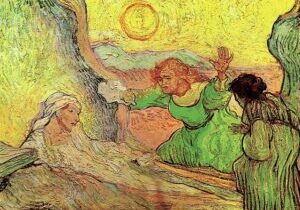
Jesus’s friend had died. When they get to the tomb, he wants them to roll the stone away, but Martha objects, seeing it as the act of a grieving friend. She warns him that the body has already started to decompose after four days. But on his command, they roll the stone away and Jesus at the top of his voice tells his friend to come out.
And the glory of God is revealed. Jesus is the way the truth and the life. But the glory of God is revealed in the suffering and grief of friends. Tears run down the face of the Master as they approach the tomb. It is not a confident triumphant procession to the tomb.
Jesus suffers with us in our deep losses – losses of our parents, our spouses, or the unbelievable pain of losing a child. As we get old, the news comes more often. A friend, a relative, a co-worker has died. We go to more funerals than weddings and anniversaries.
Jesus does not stand aloof at a safe distance. We are his friends and he weeps for us and with us in a deep communion. We do not walk this road alone. We have our close friend and companion even in the worst of times right there beside us. (Jn 11:1-45)
Jesus said to her, “I am the resurrection and the life. The one who believes in me will live, even though they die; and whoever lives by believing in me will never die. Do you believe this?”
“Yes, Lord,” she replied, “I believe that you are the Messiah, the Son of God, who is to come into the world.”
Do we believe?
Readings for the Fifth Sunday of Lent – Cycle A
Read More