Pages Menu
RssFacebook
Categories Menu

Posted by on Jul 27, 2025

Be Bold and Persistent

Be Bold and Persistent

“Ama, you sit here and I’m going to sit in this chair. Now you can read to me.” Thus says the two-and-a-half-year-old grandchild as she brings a story to be read to her. She has no hesitation about telling an older person what to do and when or how to do it. She is still so very innocent that she boldly expresses what she would like to have happen and trusts the rest of the family will comply. Of course, it doesn’t always work out that things go her way, but she’s confident that most of the time it will, especially on visits with grandparents.

As we get older, we learn the world doesn’t revolve around us. We learn that people in power don’t always listen to those with lower status or power. We learn to be cautious in our expectations and not to aim too high.

Yet is this the way to approach our relationship with God? Maybe not.

Abraham’s visitors went on their way after having a fine meal at the camp of Abraham and Sarah at the terebinth of Mamre. But one stayed behind to speak further with Abraham. It seems he, the Lord, was going to the cities of Sodom and Gomorrah to see if the people there were indeed as wicked as he had heard they were. If that turned out to be the case, he planned to destroy the cities and all within them.

Now Abraham found this quite disturbing. He had family members living in Sodom and didn’t want to see any harm come to them. So, he began to appeal to the softer side of the Lord. What if there are fifty good people in the city. Would you kill the innocent with the guilty? Well, when put that way, the Lord agreed it would not be fair to the fifty, so he agreed to spare the city if fifty good people were found.

So far, so good. But Abraham didn’t stop there. He boldly asked, What about if there are only forty-five? The Lord agreed that forty-five would be enough to hold off destroying the city. The bargaining continued until they finally agreed that if there were as many (or as few) as ten good people, the Lord would not destroy the city.

Abraham was polite, respectful, and yet bold in his advocacy for the people of Sodom and Gomorrah. The Lord responded with kind respect as well, willing to listen to a plea for mercy. A very different response than can be expected from most rulers. Abraham was bold and persistent. He started with a large number and continued bargaining, requesting mercy for a population with fewer and fewer examples of good behavior and good will. When he stopped, it was probably because he assumed at least his own extended family would make up enough good people to save the cities. (Gen 18:20-32)

The question of how to be an advocate with the Lord has continued through the centuries.

Jesus was asked one day by his disciples to teach them how to pray. He responded with what we often call “The Lord’s Prayer,” a.k.a. “The Our Father.” We begin, speaking to God as a loving father, with the hope that his power and authority will be recognized and respected by all. We hope for the coming of the Kingdom and that the Lord’s will should be done everywhere. Then come the practical things – daily bread, forgiveness for our offenses, protection from temptation, and deliverance from evil. One hitch is that forgiveness is requested to the degree that we ourselves forgive others. That’s not always easy. But all in all, it’s a strong prayer that rests on the loving, intimate family relationship of parent and child. “Daddy, you sit here while you read me a story.”

Jesus didn’t stop with just how to pray. He went on to encourage great confidence in prayer. “Ask and you shall receive, seek and you shall find, knock and the door will be opened.” Keep knocking even if you get a negative result the first time. The neighbor who won’t get up and wake his whole family to get you an extra loaf of bread for a guest the first time you ask will do so if you keep asking again and again in the night. Be persistent. Be bold. (Lk 11:1-13)

Now, do we always get what we ask for in prayer? No. So what about that promise of ask and you shall receive? Maybe it’s a question of what is requested and for whom?

Abraham asked on behalf of the innocent people in Sodom and Gomorrah. For the innocent ones, the Lord was willing to change plans.

When we ask for things that only benefit ourselves, there’s no guarantee the request will be granted. But if we ask on behalf of another person, and what we ask is genuinely what will be best for that person, our request is more likely to be granted. Sometimes, when we ask, it begins the process of consideration of what would be a good thing to see happen. Might we do something ourselves that would help? We are the Body of Christ now in our time. How can we do the Lord’s work and bring about needed change or help for those in need?

Sometimes it takes a long time for change to happen. Sometimes suffering continues far too long, because the forces causing the pain are strong and don’t easily surrender. It’s then that persistence is essential. It may take many years, but with enough people working for reform or change, the new way comes into being. Doors open. Opportunities appear. And lives are changed.

As we move through the days and weeks to come, may we remember to pray constantly, seeking ways to bring the Kingdom and the freedom of loving response to the challenges of our time into our everyday lives. How do we help the poor? How do we support immigrants? How do we keep healthcare accessible for those whose employers don’t offer it? How do we provide books and opportunities for children in school to learn? How do we feed children so they can learn when they get to school?

So many, many challenges face us all at this time. Yet the Lord assures us, “Ask and you will receive.”

So, let us ask boldly and act with courage to open the doors of our hearts, minds, and homes to live in the Kingdom of God, the Kingdom of Love for all, regardless of social or legal status. All are God’s children. All are our sisters and brothers. All…

Be bold and be persistent.

Readings for the Seventeenth Sunday in Ordinary Time – Cycle C


Read More

Posted by on Jul 18, 2025

The Day the Lord Came to Dinner

The Day the Lord Came to Dinner

Imagine for a moment that you got a letter, special delivery, saying the King of England was coming to dine at your home tomorrow evening. Once you got over the shock, how would you prepare? You’re an ordinary person, with no servants or staff to make things happen. Your home is well lived-in, not always perfectly tidy, but comfortable.

What are the most important things or rooms to have clean? What will you serve for dinner? Which dishes should you use? Why would the King ever think to come to your house? So very, very much to do in such a short time… How can it be possible to get everything ready on time?

In a great whirl of activity, the house is cleaned, the meal prepared, best clothes are worn, and at the appointed time, the King arrives. It proves to be a memorable dinner, because, surprise, he can be just a regular guy when he’s not acting as King!

Now most of us will never have this challenge land on our doorstep. Kings  don’t often drop in for dinner and I would guess most of us have never received a letter from the King of any country. Still … there are times when hospitality is the most important thing we can offer.

One very ordinary day, Abraham and his wife Sarah were camping by the terebinth of Mamre. A terebinth is a shrub from the cashew family that grows to be the size of a tree and also produces turpentine. They traveled with their sheep from one part of the land to another. But this particular day was noteworthy.

It was around the middle of the day and getting hot. Abraham came out of the tent, perhaps to cool off in the shade of the tree. He noticed three men approaching as he left the entrance of the tent. Visitors were not common in those days and places, so he ran out to greet them and invite them to stop for a meal and a rest in their journey. He was delighted when they agreed to do so. It would be a chance to catch up on the news from far away.

He quickly went into the tent and asked Sarah to make rolls for the meal, using plenty of fine flour. He chose a choice steer and ordered a servant to prepare it to be eaten. Then he took curds and milk, along with the meat of the steer and the rolls and served the three visitors a fine meal. He stood beside them as they ate, ready to provide for anything more they might request.

After they finished eating, they asked Abraham where his wife might be. He responded that she was in the tent. A modest woman would not go out to meet strangers in those days. One of the visitors told Abraham that in a year when he, the visitor, returned, Sarah would have a son.

Now Abraham and Sarah were both old and they had never had children, so this sounded pretty far-fetched. In fact, Sarah laughed out loud at the preposterous thought! But as it turned out, she did have a son the next year and his name meant, “I laughed.” (Gen 18:1-10a)

It wasn’t the King of England who visited Abraham and Sarah. It was the Lord who came without warning and happily accepted the hospitality of a man and his wife. The blessing of their gift of hospitality by the Lord opened the door for all the blessings that would follow through the centuries, from the time of Abraham to the present.

Jesus too stopped in for dinner unannounced on occasion. One day he visited the home of his friends Martha, Mary, and Lazarus. His visit was unexpected and there was much hustle and bustle in the house and kitchen to get dinner ready. The men were not expected to help fix dinner. Their role was to visit with and entertain the guests. The women were to get the food ready and serve it.

But this day, Mary couldn’t resist the urge to sit with those around Jesus and listen to him talk. He was always such an interesting person. Martha, on the other hand, was very aware that an important part of the team was missing from the kitchen. What was Mary thinking! She needed to be in the kitchen helping. No excuses.

When Martha went to Jesus to demand that he send Mary to help in the kitchen where she belonged, she got a surprise. Jesus responded, “Martha, Martha, you are anxious and worried about many things. There is need of only one thing. Mary has chosen the better part and it will not be taken from her.” (Lk 10:38-42)

Wow. That would be hard to hear, I imagine. How can it be that not doing what is needed to provide for a guest is better? Yet there’s an important lesson for all of us here. Sometimes we can’t and don’t need to make sure everything is organized and ready on time or in the usual way. Sometimes we simply need to stop and listen and learn what is really important for that moment. The gift of the present moment can’t be replaced. Somehow, folks will find food to eat. They may need to work together in unfamiliar ways, but generally no one starves for want of getting into the kitchen and preparing the food that’s there! In the meanwhile, there are treasures of wisdom that will be missed if the focus is too strictly on what is expected of each person at any given time.

The Lord came to dinner that day. They didn’t know he was the Lord. He was their friend, Jesus of Nazareth, who happened to be a traveling preacher and healer. Maybe even a prophet. His words to Martha that day were really a reminder that there’s a time to take off the apron of management of the kitchen and hosting the meal and instead sit to be present with the guests, honoring the gift of their presence.

Years later, in his teaching, St. Paul explained to the Colossians that all the hardships and suffering he had experienced through his many years of travel and teaching were worthwhile. They made it possible for him to share the great wonder of the incarnation. Christ is present now in each person in the community, following the death and resurrection of Jesus. Each person may bring the presence of the Lord into every encounter with another. As we live as a community, or as a family, or as individuals with friends, we bring the presence of the Lord to our encounters. When we gather at the table at home, the Lord is present with us. When we gather at the table of Eucharist, the Lord is present with us. (Col 1:24-28)

We don’t need to receive a letter announcing the coming of a special guest. Each person we encounter, each person with whom we share our lives, brings the possibility of meeting the Lord in a new way. The big challenge we face is to remember to stop and listen, to hear the deeper message of love. Not always easy. Often we miss the boat. But always an important goal.

This week, may we remember to take time to welcome each person who joins us at table. Even the family with whom we eat every day! There’s always something that can be learned or shared if we take time to listen and ask questions. And when we meet others outside the family, may we be open to hear the Lord’s voice from them as well.

Peace and joy be yours as the Lord joins you for dinner.

Readings for the Sixteenth Sunday in Ordinary Time – Cycle C


Read More

Posted by on Jul 13, 2025

Hidden in your Hearts

Hidden in your Hearts

Children’s songs are passed down from generation to generation, sometimes with slightly different words, but with essentially the same tune and ideas. One such song is “Goin’ on a Lion Hunt.” I learned it as a Brownie Scout and we sang it through the years around campfires or in troop gatherings. It was always fun to act out the words as in the song we came up to a tree and had to “go around it” or a creek or a field and had to “go through it.” Of course, when we finally found the lion, we were far from prepared for the sight and had to repeat all of the motions in reverse as fast as we could until we arrived safely at home!

Quest stories are a feature of most cultures. A person is presented with a challenge and must go forth, away from all that is familiar, in search of the answer to the question, or a treatment for an illness or enchantment, or their true calling in life. Sometimes the quest includes other persons of about the same age. Sometimes, the hero must go alone, seeking advice from those met along the way, including spirits and animal friends. Trials abound, traps for the unwary, surprise sources of inspiration, and eventually, the goal of attaining the wisdom or prize of the quest.

Many of my favorite stories have been those of quests, especially those that include young people and some historical or mythological characters as well. It’s fun to learn about other cultures or historical events through the eyes of observers who are witnesses or participants in them.

Sometimes we think a quest must also be necessary to figure out God’s will for us. What are we to do? What does God want of us? Where will we find the answers? Surely something important enough to please a divine being must be big and elusive!

Yet shortly before his death, Moses spoke to the Israelites, descendants of those who had been enslaved in Egypt and freed through Passover. “If only you would heed the voice of the Lord, your God, and keep his commandments and statutes that are written in this book of the law…” It sounds like these commandments must be something difficult to find. But no, the command “is not too mysterious and remote for you.” It’s not up in the sky or across the river. It’s not like going Lion hunting – through many dangers and challenges.

“It is something very near to you, already in your mouths and in your hearts; you have only to carry it out.” (Deut 30:10-14)

Already in our hearts? How can that be? What are the commands that can be in our hearts?

The Law states very clearly what is expected. “You shall love the Lord, your God, with all your heart, with all your being, with all your strength, and with all your mind, and your neighbor as yourself.”

OK, but what does that mean in terms of actions? A scholar of the law asked Jesus that exact question one day. “Who is my neighbor?”

Jesus didn’t send him on a quest to find the answer to the question, though in a novel he might have done so. Instead, he told the man a story.

“A man fell victim to robbers…” The poor man was stripped of his clothing, beaten, and left half dead by the side of the road. We’ve heard the story many times. A priest saw him and moved to walk on the other side of the road. A Levite, a person who could assist with sacrifices in the Temple, also crossed the road to avoid contact with the injured man. Only a man from a stigmatized group, a Samaritan, stopped to help the injured man.

The Samaritan was “moved by compassion” and stopped to offer first aid and care. He took the man to an inn, carrying him on his own animal. He had to continue on his journey the next day, but he paid the innkeeper to continue to care for the wounded man, promising to pay any additional cost of the care when he returned.

Jesus asked the scholar, “Which of these three, in your opinion, was neighbor to the robbers’ victim?” When the scholar answered, “The one who treated him with mercy,” Jesus confirmed his observation. “Go and do likewise,” he said. (Lk 10:25-37)

Compassion, mercy, kindness, forgiveness, gentleness. All are signs of obedience to the commands of the Law. They are shared among all people.

Jesus, “the image of the invisible God, the firstborn of all creation” through whom all was created, who holds all things together, tells the young man, “Go and do likewise.”

Each of us is included in that command. “Go and do likewise.”

We are born into a family, a culture, a nation, and we learn the ways of those who raise us. Some of those ways may not exactly be loving or welcoming of differences among peoples. Some may be hostile to ways of being that are not acceptable to “our people.” Some are fearful of outside influences and seek to remain “pure” in beliefs and actions. Some are afraid of change.

In a way, we each have a quest on which we embark as we grow up. We learn the ways and expectations of our families and peers with our mothers’ milk, and we take them as absolute truth when we are very small. As we grow, we learn of other peoples and other ways. We seek to find the right way to live as human beings.

In our quest, Moses told the people, we are not to think it necessary to go up to the sky to find the Lord’s command, nor are we to think we must cross the sea to find it. It is already near to us, “already in your mouths and in your hearts.”

Jesus too tells us that the place to look is within our hearts – to look for mercy and kindness and compassion that reaches out to those in need, those who are not from our own group, those who may be from other countries or ways of living. We each have gifts from the Father that are to be used for others. Part of our quest is to identify those gifts. One way to do it is by serving others. Opportunities open up, walls fall down as we approach, a smile opens the door to a heart.

Jesus is “the head of the body, the church … in him all the fullness was pleased to dwell, and through him to reconcile all things…” (Col 1:15-20)

Following his instructions, may we too go out this week and serve our fellow travelers on the way with gentle, compassionate, acceptance and understanding. We’ll meet some amazing people and have some wonderful adventures along the way.

Readings for the Fifteenth Sunday in Ordinary Time – Cycle C


Read More

Posted by on Jul 6, 2025

Two by Two and Away We Go

Two by Two and Away We Go

There’s an old song that includes a phrase I couldn’t find on the internet, but which I remember clearly. The phrase is from a little ditty and it goes, “Hey Dearie Dee and away we go, heigh ho, heigh ho, heigh ho.” It’s similar to songs from “Pinocchio” and “Snow White,” but the song I learned as a child had a different tune to go with these words.

This little song came to mind as I was thinking about the Gospel reading. Jesus sent seventy-two of his disciples out, two by two, to tell of the coming of the Kingdom, as well as to heal the sick. The disciples went out without any provisions, trusting in the goodwill of the people of the communities they would visit for meals and places to sleep. They came back amazed at the fact that they were able to heal the sick and even to “cast out demons.” Jesus was not surprised at this, encouraging them to continue to trust they would be protected from dangerous creatures such as scorpions and snakes.

Interestingly, the phrase regarding snakes in the Gospel is in quotation marks – the power to “tread upon serpents.” In the Book of Genesis, it’s the serpent in the Garden who tricks Eve into disobeying God by eating the fruit of the Tree of the Knowledge of Good and Evil. In this, Jesus is saying that spirits which oppose the Kingdom can be defeated as well. However, and more importantly, he reminds them and us, “do not rejoice because the spirits are subject to you, but rejoice because your names are written in heaven.” (Lk 10:1-12, 17-20) 

In some ways, the buddy system we see in youth organizations such as Scouting is similar – designed to protect participants, aid in learning new skills, and offer built-in companionship for activities. When things are going well, a buddy shares the joy. When things are hard, a buddy is there to share the difficulties and offer encouragement to keep going. Buddies also help each other figure out why things aren’t going as expected and what alternatives might work better.

Jesus and the early Christians used the buddy system too. Jesus traveled with a group of disciples. Paul and the other apostles traveled with companions on their journeys. The people they met formed communities, sharing what they had and working out differences of opinion. Early Christians tussled over the importance or need for circumcision. They tried to understand the meaning of the crucifixion. They suffered violent opposition from the authorities or influential people in the cities and towns they visited.

Yet through it all, they worked together to understand and share a completely new insight. Through the cross of Jesus and through baptism into this mystery, something new emerges. People become more than they were before the experience. They are a new creation, a new people, not divided by historical family ties into Jews and Gentiles, but one that is the new people of God.

Paul speaks of bearing the marks of Jesus on his body. Many times he suffered physically for his testimony to unwilling audiences, including at least one occasion when he was stoned and left for dead. Yet each time he continued forward, shaking the dust of the unwelcoming community from his feet and traveling on to the next town. (Gal 6:14-18)

Through the witness of the first Christians, a new community was born. This new community was a direct descendant of those who returned from exile in Babylon and rebuilt the city of Jerusalem and the temple of God on the holy mountain where it had been historically. The city is still in the same place today and the holy mountain continues to be a holy place for Jews, Christians, and Muslims.

Isaiah presents the Lord speaking of Jerusalem as a mother who nurses her child, calling on all to rejoice at her restoration. “Be glad because of her, all you who love her; exult, exult with her, all you who were mourning over her! … As nurslings, you shall be carried in her arms, and fondled in her lap … in Jerusalem you shall find your comfort.” Jerusalem will prosper again, says the Lord, and the people will rejoice and flourish as the power of the LORD becomes clear to those who serve him. (Is 66:10-14c)

Once again, we are not hearing about a solitary person. An entire people are included in this call to rejoice. The city was rebuilt and, like many cities through the course of history, it was conquered multiple times afterwards. Foreign rulers came and went. The city was destroyed more than once. But it’s always been rebuilt. And those who rebuild it rejoice in its rebirth.

Through the life and ministry of Jesus and the apostles, as well as all their successors through the ages, we too rejoice in the Lord’s presence and working in the world.

We too are called to go out into our own worlds of home, families, friends, work, community, and the wider world to share the Good News of God’s love and the coming of the Kingdom of God. Two by two symbolically, we encourage each other. Sometimes the interaction will be more solitary, but always we know we are part of a larger community and we share our experiences with each other. The message is not always welcome. It can be difficult to explain why we behave as we do, why we refrain from certain activities because they would harm or demean others, why we share what we have even if we don’t have as much as others might have. But with the support of our families and communities, we move forward in faith.

As we move through this next week, with all the potential changes and uncertainty it will bring, may we remember that we are not alone. We are a community, a group of people who have met the Lord as we reach out in service to those most vulnerable among us. We have met the Lord in our worship, in our sacraments, in our own quiet prayer times. We have met the Lord in the beauty of creation, the wonder of a sunrise or sunset, the roar of the sea, the power of a wind or thunderstorm. We have met the Lord in the help we ourselves have received in the hard times – brought for us by our buddies in the journey.

May our eyes and ears be open to see and hear – “Two by two and away we go, heigh ho, heigh ho, heigh ho!”

Readings for the Fourteenth Sunday in Ordinary Time – Cycle C


Read More

Posted by on Jun 29, 2025

Peter and Paul – Unlikely Heroes

Peter and Paul – Unlikely Heroes

Peter and Paul – One a Galilean fisherman, the other a Pharisee, scholar of the Law, immigrant from the city of Tarsus in the province of Cilicia in Asia Minor, and Roman citizen. The first’s original name was Simon and the other’s was Saul.

The chances they would ever meet, let alone become co-workers, sharing the news of the coming of the Christ to all they met and serving as leaders in the community of disciples of Jesus were miniscule. Both would eventually meet their death in Rome in 64 CE – capital city of the Empire. According to tradition, Peter was crucified, upside down per his request. Paul, as a Roman citizen, was beheaded – crucifixion was reserved for non-citizens!

A simple fisherman

Simon/Peter first met Jesus in the fishing town of Capernaum. Jesus saw him, mending and drying nets with his brothers after a long fruitless night of fishing. They had not caught anything. St Luke tells us that Jesus got into the boat to teach the people gathered on the shore. After a while he told Simon and the others to take the boat out again and toss out their nets for a catch. What nonsense! Fish didn’t bite or get caught during the day.

But something about Jesus was different, compelling even, and so they set out again. Imagine their amazement when the nets filled to overflowing with fish! They had to call the other boat with whom they usually worked to come help. Both boats were filled to the brim and more. Simon dropped to his knees and begged Jesus to leave him, a sinner not worthy of such a miracle. Jesus’ response was totally unexpected. “Do not be afraid, from now on you will be catching men.” They took their boat to the shore, left everything – boat, nets, fish, even families – to follow this man. And, oh, the wonders they would see.

Through the next three years they witnessed healings of all kinds, children and adults raised to life again, storms on the Sea of Galilee calmed at a word, thousands of people fed with just a few fish and loaves of bread, a triumphal entry into Jerusalem, and so much more. All the while, Jesus was teaching them about the Father and the Kingdom of God.

So many people came to hear Jesus and follow, but Simon held a special place among the twelve who were his closest friends. More than just followers, disciples, they were his friends. Clueless friends sometimes, but Jesus was patient with them and kept teaching about the Kingdom.

They traveled through the Galilee, Samaria, and Judea. Many times Jesus had to correct their expectations of who the Messiah would be and what their role would be. After the times he had fed thousands of people who had come to listen to him with just a few fish and loaves of bread, he asked his disciples one day, “Who do people say that I am?” They replied that folks thought he might be Elijah the prophet returned to earth, or John the Baptist raised from the dead, or Jeremiah or some other prophet. Then Jesus asked a more personal question. “Who do you say that I am.” Simon replied, “You are the Christ, the Son of the Living God.” Pretty daring words, but Jesus didn’t deny it. He acknowledged what Simon had said, adding, “… You are Peter (Rock) and on this rock I will build my church.” (Mt 16:13-19)

No one understood what Jesus meant at the time. Peter continued to learn without clearly seeing what was coming, even denying he knew Jesus in the garden of the high priest during the trial. He didn’t believe when Mary of Magdala brought word of the resurrection and he and the others hid in fear of the authorities before the coming of the Holy Spirit at Pentecost. Yet Peter became and remained the leader of the community. He and the other apostles, none of them trained in theology or leadership, learned how to lead a community and proclaim boldly what they had seen and heard. They preached, they healed the sick and lame, they witnessed to the religious leaders about what they had seen and come to believe, and rejoiced when as a result they were publicly whipped and otherwise shamed.

When Herod was persecuting the community, Peter was arrested. Herod planned to have a trial and execute him after the festival of Unleavened Bread. Sixteen soldiers were set to guard him, lest he escape. The community prayed fervently for his release, and God answered. The night before his trial, while sleeping chained to two soldiers – one on each side of him – an angel came and woke Peter. The chains that held him bound to the guards dropped away. The angel was quite practical, telling him to get his belt and pouch and to put on his cloak, then follow. He was led out of the prison, past the other guards and out the door and the iron gate, which rose silently and automatically as they approached. He found himself free on the streets of Jerusalem. He went to the house of John Mark, where all were amazed to see him, assumed he must be a ghost, and then gave thanks for his release. Afterwards, he wisely left the area to work in another community. (Acts 12:1-11)

A Pharisee and Student of the Law

Paul/Saul, on the other hand, was a tent-maker by trade. He never met Jesus before Jesus’ arrest, condemnation, death, and resurrection. In fact, he was so absolutely positive these people were liars and heretics – probably low-life scum out to take advantage of others and lead them astray – that he actively set about to arrest and convict them of crimes punishable by death.

When Stephen was arrested and charged with heresy, Saul was among those outraged by his words testifying to his faith. He watched over with approval the robes of those who stoned Stephen to death – the first to die as a martyr, a witness to the coming of the Kingdom.

Following Stephen’s death, Saul led a group from Jerusalem to Damascus to arrest the Christians there. On the road, he met Jesus and his life was turned upside down! Left blind by the vision of Jesus with whom he spoke, he went on to Damascus and there was visited by Ananias, who taught him of Jesus’ life and teaching. Saul, now known as Paul, became such a persuasive preacher that the community had to lower him in a basket outside the city walls in order for him to avoid death at the hands of Jewish authorities there!

Folks in Jerusalem were not ready to trust or welcome him. The leaders eventually accepted him, but his preaching was so compelling it attracted too much attention from the authorities. It was decided that it would be better for all if he just went home to Tarsus and went back to making tents.

Several years later, he was called back to Antioch and sent on the first of his missionary journeys to another part of western Asia Minor to preach the Gospel. He found a more willing audience among non-Jews, though he always began with the Jewish communities in his preaching.

His ministry to the Gentiles, combined with Peter’s experience in the house of Cornelius when the Spirit came upon the Romans there before they were baptized, led to the decision at the Council of Jerusalem, called to determine whether folks had to become Jews in order to be Christians. The decision, based on the experiences of Peter and Paul, was that it was not necessary and the Church set out on a new and broader path.

Eventually, both Peter and Paul ended up in Rome. Peter went there freely to work with new Christians in the city. Paul appealed to Rome for trial after having been arrested in Jerusalem. It was his right as a Roman citizen to be tried in Rome. Both died there.

Paul wrote of his life and hope for the future to his close friend and disciple, Timothy, as his death approached. His words have been an inspiration for centuries. (2 Tim 4:6-8, 17-18)

A new leader was chosen for the people of Rome after Peter’s death. To this day, the Bishop of Rome, as successor to Peter, is the leader of the Roman branch of the Catholic church community.

Heroes who changed the world

Two very unlikely heroes. One with little formal education. One with quite a lot of it. One from a conquered country. One a citizen of the conquering nation because he was born in a city of the empire. In art, one is portrayed carrying a set of keys and the other with a book and a sword. Peter and Paul.

Together, they became essential leaders of a community whose beliefs transformed the world in which they lived. Western civilization developed in a different way than it would have before they accepted the call they received to go out to the ends of the earth and teach everyone about the man they had met who turned out to be the Son of God, the Chosen One come to show humans how to live as children of God, heirs to a greater Kingdom.

None of us is likely to become as famous as they became. But each of us is also called to be part of that Kingdom they brought from a seemingly insignificant land out into the broader world. Each of us will influence others as well, for better or worse, in hearing about and choosing to become part of the Kingdom or not.

In that Kingdom they helped introduce to the rest of the world, the poor are helped to find food and shelter, welcome from the community and a chance to build a new life. Those who are sick receive care. Those who are from less honored communities are respected. Those whose lives are threatened by the strong are given refuge.

We are the ones called today. We follow Peter and Paul, and so many, many others after them as we live our lives in service to the Lord through our own families and communities, and even to the ends of the earth.

As the psalmist proclaims in song, “Taste and see how good the Lord is: blessed the one who takes refuge in him.” (Ps 34:2-3, 4-5, 6-7, 8-9)

Peter and Paul – unlikely heroes, who model a life of faith and witness for us all.

Readings for the Solemnity of Saints Peter and Paul, Apostles – Cycle C


Read More

Posted by on Mar 2, 2025

From the Fullness of the Heart

From the Fullness of the Heart

“Think before you speak!”  “You have two ears and one mouth.” “Listen carefully before speaking.” “Out of the mouths of babes …” “Stop, look, and listen.”

We have many expressions that describe the relationship between our thoughts and our words, between what we perceive and the objective reality of what is happening around us. When we blurt out our first response to something unexpected, we often discover that our reaction does not take into account the total reality of the situation. There can be many factors we haven’t noticed that played a part in the way the situation developed and reached its climax.

Wisdom lies in quieting the inner and outer tongues that speak our thoughts, often before we have time to consider them carefully. “Think first, then speak,” is advice well suited to the complexity of our personal and public lives.

Around 200 years before the birth of Jesus, a man named Jesus, ben Eleazar, ben Sirach collected wisdom sayings from his community. Wisdom tales are told around the world, passing on to younger members of the family or village the traditions and common-sense approaches to the challenges of life we have come to understand. We still tell these stories ourselves, because they offer practical examples for dealing with complex realities. For example, “a watched pot never boils” reminds us to be patient as things work their way to a conclusion for which we have every reason to hope. Ben Sirach’s words are remembered today, though their fullest meanings are not always clear to us.

The first verse we hear today speaks of a sieve being shaken, which results in the appearance of husks. This is paired with a reminder that our faults too appear when we speak. What do our words have to do with grain and husks? Not something most of us would suggest, but something obvious in his times. There were no “combines” in those days, the big harvesters which could cut the grain, thresh it, and separate the grains from the chaff as they moved through the fields. In those days, oxen walked across the cut grain, breaking up the heads of wheat or other crops after they had been cut and placed together for threshing. The grain would fall out on the threshing floor. Later, everything on the floor would be scooped up and run through a sieve to separate out the grain from the chaff and excrement of the animals used for threshing the crop. When the time came to complete the harvest, the grain, chaff, and anything else on the threshing floor would be tossed into the air using a sieve. This allowed the smaller grains to pass through and keep the waste from contaminating the harvest.  In many places even today, grain is threshed and prepared for use in this same basic way. Ben Sirach reminds us that “… one’s faults (appear) when one speaks.”

Ben Sirach notes that trees bear fruit when they receive the proper care and offers an important piece of advice for us today too. “Praise no one before he speaks, for it is then that people are tested.”  In other words, “don’t judge a book by its cover.” (Sir 27:4-7)

Jesus offers similar advice as he finishes the Sermon on the Plain. He points out that when “the blind are leading the blind,” both can land in a pit. Through a series of examples, he cautions against judging others, lest we fail to notice our own weakness and sinfulness as we point out that of others. Those who are good will bear good fruit. Their goodness will become apparent through their choices and their actions. “A good person out of the store of goodness in his heart produces good…” When the heart is filled with negative emotions, a different scenario emerges and we see evil spreading. Words matter and reflect the beauty or ugliness of the heart when they are spoken. “… From the fullness of the heart, the mouth speaks.” (Lk 6:39-45)

As we move through life, we find times that are discouraging and hard to get through. Sometimes it seems that evil will triumph. We may feel like everything we try will end in failure. “Life is hard and then you die,” goes the saying today. People in ancient times experienced the same thing. St. Paul explains that a time will come in which the pattern of death and failure will end. “Death is swallowed up in victory. Where, O death, is your victory! Where … is your sting?” We have gained the upper hand, the victory, through Jesus. Our response of loving service will not be in vain. (1 Cor 15:54-58)

We are living through a time of great turmoil today. Wars are raging. Leaders of countries are meeting, but not always peacefully or respectfully. The fate of nations is hanging in a balance that is not at all certain to end well for anyone. In our personal lives, we are called to make choices and offer a hand or an ear to others we meet.

As we move forward, holding on with all our might to hope in the Lord’s help in the great work of protecting the vulnerable, caring for the young, the very  old, and those who can’t care for themselves, seeking justice for those who face persecution or discrimination, safeguarding the vision of hope and liberty for all which we received from our parents and grandparents, may we remember the wisdom from of old. Wait and hear that what people say or do is wise and just before following their lead or obeying their commands. Be sensitive to our own faults before condemning others. In what ways do we try to correct in others the faults of which we ourselves are more guilty?

May our words be kind and merciful, flowing from a heart that has known forgiveness and acceptance. From the fullness of this experience of being loved and forgiven, may our mouths speak to those we meet each day.

Readings for the Eighth Sunday in Ordinary Time – Cycle C


Read More

Posted by on Feb 23, 2025

The Weight of a Snowflake

The Weight of a Snowflake

Each year a conference takes place in Southern California, for the Archdiocese of Los Angeles which is attended by people from all over the country and the world. Formally known as the Los Angeles Religious Education Congress, most folks simply call it LA Congress. This program first started in 1956 in Los Angeles, but quickly grew large enough that it was moved to Anaheim. This year was no exception. Blessedly, the organizers have taken advantage of today’s technology and live streaming has brought the arena sessions to those of us who can’t be there in person.

One of my favorite speakers each year is the Rev. Terry Hershey. Terry writes a regular column, “Sabbath Moment.” His great insight and mission is to share the importance of taking time for reflection and stillness in our busy lives. This year he shared a story near the end of his presentation that expressed a vision of hope for these very difficult times in which we live today.

It seems there was a small bird, a coalmouse or coal tit, that was talking with a dove. Somehow the subject of the weight of a snowflake came up. The dove said that snowflakes were so light that they really make no difference at all in the world. The coalmouse boldly told the dove that in fact the weight of a snowflake matters. One afternoon, the coalmouse had nothing better to do, so he sat on the branch of a tree and began to count the snowflakes that were falling. Finally, the total reached 3,741,952 snowflakes that had fallen on the branch where the coalmouse was sitting. And then, one more snowflake fell on the branch – number 3,741,953. When that snowflake landed on the branch, the branch broke. That last snowflake was too much for the branch. It was too heavy.

There are times when everything going on in the world around seems too much to bear. Everything seems to be crashing. People are losing their livelihoods. Institutions are being broken down. No one knows when it will end. Where will it all end? Has anything like this ever happened before?

In point of fact, turmoil, upheaval, pain, suffering, fear, dismay – so much can and has happened so quickly and more than once in the history of the world. Like one snowflake on the branch of a tree, all can come crashing down.

Long, long ago, when Saul was king of Israel and Samuel was the Lord’s prophet, Saul ceased to follow the will of the Lord. He began to look out for himself and his cronies first, rather than caring for the people he had been selected to lead and care for. David had been anointed by Samuel to be the next king of Israel. Saul was not happy about this and took an army of 3,000 men out to find and kill David.

One night, while Saul and his men were sleeping, David and a few of his men entered the camp. They found Saul and some of his men in a tent. David’s friend offered to use Saul’s spear to kill the sleeping king, but David refused the offer. “Do not harm him, for who can lay hands on the Lord’s anointed and remain unpunished?”  David and his men left the camp, taking Saul’s spear and water jug with them. From a far hill, David called out to Saul and his army, “Here is the king’s spear. … Today the Lord delivered you into my grasp, I would not harm the Lord’s anointed.” (1 Sam 26:2, 7-9, 12-13, 22-23)

Eventually David became king, but it took many years before peace returned to the land.

Jesus lived in a time when his nation had been conquered and people were very aware of who their enemies were. In his teaching, he clearly stated a series of rules for living that were contrary to what humans typically do. “Love your enemies, do good to those who hate you, bless those who curse you, pray for those who mistreat you. … Do to others as you would have them do to you. … Love your enemies and do good to them.”

These words of Jesus are not what we hear every day. But they are the fundamental ground rules for our lives as followers of Jesus. He promises, “Forgive and you will be forgiven. … the measure with which you measure will in return be measured out to you.” (Lk 6:27-38)

These words speak deeply to anyone who will hear. They offer hope for a future in which we together offer love and help to those who are in need, to those who seek a safe place to live, to those whose bodies don’t reflect their sense of who they are in the depths of their being, to those who simply need a place to call home and a family to love them.

St. Paul spoke of the first Adam and the last Adam. The first “became a living being, the last Adam a life-giving spirit.” Jesus is the last Adam in this teaching. He brought the earthly and heavenly realms together, so that “as we have borne the image of the earthly one, we shall also bear the image of the heavenly one.” (1 Cor 15:45-49)

Terry told another story right after the story of the coalmouse. This story was of a boy on an ocean beach. A bunch of sea stars (aka, starfish) had been washed up onto the beach. The boy was picking them up, one at a time, and tossing them back into the water, so they wouldn’t die on the beach. An old man asked the boy what he was doing and explained to the boy that there were lots of starfish in the ocean. It wouldn’t make a huge difference overall if these on the beach didn’t make it back into the water. The boy picked up another sea star and tossed it into the water, saying, “It made a difference for that one.”

Today we are called to live in hope in the face of upheaval and injustice. We are to act with love and respect both for those whom we seek to help and those who are responsible for causing great harm to others. The weight of one snowflake can cause a branch to break. One action can lead to healing the heart of another person. One action can stop a chain of harm from continuing. One starfish thrown back into the ocean makes a difference.  One snowflake of mercy and compassion, when joined with others, can lead to healing of a nation and a world.

What starfish will we be called to help this week? When will the snowflake of our refusal to go along with orders to harm others begin to bear fruit in changing those orders? How will our light shine into the darkness and give hope?

We live in hope.

Readings for the Seventh Sunday in Ordinary Time – Cycle C


Read More

Posted by on Feb 16, 2025

Dreams and Their Consequences

Dreams and Their Consequences

In the early years of television, a show called “Truth or Consequences” was quite popular. Contestants were given a trivia question to answer and if they didn’t get the correct answer in a matter of moments, they had to perform some kind of crazy or embarrassing activity or action. The program continued for several decades and its producers pioneered some of the film and live-broadcast techniques that are basic to video and television productions today.

The show came to mind as I was reflecting on the readings this week. The prophet Jeremiah, writing in the years before the Babylonian conquest of Jerusalem in 587 BCE and the years that followed, begins a prophetic oracle with these words, “Cursed is the one who trusts in human beings.” He contrasts this with a contrasting statement, “Blessed is the one who trusts in the Lord.” (Jer 17:5-8)

Each of these statements is followed by descriptions of the behaviors that characterize each type of trust and its ultimate consequences. The words used – cursed/blessed – are easy to misunderstand. Who curses? Who blesses? What does the word mean fundamentally?

For the Hebrew people, the messages proclaimed by the prophets are announced with the words, “Thus says the Lord.” It is the Lord, the Most High of Israel, who is speaking this message to the people through the prophet. We hear the word “cursed” and think of an angry, violent, vengeful, jealous person who doesn’t hesitate to punish and hurt the ones who don’t obey. Similarly, when we hear the word “blessed,” we typically think of a person who loves and rewards conditionally. As long as the person over whom the authority holds power obeys, all will be well and they will prosper.

But is this what the prophecies really mean? Is the Lord, the Holy One of Israel, really an angry, jealous, vengeful deity? Or are we maybe misunderstanding what is meant by the words.

Imagine a child with a new scooter. This child is excited to go out and try it on the hill behind the house. The hill is high and pretty steep at one end, the edge of a higher plateau. There are some shorter parts of the hill. One section is about half as high as the highest one and not as steep. The final section is much lower. A gentle slope that started out steeper than the bottom – it smoothed out to a level sidewalk up to the back door.

The parents will assess the age and strength of the child when deciding to allow the child to go try out the scooter. The high plateau end is going to be too high for the child, even for an older child. Heavens, it’s too high even for an experienced adult to slide down safely! The admonition not to go there will be much stronger about that steep hill. “Don’t even think about it. You’ll break your neck!”

The intermediate size hill may be safe for an older child. The parents will say, “Be careful. Watch what you’re doing. Don’t get going too fast.”

A younger child will be able to enjoy the scooter on the lower hill. The instructions may well sound like those given to the older child on the intermediate hill. But the parents will be watching much more closely and maybe running down the hill alongside the child on the scooter, to help keep both child and scooter safe.

Perhaps the words of the Lord given by the prophet are more in the style of the words of these parents of the child with a new scooter.

“Cursed are those who …” might mean the same thing as “Things could go very badly in the end for those who …”

The images Jeremiah uses are those that the people of his time will understand – “A barren bush in the desert, … a lava waste, a salt and empty earth.” On the other hand, for those who listen to the advice of the Lord, he speaks of “a tree planted beside the waters that stretches its root to the stream … in the year of drought … still bears fruit.” The results for this person will be positive in the long run.

Jesus used a similar style in speaking with a large crowd of people who gathered to hear his words. “Blessed are you …” describes people who do not hurt others in order to live their lives. For those whose behavior was not kind and loving, his words were “Woe to you who …” (Lk 6:17, 20-26)

Was Jesus condemning those whose behavior seemed to indicate divine blessing? People who were financially rich, never hungry, welcomed as an honored, well-loved guest, or praised by all who knew them – is he condemning them? Or was he offering a warning that those in power can so easily find the tables turned and themselves disgraced, imprisoned or out of work?

And those who were in need? Was it because of something they had done? Were they lazy or unwilling to try to help themselves? What about that old saying, “God helps those who help themselves?” But Jesus says, those who help others are blessed. Those who don’t worry about having approval from the rest of the world are the ones who are pleasing to God.

Consequences don’t have to be unpleasant. They don’t have to be embarrassing. They come along as a result of decisions we make and actions we take. Those who have great wealth don’t always feel secure. They can lose it very quickly. Those who put all their money into homes or possessions can lose everything in a fire, flood, or tornado. But those who put their energy and resources into supporting and helping other people will find help and love from those they have helped when they themselves are in need. “Asbestos checks” don’t necessarily help those who die with great riches but little history of having cared for or shared with others. But the help and love we share with others grows and flows out into the world, growing ever broader and stronger.

Truth or consequences. Do we believe the truth spoken by Jeremiah and Jesus? Which consequences do we want to see in our lives? Do we trust in money, fame, lands, power to save us from loss and suffering? Or do we trust in mutual support, help for those in need of an extra hand, comfort offered to those who have experienced great losses, and decide to continue to do so despite the opposition of those who find their power threatened by this freedom?

Which will lead to everlasting blessing? Which joins us to the life of Christ?

In the days to come, may we trust that our Lord is good and loving, caring for all of us, and hoping we will join in helping and supporting each other, no matter where we have come from or where we live now. We are the Lord’s hands and voice here and now. May we speak the truth and share in the blessings promised.

Readings for the Sixth Sunday in Ordinary Time – Cycle C


Read More

Posted by on Feb 9, 2025

Somebody Oughta Do Somethin’ About It

Somebody Oughta Do Somethin’ About It

If you or I had a nickel for every time we heard the phrase, “somebody oughta do somethin’ about it,” I think we would have enough cash for a special treat, if not a fine vacation. As people, we are social beings. We get together and share our thoughts and experiences, whether within our family circles or in our larger communities of work, school, church, clubs, gyms, etc. Since life is not perfect, there always seems to be something about which someone can and will complain. Wages are too low, the work is too hard, there aren’t enough safety measures, there are too many restrictions, too much homework, too many new people are moving into town, housing costs too much … And have you seen the price of eggs lately?

These sentiments are heard even in relatively good times economically, socially, and politically. Life is not perfect, despite our wish it could be so – and what is good for me is not necessarily good for you or the neighbor down the street.

In our world today, it sometimes feels like everything has been tossed willy nilly into a big pot and stirred with the proverbial dirty stick. As Goofy might say, “Sumpin’ wrong here!” Things we should be able to count on are no longer steady and predictable. Will I have a job tomorrow? Is my Social Security deposit going to happen? Who has access to my health information? Is any data secure anymore? We simply don’t know.

“Somebody oughta do somethin’ about it!” But who and what? And is this something that has never happened in the world before our time? No, not really. We have gotten used to a system here that was designed to help keep things stable and predictable, governed by laws and branches of government that balanced each other out. It’s been a very special time and place where we have lived.

When we look at the experience of the Hebrew people through the centuries, there have been many times of upheaval and change. Invading armies carried people off into exile. Other nations conquered the conquerors and the people were allowed to return to their own land. Sometimes good kings served as rulers. Sometimes not. The land we call the Middle East today has witnessed thousands of years of turbulence.

The prophet Isaiah began his public career sometime around 742 BCE. This was a time when the king of Assyria conquered the northern kingdom of Israel. Ahaz, was the ruler of Judah in the south at the time. Despite the conquest of the northern kingdom and Samaria, Judah was not harmed. But later, under King Hezakiah, the Assyrian king did invade Judah and was miraculously defeated.

Isaiah tells the history early in the book that bears his name of how he became a prophet. “In the year King Uzziah died, I saw the Lord seated on a high and lofty throne, with the train of his garment filling the temple.” He goes on to describe the scene further and the praise that shook the doorframe and filled the house with smoke. At this, he realized that there was no way he should be there and have any expectation of survival. “Woe is me, I am doomed! For I am a man of unclean lips … yet my eyes have seen the King, the Lord of hosts!”

Isaiah was saved from doom when one of the angels, a seraphim, flew over to him with an ember from the altar. The seraphim touched Isaiah’s lips with the ember, removing his “wickedness.”

The Lord then called out, “Whom shall I send? Who will go for us?” Isaiah volunteered, “Here I am … send me!” (Is 6:1-2a, 3-8)

Somebody oughta do somethin’. “Here I am, send me,” was Isaiah’s response as he set out into his vocation as a prophet in his homeland. Sometimes it went well. Sometimes not so well. But he was faithful. When he heard the call, he answered.

St. Luke described the call of the first followers of Jesus, those who became his closest friends. Jesus had already been teaching near Lake Gennesaret in Galilee. Although Luke doesn’t mention it as this point in his writing, Jesus spent a lot of time in Capernaum and nearby communities by the lake.

Jesus was at the lakeshore and people were crowding around him. Two boats had just come in from a night of fishing and the fishermen were cleaning up their nets before going home to sleep. Jesus got into one of the boats and asked the fisherman, Simon, to take him out into the water a bit, so he could teach from the boat without getting overwhelmed by the press of the crowd.

He sat in the boat and taught for a while. Then he told Simon to go back out into the deep water and drop the nets again. Simon protested. This was crazy. They had fished all night without catching anything. Fish didn’t get caught during the day. What a waste of time and energy. And with a newly cleaned net? Double work in having to clean it again!

But Simon agreed to lower the nets, against his better judgement. What a surprise when the nets were suddenly filled to overflowing. There were so many fish, they had to get their partners in the other boat to come help bring in the catch.

Simon immediately knew he was beyond his depth when it came to this prophet who had asked him for a place to sit and teach. “Depart from me, Lord, for I am a sinful man.”

But Jesus had other plans for him. “Do not be afraid; from now on you will be catching men.” And Simon and his partners left their boats and nets and followed him that very day. (Lk 5:1-11)

Somebody oughta do somethin’. That somethin’ for Simon and his partners was to follow the one who called them from their everyday lives into a new way of living and sharing in the mission of their Lord.

Paul was called by Jesus much later than Peter and company. He was a persecutor of the followers of Jesus, until he met the risen Jesus on the road to Damascus. His life was turned around completely by that encounter. Sent out to preach and share the Good News outside Israel, Paul traveled through Asia Minor and Greece for many years. His letters to members of the communities that grew up in those lands remain with us today.

In Corinth, there were disputes about many things, including the details of the faith he had taught them. He wrote to the community, restating the basics of Christian belief and concluding with an account of his credentials as an apostle. Christ appeared to many people after the Resurrection, “Last of all, as to one born abnormally, he appeared to me.” Jesus needed someone like Paul and chose him personally, turning his life around completely. (1 Cor 15:1-11)

Somebody oughta do somethin’.

The Lord continues to call people to do the somethin’ that is needed right here and now. We don’t typically meet him in a great flash that knocks us to the ground as Paul did. He doesn’t usually come and ask to borrow our boats or cars or stages so he can personally teach our communities. But he does call. It’s a quiet, often subtle call. We notice something that is a surprise. Someone invites us to come to a gathering for prayer. Someone introduces us to a visitor who tells us about a need in their home community. Someone goes off to the missions and writes home with a request for help to get supplies needed by the people there.

As we move through the coming weeks and months, we too are called to pay attention to those around us. Keep our ears open to hear the Lord’s call. Who needs our help and how can I personally help? How can you help?

Somebody oughta do somethin’ today. What is it for you to do? What is it for me? The Lord needs our hands, our eyes, our feet, our hearts, and our willingness to go out into the unknown, out on a limb and saw madly if needed, to help those who are in danger, those who have come seeking help, safety, and a new life, those who have special needs, those who have been the victims of discrimination, and those whose lives have been “stirred around with a dirty stick.”

We are called to be people of peace, kindness, love, gentleness, and firm faith in the call to serve and protect all of the Lord’s children, from the wealthiest to the very poorest. All are children of God. All are our sisters and brothers. All are welcome. All have gifts to share with us.

We move forward now in faith. We share our hopes and dreams. We share the struggles. We share the joy. And one day, we will share the stories of how the Lord called, we answered, lives were saved, and our communities were enriched by the gifts brought to us by those we helped along the way.

Readings for the Fifth Sunday in Ordinary Time – Cycle C


Read More

Posted by on Jan 26, 2025

Fulfilled in Your Hearing

Fulfilled in Your Hearing

The gift of hearing is one most of us don’t truly appreciate. We are born able to hear and part of our growing and maturing is to begin to make sense of the sounds we hear. We copy the sounds of our world without really understanding their meaning. Often the tones and rhythms are repeated accurately long before the actual words are spoken and used in communication. Waiting in line in the grocery store, for example, one day a little child in a stroller looked up at me and in absolutely perfect rhythm and tones the asked, “ow ah oo.” I responded, “I’m fine, thank you. How are you?” The child beamed. His friendly question had been understood. His mother looked at me like I had two heads. She hadn’t realized he was speaking in tones. I recognized that he was asking a question only because my mother had once pointed out to me the way children first communicate with tones and sounds rather than words.

As we get older, hearing can begin to fail. We don’t hear what others say to us and wonder why their feelings get hurt when we continue to walk away rather than turn and respond to their words. We don’t notice the lack of sound and get used to the peace and quiet. When our families or friends point out that we are losing our hearing, it can be an upsetting thing to hear. “What do you mean, I can’t hear? I hear just fine!” But really, communication begins to fail. And eventually, if not treated, the nerve pathways for hearing get reprogrammed to do other things. There is convincing evidence that hearing loss can contribute to the development of dementia.

What does all of this have to do with the readings for the Third Sunday of Ordinary Time? Hearing, understanding and remembering are all activities that can be lost or forgotten. Sometimes, we need to be reminded to open our ears and minds and hear what is being communicated.

A People Reminded of their Calling

At the end of the exile of the Jewish people in Babylon, King Cyrus of Persia sent them back to Jerusalem, to the land from which they had been taken. He sent Nehemiah, one of his trusted officials, along to help them rebuild their city, the temple, and their community. Ezra was a priest who worked with Nehemiah in the enterprise.

During the time in exile, most of the people had lost their connection to the ancient covenant with God that was established at the time of the Exodus. The people at the time of the Exodus had traveled through the Sinai peninsula and surrounding lands for forty years before entering the land to the west of the Jordan River where they settled, the land that came to be known as Israel. As part of the renewal of their community, Ezra gathered together all those returning from Babylon to re-introduce the Law.

Standing on a platform higher than the gathered people, he opened the scroll of the Law and began to read at dawn to all the people, including the children old enough to understand. As he began, he offered a prayer of blessing, a kind of thanksgiving prayer, to the Lord. In response all the people raised their hands in a great acclamation – “Amen, Amen!” They bowed down, prostrate on the ground in honor of the scroll and the law they would hear.

Ezra read from the scroll, the book of the law of God, and explained what was meant by its words.  Many no longer understood their own ancient language, the language in which the scroll was written. As he read, the people began to cry, but Ezra, Nehemiah, and the Levites who were teaching the people all explained that the words were ones of encouragement and hope. It was a time to celebrate. “Go, eat rich foods and drink sweet drinks, and allot portions to those had nothing prepared; for today is holy to the Lord.” Furthermore, they proclaimed, “…rejoicing in the Lord must be your strength.” (Neh 8:2-4a, 5-6, 8-10)

Hearing for the first time the words of the covenant with the Lord was a time for rejoicing. A new beginning. A reminder of the ancient words calling them to a life of faith, of caring for each other, of welcoming strangers (foreigners) who would come to live among them, of justice and peace.

In addition to the Law, the people of Israel had the traditional teachings of the prophets who had guided the nation for centuries. Again and again, the prophets reminded the people and their leaders of the Lord’s demand that they care for widows and orphans, welcome peoples of other nations who came to live among them, not cheat others in business dealings, forgive debts, free captives who were being held unjustly, and share their belongings freely. The prophets also spoke of the One who would come and re-establish the relationship between God and the people, ruling the nation with justice.

Through the centuries, sometimes Israel was a free nation. Sometimes it was a conquered colony of another people. Their land was part of an extensive set of trade routes from China and India to Egypt and lands farther west. Whoever was the strongest warrior always felt a need to control their land. Through it all, the people held on to their faith in the Lord and trust that, one day, their God would send a person, a savior, to lead all to freedom.

A Prophecy Recognized and Received

St. Luke begins his narration of the life of Jesus with a formal note to a person named Theophilus – Lover of God. He assures Theophilus that the information he will be recording has been verified by many and he can be assured that what he will be reading is true. With this introduction, we skip over to the time after Jesus’ baptism when he has begun to preach and teach in Galilee.

One day, Jesus returned to his hometown, Nazareth. As was normal for him, he went to the synagogue on the Sabbath. There he was welcomed and invited to read from the Scriptures. This was not unusual, particularly since he was already developing a reputation for preaching and teaching. He opened the scroll to a passage from the prophet Isaiah. Isaiah was one of the major prophets and spoke in many different times of the one who was to come, the Messiah, the Anointed One, the Son of Man.

The passage Jesus selected was memorable, powerful, and not generally expected to refer to anyone who had grown up in their town. “The Spirit of the Lord is upon me, because he has anointed me to bring glad tidings to the poor … liberty to captives … recovery of sight to the blind … to let the oppressed go free … to proclaim a year acceptable to the Lord.”

It’s a marvelous passage, filled with hope and joy in the great promise of salvation. People would have heard it regularly. But not what followed. Jesus sat down after reading the passage and returning the scroll to the attendant. As all watched him, waiting to hear what he might say about the prophecy, he said quite simply and unexpectedly, “Today this Scripture passage is fulfilled in your hearing.” (Lk 1:1-4; 4:14-21)

Wait, what? What did he say? Is he saying he is the one who is to come? Who does he think he is?

We don’t actually hear these words in the section of the Gospel we read today, but that was the reaction of those who heard his words.

What do we hear today? Do we hear clearly what he is saying? Sight to the blind? Liberty to captives? Help for the poor? Freedom from oppression (whether from outside or inside the culture)? When does this happen? He said it is “fulfilled in your hearing.” That means it has already begun. It is a reality. It is for all of us, here and now too. We too have been anointed for this mission.

All of us? Those born here? Those who have come here from other places? Those who might not have legal documentation? Those who need special help? Those who are older or who have limited incomes? Those who have lost their jobs or can’t find work that pays enough for them to have a simple home? Help and healing and support for all people?

Who is Called to Respond?

Many times, people in communities begin to compare themselves to each other. Hierarchies of respect and privilege begin to appear. It was no different in the city of Corinth in the years after the resurrection. St. Paul took the news of Jesus’ coming and the coming of the kingdom to the people of Corinth. A community of people grew up, sharing in a life of faith together. But over time they began to argue about which of them had gifts that were more important to the community and therefore more worthy of respect and privilege. This development harmed the community and the witness of their lives to those who had not yet come to believe in Jesus and the Resurrection.

St. Paul famously explained the importance of each person in the community by comparing the gifts of the Holy Spirit and those who received each of them to the parts of the body. Some are more acceptable and presentable than others, but all are important. He reminds us all that we give greatest honor and protection to the parts of our bodies that we consider least presentable publicly. So therefore, we need to remember that all gifts are important and some that we think are among the least notable may actually be the most important. (1 Cor 12:12-30)

We all have important gifts from the Spirit to nurture and share. Some are called to speak. Some are called to help others heal. Some are good at administration. Others are great at coming up with bright ideas that need someone else to make them actually work. Each of us has gifts to share.

How do we hear these words? How do the words of Jesus continue to be fulfilled in our midst?

These questions are particularly important at this point in time in our land and our world. How do we love, respect, and support those with whom we live? How do we protect those who have come here from other lands in search of protection from gangs who have taken their land? How do we welcome those whose gender identity would lead to their murder in their own lands? How do we share the riches of our land with those around the world who don’t have the same resources or opportunities? How do we work for international peace? How do we help our own children to be able to learn by making sure they can have enough to eat each day and get healthcare when they need it?

We have come through many years of increasing anger and distrust that has damaged our ability to talk with each other and find solutions to the challenges we all face. How do we begin to break down those barriers when those in power prefer to keep us divided? If we don’t find a way, we will all pay a steep price.

How do we begin again to hear? What kind of hearing aids do we need? Can we begin to hear communication that is not in easily understood words? “Ow ah oo?”

“Today this Scripture passage is fulfilled in your hearing.”

May we open our ears and hearts to hear and respond.

Readings for the Third Sunday in Ordinary Time – Cycle C


Read More

Posted by on Jan 19, 2025

Marriage Feasts – Celebrating Together

Marriage Feasts – Celebrating Together

“We only seem to get together for marry’ns and bury’ns.” (Spelling?) This comment was often heard  as I was growing up when a wedding or funeral drew our large, extended family together. It was generally spoken towards the end of a gathering, accompanied by the sentiment that we really ought to get together more frequently, when we might have a bit more time to visit.

While the weddings were typically happy occasions, we had a great time at funerals too. It was sad to have lost someone, but so good to see family, tell stories, share favorite foods, play games, and get caught up on all that had happened since our last gathering.

Many families in industrialized countries do not live in the same town as others of their relatives. As a result, the times they gather are different than gatherings among people who see each other often and frequently get together. They can feel very hurried and way too short.

The type of family structure also affects the nature of such gatherings. In patrilineal or matrilineal families, for example, the only ones who are seen as family are those related through the father’s line or the mother’s line. The bride or groom marries into the spouse’s family, but the spouse does not become part of their family of origin. In Western societies, we typically trace our lineage through both mother’s and father’s lines. When we marry, both bride and groom enter a second family – each other’s.

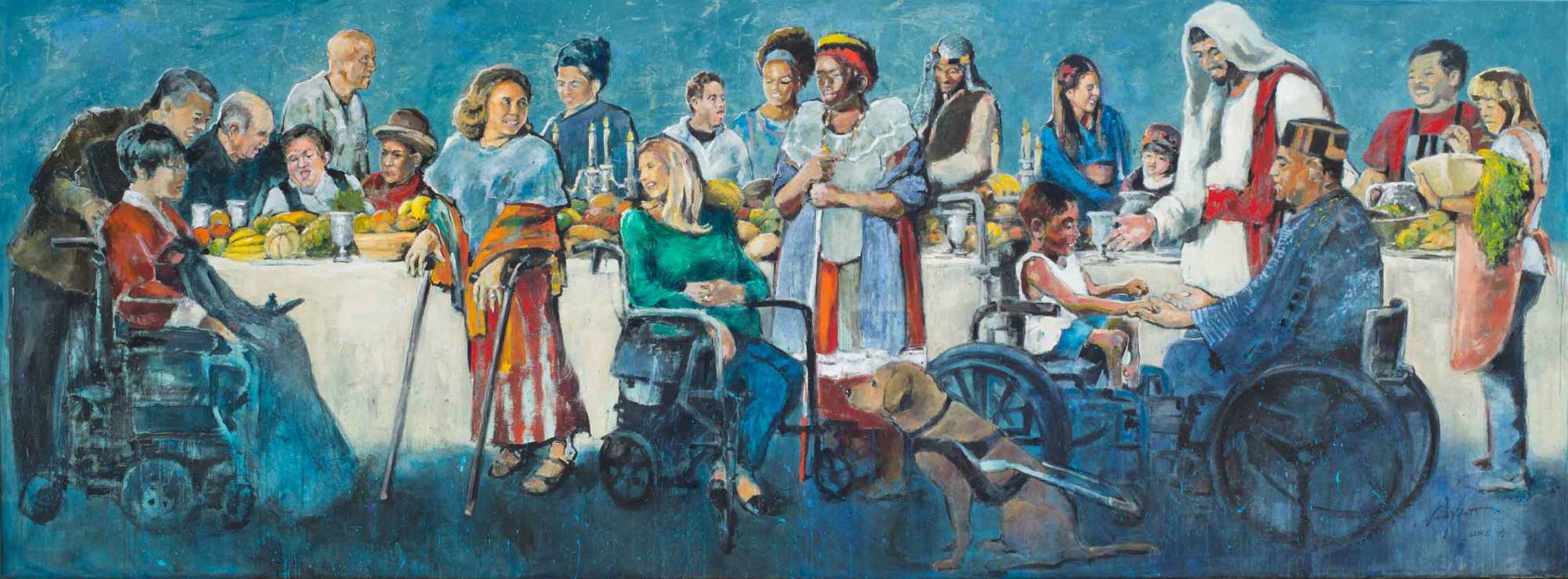
The wedding feast Jesus, his mother, and his followers attended at Cana in Galilee was a family affair that included many guests. The bride was joining her husband’s family. It was a new beginning and important to show abundant hospitality to the guests – a matter of honor for the groom’s family to offer joyful feasting with plenty of everything to eat and drink. To run out of anything was a serious source of shame for his family, particularly since the bride’s family would be witnesses of the shortfall.

Unfortunately, the wine was running out. Wine was added to water to make the water safe to drink. The amount the wine was watered down might vary, but it was essential to have the wine. It wouldn’t do to have nothing to offer guests to drink.

Jesus’ mother noticed the problem. She told him about it, then instructed the servants to do whatever her son told them to do. What a leap of faith! Jesus didn’t think it was time for him to do anything yet. It was not his time. But Mary set the stage and he acted.

Water jugs for washing the feet of guests were not what one would expect to find used for wine. But Jesus instructed the servants to fill the jugs with water – just regular water. Then, he told them to serve it to the headwaiter for approval. The servants must have been very nervous about those instructions. The headwaiter was not going to be happy about receiving water from the washing-water jugs to drink! But somehow they accepted Mary’s vouching for her son’s ability to help and they filled the jugs with water, gave them to the headwaiter, and I suspect they were more astounded than the headwaiter to learn that the plain, old, everyday water had become fine wine.

“You have kept the good wine until now,” he said to the bridegroom with amazement. This observation sets the stage for Jesus’ mission. In fact, St. John says this was the first of the signs Jesus gave that revealed his glory – who he truly was and is. His disciples began to believe in him when they saw this sign. (Jn 2:1-11)

Why would this sign at a wedding signal the glory of the Lord present in a city in Galilee?

There is a history of weddings and the relationship between men and women, husbands and wives, in Hebrew religious tradition that points to the relationship God wants to have with humans. The prophet Isaiah speaks of this to the people who have returned from captivity in Babylon. The people who have returned to Jerusalem will rebuild the city and the temple. Their trust in God through their long exile will be vindicated, as God’s protection shines forth over the city like dawn breaking after a long night. Jerusalem’s victory is compared to a burning torch, shining brightly.

The people themselves, loved and freed by their God, will no longer be seen as forsaken and their land desolate.  God has rescued them and takes them as his bride, the one loved and protected as by a husband. It’s a new beginning. A time for great joy. An example and blessing of human love and marriage. (Is 62:1-5)

And so, when Jesus begins his ministry of teaching and healing at a wedding, we see a new beginning for humanity again. Just as the bride and groom begin their new lives together, so humans and the Lord begin a new relationship as children of God, heirs of the kingdom. The messenger has arrived. The best wine is ready to serve. The story begins.

We have many new beginnings in our lives as individuals and communities. Sometimes the new beginnings go smoothly. Other times they are more bumpy. Sometimes people are happy with the change. Other times they have their doubts about it. Sometimes people get along with each other. Other times they find all sorts of things about which to disagree and argue.

The people of Corinth got to arguing about the gifts of the Holy Spirit. Which one was best? Who got the best gifts? Why did one person get a highly valued gift and another get one that was seen as humdrum and common? St. Paul reminded them that the gifts received from the Spirit were not a reward of any sort for good behavior. The gifts were from the Holy Spirit of God, given to each person in order to be used to help build up the community. One person might be called to offer wisdom. Another might be gifted with the ability to heal or to understand what the spirit is calling someone else to do. The gifts given to each person were only good insofar as they were used for the community as a whole. (1 Cor 12:4-11) Such controversies are not at all uncommon among people who live together and must find their way to agreement on what to do in any given situation. We look at a challenge and bring our own gifts to the effort to address it.

We are at a time in the world with many new challenges to address. Leadership of many countries is changing. The approach to solving common challenges facing communities and nations can vary widely. But it’s important to remember that we humans are loved like a bride by our God – all of us. As a result, we are called to love in return.

Part of that requirement of love is to listen to each other and honestly try to find ways to work together to solve common problems. How do we help those who have come to our homelands seeking protection? How do we help those who simply need work to support their families? How do we assure our fellow women and men that they and their children can get healthcare when they need it? How do we grow, harvest, and distribute food so that all can eat and grow to a healthy adulthood and old age? How do we find affordable housing for all? How do we educate and support our children, helping them grow to be loving, competent adults?

Just as at the wedding feast at Cana, Jesus is present when we invite him into these conversations. How will water be turned into wine in our lives? Will we trust him enough to put the water into the jars and take it out to those who will judge its quality and pass it on? Which gifts of the Spirit are we sent to bring to the conversation? Will we have the courage to speak based on insights we have received through the gifts we have received?

We are not just guests at a wedding this time. We are the Bride of our God, sisters and brothers of Jesus, children of the Father. May we always remember this and work to bring others into our family of love and support. The wedding feast has begun. It’s time to celebrate that love and take it into our world.

Readings for the Second Sunday of Ordinary Time – Cycle C


Read More

Posted by on Nov 16, 2024

Missed the Rapture Again?

Missed the Rapture Again?

We have a joke in the family that gets repeated once in a while. Living in a tourist destination community, we are used to seeing busy highways and local roads at certain times on weekends and during holidays. But every so often, when we would usually expect the highways to be full, they aren’t. On those days, returning home, one or another of us will note, “Well, we missed the Rapture again!”

Our liturgical year is drawing to a close. We have celebrated Advent, Christmas, Lent, Easter, and all the days in-between. We have heard God’s word proclaimed in Scripture, through worship, and in our daily lives for another year. We hope that we have grown a bit in wisdom and grace as we have in age.

Now, here we are again, at the last two weeks of the year. The readings speak of final days and describe cosmic disasters that bring an end to all and usher in the final coming of the Son of Man.

If we look at these readings literally, and look at the state of the world today, it can be terribly distressing. Is the world really coming to an end? Are we among those left behind to suffer for our evil behavior? Is there any hope? Did we miss the Rapture?

Objectively speaking, things are something of a mess out there in the world. For that matter, sometimes at home they’re a mess too. We’ve come through a world-wide pandemic, with economic and social upheavals as a result of it. We see wars raging in Africa, Europe, and the Middle East. War has been threatened in Asia as well. One long one in Afghanistan ended, but there are other areas of conflict that have not risen beyond the level of “trade wars” yet. Families are under stress. Inflation has been high, because of many pandemic and trade war-related issues. Unemployment has come down dramatically, but it was high for a while when businesses had to close or cut back due to the pandemic and associated supply-chain problems. Food costs have risen. Housing is in short supply. And so on and on.

On the physical front, we are having to deal with droughts, wildfires, floods, earthquakes, and all the natural “disasters” that occur when humans and the forces of nature meet in dramatic ways. How many hurricanes or cyclones or typhoons should any area have to endure? Why so many tornados? Will the rains come so the fires stop? Why so much rain at a time? Can’t we have just a bit and when we need it rather than all at once?

People are divided over how best to deal with the economy, with the wars that are raging, changes in what we expect of our environment, emerging understandings of gender, the role of women and others who have traditionally been kept at lower status than the leadership of our communities and of industry, to mention just a few issues. Elections around the world are reflecting the divisions among us over how to move forward. Lots of fear and angst are expressed in these votes.

When the victors emerge, again, there is dismay among one group and rejoicing by others. Yet we are all still in this together. None of us got out in a Rapture of any sort. None were swept up to Heaven for protection while God deals with the messiness of the lives of the rest of us. We all missed the Rapture!

The readings from Daniel speak of the distress that can arise in life. The book of Daniel was written during a period of conquest and persecution under King Antiochus IV, a Selucid King ruling from 167-164 BCE. They offer hope that an end will come to the trials of the age and that peace will come. There is a mention of the dead rising again to life and of others remaining dead. (These conversations continued into the time of Jesus and his followers. We even hear them today!)

Nevertheless, the reading ends on a note of promise. “The wise shall shine brightly like the splendor of the firmament, and those who lead the many to justice shall be like the stars forever.” (Dn 12:1-3)

Things can get very bad, very frightening, very distressing, but hope is not lost. Wisdom will continue to shine forth and people will emerge who will continue to work for justice and peace.

So, who is this Son of Man person? “Son of Man” as used in the readings today is the title given to an apocalyptic figure who comes to the rescue. The individual is human, but gifted with special powers to accomplish God’s work and then be raised to Heaven. Daniel speaks of the Son of Man as the one who will come to make all right again. In the midst of great turmoil and destruction, the Son of Man will come with power and glory. Those found worthy and faithful will be rescued before all ends.

Jesus tells his followers that no one knows when the end of the world will come, when the present age will end, but a time will come when all is concluded. Worlds end. Do they always end physically? No. But we are to be alert to see the signs of change, of transition, in our day. (Mk 13:24-32)

Where do we see these signs? That is the big question. Where do we see the love of God shining into our lives and our world. When God comes, it will not be as a punishing, vindictive bully who is out to get revenge on all who have done him wrong! God is Love. Love doesn’t behave that way.

So where do we see the signs of the coming of the Son of Man? Where do we see the Lord in our lives?

We see the Lord in those who reach out to others, including those with whom they disagree. We see the Lord in those who work to protect others who are being persecuted because of who they are and how God made them. We see the Lord in those who seek to assure that children and their families can get enough to eat and still have a place to live. We see the Lord in those who care for the sick. We see the Lord in those who work to protect prisoners from abuse. We see the Lord in those who step up to serve in leadership roles that allow them to enact laws protecting rather than exploiting the weak and powerless.

We see the Lord in the work of those who are willing to give of their time, talent, treasure, and lives to serve others and make a better world for all. Jesus gave us a set of guidelines in the Beatitudes. He told us where to find him in the story of the Last Judgement. He willingly faced torture and death, put his very life on the line, in the process of reconciling humanity with our Father, the creator of all.

We missed the Rapture, all of us. Now it’s time to learn from the fig tree, to see the signs around us, and to roll up our sleeves and get to work. It’s time to continue to work and build a world of love and support for our sisters and brothers, wherever they are from, and whoever they are. We’re in this together. The Kingdom is coming to birth among us. Let’s get going!

Readings for the Thirty-third Sunday in Ordinary Time – Cycle B


Read More

Posted by on Nov 13, 2024

Widows, Children, and the Kingdom

Widows, Children, and the Kingdom

The doorbell rang at about 11:30 one morning and when I answered, I was met by a middle-aged man who greeted me in friendly terms and introduced himself as a Jehovah’s Witness, visiting folks in my neighborhood. Would I like to spend a few minutes and talk about the Bible? First question after asking about whether I believe in God, “Do you ever think about or read the Bible?”

Now, for those who know me, that question has a pretty obvious answer. However, this man was a stranger. When I explained that I regularly write about the Bible readings for the Sunday liturgy, his response was, “Oh, then you read the Bible?”

We talked a little bit and he asked about prayer and what might be an important prayer. I suggested, and he agreed, that “The Lord’s Prayer” is fundamental. He began to recite, “Our Father, who art in Heaven, hallowed be thy name. Thy kingdom come….” At that point he stopped. “What do you know about the kingdom?”

I was surprised by his reaction when I said that the Kingdom is here and now. We live in and help bring the Kingdom into the present reality of the world in which we live. Our actions and reactions to what we experience are all part of this process.

He seemed rather dismayed and was ready to educate me further about the Kingdom as it will one day be manifest in concrete form. However, for better or worse, I had been working when he came calling and I needed to complete a couple of things before afternoon, so I excused myself from further conversation. He left, voicing the thought that “We should meet again one day soon and talk further about this.”

In the light of recent events and the political power of some of the fundamentalist streams of the Christian tradition that played a role in the election, I had been pondering the stories of the widow whose was willing to trust God and feed a stranger and the widow who gave all she had to the Temple treasury. What do these stories tell us about God and about the Kingdom of God? The encounter with this unexpected visitor helped focus my thoughts.

When King Ahab ruled in northern Israel, he married a non-Israelite woman named Jezebel. She worshiped the god of her people and led Ahab to do the same. The prophet, Elijah, spoke up and called upon Ahab to return to exclusive worship of the Lord. As a result of Ahab’s refusal to do so, a drought came upon the land and there was much suffering. Eiljah was forced to flee the land, as Jezebel was determined to get rid of him permanently! He went north to a small town called Zarephath in Phoenicia. (The town still exists and is now called Surafend.)

When Elijah arrived at the gate of the town, he found a widow who was collecting sticks outside the town walls. He asked her for a small cup of water to drink and she headed back into town to get it for him. He asked her also to bring him a small bit of bread to eat with the water. At that, she stopped and explained her situation.

Widows in the ancient world had no one who protected them or would help them survive. These were patrilineal families. When a woman married, her family no longer took any responsibility for her welfare. Her husband’s family had total responsibility. If the husband died, his family no longer felt any need to care for her, particularly if there were any challenges in the relationship. She would no longer be providing heirs for the family. She was disposable.

In this case, the widow had a son, but he was a child. There were no guarantees he would grow up. She was on her own and there was a drought. They were down to their last handful of flour and just a touch of oil. Enough for one more tiny meal. Then they would die of starvation. No social safety net. No food for the poor. No meals at school. No food stamps. They were going to die.

Elijah reassured her and made her a promise. “Do not be afraid. Go and do as you propose. But first make me a little cake and bring it to me. Then you can prepare something for yourself and your son. For the Lord, the God of Israel, says, ‘The jar of flour shall not go empty, nor the jug of oil run dry, until the day when the Lord sends rain upon the earth.’”

This was a big chance she was taking. Bring food to a stranger first, then feed her son and herself? And he was not one of her people. He was a foreigner, from another land with which relations had been filled with conflict in the past. But she took a chance on him and the promise of his God.

Elijah lived with her and her son until the time the rains came again, over three years later. The jar never ran out of flour and the jug of oil continued to have enough to make their meals until the rains came again and food became available.

The widow of Zarephath took pity on a stranger, a foreigner. And because of her willingness to help him, she and her son survived. (1 Kgs 17:10-16)

Many years later, Jesus and his followers arrived in Jerusalem from the Galilee. They sat in the Temple, watching the people coming and going. Then as now, people offered monetary sacrifices to God in thanksgiving for gifts received and in hopes of receiving God’s favor in a practical way – with success or healing or other tangible signs of fortune and blessing. They dropped coins into the treasury as one form of sacrifice.

Many people offered these gifts. Some offered quite large sums. Quite likely it was not terribly quiet. Imagine pouring a bag of coins into a bucket, jar, or bowl. Coins are not quiet as they fall.

Jesus had been speaking to his disciples about the importance of not looking at obvious signs of wealth or influence as indicators of holiness, honesty, or trustworthiness. These images of success were not signs that the example of those who were wealthy or influential should be the model of behavior to be followed. “Beware of the scribes, who like to go around in long robes and accept greetings in the marketplaces… and places of honor at banquets.” Why? “They devour the houses of widows and, as a pretext recite lengthy prayers.”

These were folks who cheated the poor and the vulnerable out of their money by offering to pray for them! Sadly, we still see this phenomenon today. Promises are made that if you just give me money, I will be your advocate and make sure to fix everything for you, so all will go in your favor and you will not suffer anymore. I can and will fix things. And people give them money and hope in their promise!

Jesus did not buy this as acceptable. He instead praised a widow who dropped a couple of small coins into the treasury. Their total value was just a few cents, a couple of pennies. Not much worth to anybody. But unlike the gifts of the wealthier folks who were pouring bags of coins into the box, she gave all she had. This was the last money she had. How would she survive? (Mk 12:38-44)

The widow’s gift of everything is challenging. How do we deal with this kind of generosity and faith in God’s care? How do we understand the decision of the widow of Zarephath?

Each of these women is presented as a worthy example of trust in God. One is not a member of the Chosen People. She is a Gentile, a foreigner to Israel. Yet she was saved by trust in God’s promise, delivered by a stranger, a refugee.

The Kingdom of God is here among us today. We see it in the same concrete ways it has appeared in past ages. Christ has entered into the heavenly sanctuary, opening it for the outpouring of divine love, the very life of God. Salvation is here through the self-offering of Jesus himself. (Heb 9:24-28)

The Kingdom of God is growing here and now when the hungry are fed, strangers are welcomed and helped, people are accepted and loved regardless of their gender, women are respected and their choices supported, those without housing are helped to find shelter, those who are imprisoned are visited and given opportunities to begin again and make better choices, those needing work find opportunities opening to them, and so many, many more signs of the presence of a loving community who know themselves to be loved and pass along that love are shining forth. We live the Kingdom through our daily decisions and actions. We don’t have to wait for God’s presence in some distant heaven. God is here now! The Kingdom of Love is here now. We are Christ’s hands and feet, his eyes and heart, opening to love those we meet and share the love with them here and now, through very practical actions and decisions.

As we approach the end of our liturgical year, may we remember these stories. May we trust that when we live the Beatitudes, caring for those less fortunate, those who need help and seek a safe refuge, we will help build the Lord’s kingdom in a land that welcomes all, just as our Father in Heaven loves and welcomes all of us.

Readings for the Thirty-second Sunday in Ordinary Time – Cycle B


Read More

Posted by on Nov 3, 2024

Love – Worth More than Burnt Offerings

Love – Worth More than Burnt Offerings

She was a large woman, tall and heavy-set, with dark skin and a unique way of dressing. I most frequently saw her with a portable grocery cart full of her possessions alongside a road in town. There was a creek running in a channel down the middle of the road, with trees and brush in which one could spend a night or rest during the day undisturbed by passersby and she often went there. She seemed to have health problems and getting around was clearly not always easy for her.

She dressed in clothing that looked like she might be from the Middle East, with her head and most of her face covered in scarves and robes that reached down over her legs. I suspected she might be Muslim, but I only saw her along that busy road ordinarily, so there was no opportunity to find out more about her.

Then one day, she came to mid-day Mass at a local chapel. Over a period of several weeks, I often saw her there. We always smiled at each other, but we didn’t typically talk much. She sat off to the side, behind a short partition that separated out a side altar and entrance from the rest of the body of the chapel. There was room for her and her cart in that section.

After Communion one day, she had her rosary in her hand and dropped it over the side of the partition. A woman picked it up and handed it back to her. She accepted it with a smile and a comment, “You are close to the Kingdom of God. Thank you.”

I later learned as we walked together after Mass on our way home that she tested people that way. She would drop something and see if they would pick it up for her. If they did, she knew it would be safe to trust and befriend them.

Time went on and my family situation changed. I was no longer able to attend daily Mass. I kept an eye out for her around town, but it’s been over 15 years since I last saw her. I think of her often. She wore the coverings for her head, face, and body in solidarity with her “sisters around the world” who have no choice but to wear them, regardless of how warm or hot the weather is. She was a prophet in our midst, saying little with words, but much with her way of dress and behavior – finding those close to the Kingdom.

Close to the Kingdom

A scribe, an educated man, approached Jesus one day and asked him what the first, most important of all the many commandments was. (There are 613 commandments in the Torah, the first five books of the Bible, not just the ten that we usually think of as The Commandments.)

Jesus responded without hesitation, reciting the Shema, the fundamental statement of Jewish tradition and worship. “Hear, O Israel! The Lord is our God, the Lord alone! Therefore, you shall love the Lord, your God, with all your heart, and with all your soul, and with all your strength.” This statement is called the Shema because it begins with the Hebrew word shema which means “hear.” Jesus continued beyond the traditional Shema, giving a second command, as important as the first. “You shall love your neighbor as yourself.”

The scribe was pleased with Jesus’ response. He summed it all up by noting that to love the Lord with one’s whole heart, understanding, and strength and to love a neighbor as yourself “is worth more than all burnt offerings and sacrifices.”

Jesus praised the scribe for his understanding, “You are not far from the kingdom of God.”

No one asked any more questions. It had all been said. This is what it was all about. Love of God and of neighbor. (Mk 12:28b-34)

The focus on love as a response to God is fundamental in the Jewish and Christian traditions. It is found right after the statement of the basic ten commandments in the book of Deuteronomy. Moses presented the requirement to the people that they love the Lord and follow his commandments, so they could be blessed with a long, prosperous life in a land of abundance which the Lord would provide. The Shema summarized the Lord’s command to love and be loyal to him. (Dt 6:2-6)

Love is a word that we often equate to romantic love. But in this context, it has a different meaning. Love here means to be loyal to someone or something. It requires a commitment to stick together through thick and thin and a promise that the Lord has something good that will come to those who are loyal to him even in hard times.

Jesus showed us how to be loyal to the Father through hard times when he accepted death rather than deny the kingdom he had come to proclaim. The author of the Letter to the Hebrews notes that as our high priest, he was “holy, innocent, undefiled, separated from sinners, higher than the heavens.” The one who is perfect in love is the one who always speaks on our behalf to the Father. (Heb 7:23-28)

So how does this all relate to my friend and her little test?

As citizens of the Kingdom, we are called to Love the Lord, as the Shema declares, with all our heart, all our soul, and all our strength. We are also to love our neighbors, with the same strength and commitment we have given to the Lord. We are to love them as ourselves, looking out for their interests as we would our own.

We can preach all we want to about Jesus, about the Law, about the Commandments, about purity in our thoughts and behaviors, about how we worship. But if we don’t really love and respect each other, if we don’t help each other willingly and without expecting anything in return, if we only speak to those with whom we agree or who look like us or who live respectably like we do, then we are missing the point of the Kingdom! Do we stoop to the ground to pick up something a person we don’t know has dropped? Do we take time to smile and chat with a child or a baby as we wait in a line? Do we wait our turn patiently to get through a traffic light or move ahead on the freeway? Are we kind to those who don’t meet our society’s standards of beauty? Do we trust that others may have valid reasons for doing things differently than we ourselves might do?

If we insist on forcing our opinions or our ways of doing things on others, are we really living what Jesus taught? Are we really loving God and neighbor? Are we loyal to the God who made us as free persons and therefore choose to support others in their free response to God’s love?

This week, many decisions will be made that affect what life will be like in the years to come. Some of them will be politically based. Some will determine the direction of countries in the months and years to come. Some will simply be the ones that affect ordinary folks in living out life as family.

Let us pray for the wisdom to choose wisely, to love each other and support each other’s freedom to choose how each moves forward in life. Let us resolve to lend a hand in support of those we meet along the way. Sometimes an action as simple as bending over to pick up a rosary for someone else is a sign of closeness to the Kingdom of God.

This love in action, offered without recrimination or condemnation, is “worth more than all burnt offerings and sacrifices.” It is what brings us into the kingdom of God,” right here and right now.

Readings for the Thirty-first Sunday in Ordinary Time – Cycle B


Read More

Posted by on Oct 27, 2024

Ephraim is My First-born

Ephraim is My First-born

In patriarchal societies, the first-born son holds a special place of honor and authority. This person will inherit leadership of the family upon his father’s death. He will get extra privileges and opportunities that are not open to his brothers, and certainly not to his sisters. His mother may refer to him with special terms of affection not shared with her other children – my king, my prince. He will get away with behavior that would draw punishment for other children in the family. And all siblings will be taught that his will is to be obeyed as they go through life.

This may sound like the reality of life as a member of a royal family and indeed most of the royal families of our day are headed by men. As we saw with Queen Elizabeth II, it’s no longer essential to be male to rule an empire, but it’s a relatively rare phenomenon. In most Western societies it is not as strictly the norm, though certain elements remain to this day.

The prophecy of Jeremiah regarding the return of the Jewish people from exile in Babylon includes an interesting statement, therefore. (Remember, this was a patriarchal society.) The Lord says through Jeremiah, “I am a father to Israel, Ephraim is my first-born.”

Ephraim was the second-born son of Joseph. Joseph was one of Jacob’s twelve sons, but far from being the first, he was actually the eleventh. His mother was Jacob’s favorite wife, Rachel. Joseph married a woman in Egypt and had two sons, Manasseh and Ephraim. Given the general rules of patriarchal society, there’s no way Ephraim would be considered anyone’s firstborn! Yet Jeremiah, speaking for the Lord in prophecy, says Ephraim is the Lord’s firstborn.

How could that happen?

Jacob was a twin, born second to his parents, Isaac and Rebecca. His older brother sold his right to the blessing reserved for the firstborn to Jacob for a bowl of food one day. Rebecca helped Jacob fool Isaac into actually giving the blessing to Jacob. The inheritance of the promised leadership of the family passed to Jacob. It could not be withdrawn and reassigned.

Jacob had to flee to another land to escape his brother’s anger. There he met Joseph’s mother. He married both Rachel and her sister Leah. (It’s a long story …)

Eventually, he had twelve sons and at least one daughter, with two wives and their servants as mothers to his children. Joseph was sold into slavery in Egypt by jealous brothers. (Another long story…)

When the family was reunited, Jacob was delighted that Joseph had sons and adopted them as his own. As Jacob neared the end of his life, he had blessings for each of his sons. When he came to Joseph, he gave the blessing to the younger son, Ephraim rather than to Manasseh. Joseph tried to correct his father, but Jacob insisted and gave Ephraim the blessing reserved for the firstborn son.

At the time of the conquest that led to the exile in Babylon, the lands settled by the descendants of Ephraim were among the first conquered in the north of Israel. In the midst of all of the sorrow and pain of the conquest and exile, Jeremiah spoke words of hope. Importantly, he also spoke words of affirmation of the value of people who had very little status in their society. Anyone with physical limitations or disabilities, women – especially when pregnant – and children were considered to be second class and often “unclean” and therefore  were kept away from ordinary folks.

Jeremiah, speaking the word of the Lord, declares “Shout with joy for Jacob… The Lord has delivered his people, the remnant of Israel.” Then he adds something amazing as he promises to gather his people from all the ends of the world. This promise specifically includes the blind, the lame, the mothers, those who are pregnant, and the children themselves. He will lead them back to their homeland, consoling and making level roads with brooks of water nearby to quench their thirst on the journey. Why? “For I am a father to Israel, Ephraim is my first-born.” (Jer 31:7-9)

The Lord does not treat us as if we were members of a patriarchal society and need to remember that the powerful are born to rule, regardless of their fitness to do so. Those who care for the vulnerable – the women and children, those with handicaps, those who flee for their lives from their homelands, those who are poor. These are the ones the Lord calls his firstborn. These are the ones we are to imitate and serve as our sisters and brothers.

Jesus also treated those who were marginalized with care and respect. He healed Bartimaeus from the blindness that had limited his options to begging by the side of the road to get enough to buy food and shelter.  Jesus didn’t assume anything, however, when he heard Bartimaeus’ call and told his followers to call him over. Instead, he respectfully asked, “What do you want me to do for you?” Bartimaeus responded, “Master, I want to see.” Jesus healed him on the spot, “Go your way; your faith has saved you.” His sight was restored immediately and he followed Jesus on the way to Jerusalem. (Mk 10:46-52)

In Mark’s Gospel, this healing is the last one before Jesus arrived in Jerusalem. The events we remember during Holy Week followed.

Reflecting on Jesus’ role in sacrificing his life in witness to his calling to proclaim the Kingdom and experience everything it is to be human except sin, the author of the letter to the Hebrews reflects on the role and calling of the High Priest. The High Priest in the days of the temple was chosen from among the people, called to represent them before God and to offer sacrifice in the most sacred part of the temple. Dating from the time in the desert, even before the temple had been imagined, God called individuals to fulfill the role of offering these sacrifices. It was always a calling from God, not a position that a person could campaign to gain. Even Jesus was selected to act as high priest, called by the Father and anointed priest in a way that could never end. Jesus, the one through whose sacrifice of his own life freed all, was the son begotten by the Father to accomplish this great task, to end the division between God and humanity. (Heb 5:1-6)

God does not look at our status, our birth order, our gender, our physical appearance, our physical prowess, our strengths when looking at us. God looks at our hearts, at how we love and respect each other, at how we reach out to help and support each other. How do we help the poor? How do we treat those who seek shelter here when they must leave their homes in other lands? How do we care for those with special needs? How patient can we be with those ahead of us in line at the grocery store? How do we share the road, especially if we are running late? How do we share our riches so that others will have enough too?

We are at a time of great turmoil in the world and in our nation in these days. We are called to be open and to love, not to slam shut the doors of our hearts, our lands, and our pocketbooks, hoping to keep out the needy and those who fear for their lives. If and when we slam shut the doors, we become blind to the love of God and the saving grace gained for us by our great high priest, Jesus. May we this week and in the weeks to come allow ourselves to be healed of the blindness that keeps us from seeing God’s presence in those around us.

“Open my eyes, Lord, Help me to see your face, Open my eyes, Lord, Help me to see!”

Readings for the Thirtieth Sunday in Ordinary Time – Cycle B

Open My Eyes – Song by Jesse Manibusan

Read More