Pages Menu
RssFacebook
Categories Menu

Posted by on Jul 3, 2022

Up from the Ruins – The Kingdom of God is Here

Up from the Ruins – The Kingdom of God is Here

During the past few weeks, the divisions among peoples and nations have once again come starkly into focus in the United States and around the world. Recent decisions by the Supreme Court have upset precedents that had long seemed established. Revelations regarding the events on January 6, 2021 make clear the potential fragility of the American system of self-governance. War continues to rage in Ukraine. Other conflicts smolder around the world. Political parties bicker over what needs to be done and how to do it. Fires, earthquakes, drought, and famine plague many around the world. And COVID-19 continues to cause illness and death.

We might be tempted to feel sorry for ourselves – a “woe is me” type of moment, perhaps. Weren’t things always better in the past? But no, they weren’t. Things have always been hard at times. Not exclusively hard all the time, mind you. Things have also been wonderful, maybe mostly wonderful. Yet the wonderful times have always also been punctuated by harder times that make people grateful for the boring, everyday-ness of most of life.

Through it all, God is present, working from within the hard times through ordinary people, to bring about the happier times and restore peace among peoples and families. The Kingdom of God is here, rising from the ruins of broken relationships and societies.

On this Fourteenth Sunday in Ordinary Time, the prophet Isaiah (66:10-14c) speaks the Lord’s words to the people of Israel at the end of their period of exile in Babylon. They are returning to their own land, to cities that have been destroyed and a temple that is in ruins. Ancient warfare left cities leveled, just as we are seeing today in Ukraine. It took a bit longer, perhaps, but the cities were destroyed and the land laid waste. The conquerors wanted nothing to be left to those whom they defeated.

So now the people return to their devastated homeland and what does the Lord say? “Rejoice with Jerusalem and be glad because of her… I will spread prosperity over Jerusalem like a river … as a mother comforts her child, so I will comfort you…” God is present with the people. Their city will rise again. God will comfort them like a mother nursing her child. Intimately. Tenderly. With love and dedication. Up close and personal. Sweet and filling!

Isaiah’s words are for us too. Our world has been turned upside down in some ways. Yet the Kingdom of God is here because God is here with us in the midst of the challenging times. “The Lord’s power shall be known to his servants.”

In a different, happier time for Israel, the psalmist rejoiced at God’s deeds (Ps 66) – “Shout joyfully to God, all the earth.” God has acted with power to protect the children of Adam. The sea was changed to dry land, a passage opened through the river (Jordan). The Lord is present with his people. “Blessed be God who refused me not my prayer or his kindness!”

The theme is continued in Paul’s letter to the Galatians (6:14-18). The reading for this week is from the end of the letter. He has presented his argument about the reasons for not requiring Gentiles to become Jews before becoming followers of Jesus and members of the Christian community. He states his position clearly. Neither circumcision nor uncircumcision means anything in terms of salvation. The only thing that matters is to become a new creation, based on the cross of the Lord and our sharing in the redemption it brought. Paul notes that he has himself suffered physically because of his faithfulness in proclaiming Jesus’ death and resurrection. He ends his letter with a wish of blessing for the members of this community. It is a blessing familiar to us even today. “The grace of our Lord Jesus Christ be with your spirit, brothers and sisters.”

Jesus, too, shares this message. “The Kingdom of God is at hand.” St. Luke (10:1-12, 17-20) tells us that Jesus selected seventy-two of his disciples and sent them ahead of him to the towns he was planning to visit. They went in groups of two. He gave them very specific instructions about what to take with them, what to say, where to stay, what to eat, and what to do if people in a town didn’t welcome them. They were to cure the sick and share the message of the coming of the kingdom of God wherever they went.

Jesus wasn’t living in a free and independent country. He was living in a conquered land, with overlords who took whatever they could get from the land and the people. Large numbers of people grew cash crops, for use by the empire, and had little left for themselves and their families. Soldiers could force people to carry their gear. Tax collectors were allowed to take as much as they could get, even above and beyond what was due. Anyone who opposed the Romans would be killed. It was not a great time in Israel. Yet he had arrived – the kingdom of God was at hand! His disciples were charged with sharing that news.

It’s interesting to note that Moses also selected seventy-two elders to help with administration of the camp and keeping order as the people moved through the desert in the years before they entered the Promised Land. Perhaps that’s part of the reason Jesus selected seventy-two disciples to alert people to the coming of God’s kingdom. This time of his coming was one long awaited.

The disciples returned with great rejoicing. Their mission had been well received and “even the demons” had obeyed them because of the power of Jesus’ name. Jesus notes their success and cautions that even more important than this power they have experienced is the fact that their own names are known by God in the heavenly kingdom.

In the midst of the troubles and hardships experienced by the Chosen People at the time of Jesus, the ruins of the former glory of their nation, the Kingdom of God has arrived.

Do we believe that God’s kingdom is present here and now as well? When things go differently than we would have chosen, can we trust that God will stand beside us in the ruins of our hopes and dreams and lift us up to the joy of the new Jerusalem and the kingdom? Will we let the Lord cradle us as a mother cradles her infant, and will we nurse as a well-loved child, secure and trusting the one who provides all we need? Will we have the courage to go forth and proclaim the love of the Lord and the Kingdom of God in our own world through our patient work to care for the most vulnerable among us? Will our commitment truly be to support children, families, women, immigrants, refugees, non-binary folks, the elderly, those with special needs? This is where God is present. In the “ruins” of social systems that favor the few and are willing to discard the rest, we find the Lord present and working.

The Kingdom of God is here, opened for us by the coming of Jesus.

Read More

Posted by on Jun 26, 2022

“All er Nothin”

“All er Nothin”

When I was a little girl, getting ready for first grade, my mother was quite worried. I loved to sing. This would not typically be an issue, but two of my favorite songs were from the musical Oklahoma. The songs in question were not something lovely like “Oh what a beautiful morning,” or something rousing like “Oklahoma.” No, my favorites were the ones sung by Ado Annie, the young woman with a less than stellar reputation for faithfulness or prudence in relationships. These songs, especially in the Broadway play version we had on our record, were quite risqué. Mom was afraid I would sing them to “Sister” and scandalize her (whoever she turned out to be). As soon as the movie version, with more family-friendly lyrics, was available, she bought it for us and that was the record I was allowed to enjoy.

Of Ado Annie’s two songs, “I Cain’t Say No” and “All Er Nothin,” the one that comes to mind and is running through my head after looking at the readings for the Thirteen Sunday in Ordinary Time, is “All Er Nothin.” Annie’s boyfriend, Will, has just returned from the big city, Kansas City, with tales of what “modren livin” is going to be – indoor plumbing, gas buggies goin by theirselves, buildings twenty stories high, etc. Will has heard rumors that Annie hasn’t exactly been the most faithful girlfriend while he was away. He confronts her in the song “All Er Nothin,” declaring “With me it’s all er nothin. Is it all er nothin with you?” She asks for clarification, and the song continues with examples and conditions. If you haven’t heard it, it’s worth checking out. (The same goes for “I Cain’t Say No”!)

In the first reading, Elijah the prophet receives instruction from God to anoint Elisha to be his successor as prophet. (1 Kings 19:16b, 19-21) Elijah has been in trouble with the rulers of the land off and on for a long time. He has just met God on the mountaintop, recognizing his presence in a gentle breeze. Now he has been sent to find the man who will succeed him as prophet in Israel.

When Elijah found Elisha, the latter was plowing the land. He had twelve yoke of oxen, the large team of a prosperous family. Elijah didn’t spend any time explaining why he had come or what his plans were. He simply approached Elisha and threw his cloak over him. In this way, he signaled that the cloak of prophet of the Lord was now his too.

Elijah didn’t stick around to explain what his action meant. Elisha understood immediately what had just happened. He ran after Elijah and requested permission to return to his family and tell them goodbye. Elijah didn’t refuse the request. He simply told Elisha to go back, adding, “Have I done anything to you?” At this Elisha makes his decision. He kills the oxen, burns his plowing equipment to cook the oxen, and gives the meat to the people to eat. Then he follows Elijah as an apprentice, learning to be the Lord’s prophet. All or nothing …

The psalmist sings in praise of the Lord, who is a refuge, gives counsel, is faithful, leads on the path of life and is his inheritance. With the Lord, nothing is lacking. (Ps 16)

St Paul writes to the Galatians (5:1, 13-18) with a similar theme. A huge controversy was raging over whether non-Jews (aka Gentiles) had to become Jews and be subject to the Law of Moses in order to become Followers of the Way (aka Christians). Paul said no and so did the leadership in Jerusalem when they were consulted. The reasoning backing up this decision included the understanding that the Law had been fulfilled in the coming of Jesus. The new Law of freedom to love took the place of the old laws that dictated what, where and when people were allowed to engage in particular activities. There were food prohibitions, rules about when and how work could be done, with whom one might speak, and many more. The new freedom to act in love superseded these old rules. If someone needed to be helped on the Sabbath, for example, then the new law required Jesus’ follower to help. No foods except blood, meat from strangled animals, and foods sacrificed to idols were prohibited. Women and men were equally children of God.

This new freedom did not mean license to do whatever one wished – that would be a question of acting according to the flesh. No, to act according to the Spirit required doing what would be best for the other person, what one would wish for oneself. Service in this new freedom is based on love.  Only in love can one live in the Spirit. It’s again a question of “All er nothin!”

Finally, we see Jesus as he sets out for Jerusalem for the final time. Luke (9:51-62) describes Jesus’ single-minded focus on this journey. If those in the Samaritan village didn’t welcome them, OK, move on to another village. No time to stop and try to change their minds or punish them either! If someone offers to follow Jesus, OK, but know that we’re not going to be settling down anywhere along the way. “The Son of Man has nowhere to rest his head.” (Son of Man was a term used in reference to the coming Messiah in Jewish tradition. Jesus used it to refer to himself.) Someone else wanted to go home and bury his father, but Jesus had no time to wait. “Let the dead bury their dead.” In other words, Let those who are not with me take care of each other. “No one who sets a hand to the plow and looks to what was left behind is fit for the kingdom of God.” It’s all or nothing!

These are strong words and images. How do we understand them today? Are we to take them literally? How do we act in loving freedom to address the pressing issues of our day? Wars are raging, between nations, between gangs, between religious groups… Refugees are camped at the borders. Some are allowed to enter. Others with equally horrendous stories of probable personal danger are turned away. Issues of protection of the vulnerable among us divide our communities. Who is to be protected and how far will we go to help? It’s all well and good to speak in generalities. Who will pay the ultimate price of decisions that are being made far away by folks who don’t know us or our situations?

It’s not an easy time. We are called to the Law of Love, to the Freedom of the Spirit. Let us pray today and in the days to come for the courage to respond wholeheartedly, in prayer and in compassion, to the needs of our sisters and brothers. Not relying on logic and rules, but on the requirements of loving support and accompaniment.

Read More

Posted by on Feb 27, 2022

From the Fullness of the Heart

From the Fullness of the Heart

“From the fullness of the heart the mouth speaks” (Lk 6:45) 

On this Eighth Sunday in Ordinary Time, the readings remind us that wisdom is not always evident in human affairs. This is a timely reminder as we deal with the reality of war in Ukraine. In the Diocese of Monterey, CA, Bishop Daniel Garcia has asked us to use a different set of Eucharistic prayers this Sunday than the usual ones. There are four ordinary Eucharistic prayers that are typically used on Sunday. But there are others that are for times of special need or celebration. Any of these can be used equally validly for the Mass. The prayers Bishop Garcia has asked be used are for times of war.

Ordinarily, there are readings that are used for each day’s Mass. We have three different sets of readings that are repeated over a period of three years. However, the Masses for special purposes or times may have their own set or sets of readings. I don’t know which ones will be used in parishes around the diocese or around the world today. However, I know which ones are the “usually scheduled” ones and another set that may be used. Fortunately, they have themes that make sense together. So, here are some thoughts about them.

The first of the regular readings is from the Book of Sirach (27:4-7). Sirach is one of the books of Wisdom literature in the Bible. It is not always included in Protestant Bibles. The book includes a collection of proverbs and observations of human behavior and its consequences. These are drawn from events and practices that would have been familiar to the people hearing them. Sirach notes that it is in times of upheaval and trial that strength is developed (as in the firing of pottery). When grain is shaken through a sieve, the grain becomes usable and the husks are removed. The reading concludes with the observation that until a person speaks, there is no way to know their character, so they should never be praised first!

St. Paul’s first letter to the Corinthians (15:54-58) continues the contrast of the earthly, mortal, corruptible world (described as clothes) with immortality. We have been hearing about various aspects of this for the past few weeks. It is to the realm of immortality that the promises of God pertain. Death is not the end. It is “swallowed up in victory,” a victory received through Jesus, Our Lord. Therefore, he calls upon his sisters and brothers in faith to be firm and steadfast in the work of the Lord. This labor from the heart will not be in vain.

In the final reading of the regular set, St. Luke continues the Sermon on the Plain (6:39-45). Jesus asks a series of questions of his listeners. “Can a blind person guide a blind person?” “Why do you notice the splinter in your brother’s eye, but do not perceive the wooden beam in your own?” He also offers some commonsense observations. “A good tree does not bear rotten fruit…” “People do not pick figs from thorn bushes…”

Jesus concludes this set of observations with the statement, “For from the fullness of the heart the mouth speaks.”

It seems to me that this is the heart of the matter. When we make choices based on the values of the world around us, we may find some success or admiration, but it will come for the wrong reasons. As we all know, beauty fades, styles change, success eventually ends. What is it that will remain? What will our families and friends remember about us as they prepare to lay us to our final rest?

Alternate readings for this day touch on many of the same themes. The story of Cain and Abel in the book of Genesis (4:3-10) describes the result of envy and anger between two brothers. Both offer gifts to the Lord, but when Abel’s gift is burned the smoke goes up. When Cain’s gift is burned, the smoke goes down. Cain is angry that his gift was not received by the Lord. The Lord warns him about the danger of his anger, but he does not listen. He invites his brother to go out into the field with him. They quarrel and Abel is killed. The Lord comes looking for them and asks Cain where his brother is. Cain responds, “I do not know. Am I my brother’s keeper?” Of course, the Lord already knows. He tells Cain that Abel’s blood cries out from the earth and banishes Cain from the land. Cain must travel to other lands and live among the people there.

(Note: this is not historical writing. This story is to help explain conflict among people and nations. Despite being one of only three sons named as children of Adam and Eve, there are peoples in other nations among whom he is to go to live. Not intended as historical fact! A story to teach us something important. An example of wisdom literature.)

St. James (4:1-10) warns the early Christian community of the dangers of envy and struggles for worldly pleasures. These are the source of anger, fights, quarrels, wars. These are not the signs of God’s friends. Indeed, they are signs of those opposed to God’s ways. “God resists the proud but bestows his favor on the lowly.” James calls the community to turn back to God with prayer and humility – to purify their hearts and be humble. Then the Lord will raise them on high.

Finally, St. Matthew, in his account of the Sermon on the Mount (5:20-24), presents Jesus’ teaching against anger. “You have heard the commandment … ‘You shall not commit murder.’ What I say to you is: everyone who grows angry with his brother shall be liable to judgement.”

These are strong words. Those who are angry must reconcile with their opponents, their brothers and sisters, before bringing their gifts to the altar. It’s the reality of what is in our hearts that matters. It is in the heart that the Lord meets us and we meet the Lord.

And so, we return to our beginning verse, “From the fullness of the heart the mouth speaks.”

May we remember this as we enter into Lent later this week. May we remember this as we watch the war in Ukraine and pray for peace. May we remember this as we deal with the ups and downs of our own lives in community, in family, in work and play.

“From the fullness of the heart, the mouth speaks.” May our words and actions be those of peace.

Read More

Posted by on Feb 20, 2022

Bearing the Image of the Heavenly One

Bearing the Image of the Heavenly One

“Just as we have borne the image of the earthly one, we shall also bear the image of the heavenly one.” (1 Cor 15:49)

St. Paul, in his first letter to the community in Corinth, provides a theme for the readings of the Seventh Sunday in Ordinary Time. You will recall that there had been a great controversy in Corinth over the question of resurrection from the dead. Some said only Jesus rose, the rest of his followers would not rise. Others said only those who never died physically would have eternal life. Paul insisted that Jesus was the first human to rise, but he would not be the last. He is simply the “first fruit” of those who would rise. In the passage immediately before today’s reading, he speaks of the different kinds of bodies of various animals and of the transformation of seeds into grown plants. He explains that transformation from one type of body to another is common in nature and so should not be unreasonable to expect. Our earthly bodies, like those of the first human, Adam, will be transformed like those of the last Adam, Jesus, whose body became a spiritual one. This last Adam’s body was heavenly in origin.

Paul’s final statement in the set of parallel comparisons here between earthly physical humans and heavenly spiritual humans is a reminder of the great promise we have received from our Father. “We shall also bear the image of the heavenly one,” the risen Christ.

When and how does this transformation happen? Is there some sort of magic at the moment of death? What about those whose lives have not been exemplary but who have a great epiphany and die believing in the Good News of God’s love for all? Is it fair that they should have an equal share in the Kingdom? Can it really be true that the Kingdom is open to all? When does the Kingdom begin? Where is the Kingdom of God? Is it limited to our universe? Do we go somewhere else? So many, many questions have arisen since the Resurrection and first appearance of Jesus to his followers.

One thing is certain, none of us can earn an entrance into the Kingdom. That is critical to remember. No matter how well we live our lives, no matter whether we are blessed with earthly success and its trappings or are the poorest of the poor, none of us is guaranteed anything except the love of God. Yet the promise remains. “Just as we have borne the image of the earthly one, we shall also bear the image of the heavenly one.”

I suggest that the other readings this day offer a glimpse into this mystery.

Saul was the first king of Israel, anointed by Samuel, the prophet and judge of Israel, at the request of the people. Israel had long been under attack by the Philistines who lived to the west of their land. The Judges, including Samuel, had led the defense of Israel. But surrounding peoples had kings and the Israelites believed they would be stronger with a King. Samuel, following the Lord’s instructions, anointed Saul as their king. Later, Saul fell out of favor with the Lord because he and his men took animals and other valuable things from one of the enemy peoples whom they battled. They had been instructed to destroy everything living, but they kept the valuable things for themselves.

Samuel was then instructed to anoint Saul’s successor. A shepherd boy named David, son of Jesse of Bethlehem, was the one chosen as the Lord’s anointed to succeed Saul. Saul and David had a long history together, but as David became a popular leader in war against the Philistines and other enemies of Israel, Saul became jealous and decided to get rid of his rival. Saul didn’t know David had been anointed as next king already, and he didn’t want to take any chances his own sons would not succeed him.

As our story begins today, Saul has taken a break from the fight with the Philistines and gone after David in the desert of Ziph. (1 Sam 26:2, 7-9, 12-13, 22-23) Saul has 3,000 men with him. David has about 600. David is badly outnumbered and things don’t look good.

Then one night, as Saul and his army slept, David and his men found where they were camping. David and Abishai slipped into the camp, into the very tent in which Saul and his soldiers were sleeping. Saul’s spear was thrust into the ground near his head, ready for use at the slightest danger.

Abishai whispered to David that he could easily kill Saul with one thrust of that spear. But David refused the offer. “Do not harm him, for who can lay hands on the Lord’s anointed and remain unpunished?” Instead, David and Abishai took the spear and a water jug from beside Saul’s head and left the tent. Amazingly, no one in the camp stirred.

David and his men retreated to a hillside far across the plain from where Saul and his men were camped. David called out at dawn to Saul and his men. He spoke to Saul as well in a section of the account that is not included in this reading. Saul invited him to come to the camp and offered not to hurt him, but David kept his distance. Instead, he replied “Here is the king’s spear. Let an attendant come over and get it … Today, though the Lord delivered you into my grasp, I would not harm the Lord’s anointed.” Saul and his men retreated from chasing David. David and his men retreated into other territories and battled against enemies of Israel from the lands in which they were now living and raising families.

Eventually, David became King of Israel and established a dynasty of rulers. But those stories are for another time and place.

David’s refusal to harm his mortal enemy is the image that speaks to me today. This is the kind of behavior that is characteristic of God’s Kingdom as envisioned by Jesus and the early Christian community – a foretaste of the image of the heavenly kingdom and its inhabitants.

The Psalmist sings of the mercy and kindness of the Lord (Ps 103). The Lord’s willingness to forgive, heal ills, save his people from destruction and crown them with kindness and compassion. Again, a different response from the typical earthly human response to bad behavior or disobedience.

Finally we get to the Gospel, where St. Luke shares Jesus’ words with us. (Lk 6:27-38) This is a continuation of his instructions in what is known as the Sermon on the Plain. Jesus has already spoken of what makes people blessed and warned of the dangers of having earthly success and acclaim. Now he gets specific about behavior.

His is a culture in which Honor and Shame are defining characteristics of human interaction and the social standing of individuals and families. Families, large extended families, are the fundamental social unit. Individual members matter little as individuals. Their importance is as members of the larger extended family. What each person says or does contributes to the perception of the family as honorable or not. Bad behavior or failure to respond to insults from others is shameful and reflects badly on the honor of the entire group. People are killed for behaving shamefully. Honor is a REALLY big deal.

Now along comes Jesus with a totally different set of expectations. “Love your enemies, do good to those who hate you … to the person who strikes you on one cheek, offer the other one as well…” These are totally counter-cultural expectations. It would be absolutely shameful not to respond in kind to an insult such as being slapped in the face. Conquering armies and occupying forces might strike a person with impunity, but an honorable person would only put up with that behavior because they are members of a conquered nation and then only from those soldiers and government officials. Whenever possible, efforts would be made to get even or overthrow them.

But Jesus changes the lens through which we are to look. Yes, humans would respond in kind, but God does not. He points out that even those far from the Kingdom forgive those who forgive them, love those who love them. Even sinners and Romans do that, for heaven’s sake! Those who are part of God’s kingdom must love their enemies and do good to them. They must lend without expectation of return. They must be merciful as their Father is merciful. It is in refusing to judge others and in forgiving and sharing generously that we become open to receive forgiveness and acceptance and everything else we truly need. As we learn to do this, the abundance of gifts which we will be able to receive from the Father will be unlimited – “good measure, packed together, shaken down, and overflowing … For the measure with which you measure will in return be measured out to you.”

Wow! Good news? Certainly worth pondering. The world might be a very different place if we all lived this way.

How open am I to trying to live this way? Does it matter if I’m the only one trying? If I live this way, would it be easier for others to live this way too? Can I remember a time when I received forgiveness that was totally unwarranted? How did I feel when that happened? Can I offer that tender gift to others now?

We bear the image of the earthly Adam/Eve, our first parents as humans. Now we are called by the Spirit to grow into the image of the second Adam, our brother Jesus, the Christ, the anointed one of God, the heavenly one. Together we go – onward on the journey of transformation, bearing the image of the heavenly one.

Read More

Posted by on Feb 13, 2022

Like a Tree Planted Beside the Waters

Like a Tree Planted Beside the Waters

The readings for the Sixth Sunday in Ordinary Time lay out a series of contrasting images. Jeremiah (17:5-8) speaks of the contrast between those who trust in human beings and those who trust in the Lord. Those who trust in human strength and turn from the Lord are like plants in the desert wasteland that bear no fruit and never see the coming of fertile soil and springtime. On the other hand, those who trust in the Lord are like trees planted beside streams of water. These are not harmed when the heat of summer comes or times of drought. They are still able to bear fruit.

As I read these words, I remember the orchards in the Okanogan Valley of Washington State where family friends lived. We spent many days there with our friends throughout my childhood. I worked in the orchard of a neighbor, thinning apples in early summer, to earn the money for a Girl Scout trip to San Francisco when I was in high school. The Okanogan Valley is on the eastern side of the Cascade Mountains. It’s a dry land, with sage brush covered hills. Yet beside the river, the orchards grow. Along the tops of the hills, there were channels built through which water from the river was diverted and flowed. We called them flumes. The orchardists opened the flumes to allow the water to flow down and irrigate their trees. Those trees produced abundant crops year after year. It didn’t matter that the weather was hot and dry in summer or cold and snowy in winter. The trees nearest the river didn’t need the irrigation water. The others got their water from the river too, but with help from the orchardists.

Jeremiah reminds us that the Lord is like the water that nourishes the trees, so long as we stay close in both good times and hard times.

Jesus too speaks of contrasting realities to a large crowd of disciples who gathered on a plain to hear his teaching (Lk 6:17, 20-26). His focus is particularly direct. “Blessed are you who are poor, for the kingdom of God is yours.” In Luke’s gospel, the words are not softened. He’s not saying poor in spirit here. He’s saying poor. Similarly, he says hungry and weeping in describing those who are blessed. In each case, they are blessed because they will receive what is needed. Even those who are persecuted, hated, and insulted are to rejoice, because the Son of Man (Jesus) was treated the same way.

These are hard words, especially for those of us who are not poor, hungry, weeping, or being insulted for our actions and beliefs. The next section, in which Jesus speaks of those who are rich and have all they need for “the good life” now compounds the discomfort. Those who have it easy right now will find that hard times will come to them. This certainly doesn’t seem to be the case when we look around our world today.

Yet Jesus is speaking of the Kingdom of God. In this Kingdom, everything is turned on its head, because God cares as much for the poor as for the rich, for children as for adults, for peasants as for kings. In many ways, those who are least able to fend for themselves are more precious, because they are more aware of their need for help. They can be more open to receiving the gifts that really satisfy our deepest human needs and bring joy.

Those who work for social justice, sharing what they have and living more simply are less likely to receive praise and honor from those who have much and wield power in our world. Jesus cautions against seeking or becoming comfortable with the praise of others, because all too often it was the false prophets who led the nation astray, away from their covenant with the Lord. The Kingdom is not about pleasing the rich and powerful. It’s about caring for each other, especially for those who cannot care for themselves.

St. Paul too speaks of contrasting groups of people (1 Cor 15:12, 16-20). For him, the issue is the resurrection of the dead. Some people were arguing that ordinary people would not rise from the dead. Only Jesus did that. But Paul is firm on the issue. If there is no resurrection, Christ could not have been raised either. If Christ is not raised, then their baptism meant nothing. They are still bound by sin and death. If that is the case, then it’s foolish to live as a Christian. Why not just live like everybody else? Why be fools?

Paul states very clearly his belief and that of the Christian community, “Christ has been raised from the dead, the firstfruits of those who have fallen asleep” in death. Firstfruits are the best and first products of the land. These were the gifts offered to God in thanksgiving for the harvest. The Risen Christ is the first, and we are the rest of the harvest, rising with him in turn.

So, paraphrasing the psalmist, blessed are they who hope in the Lord, who delight in the law of the Lord and meditate on his law day and night. Those who stick close to the Lord, like a tree growing near the river, will bear fruit for the Lord. And the Lord will watch over them and the Kingdom of God will be theirs.

Today let’s pray that we have the courage to be among the blessed, to sink our roots deep into the water of the Lord’s love and support as we reach out in service to those in need of love, acceptance, and help in our families, communities, and world. It’s all too easy to look at others who have less than we do and judge them unworthy of our respect and help. As we reach out in service, we discover the depth of faith and trust in the Lord that comes from truly depending on him for the basics of life.

How is the Lord calling me to service today? Will I go forward without worrying what others will think of me? Will I see the blessed among us and be part of the Kingdom with them? Will I let my roots go deep?

Read More

Posted by on Feb 6, 2022

With God It’s All Personal!

With God It’s All Personal!

“Nothing personal, but …” These few words so often come before a comment criticizing an action or an idea just expressed that it’s hard not to take them personally. “Nothing personal, but I just don’t see how anyone could (insert your pet peeve).” If I’ve just expressed even a willingness to consider the notion or action named in the pet peeve, I find it difficult not to take it personally when I hear those first words. How about you?

When I looked at the readings for the Fifth Sunday in Ordinary Time, it struck me that God doesn’t work this way. God speaks to each of us personally. With God everything is a part of a personal relationship. This includes waking up in the morning, our reactions to the events of our day, the gifts and challenges we experience along the way, and our going to sleep again at night. The entire day is part of God’s personal gift to each of us.

Isaiah lived in the time of King Uzziah. King Uzziah ruled over Israel for more than 50 years. He was a powerful ruler and military leader who, by the time of his death, had become overly proud and at least once even took the role of the high priest in offering sacrifice in the temple. King Uzziah died in 792 BCE.

Isaiah tells the story of his call to prophecy by situating it in a specific time-period (Is 6:1-2a, 3-8). “In the year King Uzziah died…” The heavens opened and Isaiah saw the Lord seated on his throne, his garments filling the temple of the skies, and Seraphim guarding the entire temple. The angels cried out “Holy is the Lord of hosts, all the earth is filled with his glory!” At these words, the house shook and filled with smoke.

Shaking of the earth is a sign of the presence of the Lord – one of the physical manifestations that ancient peoples took as indicators of divine action in the world. Isaiah believed he was about to die – no one could see the face of the Lord and live. He cried out in fear, knowing that he was a person with human limitations and unworthy to see or speak to/for the Lord.

One of the seraphim cleansed Isaiah’s lips with an ember from the altar, purifying him to be in the Lord’s presence. When the Lord then asked, “Whom shall I send?” Isaiah was ready and willing to volunteer. This was his call to serve as a prophet – a personal invitation from the Lord and a ready response to serve.

St. Paul also received a personal invitation to serve as an apostle of the Lord. Many people were disciples of Jesus. Many people shared their faith with family, friends, neighbors, and others. But not all were called apostles. Apostle means “one who is sent.” Very few of Jesus’ early followers were called apostles. There were the original twelve, one of whom betrayed him. There was one, Matthias, elected after the resurrection to replace Judas Iscariot. Mary Magdalene was known as the Apostle to the Apostles, because Jesus sent her on Easter morning with a message to the eleven remaining members of that close circle of the twelve followers. And then there was Paul, who became known as the Apostle to the Gentiles.

Paul today reminds us of Jesus’ Resurrection and the promise of life for all of us that comes because of Jesus’ passion, death and resurrection. He speaks of the witnesses of the resurrection and reminds the people of Corinth that many of those witnesses are still alive. Then he speaks of his own calling to be an apostle.

Remember that Paul (then called Saul) was one of those who persecuted the Followers of the Way (Christians before they got that name). He was a Pharisee and a teacher of the Law. He wanted to root out this false teaching, to get rid of all who professed these beliefs. He was on his way to Damascus in Syria to arrest people there and return them to Jerusalem for trial and execution if they refused to renounce their faith in Jesus.

Along the way, he met the Risen Christ. It changed his life. A light flashed from the sky and a voice boomed out, “Saul, Saul, why do you persecute me?” Saul asked the one whose voice he heard, “Who are you, sir?” and was told, “I am Jesus, the one you are persecuting.” Jesus instructed him to continue on into the city and wait to be told what to do. Blind and disoriented, he did as he was told. In Damascus, a Christian leader named Ananais received instructions in a vision telling him to go to Saul to heal and teach him. (Acts 9:1-19)

Paul became one of the best known Apostles in history and we read from his letters during most of the year in our Sunday liturgies. Yet his call was personal. Jesus spoke personally to him. Saul/Paul responded to a personal invitation.

And then there was the call of the first of Jesus’ twelve closest friends, the ones who came to be called Apostles. (L5:1-11)

Simon was a fisherman in Capernaum. He worked nights, fishing in the Sea of Galilee. He and other fishermen were washing their nets and preparing to go home. They hadn’t caught anything all night. They were tired and discouraged. Then along came Jesus and their lives were changed.

Jesus was teaching and healing in Capernaum. A large crowd was pressing around him and he found himself at the shore. He asked Simon to take him on his boat out into the water a little ways, so he could teach without people pushing against him. He sat down in the boat and began to teach. When he finished, he asked Simon to take the boat out a bit more and drop the nets again.

Simon knew it was a fool’s errand. Fish didn’t bite during the day, nor did they swim in groups where they would get caught in nets. But he took the boat out a bit anyway and did as Jesus asked. To his surprise the net was filled to bursting with fish. There were so many they couldn’t load all of them into the boat. They had to call for help from other boats.

Simon realized Jesus had to be someone special. His fishing partners, James and John, were also there and had the same astonished reaction that he did. He fell down on his knees in front of Jesus and asked him to leave in peace – ordinary folks had no business dealing with the Lord or the Lord’s messengers! Instead, Jesus reassured him, “Do not be afraid; from now on you will be catching men.”

Simon, James, and John took their boat back to the shore and left everything right there. They followed Jesus for the rest of his days, from Galilee all the way to Jerusalem. After the Resurrection, these three men, called by a personal invitation, continued as Apostles to the rest of their community and the world.

In each of these readings, we see the Lord personally calling an individual. In each case, the individual responded and followed in witness to what they had experienced and known of the Lord.

These calls of individuals have continued throughout history, even into our times. Sometimes we think they are only for the very holy or the remarkable, or the very brave, or…. But actually, they come to each one of us. Some are called to do great and very public things. Some are called to live what seem like very ordinary lives. For some the call is dramatic. For others the call comes gently and over time. But each of us is called. Each of us is known personally by our God. Each of us is deeply, deeply loved and cherished, just as we are, by our God. And each of us is called to share that love with our world.

Today let’s reflect on the call we have received from our God. When have we heard the voice of the Lord? When have we seen the Lord’s actions in our own lives or those of our family and friends? When have we known the consolation of the Lord’s presence in tough times? When have we heard the Lord’s chuckle as we realize once again that he has just been waiting for us to notice something important? When have we known the deep consolation of receiving forgiveness for times we’ve really messed up and done something wrong?

We are all called. It’s always personal with God. And it always involves our community and our world. God cares personally about each and every one of us. With God it’s all personal!

Read More

Posted by on Jan 30, 2022

Called to Action by Love

Called to Action by Love

One theory regarding the universe is that God created everything, set it in motion, and then sat back to watch how history would unfold. In this scenario, God is simply a character like a watchmaker who has a master vision of how all the gears will work together and accomplish the desired outcome – keeping time in a regular rhythm.

God, as we know God, is not a glorified watchmaker. Though there is much we do not know about God and much we only surmise, we do know from the Gospels and from the letters of St. John that God is love. St. Paul goes so far as to say that the most important thing for any of us is love. Underlying all the wonderful gifts God gives to the community are faith, hope, and love. These three gifts from God are all that remain when everything else is taken away. Of these three gifts, “the greatest of these is love.” (1 Cor 13:13)

Since love is so fundamental, it’s important to understand what is meant by the word love. Greek, the language in which the Christian scriptures are written, distinguishes among different forms of love. One is the sensual, bodily love that we see so often on television and in movies – romantic love or passionate love for something or someone. It is known as eros. Another is the affectionate caring between equals, including friends and family. This form of love is called philia. A third is agape, the word used by St. Paul in his first letter to the community in Corinth. The love God has for us is called agape. Agape is also the love of parents for children, or spouses for each other. It assumes a willing of good for the other.

In the readings for the Fourth Sunday in Ordinary Time, we see examples of love as a call to action. The story of Jeremiah the prophet begins with his call by God to become a prophet. Jeremiah was a young man, probably in his early 20s, when he heard the Lord’s call to become a prophet. (Jer 1:4-5,17-19) Called even before his birth, the Lord chose him to call the people of Israel to faithfulness to the covenant, away from worship of foreign gods. He lived and worked through the rule of three kings and the conquest of Jerusalem by Babylonian forces. He remained in Jerusalem when it was destroyed, still calling the people to worship only the Lord.

Like other prophets, Jeremiah faced much opposition. In fact, he objected to becoming a prophet when he was first called by the Lord because he knew prophets were never well-received. However, the Lord didn’t back down. After telling him about the coming defeat of Israel by Assyria, the Lord promised he would never abandon Jeremiah.

At times it certainly seemed as if the Lord might have abandoned him, but always the Lord supported him in his faithful and courageous witness as he continued to speak out. Though the text doesn’t spell out this thought, it seems that God’s love and care for His people is seen through the call of Jeremiah to remind them of their mutual relationship. God, through Jeremiah, calls them back again and again. Jeremiah’s actions reflect that love for God and for his own nation during times of war and catastrophic defeat.

Jesus too faced opposition as he began his ministry (Lk 4:21-30). Having been awakened to his calling at the Jordan River, he began to preach of God’s love and to heal the sick. In his own village, he read the words of Isaiah regarding the coming of the kingdom of God. When he shared with those who had known him from childhood that he was the one of whom Isaiah spoke, some expressed doubt that it could be true. “Haven’t we known him all his life? Isn’t he the son of Joseph the carpenter?” Jesus did not back down. Instead, he reminded them that prophets are often not appreciated by their own people. In fact, even foreigners sometimes benefited from the help of prophets while the Jewish people were left unaided. Faith is a necessary foundation before help and healing can be received.

Jesus did not back down when challenged. He continued to move forward in his ministry, healing those open to receive it and teaching those open to hear and accept God’s love for them. His response to God’s call was one of loving service to those he met as he traveled through Galilee, Samaria, Judea, and even outside Israel to Tyre and Sidon to the north.

St. Paul makes clear to the people of Corinth that although spiritual gifts are wonderful and can build up the community, the most important things are those that underlie gifts such as tongues, prophecy, and healing. (1 Cor 12:31-13:13) Without love to ground them, all the other gifts are worthless. Love, agape, gives meaning to all. Paul uses verbs in Greek to express what love is and is not. For us, love is the noun and adjectives describe its varied expressions. Nevertheless, it’s useful to think of each as part of an action founded in love. Love is not something that just sits around observing the world. Love must be active. God is love and that love overflows into all of creation. God is active love. As the Body of Christ, we are also called to active love. As we live in this love day by day, we will see ever more clearly God’s presence and God’s presence will be ever more visible in us.

Where will I bring love today? Into what hidden corner will I help God’s love to shine? Will a child smile because I reached out? Will an immigrant find legal help? Will someone hungry get a good meal? Will someone who needs a friendly ear find mine ready to listen? Will a widow receive a note letting her know she is not alone and forgotten? Will someone hear a word of encouragement from me?

Love is a not a static object that can be put on a shelf and admired. Love is active and we are called to action. Together we will move mountains and with God’s help, we’ll remake the earth, beginning with our own little corner of it!

Read More

Posted by on Jan 23, 2022

Anointed to Bring Glad Tidings to the Poor!

Anointed to Bring Glad Tidings to the Poor!

Glad tidings, new beginnings, a year acceptable to the Lord… The readings for the Third Sunday in Ordinary Time are rich in hope and new beginnings. They are also practical in their orientation – not the dreams of what could never be. These are focused on how to be part of bringing a new order into being.

The land of Judah had been conquered and its cities and temple destroyed. The people had been taken into exile in a great land to the east, Babylon. All seemed lost forever. How could they ever return and become a nation again? Yet by the time today’s first reading opens, a new ruler, Cyrus the Great, King of Persia, has conquered Babylon and ordered that the people of Judah be allowed to return to their ancestral lands. Furthermore, the peoples among whom they were living were to give them precious metals, jewels, and other valuable objects to help them on their journey – to pay their way and establish new homes. The items taken from the temple were to be returned to their priests, so the ancient form of temple sacrifice and worship might be restored.

As the first of the people reach Jerusalem, Ezra, the priest who accompanies them, and Nehemiah, the administrator who has come with them to help them rebuild a city, the temple, and a government, call all the people together. Ezra stands on a high platform, so all can see and hear him. All adults and children old enough to understand are present. Ezra reads the Law to them – the Torah.

The Torah is more than just the Ten Commandments. The Torah contains all the rules and expectations for life in Jewish families and communities. The story of creation and the history of their community through the Exodus to the end of their time in the desert before crossing the Jordan River into Palestine, all are included in the Torah. It is a foundational collection and sets up the standards by which this new community, just returned to the homeland of their ancestors, will live and govern themselves. The reading of the Law begins at dawn and continues to midday. It is overwhelming to hear the entire story. Many people cry in response.

Nehemiah and Ezra encourage the people to rejoice. It’s a time of new beginnings. A time of recommitment to an ancient way of life. A time to celebrate a day holy to the Lord, the One who accompanies them always and will be their strength as they rebuild their community. (Neh 8:2-4a, 5-6,8-10)

St. Luke also writes of beginnings in the Gospel reading today. (Lk 1:1-4, 4:14-21) This reading is a bit confusing because it includes two different sections of the Gospel, the formal introduction to the work and an early event in Jesus’ public ministry. Luke writes to Theophilus and addresses him as “most excellent.” He writes in the form and style of Greek used by the educated and upper classes. He wants Theophilus to know what has happened and that the events narrated are based on eye-witness reports.

We have already heard the stories told in the first three chapters of this Gospel – the announcement of the birth of John, the annunciation, Mary’s visit to Elizabeth, the births of John and Jesus, and all the things that accompanied these events. Jesus’ baptism and the time he spent in prayer in the desert are also skipped over in today’s readings, though we hear of them on other Sundays.

Today we hear that “Jesus returned to Galilee in the power of the Spirit” and began teaching. News about him spread like wildfire through the region. When he returned to his hometown, Nazareth, everyone was excited to see and hear him. All gathered at the Synagogue that Sabbath to see and hear him. It was common for visitors to be invited to do one of the readings and share thoughts about it (as in, give a little homily). Jesus was invited to do just this.

The reading Jesus chose was from the writings of the prophet Isaiah. It immediately follows the description of the one the Lord declares will be his servant, one of the Servant of the Lord oracles. Jesus read the scripture: “The Spirit of the Lord is upon me, because he has anointed me…” Anointed for what? To bring glad tidings to the poor, liberty to captives, sight to the blind, freedom for the oppressed. The Servant of the Lord proclaims through words and actions a year acceptable to the Lord – a year of forgiveness and new beginnings.

Jesus was only one individual person and his message not always happily received. In order for the poor to be helped, captives to be freed, and all the other promises of the year of the Lord, it would take more help and more time. His teachings attracted followers, some of whom he selected to take his teachings out to the world after his time on Earth ended. The Good News spread farther than just the people who walked with him through Galilee, Samaria, and Judea.

St. Paul took the Gospel to Corinth, a Greek seaport, and a community of followers of The Way grew there. It was not a community of people who always got along well with each other. As a result, some of the more important writings about living in community came from letters Paul sent to the folks in Corinth when the battles among them became too disruptive.

The image of the body as a metaphor for the Christian community comes from St. Paul. (1 Cor 12:12-30) He reminds us that our bodies have many parts and all are necessary. Then he goes a step further and speaks of the Body of Christ. We are all part of Jesus’ body here and now. Each of us has a role to play. Some are more highly respected, perhaps, but all are equally essential. In fact, we take extra care of the less respectable parts of our bodies, and we should do the same with those less respected members of Christ’s body. And just as no part of our body chooses which part it is to be, so too we don’t decide which gifts we will receive. The Spirit gives the gifts and each of us is called to use the one(s) received.

How does this tie in? Jesus, the Servant of the Lord, came to proclaim a year of the Lord’s favor. This year is not a calendar year. It’s the beginning of a new way of being, a new age in human history and the relationship between God and humans. Each part of Jesus’ body has a role in this. No part is unnecessary.

The relationship between God and humans, celebrated in the Torah, announced to the people upon their return from exile in Babylon, and brought to its fullness in Jesus, the anointed one of God, is our relationship too. We are the sisters and brothers of Jesus, children of God. We too are anointed to bring glad tidings to the poor, release to prisoners, sight to the blind, freedom to the oppressed, and a year acceptable, treasured, valued by the Lord.

How do we live out this call? Do we hear this call in the small details of our lives? Is there a smile for others waiting in line at the grocery store? Do we patiently answer a young child’s “why” yet one more time? Do we share what we have with others? Can we wait a bit for something we want but don’t really need if that will allow giving help to another? Can we still our tongues and patiently work with folks who might not see the same solutions to problems that we see? Are we willing to be bearers of glad tidings?

Let’s help each other along the way. We are the Body of Christ, anointed to bring good news to our world.

Read More

Posted by on Jan 16, 2022

Scarcity or Abundance – The Transforming Presence of God

Scarcity or Abundance – The Transforming Presence of God

Exile, triumphant return, wine run out, empty water jars filled,  water changed into wine, brides and bridegrooms, a variety of gifts – many images are presented in the readings for the Second Sunday of Ordinary Time.

The readings begin as the exile of the Jewish people in Babylon is drawing to a close. People are beginning to return to Jerusalem and Isaiah speaks the Lord’s words of joyful triumph: “I will not be silent, for Jerusalem’s sake I will not be quiet, her vindication shines forth like the dawn…” (Is 62:1-5) Jerusalem, the remnant of those exiled to Babylon, will shine again before all the nations. The Lord will bless her with a new name – My Delight. She will be a beautiful crown held by her God. The Lord is as delighted with her as a bridegroom is with his bride. This is all fantastic news to a people who have felt abandoned by God in bitter defeat and exile from their homes and homeland. From the depths of loss to the triumph of the abundant love of God, their return home is filled with reasons for rejoicing. God is again present with the people of Israel and they are home.

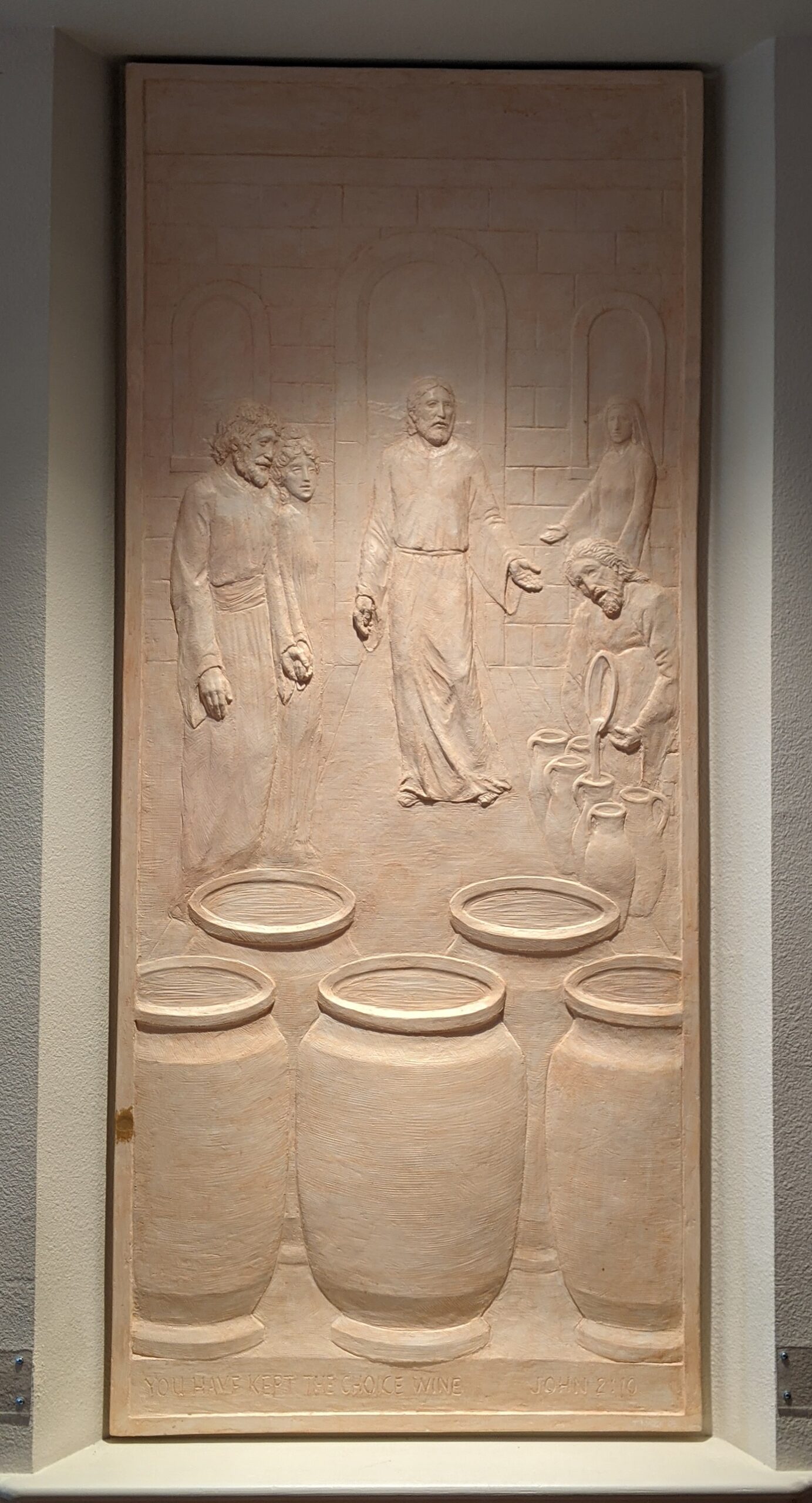
We see another case of scarcity transformed to abundance in the story of Jesus at the wedding in Cana of Galilee, not too far from Nazareth (Jn 2:1-11). Jesus and his friends have been invited to a wedding feast. His mother is there too. It’s a wonderful party and all are having a great time. All, that is, except the hosts. The wine is running out. Someone miscalculated how much people would drink or how many people would be there, or something. It really didn’t matter. Running out of food or drink at a wedding feast is a terrible issue, a shameful thing, even today.

Jesus’ mother notices the problem. She’s probably been involved in planning many weddings and other parties with family and friends through the years. The families of the couple are friends or relatives. What can anyone do to help in such a situation?

In St. John’s telling of the incident, there is something important that she can do. She can tell her son and in so doing, she nudges him to begin his public life. Jesus essentially asks her, “What am I supposed to do about that?” Yet in John’s Gospel, Jesus is presented as one who is in control of what is happening in his life. He is God become human and very much actively in charge of events. He adds, “My hour has not yet come.” It’s not the point in his teaching and ministry to begin doing extraordinary things and showing forth the glory of God, at least he doesn’t think so. But Mary is not deterred. These people need help and they need it right now. “Do whatever he tells you,” she says to the servers.

And so, what to do? Jesus looks around and there are six water jugs in the room. These jugs were used for ritual washing ceremonies when people gathered. Jesus, using what was available, directs that the jars be refilled with water. When this has been accomplished, he instructs the servers to take some to the headwaiter. It was now wine. Not just any everyday, watered down wine, but really good wine. Better than what had been served earlier. The headwaiter even sort of scolds the bridegroom for not serving the best wine first. Folks who have been drinking for a while won’t fully appreciate how good this stuff is!

John ends this story with the comment that in this first of the signs of his coming (as the Messiah), Jesus revealed his glory to his disciples and they “began to believe in him.” He became more than someone John the Baptist thought was important. Maybe he really was someone different and important. Maybe the Promised One had come.

Scarcity had been replaced with an abundance of wine, an abundance of life. God’s presence is revealed.

St. Paul presents another image of abundance (1 Cor 12:4-11). He’s dealing with a community in Corinth that was very diverse and whose members didn’t think of themselves as all being equals. There were many divisions in their society and those divisions didn’t go away when they gathered as a community.

Paul reminds them firmly that there are many kinds of gifts, many kinds of service. All come from God. There is only one Lord. There is no need to argue over which gift or which service is more important. None is more important or more valuable than any other. All are important and all are distributed by God. The Spirit’s presence is seen in each person’s gifts as that person uses the gift for the benefit of all.

A list of different gifts is found here. Wisdom, knowledge, faith, healing, mighty deeds, prophecy, discernment of spirits, tongues, interpretation of tongues. All of these are important, but only if they are used on behalf of the community. No one gets a gift because it is earned or deserved. Gifts are only given as they are needed and they are given to the person who will best be able to use them in service. Yet, there is an abundance of gifts within the community when they are all shared.

The key to each of these stories of scarcity and later abundance is the presence of God. We each have known times that are hard. Times when it seems like nothing will ever get easier. Little or no hope is visible, even on the horizon. Yet when we let the Lord into our hearts in those times, hope begins to blossom like a small flame. As we move forward in trust, serving the Lord and our fellow people with the gifts we’ve been given, however small they may seem, that scarcity falls behind us. We begin to see the abundance of love that fills the world, even when it is masked by “ordinariness” in our days.

Today let’s ask ourselves where the Lord is present, transforming the difficulties and challenges of our ordinary human lives into the beauty of new life, of diadems in the hands of God, of new love between bride and bridegroom, of joyful celebrations of love and new beginnings, and of the growth in wisdom, age, and grace to which we are all called in life.

The Lord has come. Where will we meet him today?

Read More

Posted by on Nov 21, 2021

King of the Universe!

King of the Universe!

Sometimes when children are playing, one or another will exclaim, “I’m King of Everything!” Today we celebrate the final Sunday of our liturgical year, The Solemnity of Our Lord Jesus Christ, King of the Universe. In this case, it’s not a question of the exuberant, excited cry of a child in a game. The Christian community, through the centuries, has proclaimed this truth, both in direct statements and in apocalyptic images.

Predictions of the coming of a savior often appear in the Hebrew Scriptures during times of exile and persecution. This savior comes and acts as the agent of God in opening the final age of salvation history, the time in which God will become the ruler over all things. The human (Son of Man) who is the instrument of God in all this upheaval and transition is to be raised to a heavenly level, implying a divine status of some sort.

Our reading from the Book of Daniel (7:13-14) describes a vision received in the night. Someone like a Son of man is coming, but not with a human army or traveling in a normal human way. This individual is coming on the clouds of heaven. The destination of this Son of man (human) is not a standard one either. The Son of man comes to the Ancient One. Who is the Ancient One? This is a title for God. This human, who has served as agent to open the new age, comes before God. God gives him dominion (authority as a ruler), glory (renown, magnificence, splendor), and kingship over all times and peoples. This new status and role will continue for all eternity.

In Psalm 93, the term Lord is used. In this context Lord is the word used to speak of God. Jews do not use God’s actual name, because if a person knows the name of another, there is some power over the other individual. Call that individual’s name and the individual will respond. God made clear from the beginning that no one else will be in charge. This is the reason for the prohibition on using God’s actual name and substituting the word Lord.

The Lord is king, dressed in strength, making the world firm and ruling from everlasting to everlasting. The decrees/statements/commands of the Lord are worthy of trust. This is a hymn of great trust and joy.

The early Christians had to figure out where their friend and teacher, Jesus of Nazareth, fit into the whole picture. The book of Revelation was probably written sometime in the years 81-96 CE, during the persecution of Christians under the reign of the emperor Domitian. The identity of the author is unknown, though the name John is assigned to this person.

Today’s reading is from the very beginning of the book (Rev 1:5-8). John sends greetings to the seven major Christian communities (the churches) of Asia. The greeting is also extended in the name of Jesus, faithful witness and firstborn of the dead. Jesus is identified as ruler of the kings of the earth. It is through the death of Jesus that the new kingdom has been brought into existence. Jesus is coming and all will see him. His sisters and brothers will be raised through him, conquering sin and death, triumphing over persecution and unbelief. The Lord is the beginning and the end, just as the Greek letters Alpha and Omega represent the beginning and end of the alphabet. (The Christian scriptures were written in Greek, making this a relevant note.) God’s life-giving power now operates in the world through Jesus, the Christ.

On this feast of Christ the King, we leave the Gospel of Matthew and instead hear from the Gospel of John (Jn 18:33b-37). Jesus stands as a prisoner in front of the Roman governor of Palestine, a man named Pilate. Pilate was responsible for keeping the territory free of revolutionaries and imposing Roman law. He asked the leaders of the Jewish court why they had brought Jesus to him for judgement. They responded that they could not legally condemn him to death.

Pilate is not interested in religious arguments between Jesus and the Jewish authorities. Their reason for the death penalty was blasphemy – the claim to be God. However, the most important issue for Pilate is whether this man standing before him has committed treason by claiming to be a king. Only Caesar in Rome gets that title. Anyone else will be executed. So Pilate asks Jesus directly, “Are you the King of the Jews?” He is expecting a simple Yes or No, but Jesus instead asks Pilate a question, essentially, why are you asking me this? If Pilate is interested in Jesus’ teaching, the conversation has potential. If not, then other issues arise. Pilate makes clear that he is not asking because he has heard of Jesus and his teaching and wants to know more. What he wants to know is: “What have you done” that the authorities of your country have turned you over to their enemies for execution?

Jesus does not answer the way Pilate expects. He explains, “My kingdom does not belong to this world.” He points out that if he were a king in the worldly sense, he would not be standing there alone. Others would be fighting for him. But his kingdom is elsewhere. Pilate takes this answer as a statement that Jesus is claiming to be a king and asks for confirmation of that interpretation. Legally it matters. “Then you are a king?” But Jesus still refuses to claim an earthly kingdom. “You say I am a king.” He doesn’t deny being a king, but he is king in a very different way. He explains that his mission is to present the truth of God’s love for humans. Any who accept that truth will be members of his kingdom. God’s gift to humanity, the self-giving love leading to God’s becoming one of us, is the source and power of this kingdom. Those who belong to the truth, listen to Jesus.

Here’s a person who really is King of Everything! Do I listen to his voice? Do I hear the truth of God’s love and the Kingdom of Love? When he comes, will I be ready?

Today let’s not get bogged down in worries about how we are doing in following our Lord. Let’s take some time and simply celebrate the wonder of this gift from our Father. He loves us so totally that he became one of us. Jesus brings this love to each one of us each day of our lives and with every breath of our bodies. Long live Christ, the King of the Universe!

Readings for the Solemnity of Our Lord Jesus Christ, King of the Universe – Cycle B – Christ the King

Read More

Posted by on Nov 14, 2021

The End Draws Near

The End Draws Near

There is a saying, “All good things come to an end.” In our daily lives, we experience this again and again. But sometimes, the end turns out to be a transition to something better. Sometimes, it’s just the end of a cycle and things begin anew.

This is the case with the readings for the Thirty-third Sunday in Ordinary Time, the next to the last Sunday of the Church year. We have traveled through the life of Jesus, from the time shortly before his birth through his Passion, Death, and Resurrection. We have heard the stories he told and met the people he met along his way from Galilee to Jerusalem during the three years of his public ministry. Now the end of the cycle draws near and we hear from both Hebrew and Christian scriptures of what will happen in the final days of salvation history. What will happen at the end of time?

The Book of Daniel tells the story of the Hebrew people during their time of exile in Babylon, but it was not written during that time. It was written much later and is an example of apocalyptic literature – literature that deals with end times. This type of literature often arises during times of persecution and suffering. The story of Daniel, a prophet, was probably written during the time the Jews were being persecuted under the reign of King Antiochus IV, just over 150 years before the birth of Jesus. The prophet hears and proclaims the word of the Lord. “At that time there shall arise Michael, the great prince, guardian of your people.” Michael is an archangel, the one who is God’s defender of the people. Michael protects the good people during a time of great distress. These people escape and will shine brightly, leading the multitudes to justice and eternal life. (Dn 12:1-3) It is noteworthy that by this time in Jewish history, the idea of life after death is seen as a reality for the righteous. It was an idea still being debated during Jesus’ lifetime, but it was accepted by large numbers of people and their leaders.

Stones Thrown to the Ground        by Roman Soldiers

Jesus was familiar with the apocalyptic literature of his people and spoke of the coming end of time during his final days in Jerusalem. The Romans were known to tolerate no dissent and no rebellions among the people they governed. Yet there was a continual undercurrent of discontent among the Jews and an absolute refusal to tolerate worship of the gods of other peoples. The coming of a Messiah to overthrow the foreign conquerors and re-establish a Jewish kingdom was eagerly anticipated. People wondered whether Jesus might be that hero and welcomed him to Jerusalem with all the fanfare they would give to a conquering hero returning home. Jesus knew that military might was not the way the kingdom of God was going to come to the world. He continually reminded his followers that this was not the path he would take. One day, after teaching in the temple, someone commented on the size of the stones that formed the building. Jesus responded that the stones would soon be demolished and not one left upon the other. (Around the time this gospel was written, the temple in Jerusalem was destroyed by the Romans following a rebellion by a group of Jews known as Zealots. The people had  been scattered into exile.)

Later that day, Jesus spoke with his friends and warned them that hard times were coming. They personally would suffer because of their loyalty to him. The entire nation would suffer because many others would come later and try to overthrow the Romans. Many would claim to be the long-awaited Messiah, but they would be false prophets and false messiahs. All would suffer as a result.

It is at this point that our reading today picks up (Mk 13:24-32). Jesus speaks of the last days of the world and his return to gather the faithful to the kingdom. He speaks of himself as the Son of Man, a title from the book of Daniel used to name and describe the Messiah.

No one knows when that last day and the return of the Son of Man will occur. Even the Son does not know. But all are to live their lives prepared for that last day to arrive. We are all to keep our eyes open and notice the signs of the times, just as we notice the changing of the seasons

It’s been a long time since these prophecies were first spoken. Many generations have passed, and likely many more will come and go before the end of the world. But the sacrifice made by our High Priest, Jesus, does not ever need to be offered again, according to the author of Hebrews (10:11-14, 18). The reconciliation between God and all of creation has been accomplished. No matter what happens, a new age has dawned. Salvation has come.

We sing with the psalmist, “You are my inheritance, O Lord! … my heart is glad and my soul rejoices … You will show me the path to life … the delights at your right hand forever.” (Ps 16)

Our liturgical year is drawing to a close. The end of days has not yet come. We face many difficulties, misunderstandings, deliberate lies, political divisions, pandemics, and other trials in our daily lives. But this is really nothing new. It has happened again and again in history. May we cling to the promises of our Lord and live in the way he taught us, being peace-makers and healers of division in our world. Very soon we begin a new year as a community. Let us take the remaining days of this year to celebrate  the protection and love of our God and prepare for the coming of the Lord into our lives today and in the days to come.

Read More

Posted by on Nov 7, 2021

Absolute Trust in the Lord

Absolute Trust in the Lord

“There is only a handful of flour in my jar and a little oil in my jug … when we have eaten it, we shall die.”

The prophet Elijah and a widow star in today’s reading from the book of Kings (1 Kg 17:10-16). Elijah has fled the wrath of Jezebel and Ahab, traveling to the city of Zarephath. Jezebel, as you will recall, has sworn to kill Elijah for his opposition to the decision of Ahab to worship the gods of her people and encourage the people of his kingdom to do the same. One would think Elijah would travel far from any lands connected to Jezebel. But the Lord sent him to the land of Sidon, ruled by Jezebel’s father! (Ever heard the phrase, the Lord’s ways are mysterious?)

Elijah arrives in Zaraphath, hungry, tired, and thirsty. A woman is gathering sticks there. Elijah asks her for a cup of water. When she starts off to get it for him, he asks for something more, a bit of something to eat. It is at this point that her situation becomes clear. She is a widow and has a child. In those days, there was no social safety net. No one was there to help her. Her husband was gone. His family was no longer responsible for her care. Her family had long since given up any responsibility for her. She was on her own. There was no way for her to go out and get a job to support herself. Many women in her situation had no option but to become prostitutes. The lives of these women were short and hard. Their children had no future either. They were left to become beggars, servants, thieves, slaves, or worse!

“Do not be afraid,” says Elijah. These words are so often heard in the scriptures. The Lord will take care of it! He assures her that there will be enough flour and oil for him to have a little cake/bread. The flour and oil will not run out until the rains come again. (This was a time of drought and supplies of food were scarce, making her situation even more precarious.)

We remember this woman because, though she was not a Jew, did not worship or know the Lord, and did not know this man who had come asking for her help, she took a chance and trusted him. She made the bread for him and hosted him in her home through the entire time he lived in Zaraphath, until it became time for him to return to his own land. The jar of flour did not go empty, nor did the jug of oil run out for the entire year they lived together.

Another widow caught the attention of Jesus in the temple in Jerusalem. On this Thirty-second Sunday in Ordinary Time, we hear the story often known as the widow’s mite. (Mk 12:38-44) As the story begins, Jesus was teaching in the temple. He warned those listening to him to beware of the scribes.

Last week we heard the story of the scribe who was praised by Jesus as a man not far from the Kingdom of God. That scribe had heard Jesus teaching when the widow in today’s story gave her gift to the temple. He asked Jesus the question about the greatest commandment and praised Jesus for his answer to the question. But this story came first.

The scribes to whom Jesus was referring here were educated men who served as recorders and lawyers. They knew the law and were careful to observe the letter of the law. Jesus did not criticize their knowledge or their position as specialists. However, he was incensed at the behavior of those who demanded high fees for their services as lawyers and justified the price by their apparent holiness. They recited elaborate prayers and accepted honors from all, then cheated widows and the poor.

Watching the people come and go in the temple, Jesus observed that many well-to-do people came and put large amounts of money into the collection boxes, the treasury. Checks were not used in those days, nor paper money or credit cards, so it was obvious when a large amount of money was being deposited. Then a poor widow came along. She gave two very small coins. These were something like giving two pennies. Not much to offer in comparison with the gifts given by most people. Certainly not enough to warrant attention or praise from bystanders. Yet Jesus noticed and praised her. He noted that those who were giving large gifts were not making any real sacrifice or putting any real trust in God. What they gave was what was left over after all their needs had been met. The woman, on the other hand, gave all that she had. There was nothing held back. She was now totally dependent on God. Her gift was much larger than that of the others, despite being such a small amount in absolute terms. With the psalmist, she could sing, “Praise the Lord, my soul!” The Lord who keeps faith, securing justice for the oppressed and food for the hungry (Ps 146): in this Lord she trusted totally.

Jesus sat in the temple and watched. He taught there. He prayed there. Sacrifices had been offered there on his behalf. That day, he would not likely have thought of himself as a High Priest. He was a carpenter who had received a call from God to tell everyone that the Kingdom of God was at hand. He was to bring good news to poor and rich alike. The Kingdom of God is at hand. Be good to each other. After his death and resurrection, the community reflected on what had just happened and tried to explain it in terms of their religious tradition. (Heb 9:24-28) They knew the High Priest offered sacrifices for himself and all the people. Day after day, year after year, sacrifices were offered in the temple. Yet Jesus had given himself and been raised up by the Father. Jesus had offered the perfect sacrifice to reconcile God and humans, giving himself as the faithful witness to God’s Kingdom and Love. This sacrifice would never need to be repeated. Jesus had promised to return to them. They awaited his coming eagerly.

It’s taken a lot more years than the early followers of Jesus thought it would take before his second coming. We’re not there yet, over 2,000 years later. Yet the stories of these two widows and the reflections of the psalmist and the author of the Letter to the Hebrews still speak to us of the call to absolute trust in God’s love and protection. There are times when we too must simply trust that enough material goods will come along to provide for what is needed, especially when we are asked to take precious time away from “earning a living” to help someone who is unable to fend for themselves. Or when we are asked to share the little bit extra we’ve set aside for something we want but don’t absolutely need. We don’t always get exactly what we might think we need, or when we think we must have it, but we get what is really needed, when it is needed, and not a second before then. I like to think of it as “God’s Just-In-Time Financing.” When the chips are down, something or someone comes through with the particular thing that is most needed.

Today I pray for the grace to continue to trust the Lord and the grace to be generous with my time and treasure, just as the two widows so long ago trusted in the Lord’s protection and care.

Read More

Posted by on Oct 31, 2021

Hear, O Israel! A Call Ever Ancient and Ever New

Hear, O Israel! A Call Ever Ancient and Ever New

The ancient world was home to many peoples and traditions. Like peoples today, questions arose in these cultures about how things came to be the way they are. Why does the sun shine only during the day? Why do the seasons change? Why do people do bad things sometimes? Why do they ever do good things? What will happen if nothing changes?

Cultures throughout the world and throughout history have struggled with these types of questions and have developed their own explanations of how things came to be and what is possible. In the ancient world, most peoples explained the physical world they saw around them and the events in their world with stories of gods – supernatural, immortal beings who were responsible for the creation of the world and the major events that affected the lives of humans. Is there a drought? It’s because the god of rain has been offended. Is there too much rain? Might be the same reason. Are we hoping for a good harvest? Then pray to the god of the harvest and offer a sacrifice of something that god likes.

There were many cultures and all had their own gods, with their own names. Yet as people from these cultures met, traded goods, and sometimes fought with each other, they noticed that many of their gods were the same as in the other culture. They realized some of these might actually be the same god, but with different names. It didn’t bother them. Sometimes they welcomed a new deity into their own religious beliefs, especially if that new one offered something new of value to them. Only when one people was conquered by another and the new one demanded that everyone worship the conquering people’s deities did issues arise. Generally, there was simply a sense that gods were active in particular areas and not in others. This was why Abram was surprised to find God present in all the lands he visited during his lifetime. Abram and his family lived in many different lands, yet God was present in all of them.

The Israelites differed from the people of surrounding countries and even of the land of Canaan in which they lived. They believed in a single deity. This deity was not like humans, with wives and children and battles with rival deities. Theirs was one God. Period. End of conversation.

The first reading for the Thirty-first Sunday in Ordinary Time reminds us of this unique perspective of the Hebrew people and its formulation. Moses has brought the tablets of the Law down from Mt. Sinai to the people. God has offered a contract, an agreement, a holy covenant to them. God will be their God and they will be His people. He is Lord (ruler) of all. He can command and they will obey. In return, He will protect them and give them rich harvests and security in the lands they inhabit. (Dt 6:2-6)

Moses speaks powerful words, words that have echoed through the centuries and are recited as part of both morning and evening prayer by faithful Jews. They are even worn in special garments as a reminder. “Hear, O Israel! The LORD is our God, the LORD alone!” This proclamation is known as the Shema. It is known and recited by Jews around the world and throughout history. What follows this first bold statement is a summation of the covenant responsibilities of the people: Love the Lord with all your heart, soul, and strength. This is the first and fundamental requirement of the Law and the Covenant.

The Psalmist sings with love and joy of this relationship with the LORD (Ps 18:2-4, 47, 51). “I love you, Lord, my strength.” He speaks of the LORD as a rock, a fortress, a shield, a stronghold. He praises the LORD for being a savior and bringing victory to the anointed king of the nation.

As a good Jew, Jesus also knew and recited the Shema.

After he entered the city of Jerusalem, he began going to the temple daily and teaching there. The priests, scribes, and elders of the temple noticed his activities and began to speak with him. His reputation had preceded him and many were likely concerned that he would awaken the hostile interest of the Romans, bringing danger to all. Members of various schools of thought among the Jewish leaders and scholars began to question him in the temple. Jesus answered many questions. Sometimes he asked another question instead of answering them directly, because he knew they were trying to trap him using his own words. Sometimes he told a story as answer to the question.

One day, a scribe heard Jesus talking with a group of Sadducees. He was impressed by Jesus’ answer to their questions and his manner of interacting with them. The scribe, a man who had specialized in study of the Law, asked Jesus a simple question (Mk 12:28b-34). “Which is the first of all the commandments?” Jesus responded by reciting the Shema. “Hear, O Israel! The Lord our God is Lord alone!” Jesus recited the entire verse. Then he added a second commandment, taken from the book of Leviticus 19:18, “You shall love your neighbor as yourself.”

The scribe complimented Jesus on his response. “Excellent, Teacher! You are right…” He noted that loving one’s neighbor was much more important in pleasing God than offering many sacrifices. Jesus saw that this scribe was a man of great insight, not focused on the letter of the law so much as on the implications of what it meant. Jesus complimented him in return, “You are not far from the reign of God.” These words echo the belief that reciting the Shema and making its words the fundamental basis of one’s life is really receiving the kingdom of Heaven (of God).

Jesus spoke as one with authority. The author of Hebrews (Heb 7:23-28) describes him as the one whose priesthood is not based on being a descendant of Jacob’s son Levi but rather on an eternal priesthood stemming from the earlier promise God made to Melchizedek, a promise of eternal priesthood. This new high priest, Jesus, is not a descendant of Levi, but as high priest he brings the ancient Levitical priesthood to a close, offering himself to bring reconciliation between God and humanity. He is the son who has been made perfect forever.

You and I are not expected to be perfect. We will never be perfect. However, we too are called to remember the two great commandments. “Hear, O Israel…” We are children of Abraham through our adoption as sisters and brothers of Jesus. God is One. There is no other. We are to love God with all our being and our neighbors near and far as ourselves. These commands are to be written in our hearts and minds and entire being.

How am I doing with that? Am I expecting God to act like I would act when dealing with the challenges and frustrations I face in daily living? Or am I taking time to remember instead that I am to try to love as God loves in response to those challenges? Do I take time to pray each morning? Do I remember to chat with God during the day? Do I say thank you at the end of the day?

Hear, O Israel … and Kathy too!

Read More

Posted by on Oct 24, 2021

Seeing Hope as Darkness Surrounds Us

Seeing Hope as Darkness Surrounds Us

Have you ever seen a snail’s tongue? They are very tiny. How do I know? I saw one last night, as a very small snail made its way across the glass of the aquarium in which it lives. Its job is to keep the glass free of algae. That’s a big task for a very small creature, but this snail was moving along, bit by bit, licking the glass clean. My sister-in-law and I watched it moving and she noticed the tiny little tongue darting in and out, cleaning the glass. The light was just right and we could see the tracks of where it had already cleaned, in lovely curves, with space between them where the snail was holding on with its great foot.

The snail spoke to me of the gift of hope in the face of what might otherwise seem like a hopeless task or future.

The readings for the Thirtieth Sunday in Ordinary Time are instructional in this regard. We begin with the prophet, Jeremiah (Jer 31:7-9). The people are still being taken into exile, nearing the final end of the kingdom of Judah in northern Palestine. They are facing the possible extinction of their nation and historical line. Yet Jeremiah proclaims, “Shout with joy for Jacob, exult at the head of the nations, proclaim your praise and say: The Lord has delivered his people, the remnant of Israel.” All seems lost, but the prophet speaks the Lord’s promise that they will be gathered from among the nations and return as a newly recreated people. They themselves can never do that alone, but the Lord will do it. The new kingdom is beginning to be understood as something more than a nation-state with a king. It’s to be much greater because not limited to control of territory on land by an individual ruler and family.

They will return on level ground, rest beside brooks of water, and know that their father is the Lord. The reference to Ephraim is also noteworthy. Ephraim was the second son of Joseph, making him a grandson of Jacob. But Ephraim’s mother was Egyptian. She was not one of the relatives of Jacob or a descendant of Abraham and Sarah. Yet he and his brother, Manasseh, were accepted into the family as adopted sons of Jacob. Their descendants became the fathers of two of the twelve tribes of Israel. When Jacob was nearing the end of his life, he gave the blessing due the firstborn of sibling sons to Ephraim, though Mannaseh was actually the older son. Jacob assured Joseph, who noticed what was happening, that he knew what he was doing, that selecting Ephraim for the firstborn’s blessing was the right thing to do. The children of Ephraim became a large tribe in the far north of Palestine. It was these people who were being taken into exile.

Now, we hear the Lord saying, through his prophet Jeremiah, that Ephraim is also the first-born son of the Lord. All will be new in relationships and in creation through the Lord’s actions. Good news of hope for those being driven from their homes and into exile in the lands of their enemies.

The Psalm speaks of the return from exile (Ps 126:1-6). “When the Lord brought back the captives of Zion, we were like men dreaming … our mouth was filled with laughter and our tongue with rejoicing.” The long period of suffering had passed. The Lord had kept the promise made so long ago. “We are filled with joy.”

In the letter to the Hebrews (Heb 5:1-6), the author speaks again of the high priest and his role. Historically the high priest was selected from among his peers, selected by God, just as Aaron had been selected to make the sacrifice of atonement for all the people so many generations earlier. But this time things have changed, we have a new high priest, also selected by God. This new high priest is the Christ. He did not select himself. When Jesus died, he was truly dead as a human being. But God glorified him, saying, “You are my son: this day I have begotten you … You are a priest forever according to the order of Melchizedek.”

Melchizedek was King of Salem and a priest who lived in the time of Abram, long before the Jewish priesthood was established among the Israelites after the Exodus. He was known as a wise, righteous, and kingly man. Jesus, the new high priest, takes this role, now and forever, chosen by God for this role because he is the Son of God. He knows both the difficulties of being human and the mercy and patience of God, so he is the best intercessor humanity could ever have.

The healing of Bartimaeus is the final event in Jesus’ life before he enters Jerusalem on his final journey there for the Passover. This section of Mark’s gospel began with the healing of a blind man in Bethsaida, on the north shore of the Sea of Galilee. Now Jesus is near Jericho, just north of the Dead Sea and next to the Jordan River. It has been a long and eventful journey, and  finally they are nearing their destination.

Bartimaeus (whose name means Son of Timaeus as Mark informs us) is sitting beside the roadside begging. He hears the crowd going by, learns that it is Jesus, and calls out to Jesus for pity. “Son of David, have pity on me. (Son of David was a title given to the expected Messiah, because the Messiah was to come from among the descendants of King David.)

Those around Bartimaeus try to silence him. But Jesus hears him and calls Bartimaeus to him. “What do you want me to do for you?” Bartimaeus comes quickly and responds immediately, “Master, I want to see.” Jesus heals his blindness, saying “Go your way; your faith has saved you.” His sight was returned immediately and rather than going home, he began to follow Jesus “on the way.”

This story comes at the end of a series of stories we have heard over the past weeks, in which Jesus has tried to let his friends know that he is not a conquering Messiah but rather the one described by Isaiah who is the Suffering Servant. His followers have not been able to see what he has been telling them. It just simply makes no sense. They are still more blind than Bartimaeus or the man healed in Bethsaida.

Mark tells us that Bartimaeus followed Jesus “on the way.” The way is not just the road to Jerusalem. After the Resurrection, Jesus’ followers were known as followers of “the way.” It was not until later that they came to be known as Christians (oil heads). Bartimaeus followed “the way” immediately after he was healed. His faith had saved him.

What are the areas of blindness in my life? Where do I lack hope? What feels like it’s crashing in my life? Where are the signs of hope? How do I hold on to the promises of God? Can I just keep doing what I’m supposed to do each day, like the little snail that makes her way around the aquarium, licking clean the glass? I pray for that gift today.

Read More

Posted by on Oct 17, 2021

How Many Times Do I Have to Tell You?

How Many Times Do I Have to Tell You?

How many times do I have to tell you? Which of us has never heard this question addressed to us by an exasperated parent or teacher? Sometimes it’s an issue of not having paid attention. Sometimes it’s a question of not believing it applies to us. Sometimes it’s an issue of thinking that what is being said is too good to be true – or too bad to be believed.

Jesus had the same problem with his followers. In the Gospel reading for the Twenty-ninth Sunday in Ordinary Time, Mark tells us of a time when two of the disciples, James and John, approached Jesus with a confidential request: “Grant that in your glory we may sit one at your right and the other at your left.” (Mk 10:35-45) Jesus was flabbergasted (totally amazed) by their request. “Can you drink the cup that I drink or be baptized with the baptism with which I am baptized?” (To be baptized means to be plunged into something.)

Now Jesus has been telling his friends for a while already that he is going to Jerusalem and there he will be turned over to the authorities to be tortured and killed. No one can comprehend that this is really going to happen. I would guess they think he’s just a worrywart or exaggerating, but he was absolutely serious. This is why he asked James and John if they could do what he was going to have to do. They brashly assured him they would be able to do whatever he had to do, after all, what made him any more capable of dealing with whatever came than they were!

As it turns out, Jesus assures them, you will indeed drink from the same cup – face death for proclaiming the coming of the Kingdom of God – and in fact, they later did die as martyrs (witnesses).

When the others caught wind of this conversation, they were incensed. Who do these guys think they are? As the anger and conflict among them grew, Jesus intervened. He told them once again what would be demanded of them as his followers. He spoke of the social reality that existed in the world of non-Jews, the Gentiles (Romans, Greeks, and other surrounding nations). Large numbers of people were slaves. Estimates are that 1/3 of the people were slaves. Most of the rest were not particularly well-off. Only the rulers and upper classes lived well. They considered themselves to be better than the rest and didn’t hesitate to abuse and take advantage of everyone below them. Slaves were seen and treated as less than human, despite the fact that anyone could be enslaved for something as out of their control as the loss of a family’s income that plunged them into debt. If a debt could not be paid, the whole family and their belongings could be sold to pay the debt!

Jesus spoke words at this point that echoed ones we all have heard so often. Mark doesn’t have him saying, “How many times do it have to tell you?” But there’s the same sense of that in what Jesus says. The disciples are told point blank that if they want to be great, they must behave as if they were slaves to all they meet. The reason for this is that he has not come to be a master. He has come to serve as if he were a slave and to give his life as a ransom. This is not the first time he has told them this. It won’t be the last. Eventually, he will show them, but that comes later…

Isaiah spoke many generations earlier of the mystery of the Suffering Servant who would give his life as an offering for sin, see his descendants in a long life, and be the channel through which the Lord’s will can be accomplished. “Through his suffering, my servant shall justify many, and their guilt he shall bear.” (Is 53:10:11) This is from the fourth song of the suffering servant, the one most fully developed.

Jesus knew of these prophecies. He took them seriously, though many probably thought of them as more symbolic than realistic. Yet they fit into an ancient theme in Jewish history and thought. While the Israelites were traveling in the desert after they left Egypt, they were instructed to set up a tent for the Lord. Only certain people were allowed to enter the tent and only at certain times. If those conditions were not met, it could be fatal for the intruders and their families. Aaron, brother of Moses and priest ordained and authorized to offer sacrifices to the Lord, discovered this the hard way when two of his sons entered the tent and died. He was then required to offer a sacrifice of atonement for their actions or die himself. This is all described in the Book of Leviticus, chapter 16.

Aaron’s sacrifice included the use of two male goats. One was sacrificed and offered to the Lord inside the tent. The other was symbolically loaded down with the guilt for the sins of his sons, himself, and all the people. Then that goat was driven out into the desert to die there, taking the sins of the people with it. This goat came to be known as the scapegoat, perhaps because it was sometimes known as the “escaping goat.” Each year after that, on a date set by the Lord for each year, the high priest was to offer sacrifice on behalf of the people. After the temple in Jerusalem was built, the very innermost court was called the Holy of Holies. The high priest was the only person allowed to enter the Holy of Holies and offer the sacrifice of atonement there. The rest of the people were also to make sacrifices in their personal lives on that day. This tradition has continued to the present day, without the inclusion of temple sacrifices, on the Day of Atonement each fall.

The Suffering Servant in Isaiah would be the one on whom the guilt of all would rest. His sacrifice would bring a restoration of the good relationship with the Lord for all the people.

This theme arises again in the Letter to the Hebrews (Heb 4:14-16). The author speaks of our great high priest, Jesus, the Son of God, who has passed through the heavens. This high priest does not need to offer a sacrifice for his sins and those of the people each year. Nor is he one who cannot understand human frailty and our tendency to sin, to miss the goal of acting lovingly. This high priest has shared everything there is to experience about being human, including suffering, loss, and death, but he has never sinned. Because our high priest is Jesus, we can approach the throne of God with absolute confidence, knowing we will be received with grace, mercy, and the help we need going forward.

So the question arises: Have I heard this time? Do I get it? Do I understand that I am not the one who will be in the driver’s seat? I am not to assume others will do my will. I am to be the one who seeks to meet the needs of my sisters and brothers, without demanding that they change or try to do things my way. Am I willing to serve as Jesus served? Am I willing to try to love as Jesus loved? Am I willing to learn to forgive as Jesus did?

The Kingdom of Love awaits. The ones who serve are the ones who will sit at the places of honor (figuratively, of course). Our Lord reaches out in service. As his followers, we are called to join him in doing the same.

Read More