Pages Menu
RssFacebook
Categories Menu

Posted by on Jun 29, 2025

Peter and Paul – Unlikely Heroes

Peter and Paul – Unlikely Heroes

Peter and Paul – One a Galilean fisherman, the other a Pharisee, scholar of the Law, immigrant from the city of Tarsus in the province of Cilicia in Asia Minor, and Roman citizen. The first’s original name was Simon and the other’s was Saul.

The chances they would ever meet, let alone become co-workers, sharing the news of the coming of the Christ to all they met and serving as leaders in the community of disciples of Jesus were miniscule. Both would eventually meet their death in Rome in 64 CE – capital city of the Empire. According to tradition, Peter was crucified, upside down per his request. Paul, as a Roman citizen, was beheaded – crucifixion was reserved for non-citizens!

A simple fisherman

Simon/Peter first met Jesus in the fishing town of Capernaum. Jesus saw him, mending and drying nets with his brothers after a long fruitless night of fishing. They had not caught anything. St Luke tells us that Jesus got into the boat to teach the people gathered on the shore. After a while he told Simon and the others to take the boat out again and toss out their nets for a catch. What nonsense! Fish didn’t bite or get caught during the day.

But something about Jesus was different, compelling even, and so they set out again. Imagine their amazement when the nets filled to overflowing with fish! They had to call the other boat with whom they usually worked to come help. Both boats were filled to the brim and more. Simon dropped to his knees and begged Jesus to leave him, a sinner not worthy of such a miracle. Jesus’ response was totally unexpected. “Do not be afraid, from now on you will be catching men.” They took their boat to the shore, left everything – boat, nets, fish, even families – to follow this man. And, oh, the wonders they would see.

Through the next three years they witnessed healings of all kinds, children and adults raised to life again, storms on the Sea of Galilee calmed at a word, thousands of people fed with just a few fish and loaves of bread, a triumphal entry into Jerusalem, and so much more. All the while, Jesus was teaching them about the Father and the Kingdom of God.

So many people came to hear Jesus and follow, but Simon held a special place among the twelve who were his closest friends. More than just followers, disciples, they were his friends. Clueless friends sometimes, but Jesus was patient with them and kept teaching about the Kingdom.

They traveled through the Galilee, Samaria, and Judea. Many times Jesus had to correct their expectations of who the Messiah would be and what their role would be. After the times he had fed thousands of people who had come to listen to him with just a few fish and loaves of bread, he asked his disciples one day, “Who do people say that I am?” They replied that folks thought he might be Elijah the prophet returned to earth, or John the Baptist raised from the dead, or Jeremiah or some other prophet. Then Jesus asked a more personal question. “Who do you say that I am.” Simon replied, “You are the Christ, the Son of the Living God.” Pretty daring words, but Jesus didn’t deny it. He acknowledged what Simon had said, adding, “… You are Peter (Rock) and on this rock I will build my church.” (Mt 16:13-19)

No one understood what Jesus meant at the time. Peter continued to learn without clearly seeing what was coming, even denying he knew Jesus in the garden of the high priest during the trial. He didn’t believe when Mary of Magdala brought word of the resurrection and he and the others hid in fear of the authorities before the coming of the Holy Spirit at Pentecost. Yet Peter became and remained the leader of the community. He and the other apostles, none of them trained in theology or leadership, learned how to lead a community and proclaim boldly what they had seen and heard. They preached, they healed the sick and lame, they witnessed to the religious leaders about what they had seen and come to believe, and rejoiced when as a result they were publicly whipped and otherwise shamed.

When Herod was persecuting the community, Peter was arrested. Herod planned to have a trial and execute him after the festival of Unleavened Bread. Sixteen soldiers were set to guard him, lest he escape. The community prayed fervently for his release, and God answered. The night before his trial, while sleeping chained to two soldiers – one on each side of him – an angel came and woke Peter. The chains that held him bound to the guards dropped away. The angel was quite practical, telling him to get his belt and pouch and to put on his cloak, then follow. He was led out of the prison, past the other guards and out the door and the iron gate, which rose silently and automatically as they approached. He found himself free on the streets of Jerusalem. He went to the house of John Mark, where all were amazed to see him, assumed he must be a ghost, and then gave thanks for his release. Afterwards, he wisely left the area to work in another community. (Acts 12:1-11)

A Pharisee and Student of the Law

Paul/Saul, on the other hand, was a tent-maker by trade. He never met Jesus before Jesus’ arrest, condemnation, death, and resurrection. In fact, he was so absolutely positive these people were liars and heretics – probably low-life scum out to take advantage of others and lead them astray – that he actively set about to arrest and convict them of crimes punishable by death.

When Stephen was arrested and charged with heresy, Saul was among those outraged by his words testifying to his faith. He watched over with approval the robes of those who stoned Stephen to death – the first to die as a martyr, a witness to the coming of the Kingdom.

Following Stephen’s death, Saul led a group from Jerusalem to Damascus to arrest the Christians there. On the road, he met Jesus and his life was turned upside down! Left blind by the vision of Jesus with whom he spoke, he went on to Damascus and there was visited by Ananias, who taught him of Jesus’ life and teaching. Saul, now known as Paul, became such a persuasive preacher that the community had to lower him in a basket outside the city walls in order for him to avoid death at the hands of Jewish authorities there!

Folks in Jerusalem were not ready to trust or welcome him. The leaders eventually accepted him, but his preaching was so compelling it attracted too much attention from the authorities. It was decided that it would be better for all if he just went home to Tarsus and went back to making tents.

Several years later, he was called back to Antioch and sent on the first of his missionary journeys to another part of western Asia Minor to preach the Gospel. He found a more willing audience among non-Jews, though he always began with the Jewish communities in his preaching.

His ministry to the Gentiles, combined with Peter’s experience in the house of Cornelius when the Spirit came upon the Romans there before they were baptized, led to the decision at the Council of Jerusalem, called to determine whether folks had to become Jews in order to be Christians. The decision, based on the experiences of Peter and Paul, was that it was not necessary and the Church set out on a new and broader path.

Eventually, both Peter and Paul ended up in Rome. Peter went there freely to work with new Christians in the city. Paul appealed to Rome for trial after having been arrested in Jerusalem. It was his right as a Roman citizen to be tried in Rome. Both died there.

Paul wrote of his life and hope for the future to his close friend and disciple, Timothy, as his death approached. His words have been an inspiration for centuries. (2 Tim 4:6-8, 17-18)

A new leader was chosen for the people of Rome after Peter’s death. To this day, the Bishop of Rome, as successor to Peter, is the leader of the Roman branch of the Catholic church community.

Heroes who changed the world

Two very unlikely heroes. One with little formal education. One with quite a lot of it. One from a conquered country. One a citizen of the conquering nation because he was born in a city of the empire. In art, one is portrayed carrying a set of keys and the other with a book and a sword. Peter and Paul.

Together, they became essential leaders of a community whose beliefs transformed the world in which they lived. Western civilization developed in a different way than it would have before they accepted the call they received to go out to the ends of the earth and teach everyone about the man they had met who turned out to be the Son of God, the Chosen One come to show humans how to live as children of God, heirs to a greater Kingdom.

None of us is likely to become as famous as they became. But each of us is also called to be part of that Kingdom they brought from a seemingly insignificant land out into the broader world. Each of us will influence others as well, for better or worse, in hearing about and choosing to become part of the Kingdom or not.

In that Kingdom they helped introduce to the rest of the world, the poor are helped to find food and shelter, welcome from the community and a chance to build a new life. Those who are sick receive care. Those who are from less honored communities are respected. Those whose lives are threatened by the strong are given refuge.

We are the ones called today. We follow Peter and Paul, and so many, many others after them as we live our lives in service to the Lord through our own families and communities, and even to the ends of the earth.

As the psalmist proclaims in song, “Taste and see how good the Lord is: blessed the one who takes refuge in him.” (Ps 34:2-3, 4-5, 6-7, 8-9)

Peter and Paul – unlikely heroes, who model a life of faith and witness for us all.

Readings for the Solemnity of Saints Peter and Paul, Apostles – Cycle C


Read More

Posted by on Aug 27, 2023

What’s in a Name?

What’s in a Name?

In our contemporary Western culture, names are given to us at birth and we typically keep them in one form or another for the rest of our lives. One of the first questions we ask when a child is born is, “What is the baby’s name?” Then we wonder how the parents happened to select that particular name. Was it a name belonging to someone else in the family? Was it the name of a friend or respected author, teacher, sports figure? Where did the name come from and what would it tell us about the child?

As we grow up, people ask us our names and we give the name by which we want to be known or by which we are legally known, depending on the circumstance in which the question is asked.

Sometimes people change their names as they grow older. It may be that the name simply doesn’t work well in their profession. A lovely woman I knew was a teacher whose last name was the same as that of a type of fish. She changed the name by which she was called to Sister Grace (her middle name) rather than Sister Iona in the early 1970s when religious women returned to their birth names rather using than their religious names. Her given name would have been too distracting to the children she taught. Others change their names to match their gender identities. Some change their names because they simply never liked the original one. Some change because their cultures expect married women to take their husband’s last name.

This is not the pattern in all cultures. In many cultures, names are not assigned until a child reaches a certain age. Names can be changed as circumstances change. In some cultures, a person’s name is what the other person wants to call them. “What would you like to call me?” is an acceptable response to a question about one’s name. The new name describes a new relationship, a new reality. Our own practice of having special names/titles for parents or other relatives is similar in this regard.

Jesus had a human name, given to him at birth. His family and friends knew him by this name. He was the son of Joseph, a native of Nazareth. His followers also had names given them by their families.

Yet as Jesus moved through the time of his public life, questions arose about who he was. In Nazareth they asked, “How can he be anybody special? We know his parents. He grew up here among us.” In other cities, folks began to wonder if he might be one of the prophets, maybe a new one or maybe Elijah, the one who was to return before the Messiah, the Anointed One, would come to restore the kingdom of Israel.

One day, when traveling with his disciples in northern Israel, Jesus asked them what they were hearing among the people. “Who do the people say that the Son of Man is?” Son of Man was a term used in Hebrew scriptures to name the savior who was to come. The savior was to be one like a Son of Man. It wasn’t a name one typically used to describe oneself, so this was in itself important. The disciples mentioned John the Baptist (Jesus’ recently executed cousin), Elijah, Jeremiah, or one of the prophets as identities that people were speculating might apply to Jesus. There was a tradition that Elijah would return before the Messiah came.

Jesus then asked the disciples, “Who do you say that I am?” Talk about putting them on the spot!

Simon, always the impulsive one, responded, “You are the Christ, the Son of the living God.” This was quite a statement. The Christ, the Anointed One, is much more than an ordinary man. We may speak of Jesus as if Christ were his last name, but Christ is much more than that. The Christ is the Messiah, one sent by God to reconcile the human and the divine. It was not a title to be used lightly. People who claimed that title could be executed as heretics.

Jesus praised Simon for his insight. Then he conferred a new name on his friend, one that was not in common use at that time. “Blessed are you, Simon son of Jonah, for flesh and blood have not revealed this to you, but my heavenly Father. And so I say to you, you are Peter and upon this Rock I will build my church…” (Mt 16:13-20)

Peter  (Petros) is a masculine form of the Greek word for rock, petra. This type of rock was not a rock like a huge boulder. It was more like a small section of a massive ledge. This new name recognized his strength and leadership position among the disciples, as well perhaps as his tendency to go out on a ledge from time to time! It was not a man’s name in use at that time, but it became common in subsequent years because of the faithful life he lived.

Names have meaning. Peter, the rock, was not a perfect follower of Jesus. He made many mistakes. He sank into the waves as he tried to walk across them to Jesus on the stormy lake. He tried to convince Jesus not to go to Jerusalem. He allowed Jesus to wash his feet, rather than refuse and be excluded from the community. He denied his master in the high priest’s courtyard when Jesus was on trial. He was not there as a witness of the crucifixion. But he was still a leader of this small group of men and women whose witness would lead to the spread of the Good News of the resurrection and of God’s great love for all of us. He saw the empty tomb. He met the Lord after the resurrection in the upper room where they had celebrated the last meal together with Jesus. And this imperfect man, this man who kept returning to ask forgiveness, was selected to be the rock-strong leader. The one whose leadership would help ensure the continuation of the mission, he learned from his mistakes and continued to follow his Lord.

What does your name mean? How does it reflect who you are? What would others call you if they could give you a new name? How would you like to be known?

This is a good time to find out a bit more about the meaning of your name. Do you have a patron saint? How about a confirmation saint? Who were they? Why did you choose them?

We grow in faith as we learn about those who came before us. We also grow as we look at our lives and dreams today. Names matter. Names are powerful. May we always use them to support each other and build a community of love and respect.

Readings for the Twenty-first Sunday of Ordinary Time – Cycle A


Read More

Posted by on Aug 13, 2023

Why Did You Doubt?

Why Did You Doubt?

As humans, we like to have things in our lives happen in predictable ways. Babies learn to expect certain patterns of behavior from the people around them. I cry, someone picks me up and feeds me, or changes my diaper, or helps me burp. I can count on getting reassurance and help when I need it. If I don’t, something is terribly wrong and I will tell the world about it at the top of my lungs!

With older children and adults, life is easier if we know what to expect. What time do I need to get up? When do we eat? What do we eat? Where do I have to be at noon? And so on.

When natural disasters hit, or wars, or even unexpected heat or rain that upsets planned or ordinary activities, we want to know why that happened. Historically, people have blamed the natural disasters on divine activity. The gods are angry, with each other or with us. Think of the stories of Zeus or Thor, who used thunderbolts or a great hammer to fight when displeased.

Middle Eastern peoples also interpreted such happenings as being the result of the displeasure of their gods. This form of explanation was simply part of their everyday experience.

The prophet Elijah ran into trouble with the king when he defeated and killed the priests of Baal. Jezebel, wife of King Ahab, was not amused. In fact, she tried to wipe out all of the priests and prophets of the Lord. Elijah escaped into the wilderness, where an angel gave him food and drink, then sent him on his way to the mountain of the Lord, Mount Horeb/Mount Sinai. On the mountain top, there was a cave. Elijah was nervous about being on the Lord’s mountain. It was dangerous. If you saw the Lord, you would die.

But the Lord told him, “Go outside and stand on the mountain before the Lord…” Before Elijah could do as he was told there was an uproar outside. The wind roared around the mountain. Rocks were crushed. There was an earthquake, then a fire. To the ancients, all of these were signs of the presence of the divine.

But God wasn’t in these physical events. After all the uproar, there was a tiny, whispering sound. That was the presence of the Lord and Elijah hid his face in his cloak, then went out to meet the Lord. (1 Kgs 19:9a, 11-13a)

Jesus’ disciples also had a frightening experience. They had just seen Jesus feed a huge crowd of people with just a few loaves of bread and a few small fish – the lunch of a child who offered to help feed the rest. Jesus had sent the disciples to return home with the boat across the Sea of Galilee, a large inland lake. He sent the people home and went up on the mountain by himself for a little while to pray. (Taking time out to pray by himself was a common practice for him.)

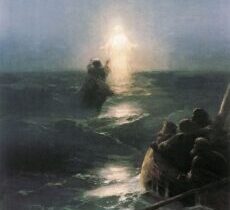
From the mountain he noticed that a great storm had arisen on the lake and the boat was struggling to stay afloat. So he went down from the mountain. Just before dawn, the disciples noticed something coming across the water. They most likely believed there were monsters deep in the lake who caused storms. Ghosts were also easily believable in the middle of a storm. So, when they saw a figure coming across the top of the water, they were terrified.

Jesus called out to them, “Take courage, it is I; do not be afraid.” Well, could that be true? Might that be the kind of thing a ghost would say to lure them into a false sense of security? Peter responded, “Lord, if it is you, command me to come to you on the water.” Jesus said simply, “Come.” And Peter went over the side of the boat and walked towards Jesus.

All was well until Peter stopped to think about what he had just done. He had stepped over the side of the boat, in the middle of a storm, on a deep lake and was now walking towards what was either a ghost or his friend Jesus. Since people don’t walk on water, it might have just been a terrible mistake on his part. As such thoughts entered his mind, he began to sink into the water. He called out, “Lord, save me!” and Jesus reached out a hand and saved him, saying “O you of little faith, why did you doubt?” The waters calmed and they got safely to the boat again.

The use of the term Lord was significant. That was a term used for God. The disciples recognized who their friend was and bowed down to honor him. “Truly, you are the Son of God.”

Once again, the storms raged, the winds blew, disaster was upon ordinary people, and the Lord was there, quietly reassuring them. Elijah on the mountain, and the Lord was in the quiet whisper outside the cave. Peter sinking in the waters of the lake. “Why did you doubt?” I am here in the midst of it all. (Mt 14:22-33)

We can think we’ve got everything under control. We want to share our faith and our experiences with others. We have a good job, or at least a steady one. Our children are healthy. And then something unexpected happens. We lose a job. A friend gets cancer. A pandemic shuts down the world. Forest fires darken the skies with smoke. Hurricanes and tornadoes destroy communities. And we wonder what we did wrong. Why did God let these terrible things happen to us? Did God do all of this to punish us? Are these indicators that the end of time is upon us?

I think it’s important to remember Jesus’ question, “Why did you doubt?”

What is it that you doubt? What do I doubt? Which promise of the Lord do I need to trust more deeply.

In this week, let’s try to remember to trust that we are loved deeply and unconditionally by our Lord. Whatever happens, it’s not that God is angry and out to get me. It may be that there are unexpected consequences to choices we have made, but God doesn’t set out to punish us. We are free to make our choices and they don’t always work out as we had expected.

Sometimes, the hard or unexpected things that happen are the result of the actions of others. In those times, the Lord is with us too, sharing in our pain and offering loving support to help us get through the troubles. He has been through hard times too. He knows our pain and suffering. He wants to help and offer a hand to lift us out of the waters of doubt and despair.

With Peter, we reach out to his offered hand. We return to the boat, having recognized our Lord.

Readings for the Nineteenth Sunday of Ordinary Time – Cycle A

Read More