Coming From the Ends of the Earth
 Again and again through the history of the world, groups of people have had to leave their homes and travel to other regions in search of a safe place, with resources available for them to use, so they can live and raise their families. We still see in our world today many of the different ways that people have found to gain the resources for their survival and even the thriving of their cultures.
Some peoples have been what anthropologists call hunter/gatherers. These folks may live in a specific region, but their livelihoods depend on having enough animals to hunt or fish and plants that can be harvested and preserved for use throughout most of the year.
Other folks follow their herds of animals from one grazing area to another. Many types of animals make up these herds – sheep, goats, cattle, llamas, alpacas, reindeer, etc. Horses, donkeys, dogs, and camels are among the other kinds of animals used to travel with and manage the herds or serve as pack animals. These animals also offer an advantage when times get hard and the community must move into the lands of other peoples, whether as traders or as invaders.
We’re more familiar with peoples who have both cities and rural lands, with a form of government that places some persons in charge or provides for the people to select representatives to manage the access to resources for living as communities.
The Hebrew people, originally herders but later a settled people with cities and rural areas, found themselves on more than one occasion either as the invaders conquering a new land for themselves or being conquered and displaced from the land. After the conquest by the armies of Babylon and its allies, they spent many years outside their former land. Eventually, however, the armies of Persia conquered Babylon and the people of Israel were allowed to return to Judea. Isaiah the prophet describes their return and the promises of the Lord as they rebuild the city of Jerusalem, the temple, and their way of life.
Near the end of the book of Isaiah, the Lord promises: “I come to gather nations of every language; they shall come and see my glory. … They shall proclaim my glory among the nations. They shall bring all your brothers and sisters from all the nations as an offering to the Lord.” (Is 66:18-21)
The words originally were understood to refer to Jewish/Hebrew exiles who lived throughout the Middle East and North Africa and also to good people from the nations among whom they lived. They would return to offer sacrifice in Jerusalem. The Lord notes that although not all are of the tribe of Levi, some of these who come will also be chosen to serve as priests and teachers. It is not necessary to be of the correct ancestry to serve the Lord.
Jesus also stressed the importance of following the way of the Lord in his teaching. “Strive to enter through the narrow gate, for many, I tell you, will attempt to enter but will not be strong enough.”
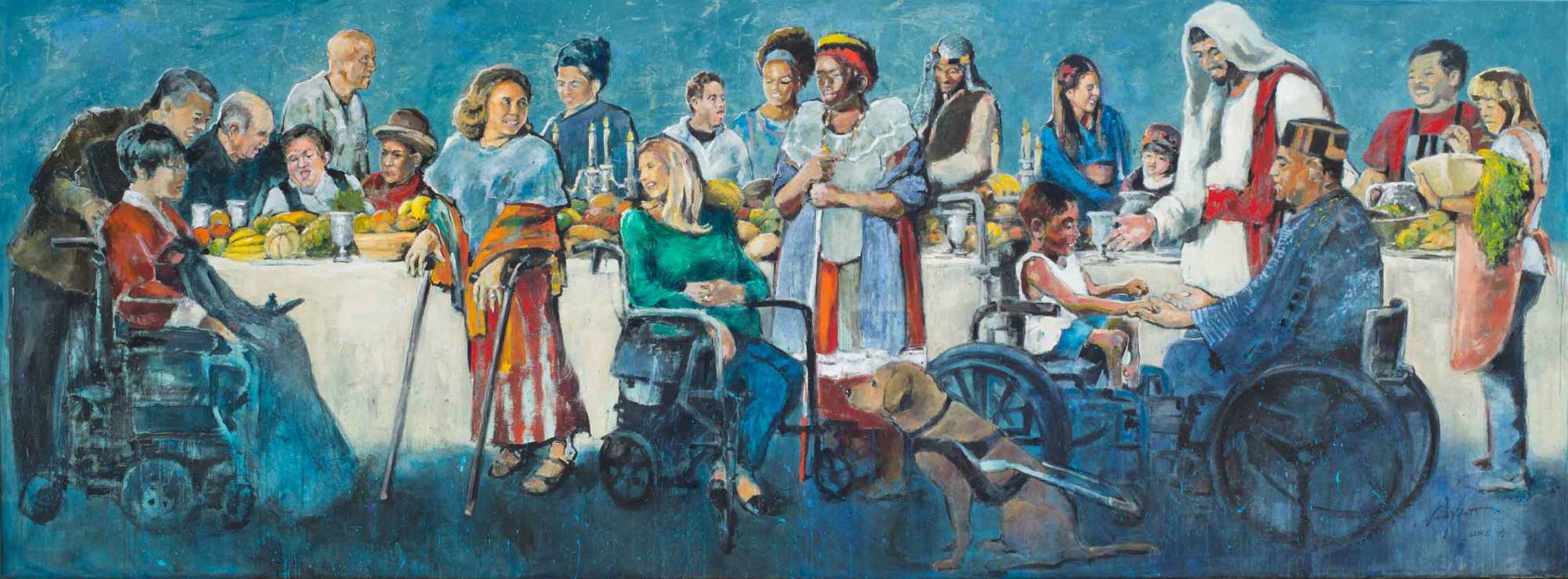
Not strong enough? Yes – not living in the way shown by “Abraham, Isaac, and Jacob and all the prophets in the kingdom of God.” Yet others, he tells us, “from the north and the south will recline at table in the kingdom of God.” Not the powerful or comfortable as would be expected in most societies. “Some are last who will be first, and some are first who will be last.”
Jesus makes clear that our choices matter. The narrow gate does not necessarily refer only to a physical gate into the city of Jerusalem. It is also a way of living: choosing to live according to the Law of love, the Law given by the Lord to guide his people in his ways. Anyone who lives in this way, will be welcomed to the kingdom of God. (Lk 13:22-30)
As might be expected, this kind of life is not easy. There will be successes and failures. When we fail to live by the law of love, to enter through the narrow gate, consequences will not be pleasant. It might seem the easy way at first, but in the long run, things can turn out very differently than first expected. What seemed a great way to live may prove to be a great way to fail to love.
The author of the letter to the Hebrews speaks of the consequences as “discipline” in the sense of the punishment a parent might impose on a wayward child to teach the child the proper way to act. The easy way, the way we are most likely to find attractive, is so often not the narrow way, the way of sacrifice that puts the well-being of others at the forefront of our considerations.
Our author reminds all that such training “brings the peaceful fruit of righteousness to those who are trained by it.” He encourages all: “… strengthen your drooping hands and your weak knees. Make straight paths for your feet, that what is lame may not be disjointed but healed.” In the long run, doing the right thing will bring its own rewards – the rewards of on-going life in the kingdom of the Lord. (Heb 12:5-7, 11-13)
Fine and good. But what does it mean for us today? Most of us live in settled communities. We have our national origin stories and mythic histories of how things came to be. We speak of rugged individuals who settled the lands known as the United States of America. We ignore the fact too often that these lands were settled long before Europeans, many of them refugees, came here seeking a new start, a way to build a community that is rather like those they left, but with the freedom to worship or govern themselves in a different way. We also ignore the contributions of people from all over the world who came to work and build the communities and institutions we take for granted now.
How do we ourselves fit into the kingdom of God? Would our communities be recognized as followers of the Way of Jesus by the early Church? What is it about us that sets us apart from the larger society? What does it mean today to go through the narrow gate? Who are those coming from the north and south, the east and west, to eat at the table of the Lord? Will we be invited to join them for dinner?
These are important questions to ask ourselves. In what ways do we help and support those with fewer resources who struggle to support themselves and their families? How do we welcome and help those who have had to flee their lands to save their lives and those of their families? How do we help children who struggle in school or who are hungry or un-housed? Do we quietly accept policies that take away help from those in need? Do we act as if all would be well if only everyone did X, Y,or Z?
When I was growing up, we lived in a working-class neighborhood. My parents grew up during the Depression and World War II. They had been to college and we had many skills that our neighbors didn’t have, including our practice of making soap and noodles – not on the same day or using the same equipment, of course! But we felt, or at least I felt, rather smug that we knew how to support ourselves better than some of our neighbors did, because our great-great-grandparents had been pioneers and passed on the skills they used in the late 1800s through the generations to us.
It was only later, as an adult, that I discovered to my shock that due to the cost of flour and eggs, it could be less expensive, more affordable, simply to buy a package of noodles to feed a family for a day than to buy the ingredients in packaging quantities that would be far more than needed for that day. If money is not an issue, it’s fine to buy enough to last for a month. But if money, or lack thereof, is an issue, then our middle-class solution would not work! Flour isn’t usually sold in one or two cup packages and it’s hard to buy just one or two eggs at the grocery store! It’s easier and more affordable simply to buy a bag of noodles.
What then do we do? How do we find the narrow gate?
Maybe we find the narrow gate by opening our eyes to those who have come and are coming from the ends of the earth. What can we learn from those who leave all behind and travel to a new land, with a new language, and new ways? How can we be a welcoming people rather than a people or even just a person who is afraid that sharing what we have will mean we don’t have enough for ourselves?
“Limited Good” or “Enough for All?”
We easily fall back on a notion common around the world that anthropologist George Foster called “limited good.” Limited good is the notion that there is only just so much of what is needed for a good life available in the world. To the extent that my family and I get a larger share of that good, you and your family will get less.
The challenge and limitation of this perspective is that it can be a source of conflict, unless a social method has been developed for sharing the wealth. In many societies, those who have much are expected to share what they have in ritual ways, including giving most of it away in specific ceremonial gatherings. Those who give away the most get the highest honor!
Suppose we could shift the idea a bit and instead of thinking about Good as a limited property or thing, we could conceive of it as being unlimited if we just work together to help each other along the way? In this scenario, I help you when I have something you need and you help me when the tables are turned.
Rather than cutting taxes for the wealthy and taking benefits away from the poor, all could benefit from providing the basic support to allow people to grow up and contribute to the good of all by using the talents they bring to the table. An approach such as this has proven to improve the well-being of most of the people of the country when actually put into practice in each community. To the extent it hasn’t worked, it’s often because the funds have not been redistributed effectively or justly to help those most in need of them.
The problem with this approach, of course, is that it’s hard to remember that having more is not necessarily the goal of life. Social respect and praise go to those who amass fortunes and live large. Having resources and sharing them freely is not valued and often not respected. It is the narrow way, the way of love, the way of the Kingdom of God.
As we go through this coming week, may we be aware of the times we have forgotten to seek and follow the narrow way. May we work to share what we have been given and work to help those with less opportunity to get the resources they need to thrive. May we help newcomers and the vulnerable among us. And most importantly, may we remember that the Lord is present in the young, the old, the poor, the un-housed, the sick, those in prison, and those who are refugees. If we want to meet him, look around. He’s right here among us.
Readings for the Twenty-first Sunday in Ordinary Time – Cycle C