Pages Menu
RssFacebook
Categories Menu

Posted by on Nov 30, 2007

Saint of the Day – St. Andrew

Saint of the Day – St. Andrew

st-andrew-apostle.jpg

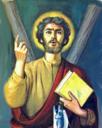
November 30 is the feast day of St. Andrew, the first apostle called by Jesus. He was the brother of St. Peter and introduced Peter to Jesus. There is very little we know about his life. The Gospels show him present in the ministry of Jesus but in the background, while Peter, James, and John are out front.

The Gospel of Mark (1:16-17) tells of his call by Jesus.

As he passed by the Sea of Galilee, he saw Simon and his brother Andrew casting their nets into the sea; they were fishermen.
17
Jesus said to them, “Come after me, and I will make you fishers of men.”

The first chapter of the Gospel of John presents the call differently:

The next day John (the Baptist) was there again with two of his disciples,
36
and as he watched Jesus walk by, he said, “Behold, the Lamb of God.”
37
The two disciples heard what he said and followed Jesus.
38
Jesus turned and saw them following him and said to them, “What are you looking for?” They said to him, “Rabbi” (which translated means Teacher), “where are you staying?”
39
He said to them,”Come, and you will see.” So they went and saw where he was staying, and they stayed with him that day. It was about four in the afternoon.
40
Andrew, the brother of Simon Peter, was one of the two who heard John and followed Jesus.
41
He first found his own brother Simon and told him, “We have found the Messiah” (which is translated Anointed).
42
Then he brought him to Jesus. Jesus looked at him and said, “You are Simon the son of John; you will be called Cephas” (which is translated Peter).
43
The next day he decided to go to Galilee, and he found Philip. And Jesus said to him, “Follow me.”
44
Now Philip was from Bethsaida, the town of Andrew and Peter.

There is a tradition that St. Andrew was crucified on an X shaped cross at Patras in Greece. We don’t really know where he went to spread the Gospel. Many countries from Greece to Russia claim him. He is the patron saint of Scotland.

These few lines from the Gospels show us a working man who heard the call of John the Baptist with his brother Peter and then followed after the Man John had called the Lamb of God. There is always a human desire to know more about such a person, but what we do know is that St. Andrew challenges us to leave our nets behind and follow too.

Read More

Posted by on Nov 29, 2007

Don’t Feed the Bears or the Deceiving Spirits

Don’t Feed the Bears or the Deceiving Spirits

bear-cubs.jpg

When I was growing up, Yogi Bear was a popular cartoon. Yogi lived in “Jellystone Park” and, with his sidekick, Boo-Boo, took it as his mission to defeat the park ranger and get picnic baskets from the tourists. It was all very silly and funny to watch.

In the actual world, “Don’t Feed the Bears” was and is a serious statement. Bears are wild animals and play an important role in the environment. However, bears that get used to eating human food or bears that come close to humans can be dangerous. Cute little cubs have fiercely protective mothers who do not hestitate to defend them.

As an adult, I have come to observe that there are other beings who should not be fed. This is the story of one person’s encounter with one of those beings.

It had been a difficult day. The children were out of sorts. She was short of sleep. Her husband was worried about problems at work. Nothing seemed to be going right. To top it all off, like the proverbial cherry on the banana split, he had criticized her housekeeping or some such thing. (Later she couldn’t even remember what it had been.) She got the children to bed, the dog to the kennel and went to bed herself.

Usually, when she’d had a day like that, a good night’s sleep took care of the problem and the next day went better. But that night she couldn’t sleep. She was too angry. She kept going over and over in her mind what had happened and how unfair and unjust it all had been. The time dragged on and she couldn’t calm down. She tried praying the rosary, because often that helped her go to sleep when she was upset or worried, but that didn’t help either.

Finally, it occured to her to ask God to take away the anger and resentment so she could get some sleep. No sooner said than done! Her eyes were closed and she was lying on her side. She had the sensation of the blankets being flung back off of her – and at that instant, there was a cold, bright, bluish flash of light which stung her leg and then was gone. She no longer felt angry or resentful, but rather peaceful and ready to sleep. Thanking God, she drifted off to a restful night of sleep.

A couple of weeks later, she was talking with a friend about what had happened. The friend has the gift of healing, so she knew he wouldn’t think she was making it up. She described what had happened and he said that he could see, looking with his mind’s eye at the scene, what she had not seen. Behind her as she lay on the bed, a golden light appeared. (Golden light is often associated with the divine or the holy – as in halos around the heads in pictures of saints.) The golden light moved over her and exposed the deceiving spirit, forcing it to flee. The spirit had stung her as it left, in anger at being exposed. Then the golden light had covered her and let her rest.

I have often reflected on this woman’s experience. I had never really thought of anger, resentment, jealousy and the other negative emotions as spirits or as having any real “being” outside of the individual person. It would seem that I was mistaken.

I am now very careful about what emotional states I nurture. When I am angry, I try to remember not to feed that “spirit” by dwelling on how I have been wronged. Feeding these deceiving spirits only strengthens them and allows them to reach out and hurt others through me. They tell me I am the one who was hurt, but in my heart of hearts I know that “it takes two to tango” and despite what they might have me believe, I am rarely a totally innocent victim.

In these days of the ending of one liturgical year and beginning of the next, when the readings speak of the last days and of judgements to come, maybe we would all do well to make a sign and post it in our hearts, “Don’t Feed the Deceiving Spirits!”

Read More

Posted by on Nov 28, 2007

The Kingdom of Heaven – Then and Now

The Kingdom of Heaven – Then and Now

siege-of-jerusalem.jpg

As Advent and the beginning of the new liturgical year approach, the readings are replete with messages of apocalypse, end times, and the reign of God.

The central theme of Jesus’ teaching in the Gospels is the approaching Kingdom of Heaven. To enter the Kingdom we must be like children, we must leave everything behind, we must have faith even as small as that of a mustard seed. The reign of heaven, the dominion of heaven, the regime of heaven, are all ways of emphasizing the transformative nature of the rule of God on earth. Jesus before Pilate says, “My kingdom is not of this world.” In His prayer teaching us to pray, Jesus says, “Your kingdom come – Your will be done on earth as it in heaven.”

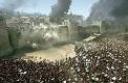
The history of Christianity is replete with efforts to make society conform to Christian teachings in order to bring about a kingdom quite different from what Jesus announced. The movie, The Kingdom of Heaven, is a modern take on crusades and comes at a pivotal time in relations between Christians and Moslems. The movie is a contemporary fable about how we all should live together in peace and religious tolerance. Certainly it is a good message, but the movie defies history to make its point. The movie presents the major protagonists – Christian and Moslem – as moderate enlightened people who might have made a go of it if religious hotheads on both sides had not inflamed the situation. The truth is that the protagonists were – like people of their time – religious. There would be no real motivation for the crusaders to leave Europe without their religious conviction. Nor would the Moslems have allowed the Christians to ransom themselves when Jerusalem was under seige if they hadn’t believed that the Christians would follow through on their threat to destroy The Dome of the Rock and other Islamic holy places. Of course, the conflict was not entirely about religion. There were issues of political and economic power. Yet, ultimately, both sides declared that it was God’s will.

While it might be fashionable to condemn the Christian response to the collapse of the Byzantine Empire, it obscures the fact that freedom of religion and religious tolerance were radical 18th century concepts. Benjamin Franklin and other key leaders of the American Revolution were not “Christians” as we understand the term. They were deists and Freemasons who saw religion as an impediment to social reform and progress. For the deist, God created a clockwork universe, set it in motion, and had nothing more to do with it. Jesus was a good teacher of morality and only that. The state should not establish or endorse a religion to the exclusion of others. While this approach provided a fertile ground for faith in the new republic, its implementation in the French Revolution led to wholesale slaughter and the destruction of France’s religious culture.

Even now, we struggle with the concept of religious freedom. There is a fear that tolerance leads to cultural and religious relativism. One is as good as another. Christians believe that the full revelation of God is in Christ Jesus. Moslems believe that Muhammed is the Seal of the Prophets. Many Christians believe that law and social policy should reflect Christian moral norms. With the legalization of divorce, birth control, and homosexuality, the current hold out positions are abortion and fetal stem cell research. Other Christians emphasize the social gospel and the need to inform the human conscience while leaving it free.

So what happened to the Kingdom of Heaven in all of this permissiveness and relativism? The challenge remains. Radical compassion is not compatible with the power politics of the state or our need to control others. There will always be this struggle between the Kingdom which is already here and the Kingdom to come, which we would rather put off indefinitely.

“When the Son of Man returns, will he find faith on the earth?” Luke 18:8

Read More

Posted by on Nov 27, 2007

Signs and Symbols – The Advent Wreath

Signs and Symbols – The Advent Wreath

advent-wreath-evergreen.jpg

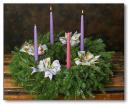
The first Sunday of Advent (December 2, 2007) is fast approaching. The season of penance and hopeful expectation has probably been observed since the fourth century. Advent begins on the fourth Sunday before the feast of Christmas, the Sunday closest to November 30, the feast of St. Andrew.  Advent wreaths appear to have come from the northern cultures of Europe, whose people used evergreen and holly for various wheels associated with the lengthening of days – the coming of the light – at the winter solstice.

The Advent wreath takes various forms. For Catholics, there are three purple candles and one rose candle. The rose candle is for the third Sunday – Gaudete or Rejoice. Protestants tend to use blue candles. Some wreaths have a white candle in the center to signify the birth of Christ. Advent wreaths were primarily used in homes for many centuries and came to churches only more recently.

A different candle is lighted on each Sunday. In our family, we light each one for the first time on Saturday after sunset, which is the liturgical beginning of Sunday. The first week only one candle burns. The second week, two are burning. By the fourth Sunday, all four are lighted, the first getting very short and the others proportionately taller. The passage of time becomes visible through the height of the candles. During all of the hustle and bustle, it is a reminder for us that the Christmas season begins on December 24th and ends on January 6th or the feast of the Epiphany – The Thee Kings.

You can find prayers and devotions for Advent at many sites. The Episcopal Church at Cornell has a wonderful booklet. St. Louis Catholic parish has a series of Advent prayers and observances at their site. Jeanne Woodward has a great collection of Advent prayer, worship, and study resources at The Text This Week. This is an impressive site, with study and worship materials for several denominations for the entire liturgical year.

For a holiday treat, take time away from food, football, and shopping. Go for a walk and gather materials for the wreath with your spouse and the children. Get a hold of some coat hangers, pliers, and some ingenuity to make the ring for the wreath. You can attach the evergreens and holly ( or other materials) with florist’s wire, plastic bag ties, or other wire. The candles can be placed in simple candle sticks inside the wreath. If you are handy you can even make wire ones.

You can sometimes find or order an Advent wreath frame. However, the key is not to create stress. Arrange some candles – don’t worry about the colors – and some greenery – or small potted plants, light a candle, say a prayer for peace, and hope and yearn for the light.

Read More

Posted by on Nov 26, 2007

Feast of Christ the King – The Reign of God

Feast of Christ the King – The Reign of God

pantocrator.JPG

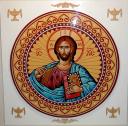
“He is the image of the invisible God, the firstborn of all creation. For in him were created all things in heaven and on earth, the visible and the invisible, whether thrones or dominions or principalities or powers; all things were created through him and for him.

He is before all things, and in him all things hold together. He is the head of the body, the church. He is the beginning, the firstborn from the dead, that in all things he himself might be preeminent.

For in him all the fullness was pleased to dwell, and through him to reconcile all things for him, making peace by the blood of his cross (through him), whether those on earth or those in heaven.

And you who once were alienated and hostile in mind because of evil deeds he has now reconciled in his fleshly body through his death, to present you holy, without blemish, and irreproachable before him”

                                                                                     Colossians 1:14-23

The feast of Christ the King is very recent. Pope Pius XI established it in 1925 to reassert the centrality of Christ in a world confronted with communist atheism and secular agnosticism. The feast is widely observed by other liturgical denominations, including Anglicans and Lutherans.

The feast of Christ the King was originally observed on the last Sunday of October, closer to all Saints Day, November 1. After the reforms of the church calendar in 1965, the feast was moved to the last Sunday of Ordinary Time – the Sunday before the first Sunday of Advent. It is the last Sunday of the liturgical year and provides a culmination that is solemn but not triumphal.

Strictly speaking, the term “basilea” in Greek is not equivalent to our sense of “kingdom” in the sense of territory. Scholars prefer terms like reign or dominion. The reading from Colossians – the second reading of the day – more aptly summarizes the meaning of the feast. All creation was made for Him and in Him and the love of Christ rescues us from our alienation from ourselves and our true meaning.

Read More

Posted by on Nov 24, 2007

Saint of the Day – St. Andrew Dung-Lac and Companions

Saint of the Day – St. Andrew Dung-Lac and Companions

st-andrew-dung-lac.jpg

November 24 is the feast day of the Vietnamese martyrs, St. Andrew Dung-Lac and Companions. He was born Ahn Tranh around 1795 in northern Vietnam. At the age of twelve, his parents moved to the city of Hue. St. Andrew Dung-Lac was instructed by a lay catechist, who also gave him the basic education that was denied to poor children like the young Ahn Tranh. His baptismal name was Andrew and he became a catechist. Later, in 1823, he was ordained a priest. After imprisonment and repeated torture, he was beheaded on December 21, 1839 for the crime of being a parish priest. St. Andrew’s 116 companions include those martyred between 1820 and 1862. They include bishops, priests, laity and 2 dozen Spanish and French missionaries. Many of these martyrs had been declared blessed. However, Pope John Paul II declared all 117 as saints in 1998.

The policy of the kingdoms that would later become Vietnam was to exclude foreigners and their influence. Catholicism came to the region by way of the Spanish and the French. Jesuits translated the Bible into Vietnamese. Being a Christian was seen as a dangerous link to the outside, tied to powerful empires seeking to advance their interest in southeast Asia. Despite the persecution and absence of clergy, the faith spread and endured. Catholics became a substantial minority, including around 5% of the population. French rule in late 19th century Viet Nam brought a degree of security and status to Catholics. The Communist takeover of the northern part of the country by Ho Chi Minh in 1954 caused an exodus of Catholics to the south, where they received preferential treatment by the ruling elite, typified by the Catholic Diem family.

The corruption and oppression of the Diem regime led to protests by Buddhists and the eventual overthrow of the government. Catholics were caught up on both sides of this struggle. The fall of South Vietnam to the Communists in 1975 led to 30 years of brutal repression. The canonization of St. Andrew Dung-Lac and the other Vietnamese martyrs by Pope John Paul II in 1998 marked the beginning of overtures by the Vatican to begin a dialog. By 2003, substantial progress had been made. In January 2007 the Vietnamese Prime Minister visited the Vatican and began the process of establishing diplomatic relations and better, if not yet ideal, conditions for the Church in Viet Nam.

This opening out to the world by Viet Nam coincides with the restoration of diplomatic relations with the United States and the emergence of Viet Nam in the age of globalism. Vietnamese Catholics are now part of a wider controversy about the independence of Christian churches in Asia. There are also important theological issues regarding the unique Asian experience of the faith and its relationship to much larger Asian religions such as Buddhism, Hinduism, and Taoism.

How does one’s membership in a worldwide church effect one’s own sense of identity and culture? To the extent that we as Christians experience the faith in our own culture are we limiting it? What is the role and importance of non-Christian faith traditions in our world? St. Andrew Dung-Lac and the Vietnamese martyrs lived the tension of these questions and witnessed to them with their lives. These questions now belong to us.

Read More

Posted by on Nov 23, 2007

Saint of the Day – Blessed Miguel Pro, S.J.

Saint of the Day – Blessed Miguel Pro, S.J.

miguel-agustin-pro-sj.jpgmiguel-pro-signature.gif

November 23 is the feast day of Blessed Miguel Agustin Pro, S.J. (1891-1927). Fr. Pro was a genial easygoing young priest shot by a firing squad for exercising his ministry against the laws of Catholic Mexico. A blind woman who attended his funeral and touched the coffin regained her sight. Other miracles followed. Fr. Pro was from a large family in Guadalupe, Zacatecas. He joined the Jesuits at the age of 20 after a happy and carefree youth. He was known for his quick and gentle wit. Due to the enforcement of anti-clerical laws in 1915, Fr. Pro and his fellow Jesuit novices left to continue their studies in California, Belgium, Nicaragua, and Spain.

To someone not familiar with the history of Mexico, it can be perplexing to understand how such a Catholic country could have outlawed the religion of the vast majority of its citizens. ( An excellent monograph in Spanish is “La Iglesia Catolica y la Politica en Mexico, 1910 – 1938.”) The story is a saga of ongoing conflict between the emerging secular state after Mexico’s independence from Spain in 1821 and the spiritual and economic power of the Church. For over 300 years prior to independence, the Church in Mexico fell under the sponsorship of the Spanish Crown. The Church, the religious orders, and lay institutes controlled vast resources of land and natural resources. In order to assert their power, the national elites knew that they needed to dis-establish the temporal power of the Church. Others believed that the only way to create a modern state was to get rid of religion altogether.

By the mid-1800’s, the Reform of President Benito Juarez attempted to deprive the Church of its lands and redistribute lands to the peasants and the native tribes. If this sounds socialist, it is. Mexico was one of the first countries to try to address the evils of social inequality by converting socialist philosophy into public policy. Just as socialist aspirations in European governments gave way to oppressive imperial governments, Mexico was ruled by dictators.

The Mexican bishops, under Popes Pius IX and Leo XIII, responded by developing a Christian social teaching focusing on peace, justice, and equality. The Christian social gospel emerged from Pope Leo XIII’s encylical letter, Rerum Novarum, in 1891 on the relationship between capital and labor. Many of the key bishops in Mexico in the early 20th century had been trained in Rome to provide a core of leaders.

The first socialist revolution of the the 20th century took place in Mexico in 1910. Industrialization, foreign control of natural resources, and endemic poverty passed the tipping point. After massive slaughter, destruction, and social dislocation, the Constitution of 1917 came into force. The anti-Church provisions of the Constitution were enforced unevenly until 1925, when President Calles passed additional legislation specifying penalties for infractions. Fortunately or unfortunately, Fr. Pro who had been recently ordained was sent back to Mexico that same year. His health had been declining and his superiors felt that he would get better away from the rigors of exile. When he returned, the situation had gotten so bad that he had to go underground and minister in secret.

The opposition to President Calles erupted in a rebellion called the Cristero war. The insurgents claimed to be fighting for religious freedom. Their cry was “Viva Cristo Rey,” “Long Live Christ the King.” Of course the history was much more complex, since practicing Catholics and anti-clericals often fought together against other factions that were also diverse in their composition. President Calles thought that the pictures of a public execution of Fr. Pro would demoralize the rebels, who were known as Cristeros. It had the opposite effect. Fr. Pro’s execution re-invigorated the fractured insurgency, drew international condemnation, and led to the involvement of the United States’ ambassador, who helped resolve the conflict in 1929. The activities and involvement of the Church in public life and education was highly restricted. However, the Church’s spiritual ministry was permitted under close control.

In 1988, Pope John Paul II visited Mexico amid jubilant throngs. At the time, he beatified Fr. Pro, who became Blessed Miguel Agustin Pro. In 1990, the Vatican and Mexico established diplomatic relations and began a decade long process of regularizing the independence of Church and state. Fr. Pro’s wish was to offer his life for Mexico. It was a wish that he confided a year before his death and a wish that was fulfilled.

Read More

Posted by on Nov 23, 2007

Apocalypse – The End of the Liturgical Year

Apocalypse – The End of the Liturgical Year

last-judgment-rubens.jpg

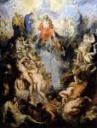
As we approach the feast of Christ the King, the cycle of readings reminds us of the end of days. Christianity is almost unique in its focus on the end and culmination of all things and the Second Coming of the Lord. The images are very different from the entry into Jerusalem on Palm Sunday. St. Stephen, the first martyr, sets the tone, declaring to his judges that the time is coming when they will see Christ descending on them in glorious judgment.

There were many books about the end of days published before the millenium. The biggest publishing success was the Left Behind series, a group of novels by Tim LeHaye and Jerry Jenkins. The series combined a literal approach to the Book of Revelation, also known by its Greek title, The Apocalypse, with a theology which came primarily from the tent revival meetings of the 20th century in the United States. There is a very strong dose of Calvinist predestination, Anabaptist altar calls to conversion, and Medieval delectatio morosa – delight in the suffering of the others, especially the damned.

Horror movies are always popular in American culture. Perhaps they are a secular celebration of evil that twists what is supposed to be the encouragement apocalyptic literature offers to those undergoing persecution. Of course there is the old technique of fire and brimstone sermons to scare the “hell” out of people. Apparently many people liked and still like the horror entertainment value of these sermons, which seem to create a god who is far from loving.

The end of the year and the beginning of the new year is a time to focus on more than the settling of scores. It is a time to show the mercy we want to receive on that Last Day.

Read More

Posted by on Nov 22, 2007

Thanksgiving Day USA – Calvin’s Elect in the New World

Thanksgiving Day USA – Calvin’s Elect in the New World

thanksgiving-rockwell.jpg

Thanksgiving Day in the United States is observed on the fourth Thursday of November. It is a time for family gatherings. The day before the holiday is the busiest travel day in the year. In keeping with its Puritan religious origins, it is not a liturgical holiday, but rather a celebration of a successful harvest and the group’s survival of the brutal winter and spring. Generally, there are no formal religious services. It is a holiday observed by people of all faiths and of no faith. The poor are fed and the rush and loneliness of contemporary life are abandoned for the day. It is a sabbath. Offices, banks, schools, and most stores are closed. The day embodies a vision of the Kingdom, without any of the overt religiosity of the country’s Calvinist social and cultural founders.

The Pilgrims were a group from Nottingham Shire in England and were part of the Puritan movement. Their religious beliefs were generally in line with those of John Calvin. The recognized only two sacraments – Baptism and the Lord’s Supper. Marriage, as a civil contract, was the province of the magistrates. Marriage existed for the procreation of children and the prevention of adultery. There was no celebration of Christmas and Easter since these were the creations of human culture to honor Christ, who did not need them. They abandoned the liturgical cycle of seasons and holy days, to return to a “pure” Christianity of the very early Church. Their meeting places were not Churches in the traditional sense and had no decoration.

They believed that everyone was predestined to salvation or damnation. Due to the sin of Adam and the fall of the human race, humanity was seen as utterly corrupt. Some people would receive grace, which was irresistible. As a result they would come to faith and be saved. The Pilgrims – unlike the Anabaptists – emphasized the baptism of infants. God’s chosen or elect would probably come from the ranks of those people who led good lives, since they already manifested the sign of divine grace. Sobriety, industry, and the absence of adornment in one’s dress, home and public spaces was the norm. The English Puritans did not believe in the need for bishops or a formal hierarchy. Each group constituted its own church and elected its own officials.

When James I of England (James IV of Scotland) came to the throne, he supported the episcopal model of the Anglican Church, which maintained the hierarchical structure of the bishops. King James, who commissioned the English Bible that still bears his name, sought to bring Puritan groups like the Pilgrims into conformity with the Church of England. The Pilgrims used the Geneva (Calvinist) translation of the Bible and refused the English Book of Common Prayer because of their preference for one’s own prayers and their aversion to reading the prayers of others. King James feared that people who did not need bishops did not need a king. (The Puritan Revolution under Oliver Cromwell was to prove him right on this point.) The group’s escape from England to the Netherlands was as courageous as it was risky – not all of them made it. In the Netherlands they found whatever work they could to support themselves, but they realized that the continued influence of Spain in the area made their longer term presence untenable. The story of their arrangements for their voyage, the trip itself, and the first years is stunning in its complexity of politics, intrigue, and danger. The History Channel’s documentary, Desperate Crossings, presents the truly dramatic history of the group – a history which had been so obscured by myth and legend as to render the actors as two dimensional soul-less characters.

Thanksgiving is a day to give thanks for blessings and deliverance and a day to remember the country’s religious founders, whose beliefs have shaped and molded a secular state and a highly religious society.

Read More

Posted by on Nov 21, 2007

Feast of the Day – Presentation of the Blessed Virgin Mary

Feast of the Day – Presentation of the Blessed Virgin Mary

presentation-bvm-icon.jpg

November 21 is the feast of the Presentation of the Blessed Virgin Mary. This feast is based on material from the Proto-Gospel of James – an apocryphal gospel that did not make it into the canon of scripture. Mary is presented in the temple at age 3 by her aging parents in fulfillment of a vow that they made.

This is an archetypal pattern of a very special child born to aged parents who is destined for great things by God. The birth of Isaac to Abraham and Sara is the first example. The birth of the prophet Samuel to Elkanah and Hannah comes about after the barren Hannah is told by Eli, the priest at Shiloh, that her prayer would be heard. In the New Testament, John the Baptist is born to Zachary and Elizabeth according to the promise of the angel. The feast of the Presentation appears to have come from Syria in the 6th century and became prominent in the West in the 11th century. However, the Presentation did not become a universal feast until the 15th century.

Although the four canonical gospels do not mention the Presentation, the devotion of the early Church to Mary as the Mother of God makes it easier to understand why there would be such a tradition. St. John the Baptist’s prominence is emphasized by the nature of his birth. Certainly, one might suspect that the apocryphal account would resonate with Christians as giving prominence to Mary and the importance of her role. While one could argue that the Annunciation is more than ample in terms of underscoring Mary’s importance, the Presentation can be seen as a reasonable corollary.

The Second Vatican Council (1961-1965), in its Dogmatic Constitution on the Church in the Modern World – Lumen Gentium – restated the ancient belief in Mary as our mother in the order of grace.

Predestined from eternity by that decree of divine providence which determined the incarnation of the Word to be the Mother of God, the Blessed Virgin was in this earth the virgin Mother of the Redeemer, and above all others and in a singular way the generous associate and humble handmaid of the Lord. She conceived, brought forth and nourished Christ. She presented Him to the Father in the temple, and was united with Him by compassion as He died on the Cross. In this singular way she cooperated by her obedience, faith, hope and burning charity in the work of the Savior in giving back supernatural life to souls. Wherefore she is our mother in the order of grace. (Lumen Gentium The Light of Nations chap 8, III,61)

Although we might have some reservations about the feast of the Presentation as a speculative notion by early Christians, there is a modern psychological explanation that underscores its development. Mary came from a devoted family who rejoiced at her birth because she was truly God’s answer to prayer for her parents. Such love, even in secular psychological terms, is always grace filled and grace giving.

Read More