Pages Menu
RssFacebook
Categories Menu

Posted by on May 30, 2008

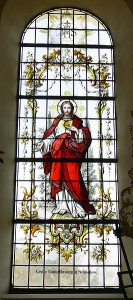
Feast of the Day – The Sacred Heart of Jesus

Feast of the Day – The Sacred Heart of Jesus

Sacred Heart of Jesus - Fronhofen Pfarrkirche

The Feast of the Sacred Heart is celebrated 19 days after Pentecost each year. It is always on a Friday.

Devotion to the Sacred Heart began to develop in the Middle Ages, but it was considered a private devotion, not a specific feast day. Saint Margaret Mary Alacoque  (1647-1690), a French nun and mystic, promoted devotion to the Sacred Heart in its current form and over time it was adopted as a formal feast. This devotion also includes Mass and Communion on the first Friday of each month.

A friend of mine was raised Catholic in an Irish family in Rhode Island. One day we were talking and laughing about some of the funny things that had happened when we were girls. She told of the time a non-Catholic friend of hers was visiting her family for the first time. The friend, a young man, commented that he was always shocked when he went into Catholic homes and was immediately confronted with a statue or picture of Jesus, with his heart showing – pierced and bleeding. He said something about how glad he was not to find that image in her parents’ home. He had begun to think that all Catholics were somehow off balance with this insistence on having the image around them. Then they went around the corner into the living room, and there was the picture on the wall, where it couldn’t be missed by anyone!

My friend and I were working together at the time. As we went around the corner into my home office, what was on the wall, but a picture of the Sacred Heart – more modern than the traditional one in her home, but unmistakably still, the Sacred Heart. We just laughed and knew again how much we had in common!

So what is it about the Sacred Heart? First, it’s important to remember that it’s not really about worshipping a physical human heart. The Feast of the Sacred Heart reminds us of the overwhelming love of God for us, as seen in the love of Jesus for us. As the Son of God, second person of the Blessed Trinity, Jesus became one of us, lived as one of us, died as one of us. God’s overflowing love poured through Jesus to us. It still does. Symbolically, Jesus’ pierced heart is a reminder that love is not always easy. It can be costly. Love flows out of the heart of God as the water flowed out of the heart of Jesus when pierced by the centurion’s sword. Nothing can stop that love’s flow but our refusal to accept it.

The Sacred Heart also reminds us that Jesus always forgives. God always forgives. Nothing we can do will keep God from loving us and forgiving us. We can turn away, but God is always there calling us back. Hoping we will once again accept love and mercy. Because God’s mercy is unfailing, all we need do is ask and accept it.

In celebrating the Feast of the Sacred Heart, we are called to love as Jesus loves, forgive as Jesus forgives and be compassionate and merciful as Jesus is compassionate and merciful. A tall order for our human hearts, but one to which, with the help of Our Lord, we are called.

Read More
Posted by on May 28, 2008

What Keeps Me From Seeing?

What Keeps Me From Seeing?


I like to take a walk in late morning each day. It helps clear my mind and stretch my muscles before I plunge into the work and activities of afternoon and evening. Living beside Monterey Bay, I never know what I’ll see on my outing.

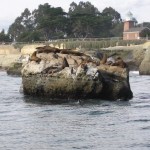
Today, when I arrived at the water’s edge (actually at the cliff beside the water!), I got a wonderful surprise. I could see all of Monterey Bay – from the Lighthouse at Point Santa Cruz, around past Santa Cruz, Capitola, Aptos, Moss Landing, to the flatter lands where the Salinas River enters the Bay. Then the Big Sur mountains rise up behind Monterey and go out all the way to the ocean.  The water was calm – very few waves for the surfers. The kelp beds were spreading out to enjoy the sunshine. The sea lions on the rock were chatting among themselves. Sea gulls soared over the water. I could see it all.

In “the olden days,” when I was a girl, I would never have thought that seeing all the way around a bay was anything special. I grew up in Eastern Washington state. We had clouds or sunshine. Sometimes we had fog. But you could always see across the river! And normally, you could see the surrounding mountains too.

Living on the coast, we never know from day to day whether the fog will be in or not. Even on a sunny day, the fog often sits in the middle of the Bay, blocking the view of the other towns and the mountains. But today it is clear. The smoke from the Summit fire is gone from the sky. The clouds we have are high and moving inland. The fog is sitting way off the coast, barely visible from land. And the view is stunning.

It occurs to me that the spiritual life is something like our views of Monterey Bay. Like the Bay, God is always present here – within us, among us, around us. I exist only because God has imagined me, given me breath, breathes through me, loves me continually into being. Yet all too often I don’t notice. I don’t see the beauty all around me. I miss the “love notes” scattered all around me – the flowers, the birds, the native bees in the weeds, the smiles of young mothers and their babies, the laughter of teens and the comfortable togetherness of retired couples out for a walk. I don’t see them for what they are, or worse, I don’t see them at all. I move through my life’s conversation doing all the talking, forgetting to look and listen for the presence of the Divine.

Today I pray that I’ll remember to open my eyes, ears, heart, mind to notice God’s presence. I’ll remember to ask myself, “What keeps me from seeing today?” I’ll remember to be grateful. I invite you to do the same. And maybe while we’re at it, we could also stop gratefully for a moment and ask, “What keeps us as a people from seeing today?”

Read More

Posted by on May 24, 2008

Corpus Christi: The Body of Christ

Corpus Christi: The Body of Christ

Stephen’s bright blue eyes smiled as we said, “Lamb of God, Give us Peace.” According to the rubrics we were now to show each other a sign of peace. Yet with Stephen’s attention deficit disorder, which had already taken him in and out the brief service at least twice, it seemed that a little catechesis might help him be a little more aware of what we were about to do. Stephen is not a little boy. He is a handsome man in his early 30s, with a number of tattoos poking out of the v-neck and short sleeves of his starched jail issued smock.

The readings had been those of Pentecost. The second reading was from First Corinthians 12. “No one can say Jesus is Lord except by the power of the Holy Spirit.” This had struck all four of the men, but had made a special impression on Stephen. “Does that mean that when I pray the Holy Spirit moves my heart?” Stephen had asked. When I answered “Yes” his eyes got wide and he said that since his attention came and went and his thoughts were often jumbled, he thought his prayers were more bothersome and must be irritating. The notion that he is a temple of the Holy Spirit was as novel to him as it was consoling.

Stephen was back now and I shared a few words on the Lamb of God, recounting the Last Supper and the passion, death, and resurrection of the Lord. We do this in His memory as He requested of us. We are invited to the Lord’s table. Stephen and his companions were not new to the faith, but this brief memorial of our Great Memorial brought a renewed awareness to the others and a slack jaw from Stephen. He did not doubt, but could not help but marvel at the wonder of it.

As we shared the wonder of the Blessed Sacrament, our communion was truly a sharing in the Body and Blood of Christ. Bread blessed and broken at the Eucharist, celebrated in the parish, given to all, shared with all, and sent to those in need and to those in prison. The Body of Christ – Corpus Christi – saving us all from our prison of loneliness, our hunger for love, and admitting us to the feast of heaven here and now.

Read More

Posted by on May 21, 2008

Trinity Suggestions

Trinity Suggestions

I asked our Theologika trustees for recommendations of materials on the Trinity for our readers. Patrick Conway, M.Div., Pastoral Associate at Resurrection Parish in Aptos, CA sent these ideas.

“On the Trinity: Abhishiktananda (Henri Le Saux) was a contemplative theologian who wrote of his mystical intuition of the Trinity, so anything by him. One of his landmark writings was Saccidananda: A Christian Approach to Advaitic Experience (Delhi: ISPCK Press, 1974). There is also an article, “Abhishiktananda’s Mystical Intuition of the Trinity”, by Wayne Teasdale in Cistercian Studies 18:1 (1983). In fact, I believe that entire issue was dedicated to Abhishiktananda.

“Then there is Rahner’s “Remarks on the Dogmatic Treatise ‘De Trinitate'” in Theological Investigations, Vol. 4, pp. 77-102. In this article he notes that, given the post-modern mentality, the only Christians would have to be mystics, particularly when it comes to faith in the Trinity. Perhaps he had Abhishiktananda in mind.

Also, Catherine LaCugna’s God For Us: The Trinity and the Christian Life. San Francisco: Harper, 1992.”

Some of these materials are easily available. Others are more likely found in libraries. If you come across them online, please let me know so I can tag them for other readers to access.

My thanks to Patrick for his quick and thoughtful response.

Read More

Posted by on May 20, 2008

Celebrating the Trinity

Celebrating the Trinity

Trinity by Andrei Rublev (ca 1410-1420)

The first Sunday after Pentecost is celebrated as Trinity Sunday. God is Father, Son, and Holy Spirit, yet one God. The Trinity is a reality over which Christians have puzzled for centuries. Jesus spoke of His Father. He stated that He and the Father were One. He promised to send their Holy Spirit. But what did it all mean?

We speak of the dogma of the Trinity as being a mystery. The use of the word mystery can be problematic. It can imply that if we just focus our attention and uncover the right clues, we can solve the mystery and get to its core. After all, that’s the way it works in detective novels and television shows! But that’s not the kind of mystery we’ve got in the Trinity. The reality of God is so much more than we can ever imagine, let alone comprehend, that the best we can do is look for threads that give us a small sense of the dimensions and reality of the whole.

Fr. Richard Rohr, OFM and the late Fr. John O’Donohue have both gifted us with meditative reflections on the Trinity in recent years. They speak of the Trinity in terms of rhythms and flow and surpise. Richard Rohr speaks of a “family resemblance” between the Trinity and all of creation, from the depths of the atom to the furthest extent of the universe, there is a similarity of pattern. All are in movement, all are in relationship to each other, the power is in the “in between.” Life is in the movement, the flow.

Fr. Rohr notes that the Greek Fathers of the Church described the Trinity as a relationship of perichoresisa mutual interpenetration and indwelling. He explains that perichoresis can be translated as dance. God is the dance and we come to know God only from within the dance of the Trinity. As long as we remain open and allow ourselves to be pulled into the flow of mutuality, to the perfect giving and perfect receiving that is the life of God, we will experience the communion, intimacy and relationship characteristic of God’s life. Anything that stops the flow of loving – anger, resentment, judgement – cannot be part of who God is. To the extent that we harbor those blocks to love, we block the flow of God’s life/love in ourselves.

John O’Donohue, in a workshop for the Religious Education Congress of the Archdiocese of Los Angeles in 2005, also spoke of the Trinity in terms of rhythm and flow, touching on many of the same themes described above. A poet and storyteller, he looks at the mystery of the Trinity through poetic images – the flow of a river, a dream of the divine, dance, music, between-ness. He speaks of God as the “secret music of the heart and the universe… the primal music and dance of all that is.”

We most often experience the world in terms of dualities such as inside/outside, masculine/feminine, divine/human, light/dark and so forth. Yet O’Donohue points out that in reality we actually find ourselves at the threshold between those dualities most of the time. It’s a threshold that must be permeable if we and our relationships are to be healthy, so that the qualities of each side of the duality can pass between, refreshing, supporting and enlivening the other. As he points out, there’s the one side, the other side and the place in between. For O’Donohue, the place in between is where we find the Holy Spirit, holding “all the between-ness together.”

The insights of these two men are well worth hearing and pondering. There’s far more to what each has said than can be described in a short blog post. But the depth of the wisdom they bring resonates with the insights of the mystics from all the ages. As John O’Donohue notes, “Once you get a taste of God, nothing else tastes the same.” And again, “That’s what it’s about – coming fully alive to the dream of the Divine within you.”

May the dream of the Divine resonate within you and lead you ever more deeply into the life of the Trinity.

Readings for the Solemnity of the Most Holy Trinity – Trinity Sunday, Cycle A

Read More

Posted by on May 15, 2008

Living in the Time of the Holy Spirit

Living in the Time of the Holy Spirit

Sunday we celebrated the Feast of Pentecost and the fulfillment of Jesus’ promise to send the Holy Spirit to His followers. Now we enter into a time called “Ordinary Time” — a name which suggests that nothing special is going on and nothing special is to be expected. That perception couldn’t be farther from the truth!

Ordinary Time is the time of the Holy Spirit in the Church. It’s a time for learning, growing, sharing, reaching out to each other and the world. It’s also a time for entering ever more deeply into the life of the Trinity, a reality we’ll celebrate this coming Sunday.

How do we recognize the coming of the Spirit? I’ve been reflecting on the symbols we use for the Spirit and the words of the songs we pray at this season of our liturgical year. There’s the dove, a symbol for gentleness and peace. The Spirit came upon Jesus like a dove when He was baptized (Jn 1:32). Then there are the mighty wind and tongues as of fire that marked the coming of the Spirit to those gathered in the Upper Room (Acts 2:2-3). In the Old Testament, the Lord came to Elijah in a gentle breeze as he waited by a cave on the mountainside (1 Kgs 19:12-13).

Each of those images tells us something important about the Spirit and what the coming of the Spirit into our lives might mean. The idea that the Lord doesn’t come in the form of earthquakes, wind storms, or the raging of nature is important. Destruction is not a characteristic result of the coming of our God. Peace and the time to live, breathe and grow are. And in times of destruction, God comes through the caring hands and presence of those who try to help alleviate the pain and suffering.

The dove is a bird that we associate with gentleness and a soft cooing call. I loved waking up to the sound of doves cooing when I was a child and visited my grandparents who lived in a warmer community, where there were doves. The dove is often a symbol of love and peace.

But then again, at Pentecost there’s wind and fire… Living in California, we’re very much aware of the power of wind and fire. In forested areas, as well as in the hills covered by chaparral (the native vegetation), fire can sweep across the land, driven by winds it creates itself, leaving a swath of seeming destruction behind it. Those who live outside of the cities and towns must be constantly vigilant to keep the underbrush back away from their homes, so there’s a chance of saving the home in a wild fire.

How does fire fit into the whole peace and love scene we associate with the Holy Spirit? The image of a forest full of brush, or the overgrown chaparral on the California hills gives a clue. Brush in a forest can become so dense that it begins to choke the life of the other plants and the animals living there. A healthy forest is one that is cleared out regularly. Nature does this with fire. The chaparral even has plants that ignite spontaneously when the temperature reaches a certain point. The whole area burns off and then new plants can grow. There are plants that depend on fire in order for new seedlings to sprout — in forests and in chaparral.

In a very real way, each of us needs cleansing fire sometimes too.  It’s not fun, but it clears the way for new growth and wondrous surprises.

Then there’s the other side of fire — the creative side. We speak of people being “fired by love” or “going like a house afire” into a new project or calling. Fire is powerful. Fire gives energy. Fire brings light. The Holy Spirit’s coming is to “light a fire” under each of us — to get us going as Christ’s body here on Earth. Hands, feet, voices, arms, legs, minds, hearts.

We sing, “Come, Lord Jesus, send us your Spirit, renew the face of the Earth.” And the Lord grants our request. The Spirit comes. And with the help and fire of the Spirit, we move forward to bring new life, to renew the face of the world around us – in our homes, our worksites, our communities, our world.

Read More

Posted by on May 7, 2008

Are You Ready for Pentecost yet?

Are You Ready for Pentecost yet?

holy-spirit.jpg

In the United States, we are used to hearing questions like, “Are you ready for Christmas yet?” or “Are you ready for Easter?” The assumption is not that we have been spending time in spiritual preparation for these wonderful feasts, but rather that we’ve done our shopping, wrapped our gifts, mailed surprises to our loved ones, sent the Christmas cards, and so on and on and on. There always seems to be one more thing that must be done to assure a perfect holiday experience for ourselves and our families. Spiritual preparation often takes a back seat in the excitement of getting ready for a holiday. Yet, if the holiday is all about the material gifts and the perfect meal and the family all being on best behavior, it is bound to be a disappointing experience. No matter how wonderful the toy looked in the catalog, or the meal looked in the recipe book, they cannot fill the empty spot in our hearts that is longing for the Divine. And certainly, no one can control the behavior of children, family or friends who may not always act in kind, loving, patient ways. If celebrating the feasts requires that all be perfect, the celebration will certainly not be joyful.

Pentecost is a different sort of holiday. It isn’t even seen as a holiday by the culture as a whole. We never see “Pentecost Sale” in the newspaper or on TV, for example. We don’t have special dishes we prepare for Pentecost. No candies are stacked by the check-out stands to tempt the unwary. No cards or wrapping paper displays vie for our attention. It is almost a secret festival – an un-event.

This year, Pentecost comes very early, because Easter was very early. Pentecost comes on the 50th day after Easter every year. It was originally a Jewish feast. It became a Christian feast because that was the day the Holy Spirit came to the Apostles and others who had been hiding out in the upper room, afraid of what would happen to them because they had been followers of Jesus. With the coming of the Holy Spirit, the fear that had bound them was dispelled. They went out and witnessed boldly to what they had seen and heard. That Jesus who had been crucified had been raised from the dead and, in Peter’s words, “… God has made him both Lord and Messiah…” (Acts 2:36)

Pentecost is the birthday of the Christian Church. If the Holy Spirit had not come, the followers of Jesus would never have found the courage to go out into the world and share the Good News. But as He promised, Jesus asked the Father and the Father sent the Advocate, the Paraclete, the Holy Spirit of Love to us. And so, two thousand years later, we can celebrate Pentecost, our birthday.

So how do we celebrate? Certainly with liturgy. Make time in your day to join with the larger community for Mass. Make a joyful noise, sing praise. Invite the Spirit to come into your life in a special way. Join often in that ancient prayer, “Come Holy Spirit,” both in the days leading up to Pentecost and on the feast itself. Be as open as you can be to the coming of the Spirit and you will receive wondrous gifts. Then, take time to enjoy nature. Spend time with your family and friends. Light a candle for dinner – maybe a red one. Use a table cloth – red any one? Bake a birthday cake. Wear a touch of red in your clothing or jewelry. Every reminder of the coming of the Spirit in “tongues as of fire” (Acts 2:3) is good.

And this year, when Pentecost and Mother’s Day fall on the same day in the United States, celebrate the love of your mother, and remember that although God is neither masculine nor feminine, the Holy Spirit of Love is often described in terms of qualities seen as feminine in our culture – loving, tender, wise, compassionate, patient.

So … are you ready for Pentecost yet?

Read More

Posted by on May 5, 2008

Ascension Blahs

Ascension Blahs

water_ripple.JPG

There is only so much joy and sunshine the soul can take. There is a rhythmic moodiness to California’s central coast. Unlike the interior valleys and the Sierra, which have more constant moods in concert with the sun and stars, the ribbon world on the sands and coastal planes changes from delight to gloom overnight — or sometimes within the hour. On our street, the fog, known by its more fluffy image as “the marine layer,” sometimes tiptoes and sometimes billows through the cypresses on Lighthouse Field and blots out the sun, roiling half way down the block before stopping on a whim in an evanescent whirl.

The Resurrection blossoms and the fulgent greens are quickly muted in the filtered gray light of the salty chill. The natives, loath to give up their flip flops and shorts, shiver in their sweatshirts as they pull their hoods over their brows to the bridge of their sunglasses.

So where has the Son gone? Why do we stand here looking up in the chill? Who turned off the party? Just when we found Him, they took him away again. No that would have been easier. It would be renewed grief. He said that it was time for Him to return to the Father and that He would send the Advocate who would teach us all the things that He still had for us to learn. Left behind … our consolation turned to desolation.

… And what to do? According to Father Ignatius, it is time to discern, to prepare for the movements of the soul that eddy from the Paraclete, that ripple from the heart, and echo in the fountain drops of the barely conscious. What now? Be still and know that I am the Lord.

Read More

Posted by on May 2, 2008

The Prophet and the Politician: Sen. Obama and Rev. Wright

The Prophet and the Politician: Sen. Obama and Rev. Wright

obama_wright-rev.jpg

Many friendships have been lost on the rocks and shoals of political campaigns. The falling out between Senator Barak Obama and the Reverend Jeremiah Wright is the latest example of such casualties. What is most striking is the Rev. Wright’s strident message. He would probably say that this style is a cultural feature of the African-American church. In a response to questions at the Washington Press Club, Rev. Wright said that he had told Mr. Obama, that if he is elected President, Rev. Wright would be coming after him as the leader of a repressive government.

Is this prophecy – speaking truth to power – or is it an ego trip? Rev. Wright went to some effort in his address to the National Association for the Advancement of Colored People (NAACP) to stress the prophetic nature of his ministry and its African-American style. However, Rev. Wright appeared to have transgressed certain boundaries of acceptable political speech. His condemnation of the United States after the 9/11 terrorist attacks, positing them as something that was the natural outcome of United States’ policies abroad, went too far in many people’s minds. His appraisal of Louis Farrakanh, the Black Muslim leader who advocates Black separatism and superiority, as one of the most influential persons in the 20th and 21st centuries raised additional hackles More alarming was his support for the idea that the United States had created the HIV/AIDS virus to decimate African-Americans.

It was all too much for Barak Obama and for most of the people of the United States.

So how far do you go in prophecy, especially in the prophecy of invective? There is an argument to be made that the 9/11 attack had a lot to do with American actions against Osama Bin Laden that drove him from exile in Sudan to Afghanistan. Any student of U.S. history knows that American policies in many parts of the world have been part of oppression. Yet do you condemn a nation that has also had a history of doing many good things on the world stage?

What struck me most was the Rev. Wright’s anger. Was it the anger of a prophet zealous for his God or was it the anger of African-American oppression, frustration, and futility? When Sen. Obama first addressed the issue of the Rev. Wright’s preaching in a landmark speech on race in America, his talk was full of restraint, understanding, and hope. The element of hope has been greatly reduced in the Rev. Wright’s recent speeches.

Ironically, the title of Sen Obama’s second book, The Audacity of Hope, is taken from one of Rev. Wright’s sermons. In fact, it actually concludes his autobiography, Dreams From My Father. It is clear that Rev. Wright infused Sen. Obama with a deep sense of hope over 20 years ago. The prophecies of Jeremiah and others in the Old Testament tend to hold out an element of hope of future redemption – of reconciliation.

Unfortunately, two roads are diverging in the wood and the nation must decide whether it will pursue the road of hope or the politics of despair, division, and personal destruction.

Read More

Posted by on May 1, 2008

The Feast of St. Joseph the Worker – May 1

The Feast of St. Joseph the Worker – May 1

christ-in-the-house-of-his-parents-sir_john_everett_millais_002.jpg 

The Feast of St. Joseph the Worker is a relatively new one in the Catholic liturgical calendar, though feasts of St. Joseph are not. Celebrating St. Joseph’s vocation as a carpenter, a worker, dates formally to 1955 when the feast was proclaimed by Pope Pius XII as a response to Communist celebrations of a festival honoring workers on May 1.

It’s not uncommon for the Church to take non-Christian celebrations and give them a Christian focus. Celebrations such as Christmas and the Feast of All Saints, for example, have been set for times when non-Christian communities into which Christian witnesses/missionaries were entering were celebrating their own religious or civic feasts. Sometimes we say those feasts were “baptized” — a kind of shift in interpretation to give new meanings to old rhythms and rituals.

Reverence for human labor and an insistence on the protection of workers predated the Communist revolutions in the Soviet Union and other nations of the world. The writers of the Gospels noted that Jesus was the son of a carpenter from Nazareth, and that He was also a carpenter. His first disciples were fishermen, tax collectors, home makers — the everyday, ordinary folk now celebrated as “workers” on May Day.

Pope Leo XIII laid out the biblical and intellectual foundations of contemporary Catholic social teaching with his encyclical, Rerum Novarum, subtitled On Capital and Labor, in 1891. From that first encyclical, through the 20th Century and into the 21st, the Church, through the writings of its Popes and Bishops, has insisted that the dignity of human labor and human laborers is to be respected and protected. No perfect social system exists – from communism through capitalism, the negative excesses of all have been critiqued and the benefits of all have been noted.

The Church insists that laborers are entitled to a fair wage. Employers have a right to make a reasonable profit, but not to excessive profits at the expense of the health and safety of their employees. Working conditions must be safe. The poorest of the poor must have a chance to live with basic human dignity and security assured. Those who are in positions of power must use that power to protect the powerless. Those with education must look out for those who have not. People of faith must speak on behalf of those treated unjustly.

Fundamentally, we are a family — God’s family. And we are responsible for each other. Each of us has our own “work” to do. Whether our work is to build bridges, tend the sick, educate the children, prepare the meals, or write blog posts, we each have a calling to work for the good of all and to build up the community.

On this Feast of St. Joseph the Worker, may we be aware of the work of great and small in this world, respect the gifts we all bring, and be attentive to protect those whose labors are least valued and respected.

Read More