Thoughtful Reflections on Religious Experience
Feast of the Day - Our Lady of Sorrows - September 15 by KathyPozos on Monday 15 September 2008 10:35 pm PDT

Mothers of the Plaza de Mayo

The Feast of Our Lady of Sorrows follows the Feast of the Exaltation of the Holy Cross by one day. On this day we remember the prophecy of Simeon when Mary and Joseph took Jesus to the temple for the first time. Simeon blessed them and said to Mary, “Behold, this child is destined for the fall and rise of many in Israel, and to be a sign that will be contradicted; and you yourself a sword will pierce, so that the thoughts of many hearts may be revealed.” (Lk 2:33-35)

This feast was not part of the official liturgical cycle of the Church until the mid-1600s, though it was celebrated in some locations as early as the 13th century. Sometimes it is known as the feast of the Seven Sorrows of Mary and includes mention of seven events from Jesus’ childhood and passion.

Our Lady of Sorrows is a title of Mary with which many women and men can identify. Bearing and raising a child is not an easy task, though it can be an extremely rewarding adventure. There are countless joys and sorrows along the way. And make no mistake about it - the commitment of parent to child is one that does not stop when the child reaches adulthood! It is a commitment for life and beyond. In our belief in the Communion of Saints and life after death, we recognize that those who went before us still care about us and look out for us. Parents who are with the Lord do not cease to be parents of those who still remain here. The relationship is just transformed.

In thinking about this feast, it came to me that surely Our Lady of Sorrows is especially close to mothers, fathers and family of those who are killed prematurely. I’m thinking of those who “disappeared” in Central and South America in recent years - victims of political violence and/or persecution for their actions in living and teaching the Gospel. I’m thinking of victims of terrorism in the Middle East - including those on both sides of the Israeli-Palestinian question and those dying almost daily in Iraq. I’m thinking of those whose children were killed in wars - Iraq, Iran, Afghanistan, India, Pakistan, Bangladesh, Sudan, Ruwanda, Brundi and so many, many others. We see the pictures year after year and our hearts become numb. Yet for all of them, and with all of them, Our Lady of Sorrows weeps. And so should we all.

And then … we must commit ourselves to work for peace. So that those who have given their lives will not have died in vain. So that those who believe that “might makes right” will learn that only love makes right. So that we truly become a community where we live our belief that what we do to the least of Jesus’ sisters and brothers, we do to Him.   

May it be so.

Easter Communion or Condemnation? by RandyPozos on Monday 31 March 2008 1:15 pm PDT

holy-communion.jpg

To receive communion during the Easter season has been a long established precept of the Catholic Church. It is a practice that we should examine more closely. To receive Christ in the Holy Eucharist requires one to be in the state of grace - free of serious or mortal sin. We are advised - wisely - to put our souls in order. We are to turn away from sin and return to the community through the grace of absolution. There must be peace and love in our hearts and a definite change in our lives.

Fr. Burke, a Discalced Carmelite from Australia, expands on the notion of communion in terms of our living out the Sacrament of the Holy Eucharist in our shared lives as Catholics and Christians. In his article, “St. Teresa and Two Spiritualities in the Church Today,” at http://www.carmelite.com/, Fr. Burke explains St. Teresa of Avila’s views on legalism as opposed to true and complete union with God and each other. It is well worth reading.

Fr. Burke has put into words what I have been feeling ever since I read selections from the popular blog, Cafeteria Closed, by Gerald Naus, who writes as Gerald Augustinus. Naus came to the United States from Austria in 1997. A former Jehovah Witness, he became a Catholic in 2005. His views are decidedly Restorationist. Unfortunately, they are generally stated in tones of arrogance, condescension, or condemnation. His posts on culture, politics, and religion are inflammatory and provocative, akin to those of Rush Limbaugh and Ann Coulter, except that Catholicism is now the justification for neo-fascism. Naus’s recent post, On the Status of Palestinian Education, uses photos and a few inflammatory lines to libel all young Palestinian men. One might argue that many of Naus’s views are Catholic in the officially regressive sense, but there seems to be little of Christian charity or communion about them. From this narrow point of view anyone who does not agree with him is wrong and should be attacked. As a major blogger, Naus has a large following in which to sow his seeds of dissension.

You will know them by their fruits. (Mt 7:20)

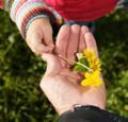
flower-gift.jpg 

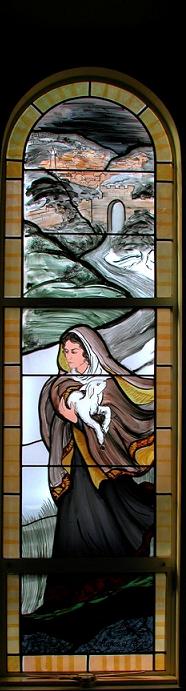
The “Book of Signs” in the Gospel of St. John begins with the story of John the Baptist - the Baptist’s statement of his own role in preparing the way of the Lord and his witness to the role of Jesus. John the Baptist saw Jesus coming and told his disciples, “Behold the Lamb of God …” He also admitted to them, “I did not know him … but the one who sent me to baptize with water told me, ‘On whomever you see the Spirit come down and remain, he is the one who will baptize with the holy Spirit.’” (Jn 1: 29, 33) Based on the Baptist’s testimony, Andrew, brother of Simon Peter, and John, son of Zebedee, followed after Jesus and became his first disciples.

How truly even today we do not recognize the Lord came clearly to me about this time seventeen years ago. My husband and I had two wonderful sons, and we had been hoping to have another child. Everything seemed to point to it being the right time and I had become pregnant as we hoped. Then in mid-January, it all fell apart. The baby in my womb died. We found out the news on a Saturday, but there was no need to do anything immediately, so the decision was made to wait until Monday to arrange for further treatment.

We went ahead and took down our Christmas tree. We had the birthday party for our firstborn, with most of his classmates attending, as we had planned. And on Monday morning, as symptoms of the miscarriage appeared, we went to Kaiser and I had the procedure to complete the process.

It was a very difficult time. We had very much wanted that child. And it was not to be.

The previous year, we had received a free overnight stay at a nice hotel up in the California wine country, to be used at a time of our choice. So we decided to go there a week or so later. That evening, I went for a walk through the courtyard by myself. I was praying. It wasn’t easy to pray during those couple of weeks. I asked the Lord, “Where have you been?” And I received his response in a series of images of faces that came into my mind. The couple who had stayed into the evening after the birthday party, so we wouldn’t have to be alone with our sorrow. The nurse who did the preliminary exam and shared that she too had lost a baby, but now had a healthy child. Another nurse who held my hand and told me it was OK to cry, as the procedure began. The doctor who was so kind and gentle. My parents, who sent flowers. They had never sent flowers before that day, but they did when I needed them. The other relatives who sent cards and plant arrangements. My son’s teacher, herself a young widow, who came after school and spent a couple of hours with me, just being there.

As all of these images and memories came to me, I knew where Jesus had been. He was right there, in his body, the People of God, the Mystical Body of Christ, about whom I had learned as a child. He was with me.

Behold the Lamb of God. Like John the Baptist, I did not recognized him when he came in person through all those wonderfully kind and thoughtful people. But the Lord is kind, and, like the Baptist, I got a second chance to recognize him - in the images of their faces that came to me that night.

Where is the Lamb of God in your life today? Keep your eyes and ears open. He is here, hoping you’ll recognize him in those around you. He’s here, too, hoping you’ll be helping him today to reach those who need his touch today.

Behold the Lamb of God!

St. Francis Xavier and Me by KathyPozos on Monday 3 December 2007 5:09 pm PDT

francis-xavier.jpg

December 3 is the feast of St. Francis Xavier, “Apostle to the East.” Francis Xavier was born in Navarre, Spain in 1506, to a wealthy and influential family. However, his family lost their lands in 1512 when Navarre was conquered by troops from Castille and Aragon. His father died in 1515.

Francis went to study in Paris when he was 19 and met Iñigo (Ignatius) Loyola there. To make a long story short, Francis eventually joined with Loyola as one of the founding members of the Society of Jesus, the Jesuits.

Francis is best known for his missionary work in India, Malacca, Sri Lanka, Indonesia, and Japan. From 1540, until his death on an island off the coast of China in 1552, he traveled and preached throughout the East, frequently returning to Goa in India. He left behind communities of Christians in each place he visited and pioneered the missionary style of the Jesuit order through the compromises he worked out with the existing Christian community, founded by St. Thomas the Apostle, in India.

There are many biographies and studies written about St. Francis Xavier’s life, teachings, influence in the Church, and miracles.

My family has had a close relationship with St. Francis for several generations in the Pacific Northwest. Jesuits were among the first to arrive in eastern Washington and brought with them a devotion to St. Francis. Growing up in parishes staffed by Jesuits, we shared in the tradition of the “Novena of Grace” each year in March. In fact, my parents’ first date ocurred when my father picked up my mother from her teaching assignment in northern Idaho and escorted her to the Novena in Spokane!

As a child, many of my early memories are related to the family tradition of attending Mass and the Novena from March 4-12. Each year we went, with our own prayer requests, and gathered with hundreds of other people from Spokane and the surrounding areas to praise God and ask St. Francis to intercede for us. There were people we only saw once a year - at the Novena.

Some years  the prayer intentions were very practical - a job for a relative out of work, health for a sick relative, help with school work, etc. Other years the intentions were more “spiritual” - help in overcoming a bad habit, help in discerning a life path, greater understanding of the Holy Spirit - little things like that!

Important things happened during or after the Novena. Two cousins who were born during the Novena were adopted into the family - we had been praying for a child for each family that year. Other children have been born into or adopted into the family in the year following the Novena. One of my brothers survived a difficult birth on March 4 and was given an extra middle name, Francis, in thanksgiving. Relatives got jobs. People got well. An uncle returned to the Church as he lay dying during the Novena. My Great Grandmother and my Grandmother both died on First Friday during the Novena. 

Sometimes funny things happened, like the year my youngest brother dropped a “steely” marble at the back of the church and it rolled all the way to the front, causing a stir as it went all the way! Mom was not amused, but we’re all still laughing about it.

The relationship with St. Francis is not limited to those nine days in March. At harvest time, when a storm threatens to ruin a crop before the field is harvested, prayers go up to “St. Frank” to protect it. When a relationship needs a boost from the Holy Spirit, prayers go to St. Francis. And when something goes really well, prayers of thanks go up too. It’s good to have a powerful big brother (saint) to help out.

A little over ten years ago, a young man from a Goan family knocked on our front door, hoping to sell a medical software program to a medical group we managed. The software was not what our group needed, but he became a close friend. We found many common threads in our educations, life experience and shared bond as Catholics. He in turn has introduced us to his family and many of his friends, including those who are the founders of Suggestica.com and who have opened this world of internet blogs and vertical discovery engines such as theologika.net to us.

It seems St. Francis Xavier is still looking out for us in this increasingly small, small world and doing his part to continue spreading the Good News.

All Souls Day - The Mystery of Transition by RandyPozos on Friday 2 November 2007 6:00 am PDT

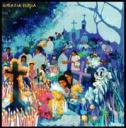
muertos1c.jpg

According to Catholic, Orthodox, and Anglican teaching, the communion of saints is made up of the faithful on earth (the church militant), the saints in purgatory (the church penitent) and the saints in heaven (the church triumphant). November 2, All Souls day, is the day on which prayers are offered for the dead, in keeping with this belief in the communion of all Christians in the Mystical Body of Christ.

Purgatory was a belief rejected by many of the Protestant groups during the Reformation. In part, this rejection was a reaction to the sale of indulgences which induced believers to part with money in exchange for the release of their loved ones from Purgatory. The Catholic Church responded by asserting that nothing had been sold and that free will offerings and alms, along with prayer and fasting were traditional ways in which the faithful on earth interceded for the deceased in their state of transformation. Jimmy Akin, a Catholic apologist (defender) and former Protestant, presents a detailed defense of Purgatory in his paper, “How to Explain Purgatory to Protestants.”

Tertulian, in the third century, taught that Purgatory was a physical place hidden deep in the bowels of the earth. It was a place where Christians who were not martyrs went after death and waited to be released at the final judgment. This view was quickly rejected by the Church.  Purgatory was seen to be a condition of the soul, not a physical place. More recently, Pope John Paul II stated that purgatory is a condition of existence outside of the passage of events we call time. According to the Pope and the Catechism of the Catholic Church, purgatory is not necessarily a place of physical suffering, but a place of transformation. Jimmy Akin, in his defense of Purgatory, says that it is implied in certain schools of Protestant belief, since man only stops sinning at the time of death and cannot sin in Heaven. Therefore, there has to be a point of purgation.

Those of us who grew up Catholic in the 1950’s remember that indulgences had certain time values assigned to them. Certain prayers or devotional acts remitted the temporal punishment of so many days or years. When I asked priests about it as a boy, they tended to roll their eyes and say that it didn’t make much sense to them - there is no time in eternity. Some tried to explain that the time was somehow equivalent to the benefit that so many days of penance would have had on the departed soul. The assignment of days and years of spiritual benefit has now been erased from our concept of prayers and devotional acts. The view today is one of solidarity with the deceased, as living members of the community. Consequently, Catholic observances tend to be less anxious and mournful than during my childhood.

The Mexican Día de Los Muertos - The Day of the Dead - a joyful celebration which actually lasts from October 31 to November 2, celebrates those in heaven and purgatory. Preparation for this celebration begins in mid-October. Death and the afterlife have a very different sensibility among less industrialized segments of Mexican society. The reality of the afterlife is not doubted but is instead celebrated. There are fewer effects of secularization in this population, so the images and concepts that result may seem bizarre to industrialized sophisticates. Pageants of saints and devils, candy in the form of skulls, and even a mock funeral procession with a live person in the casket are part and parcel of a lively festival. Altars with votive offerings bring to mind those of pre-Christian shamans and an ongoing connection with ancient indigenous traditions as well.

Life, death, and new life is also a persistent belief outside of Christianity and a mystery that can never be understood but only celebrated. What happens at that moment of transition between two worlds and modes of existence? Something terrible and something wonderful. All Souls Day is a day to stop and ponder the mystery.

Saint of the Day - All Saints by RandyPozos on Thursday 1 November 2007 6:00 am PDT

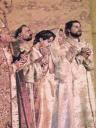
all-saints-nava.jpg

The feast of All Saints was originally celebrated as the feast of All Martyrs on May 13, beginning around 610, when it was established by Pope Boniface IV. The date coincided with an ancient three day Roman festival, Lemures, which ended on May 13. Lemures was a time when Romans attempted to appease the dead. The date was also celebrated as the dedication of the Pantheon in Rome to St. Mary and All the Martyrs. A feast commemorating All Martyrs was held as early as 270, but there is no record of the actual date. There is evidence that All Martyrs was observed in Antioch on the first Sunday after Pentecost in the 300’s. This tradition still continues in the Orthodox and Eastern Churches as All Saints Sunday. The feast of All Saints was proclaimed on November 1 when Pope Gregory III (731-741) dedicated a chapel within St. Peter’s for the relics of the apostles and all saints. The Irish church celebrated All Saints on April 20 throughout the early Middle Ages.

Devotion to the saints became a highly contentious issue during the Reformation. Reformers alleged - with some very good evidence - that the saints were being worshiped, as opposed to being venerated. The general criticism was that attention was not being focused primarily on Christ. The focus on relics, indulgences, and special novenas appeared to make these exemplars of the faith into demigods.

500 years later, and 40 years after the Second Vatican Council, our approach to the saints is more communal. The Mystical Body of Christ, as emphasized by Pope Pius XII in Mystici Corporis Christi (On the Mystical Body of Christ -1943), led to a broader understanding of the holiness and vocation we all share in the Communion of Saints. In keeping with the renewed emphasis on St. Paul’s vision of the church as the Mystical Body, the contemporary church has renewed the ancient Pauline tradition of referring to all Christians as “the saints” or those made holy in Christ. Some sermons today even extend the feast day greetings to everyone in the congregation.

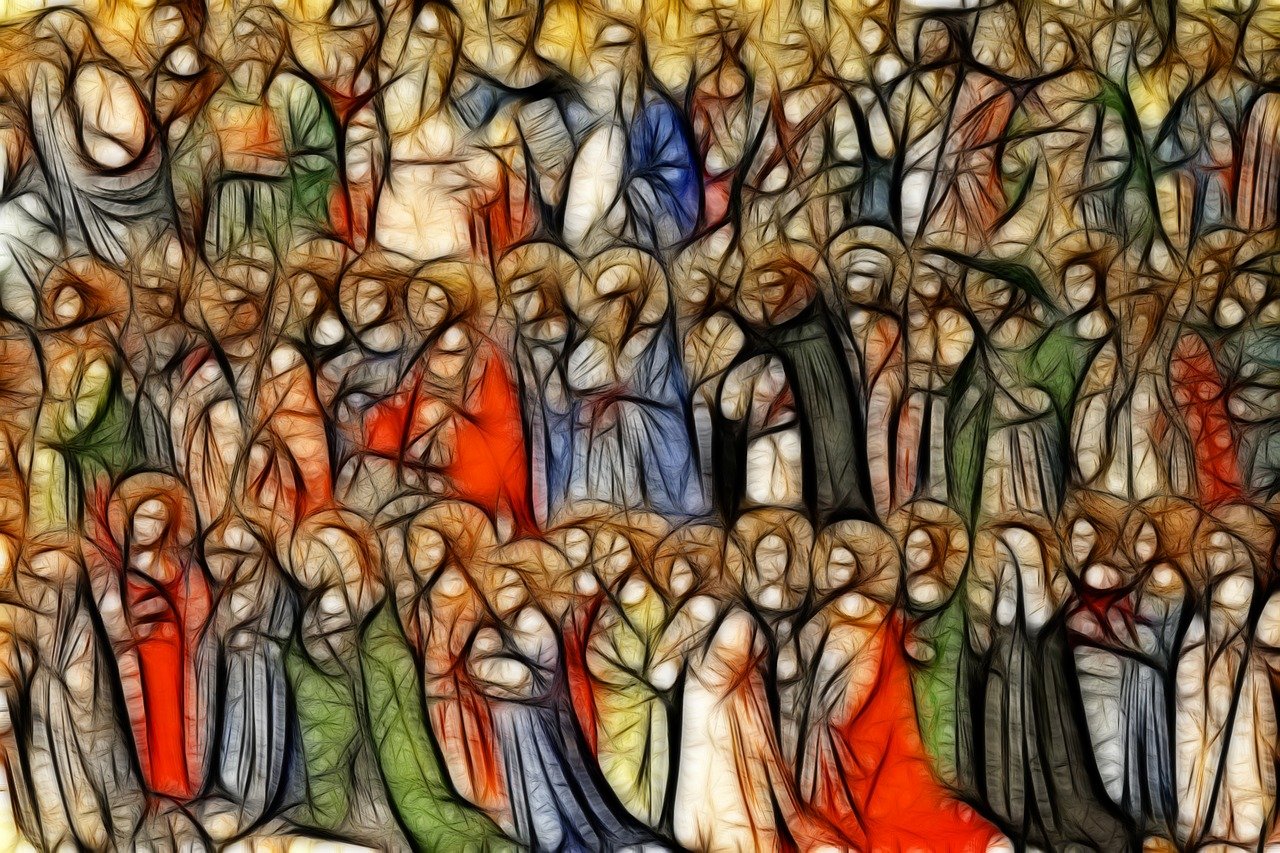
Experiencing the Communion of Saints as more than an intellectual concept is difficult. Something of the reality can be experienced in the new Cathedral of Our Lady of the Angels in Los Angeles. The largest church in the United States, Our Lady of the Angels has an enormous openness and can be somewhat overwhelming, until you start to walk down the aisle. The walls are covered with huge tapestries designed by John Nava and manufactured in Belgium. All of a sudden you are part of large community of saints who really look like people. The faces are not stylized in the traditional poses of rapture. The faces are all the more startling because in many cases they are the actual likeness of the saint. Paintings of the 136 saints and blesseds were first made from photographs. The paintings were then graphed and digitized and sent by e-mail to the looms for weaving. Nava’s art is described as neo-classical post-modernist, indicating a vision of the post-modern world returning to classical forms in a completely original way. This style might be a very apt inspiration for all of us post-modern saints.

Canning, A Little “Communion of Saints” by KathyPozos on Saturday 22 September 2007 11:46 am PDT

Monday this past week was a “Canning Day” at our house. The pears were ripe enough to be sweet even without the addition of a light syrup. Canning days cannot be easily scheduled. They can be predicted, but everything must wait for the right degree of ripeness. I had bought the pears nearly a week earlier, on Tuesday, with the hopes that they would be ripe on Saturday. (Saturdays are easier for canning because I can lasso a helper. Weekdays she’s in school.) But they were still green. Sunday they were smelling like ripening pears, but when we tasted one that was beginning to mold, it still had a green tang, so we waited. I washed the jars and made sure I had honey for making the syrup, but that was as far as I could go. Monday they were ready and I set to work.

Canning pears is not difficult, but it is time consuming because the pears must be pealed and the core removed before they are put into the jars for processing. I only had one box of them, but it still took an afternoon of work to get them into the jars and processed and the jam made to complete the day’s work. But oh, the wonder of them in the middle of the winter, when I enjoy them as part of my breakfast or for a midnight snack! It’s worth every minute spent.

So how does this relate to the “Communion of Saints?” I was blessed to know not only all of my grandparents, but also one set of my great-grandparents. Great Grandad died when I was very young and I really don’t remember him except from a picture. But my Great Grandmother Heitstuman lived until after I graduated from college and was engaged. She lived in town and we saw her frequently. We called her Grandma, because I was the first great grandchild and she didn’t like to think she was old enough to be a great grandmother. She even gave us lemon drops when we remembered for a whole visit to call her “Grandma” rather than “Great Grandma.”

Grandma’s birthday was July 3 and she liked to celebrate it on the 4th. We’d gather at her house for a potluck of all the relatives living in town, including three families of my Mother’s cousins who were children my age. (We called my mother’s mother, Grammy. Grammy’s brothers and sister had children much later than she did.) While awaiting the expected fireworks coming after dark, we children would play in the yards and basements of the three family houses on Grandma’s block. In a corner, safely tucked away on neat shelves, there were the jars and jars of canned fruits, vegetables, jams, and jellies. Everyone had them. By the end of the growing season, the shelves were full of the bounty of summer and ready to take us all through the coming winter.

My grandmothers, my mother, my aunts, and many of our neighbors and friends preserved both fruits and vegetables. When I got married, I too began to preserve foods for my family, despite the fact that by the mid-70s fresh fruits and vegetables were available in the stores year round. The variety, textures and flavors of commercially prepared or preserved foods did not match those I had grown up loving. Continuing the tradition, my married son and his wife have joined in the art of canning and preserving foods for the coming seasons.

While none of us is likely ever to be named officially as saints, and certainly we all have our share of faults, our sharing in this activity of canning brings us together in a very special way. I always feel very close to the women who have gone before me as I prepare the raw ingredients and fill the shelves with jars of pickles, jams and canned fruits. I’m sure they are smiling at the sight with their own memories of the work and the pleasure of the enterprise.

The Communion of Saints is somewhat like this communion of canners of fruits. Not people we worship in any way, but more like older sisters and brothers, aunts, uncles, cousins, grandparents. People who care about us, who are interested in what we do and how we do it, and who want to help us in whatever way they can to live our lives responsibly, do the good that God hopes we will accomplish, and have a little fun along the way. And, like an older brother or sister, if we need someone to put in a good word for us along the way, they’re happy to do that too!

Yes, Canning Days are special. They bring the reality of my little “communion of saints” into focus again in its relationship to the great Communion of Saints in which all of us share.

Categories

  • Angels (3)
  • atonement (13)
  • Christian Unity/Ecumenism (3)
  • Communion of Saints (7)
  • Conversion (25)
  • Doctor of the Church (19)
  • Edith Stein (2)
  • Eucharist (6)
  • Ever Ancient / New (46)
  • everyday revelation (69)
  • Faith and Reason (51)
  • Faith in Action (98)
  • Fathers of the Church (8)
  • Feasts - liturgical (54)
  • Festive recipes (3)
  • Forgiveness (12)
  • God in All Things (36)
  • Gratitude (16)
  • Holocaust (3)
  • Incarnation (21)
  • It's to laugh (1)
  • Jewish / Christian Relations (3)
  • Korean Martyrs (1)
  • Liturgical year (42)
  • love (35)
  • Marriage (5)
  • Ministry (1)
  • Miracles (13)
  • Missions (10)
  • Mother Teresa (3)
  • Mystics (11)
  • Pagan/Christian Relations (1)
  • Pope John Paul II (3)
  • Pope John XXIII (2)
  • Pope Paul VI (1)
  • problem of evil (9)
  • Sacraments (9)
  • Saints (107)
  • Salvation (24)
  • Second Vatican Council (5)
  • Site logistics (4)
  • Social Justice (31)
  • spiritual growth (67)
  • spirituality (53)
  • St. Augustine (1)
  • St. Faustina Kowalska (1)
  • St. Francis of Assisi (2)
  • St. Ignatius Loyola (2)
  • St. Jerome (1)
  • St. John Chrysostom (1)
  • St. Joseph of Cupertino (1)
  • St. Matthew (1)
  • St. Robert Bellarmine (3)
  • St. Therese of Lisieux (3)
  • St. Vincent De Paul (1)
  • St.Thomas of Villanova (1)
  • Theodicy (2)
  • Thomas Merton (1)
  • Uncategorized (10)
  • Virgin Mary (6)
  • Vocation (2)
  • Yom Kippur (1)
  • Youth Ministry (1)
  • Monthly Archives

  • January 2009
  • December 2008
  • November 2008
  • October 2008
  • September 2008
  • August 2008
  • July 2008
  • June 2008
  • May 2008
  • April 2008
  • March 2008
  • February 2008
  • January 2008
  • December 2007
  • November 2007
  • October 2007
  • September 2007
  • August 2007
  • July 2007
  • Recent Posts

    Recent Comments

    RSS Subscription

    Subscribe by Email

    Enter your Email


    Preview | Powered by FeedBlitz

    Visitors

    Locations of visitors to this page

    Creative Commons LICENSE

    This work is licensed under a Creative Commons License.