Thoughtful Reflections on Religious Experience
Aurelius Augustinus – You Done Us Wrong? by RandyPozos on Tuesday 18 August 2009 9:30 pm PDT

Redwoods

While camping recently with my wife and daughter in the redwoods near Santa Cruz, I spent some time with an enlightening and very readable book.

Christopher Hall in Learning Theology With the Church Fathers does a good job of summarizing St. Augustine’s notion of the fallen nature of humanity. St. Augustine is convinced that something went terribly wrong when Adam ate the forbidden fruit so that we are not capable of really loving and knowing the good until we are redeemed in Baptism. Of course this led not only to the notion of infant baptism but also to the notion that unbaptized infants would suffer the wrath of God in eternal punishment. It is logically consistent but it seems to be extreme and never became as much of a prominent idea in the Orthodox East as it did in the Catholic and Protestant West.

This doesn’t square with the Black civil rights assertion of human dignity: “God don’t make no trash!” In fact, it seems at odds with the fundamental goodness of creation which St. Augustine upheld in the face the Gnostic conception that creation was a mistake by a lesser god and matter is evil.

Today we might explain these things as laziness, psychological conflicts, compulsions, addictions, or unhealthy repression.

In St. Augustine’s defense, we should remember that he is also considered one of the founders of psychology. His concepts of memory, will, and understanding as the core of individual identity still hold up in the face of contemporary neuroscience. It seems that the key problem he wrestled with from his own experience and that of people he observed was our ability to know what is good and not to be drawn to it in a way that compels our will. In other words, we know the right thing to do and we do the opposite.

For Augustine, the arena of sexual behavior was particularly problematic. Unfortunately, for example, he didn’t have our understanding of human sexual anatomy and physiology and he felt that what we would call involuntary responses were a sign of lack of control and the conquest of the will. His promiscuous sexual behavior prior to his conversion appears to us post-moderns as bordering on addiction. Today, in contrast, we might view orgasm as something healthy and transformative. In fact, we have made it something holy at the core of the sacrament of matrimony. However, the momentary obliteration of memory, understanding, and will made it highly suspect for an upper class Roman like St. Augustine living during the decline and fall of the empire.

Relaxing in the redwoods enjoying creation seems an awful lot like a certain lost garden. Does God really need to be appeased or does he just continue to reach out to us in love – the beautiful love of creation? Are we only saved in Christ if we are baptized? Is salvation questionable outside the community of the baptized faithful? The traditional and orthodox answers are yes. Is everything else outside the assembly’s official teaching false? The official answer is yes.

What about the Spirit hovering over the abyss? About the eruption of God in space-time? Is our teaching about faith or about certainty? The church fathers sought revelation in the written books and the book of nature. Does not all creation shout the glory of God? Did not Jesus put all things right? Would a God of love do it for just a few?

Would a father or mother provide for only some of their children and leave the rest in eternal darkness? “Evil as you are would any of you give your son a scorpion when he asked for bread…” Would a father or mother require death by hideous torture of a beloved son?

In terms of making some sense of the death of Jesus in a culture in which thousands of animals were sacrificed each day as part of official worship, the notion of Christ as the final and only suitable victim is comprehensible. His final and complete sacrifice also explain the loss of the Temple and the genocide of a people lost in hopeless insurrection. How else could the death of God’s son make any sense? Yet once we begin this paternal projection and anthropomorphism of the One God, our words and images fall on hard ground.

Per usual, I have begun at the end, since Learning Theology With the Church Fathers actually begins with wonderful treatments of what we used to call De Deo Uno (the one God) and De Deo Trino (the triune God). Hall takes the wise course of not trying to explain the indescribable but begins by the efforts of the early Hellenistic church trying somehow to grasp the reality behind the hymns of praise to the Father, Son, and Holy Spirit as the one God and to Jesus as the Eternal Word.

How can this be? Yes, that is the question, whether one is caught up in the majesty of the redwoods or the radiant light from light, begotten not made causing them to break forth into the Song beyond all hearing that is Music, Word, and Divine Rhythm.

St. Augustine’s famous Chapter 10 of The Confessions says it much better than I could.

Late have I loved you,
O Beauty ever ancient, ever new,
late have I loved you!

You were within me, but I was outside,
and it was there that I searched for you.
In my unloveliness I plunged into the lovely things which you created.

You were with me, but I was not with you.
Created things kept me from you;
yet if they had not been in you they would not have been at all.

You called, you shouted, and you broke through my deafness.
You flashed, you shone, and you dispelled my blindness.
You breathed your fragrance on me;
I drew in breath and now I pant for you.

I have tasted you, now I hunger and thirst for more.
You touched me, and I burned for your peace.

A Weekend With the Holy Trinity by RandyPozos on Saturday 14 March 2009 11:52 am PDT

shackcoversm

There are all kinds of stories of growing up Catholic but very few that focus on that core of the culture that is the Sign of the Cross. “In the name of the Father and of the Son and of the Holy Spirit. Amen.” This Trinitarian invocation begins and ends almost every event, every ritual, every meal – whether it is a blessing pronounced by the Pope or the gesture we learn from our parents before we can talk.

For all of Catholicism’s lengthy tradition, its mantras and catchphrases, Trinity Sunday is the only Sunday that fails to attempt in words what is incomprehensible. The priest who has a sermon for each Sunday looks into his bag or online list of stock themes, works hard on the presentation, and raises the white flag of surrender as he steps into the pulpit. The standard disclaimer is “We really cannot understand the Trinity. It is a matter of faith.” After confusing those who are awake in the congregation with St. Patrick’s shamrock “three in one” or various other analogies, he repeats the opening disclaimer and makes a hasty retreat to the Nicene Creed, where we sleepwalk our way through beautiful Trinitarian poetry that we ignore out of repetition. “…Light from light, True God from True God, Begotten not made, One in Being with the Father…”

For those of us who graduated from Catholic schools and had a good review of the Trinitarian controversies of the first three centuries and the further travails of this teaching in Church history, the sense of incomprehensibility grows.

William Paul Young’s allegory, The Shack, presents a weekend encounter with the Holy Trinity by a deeply wounded and grieving father. It is a mystical healing encounter that shows us that our concept of God has more to do with us than with the Divine. As a work of fiction it is easier for us to comprehend than the abstractions of theology. The contemporary setting and the issue of why the innocent are slaughtered make this central Mystery more accessible to us than the writings of the mystics who lived in different times and cultures.

Athan Smith tells us that his reading of The Shack brought the Trinity to the center of his life.

I encourage you to read the book. Once you do, that automatic gesture – the Sign of the Cross will be the gift that it is – an entry point to the very life of God.

De Vita: Toward a Christian Philosophy of Life by RandyPozos on Thursday 4 December 2008 6:02 pm PDT
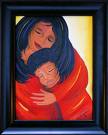
Madonna by Ralph & Shelly Neibuhr

Latin Baby by Ralph & Shelly Neibuhr


In an interview on National Public Radio yesterday, former Arkansas Governor Mike Huckabee offered a very intelligent and fluent presentation of the pro-life position. While being interviewed about his new book, Do the Right Thing, he stated clearly and succinctly that life has to be seen as sacred and valued and that humans cannot be wantonly discarded when they are inconvenient or an economic liability. The big danger, as Mr. Huckabee pointed out, is that if we teach our children that certain marginal people are disposable, we ourselves may become disposable once we are old and infirm.

One of the listeners emailed a questioned about the consistency of an anti-abortion position and one in favor of capital punishment. Mr. Huckabee allowed that there might come a point when the case could be made to eliminate the death penalty. Even as he praised those who participated in candle light vigils outside the Governor’s mansion protesting the execution of criminals, Mr. Huckabee said that the taking of such lives occurred not at the whim of an individual mother but after an exhaustive judicial process. He made the point that some crimes are so severe and the danger to society is so great that killing people is the one definite way to make sure that such people will never commit this crime again. He added that the death penalty is a deterrent that benefits society.

His presentation was very sincere, yet there was something that made me uneasy about it. Is re-criminalizing abortion truly a pro-life position? Abortion still occurred when it was illegal. Making it illegal once again will not stop the practice. Philosophically, a true pro-life position requires supports and incentives for the care and nurturing of all - at every stage of life. An acceptance of abortion can represent a coarsening of the public’s view of unborn children and human life.  An acceptance or a toleration of abortion is seen by many as leading to a debasement of the human fetus and of motherhood itself.

Nevertheless, if we criminalize abortion, we won’t stop it. We can “enjoy” taking the moral high ground, but I think that this is an illusion. What happens when women do not have safe and legal access to abortion? The mother and child relationship becomes socialized without the benefit of the social and economic supports necessary to lead a life of worth and dignity.

If we accept the view that birth control is also immoral, we are holding to an idealized view that sex only occurs in marriage and that in natural family planning, reason and ovulation always win out over human passion.

Although well intentioned – that great pavement on the road to perdition – the movement to re-criminalize abortion does not represent a well integrated philosophy of the dignity and worth of life. Criminalization could very well return us to a public policy that moves us away from a humanistic and Christian philosophy of life.

Morally, one can advocate an idealized Christian lifestyle focused on virginity, abstinence, and separate beds for married couples, but pastoral applications of moral theology have always been more about actual living - and dealing with the messiness of life.

Perhaps, what we are really wrestling with is the notion of what it is to be inhuman. Interrupting an otherwise healthy pregnancy without a very compelling reason still appears to have a lot of support as being an inhuman activity. Then again, the notion of placing a woman at risk of death because she does not share our beliefs or because she perceives she has no other choices also appears to have widespread support as something that is inhuman.

Can you have a secular policy that permits abortion and even physician assisted suicide? It is hardly a Christian position. Then again, perhaps the Christian witness is better seen in public policy that makes these choices less necessary and less desirable. If we insist that public policy has to be Christian in a post-Christian civilization, we may be doing something that is not really very Christian – we may be claiming (against the teaching of St. Paul) – that the law can save us.

(Image taken from Shelly Niebuhr’s home page: http://shellyn.com/pageForLarger.html)

The Encounter at Emmaus by RandyPozos on Sunday 6 April 2008 6:27 pm PDT

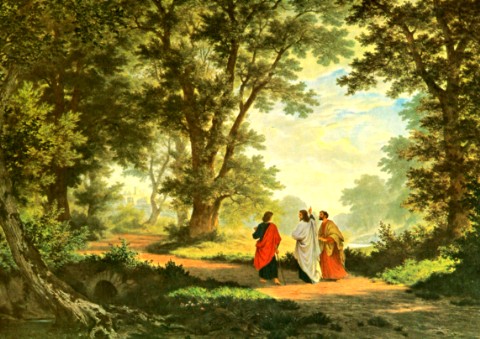
emmaus.jpg

I have been struck by the stories this Resurrection Season because for the first time, they strike me not as eye witness accounts of the Risen Christ, but as the challenge of faith for the disciples and us. The disciples on the way to Emmaus are leaving Jerusalem – returning home, perhaps, – grief stricken, but more importantly, disillusioned. The teacher has failed. The forces of evil have destroyed a very good and wonderful young man.

One way to see this story is to take it as another proof of the Risen Christ as encountered by his disciples. The story does convey this message. However, the story also tells us that we find the Risen Christ when He opens our minds to see the scriptures and when our hearts are opened at the Breaking of the Bread. Look for Him in the scriptures and invite Him in to dinner and your hospitality will be more than repaid.

There is just a glimpse – a flash of recognition and he disappears from our midst. The presence of the Risen Christ is a momentary and ongoing discovery. It is the result of searching, wandering, questing in grief and disillusionment and being open to the challenge of the Stranger.

All of us have moments, years, decades, in which everything we knew and had hoped for is swept away. The disciples had no clue of what was to become of their beloved teacher, but his torture and death threw them into utter grief and confusion. Yet their confusion only increased when they heard that other disciples had found the empty tomb and seen the angels. They were re-grouping, leaving town, trying to get some distance. A Stranger notices their grief and inquires. They listen and reflect on the scriptures and Break Bread.

This is the Christian life – the quest and the encounter in the village of Emmaus – continuing through all generations.

christ-of-maryknoll.jpg

For those who love Christ, remembering His passion and death is always an occasion for sorrow. However, such human acts as compassion are never simple. The pain of the impending loss of a loved one – anticipatory grief – can be worse than the actual loss. In fact, when death finally comes, we often feel guilty about experiencing relief. My friend Jim lost his father when Jim was in eighth grade, after a protracted two year battle with cancer. When we talked about it a couple of years later, Jim confessed that he still felt more relief than grief.

Of course, we couldn’t experience compassion without a close identification with the other. This becomes very complex in the person of the Christ. He did not fight his enemies. He did not curse. He did not condemn. He forgave. He blessed. This human-divine reaction to an injustice that is almost as inconceivable as it is enraging provides no adequate psychological outlet for the post-Freudian soul. How can we proclaim and fight for justice if God Himself did not? Tragically, the consolation in the Gospels and the wider testimony of the New Testament – that no evil, no matter how overwhelming, how senseless, can ever separate us from the love of God in Christ Jesus – escapes us. (Romans 8:38-39) Instead of experiencing this Passover of the Lord – the Blood of the Lamb on the door posts and lintel of our home that spares us from the Angel of Death – we run out into that night of despair by focusing on the ways we have been complicit with that evil.

When we hear that we are saved from a life defined by suffering and pain without meaning and no exit, we can think that we were saved from something we deserved. “Evil as you are … who among you would give his son a scorpion when he asked for bread?” (Loosely taken from Luke 11: 11-13) is a stark reminder to the disciples that Jesus could not conceive of His Father wanting anything less than we ourselves would want for our own children. Just as our children are all too much in our own image and likeness, we are in God’s. The teaching and life of Jesus in this regard is at odds with the vengeful patriarch of the Old Testament who punishes and chastises. (Lest we be tempted to think that Jews hold or held onto to this concept, we should remember that Jesus was not the only Jew who presented a view that had grown beyond it. The are interesting similarities between Jesus and his contemporary, Hillel the Elder.)

Enter God’s protectors:

“Ah hah! Now he has said it on his very own blog! Your own words condemn you. God doesn’t care about sin, you say. There are no consequences, no punishment, no reckoning. You present a God who is merciful, but not just. If Christ did not die for our sins how was the Father appeased? How is he the sacrificial victim?”

The Blogger Offers a Parable:

Once upon a time, there was a wonderful teacher who healed by word and touch and saved people from all kinds of physical, psychological, and social maladies. He made the mistake of speaking truth to power and telling religious and civil leaders that outward observance only made them into whitened sepulchers. They waited for the right time and got a close friend to betray him, and they took him off to Guantanamo, and then transferred him to a third world country, where he was tortured to death by specialists trained at the School of the Americas. Like so many thousands of his time, he was supposed to have become one of the disappeared. Fortunately for us, He didn’t stay dead and he didn’t stay hidden. Strangely though, he left again, said he would return, and in the meantime the were supposed to wait for a Holy Wind to make everything clear.

Yet His disciples wanted an explanation. If He was truly God’s Son, how could this have happened to Him? If he really was the Messiah, how could he have failed? He was just as maddening as those parables he used to tell them. Where are the answers? It was like one of those Eastern religions. “The question is the answer.” And that other junk the Beatles found in India, under the influence of something other than the great American mystic, Jack Daniels.

God finally sent them someone they could understand – sort of. “Like, well, yuh see, dude- God don’t need sacafices, ” The voice of the aging surfer was hoarse with too many years of funny cigarettes, his faced etched with too much salt and sun, his eyes opaque while he waited for the waves to rise. “It’s like, all ’bout love. All God wants is love. The torture and sufferin’ part, that’s what we do to us and each other. Man, like the Teacher Dude, the Guru Guy, like he couldn’t hang out forever. ‘Cause like, you guys were all brain dead on a kind a gnarly bad trip. Like he let it happen. The tube was closin’. Like there was just the wipeout; like really bad at Mavericks. He did it to show y’all that if yah stay in the water and go for it, sooner or later it’s gonna happen if ya stay true to the search for the Big One.  Dude, got some extra change? My old lady’s on me for the rent, like ya know.”

The words of reproach, as the seeker turned away, were familiar. “That sucks man. What a waste. I came to hear some guy explain some @$#%?! blogger’s crappy parable. I could’a been watchin’ the game on my big screen.” So he zipped up his jacket and marched straight home, out of the saving mystery, ignoring the glory of the sky, the dazzle of the water, and the carpet of color and bird song all about him.

Christ in the Desert and the County Jail by RandyPozos on Thursday 7 February 2008 12:02 am PDT

christ-of-maryknoll.jpg

On Shrove Tuesday, while much of the world was at Mardi Gras, I was praying and sharing scripture with a small group of inmates at the county jail. Our scripture was the Temptation of Christ (Luke 4:1-19). One thing that emerged in our prayer and reflection was Christ’s acceptance of the Father’s way of rejecting power and advantage in the announcement of the Kingdom.

Why take the hard way? God could have redeemed us in many different ways. Why such a horrible death? Why did the Spirit drive Jesus into the wilderness after his baptism by John? Why was the Son of God fasting and praying for 40 days?

One of our group restated a common view that the offenses of humanity had become so severe that God demanded the most severe appeasement. I suggested that maybe the answer was in the persistence of evil in our lives. For so many of the men I was praying with, their lives had been damaged by forces beyond their control – poverty, addiction, and mental illness. (Hardened criminals generally don’t come to a prayer meeting in our jail. The faith of those who do come is something, I am sure that Jesus did not find in Israel and does not find in most respectable Christians.)

Christ, who was like us in all things but sin, chose to identify with the powerless and to put his faith in the Father through non-violence. Utter foolishness – according to St. Paul. In our suffering and defeat how could we be one with a God who was not defeated – a God who was not an utter failure? Did the Father exact this humiliation out of a some perverse pleasure unworthy of a human father?

That community of Divine love – Father, Son, Holy Spirit – Creator, Redeemer, Breath of Life come to the heart as love. Love can never be forced. True love can never come through power, glamour, or glitz. As we reflected and prayed it became more obvious to us that God can only come to us in compassion and that is how we come to him. Yet compassion is not compatible with power, wealth, and success – like a camel passing through the eye of the needle.

God with us. God like us. Powerless in love.

A Thread of Grace – Resisting The Italian Holocaust by RandyPozos on Wednesday 19 September 2007 6:00 am PDT

Grace is a heavy topic in systematic and historical theology. It has been the center of a longstanding dispute between Catholics and Protestants. In many respects, this dispute that dates to the Reformation is about how much credit we can take for the good we do or whether we have to credit everything to God.

I must say that when I picked up Mary Doria Russell’s, A Thread of Grace, I thought that the title was more of a poetic touch than a solid theological theme. I was attracted to the subject of the Holocaust in Italy. Since we are now between Rosh Hashanah, the Jewish New Year, and Yom Kippur, the Day of Atonement, the timing of this post seems appropriate.

When I picked up A Thread of Grace this summer for some “light” reading on vacation, I was unaware of Mary Doria Russell’s previous books, The Sparrow and Children of God, which are both works of science fiction with theological and philosophical themes. The Sparrow is the story of a Jesuit mission to an alien planet told by the sole survivor, Fr. Emilio Sandoz. In Children of God, Fr. Sandoz is called upon to return to Alpha Centauri.

Even though it is a work of historical fiction, A Thread of Grace reads like a thriller. Italy withdraws from World War II. Nazis come pouring in, along with refugee Jews from areas of southern France that had been controlled by Italy. Italians resist the Nazi extension of the Holocaust and 85% of resident and refugee Jews in Italy survive the 20 months of German occupation. The story takes place in northwestern Italy and presents the complexity and richness of the stories of the major characters. Who lives and who dies and how they die appears to be largely a matter of chance or fate.

The desperate situation of the region, caught between the collapse of their government and military, the German invasion, the relentless Allied bombing, and various partisan factions, provides a relentless cauldron in which the Jews are offered refuge and protection. The plot is very complicated but the characters reveal a great deal about simple truths. Werner Schramm, a Nazi doctor guilty of horrendous crimes, finds a measure of redemption after he is given a place and help to recover from tuberculosis. The man responsible for this help is the main character, Renzo Leoni, a Jewish aviator and veteran of the Abyssinian War, who has his own guilt about war crimes. Fr. Osvaldo Tomitz, who refuses to give absolution to Dr. Schramm, later receives his final Communion and last blessings from the Nazi doctor who is too late to rescue him. Iacopo Soncini, the local rabbi, comforts Fr. Tomitz when the priest comes to warn him and the Jewish community. People act to help others at an unbelievable cost – torture, the loss of their family, friends, and communities.

While this is certainly not a “feel good” book about the Holocaust, it is a resounding testament to people doing the right things in moments of grace. Are they responsible for these heroic actions or is God? The lives of these believers and unbelievers, these saints and sinners all wrapped up in the same complex person, render the academic quarrel over grace moot. God does not overpower free will and free will snatches hope from despair.

“There is a saying in Hebrew… No matter how dark the tapestry God weaves for us, there is always a thread of grace.”

Saint of the Day: St. Joseph of Cupertino by RandyPozos on Tuesday 18 September 2007 6:00 am PDT

Joseph Desa (1603-1663) was born in Cupertino, near Brindisi in the Kingdom of Naples.

St. Joseph of Cupertino is a challenge to anyone of an intellectual bent. His life is the prototypic story of an uneducated child, beset by poverty, who has ecstatic experiences beginning at age 8 which leave his mouth agape. His school mates called him “voca aperta.” The young child had quite a temper, which his mother tried to moderate, and he was later apprenticed to a shoemaker. At 17 he was turned away from the Friars Minor Conventual because of his ignorance. The Capuchins at first accepted him as a lay brother but his continued ecstasies made it impossible for him to do his work, so he found himself out on the street again. His mother and his uncles had given up on him and abused him as a good for nothing. Finally, after repeated prayers and a lot of tears he was allowed to work in the stable at the Franciscan convent of La Grotella near Cupertino. He was basically a lay servant. His humility, obedience, and love of penance must have impressed the friars because he was not only allowed to became a cleric but he was also ordained a priest over a period of years. Despite his lack of education, he demonstrated an amazing knowledge which appeared to be infused as a mystical gift. He was able to solve intricate problems.

His life was one long series of episodes of ecstasy, vision, and levitation. His superiors had to keep sending him from convent to convent to escape the curious.

John Coulson in his brief biography relates an incident that was all too typical.

“In 1645 the Spanish ambassador to the Holy See, the High Admiral of Castile, having spoken for some time with him in his cell at Assisi, said that his wife too would like to meet him. The Father Guardian told him to go down to the church: Joseph said he would obey but did not know whether he would be able to speak to her. He entered the church, saw a statue of our Lady over the altar and straightway flew some twelve paces above the onlookers to its feet, and after a while, ‘uttering his customary shrill cry’, returned to the floor and then his cell, having said nothing to the Admiral, his wife and their large retinue. Instances could be multiplied up to the last month of Joseph’s life.”

Through it all St. Joseph of Cupertino kept his sense of peace and humility. It almost seems as if his life was written as an object lesson about the need for men in religious orders to temper and even validate their spirituality through obedience. This is not an uncommon theme of the time. How much of this is history, legend, and myth?

The art of writing about the lives of saints – hagiography – has undergone extensive criticism in the last 100 years. St. Christopher, the patron saint of travelers, was removed from the Church calendar by the Vatican in 1969 because there wasn’t enough historical evidence that he had existed or had lived a life of holiness. Many lives of saints had become embellished over the centuries. For example, St. Nicholas was said to have stood up in the bathtub as an infant and preached a sermon.

In the 17th century, a group of Jesuit scholars, the Bollandists, were commissioned by the Pope to prepare a definitive collection of the Acta Sanctorum, The Lives of the Saints – or literally, the Deeds of the Saints. In a bow to the Enlightenment and rationalism, the resulting investigations cleared away a lot of misinformation and also validated significant historical information.

We might expect that the flying Franciscan would have been relegated to the dustbin of history. However, the historical testimony of Pope Urban VIII, who saw St. Joseph of Cupertino in ecstasy, the accounts of powerful nobles and officials who saw his miracles, and the records of the Inquisition, bear historical witness to a saint who baffled his contemporaries as much as he baffles us today.

St. Joseph of Cupertino defies our psychological categories. We could use the terms: hysteria, seizure disorders, aphasia, schizophrenia. Yet he certainly did not fit the social norm of insanity. Against the odds, his superiors judged him worthy of ordination to the priesthood, although his paranormal behavior prevented him from saying Mass in church and participating in processions. In 35 years he could not eat in the common dining room (refectory) or participate in the “choir” or singing of the Liturgy of the Hours (The Divine Office). His creativity in solving problems seems to remove him from the idiot savant category.

If we can’t explain away his behavior as a mental illness, then perhaps we are getting a glimpse of what it means to have a lifestyle of intense religious experience. If we leave science behind, we enter into the language of faith itself, or at a minimum, we enter the language of theoretical physics by talking about additional dimensions beyond the space-time continuum or the notion of parallel universes.

As I wrestle for some type of explanation, I feel that at any moment people will come rushing forward to tell me that I have made a fool of myself in front of some hidden camera. On the other hand, maybe that is what St. Joseph of Cupertino is all about.

1 Corinthians 1:26-31
Brothers, think of what you were when you were called. Not many of you were wise by human standards; not many were influential; not many were of noble birth. But God chose the foolish things of the world to shame the wise; God chose the weak things of the world to shame the strong. He chose the lowly things of this world and the despised things—and the things that are not—to nullify the things that are, so that no one may boast before him. It is because of him that you are in Christ Jesus, who has become for us wisdom from God—that is, our righteousness, holiness and redemption. Therefore, as it is written: “Let him who boasts boast in the Lord.”

St. Augustine: The Once and Future Giant by RandyPozos on Wednesday 29 August 2007 3:05 pm PDT

 Augustine by Botticelli

August 28th. is the feast day of Aurelius Augustinus Bishop of Hippo.

St. Augustine (354 to 430) was one of my boyhood heroes. I read Louis de Wohl’s biography of the saint, The Restless Flame. As a German writer in the 1920’s and 1930’s, de Wohl was immensely successful as a writer of thrillers and he brought this sense of action to his religious historical novels written in English after World War II. I was introduced to Augustine as a man of great learning and action, a man who moved mountains and changed the course of oceans of thought and action.

Later, when I read his Confessions and the City of God in Latin, I met a more complex man, very much at odds with mid-twentieth century psychology. Yes, Augustine was a giant of Western thought, but he was also a major force for movements and institutions that had been blown apart with the end of the modern era when World War II left Christendom in smoke and ashes.

The alliance of empire and church, the oneness of truth that allowed for state violence to save those in rebellious error, the primacy of celibacy, and the utterly fallen nature of humans conceived in original sin are significant positions which post-modern thinkers judge to have been more harmful than helpful.

The development of history as a critical discipline in the 19th century blossomed in the 20th with the tools of science, linguistics, and anthropology. The political, human, and moral catastrophes of saturation bombing, genocide, and nuclear weapons have led to a profound soul searching about what brought us to this point. Needless to say, many of Augustine’s positions came under fire by revisionists.

John J. O’Donnell, in Augustine: A New Biography, presents Augustine as a man of his time, with more warts and wrinkles than a halo. The dreaded heresies Augustine defeated, Donatism and Pelagianism, come in for a revisionist appraisal of their good points. David Hunter, in his review of O’Donnell’s book in America magazine, takes the author to task.

“This Augustine will surprise many readers. The following section headings, although taken from a single chapter, characterize the tone that prevails throughout the whole book: “Augustine the Self-Promoter,” “Augustine the Social Climber,” “Augustine the Troublemaker.” O’Donnell’s Augustine never seems to have outgrown his youthful aggressions and ambitions: “When writing about his first book in the Confessions, he reproached himself for his worldly ambition, even as, with the Confessions, he was carrying out an ecclesiastical version of the same social climbing.” O’Donnell duly documents Augustine’s later associations with powerful Roman generals as evidence of his subject’s lifelong attraction to power.”

O’Donnell has tremendous crediblity as the author of a three volume commentary on the Confessions of St. Augustine. However, his critics excoriate his portrayal of Augustine as less than saintly.

St. Augustine will rise again after this bout of historical criticism because the positive aspects of his legacy, his passionate devotion to Christ, his attempts to build a theology on scripture, the constitution of the human being as being body and soul, and the power of love, will, and memory will all come to the fore once again. From time to time St. Augustine may suffer from our ambivalence, but he is the pivotal ancestor that believers and non-believers in the post-modern world cannot deny.

Take a look at O’Donnell’s profile on the Georgetown University website and select some of the reviews. It’s an eye opener.

Theology in Harry Potter? by RandyPozos on Friday 3 August 2007 1:26 pm PDT

Harry Potter

So how can I follow posts on heavy topics such as the meaning of human suffering (Richard Rohr, OFM) and the consciousness of God in all things (Ignatius of Loyola) with Harry Potter? A lot of Christians would say the whole series is anti-Christian, pro-witchcraft, and neo-pagan, although some naysayers have had a change of heart. When we look at the basic themes, there is a similarity. Rohr’s focus on the discovery of God “at the bottom,” when everything has gone wrong, finds its echo in the story. The presence and activity of God in our daily lives, as taught by Ignatius Loyola, and our being led by the Spirit, finds an analog here as well.

Lev Grossman in his July 21, 2007 Time Magazine pre-publication review of the seventh and final volume of the series, Harry Potter and the Deathly Hallows, summarizes the “cosmology of the Potterverse”.

Though thematically speaking it’s a sidelight, it’s one of the key differences between Rowling and her great literary forebears. Rowling has been careful to build Harry up from boy to man, student to leader, but she has been equally attentive to the task of breaking Dumbledore down, from a divine father-figure to a mere human. Her insistence on this point is a reflection of the cosmology of the Potterverse: there are no higher powers in residence there. The attic and the basement are empty. There may be an afterlife, and ghosts, but there is certainly no God, and no devil. There are also no immortal, all-wise elves, as in Tolkien, nor are there any mystical Maiar, which is what Gandalf was (what, you thought he was human? Genealogically speaking, he’s closer to a balrog than he is to a man.) There is certainly no benevolent, paternal Aslan to turn up late in the book and fight the Big Bad. The essential problem in Rowling’s books is how to love in the face of death, and her characters must arrive at the solution all on their own, hand-to-hand, at street level, with bleeding knuckles and gritted teeth, and then sweep up the rubble afterwards.

According to Grossman, there is no God in the universe of Harry Potter. To quote The Hitchhiker’s Guide to the Galaxy, “Well that about wraps it up for God.” Or does it?

Earlier in his review, Grossman reviews the primary theme of the series:

Deathly Hallows is of course not merely the tying up of plot-threads, it’s the final iteration of Rowling’s abiding thematic concern: the overwhelming importance of continuing to love in the face of death. On this point, at least, we’re not waiting for a new wrinkle. Dumbledore has been schooling us on this subject since Goblet of Fire, if not longer — when in doubt Rowling tends to err on the side of quashing ambiguity, both telling and showing when one would probably do. So we have known for a while that Voldemort cannot love, that he has been spiritually ruined by his parents’ deaths, and he will kill anyone to stave off his own death. Harry, though also an orphan, has found the courage to love. “Do not pity the dead, Harry,” a wise man tells Harry in Deathly Hallows. “Pity the living, and, above all, those who live without love.”

Grossman does not give the ending – or even much of the story – away. So after reading his review, my hopes for a theology of Harry Potter appeared to meet the fate of most of my bright ideas. Nevertheless, I mentioned it to my in house Potter expert, my 14 year old Rosie. Her answer was prefaced by that sort of perplexed look she inherited from her mother prior to asking me to get down – very carefully – from my cloud. Her question was obvious. “How can there be a theology if there is no God in the series?”

Although my intellectual backhand has never been very good, I can sometimes get it to return the ball over the net. “Well,” I said, trying to sound neither too defensive nor too academically pompous “some German theologians published a paper on the theology of Harry Potter some years ago, so…” The flash in her eyes indicated that I was getting into the forbidden “lecture zone,” so I knew I had 5 milliseconds to change the topic before I got the dreaded wrinkling of the eyebrows, signifying an impending system lockout heralded by the morning comics coming up to somehow mask the rolling of the eyes that burned through the newsprint anyway.

Deciding that a diplomatic back channel through a third party might give me a chance to make my argument, I pivoted by gaze to my wife Kathy, whose eyes came up from her morning toast with her best “to the rescue” look of quizicality. I made my case.

In “Harry Potter and the Art of Theology 2” Wandinger, Drexler, and Peter (2005) present their analysis of an implicit theology.

J. K. Rowling’s novels are read as containing an implicit theology that is essentially Christian. We argue this case here for a theology of sacrifice and the novels’ allusion to a Messianic calling of their main character.

I pointed out that the basic themes were all there, even if they were buried beneath the post-modern, post-Christian rubble of a 21st century deconstructed worldview.

A few days later, after we had read the final book, I sat down at the table and Rosie said, “Do you always look so smug when you are right?” She continued “a sacrifice — he goes willingly to save others – a resurrection of sorts.” Flabbergasted and delighted, the only thing that I could think to say was the obvious. “I inherited it from my children.”

Post Script:

Behold A Phoenix, a blog about the Christian values in the Harry Potter series takes on Grossman’s atheistic interpretation and counters it with Rowling’s views as quoted in a Vancouver interview. The author declares that she is a Christian and that her admission would probably be more disturbing to the Christian right than to athiests. Harry Potter and the Deathly Hallows appears to reflect very central Christian themes of faith, love, and hope in the face of death and trust in the resurrection. Will Rowling be the new C.S. Lewis?

Categories

  • Angels (3)
  • atonement (16)
  • Bio-Ethics (3)
  • Christian Unity/Ecumenism (3)
  • Communion of Saints (8)
  • Conversion (32)
  • Doctor of the Church (22)
  • Edith Stein (2)
  • Eucharist (7)
  • Ever Ancient / New (58)
  • everyday revelation (94)
  • Faith and Public Policy (6)
  • Faith and Reason (63)
  • Faith in Action (120)
  • Fathers of the Church (10)
  • Feasts – liturgical (67)
  • Festive recipes (4)
  • Forgiveness (16)
  • God in All Things (48)
  • Gratitude (19)
  • Holocaust (3)
  • Incarnation (26)
  • It's to laugh (2)
  • Jewish / Christian Relations (3)
  • Korean Martyrs (1)
  • Liturgical year (59)
  • love (39)
  • Marriage (7)
  • Ministry (4)
  • Miracles (14)
  • Missions (10)
  • Mother Teresa (4)
  • Mystics (13)
  • Pagan/Christian Relations (3)
  • Pope John Paul II (3)
  • Pope John XXIII (2)
  • Pope Paul VI (1)
  • Prayer (2)
  • problem of evil (11)
  • Sacraments (9)
  • Saints (123)
  • Salvation (29)
  • Second Vatican Council (5)
  • Site logistics (4)
  • Social Justice (39)
  • spiritual growth (71)
  • spirituality (62)
  • St. Augustine (1)
  • St. Faustina Kowalska (1)
  • St. Francis of Assisi (2)
  • St. Ignatius Loyola (3)
  • St. Jerome (1)
  • St. John Chrysostom (1)
  • St. Joseph of Cupertino (1)
  • St. Matthew (1)
  • St. Robert Bellarmine (3)
  • St. Therese of Lisieux (3)
  • St. Vincent De Paul (1)
  • St.Thomas of Villanova (1)
  • Theodicy (3)
  • Thomas Merton (1)
  • Uncategorized (10)
  • Virgin Mary (11)
  • Vocation (3)
  • Yom Kippur (1)
  • Youth Ministry (3)
  • Monthly Archives

  • March 2010
  • February 2010
  • January 2010
  • December 2009
  • November 2009
  • October 2009
  • September 2009
  • August 2009
  • July 2009
  • June 2009
  • May 2009
  • April 2009
  • March 2009
  • February 2009
  • January 2009
  • December 2008
  • November 2008
  • October 2008
  • September 2008
  • August 2008
  • July 2008
  • June 2008
  • May 2008
  • April 2008
  • March 2008
  • February 2008
  • January 2008
  • December 2007
  • November 2007
  • October 2007
  • September 2007
  • August 2007
  • July 2007
  • Recent Posts

    Recent Comments

    RSS Subscription

    Subscribe by Email

    Enter your Email


    Preview | Powered by FeedBlitz

    Visitors

    Locations of visitors to this page

    Creative Commons LICENSE

    This work is licensed under a Creative Commons License.