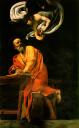
St. Matthew the Apostle

According to tradition and some internal evidence, St. Matthew was the author of the Gospel that bears his name. He was also the tax collector referred to in the Gospels who turned to follow Christ. Tax collectors of the time were the most reviled of all sinners.
According to Philo of Alexandria, a Jewish writer (30 BC – 45 AD), as cited by Maureen B. Cavanaugh in her article, “Private Tax Collectors: A Roman, Christian, and Jewish Perspective”
“They [Romans] deliberately choose as tax collectors men who are absolutely ruthless and savage, and give them the means of satisfying their greed. These people who are mischief-makers by nature, gain added immunity because of their “superior orders,” obsequious in everything where their masters are concerned, leave undone no cruelty of any kind and recognize no equity or gentleness . . . as they collect the taxes they spread confusion and chaos everywhere. They exact money not only from people’s property but also from their bodies by means of personal injuries, assault and completely unheard of forms of torture.”
Tax collectors were independent contractors who frequently got out of control, since there were few safeguards to protect the local populace in ancient society. Interestingly, Ms. Cavanaugh’s article is a cautionary history lesson in the context of plans by the United States government to outsource tax collection to independent contractors.
Jesus’ association with tax collectors was even more scandalous than his association with prostitutes and members of terrorist organizations such as Simon the Zealot. Tax collectors were so despicable that their ritual “dirtiness” defiled everything in a house that they entered. In contrast, a thief only defiled those things that he touched in the house.
After his conversion, Matthew was not free from controversy. His Gospel established a hostile attitude toward Jews that persisted for almost 2,000 years. Since the Gospel According to Matthew refers to the temple and city of Jerusalem in their state before their obliteration in 70 A.D., some scholars conclude that the Gospel was written prior to that year. St. Matthew’s stance toward Jews can be understood in the context of a struggle between Jews regarding adherence to their traditional faith or conversion to Christianity. St. Paul lists himself as a persecutor of early Christians. In fact, his conversion occured while he was on a mission to track down believers.
Douglas R. A. Hare’s monograph “The Theme of Jewish Persecution in the Gospel According to St. Matthew,” asks whether St. Matthew exaggerated the persecution and what effect it had on his theology. Using Christian and Rabbinic sources, Hare concludes that the persecution was directed at Christian missionaries, as opposed to Christians in general.
We see this continuing contest after the destruction of 70 AD in the efforts of St. John Chrysostom to stem Jewish influence in the Christian community in Antioch in the fourth century. It was not until 1965 that the Second Vatican Council, in its decree on relations with non-Christians, “Nostra Aetate” (“In Our Time”), that the Church told her members to adopt a posture of respect and dialog with Jews.
The Gospel of St. Matthew, in its beauty, is a central document in Christianity. The emphasis on Christ as the Messiah and the passing away of Judaism are central themes. Pharisees, those staunch guardians of Judaism from the rampant Hellenistic paganism of the time, won’t make it into the Kingdom before repentant tax collectors and prostitutes.
If we substitute the words “Faithful Christians” for “Pharisees” we get some idea of how incendiary the message still is today.
Read More