“Life, the Universe and Everything”: The Ultimate Question and Jesus the Christ

Christ the King
What is the most fundamental question in my life? For what personal “ultimate concern” does the statement “Jesus is the Christ” provide the answer? Is this concern peculiar to me or can it be generalized to others? Do we ask this question about Christ differently today than people have asked it in the past because of any elements of our present situation?
These questions, asked as part of a class in Christology, bring to mind a novel by Douglas Adams, The Hitchhiker’s Guide to the Galaxy. In one part of the story, Adams tells of an ancient people who decide to create a computer that will give them the answer to the question of “life, the universe and everything.” The computer, known as Deep Thought, takes millions of years to ponder the question, finally coming up with the answer: forty-two. When challenged by descendants of the people who had commissioned the work to explain why the answer was simply a number, Deep Thought explains that the problem is that perhaps they don’t really know what the question is.
“Jesus is the Christ”
In order to identify an ultimate concern for which this statement would be the best answer, the first question that must be addressed is what is meant by “the Christ.” As in Deep Thought’s response, to a very real degree, the meaning of “the Christ” depends on what concern is being addressed. Literally and historically, the term “Christ” refers to the one who is anointed with oil: a ruler, an athlete, or a messiah/savior. The anointing sets the individual aside for a special role. Yet today, in industrialized societies, this meaning is generally not understood. “Christ” is all too often used as if it were the surname of Jesus rather than the title that explains who he is for us. The simple notion that the Christ will come and restore an earthly monarchy or re-establish a people in a powerful and independent homeland is not particularly relevant to most of us today. The notion that the Christ will come at the end of time to punish sinners and reward the good offers only slight consolation to those who are suffering from today’s injustice. While this vision may seem to fit with the story of the Last Judgment – Jesus was very clear in teaching that the criterion for admittance to the presence of the Father was having cared for the least of his brothers and sisters – the implication remains that something more than simply waiting for the end of time and space is at stake here. Even the notion of “savior from our sins” does not move many contemporary hearts – hearts that demand to know how a god who is supposed to be a loving parent could demand the bloody sacrifice of an innocent victim to make up for the sins of others.
“Where have you been, Lord?”
The question of ultimate concern in my life that is answered by the question, “Jesus is the Christ,” is this one: “Where have you been, Lord?” Coming from a Catholic family, nurtured in faith in the traditions of that family, and having experienced the presence of God in my life from a very early age, I still found myself asking God that question with great sadness and not a little anger one night following the loss of a long-desired pregnancy.
The response came immediately. My mind was flooded with images of the care-givers who had been so kind to me as they told me of the baby’s death; the woman at the local family planning clinic who made the appointment for me to have a D&C; the nurses and doctors at Kaiser who ended up performing the D&C when I began bleeding a few days before my clinic appointment; the nurse who reassured me that losing this child did not mean we would never have another because she too had miscarried but later had a successful pregnancy; my mother who sent flowers (she rarely ever does that); the babysitter who stayed with us and helped take down the Christmas tree that first awful day when I knew I was carrying a dead child; the friends who remained after our son’s birthday party so we wouldn’t be alone with our pain; another child’s teacher (a young widow) who dropped by one afternoon to share a cup of tea and be with me; the husband who held my hand through it all and matter-of-factly cleaned up the blood that splashed on the floor when I stood up to dress to go home from the hospital; the friends who had cared for our children after school; and so many others who had cried with me and supported me in that first week. I understood then where the Lord had been. He had been with me in all of those people – his Body here and now. It was not any easier to have lost that child, but I knew I was not alone. And perhaps more importantly, I knew that God cries with us in such moments and wants nothing more than to hold us close, as a parent holds and comforts an injured child.
How does this relate to Jesus as the Christ?
Through the incarnation, God became truly one of us. As a result of the incarnation, Jesus is the most human of all human beings who have ever lived or will ever live. Jesus’ life is the most authentically human life ever lived. Because God entered totally into human existence and experience through the life of Jesus, our human experiences have become part of God’s being in a very real way. God did not demand that we suffer or that Jesus suffer in order to bring us back to the unity of love overflowing from which all of creation sprang in the first instant of creation. Suffering can bring us to the point of noticing that we do not really control much in our lives and that we need to be part of a greater reality, but in and of itself, suffering is not what God wants for us. Sometimes suffering comes as a result of our own choices, but often it comes because of forces outside our control. Sometimes suffering even comes because we choose to remain authentic to who we are and what we are called to bring to the world. In the case of Jesus and many other good men and women through the ages, that choice resulted in death – a death that was/is the entry into eternity and a different degree of life. Jesus, in his life, death, and resurrection, is the Christ, the one “anointed” or called and set aside by God to open our eyes to this wondrous reality of a God who is Love and who cannot be anything other than Love. In this, he is our savior from the more common notion of a deity that is angry, vengeful, rejoicing in the misfortune of its subjects, and eager to punish them severely. His coming, and the sharing of his experience, is truly good news for the world. He is the one through whom Love enters directly into our lives, including the times of pain and suffering. He is the one who reaches out through each of us to ease the pain and suffering of others. He is the one who turns tears into dancing as healing comes to battered hearts at his touch.
Does our present situation change how we ask this ultimate question?
To the extent that we are more aware of the suffering of people around us and around the world, we may find ourselves asking this ultimate question more frequently than did people of past ages or people in non-industrialized communities. Why do children get killed at school by a person who should never have had access to guns? Why do people get blown up by suicide bombers? Why do humans so quickly resort to wars, both with physical weapons and with words and actions in our homes and workplaces? Why do bad things happen to good people? Shouldn’t becoming a Christian mean that everything should be fine and dandy from here on out? How can good Christian people lose their homes and savings and livelihoods as a result of bad decisions by investment bankers or real estate speculators?
Our access to news and information on a 24/7 basis is a blessing and a curse. We hear far too much of the suffering humans inflict on each other, whether directly or indirectly. We also hear too much about the suffering that results from natural disasters. The simple formula that promises happiness once they have died to those who suffer (“Life is hard and then you die”) rings hollow. We become numb to the suffering of those in other lands or those whose experience of life and faith even in our own nation is different than ours. We still cry out in sadness, anger, fear: Where have you been, Lord? How can a loving God let such things happen?
Into this reality, Jesus continues to come as the Christ, the anointed one. Jesus is the one who understands the pain of human life from the inside. Through the incarnation, through Jesus’ life, God too understands the pain of human life, as well as the joys and wonders of it. In Jesus, God reaches out and touches each of us and all of creation in a new, deeply intimate way. The everlasting, ever-living, all-powerful One can touch and raise up the created ones to share in the divine life of Love, to become fully human. The light of Love shines in the darkness, a darkness that cannot overcome it. So for this age and the ages to come, “Jesus is the Christ” still answers the ultimate question(s) of human existence.
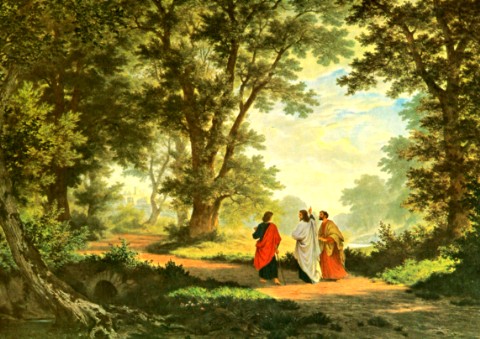
Image from Annunciation Melkite Catholic Cathedral
Read More