Pages Menu
RssFacebook
Categories Menu

Posted by on Apr 3, 2009

Obama at Notre Dame: Why the Catholic Right is Wrong

Obama at Notre Dame: Why the Catholic Right is Wrong

notre-dame-indiana-dome1

The Cardinal Newman Society has launched a petition drive objecting to President Barack Obama’s appearance at Notre Dame University’s commencement this year. Here is another approach to the issue.

George B. York III sent this letter to the National Catholic Reporter. It is presented here by permission of the author.

God and Man at Notre Dame

Notre Dame’s President, Fr. Jenkins, has extended
an invitation to President Obama to speak on
campus; the President has accepted. Some object,
asking, How could the President of Notre Dame
compromise with abortion? Closely observing
Jesus’ behavior in the Gospel of Luke, (7:40 and
following), I find Fr.Jenkins’ position consistent
with Jesus’ behavior, and in no way a compromise
with abortion.

In the story of Jesus’ evening in Simon’s
house an outsider, a woman, washes Jesus’ feet
with her tears and dries them with her hair. Simon
thinks, `Doesn’t he know what kind of woman she
is?’ Knowing what Simon is thinking, Jesus
surprises him by simply pointing to ways in which
Simon did not welcome Jesus; in so doing, Jesus
invites Simon to convert from hypocrisy to a
different way of judging and acting toward fellow
humans. While Jesus is uncompromising toward
misdeeds or sin, isn’t he also uncompromising when
it comes to accepting others, friend and foe alike, in
this case, welcoming the woman and challenging
but not rejecting Simon? Are humans defined only
by their real or supposed misdeeds?

About the strategy of some of his brother
bishops to `make war’ on abortion, South Dakota
Catholic Bishop Cupich told them: `…a prophecy of
denunciation quickly wears thin …what we need is a
prophecy of solidarity, with the community we
serve and the nation that we live in’. (quoted in
Commonweal Editorial, 5/12/08).

The way of implementing a prophecy of
solidarity is indicated by American Jesuit
Cardinal Avery Dulles. In commenting on
envisioning unity among Christians; he says, `The
first condition . . . is that the various Christian
communities be ready to speak and listen to one
another. . . . The process of growth through mutual
attestation will probably never reach its final
consummation within historical time, but it can
bring palpable results. . . . The result to be sought is
unity in diversity.’ (First Things, ’07)

Those are not just a Christian condition and
result; they are fully human. Does experience not
validate a claim that the better way between
different, opposed individuals and groups is one
leading to “unity in diversity”? Are exclusion and
isolation anything but impotent and sterile? Aren’t
Simon and the woman drawn within a more human
process? As a result don’t they depart from their
evening with their ability to hear reason and with
their freedom intact? In fact, is it not credible that
both Simon and the woman are invited, if not
actually drawn, closer not only to Jesus but also to
one another? Finally, to return to Bishop Cupich’s
solidarity, doesn’t `E pluribus unum’ mean unity in
diversity — union, not in sameness, but in
difference?

Such solidarity is impossible when one’s
starting point is that expressed in Simon’s initial
attitude: “Doesn’t Jesus know what kind of woman
she is?” Therefore, I have to wonder, Is it truly
Christian or even human to start, as some seem to
start, with a question like: “Doesn’t Fr. Jenkins
knowwhat kind of man Obama is?”

Isn’t the call to every Christian to put on the
mind of Jesus who Christians believe emptied
himself of power and the ways of power and drew
others neither by compromise with sin nor by
isolating rejection or coercion? To the extent a so-
called `prophecy of denunciation’ expresses a spirit
like that of the Pharisees (Simon’s initial attitude),
isn’t it a betrayal of the mind of Jesus? ? Isn’t such
prophecy animated by a spirit aiming at institutional
control, expressing a desire to force conformity in
the name of real or supposed truth? In the case of
NotreDame, doesn’t it express an ill-advised wish to
forceFr. Jenkins to dis-invite a supposedly unclean
Obama?

To the extent your answer is `Yes’, you see
why I say that Fr. Jenkin’s invitation to Obama
could be called a compromise with abortion only if
Jesus’ firm but friendly challenge to Simon could be
called a compromise with hypocrisy.

George B. York, lives in Denver. His
publication, `Michel de Certeau or Union in
Difference’ (2009, ISBN 978 0 85244 684 3),
concerns Faith in the understanding of a celebrated
French Jesuit historian.


Read More

Posted by on Mar 14, 2009

Obama at Notre Dame: Why the Catholic Right is Wrong

A Weekend With the Holy Trinity

shackcoversm

There are all kinds of stories of growing up Catholic but very few that focus on that core of the culture that is the Sign of the Cross. “In the name of the Father and of the Son and of the Holy Spirit. Amen.” This Trinitarian invocation begins and ends almost every event, every ritual, every meal – whether it is a blessing pronounced by the Pope or the gesture we learn from our parents before we can talk.

For all of Catholicism’s lengthy tradition, its mantras and catchphrases, Trinity Sunday is the only Sunday that fails to attempt in words what is incomprehensible. The priest who has a sermon for each Sunday looks into his bag or online list of stock themes, works hard on the presentation, and raises the white flag of surrender as he steps into the pulpit. The standard disclaimer is “We really cannot understand the Trinity. It is a matter of faith.” After confusing those who are awake in the congregation with St. Patrick’s shamrock “three in one” or various other analogies, he repeats the opening disclaimer and makes a hasty retreat to the Nicene Creed, where we sleepwalk our way through beautiful Trinitarian poetry that we ignore out of repetition. “…Light from light, True God from True God, Begotten not made, One in Being with the Father…”

For those of us who graduated from Catholic schools and had a good review of the Trinitarian controversies of the first three centuries and the further travails of this teaching in Church history, the sense of incomprehensibility grows.

William Paul Young’s allegory, The Shack, presents a weekend encounter with the Holy Trinity by a deeply wounded and grieving father. It is a mystical healing encounter that shows us that our concept of God has more to do with us than with the Divine. As a work of fiction it is easier for us to comprehend than the abstractions of theology. The contemporary setting and the issue of why the innocent are slaughtered make this central Mystery more accessible to us than the writings of the mystics who lived in different times and cultures.

I encourage you to read the book. Once you do, that automatic gesture – the Sign of the Cross will be the gift that it is – an entry point to the very life of God.

Read More

Posted by on Dec 24, 2008

Obama at Notre Dame: Why the Catholic Right is Wrong

The Star: Signs in the Heavens

christmas-eve-goa

Lackey #1:  Your Grace the neo-pagans are at the door.

His Grace:  Very Well. Let them in and call my theologians.

Lackey #1 to Visitors:  Please be seated, the palace theologians will be with you shortly. Would anyone like coffee or mineral water?

Visitor #1:  We appreciate the welcome but we were hoping to speak with his Grace. We have come a long way with a special message for his Lordship.

Lackey #1:  I’m sorry, it won’t be possible. Philosophers, sages, luminaries, and other thinking persons have to be interviewed by the court theologians. I’m afraid it is protocol.

Visitor #2:  We emailed our request for an audience some time ago and explained that we have a message based on Signs in the Heavens.

Lackey #1:  I’m sorry but we only receive messages, electronic or otherwise, from persons who are properly credentialed. It all started after that unfortunate affair with John the Terrorist and his threats against the government.

Visitor #3:  We thought that he was some sort of leader of revivals – a fringe sort of religious figure with some sort of discredited theology of liberation. We didn’t know he was a terrorist.

Lackey #1:  Most people don’t know that and we would prefer to keep it that way – but some of his followers confessed after some aggressive interrogation.

Visitor #1:  We thought that torture was outlawed here in the Commonwealth.

Lackey #1:  It is, but let’s just say that our less squeamish allies can be of great assistance. Besides, most of our citizens are in favor of  “necessary means” according to the polls if it will produce valuable information.

Visitor #2:  You mean they would give up their constitutional rights?

Lackey #1:  Not their own rights, mind you – just those of people opposed to his Grace. Well, here are the members of the Government’s Panel of Divinity. Please rise.

Theologian #1:  Welcome Ladies of the New Age or should I say Priestesses of the Orient?

Visitor #1:  Actually, we are astronomers and astrologers – scientists and visionaries.

Theologian #2:  We are interested in speaking with you. We are specially licensed to deal with the occult and other forms of demon worship.

Visitor #2:  We are not shamans or priestesses of the Crystal.

Visitor #3:  We study the stars and are accredited to the Global Space Research Council.

Theologian #3:  As unbelieving secularists how can you claim to be visionaries?

Visitor #1:  We are as perplexed as anyone else. The patterns of planetary alignments are most unusual. The probability that this is mere chance is very, very low.

Theologian #1:  Wouldn’t you say that it is just random chance in your Godless scheme of things? Besides, how would you know to come here? – and for what?

Visitor #2:  What indeed! The Star Regulus – the King Star –  in conjunction with Jupiter and Saturn in Pisces – the House of Judah – is a very unusual occurrence.

Theologian #2:  Reading the stars. Don’t you mean reading into the stars? Astrology was discredited centuries ago and now you want to revive it in your so called Age of Aquarius? You must be the laughingstock of your fellow scientists!

Visitor #3:  Empirical science is one mode of knowing certain things, including the mechanics of the stars, but it does not tell you what it means.

Theologian #3:  It is very clear from the Writings what it means. God made Creation whole out of nothing – everything in six days.

Visitor #1:  And the fossils?

Theologian #1:  A simple test of faith. God made the fossils to fool unbelievers like you.

Visitor #2:  We came here to honor the birth of a heavenly ruler. Has a child been born here?

Theologian #1:  What Child? That’s absurd. We are a republic founded by God fearing men. How could a child be the Ruler?

Visitor #3:  It has become more common for the sons of your rulers to be elected. But perhaps we are wrong.

Theologian #2:  That seems to be the case. The Child was born a long time ago and rules in Everlasting Glory. Have you not heard the Good News?

Visitor #1:  With all due respect, it hasn’t been such good news.

Theologian #3:  What the hell!

Visitor #2:  Yes, I am afraid that that has been the case.

Theologian #1:  Did you come here to insult us or did your stars send a message with you.

Visitor #3:  We will have to look elsewhere. She is not here.

Theologian #2:  You’re going to look a long time. He came as a man.

Visitor #1:  I thought it is written “He became one of us.”

Theologian #3:  The correct wording is “He became man.”

Theologian #2:  Perhaps you could let us know when you find her. We would be most interested in seeing who she is.

Visitor #2:  Yes, perhaps we should be on our way. We are free to leave aren’t we?

Theologian #1:  It’s a free country isn’t it?

Visitor #3:  Peace Be With You

Lackey #1:  Ladies – this way please.

Read More

Posted by on Dec 23, 2008

Obama at Notre Dame: Why the Catholic Right is Wrong

Saint of the Day 12/23- St. John of Kanty (Cantius)

St. John of Kanty (June 24, 1390 –  December 24, 1473) was born in the town of Kenty near Oswiecim (Auschwitz) in the diocese of Cracow, Poland. St. John of Kanty had an easy going personality and a brilliant mind. At the age of 23 he enrolled in one of the oldest universities in Europe, the Cracow Academy.

St. John of Kanty spent most of the rest of his life studying philosophy and theology and becoming head of the department of philosophy. The only time he was away was a brief period during which he had been fired as a result of unjust charges brought by his rivals. He served for eight years as a parish priest, winning the hearts of his parishioners, who begged him to stay with them when his position at the University was restored. As a result of this experience, he is sometimes seen as a patron for those who are out of work or seeking work.

Founded in 1364, the Cracow Academy was renamed in 1817 as the Jagiellonian University to commemorate a Polish dynasty.  Copernicus registered at the Cracow Academy 80 years after John of Kanty first registered. Several centuries later another Polish philosopher at the Jagiellonian University, Carol Wojtyla – Pope John Paul II,  would look to St. John of Kanty as a patron. In his 1997 visit to his homeland, Pope John Paul II prayed at the tomb of St. John of Kanty as he had when he was a student. His address to professors of the university was based on the theme that summarized the life of St. John of Kanty –  knowledge and wisdom seek a covenant with holiness.

Read More

Posted by on Dec 4, 2008

Obama at Notre Dame: Why the Catholic Right is Wrong

Saint of the Day: St. John of Damascus – December 4

St. John of Damascus (676 – 794), a monk and priest, was a native of Damascus and was also Chief Councilor to the Caliph. As a Christian, he held an hereditary position of great importance under the Ummayid dynasty of Syria.  The Caliph was the chief religious and political leader of the Islamic world.

David Levering Lewis’s book, God’s Crucible: Islam and the Making of Europe, 570 – 1215, provides an interesting insight into this transitional world in which Christianity gives way to Islam. (God’s Crucible also deals with the ways in which Islam stopped at the Pyrenees and the reconquest of Spain.) There were roles for Christians and Jews as subordinate groups.

The Sassanid dynasty of the second Persian Empire (which included Syria) had been defeated a generation earlier by the Caliphate in 651. St. John of Damascus became a key religious and Christian cultural figure at a time of great transition. St. John of Damascus is often called the last of the Greek Fathers and signals the end of the great Patristic period in theological and philosophical reflection. The little that we know about his life is fragmentary and subject to historical criticism. What we do have and know are his writings.

In the various theological controversies of the Patristic period, in both the East and the West, the political and cultural context provides a fascinating dimension for appreciating the wider meaning and importance of these seemingly abstract issues and their very real importance not only to the faith but also to the wider culture.

Despite his contributions to law, philosophy, theology, and music, St. John of Damascus is best known for his role in the Iconoclastic controversy. The Byzantine court endorsed a movement that rejected the veneration of religious images. St. John of Damascus, a high official in the Islamic Caliphate in Damascus opposed the Emperor, Leo III, and supported the Patriarch of Constantinople in support of the veneration of icons and their public display. Ironically, the making and admiration of images of either a secular or sacred nature were not tolerated by Islam. Although Islam provides a place for Jesus as a prophet and accords a special place to Mary, St. John of Damascus exhalted her status in his writings on the Assumption of Mary into heaven. At a time of the repression of Christian culture, St. John of Damascus composed hymns that became the core of the Eastern liturgy and are sung even today.

It is perhaps only fitting that St. John of Damascus has become the subject of venerated icons. The one above is an Arabic icon from the the 19th century attributed to the iconographer Ne’meh Nasr Homsi and is now in the public domain.

Read More

Posted by on Dec 4, 2008

Obama at Notre Dame: Why the Catholic Right is Wrong

De Vita: Toward a Christian Philosophy of Life

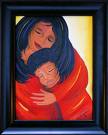
Madonna by Ralph & Shelly Neibuhr

Latin Baby by Ralph & Shelly Neibuhr


In an interview on National Public Radio yesterday, former Arkansas Governor Mike Huckabee offered a very intelligent and fluent presentation of the pro-life position. While being interviewed about his new book, Do the Right Thing, he stated clearly and succinctly that life has to be seen as sacred and valued and that humans cannot be wantonly discarded when they are inconvenient or an economic liability. The big danger, as Mr. Huckabee pointed out, is that if we teach our children that certain marginal people are disposable, we ourselves may become disposable once we are old and infirm.

One of the listeners emailed a questioned about the consistency of an anti-abortion position and one in favor of capital punishment. Mr. Huckabee allowed that there might come a point when the case could be made to eliminate the death penalty. Even as he praised those who participated in candle light vigils outside the Governor’s mansion protesting the execution of criminals, Mr. Huckabee said that the taking of such lives occurred not at the whim of an individual mother but after an exhaustive judicial process. He made the point that some crimes are so severe and the danger to society is so great that killing people is the one definite way to make sure that such people will never commit this crime again. He added that the death penalty is a deterrent that benefits society.

His presentation was very sincere, yet there was something that made me uneasy about it. Is re-criminalizing abortion truly a pro-life position? Abortion still occurred when it was illegal. Making it illegal once again will not stop the practice. Philosophically, a true pro-life position requires supports and incentives for the care and nurturing of all – at every stage of life. An acceptance of abortion can represent a coarsening of the public’s view of unborn children and human life.  An acceptance or a toleration of abortion is seen by many as leading to a debasement of the human fetus and of motherhood itself.

Nevertheless, if we criminalize abortion, we won’t stop it. We can “enjoy” taking the moral high ground, but I think that this is an illusion. What happens when women do not have safe and legal access to abortion? The mother and child relationship becomes socialized without the benefit of the social and economic supports necessary to lead a life of worth and dignity.

If we accept the view that birth control is also immoral, we are holding to an idealized view that sex only occurs in marriage and that in natural family planning, reason and ovulation always win out over human passion.

Although well intentioned – that great pavement on the road to perdition – the movement to re-criminalize abortion does not represent a well integrated philosophy of the dignity and worth of life. Criminalization could very well return us to a public policy that moves us away from a humanistic and Christian philosophy of life.

Morally, one can advocate an idealized Christian lifestyle focused on virginity, abstinence, and separate beds for married couples, but pastoral applications of moral theology have always been more about actual living – and dealing with the messiness of life.

Perhaps, what we are really wrestling with is the notion of what it is to be inhuman. Interrupting an otherwise healthy pregnancy without a very compelling reason still appears to have a lot of support as being an inhuman activity. Then again, the notion of placing a woman at risk of death because she does not share our beliefs or because she perceives she has no other choices also appears to have widespread support as something that is inhuman.

Can you have a secular policy that permits abortion and even physician assisted suicide? It is hardly a Christian position. Then again, perhaps the Christian witness is better seen in public policy that makes these choices less necessary and less desirable. If we insist that public policy has to be Christian in a post-Christian civilization, we may be doing something that is not really very Christian – we may be claiming (against the teaching of St. Paul) – that the law can save us.

(Image taken from Shelly Niebuhr’s home page: http://shellyn.com/pageForLarger.html)

Read More

Posted by on Oct 20, 2008

Obama at Notre Dame: Why the Catholic Right is Wrong

Fidelius and Diabolus: The Not So Gay Marriage Dialog

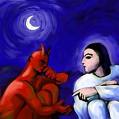
Image taken from oneyearbibleimages.com

Image taken from oneyearbibleimages.com

Diabolus: How’s it going?

Fidelius: You know we can’t talk – why do you persist?

Diabolus: That might be true if I were the Devil, but what if I’m your conscience?

Fidelius: There are no views but those of the Church.

Diabolus: True, but what about Church teaching, which acknowledges the “Sensus Fidelium” or Sense of the Faithful?

Fidelius: Stop bugging me Diabolus.

Diabolus: How do you know that’s my name?

Fidelius: You’re tempting me to think for myself. You’re torturing me.

Diabolus: No one can control your mind and heart. What’s bothering you?

Fidelius: I will take my counsel from my confessor, not from a post-Pepperoni heartburn!

Diabolus: “Pepperoni.” What a great name! Why don’t you call me that?

Fidelius: You are what you are.

Diabolus: And what is that?

Fidelius: The Tempter, the Evil One.

Diabolus: Have I ever suggested that you do anything wrong? Did I set your eye to wandering or encourage you to blow up when the Angels didn’t make the pennant?

Fidelius: Good people are tempted under the guise of good.

Diabolus: So, you’re a good person?

Fidelius: Yes. Generally, that is.

Diabolus: So then, why are you thinking about “it” again.

Fidelius: What “it”?

Diabolus: You know. Your conflict about gays.

Fidelius: They’re disgusting, you know that.

Diabolus: That’s not an uncommon opinion.

Fidelius: They make me squirm – and now they want to get married!

Diabolus: So, you think that it would be better to encourage them to stay with promiscuity as opposed to having a life of fidelity?

Fidelius: There can be nothing good in an act that is “intrinsically evil”.

Diabolus: So, you mean that you and Cynthia have never done anything “kinky”?

Fidelius: Shut up. We’re married.

Diabolus: My point exactly. You know, pleasure in marriage used to be called concupiscence.

Fidelius: What’s that?

Diabolus: You know – messed up like everything else after the fall of Adam and Eve.

Fidelius: So now you presume to teach me moral theology!

Diabolus: No. You learned it at that expensive Catholic college. Remember – the one you drank your way through?

Fidelius: Yeah, but it was after Vatican II. They weren’t Catholic anyway.

Diabolus: You mean like old Father Sullivan, who came to class in his cassock with the old yellowed pages on St. Thomas Aquinas?

Fidelius: He was different.

Diabolus: Yeah – he made you sweat to get a “C”. Not like the easy liberal that you gave you a “B+” for some beer can “sculpture” you threw together at the last minute.

Fidelius: Yeah, he was real.

Diabolus: Wasn’t he the guy that told you to have a happy sex life when you got married?

Fidelius: How do you know that? That was in confession!

Diabolus: Remember? I was there.

Fidelius: All I felt was so dirty.

Diabolus: You thought that he was going to throw the book at you.

Fidelius: Yeah, but he didn’t.

Diabolus: But there was a sin you didn’t confess.

Fidelius: What do you mean?

Diabolus: You remember. The time you stopped your fraternity brothers from beating up David Farnsworth, the fag?

Fidelius: He wasn’t gay – besides, “fag” isn’t politically correct.

Diabolus: Yeah. That’s why you found him dying in the AIDS ward a few years later at St. Mary’s, when you were helping the administration get their finances in order! A young guy out of business school and you go through the wrong door!

Fidelius: He never had a chance.

Diabolus: What do you mean? We all have free will. We all make choices.

Fidelius: His only moral choice was not to have sex.

Diabolus: He could have had a partner. You know – spend their lives together and all that? Maybe adopt a kid?

Fidelius: It would have been one mortal sin piled on another. He’d be deeper in Hell than he is now.

Diabolus: You don’t believe that.

Fidelius: Well, I heard Fr. Sullivan got to him before it was too late. But Purgatory’s no picnic.

Diabolus: So why did you pay for the Plenary Indulgence for him?

Fidelius: I didn’t pay for it. I just made an offering.

Diabolus: Strange. All this good will. Did you have a thing for this guy?

Fidelius: He was a guy. Got it? Like anybody. He deserved some decency, some respect.

Diabolus: But not a home.

Fidelius: He wasn’t homeless. He was making good money as an attorney.

Diabolus: No one to come home to; just work, parties, the bars …

Fidelius: He knew marriage was for straights. He was a good Catholic.

Diabolus: Yeah right. A gay can be a good Catholic; as likely as the Good Samaritan.

Fidelius: The Samaritan was real.

Diabolus: Maybe – or was he just a way for Jesus to show up the “good” people who had no compassion?

Fidelius: We can’t encourage gay culture. We’d be undermining the family; the basis of society.

Diabolus: Right. We can’t encourage a culture of life and fidelity.

Fidelius: It’s wrong. Remember, God made Adam and Eve – not Adam and Steve.

Diabolus: An interesting piece of demagoguery, but it doesn’t seem very compassionate.

Fidelius: The kids’ll get the wrong idea. They’ll think it’s okay.

Diabolus: Is that why so many gay people hate themselves?

Fidelius: It’s not my problem.

Diabolus: David became your problem when you saved him from that pack of apes.

Fidelius: I would have done it for anybody. Nobody deserves that kind of hate.

Diabolus: So where do you stop on this slippery slope?

Fidelius: It’s easy. The Church says, don’t beat ’em up but don’t let ’em get married.

Diabolus: That’s why you and Cynthia have only 3 kids – after 20 years?

Fidelius: We couldn’t have afforded more kids. You know that. With Cynthia’s problems it probably would have killed her.

Diabolus: So you love your wife more than God?

Fidelius: There’s a difference between God and the Church.

Diabolus: So who’s being the Devil now?

Fidelius: It’s in the Apostles Creed… “I believe in God, the Father Almighty.” Toward the end it says “I believe in one, holy, catholic, and apostolic church.”

Diabolus: Conscience. That weasel thing you picked up from those liberal priests!

Fidelius: It was a Vatican II thing. I had to write a paper on it.

Diabolus: So you did learn something!

Fidelius: Only because Fr. Sullivan made me re-write it 3 times.

Diablolus: I can’t imagine St. Thomas being on the side of conscience. He was a real theologian – and a saint.

Fidelius: Yeah. It’s a big thing for him – like it was for those Moslems philosophers he studied.

Diabolus: They only blow up stuff.

Fidelius: Conscience. You know – “formed according to the teaching of the Church.”

Diabolus: So why did Aquinas end up on the list of forbidden books so long?

Fidelius: He was accused of subjecting God to human reason.

Diabolus: Well I gotta go. Time “to prowl about seeking the ruin of souls”.

Fidelius: What about me?

Diabolus: You’re hopeless!

Fidelius: Hopeless?

Diabolus: Just the opposite, I’m afraid. No sale here today.

Fidelius: What about gay marriage?

Diabolus: Deciding that by a crowd? I like lynchings. Remember? But you know, it’s not my thing. You should look at that WMD “weapons of mass destruction” bracelet you wear.

Fidelius: It’s WWJD! What would Jesus do?

Diabolus: Yeah. I wonder. Later dude.. out’a here..

Read More

Posted by on Oct 6, 2008

Obama at Notre Dame: Why the Catholic Right is Wrong

Saint of the Day – Blessed Marie-Rose Durocher – October 6

Eulalie Durocher was born on October 6, 1811, in San Antoine sur Richelieu near Montreal. Her life can be summarized very briefly. She was the tenth of eleven children and one of her older brothers was a priest.  When she was 18, her mother passed away and Eulalie and her father went to live with her brother, Theophile, at his parish in Boleil. The young Eulalie took charge of the priest’s home as housekeeper, hostess, and parish assistant. Although she was reputed to be lively and something of a tomboy, her health was never really robust.

At the request of Bishop Ignace Bourget, Eulalie, at 32, in 1842 became the reluctant co-founder, with the bishop, of the Sisters of the Holy Names of Jesus and Mary. (Bishop Bourget also founded 3 other religious orders to help meet the needs of his diocese, which was the vastness of Canada.) At her profession of vows, she took the name Sr. Marie-Rose. Two of her friends joined her in this new work, focusing on the religious education of children, especially girls.  Blessed Marie Rose led her group for 6 difficult years until she died on her birthday October 6, 1849.

We know that her spiritual formation under Fr. Telmon was strict and that she set a very high standard for the members of her community. However, her service to the poor and her efforts to deal with the social ills of her time set the order on a trajectory of education, nursing, social work, and spiritual direction.

The Sisters of the Holy Names have been leaders in the education of women and pastoral care and service of the most disadvantaged. Kathy and I are both indebted to the Sisters of the Holy Names. Kathy was educated by Holy Names Sisters for 10 years, first in her parish grammar school and later at Holy Names Academy in Spokane, WA. My first full time teaching position was in the Education Department of Holy Names University in Oakland, CA some 30 years ago. We send our greetings, thanks and prayers to the Sisters of the Holy Names on this the feast of their foundress.

Read More

Posted by on Sep 30, 2008

Obama at Notre Dame: Why the Catholic Right is Wrong

Saint of the Day – St. Jerome: September 30

St. Jerome (340 – 420) is one of the most interesting personalities among the fathers of the early Church. We generally envision saints as fairly moderate and gentle persons. It is safe to say that St. Jerome never believed in moderation. He was one of the most brilliant and well educated men of his time, a man who lived and wrote with incredible energy and passion. St. Jerome’s Latin translation of the scriptures, which is a literary and scholarly tour de force even by today’s standards, would become the intellectual standard for western civilization.

In many respects, St. Jerome embodies very basic conflicts and contradictions among Christian scholars and educated clergy.  St. Jerome’s knowledge and love of secular – in his case – pagan literature gives him a great appreciation of literature and skill in communication. However, the moral conflict of this literature with the Christian ideal and the values portrayed in scripture create a real tension. As one of the founders of western literary criticism and biblical archaeology, St. Jerome establishes a secular “scientific” standard for deciding which texts are inspired and whether to consider the Greek translation of the Jewish scriptures, the Septuagint, as less authoritative than the Hebrew original.

In addition, virginity and celibacy were very important to St. Jerome. He and other fathers of the Church would establish sexual abstinence as the ideal Christian lifestyle, in keeping with the pre-eminence celibacy enjoyed in certain non-Christian religions of the day. Temptations of the “flesh” became the work of the devil. Such impulses, which we today consider in a more measured and moderate way as the product of genetics, socialization, and choice, were for St. Jerome forces to be conquered through prayer, fasting, and physical punishment of the body. Today we would call it “aversion” therapy.

This tradition of seeing the natural as the lesser part of our being is not in keeping with our being made in the image and likeness of God. The fear of our erotic and sexually creative dimension, as part of our fallen and corrupted nature, appears to challenge the appropriateness of the Word becoming flesh and the redemption of humanity in the death and resurrection of Christ.

Clearly, when we look at the excesses and exploitation of people in the Graeco-Roman world, the corrective action of St. Jerome in a lifestyle that witnessed to a coming of the kingdom of justice, peace, and dignity – the sober controlled Christian life – is an understandable ideal.

Perhaps, a great deal of our problem as citizens of the era of psychology and human potential is grappling with such an outsized cauldron of talent and passion. In many respects, although he did his best to stay within certain boundaries, the combination of the terms “Saint” and “Jerome” in reference to the same person should encourage the outlandish and the fire of divine genius in us all.

Read More

Posted by on Aug 15, 2008

Obama at Notre Dame: Why the Catholic Right is Wrong

Marian Theology: The Feast of the Assumption – August 15

The Assumption by Murillo

The Assumption by Murillo

August 15th, the Feast of the Assumption, dates to the 6th and 7th centuries. The official proclamation of the Assumption by Pope Pius XII in Munificentisimus Deus as an article of faith for Catholics occurred recently, on November 1, 1950. Objections to this teaching cite the absence of support for it in Scripture and in the Fathers of the Church. These same arguments are also made against the doctrine of the Immaculate Conception, which states that Mary received the benefit of the redemption in advance from the moment of her conception. However, since the theological significance of Mary is intertwined with that of Christ, as mother and son, much of what we say about Mary (Mariology) derives from what we say about the identity and meaning of Christ (Christology).

For most Catholics, Orthodox, Coptics, and Anglicans, images and veneration of Mary, the Mother of Jesus, are part of the very fabric of their faith. This emotional and doctrinal emphasis on Miriam of Nazareth gives many in the Anabaptist and Calvinist traditions emotional and doctrinal heartburn. Some evangelicals are strident in their belief that Marian devotion – at best – detracts from the key act of salvation, which they formulate as “accepting Jesus as your personal Lord and Savior.”

The notion of salvation in the apostolic churches is centered on the church community. Christ’s death and resurrection has saved all and we enter into this paschal mystery embodied in the church. Our salvation is entering the faith community, the Body of Christ. From the earliest days, the Fathers of the Church identified Mary as the model of the Church. The following excerpt, taken from Wikipedia’s article on Roman Catholic Mariology, summarizes the position and importance of the Blessed Mother. Please note that the words in parentheses are my own.

Pope Benedict XVI addresses the issue, why Mariology is related to ecclesiology (the theology of the Church). On first sight, he argues, it may seem accidental, that the (Second Vatican) Council moved Mariology into ecclesiology. This relation helps to understand what “Church” really is. The theologian Hugo Rahner showed that Mariology was originally ecclesiology. The Church is like Mary.[96]

The Church is virgin and mother, she is immaculate and carries the burdens of history. She suffers and she is assumed into heaven. Slowly she learns, that Mary is her mirror, that she is a person in Mary. Mary on the other hand is not an isolated individual, who rests in herself. She is carrying the mystery of the Church.[97]

Pope Benedict XVI lamented that this unity of Church and Mary was overshadowed in later centuries, which overburdened Mary with privileges and removed her into a far away distance. Both Mariology and ecclesiology suffered under this. A Marian view of the Church and an ecclesiological view of Mary in salvation history lead directly to Christ. It brings to light what is meant by holiness and by God being human.[98]

It is interesting to note that Pope Benedict XVI laments the removal of Mary “overburdened … with privileges.” This is also the image of Mary lamented by the reformation. However, the close identification of Mary with the Church, in the sense that “Mary is carrying the mystery of the Church,” represents a notion of church that many of the reformers rejected. Consequently, they rejected the image and role of Mary, and with it, the redemptive grace and power of the feminine.

Read More