Pages Menu
RssFacebook
Categories Menu

Posted by on Jan 22, 2015

James MacMillan — Music and Faith

James MacMillan — Music and Faith

James MacMillan - Wisconsin Public Radio

James MacMillan

James MacMillan is a Catholic Scottish composer from a working class town in the west of Scotland. He composed the Mass of Blessed John Henry Newman which was performed in Westminster Cathedral in London on the occasion of Pope Benedict XVI’s beatification of the 19th century Cardinal who converted to Catholicism. This was the first visit of a pope to the United Kingdom.

This is an interesting interview about his compositions for parishes and the simplicity underlying MacMillan’s Mass and other religious compositions.

Here is the grand “Tu Es Petrus” (You are Peter, and upon this rock I will build my church.) which is the traditional fanfare for a pope rendered in a very modern tone.

Read More

Posted by on Jan 22, 2015

James MacMillan — Music and Faith

Sainthood for Father Junipero Serra

Bl. Junipero Serra Public Domain Image

Bl. Junipero Serra
Public Domain

Pope Francis on January 16 announced his decision to canonize Fr. Junipero Serra, the Franciscan founder of the California missions during his visit to Washington, DC this fall. The ceremony will take place at the National Shrine of the Basilica of the Immaculate Conception. The Pope decided to waive the requirement for two miracles. Blessed Fr. Serra is said to have cured a nun in St. Louis from lupus. However a second miracle has not been attributed to his intervention. Pope Francis said that Blessed Junipero Serra has been considered to have been a holy man for many decades and that he is a good example of evangelization — bringing the gospel — to those who have not heard it.

Blessed Junipero Serra has become a controversial figure since the mission system led to the downfall of the ancient cultures of the native people and their way of life. He and the other missionaries are blamed for the destruction of ancient ways. Others see him as the founder of California and a moderating force in the Spanish expansion into Alta California. For example, when the Viceroy demanded the execution of 12 captured Kumeyaay Indians who had attacked Mission San Diego in 1775 and killed three Spaniards, Blessed Junipero Serra managed to spare their lives. The Los Angeles Times published a well balanced article on January 16,  “Decision to Canonize Father Junipero Serra draws divided reaction.”

Native people today are divided on the subject. Andy Galvan an Ohlone Indian and curator of Mission Dolores in San Francisco focuses on the positive aspects of Spanish colonization and says that Blessed Junipero Serra “was a very good man in a very bad situation.” His cousin, Vincent Medina, who is also an Ohlone Indian and the assistant curator at Mission Dolores, focuses on the negative outcomes. Jesuit Father Thomas Rausch, SJ, PhD, a religious studies professor at Loyola Marymount College in Los Angeles, has characterized the controversy as a debate about “an 18th century Catholic missionary by 21st century standards of cultural diversity, religious pluralism and personal autonomy.”

Read More

Posted by on Jan 21, 2015

Martin Luther King, Jr. — A Gift of One’s Self

Martin Luther King, Jr. — A Gift of One’s Self


January 19, 2105 is the Martin Luther King holiday in the United States. The first reading of the day in the lectionary is Hebrews 5: 1-10. Christ’s adherence to the will of the Father has led Him on a path of suffering, death and glorification. Dr, King took this path of God’s will to which we are all called.

“In the days when he was in the Flesh, he offered prayers and supplications with loud cries and tears to the one who was able to save him from death, and he was heard because of his reverence. Son though he was, he learned obedience from what he suffered; and when he was made perfect, he became the source of eternal salvation for all who obey him.” – Hebrews 5: 5-10

The Feast of Martin Luther King, Jr is not a feast of the Roman calendar, but it is a national holiday to celebrate a civil rights leader and a Baptist minister who advocated non-violence. Today is a tribute to all who work for human and civil rights for African-Americans and all people. Many of us are of an age to remember the Reverend King. The three television networks brought us live coverage in black and white of the marches, the sit-ins, and the fire hoses and police dogs that were part of the black struggle against white oppression. There was the famous “I have a dream speech” at the Lincoln Memorial. The haunting last speech before Dr. King was gunned down, “I Have Been to the Mountain Top” in which he saw the promised land of freedom, “I may not get there with you but I have seen it.”

Like all of us, Dr. King was an imperfect human being. Like all of us he was a sinner, but his redemption, like ours, is based in obedience to Christ, the source of eternal salvation for all. We know that precisely because Jesus is the Son of God, His will is perfectly aligned with that of the Father. Since Jesus was truly divine and truly human, his obedience came at a human cost. “In the days when he was in the Flesh, he offered prayers and supplications with loud cries and tears to the one who was able to save him from death, AND HE WAS HEARD because of His Reverence.

In his work of announcing the kingdom, healing the sick, feeding the multitudes, Jesus did not shy away from doing the will of his Father. But he knew where his call was leading. It became more and more obvious that if he stayed true to the person he was — the Divine Word become human — that His hands that had been raised in blessing and healing would be nailed to the cross. With loud cries and tears he asks the Father to take this cup away, but he is true to his calling and the will of the Father. “Let not my will be done but yours.” It is through this obedience that Jesus goes to his excruciating death on the cross and to the glory of the resurrection. He WAS HEARD because of His Reverence.

For Dr. King, Mahatma Gandhi, all Christian saints and martyrs, and ourselves, this call to obedience is not only a question of observing certain commandments but a deeper call to be the person God created us to be, to be at one with God, to hear at one with God, to accept God’s truth about our mission in life to advance the kingdom of heaven.

There were many black leaders in the civil rights movement of the 1960s. Dr. King didn’t need to have such a high profile in the movement. Yet it was something that Dr. King was drawn into despite all of the obvious risks to himself and his family. He was born and raised in Atlanta in a strictly segregated society. Dr. King knew what happened to black people who broke the rules. He certainly could have taken an easier type of ministry, but he heard the Word of God, the Will of the Father for his life and his death.

Most of us think that we are not called to such types of work. We are certain that God’s will for us involves something less “glamorous,” nothing so heroic as what Jesus and the saints like Mother Teresa and Dr. King did. But I wonder. All of us have that little voice within us to do something special, something only we can do, but we know that it will cost us. Dr. King used his gift of oratory, of speaking and preaching, to give voice to the prayers and aspirations of the millions enslaved and oppressed using the language, song, and rhythm that the Spirit had given them in their bondage and oppression.

Many of us see fewer years ahead of us than the ones that have fled so swiftly. The babies we held are now grown adults with their own babies. What are we called to do to announce the Kingdom of Heaven and to make it a reality? What can we do to end poverty, hunger, oppression, and violence? How do we draw closer to God and each other in prayer? How do we move toward reconciliation and forgiveness?

We can only do it if we take the time to be quiet and to listen — to pay attention to that little voice that comes to us or the massive cry that comes to us in outrage at the atrocities of the world visited upon the young, the poor, the defenseless. There is a price to be paid, and eternal life to be gained.


Read More

Posted by on Jan 20, 2015

Why Do Children Suffer? Pope Francis Speaks to Filipino Youth

Why Do Children Suffer? Pope Francis Speaks to Filipino Youth


The video and the text are largely in Spanish, though a simultaneous translation into English is included. This is a summary of a small part of the Pope’s extemporaneous speech.

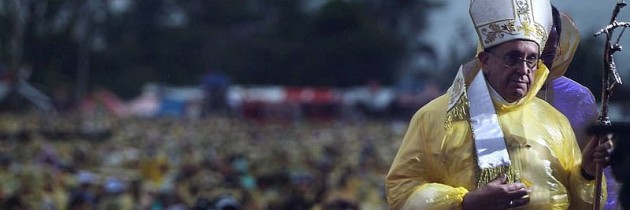
During a presentation to young people in the Philippines, the Holy Father set aside his prepared text to answer a question that had been raised by a 12 year old girl who had been rescued from the street. Tearfully weeping, Glyzelle Palomar, recounted the miseries of her life in a few words and asked, “Many children are abandoned by their own parents, many are victims of many terrible things such as drugs and prostitution. Why does God permit these things even though the children are not at fault.Why do so few people come forward to help?” In this video we can view the scene and the Pope’s compassionate embrace of the child.

What response is possible to the perennial problem of evil? Pope Francis did not try to evade the question with platitudes. He took the question head-on, educating about 30,000 of the faithful and challenging them. First, he noted the shortage of women among those making presentations and he emphasized the importance of the point of view of women. The Pope said that women pose questions which men could never stop trying to understand, that is, never grasp.

We can understand something, added the Holy Father, “when the heart reaches the place in which it can ask the questions and cry. Only through tears do we arrive at a true compassion which can transform the world.” Pope Francis described a common, worldly type of compassion as one in which we just take a coin out of our pocket. He added that if Christ had shown this type of compassion, he would simply have spent a little time with a few people and gone back to the Father. Jesus could comprehend our lives, the Pope said, when He was able to cry and did cry.

He notes, “In today’s world, there is a lack of crying. Although the marginalized, the poor, and the outcasts cry, those of us who do not lack anything essential do not cry. Only those eyes that have been cleansed by tears are able to so see things as they are.”

The Pope challenged the faithful. “Let us not forget (this young woman’s) testimony. She asked the great question ‘why do children suffer?’ crying. And the great answer all of us can give is to learn how to cry.”


Read More

Posted by on Jan 20, 2015

¿Por qué Sufren los Niños? Papa Francisco a Los Jóvenes en Filipinas

¿Por qué Sufren los Niños? Papa Francisco a Los Jóvenes en Filipinas


El Santo Papa dejó su texto preparado para contestar la pregunta que le había puesto una niña rescatada de la calle.  Con lágrimas, gemiendo, Glyzelle Palomar contó en pocas palabras las miserias que había padecido y preguntó, “Hay muchos niños abandonados por sus propios padres, muchas víctimas de muchas cosas terribles como las drogas o la prostitución. ¿Por qué Dios permite estas cosas, aunque no es culpa de los niños? ¿Y por qué tan poca gente nos viene a ayudar?” En este video podemos ver el escenario y la compasión del abrazo del Santo Padre.

¿Qué respuesta es possible al perenne problema de la maldad? El Papa Francisco no trataba de evadir la cuestión con palabras blandas y dulces. Enfrentó la cuestión enseñándoles a unos 30 mil de los fieles y desafíandoles. Primero notó la escasez de mujeres en las presentaciones y la importancia del punto de vista feminino. Dijo el Pontífice que la mujer se puede hacer preguntas que los hombres “no terminamos de entender.”

Podemos entender algo añadió El Santo Papa “cuando el corazón alcanza a hacerse la pregunta y a llorar.” Solamente por lágrimas llegamos a la verdadera compasión que se puede transformar al mundo. El Papa Francisco describió una compasión mundana por lo cual solamente sacamos una moneda del bolsillo. Añadió que si hubiera Cristo demonstraba esa compasión, hubiera pasado unos momentos con algunas personas, y se hubiera vuelto al Padre. Jesucristo entendió nuestros dramas, dijo El Papa, cuando fue capaz de llorar y lloró.

Declaró, “Al mundo de hoy le falta llorar, lloran los marginados, lloran los que son dejados de lado, lloran los despreciados, pero aquellos que llevamos una vida más o menos sin necesidades no sabemos llorar. Solo ciertas realidades de la vida se ven con los ojos limpiados por las lágrimas.”

El Papa desafió a los fieles “No olvidemos este testimonio. La gran pregunta ‘por qué sufren los niños’ la hizo llorando. Y la gran respuesta que podemos hacer todos nosotros es aprender a llorar.”


Read More

Posted by on Jan 17, 2015

James MacMillan — Music and Faith

Would You Baptize an Extraterrestrial? – The Gift of Inquiry


Hubble's View of NGC 5584Vatican astronomers, Br. Guy Consolmagno and Fr. Paul Mueller have penned this provocative question as the title of their new book. Would You Baptize an Extraterrestrial? deals with the most common questions they receive. Generally the questions assume a conflict between science and faith. Their first task is to reduce the assumption of conflict and to look at the information in an analytical and thoughtful way.

For example, they take on the star of Bethlehem and rule out many of the scientific explanations. It was most likely not a supernova as Kepler had proposed. It may have been a conjunction of planets as proposed by Molnar in his 1999 book, The Star of Bethlehem: The Legacy of the Magi. However, limiting the question to how it occurred and which laws of nature were violated can miss the point. According to Fr. Mueller, miracles don’t always mean a suspension of the laws of nature. The point of the star of Bethlehem is that God gave a great sign. According to Fr. Mueller, miracles, whether they accord with the laws of science or not, are some great sign of the coming of the Kingdom of God.

Br. Consolmagno defines science as an ongoing conversation about facts. It is not a book of rules. Likewise religion is conversation we have within our church, among ourselves, and with God. He concludes, “One of the joys of science and philosophy is learning how to live and enjoy a mystery.”

Read More

Posted by on Jan 16, 2015

The Magi and the Gift of Holy Discontent

The Magi and the Gift of Holy Discontent


http://youtu.be/m8jHx7W-iI4
Fr. Geoffrey Plant of Sydney, Australia has prepared a multimedia homily for the feast of the Epiphany. In his homily, Fr. Plant presents the main points of the feast.

The term “epiphany” comes from the Greek meaning to “shine forth”. We tend to assume that there were three kings because there were three gifts named: gold, frankincense, and myrrh.  Fr. Plant notes that they were not called kings but “magi” in Greek, with stands for wise men or sages.

The gifts are symbolic of the nature and meaning of Jesus. Gold is a symbol of royalty, frankincense is a sign of the divine, and myrrh is for burial, indicating that Jesus will triumph through suffering and death.

Fr. Plant suggests the wise men also brought the gift of Holy Discontent. Examples of holy discontent may be seen in the character of Popeye. An example of unholy indifference is seen in the the character of Bilbo Baggins in The Hobbit. Fr. Plant sees the magi as showing a holy discontent: a willingness to search, to be changed, and not to feel comfortable again. He compares them to Herod’s wise men who despite being so close to Bethlehem fail to see the signs in the heavens though others have seen them from afar.  Quoting W. H. Auden, Fr. Plant compares the hardness of heart of Herod’s wise men to our own post-modern era:

We would rather be ruined than changed

We would rather die in our dread

Than climb the cross of the moment

And let our illusions die

W.H. Auden, The Age of Anxiety

This gift of Holy Discontent — the gift of prophecy and activism — is what the wise men bring to the Christ child and to us according to Fr. Plant. It is the divine call to the kingdom through suffering, death, and resurrection.


Read More

Posted by on Dec 17, 2014

James MacMillan — Music and Faith

El Santo Papa Francisco Ayuda Relaciones Entre EEUU y Cuba


President Obama and Pope Francis - public domain Whitehouse.gov

El Presidente Obama y el Santo Padre Francisco


En el día de su cumpleaños, el Santo Padre Francisco recibío un regalo especial. Los presidentes de Cuba y los Estados Unidos anunciaron un acuerdo de reestablecer relaciones diplomáticas después de una ruptura de más de 55 años. El acuerdo fue animado y conducido en mayor parte por la Santa Sede. Durante su audiencia con el President Obama en el Vaticano en Marzo el Papa Francisco presentó su iniciativa. Durante el verano, el Santo Padre escribiá formalmente a los presidentes Obama y Castro. Después de una recepción favorable, el Vaticano organizó pláticas secretas para facilitar el desarollo del acuerdo.

El Vaticano se había opuesto el embargo de los Estados Unidos que prohibe el comercio con Cuba por más de 55 años. Los Papas El Santo Juan Pablo II y Benedicto hicieron declaraciones durante sus visitas a Cuba en contra del embargo por razon del sufrimiento del pueblo debajo esas restricciones. El Santo Papa comprende bien la situación y es amigo del arzobispo de La Havana. Además, el Secretario del Estado de la Santa Sede, el Monseñor Parolin ha servido como embajador ó Nuncio Papal a Cuba y su aliado más cercano, Venezuela.

Según el Presidente Obama, la política de desestablecer el gobierno comunista en Cuba por aislar al país insular no ha servido por 55 años y es tiempo para abrir relaciones diplomáticas. El presidente dijo que los visitantes a Cuba serían los embajadores mejores de los valores norteamericanos de democracia y libertad.

El profesor de ciencias políticas en la Universidad de Notre Dame, Michael Desch, dijo que la apertura de Cuba al oeste ofrece más posibilidad de cambiar el sistema comunista.
Read More

Posted by on Dec 17, 2014

Pope Francis Helps US Cuba Relations

Pope Francis Helps US Cuba Relations

Pope Francis received a special birthday present today with separate announcements by President Obama and Cuban President Raul Castro to re-establish diplomatic relations and soften aspects of United States and Cuban policy toward each other. President Obama thanked the Pope in his remarks announcing the change in US policy. Pope Francis first raised the issue in March when President Obama visited the Pope. The Vatican facilitated subsequent meetings in Canada and brokered the final agreement.

Improved relations with Cuba have been high on the agenda of previous popes including St. John Paul II and Benedict XVI. Vatican policy has opposed the United States trade embargo due to the hardships it causes for everyday people in Cuba. During their visits to Cuba both St. John Paul II and Pope Benedict called for an end to the Cuban embargo. Pope Francis knows the Cuban situation well and is close friends with the Archbishop of Havana. The Vatican Secretary of State, Cardinal Parolin has served as the Papal ambassador or nuncio to Cuba and Venezuela which is Cuba’s closest ally.

University of Notre Dame professor of political science, Michael Desch, called this a “long overdue step.” Professor Desch said that normalizing relations with Cuba will not strengthen the Castro regime. He called that logic flawed saying, “The more they are exposed to American culture, politics, and our economy, the weaker the hold of the Castroites on power.”

Read More

Posted by on Nov 20, 2014

James MacMillan — Music and Faith

New Chicago Archbishop Blase Cupich

Chicago has new archbishop

Archbishop Blase Cupich

The Chicago Archdiocese officially has a new archbishop, Blase Cupich (soopitch) as of November 18. Cupich became the bishop of Spokane, WA in 2010. He has graduate training in Liturgy and has studied at the Pontifical Gregorian University in Rome. Originally from Omaha, Nebraska he was the third of nine children born to Blasé and Mary Cupich.

The Chicago Tribune calls him a charismatic clergyman, the grandson of Croatian immigrants, with a strong emphasis on social justice and a pastoral approach that involves listening and dialog. The same newspaper quotes him as saying, “The church can challenge society, but society also challenges the church.”

Cupich has become known for his more moderate approach for dealing with controversial issues such as abortion and gay marriage. As the bishop of Rapid City, South Dakota, Cupich was one of the bishops in 2004 who was not in favor of denying communion to candidates who supported abortion rights.  He said that we cannot cherry-pick particular issues. We have to be willing to talk about all issues. He emphasized that, while the Catholic position begins with protecting the unborn,  it doesn’t end there.

In 2011 Cupich headed the US Catholic Conference of Bishops Committee for Protection of Children and Young People. At that time there was a Grand Jury finding that the Archdiocese of Philadelphia had allowed 37 priests accused of abuse or inappropriate behavior to remain in active ministry. Cupich’s response to this failure to comply with the reforms listed in the Dallas Charter of 2002 was to express frustration and disappointment since so many people were working hard to implement the reforms. He later said that the Philadelphia situation was unusual.

As bishop of Spokane, Cupich lived in simple suite of rooms in the seminary. In Chicago he has announced that he will be living in the cathedral rectory and not in the opulent Gold Coast mansion with is the Archbishop’s official residence. Many have pointed out a similar tone and style in Archbishop Cupich and Pope Francis. Their simplicity, cordiality, and focus on engagement as opposed to separation or denunciation of those who disagree with the church are attributes they share.

Cupich gave a talk in June 2014 at the Catholic University of America in Washington, DC on the contradiction between Catholic social teaching and libertarianism in the United States. He supported the position of Pope Francis which focuses on encounter and accompaniment in society and the economy. In other words, Catholic social teaching focuses on our obligations to each other. This contrasts with the Libertarian view that the one’s interests as an individual come first.

Cupich is the first major appointment in the United States by Pope Francis. Additional appointments by the Pope will likely bring significant change to the church in the United States.


Read More