Pages Menu
RssFacebook
Categories Menu

Posted by on Jul 22, 2011

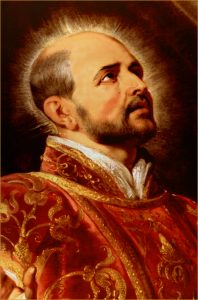
Preparing for the Feast of St. Ignatius Loyola

Novenas – Nine days of prayer before major feasts are a widespread Catholic devotion. The practice derives from the nine days  the disciples spent in prayer after the Ascension of Jesus which concluded with their anointing in the Spirit at Pentecost.

Generally novenas are based on asking for something. Often we pray for solutions to personal problems – illness, finances, worries about family and friends. We often approach God with a wish list. Throughout the course of the novena we come to a more peaceful and hopeful feeling about these problems and issues in our lives.

I would like to propose something a little different for the nine days leading up to the feast of St. Ignatius Loyola on July 31. St. Ignatius left us with some marvelous ways to listen to the Holy Spirit and what God is calling us to do for our happiness and fulfillment. So, instead of asking St. Ignatius to pray for us to help us in our personal difficulties, let’s take nine days to see how we can be more aware of God in our lives and be more attentive to ways in which we can be of service to God and our neighbor.

Obviously, our concerns and worries will come into our prayer and our contemplation in action throughout the day. However, let’s take this time to set these aside as things that need to be solved and try to feel and visualize where the Spirit is leading us. St. Ignatius has given us a very powerful type of prayer called the Examen. Translating it literally as “examination” doesn’t capture its meaning in Latin or Spanish. A good translation is Reflection. The five steps of the Examen / Reflection empower us to become aware of God in our lives. This novena will be based on this special method of prayer.

After all, our journey is not really about us and our cares and concerns. Jesus said that we should not be as worried about material things as we should about responding to the much greater calling we have to announce the Kingdom and to make it a reality through healing and the alleviation of poverty and suffering. Let’s spend these nine days as the disciples did during the first novena. Hopefully, we will be as surprised and transformed as they were.

Read More

Posted by on Apr 28, 2011

Easter Week Daze

I tried to blog during Holy Week. I would like to say that I was too caught up in ecstasy to touch the keyboard, but I was really silenced. It wasn’t really writer’s block. It was more a sense of something I am learning in my old age – to keep my mouth shut. As an extrovert this is an occurrence of note, since I don’t often know what I am thinking until I am expressing it.

Per usual, after the stress of the event, I can begin talking or writing about my experiences of Lent and Holy Week now that we are in Easter Tide.

Easter Triduum, from Holy Thursday to Easter Vigil, is a montage of one highly charged event ebbing and flowing over many others. The breaking of the bread at the Last Supper; Judas sent off on his errand; Jesus looking for support and finding us asleep. The darkness at noon covers all creation. Nicodemus asks for the body of Jesus. Mary of Magdala weeping as she asked the Gardener, “Where have you laid him?” followed by the overpoweringly personal entreaty of a close Friend, “Mary.” The disillusioned disciples heading back home and being consoled by a stranger Whom they invited in for the evening. The guest only reveals Himself in the moment of the breaking of the bread. After all of the betrayals, the abandonment, with the marks of the crucifixion on His body, His first words to the men who “threw Him under the bus” was “Peace.” In all of previous salvation history, God’s messengers manifest with the same greeting of peace, but now God does it directly, for the first time.

I understand that the traditional teaching is that the sacrifice of Jesus satisfied the Father’s need for atonement, but somehow, it is hard for me to imagine that God, in Jesus, would not take offense at the rejection of his goodness. Yet, Jesus doesn’t take offense even as the disciples and all of us cower in hiding.

The only thing that I can compare this daze to is to singing the last note of Hadyn’s Creation Mass as a member of the Loyola Men’s Chorus. The director had told us that we would know if we had succeeded if there was a deafening silence before the audience responded. The last note hung in the air. The director brought his thumb and forefinger together; the note evaporated high in the nave. The silence was profound and seemed to last forever. The temperature dropped and then there was thunderous applause.

I am still in the coolness of the silence after that last note. It is not a bad place to be. I hope you are too. Peace.

Read More

Posted by on Apr 26, 2011

Violence and Atonement: A Necessary Link?

Violence and Atonement: A Necessary Link?

Fireweed by Joseph N. Hall

The relationship between violence and atonement is closely woven in scripture and theology but it seems inimical to me. As a life long Catholic, anthropologist, and amateur theologian, I grew up with the notion of the Mass as the unbloody sacrifice of Calvary. Things changed after Vatican II to a focus on the Paschal mystery. Despite all of the language we have about the Father requiring satisfaction, it does seem contrary to Jesus’ own teaching about the fact that human fathers, “evil as you are,” would not give your son a stone when he asks for bread. (Matt 7:11)

Clearly, there is patriarchal and tribal language in the concept of satisfaction. This is still prevalent, as seen in a recent gang rape case in Pakistan. A young woman was brutally gang raped by men of another sub-tribe because her 13 year old brother had apparently flirted with a young girl of the other group. To settle the conflict and avoid greater reprisals, the elders of the young woman’s group offered her as a settlement. http://articles.latimes.com/2011/apr/22/world/la-fg-pakistan-rape-20110422

This is not only revolting to our current sensibilities, but it challenges the notion of sacrifice in the tribal sense. My own existentialist take on redemption has to do with authenticity. God took upon Himself our human condition and brought mercy, healing, and peace. For this he was publicly tortured to death.

My own post-modern sense is that the Father is not so much offended by our sin as appalled by it, as an act of vandalism or destruction of works of great beauty conceived in boundless love. The freedom that is required for the reciprocation of love can also be used to reject it. I personally cannot conceive of an infinite God who is somehow diminished or “offended.” To continue to anthropomorphize the Father as a post-modern, post-Freudian human father leads us to a Father, Son, and Spirit caught up in the continuing ongoing creation of bonum diffusivum sibi – good diffusive of itself. The Incarnation and Christ event are the result of an unlimited and unconditional love.

Clearly, this post-modern language flies in the face of Old Testament pastoral society and the cult of Temple sacrifice in the New Testament. Early Christians had to find a way to explain the Christ event in their own cultural and historical context. However, there is no denying that a post-modern Father is less monstrous to the secular humanist ethics and sensibilities that derive from the Christian tradition of the West.

As terrible as the death of Jesus was, it was completely overshadowed by the fact that no evil can come between us and the Love of God in Christ Jesus. (Romans 8:39)

The great peril of a tribal metaphor is not its irrelevance nor its systemic violence, but rather the chasm it creates between God and us that continues to be the original and fundamental blasphemy alienating us from God and ourselves. The preface to the Eucharistic prayer at the Mass of the Easter Vigil and Easter Sunday begins in astonishment “Father, you love us still and sent us the Christ.” Yes, what amazement there is, that in spite of our rejection, God never stopped loving us.

The demand for violence attributed to the Father elevates evil to the level of the divine. The unrelenting intrusion of the divine in the human train wreck, of necessity, requires God to confront violence; which he does with non-violence – even to death on a cross. (Philippians 2:8)

Read More

Posted by on Apr 11, 2011

Violence and Atonement: A Necessary Link?

St.Thomas: The Post-Modern Realist

Sun Shining Through Clouds

St Thomas the Apostle is often known as Doubting Thomas because he refused initially to believe the reports of the resurrection of the Lord. In today’s gospel reading from St. John (Jn 11:1-45), the raising of Lazarus from the dead, I saw something for the first time about St. Thomas that changed my view of him.

Jesus receives word that his fried Lazarus is seriously ill and prepares to head back to Bethany near Jerusalem. The apostles don’t think this is a good idea because they had just left the area after threats against the Master’s life. Jesus tells his uncomprehending followers that Lazarus is dead, but they are returning to Bethany so that his followers can see Him for who He is. This doesn’t appear to make any sense. It is a pointless suicide mission. Thomas doesn’t doubt. He is quite certain, but he is loyal and will not leave his master. His statement, “Let us go and die with Him,” is not skeptical. It is very certain. It is almost absurd in a 20th century style worthy of an an existentialist play.

In fact, Thomas is the grown up we are supposed to be. Look at the facts. Be reasonable, sensible. You may be willing, out of love, to sacrifice yourself for a great cause or a great love, but you approach it with knowledge, with courage, stoically.

This scene actually creates a set of book ends. The matching scene is the encounter with Jesus after the Resurrection, after Thomas had declared that he wouldn’t believe the reports until he saw Jesus personally. None of the apostles died with Jesus. In fact, at the time of his arrest Jesus told the authorities to take Him but to leave them alone. We all know the story of how they – and all of us – scattered in the night when the Shepherd was struck. Peter follows at some distance only to deny Him three times. John is the only man at the foot of the cross. In His time of need Jesus can count on His mother and a handful of women. All too true – real enough for the followers then and now.

Somehow it is easier to “to go and die with Him.” It sounds noble, altruistic. It is easier to believe in the finality of death than the open endedness that is resurrection. El sentido trágico de la vida – the famous Spanish existentialist manifesto – The meaning of life is tragedy. Yes, I know that is not the more literal translation – the tragic sense of life. The death of Jesus would indeed be the Great Tragedy another one of his great disappointments, another cosmic joke perpetrated on an accidentally occurring Homo sapiens.

As post modern people and followers, we are so overcome with the senseless suffering and death of millions that we claim that we believe. Yet our faith is more of an adolescent, impotent tantrum of defiance, because, in the end the facts are the facts. So, let us go and die with Him.

This is an interesting set up for Palm Sunday and Easter. Of course, this is just what St. John’s Gospel does. Jesus is the Resurrection and the Life. The challenge to us and to Thomas is to believe in a life beyond tragedy, absurdity, meaninglessness.

Yeah, well, heard that, been there… but it can’t work. It’s foolish. We are all dying. Just be brave about it. It is what it is. Resignation to the inevitable makes sense. Resurrection by our Best Friend who cries in grief and loss for us doesn’t make any sense at all. Or does it?

Image by Robert & Mihaela Vicol – Released to the Public Domain

Read More

Posted by on Mar 9, 2011

Violence and Atonement: A Necessary Link?

Ash Wednesday: Spiritual R & R – Reconciliation and Renewal

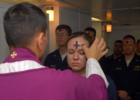
Receiving the Ashes in the Sign of the Cross


Ash Wednesday begins the season of Lent. It tends to be a day when people think about what they are going to give up in preparation for Easter. Fasting can be seen as a convenient type of dieting. Almsgiving can be reduced to cleaning out the closets.

However, prayer, fasting, and almsgiving are ancient practices in societies and religions all across the world. They are ways to produce altered states of consciousness and encounters with the divine. In the Christian tradition they are part of the “via negativa” or negative way. Generally, we tend to see this type of deprivation against the historical backdrop of hermits in the desert rejecting the “flesh” of worldly temptation and indulgence. Of course this conflicts with our consumer culture of comfort and instant gratification. It also conflicts with a more positive psychological model in which the focus on human weakness is replaced with a focus on human self-fulfillment and actualization.

In the secular model of well being, human and social limitations can be overcome by refocusing our attention and modifying our behavior. Hammering down our feeling and emotions – especially sexual ones – is sometimes seen as harming mental health. By denying our interior tensions and conflicts, we can fail to confront the real challenges we should be facing in our psychological development.

Lent itself is an old word for Spring – that time when the world comes to life again. The “via negativa,” the more traditional model of asceticism (an interesting Greek word for athletic training), and the contemporary model of self affirmation are not really opposed. They can actually be healthy correctives. If we focus exclusively on restraining ourselves we not only ignore opportunities for growth, we can also ignore what God is calling us to do. Focusing only on my needs and self-fulfillment can also lead to such an inward narcissistic self-absorbed focus that we cut ourselves off from true happiness.

In subsequent posts, as we journey through Lent, I will share with you some more reflections on being happy, holy, and healthy. This is a wonderful season for reconciliation with ourselves and others and a time of renewal for our call to serve and to engage in the coming of the Kingdom – the age of justice.

So.. what am I going to get for Lent?

Read More

Posted by on Jan 3, 2011

Last Chance to Copy and Save Your Data!

We will be shifting to a new platform for our discovery engine. Due to circumstance beyond our control, the discovery engine has been down. There is now a narrow window of time to copy and save your own private password protected directories and lists. It is very simple. (For our readers who are familiar with the copy and paste function, we apologize for the great detail. However we are trying to make it as clear as possible.)

To save each item we recommend this method:

First, open a new Excel or similar type of spreadsheet program.
Next, open your directory.
Highlight the title of the item and press the control and “c” keys at the same time to copy it.
Next, move your cursor or “pointer” to the cell at the top of the left column on the Excel spreadsheet and paste the copied title by pressing the control and “v” keys at the same time.

Second, copy the description of the item.
Next, paste the description in the second column next to the title on the spreadsheet.

Finally, repeat the same process for the tags by copying and placing that information in the third column next to the body for the same entry. Be sure to press the down arrow at the end of your line of tags in Theologika to make sure that you copy them all.

Begin the pasting of each item on a new row of the spreadsheet.

Repeat these steps for each item to create an orderly table. Remember to save your file as you go along!

Another option is to create a table with three columns and at least enough rows to correspond with your number of items in your directory in Word or other word processing program. You can copy and paste the information using the process that we have outlined above and increase the number of rows as necessary.

If you have any difficulties or questions please email kathypozos@theologika.net.

Best wishes for a happy New Year. Stay tuned for the new Theologika.net 2011!

Randy and Kathy Pozos

Read More

Posted by on Jan 1, 2011

Violence and Atonement: A Necessary Link?

World Peace and Freedom of Religion

(Credit: Hiking Artist Cartoons – Used with permission)

This New Year’s post and my resolution comes from Fr. Cyprian Consiglio’s homily today at Holy Cross Church in Santa Cruz, California. Fr. Cyprian is a Camaldolese monk, musician, and student of world religions.

A liturgy with Fr. Cyprian is always a wonderful experience. His homily was based on the theme for today’s observance of World Peace Day.

Pope Benedict XVI focused on Freedom of Religion as the theme for this New Year’s Day of Peace 2011.

Religious freedom is not the exclusive patrimony of believers, but of the whole family of the earth’s peoples. It is an essential element of a constitutional state; it cannot be denied without at the same time encroaching on all fundamental rights and freedoms, since it is their synthesis and keystone. It is “the litmus test for the respect of all the other human rights”.[8] While it favours the exercise of our most specifically human faculties, it creates the necessary premises for the attainment of an integral development which concerns the whole of the person in every single dimension.

In his homily, Fr. Cyprian reflected on the number of groups which observed peace vigils New Year’s Eve and that the growing number showed, perhaps, an increase in consciousness and enlightenment. He went to some pains to point out that many of the groups from diverse traditions did not agree on everything and probably never would. However, it is only through the free exercise of religion and the building of bridges of good will that these tensions can be recognized, managed, and appreciated.

In fact Fr. Cyprian’s life as a troubadour of peace has bridged many of these divides through the dialog of contemplation and world music. (For wonderful and challenging reflections, subscribe to Fr. Cyprian’s blog.)

The unspoken lesson: Become the Peace You Want.

YouTube – CyprianConsiglio’s Channel.

For a brief but deep meditation on peace, tune into the chants Benedictus, Namo Janitre, and Awakening performed by Fr. Cyprian and Dr. John Pennington for a truly happy entry into this New Year.

Fr. Cyprian Consiglio and Dr. John Pennington

I highly recommend Fr. Cyprian’s blog and Dr. John Pennington’s website.

Read More

Posted by on Dec 24, 2010

Violence and Atonement: A Necessary Link?

All the World At Peace – The Christmas Proclamation

The New – The Social Media Nativity

A Digital Nativity Story

The Old: The Christmas Proclamation

This is one my favorite rituals of the Christmas season. There are several version of this proclamation. Fr. Felix Just, SJ, PhD presents a good summary. The following is a translation from the version used by the Vatican in 2009.

Eight days before the Kalends of January, fifteenth of the lunar month.

Innumerable ages having passed since the creation of the world, when in the beginning God created heaven and earth and formed mankind after his own image;

Many centuries after the flood, when the Most High placed his rainbow in the heavens as a sign of peace and of the covenant;

Twenty-one centuries after the going forth of Abraham, our father in faith, from Ur of the Chaldees;

Thirteen centuries from the exodus of the people of Israel out of Egypt, led by Moses;

About one thousand years from the anointing of David as King;
in the sixty-fifth week according to the prophecy of Daniel;
in the one hundred and ninety-fourth Olympiad;
in the year seven hundred and fifty-two from the founding of the city of Rome;
in the forty-second year of the rule of Caesar Octavian Augustus;
when the whole world was at peace:

Jesus Christ, eternal God and Son of the eternal Father, being pleased to hallow the world by His most gracious coming, having been conceived of the Holy Spirit, and nine months having passed since His conception, having become Man, was born at Bethlehem in Judah of the Virgin Mary.

THE NATIVITY OF OUR LORD JESUS CHRIST ACCORDING TO THE FLESH.

A Digital Nativity Story

Read More

Posted by on Dec 12, 2010

Violence and Atonement: A Necessary Link?

Lived Religion – Relating to Our Lady of Guadalupe

Lived religion is a sociological term for the way people behave on a day to day basis. Santa Clara University sociologist Maria del Socorro Castaneda Liles has written Our Lady of Everyday Life an ethnography of Mexican American women and their relation to Our Lady of Guadalupe. Joe Rodriguez, a columnist for the San Jose Mercury News has summarized this research in the title of his article with the words Mother, Friend, Lawyer. Pesonally, I would not have used the term “lawyer” because it has a more legal, technical connotation than the word advocate. The Spanish term “abogado” is used for both.

These interviews documented something familiar to most of us who share a Mexican heritage. There is more of a casual, friendly, and intimate conversation between devotees and the Virgin, as opposed to a more ritual relationship embodied in formalized prayers or devotional manuals. The interviews also show that women and their sense of themselves is changing.

Younger women felt that Our Lady could relate to their economic struggles as single mothers and to their decisions to control the number of children they have. In Guadalupe, they find the Mother of God as strong, resourceful, and capable.

This theme of empowerment might seem new and contemporary but it is at the heart, literally the heart, of the Guadalupe experience for the conquered indigenous people of Mexico and the “Gran Mestizaje,” the resulting nation of people created by the blending of European, African, and indigenous American groups.

The appearance of Mary, pregnant and dark complected as the advocate and protectress of the lowly, the powerless, is also an act of heavenly recognition of human dignity and worth.

From a purely secular standpoint this is a startling phenomenon. The general pattern in times of such social upheaval and distress is the development of revitalization movements which attempt to go back to earlier better times, to plead with the gods who have abandoned a civilization, or in some cases to engage in “ghost dances” to render themselves invisible.

In many respects, the name Guadalupe is an attempt by the Spanish to claim the apparition as that of one of the black Madonnas from their homeland who was also a patron of Christopher Columbus. Yet, people who know her real name call her “Tepeyac” from the hill on which she appeared.

While it might be tempting to equate her with Tonantzin, the Aztec goddess of the dawn, the woman who appeared to Juan Diego and her subsequent cult had none of the darkness and blood that characterized the Aztec and Meso-American pantheon.

The slide show from the online version of the same article conveys the intimacy of a people and their “Patrona”.

Read More

Posted by on Jul 15, 2010

Violence and Atonement: A Necessary Link?

Saint of the Day – St. Bonaventure, the Athiests and the NeoPagans

Forest, by mohan p

There is a growing cottage industry of books attempting to prove or disprove the existence of God. Today, on this spot on the Church calendar devoted to St. Bonaventure (July 15), reflection on his blending of the rational and the spiritual is even more important than when he formulated it seven centuries ago.

Unfortunately, we live in a time of two simplistic approaches. One claims that religion is literally a superstitious hangover from the time of Bonaventure – the late Middle Ages – and has no basis in rational scientific thought. The inhumanity to which we have been reduced by the rational technological world destroys our spirit just as surely as the dogma of the religious. The scientific rationalists show that there is no empirical proof for the existence of God and the literalist acceptance of the Bible only heaps on further irrationality. The spiritualists of the New Age, on the other hand, are concerned about energy flows, the design of built spaces and the sacred diffuse life force emanating from the planet, with its animate and inanimate manifestations.

As much as we might like to think that these debates are new, they are as old as recorded civilization. Christianity is unusual in the sense that it holds and affirms the supra-rationality of faith in the unknowable and then elaborates the faith experience and its doctrinal content in a rational manner. To say it in more simple terms, the Christian experiences and creates reality within the faith experience itself. Given the inherent order of creation itself, this experience reveals and elaborates that core capability of the human, which is critical reason. Creation is sacred and diaphanous and faith enlightens our minds and leads them to the perfect knowledge revealed in Christ.

These view are presented mystically, poetically, and rationally in St. Bonaventure’s Itinerarium Mentis Ad Deum (The Mind’s Road to God). This small book is in many ways a meditation on the the vision of Christ by St. Francis on Mount Alverno, in which the saint becomes so identified with the Risen Christ that he receives the stigmata and the five wounds appear on his body.

How can thinking people believe is the post modern question. How can people with systematic rationalized collections of belief be spiritual is the New Age question. In the post modern age, empirical science is truth. In the New Age there is my truth, my karma, and your truth, your karma. No faith is required. No revelation is possible. There is no enlightenment and encounter with the Divine – a Divine that we cannot control with mathematical models or the arrangement of crystals.

Bonaventure provides a guide to living for the post-modern / New Age Christian – delightfully encountering the “vestigia Trinitatis,” the footprints of the Trinity in creation, learning and understanding in enlightenment, and caught up in the wonder of the divine.

Read More