Pages Menu
RssFacebook
Categories Menu

Posted by on Jul 9, 2023

Easy Yokes and Light Burdens

Easy Yokes and Light Burdens

What do you expect of a ruler? Someone strong and decisive? Someone confident and willing to make decisions? Or someone who asks questions and listens carefully to the answers that come even from the lowest social and economic tier of workers?

Zechariah speaks in prophetic form of the ruler who will come to Jerusalem. “Thus says the Lord …” lets all know that these are not the thoughts or dreams of the one who speaks. They are words received in prophecy, oracles that shed light on the thoughts and plans of the divine.

And what does the oracle foretell? “Rejoice heartily, O daughter Zion, shout for joy, O daughter Jerusalem!” Why should Zion shout for joy? Because a king is coming who will not be a warrior. A ruler who is just and humble, so humble, in fact, that he will ride a young donkey into town. Kings typically arrived with a great retinue of folks – trumpeters, chariots, archers, foot soldiers, and finally, the carriage in which the ruler rode. Servants and courtiers also traveled with the ruler, to make a luxurious camp or set up housekeeping in the home of a local noble. Rulers didn’t ride donkeys, especially not very young donkeys. They rode majestic horses or in fabulous chariots or carriages.

But this ruler foreseen by Zecharia is to come proclaiming peace to the nations. This one will rule over all the land, not just the land of Israel. All the ends of the earth. When Jesus chose to enter the city of Jerusalem riding on a donkey, he was absolutely aware of this oracle and what it would mean to the people of his community. This was a claim to being the one who was to come, the king who would rule the entire world. The people who witnessed his arrival understood clearly what he was saying. So did the rulers of Jerusalem.

What kind of ruler would he be and who would recognize and accept him? Jesus had thought about who would be open to recognizing this long-awaited king. It would not be the wise and learned, the teachers and priests of the temple or the most educated people in each little town. It would be the ordinary folks, the “little ones” who must depend totally on God’s care and help to get by in their lives. These would recognize the Father’s presence in the Son’s love and teaching.

What kind of ruler? That’s the big question. Would this one who knows the Father personally throw his weight around and demand great works of daring and costly sacrifice to elevate his stature?

Jesus answers clearly. “Come to me all you who labor and are burdened, and I will give you rest.” I’m not going to demand that you keep working so hard before I love you. I don’t expect you to give me rich gifts and build up my ego. “I will give you rest.” I am humble and will serve gently those who come to me. “My yoke is easy, and my burden light.” I don’t ask for costly sacrifices, or long, unhappy, pressured hours of work. I will be there helping to make our time together pleasant and to share the carrying of life’s burdens.

As we move through this coming week, let us remember and rejoice with Daughter Zion that the Lord has come. The yoke of servitude has been replaced with a shared journey through life. No one is alone. The Lord is always with us, our partner in the yoke, helping us handle the challenges life throws our way and reminding us to reach out to each other in love and trust, so no one is left with an unbearable burden.

“My yoke is easy and my burden light.”

Readings for the Fourteenth Sunday in Ordinary Time – Cycle A

Read More

Posted by on Jun 18, 2023

Without Cost You Have Received

Without Cost You Have Received

“Money can’t buy love.” God’s interaction with humanity might be summed up in this simple phrase.  It seems self-evident and we assume our interactions with family, friends, and strangers will start with this premise. However, all too often we forget. We start worrying if the person we are will be attractive enough, if the clothes we wear are of the “right” style, if the things we like to do are “cool” enough, if our economic or social situation will work against us. So many things to burden our hearts and minds.

For better or for worse, God doesn’t work that way. God met Moses on the mountain and reminded him of the way He had treated the Egyptians when He led the Israelites out of slavery. The Lord promises to love and care for this specific people above all others. In return, the Lord asks only that they live in covenant with Him. (Ex 19:2-6a)

Jesus too, in looking around at the people among whom he was living, teaching, and ministering, took pity on them because “they were troubled and abandoned,” like sheep without a shepherd. He envisioned an abundant harvest of hearts waiting for love, but not enough people willing to reach out and work in the harvest. He sent his followers to proclaim the coming of the kingdom by healing the sick, driving out demons, raising the dead. All this was and is to be done without charge, because all has been freely given to them. (Mt 9:36-10:8)

Jesus himself gave everything, including his life, as a free gift of reconciliation between humanity and the Father. The shepherd laid down his life for the sheep. It cost the sheep nothing. (Rom 5:6-11)

Today we too are called to love freely and share love with all we meet. We don’t typically cure illnesses or raise the dead to life again literally. However, a smile, a kind word, a patient willingness to wait our turn in line even when someone else is moving slowly ahead of us, all are gifts of healing we can bring.

The other day, an older man at the grocery store was trying to complete a purchase. At first, he couldn’t find his wallet, so he walked away from the checkout stand. The checker knew him and simply put the goods aside, ready to start on my purchases. Then the man called out the checker’s name and returned in great joy. He had found the wallet, in a different pocket than where he usually kept it. I told the checker I would wait for the man to complete his purchase. It should have been very simple, but it wasn’t. When the final total was reached, the man tried to use his debit card to make the payment. He tried two different PINs, neither of which worked. He didn’t want to try too many times and lock the card, but decided to try one more time. Very carefully, he entered the number, and it worked! He was amazed and delighted. I smiled at him and said simply. “See, third time was a charm,” echoing what he had said just before trying the third PIN. He had been feeling upset and ashamed that it had taken so long to do a simple task, but now his spirits were lifted and his embarrassment ended. As he picked up his purchase to leave, he tipped his hat and bowed to me, with a happy smile. I responded in kind and he went on his way, with a spring in his step. For a short while anyway, something within him was healed.

We are all called to serve our world, our sisters and brothers, in simple, everyday, ordinary ways. When we do, the Kingdom of God is here. We have received without cost. Now we give freely of what we have received.

Readings for the Eleventh Sunday in Ordinary Time – Cycle A

Read More

Posted by on May 21, 2023

Transition Times – Ascension

Transition Times – Ascension

A consistent rule in life and time is the reality that things change. Transitions invariably occur. People are born. People grow up. People die. Even mountains, valleys, continents, planets, and solar systems change over time.

As humans, we typically use words to describe the variety of stages in which each part of creation is found at any given moment. The development of awareness of self and other is a huge part of growth for infants. When the first smiles come, when the first smile at the baby in the mirror appears, when awareness of strangers pops up, when the first “Mama” or “Dada” is voiced – all are moments of joy for parents and family to witness. Each milestone is a transition on the way to full sharing in the human experience. Each of us has passed through these transitions and more. We rejoice in witnessing and celebrating them.

For Jesus and the disciples, transitions were also characteristic events in life. Jesus went a step farther in the transitions of his life. He rose from death to new life. And he came back to bring the news to his friends… Death is not the end of life. Death is a transition. The Son has returned to the Father. His sisters and brothers will share in this transition too, returning to the Father.

But did the story end there? The Savior has come, died, risen, and appears among us once in a while and that is the end of the story? No, not by a long shot. God had other plans.

Jesus’ passion, death, and resurrection were just the beginning. Now it was time to share this Good News of reconciliation between humanity and Creator. Time to let even more people know how loved they are and how gifted they are to share in God’s life (a.k.a. grace). God had not yet finished the project. And God needed/wanted more folks to share in it.

This is what we celebrate with the Feast of the Ascension. Jesus has come, shared the Good News with his friends, died, and risen. He has met with them again and explained more of what has happened. They are beginning to get a sense of the wonder and reality of it. But they are still afraid to say much about it. Who would ever believe it? They know what happens to prophets.

Forty days after the resurrection, Jesus met his friends again on a mountain top – the traditional place of encounter with God. He told them to remain in Jerusalem and wait for the promise of the Spirit who would come from the Father. They would be baptized with the Holy Spirit. (To be baptized means to be plunged into something and emerge transformed.) Through this baptism, they would receive power to become witnesses, first in Jerusalem, then branching out to Judea and Samaria and ultimately “to the ends of the earth.” (Acts 1:1-11)

A transition. No longer silent, fearful witnesses. Now they are to become bold witnesses, filled with the Spirit of wisdom and revelation who know God personally. The eyes of their hearts will be enlightened and hope based on being part of those called to new life will fill their lives. They will share what they have seen. (Eph 1:17-23)

But on this day, Jesus had been taken from their sight. Two men dressed in white appeared and reassured them that he would return in the same way one day. That’s all they knew.

They returned to Jerusalem as instructed, to wait for his return. Down through the centuries even to our days, Jesus has not yet returned in glory on the clouds in judgement over all the earth. (God’s time is very different than human time.)  Nevertheless, in Jerusalem those many years ago, something very important was about to happen. The Holy Spirit was coming. It was time to wait and pray. Whenever the Spirit comes upon humans, amazing things happen. But the disciples didn’t know that yet.

This week we wait with them. We pray for the coming of the Spirit in our lives and times as well.

Sometimes folks have been told that the Spirit doesn’t come upon people today in the same way. “Don’t expect anything special to happen in your life with God today.” But that is not actually true. The Spirit is still active. The Spirit still guides the Church, the People of God. The Spirit still is teaching us better ways to love and serve each other as faithful children of God, sisters and brothers of the Lord. Keep your eyes, ears, and heart open. Transition times are here once more. Wondrous things are afoot!

Readings for The Ascension of the Lord – Cycle A

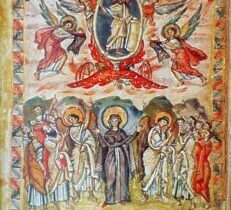
Image is from the Rabbula Gospels, a Syriac manuscript completed in 586 at Monastery of St. John of Zagba.

Read More

Posted by on Apr 23, 2023

Walking Together on the Road to Emmaus

Walking Together on the Road to Emmaus

The morning after… Most of our lives are passed with relatively few surprises or major transitions happening on any given day. Each day follows the one before it in a predictable way and we don’t spend a lot of time going over it in our minds or talking about it with family and friends. But once in a while, something major happens. There is a transition and nothing is the same. It is the morning after and everything is different.

In Anthropology, we speak of these times as liminal times, from the Latin word for threshold. The term comes from the experience we commonly have of passing through a doorway, over a threshold between two different places. On one side of the door, for example, we experience the warmth of the kitchen and home. On the other side, we are in the stormy weather of winter. Passing through the door is a liminal experience of a very ordinary sort.

Rites of passage, in which an individual moves from one social status (child) to another (adult) for example, were some of the first transitions identified and studied as liminal experiences. They may take place over a period of days. Once the ritual begins, the persons who are transitioning are neither who they were originally, nor who they will be at the end. They are inside the threshold.

Many kinds of transitions today are recognized as liminal, including times of political and social transitions. The days and weeks following the birth of a child or the death of a family member or friend are examples of liminal times. Nothing is quite the same as it was before. Everything gets experienced in a new way and everyday ordinary things no longer feel quite the same.

The time between Jesus’ death and Pentecost were in many ways a time of liminality for his friends as well. Their friend/teacher/master had been executed. They had hoped he was the one who would bring freedom from domination by a foreign power and new hope for the nation. But he had been executed and buried. Now some women were saying he was alive again! How foolish could a person be! They must be hysterical. But still, a few of the men had gone to the tomb to check out the women’s story and they didn’t find his body there either. They didn’t see him, though a woman said she had seen him in the garden. What were they to believe? It couldn’t possibly be true. Best just go home and face the music from family and friends who had said all along that they were fools to go tramping around the country following a “prophet.”

As they walked along, talking about all of this, a stranger joined them. He asked what they were discussing. When they told him, the stranger began to explain the events from the perspective of their own religious history and traditions. So many things began to make sense.

It was getting late and time to stop for the night. The stranger agreed to stop too and they ordered dinner. When the food arrived, the stranger offered the blessing, but in a way that opened their eyes. He took the bread, blessed it, broke it, and gave it to them, just as Jesus had done at the Last Supper. In that instant they knew who he was and he vanished from their sight. They recognized him in the breaking of the bread.

They didn’t waste any time. They got up and returned to Jerusalem to tell the others. Upon their arrival, they were greeted with “The Lord has truly been raised and has appeared to Simon.” (Lk 24:13-35)

Fifty days after the Resurrection, the Holy Spirit blew into town, igniting a whole new time in their lives and the world. No longer frightened and hiding away from the authorities, they went out into the world and spoke boldly of what they had seen of God’s actions through the life, death, and resurrection of Jesus. They proclaimed their belief that God had raised Jesus to life again and poured the Holy Spirit forth into his followers and the world. It was a new day, a new world, a new reality for all. (Acts 2:14,22-33)

Did the period of liminality end then? In one respect, yes. The initial phase of it did anyway. The disciples headed out into the world, telling everyone what they had seen and learned of God’s love for humanity. There were many controversies along the way. Much to learn and sort out about living this new way as a community of faith.

We have letters from some of the original leaders and teachers that give us a peek at what was going on in those early days. Some were written by the individuals whose name is on the letter. Others were written by people who learned from the one to whom the letter is attributed. The letters continually remind the community of the great love of God in sending Jesus, like a spotless lamb, to restore the relationship between humanity and the creator.

For a pastoral people whose history included centuries of offering lambs in sacrifice to God and whose very survival and exodus from Egypt involved the sacrifice of a lamb and the placing of its blood on the door frame, the image of Jesus as a lamb offered in sacrifice to restore the relationship with God made perfect sense. We see it again and again in the letters. Peter reminds us all that we are to behave with reverence while we live, remembering that we have been saved from the old behavioral traps and set free to love because of the sacrifice of “the precious blood of Christ as of a spotless unblemished lamb.” (1 Pet 1:17-21)

Nevertheless, the time of liminality is not yet over and done. The final days have not yet arrived. The community of followers of Jesus continues to share the good news with those among whom they live. Controversies continue to arise. We need to be reminded to speak the truth we hear boldly, and to listen equally deeply to others as they speak of what they have known and experienced. We live and learn. We share our hopes and dreams. We listen to the hopes and dreams of our sisters and brothers around the world. We ask the Holy Spirit to move among us today and in the days to come as well, that we too be energized and empowered to speak of God’s great love to all those we meet and to share it in concrete ways of service.

As we move through our days, we find ourselves meeting the Lord in unexpected times and places. He is present in the stranger who is kind to us when we are in a new town, or the friend who calls with a word of encouragement when times are hard, or the child who smiles at us while we wait in line at the grocery store. He is also in the un-housed person begging for spare change whom we pass on the street or the clerk at the local store who works the late shift and hopes the children at home are all right. We all walk on the road to Emmaus each day. When and where will we meet the Lord? When and how will we share the Lord’s love with our sisters and brothers?

“Were our hearts not burning within us while he spoke to us on the way and opened the Scriptures to us?” May these be our words too, as we watch for and listen to the Lord whom we meet in our daily travels along the way of life.

Readings for the Third Sunday of Easter


Read More

Posted by on Mar 19, 2023

Not as Humans See

Not as Humans See

Sight is an amazing gift. A new baby’s eyes open and immediately floods of new sensations pour into existence for the child. It would all be overwhelmingly overpowering if the baby could see everything going on around it. Fortunately, at first babies don’t see things far away clearly.

The face of mother or father are among the first to be seen – that’s a good distance for starters. Baby studies them carefully and begins to associate experiences with what is being perceived visually. Gradually, the distance increases and more wonders come into view. Experiences begin to be associated with what the eyes are reporting.

Baby reflects:
I cry and the tall folks around me pick me up and give me something to eat! I’m sitting in my car seat and I’m feeling pretty peaceful, but there’s one of those tall beings who pick me up when I cry. Oh boy, I’ll just cry and get picked up! No? Well then, I’ll complain some more. Oh. Now I can’t see them. Oh well, I guess I’ll just sit here quietly and see what comes next…

For the man born blind, the story of whose encounter with Jesus we hear in John’s Gospel, these experiences didn’t happen. He had to figure out the world in different ways. With much help from family and friends, he grew up, but the only way he had to support himself as an adult was to beg for alms from passers-by. A far cry from the experience of those who are blind in developed societies. (Jn 9:1-41)

In Jesus’ time, people believed that the light residing within people was what made it possible for them to see. If a person was born unable to see, there must not be any light within them. If there’s no light, then it’s only reasonable to assume that only darkness is there. Darkness is the realm of evil, so someone must have sinned in order for the child to be filled with darkness. For this reason, people asked Jesus, who had been the sinner whose actions resulted in the birth of a blind child: the parents or the child before birth? Jesus responded firmly, “Neither he nor his parents sinned; it is so that the works of God might be made visible through him.”

Jesus didn’t wait around to see what would happen to the man as life continued. He acted. “While I am in the world, I am the light of the world.” Then he spat on the clay ground and made some mud, which he smeared on the man’s eyes. He then told the man to go to a pool called Siloam (Sent) and wash off the mud. This pool was known to be a place where people were sometimes healed, so the man went. He washed off the mud and he gained the gift of sight, not the gradually expanding sight of an infant, but the sight of a person who could function in society.

The rest of the story tells of the consequences of this new experience in the man’s life. People were astonished. He was led to testify before the religious authorities about what had happened. (It was on a Sabbath that Jesus acted – how could he be from God if he broke the Sabbath by working?) Who was this Jesus after all? What did the man think of him? The man didn’t change his evaluation of the experience: the man who healed me must be from God because he “opened my eyes.”

Jesus went to find the man after he had been tossed out of his religious community by the authorities. He asked the man if he believed in the Son of Man, a title for the savior who was to come from God. The man became a follower of Jesus when he learned that Jesus was the one who had transformed his life.

This theme of sight and of light runs through the readings from the book of Samuel (16:1b, 6-7, 10-13a) and the letter to the Ephesians (5:8-14) as well.

When the Hebrew people decided they needed to have a king rather than be led by strong, wise men and women in times of danger or attack. God acquiesced to their request and Saul was anointed king. However, Saul didn’t turn out to be entirely faithful to God’s instructional leadership. God had someone else in mind to be the next king. The challenge was that kingship so commonly passes from father to son. Saul’s sons were not the ones God had in mind either!

The Lord sent the prophet Samuel to the village of Bethlehem, to a man named Jesse. One of Jesse’s sons would be the one he should anoint the one to be the next king. Jesse had eight sons. Any one of them might be the one, so one by one they were presented to Samuel. Each time Samuel thought, surely this would be the one. But none of the seven older sons was the one. Finally, they called David in from tending the sheep. David was still quite young. No one would have expected him to be the choice, yet this young man was the one chosen. Samuel anointed him in the presence of his family and the elders of the community. The spirit of the Lord, the holy breath of God, rushed upon him and remained with him.

As the Lord told Samuel, “Not as man (humankind) sees does God see, because man sees the appearance but the Lord looks into the heart.”

As members of the Followers of the Way, the early Christians in Ephesus were learning new ways to live. Many things that were acceptable behavior in their society were not “pleasing to the Lord.” Paul encouraged them: “You were once in darkness, but now you are light in the Lord. Live as children of light…” He advised them to act always with the assumption that what they were doing must be worthy of being seen – done in the light. Everything done in the light can be seen and everything that can be seen is light. He concludes, “Awake, O sleeper, and arise from the dead, and Christ will give you light.”

Light and sight are the keys. God sees in different ways than we do. Our human vision and understanding can go only just so far. Like the new baby, as we grow, we see more deeply and more clearly. As we grow in the experience of God’s love and life, our ability increases to perceive how far and deeply love extends and actually forms the substance of all life.

As we continue the journey to Holy Week and Easter, let’s ask the Lord to open our eyes too. To help us to see the face of Love all around us – in the people, the plants and animals, the environment, and the universe. To help us to value the unseen goodness of all of creation and treat it with reverence. To trust that all will be well, as long as we keep our eyes open in trust to the Lord, our God. And finally, to let that light be reflected into the world around us, letting the Light of Christ pour through us into our world.

Readings for the Fourth Sunday of Lent – Cycle A

Open My Eyes – Jesse Manibusan

 Liturgy – Resurrection Catholic Community


Read More

Posted by on Mar 5, 2023

Light Shining Forth

Light Shining Forth

Abram was a shepherd, from Ur of the Chaldees (in contemporary Iraq). Jesus was a carpenter from Nazareth in the Galilee. Paul was a tent maker from Tarsus, a city in Cilicia to the north of Syria who had become a student and teacher of the Law in Jerusalem. Each heard God’s call and responded in faith.

Abram had already left his homeland with his flocks and family and was living in Haran, an area that is now part of Türkiye. He heard the Lord’s call to move south to Shechem in the land of Canaan. (Gn 12:1-4a) This was a big deal. Gods were believed to be local to a geographic area. Yet his God was telling him to go to a new area, where the people worshiped other gods. God promised that a great nation would grow from this man who had no children at the time. Abram took God at his word and moved his family south. Much to his relief, I imagine, God was present in the new land too.

Just as God had promised, Abram became the father of not one but two great peoples, the Arabs and the Jews. And through his obedience to the call, blessings have come to all the communities of the earth.

Jesus too listened to God’s voice calling him at his baptism in the Jordan River. When he returned from his forty-day retreat in the desert, he began proclaiming the good news that the kingdom of God was at hand. The time had come in which the people’s relationship with God would be mended. The signs of this new kingdom would include the poor hearing good news, the blind seeing, the deaf hearing, those who were crippled being healed. It was a different kind of kingdom than the one expected by his contemporaries. But many people followed him. It wasn’t every day that one could see a healer at work or hear new teachings.

Jesus had some very close friends with whom he shared the last three years of his life. He took three of them up on a mountain one day. (Mt 17:1-9) Mountains in Scripture are often places where God meets people. This was no exception. On this day, both Moses (representing the Law) and Elijah (representing the Prophets) appeared and spoke with Jesus about what was coming. His friends were astounded. Jesus’ face was shining like the sun and his clothing was blazing white. They rightly understood that God was present in that moment, his light shining through Jesus. Peter suggested that three tents could be set up, so Moses, Elijah, and Jesus would have a comfortable place to stay. Then they heard God’s voice telling them that this was his beloved son, to whom they should listen. This confirmed God’s presence there and they were afraid. They fell to the ground in worship.

The moment passed. Jesus touched them. Instructed them to get up. And as they went back down the mountain, he told them not to tell anyone what they had seen until after he had risen from the dead. Of course, they had no idea what that meant, but we’ve all been told about it now – after the Resurrection.

Paul too had an encounter with the Risen Jesus. Another brilliant light experience. He was blinded for a few days afterwards. Then he got busy and devoted the rest of his life to telling what he had learned and experienced of God’s love and presence. He traveled through much of the ancient world between Jerusalem and Greece, all the way to Rome. His letters tell us today what he learned of God’s call and support for each of us in living the new way of love and service. (2 Tim 1:8b-10) He reminds us that God is the one who called us and will support us through any and all hardships that come our way as a result of following Jesus.

When I was in grade school, some of my teachers told us that we shouldn’t expect great or outstanding things to happen to us as followers of Christ. The miracles pretty much had all happened long ago.

For the most part, we do go through our lives with few surprise interventions from the divine world. At least, we don’t notice them most days. The sun rising, the moon and stars at night, the smiles of those we love, the people with whom we interact – all seem very normal. Nothing special there, folks.

Yet I believe we sell ourselves and our lives short when we say it’s all just ordinary. Amazing things still happen. God touches people directly and indirectly even today. We don’t talk about it much, but it happens.

There is a light shining just below the surface of the world around us. We don’t see it most of the time. But there are moments when it breaks through. A child races down the sidewalk to give us a hug. A friend calls just to say hello. The clouds pick up the sun’s rays at just the right moment to paint the sky with shades of rose. A bird greets us when we walk out the door in the morning, then picks up the treat it has just found and hides it in a neighbor’s gutter, planning to come back and enjoy more of it later. (No kidding. I watched a crow do just that a couple of weeks ago!)

Remember the words of the song, “You light up my life…” Remember the times you have seen someone’s face light up with delight. We speak of lighted faces. God is shining through those faces, smiling at each of us. May we each day be open and transparent enough in our interactions with others that God’s smile shines through us as well.

Abram, Jesus, and Paul were not the only ones whom God has called to go forth and bring blessing to the world through our lives. He calls ordinary people in all ages, including each of us too. The light continues to shine forth. Not as brightly as it did through Jesus at the Transfiguration, but enough that it can be noticed as a calming, reassuring, and powerful sign of love.

Here’s to the light!

Readings for the Second Sunday of Lent – Cycle A


Read More

Posted by on Feb 12, 2023

Going Deeper with The Law

Going Deeper with The Law

In the Sermon on the Mount in St Matthew’s Gospel, Jesus says several times, “You have heard that it was said … But I say to you…” (Mt 5:17-37) Each of the things Jesus says takes the requirement farther than the original teaching from Mosaic Law seemed to go. It’s not enough to refrain from murdering someone, even getting angry and holding on to the anger is too much. It’s not enough not to be unfaithful to a spouse. Even harboring unfaithful thoughts is too much. It’s not enough not to swear a false oath. Don’t swear oaths at all. You really have no way to back it up.

We so often are tempted to split hairs. Well, she didn’t really say I couldn’t stop for ice cream on the way home, she just said to come home! Well, it’s only a little untruthful, what difference will that make? What right does he have to tell me what to do anyway? It won’t hurt anything to do it my way instead! And so we justify what we want to do, regardless of what is asked of us.

But Jesus wants us to look at the underlying meaning of the commandments. How do we live out the spirit of the law rather than the letter of the law. It’s in the spirit of the law that we learn the wisdom of God and choose life. He was very clear on this. He didn’t come to overturn the Law. He came to fulfill it.

Does that mean that we have to take everything we hear in scripture at face value, even if our culture is very different from Jesus’ culture? No. But we need to understand what the reasoning was for his teachings. For example, when he speaks of divorce, it is about a different social reality than we know today in our Western culture. In his time and culture, a man could divorce a woman, but a woman could not divorce a man. Beyond that, once a woman was married, she was the responsibility of her husband’s family. Her family was no longer responsible to support her in any way. If her husband divorced her, there was no one to look out for her. She had no income, no home, no support. That’s why Jesus spoke of such women as having to commit adultery. It was the only way a lot of them could survive, but their survival method put them in violation of the letter and spirit of the law.

How about that business of gouging out an eye or cutting off a hand that causes us to sin? Not to be taken literally at all. But we need to act definitively sometimes to cut out the things from our lives that lead us to make the wrong choice or to go down the wrong road. If watching TV in the evening leads me to get angry with the baby who interrupts my watching, it’s not the baby’s fault. I need to cut out the TV watching. If having the computer in my bedroom leads me to watch YouTube rather than do my homework, maybe I need to keep and use the computer only in a public area of my home. If being around people who are smoking or drinking makes me want to do it too, or if I can’t resist their offers to join in, maybe I need to hang out with other people.

Sirach (15:15-20), long ago, presented a series of choices the Lord offers that ring true today. Fire or water? Life or death? Hang on to anger and revenge – you’ve chosen a fire that will eat at you and eventually destroy you. Choose water and you can be washed clean of the anger and other negative emotions – you are choosing life. Wisdom comes as we choose the path of life again and again over time. And sometimes, it comes as a result of having to turn from the wrong choices and the messes that have resulted when we made them. Turning from death to life.

God doesn’t force us to do anything we don’t want to do. That is a key reality of love. Freedom to choose. But God also doesn’t shield us from the consequences of our choices. God is simply there to help us pick up the pieces when we realize our mistake and make better choices the next time around. Then God gives us a big hug to let us know how much we are loved, even when we mess things up royally.

So, as we listen to the readings from Sirach, St. Paul (1 Cor 2:6-10), and the Gospel today, with all of these more demanding instructions, let’s remember that we are called to hear a deeper meaning to the rules. We’re to hear the meaning that seeks to call us to be our best selves and choose the path of life and love rather than sinking more deeply into the morass of anger, selfishness, deceit, and all that goes with them, all the while thinking we are keeping the rules as they are literally formulated. We are called to go deeper.

Readings for the Sixth Sunday in Ordinary Time – Cycle A


Read More

Posted by on Jan 22, 2023

A Voice Calls to You – Do you hear?

A Voice Calls to You – Do you hear?

Have you ever received a phone call, a text, or a letter inviting you to an event or an activity that you would never have considered attending? It might even be an invitation to something that you didn’t know existed, something so totally out of character for you that you are surprised anyone would ever associate you with that!

My initial reaction in these moments is to decline. “No, I can’t possibly do that.” “I don’t have time.” Usually I don’t say, “Are you crazy? Why would you think I would ever be associated with something like that?” I may be thinking that, but I try to be polite as my mother taught me.

Nevertheless, there have been times when I didn’t say no to the invitation. Invariably, I have learned something important in the process.

I was never into rock and much of the contemporary music of my day as a teen and young adult. As a result, the thought of attending a Grateful Dead concert never entered my mind. Yet as an adult in the late 70s and early 80s, I was working with a group, the Seva Foundation, that was trying to combat preventable blindness in Nepal. (I discovered I was not good at fundraising in the process, but that’s another story.)

One of the folks with whom I was working knew someone from the Grateful Dead and was able to instigate the planning of a benefit concert that included some members of the Dead, along with many other folk and rock artists who were well-known musicians and activists. We were invited to attend as well.

That night, as we stood in line at the will-call ticket booth, a young woman ahead of us, clearly rather “spaced-out,” approached the booth. She went up to the window and warmly greeted Jahanara, who was handing out the tickets. Jahanara smiled and greeted her in return. It was clear the young woman was not there to pick up tickets, but it didn’t matter to Jahanara. There was a warm smile and a wish for a happy evening. Then the young woman walked away peacefully.

I have often reflected on that encounter. I don’t know that I would have had the grace that Jahanara exhibited that night. I might instead have been irritated that the young woman had wasted my time and that of the folks in line. But I think Jahanara’s response was the way Jesus would have responded. I have never forgotten that moment of grace.

Liturgically, we are in a time of hearing about the events in Jesus’ life that led to its climax with his passion, death, and resurrection. We have heard about John the Baptist’s testimony. Today we hear about what happened after John had been arrested by Herod but before his execution. (Mt 4:12-23) Jesus moved from Nazareth to Capernaum and began his journey of preaching: “Repent, the kingdom of God is at hand.”

Capernaum is on the shore of the Sea of Galilee. It’s a very big lake and many folks made their living as fishermen. As he walked along the lake, he saw Andrew and Simon throwing their nets into the lake. He called to them, “Come after me, and I will make you fishers of men.” That seems a crazy thing to say and they responded in an even crazier way. They left their nets right there and walked on with him. Then they saw two other brothers, James and John, in the boat with their father Zebedee. Jesus called them as well. They left their father and went off with him.

These were absolutely outrageous things to do. Totally irresponsible and unheard of. Yet because they heard the invitation and responded, they became witnesses to the greatest event of salvation history – the reconciliation of humanity with God.

Most of the time our own encounters with strangers don’t seem to have cosmic implications. Most of the people we meet on the street or in the grocery store are pretty ordinary folks, with ordinary lives and hopes. But I think we make a great mistake if we assume that because they seem ordinary, there is nothing special about them. Each of us is here for a reason. We mostly have no clue what that reason is, but God has a reason for each of us to be here. There is someone we are to greet. Someone with whom we are to share a smile. Someone who just needs to be seen by another person and treasured as one of God’s special ones.

When Jesus comes into our lives, it’s not generally going to be with trumpet blasts and fanfare. Very likely it will come in the form of an invitation to do or try something that we would not ordinarily do. Who would ever have thought the I would go to a concert and enjoy the music of the Grateful Dead? But I did and it was a wonderful experience. And in the process, I saw the Lord reaching out in kindness to a young woman who needed to hear a gentle word that night.

Jesus continues to walk among us, mostly unseen. He is present in each one of us and wants us to reach out to each other and to those we meet, sharing the great love the Father has for each of his children. We too are called to leave our ordinary “nets” and follow along with him. He will make us fishers of men, women, and children too.

A voice is calling. Do you hear him?

Readings for the Third Sunday in Ordinary Time

Read More

Posted by on Jan 15, 2023

I did not know him …

I did not know him …

John the Baptist spoke these words about Jesus, “I did not know him, but the reason why I came baptizing with water was that he might be made known to Israel.”

The context for these words is not crystal clear when we hear them read at Mass. We are used to the stories in the first three Gospels, the Synoptics, that tell of John baptizing Jesus. We also have heard that the mothers of Jesus and John are cousins, so we expect that the boys would have known each other while they were growing up. But these assumptions aren’t necessarily correct. They come from our perspective as people from a culture in which kinship is established through the lines of both our fathers and our mothers. This was not the case in Jesus’ culture. One’s mother had to be Jewish for a child to be born a Jew, but kinship was established through the father’s line. Also, one child grew up near Jerusalem while the other grew up in Nazareth, several days’ journey to the north.

John the Evangelist, in his Gospel, also tells us about Jesus and John the Baptist, but this story has a different focus. (Jn 1:29-34) In the section of the Gospel that comes just before John identifies Jesus to his own disciples as the Lamb of God, John has been speaking with those who came out from Jerusalem to find out what the heck he was doing and to ask who was he to be doing it! That is one of the readings we typically hear in Advent liturgies. As we enter into Ordinary Time (that is to say, Counted Time), we hear the rest of the story.

John breaks his account of Jesus’ life into two books: The Book of Signs and The Book of Glory. Just before the Book of Signs, we find the Prologue, with its famous line, “In the beginning was the Word.” This is a new beginning of the history of the relationship between God and creation.  Just as in Genesis, “In the beginning …” The Prologue summarizes the themes of the entire Gospel and notes that John came ahead to testify to the light so that others might believe when his identity became known.

The Book of Signs presents key events in the life of Jesus that point to his divine origin. Thus, the Book of Signs picks up the story with John’s testimony to those from Jerusalem: “There is one among you whom you do not recognize – the one who is to come after me..” The very next day, as Jesus came towards him, John suddenly exclaimed to those around him: “Look! There is the Lamb of God who takes away the sin of the world! … I did not know him …”

In the Synoptic Gospels, written by Matthew, Mark, and Luke, we are told that John baptized Jesus. In Matthew’s account, John demurs, but Jesus insists that they do it that way. Immediately afterwards, the Holy Spirit descends on Jesus like a dove and the words, “This is my beloved son” are heard coming from the heavens. John the Evangelist also speaks of this event, but with a different focus and in more detail. In his account, John the Baptist declares a second time, “I did not know him.” It was only when “the one who sent me to baptize with water told me” that the descent of the Spirit like a dove from heaven would be the sign of the chosen Servant or Son of God that he was able to recognize Jesus as the one.

John the Baptist immediately testified to what he had seen, telling his disciples that this man was the one, the long-awaited Lamb of God.

Isaiah also spoke of one or ones who would be Servants (or Sons) of God. (Is 49:3, 5-6) The terms were used interchangeably. These were ones called by God from among the people to be faithful to the covenant and lead their nation back to a right relationship with God as their nation was rebuilt. The rulers were not necessarily going to be the ones who would do it right. Yet God would call people from among the community and through them Jerusalem and her people would become a light to the nations and salvation would reach to the ends of the earth.

Paul too makes it clear in his greeting to the people of Corinth (1 Cor 1:1-3) among whom he had lived for over a year, that all of them, Jews and Gentiles alike, had been called to holiness in Jesus. To them and to us comes his greeting: “Grace to you and peace from God our Father and the Lord Jesus Christ.”

Today, I invite you to pray with me for the grace to see God’s servants among those I meet each day. In seeing ordinary folks who are living witnesses to love and grace and forgiveness in their lives, we begin to see the face of the Son of God among us as well. We don’t always recognize him. It’s way too easy to get focused on our tasks and responsibilities, our concerns and our worries. Yet he is there among us, day to day, in the middle of it all. At the grocery store. At school. At the office. Walking along the beach. Playing in a puddle. Helping someone shovel water out of a flooded home.  All the many activities of our lives.

“I did not know him…” With God’s help and prompting, may we say with John, “Now I have seen and testified …” The Son of God is here with us now.

Readings for the Second Sunday in Ordinary Time – Cycle A


Read More

Posted by on Dec 23, 2022

Sometimes things don’t go as expected.

Sometimes things don’t go as expected.

Have you ever had one of those days when you get up in the morning with all sorts of plans and almost immediately they start getting derailed? I think they happen to all of us from time to time. Sometimes the plans can be picked up again the next day. Other times they are simply gone and we have to move on to the next step.

This kind of experience is not unique to people of our time. Ahaz in the eighth century BC was king of Judah. The Assyrians were moving south, conquering any nation that wasn’t willing to be one of their territories. Ahaz had to decide whether to ally his kingdom with that of Israel to the north, which was planning to resist Assyria, or whether to trust God to help and protect his kingdom and its people. The Lord told Ahaz to ask for a sign, anything at all, to indicate that the Lord would be with Judah in the days to come. Ahaz refused to ask for a sign and Isaiah spoke a prophecy of what would be the sign. “The virgin shall conceive, and bear a son, and shall name him Emmanuel.”

Many generations later, a young woman was visited by an angel and agreed to become the mother of a child. The challenge was that she was only engaged, not yet married. The man to whom she was engaged cared about her enough that he didn’t want to denounce her to the authorities as having been unfaithful before she was even married. He decided to end the engagement quietly, so she could go away, have the child, and continue to live. The penalty otherwise could have been stoning.

Joseph went to sleep after making that decision and was visited in a dream by an angel, a messenger of God. The angel reassured him that Mary had not been unfaithful. The child had been conceived by the power of the Holy Spirit. The angel told him the name he was to give the child. It was the same name given to Mary for her child when Gabriel visited her with God’s request. Jesus. The angel quotes the prophecy from Isaiah in which the child is called Emmanuel. The name Emmanuel means “God is with us.”

Joseph believed the words of the angel. He took Mary into his home as his wife. This descendant of David became the father of Jesus by choosing to accept him as his son. The ancient promise made to David that the Messiah would come from among his descendants was to be fulfilled. The sign given to Ahaz was also fulfilled.

Like Ahaz, Joseph, and Mary, we don’t always know what will come of the unexpected in our lives. We can only trust that somehow, God is in charge and will make things right.

Readings for the Fourth Sunday of Advent, Cycle A

Read More

Posted by on Nov 27, 2022

Time to Wake Up!

Time to Wake Up!

A new year begins today! Much of the world around us is focused on big sales and preparing for Christmas. But with the First Sunday of Advent, we begin a new year. We light the first candle on our Advent Wreath. We turn our focus to preparing for the coming of Christ. We look forward to a new set of liturgical readings as well. This year we will hear from St. Matthew as he shares the story of the coming of the Messiah.

How does the Messiah come into our lives? How do we prepare for his coming? Is there something different we should be doing? Why do we need to do anything differently at all?

The beginning of a new liturgical year is a bit like the beginning of a school year, after a long summer vacation of sleeping late and playing outside long into the evening. It is not always a welcomed thing to have to get up on time to get to school again. And yet, there is an excitement to be back together and to start doing and learning new things.

We have come through a year of hearing St. Luke’s stories, both those told by Jesus and those told by others about him. What new things will we learn this year?

Isaiah tells us about the time when the exile of Israel in Babylon was drawing to an end. (Is 2:1-5) The people had received permission and encouragement to return to their own land again. Folks who had seen Jerusalem destroyed and who had begun life anew in Babylon were not necessarily excited about returning to a ruined city and once again starting over. They had become comfortable in their new homes.

Isaiah calls them back. “In days to come, the mountain of the Lord’s house shall be established as the highest mountain… All nations shall stream toward it…” He foretells a time when people from all over the earth will listen to the Lord’s voice, ruling from Jerusalem, judging the nations, and bringing peace to the world. He calls, “O house of Jacob, come, let us walk in the light of the Lord!”

It’s a new time, a new day, a new hope for the peoples of the world.

The psalmist, in Psalm 122, speaks of Jerusalem as well. “Let us go rejoicing to the house of the Lord.” Jerusalem is the city in which the Lord’s house is located. There the people give thanks. There the judgement seats are set up for the house of David. There the prayers are offered for peace, prosperity, and good things for all peoples. Truly a place for rejoicing.

St. Paul also speaks of waking up in his letter to the Romans (13:11-14). “It is the hour now for you to awake from sleep.” Salvation is at hand. The time of darkness, with all the awful things that can happen in the dark, is passing away. It’s a time for light and life, for conduct reflecting the light of the Lord Jesus. So “put on the Lord Jesus Christ” in this new day and age. Wake up! Let go of the past. Decide each day to live in the light of this new day.

Finally, St. Matthew (24:37-44) relates Jesus’ instructions regarding the final times – the time when the Son of Man will come at last. He begins with an example familiar to all. “In the days of Noah” it was like it will be when the Son of Man comes. Folks lived their daily lives. They ate and drank. They married and gave their children in marriage. They had no clue anything was going to change in their lifetimes. If they noticed Noah’s preparations for a changed reality, they didn’t believe it or change their way of life. The kept on keeping on and enjoying their lives. And then the flood came and they were unprepared.

Similarly, says Jesus, when the Son of Man comes, it will be a surprise. Some will be taken and others will remain behind, living life as they are accustomed to live it. He says, “Stay awake!” Would those left behind have remained behind if they had been paying attention and noticed that the Son of Man had come?

We do not know the day or the hour when we will meet the Son of Man. It doesn’t need to be a great earth-shaking calamity in which the world is destroyed or Jesus comes on a cloud to judge all the people of the world. The day will come on which each of us meets the Lord in person. There are no guarantees when we get up in the morning that we will go to bed at night. And vice versa.

As we begin this new year, it is good to remember that all can change in an instant. So we must remain alert and prepared for meeting the Lord. It may be that we meet him in another person. It may be that we see the Lord’s hand in a beautiful sunrise or sunset or in the smile of a child. It may be that we meet him as we make that final transition into eternal life. Wherever and whenever we meet him, pray with me that our eyes will recognize his loving presence.

Wake up! Get ready! A brand new year of life and growth in love awaits us.

Happy New Year!

Readings for the First Sunday of Advent, Cycle A


Read More

Posted by on Nov 13, 2022

Little Things Matter

Little Things Matter

Last Friday evening we had a small earthquake. I was with a group of people at a retreat when there was a bit of a jolt and shake of the room. Not a big one, but definitely noticeable. I don’t know how large it was. We have all lived in California long enough not to be bothered by a small earthquake. The speaker didn’t even notice it, because he was moving around a bit.

Little earthquakes are a welcome feature of this coastal land. They release some of the pressure that builds up constantly as plates in the earth move past each other. We had a considerably larger one a couple of weeks ago, though, so I think it’s definitely time to update the “earthquake supplies” and be sure we have enough water and food stored outside the house. Wouldn’t hurt to update the clothing either. A teenager can’t very well wear clothing stored outside for him when he was a small child! When we start getting quakes more frequently that are big enough to notice, it can be an indication that a larger one is coming. We saw that in 1989!

As humans, we like exciting things, things that are pleasantly unexpected, fun to do and out of the ordinary. We remember them and talk about them for years afterwards. The everyday ordinary things of our lives can’t hold a candle to them, though they take up most of our time.

We’re at the next-to-the-last week of Ordinary Time now. Soon a new year will begin. We look to last days and remember how as Christians we are always preparing for the coming of the Kingdom and the return of Christ. We tend to forget that the Kingdom has already begun. It is growing and spreading through our actions here and now. But it’s much more enticing to look for the signs and wonders that might announce major changes that the whole world would notice. Then we could stand up straight and proclaim, “See, I told you so…”

But it doesn’t work like that.

Throughout history, people have tried to live in good and holy ways. The people of ancient Israel were no exception. Yet it always seemed that those who didn’t follow the Law and who didn’t live justly were rewarded with better lives here and now than those who did. How could that be? The prophet Malachi encouraged them to keep trying. (Mal 3:19-20a) He spoke of the day of the Lord that would come “blazing like an oven” and destroy those who do evil. Those who lived good lives would then see the rising of the “sun of justice with its healing rays.” This was a reference to a symbol found throughout the Middle East, a solar disk with wings that hovered over the earth. For the just, the wings provided shelter from the burning heat.

Some of the people of Thessalonica also expected the return of the Lord on a timely basis. No need to work hard and build up savings for the future, or even for today. The Lord was coming soon. No one was going to starve. Someone would make sure the children got food. More important to point out what bad things others might be doing, so they would quit worrying about work or worldly cares and prepare for the last day!

St. Paul did not agree. (2 Thess 3:7-12) In fact, he notes, he and his companions worked at their trades to support themselves during the time they lived in Thessalonica. He was a tent maker and always supported himself – the demand for tents was constant in the ancient world. He also points out that each of us is to mind our own business, not waste our time pointing out the failures of others. Each person is to carry out their own responsibilities and not expect to live on the charity of others.

Of course, this latter instruction can be misinterpreted to imply that absolutely everyone must work to support themselves. That would be incorrect. There are people who are not able to work, whether because of a disability, illness, injury, or other misfortune/limitation. As a community, we are responsible for each other. But we are not to waste our time criticizing others. We are to care for those in need and be bearers of God’s love to all we meet.

The little things matter. Everyday tasks have a purpose. All are to share in the ordinary rather than expect the extraordinary to happen on our own schedule.

Jesus ran into this with his followers as well. (Lk 21:5-19) When they got to Jerusalem, folks were amazed by the beauty of the temple. It was a place of wondrous beauty, adorned with precious metals and jewels. People had given rich gifts to make it a place worthy for their Lord God to dwell among them. In fact, when the temple was destroyed by the Romans in about 70 AD, the riches from the temple were taken to Rome and used to fund the construction of the great Colosseum there!

Jesus warned the people who were marveling at the temple’s wonders that it would one day be destroyed. So they asked, “When will this happen? And what signs will there be when all these things are to happen?”

His response was less than satisfying to them. Rather than giving them a date and time, he cautioned them not to be fooled. Many would come predicting that all was coming to an end. In fact, terrible things would happen again and again. This was and is a long-standing pattern among peoples of the world – both in ancient times and today. Even without considering the battles between peoples, there are earthquakes, fires, floods, famines, and many other disasters. But these do not indicate that the end is near.

Instead of giving a timeline for the end of times, Jesus makes it clear that their lives will not be safe or secure as his followers. There will be times when they face great opposition, perhaps even trials and death. St. Luke includes this as part of his Gospel because by the time it was written, these things were already happening to the community. They have happened through the centuries and continue to happen even in our times.

Nevertheless, Jesus offers reassurance. Don’t waste time worrying about what you will say if ever the time comes that you must testify to your faith or experience of his life and love. Live each day doing what you are called to do by your faith. When the time comes to testify, you will be given the words you need to say. As a result, people who might not otherwise ever hear the Lord’s word and promises, will have a chance to hear them. God will protect you, though you might not survive physically. Your life, the life you have in and through Christ, will be saved.

So we keep on keeping on. We get up in the morning. We do the work that awaits us. Along the way, we meet our family and friends. We see or speak with co-workers. We meet people on the street. We wait patiently in line at the grocery store. We smile at those we meet. We offer a word of greeting or encouragement. We hold our tongues when tempted to speak harshly. We wash the dishes yet again. We make the beds, dust the house, sweep the floors, pull the weeds, make the phone calls, balance the books, teach yet another group of children, repair another set of brakes on a car, and so move through our days and lives. Each of the small things we do in these days is important. It touches others. To the degree that we do it with love and patience, they will know the love of God, because they will have known the love we carry inside us from God.

Little things matter. Little earthquakes. Little acts of kindness. Little acts of forgiveness. And with God’s help, when the time comes for the big ones, we’ll be in practice and ready.

Readings for the Thirty-third Sunday in Ordinary Time, Cycle C

Read More

Posted by on Nov 6, 2022

Playing the Long-Game on God’s Team

Playing the Long-Game on God’s Team

Several things have been on my mind this week. We have just celebrated All Hallows Eve, All Saints, and All Souls. The weather is changing. In the Northern Hemisphere we are settling into our school and colder weather routines. It’s getting darker. We’re beginning to get rain on the Central Coast of California. Other areas are seeing snow already.

While much of the hemisphere settles in for a long winter sleep of the vegetation, here the grass is sprouting after a long, dry summer and early fall. By Christmas, all will be green and beautiful. Wildflowers will be in bloom and it will feel to someone from farther north to be spring already. I must admit, it took me a while to get used to this.

But despite the appearance of spring outside, it is dark earlier and colder. Rain gear is needed and with the humidity, warm coats are a must.

We play the long-game in our lives in the natural world. Nothing happens overnight. Things just begin, grow, and reach their term over an extended period. Sometimes what develops is objectively good. Sometimes not so much.

On the grand stage of international relations and the history of peoples, the long-game of God becomes even more important. We are all called to play our part in it.

In the second century before Jesus was born, Greek warriors, led by Alexander the Great, conquered much of the known world. Palestine was one of the conquered lands. The Greeks were not a people who encouraged the peoples of conquered lands to continue their own religious beliefs and traditions. Conquered people were expected to worship the Greek gods instead of their own. This applied to the people of Israel as well. Some of the Jewish leaders encouraged the people to go along with their new rulers. But not all agreed to that and resistance arose, led initially by Mattathias, son of John, and later by his own son, Judas Maccabeus. It was a time of great turmoil and struggle. Eventually, the Greeks were conquered by the Romans, who allowed Jews to worship as they pleased, as long as they did not contest Roman rule. But that’s a story for another time.

As we near the end of our liturgical year, we listen to the witness of a group of Jewish martyrs during the years of Greek rule of their land. Their story is told in the second book of Maccabees. (2 Mac 7:1-2, 9-14) Seven brothers and their mother had been ordered to eat pork, in direct opposition to Jewish law. All refused. One by one, they were tortured and killed, with their mother being the last to die. Each brother got a turn to speak and each testified of his willingness to die rather than to break God’s law. They spoke of their trust in “the King of the world (who) will raise us up to live again forever.” The Sunday reading only includes the stories of the first, third, and fourth brother, but the story of all is found in the complete text.

The brothers and their mother recognized their place in God’s long-game. They knew that whatever happened to them, God was still in charge and would not abandon them. They might not/would not survive this time of witness/martyrdom, but God would raise them back to life – a life that would not end.

St. Paul recognized by the last months and years of his life that the return of the Lord was going to be part of God’s long-game too. Originally, Christians thought and taught that Jesus would return during their lifetimes. The end of the world was coming soon. But as time went on, it became clear that it was going to take longer.

Paul writes to the people of Thessalonica (2 Thess 2:16-3:5) to encourage them to keep up their hopes and good work, encouraged by the grace and love of the Lord Jesus Christ. He asks God to bless them and strengthen them to live in faith through good deeds and words. They are to carry on Christ’s work in their families and communities. He also asks them to pray for him, for protection from those who have lost faith or never believed. Finally, he prays that the Lord will continue to guard them and guide them in their lives of faith, helping them to carry on their lives of faith with the strength of Christ.

Jesus too speaks today of the reality of life after death. (Lk 20:27-38) A group of students of the Law, the Sadducees, did not believe in life after death. The concept was one that had developed slowly in Jewish thinking and was not accepted by all. Trying to trap Jesus into falling into either the camp that believed or the camp that didn’t, and thereby enter into the religious politics of the day on one side or the other, they presented a case study.

A man was married, but his wife had no children before he died. According to the Law, the man’s brother was to marry his brother’s widow. (It was allowed to have more than one wife at that time.) He too died without her bearing a son. The son would have been considered the child and heir of the first brother. This continued through a total of seven sons and marriages. The woman never had a child. Eventually, all had died. They asked Jesus, “Now at the resurrection, whose wife will that woman be?”

Jesus answered, but from a totally different perspective than consideration of inheritance of family position or heritage. Those who die no longer are bound by traditions such as marriage. They are free like angels. They are children of God and cannot die again.

Jesus knows that God’s approach is to act over time, touching the hearts and minds of people, so that gradually humans come to live as members of the Kingdom of Heaven in their daily lives. It’s a long-game strategy, but it is consistent with the reality that God created us to be free to make up our own minds about what to do and how to act. God doesn’t force anyone to act justly or lovingly. No one is forced to forgive or to accept suffering or criticism rather than act evilly or curse the opponent. Each person must decide personally how to react in good and hard times.

It’s a bit like the struggle sometimes waged in households over what kind of language is acceptable for children and adults to use. If everyone is using foul language at school or at work, is it OK to use it oneself? What alternatives are there? How can one be part of the group and not behave exactly like everyone else? Does it really make any difference in the long run?

Pope Francis, speaking to the Catholic community of Bahrain recently, encouraged them and all of us to do what is good “even when evil is done to us.” He continued, “There will be cases of friction, moments of tension, conflicts and opposing viewpoints, but those who follow the Prince of Peace must always strive for peace. And peace cannot be restored if a harsh word is answered with an even harsher one. No, we need to ‘disarm,’ to shatter the chains of evil, to break the spiral of violence, and to put an end to resentment, complaints, and self-pity.”

This is long-game language and strategy. We are all called to play the long-game on God’s team.

I pray that you and I will have the courage and strength to make decisions that lead to reconciliation and peace in our families, our communities, and our world in the days and weeks to come. We are going into the holidays soon. A new year will begin for our Church community in just a couple of weeks. 2023 will be upon us before we know it. Now is the time to commit ourselves to the long-game of God’s kingdom, to build a world of peace, forgiveness, and mutual care and support.

Go team!

Readings for the Thirty-second Sunday in Ordinary Time – Cycle C

Read More

Posted by on Oct 30, 2022

Recognizing and Responding to the Imperishable Spirit

Recognizing and Responding to the Imperishable Spirit

“Your imperishable spirit is in all things!”

A grain of sand, a drop of dew, a spider’s web, a mighty redwood tree, a blade of grass, a thunder cloud, a little child – all are created by God and all bear within them the Lord’s imperishable spirit. All of creation is poured forth, bursting out through the dance of love that is our God. Everything carries a bit of that energy of love that brought it into being.

We stand in awe of the wonders of the earth as we pause at the edge of the ocean just before a storm, or on the rim of the Grand Canyon, or walk amid the redwoods in California. We marvel at the wonder of a newborn baby, with such tiny fingernails and ears. We rejoice as new life sprouts from the earth when the seasons change and rains come to water the ground. We stand in silence as we contemplate the passing of those we love from this life to the next.

The world is full of mystery and that mystery is filled with the presence of an imperishable spirit.

It’s no wonder, then, that peoples around the world have recognized this presence. Most, if not all, peoples historically have told stories of how things came to be, why things don’t always go right at first, how important it is to respect and care for the life around us. Religious myths and rituals abound, giving expression to this sense of the closeness and immanence of the creating spirit. In some of these, the spirit is benevolent. In some the spirit is spiteful. In some the spirit(s) behave very much like humans do.

In our Judeo-Christian tradition, the One who is our creator is infinitely creative, loving, forgiving, patient, persistent, and inventive. In the Book of Wisdom (Wis 11:22-12:2), we hear of the impressive power and might of the Lord, as well as his unlimited love and compassion. “You have mercy on all, because you can do all things; and you overlook people’s sins that they may repent.” The Lord loves all things – we know this because he would not have created anything he didn’t love. Nothing is hated, all is preserved, because all belong to the Lord.

So, what does the Lord do if part of creation doesn’t want to behave in a loving, responsible manner? How does the Lord deal with all of us humans, who so often have our own ideas of what we want to do and let our emotions rule our actions far too often? Like a patient parent. Little by little. With stories and humor. By letting us experience the consequences of a wrong choice and being there waiting with a big hug when we come racing back to the safety of Mom or Dad’s arms. By playing peek-a-boo with us, popping out around door frames, or into rooms, or out from under a table – figuratively – catching us off guard and helping us laugh as we recognize his presence once again.

As the wise one wrote, “… you rebuke offenders little by little, warn them and remind them of the sins they are committing, that they may abandon their wickedness and believe in you, O Lord!”

It was true in ancient times and remains true today.

St. Luke gives us an example of the way God works with all of us. (Lk 19:1-10) Jesus was traveling up to Jerusalem. (Jerusalem is on a mountain, so no matter from which geographic direction one approaches, one must go up to Jerusalem.) This time, he was coming through lands we now know as the West Bank of the Jordan River, east of Jerusalem, passing through the city of Jericho. The road was part of an important trade route that was well-traveled – not always in complete safety.

Jesus planned to continue his journey through Jericho and stop at another place closer to Jerusalem. Crowds of people gathered to see him. His reputation as a healer and worker of miracles preceded him.

One of the residents of Jericho was named Zacchaeus. Zacchaeus was the chief tax collector in the region. He supervised the other tax collectors who worked in the city and surrounding regions. As was the common rule, he was allowed to demand as much as he could get over and above the quota of taxes he had to send to his superiors in Jerusalem. Accordingly, he demanded that those under his leadership send more than he was required to collect. They too were allowed to collect more than they had to send to him. It was what we would see as a totally corrupt system. They took it for granted as just the way things were done. For the Romans, it was a way to get revenue collected by local people without having to send folks out from the comfort of Rome.

Zacchaeus was a short man. He wanted to see Jesus too, but you can be pretty sure that no one willingly moved aside so he could get to the front of the crowd and watch. He was stuck back behind, where he hadn’t a chance of seeing this famous man who was passing through town.

Then he noticed a sycamore tree along the road up ahead. Sycamores were common trees in the area, providing fruit and shade in a hot land. Racing ahead of the crowd, he climbed the tree, so he could have a good view.

When Jesus got to the tree, he called out, “Zacchaeus, come down quickly, for today I must stay at your house.” This was totally unexpected. Zacchaeus quickly came out of the tree and greeted Jesus with joy. Bystanders were totally upset by Jesus’ action. “He has gone to stay at the house of a sinner.” This was the worst kind of accusation. Staying in the home of a sinner tainted the guest with the guilt of the sinner. How could Jesus do such a thing? Didn’t he know better? Did he really know who this man was?

But Zacchaeus responded in a way no one in the crowd expected. He stood before the Lord and made a promise of restoration and justice – “Half of my possessions, Lord, I shall give to the poor, and if I have extorted anything from anyone I shall repay it four times over.” This was more than anyone might ever have expected. Four times more returned than stolen? Half of his considerable wealth given away?

Zacchaeus had become a wealthy man because of the extortion of extra tax money from his neighbors. He certainly had invested it again and again as he grew in wealth. To give away even more than he had taken was a recognition that the harm he had done was not measured only in the money taken. It also had to be measured in the suffering inflicted.

Jesus responded, “Today salvation has come to this house… the Son of Man has come to seek and to save what was lost.” The Lord doesn’t give up on anyone. He keeps reaching out until we respond in love too.

St. Paul reminds the people of Thessalonica and us that he always prays for us, that we may be worthy of the Lord’s calling and faithful in all our endeavors, so that Jesus may be glorified in us and we in him. This is the will and gift of Jesus for us. (2 Thes 1:11-2:2)

Rumors of the coming of the last days were spreading (as they sometimes do today as well) and upsetting the community there. Paul told all of us that we are not to worry about when and whether the end of days is upon us. We are not to fret about rumors of terrible things to come. We are instead to focus on living in faith.

“Before the Lord, the whole universe is as a grain from a balance or a drop of morning dew…” Wisdom again.

We are important because we are part of this wonderful creation that is filled with the imperishable spirit that is in all things and brings all into being. We are conscious of our existence and able to choose how we respond. Recognizing this special quality shared with us, the Lord comes in great patience and love, teaching us bit by bit, and leading us to believe and follow him in love.

We are so blessed to be part of this wonderful world. May our eyes be opened each day to see the beauty of God peeking forth from all around us, embracing us and healing us, so we will be ready when it comes time to meet face to face, to run into the loving arms that await us.

Readings for the Thirty-first Sunday in Ordinary Time

Read More

Posted by on Sep 25, 2022

Habits and What We See – What Do I Notice?

Habits and What We See – What Do I Notice?

Walking or driving down the road, on a route I’ve been taking regularly for over thirty years, once in a while I’ll notice something out of the ordinary. It may be only a quick glimpse as I go by or it may be something I see up ahead and take a moment to observe as I approach and move past it. Yesterday it was a red-tail hawk that flew from the bluff up onto a lamp post. Tomorrow it may be something else. When this happens, I find myself wondering how many other things I might have missed seeing as I’ve gone along my way.

Researchers say that most of what we see never consciously registers. We get used to seeing things that haven’t changed from day to day. It’s only when something changes that we notice it.

The same can be all too true of our relationships with other people, whether family members, friends, or strangers. We come to expect certain behaviors and reactions from those we know. Our interactions are pre-established and based on a long history of encounters. We think we know the other person and nothing will be any different this time around, so we don’t notice the sometimes subtle cues that a change has occurred. Similarly, when we are always with people who have known us for a long time, we don’t get a lot of chances to become different persons with them. That’s one of the great advantages of moving to a different area for college or work, especially for young people. There’s a chance to discover new things about themselves and experiment with new activities and lifestyles.

This continuity of expectations with a family or community is a common human experience. It’s part of the formation and maintenance of cultures and traditions. As a general rule, it works pretty well. But not always… Social class, societal expectations, peer pressure, fear – all can lead to a certain amount of blindness to the presence and needs of those around us.

The land of Israel in ancient times was divided into areas populated by the descendants of Jacob and his son Joseph. Those who lived in one geographic and territorial area did not always pay much attention to what was happening in another one. As a result, when the northern lands were conquered by Assyria in around 721 BC, wealthy folks in the southern territories didn’t pay much attention. The wealthy continued their lives of luxury and ease. They ate food that was normally only used for sacrificial offerings, made music, used costly oils and perfumes, and generally lived the “good life.” Not much attention was wasted with concern for the fate of folks in the northern territories or the poor of their own land. Amos, a prophet in the southland, called to them with a serious warning that this was not going to last. “They shall be the first to go into exile, and their wanton revelry shall be done away with.” (Am 6:1a, 4-7) Needless to say, this is exactly what happened to the southern kingdom as well, on more than one occasion.

Those who saw only what they expected to see, missed the signs of coming disaster. Those who did not care for the less fortunate, found themselves joining the latter in suffering. Those who fancied themselves to be singers and composers of great songs, like David, didn’t notice the themes of David’s psalms: justice for the poor, food for the hungry, sight for the blind, freedom for captives, protection for strangers …

Another person who didn’t see what was around him was the rich man in the story Jesus told to a group of Pharisees with whom he was speaking one day. This rich man was extremely wealthy. He wore purple linen clothing. Linen is a fine fabric and was not commonly used by ordinary folk for clothing. Purple is such a hard color to produce as a dye that typically only rulers wore it. It’s commonly used today, but not in those days. This mega-millionaire/billionaire ate lavishly each day and had everything he could ever want.

Another man, named Lazarus, is also featured in the story. Lazarus, whose name means “my God helps,” is extraordinarily poor. He lies beside the door of the rich man and would happily eat the scraps that fell on the floor from the table of the rich man, but even those are never offered to him. In fact, the only ones who seem to notice him are the dogs who come and lick his sores!

The rich man does not see Lazarus in any meaningful way. To the extent that he does notice him, he doesn’t care. Lazarus is just a regular feature of the world outside his door. Nothing worth notice here …

The position of the two changes upon their deaths. Abraham welcomes Lazarus, carried to him in the arms of angels. The rich man ends up in the netherworld, suffering greatly. Adding insult to injury, the rich man can see Lazarus with Abraham. Ever the practical man, and accustomed to getting what he wants, the rich man calls out to Abraham, asking that Lazarus be sent with a drop of water to ease his sufferings.

Notice that the rich man never noticed Lazarus in life, but he sees him in death. Abraham and Lazarus can see the rich man too. They could always see him. However, there’s a chasm between the two experiences of the afterlife. No matter how much they might want to help the rich man, they cannot do so. The rich man is still thinking primarily of his own comfort. He doesn’t apologize for mistreating Lazarus in life. He just asks for help for himself and assumes Lazarus is the one to provide it.

When Abraham explains that such help is not available to the rich man, the next request is that Lazarus be sent to the five brothers of the rich man, so they can be warned and avoid the same terrible fate. This is a bit of a step forward, at least he’s thinking of someone else. However, this is not to be. Abraham reminds him that Moses and the prophets already had spoken such words of warning. The brothers should listen to those words. Still not seeing his own relationship with Lazarus as one of brotherhood in God’s family, the rich man argues that surely his brothers would change their behavior if one who returned from the dead brought them a warning. Abraham responds, “If they will not listen to Moses and the prophets, neither will the be persuaded if someone should rise from the dead.” (Lk 16:19-31)

This story speaks to us too. Do we believe the words of the one who rose from the dead? How do our habits of seeing and not seeing impact our relationships with those around us?

We, like Timothy of old, are called to “pursue righteousness, devotion, faith, love, patience, and gentleness.” (1 Tim 6:11-16) St. Paul reminds his friend and us that this is not an easy pursuit. It will take time and commitment to live this way. Opposition will arise along the way. But the Lord Jesus will return as ruler when the time is right. The way we see others and the way we live our calling will depend at least in part on the habits we form as we live out our calling as followers of Jesus.

There is much to ponder here. Is the chasm really so deep that those who do not live lives of service and compassion cannot ever cross or that those like Abraham who can see across the chasm cannot reach out and help (which would likely be their normal response)? What about God’s willingness to forgive everything? Is it possible to be excluded from that forgiveness? Do we have to do anything to get that forgiveness? It can’t be demanded as a right or bought. What hope is there?

I read a book last spring that offers an intriguing peek at some of the issues raised by these bits of Scripture. The Book of Boy, by Catherine Gilbert Murdock, takes place in medieval times. It’s easy to read, geared towards middle school level readers. A boy whose origins are unknown, accompanies a ragtag traveler through Europe to Rome, searching for and stealing relics of St. Peter along the way. The actual identity of the traveler and the boy are revealed in hints and only very gradually as they travel. Not until the very end does the complete picture come together. I highly recommend it to any who are ready to open their eyes and ears to a glimpse of a complex truth as revealed in what seem like very ordinary, somewhat disreputable, earthly actors and their interaction.

For now, let’s be careful to keep our eyes open, to notice what’s around us all the time, not just new and different things. Smile at the folks you meet on the street. You may be the only one who does all day. Give a hand when you can. Even small things can make a big difference. Welcome newcomers. Help refugees. Notice the un-housed on the street and treat them with respect. Be patient with each other at home. Play with children. Laugh with those who laugh. Be present and quiet with those who mourn.

Habits take time to establish. Here’s hoping the ones we have at the end of our lives eliminate the great chasm between us and the bosom of Abraham. Let’s open our eyes and see the Lord’s presence here with us, today and always.

Readings for the Twenty-sixth Sunday in Ordinary Time, Cycle C

Read More