Pages Menu
RssFacebook
Categories Menu

Posted by on Nov 13, 2022

Little Things Matter

Little Things Matter

Last Friday evening we had a small earthquake. I was with a group of people at a retreat when there was a bit of a jolt and shake of the room. Not a big one, but definitely noticeable. I don’t know how large it was. We have all lived in California long enough not to be bothered by a small earthquake. The speaker didn’t even notice it, because he was moving around a bit.

Little earthquakes are a welcome feature of this coastal land. They release some of the pressure that builds up constantly as plates in the earth move past each other. We had a considerably larger one a couple of weeks ago, though, so I think it’s definitely time to update the “earthquake supplies” and be sure we have enough water and food stored outside the house. Wouldn’t hurt to update the clothing either. A teenager can’t very well wear clothing stored outside for him when he was a small child! When we start getting quakes more frequently that are big enough to notice, it can be an indication that a larger one is coming. We saw that in 1989!

As humans, we like exciting things, things that are pleasantly unexpected, fun to do and out of the ordinary. We remember them and talk about them for years afterwards. The everyday ordinary things of our lives can’t hold a candle to them, though they take up most of our time.

We’re at the next-to-the-last week of Ordinary Time now. Soon a new year will begin. We look to last days and remember how as Christians we are always preparing for the coming of the Kingdom and the return of Christ. We tend to forget that the Kingdom has already begun. It is growing and spreading through our actions here and now. But it’s much more enticing to look for the signs and wonders that might announce major changes that the whole world would notice. Then we could stand up straight and proclaim, “See, I told you so…”

But it doesn’t work like that.

Throughout history, people have tried to live in good and holy ways. The people of ancient Israel were no exception. Yet it always seemed that those who didn’t follow the Law and who didn’t live justly were rewarded with better lives here and now than those who did. How could that be? The prophet Malachi encouraged them to keep trying. (Mal 3:19-20a) He spoke of the day of the Lord that would come “blazing like an oven” and destroy those who do evil. Those who lived good lives would then see the rising of the “sun of justice with its healing rays.” This was a reference to a symbol found throughout the Middle East, a solar disk with wings that hovered over the earth. For the just, the wings provided shelter from the burning heat.

Some of the people of Thessalonica also expected the return of the Lord on a timely basis. No need to work hard and build up savings for the future, or even for today. The Lord was coming soon. No one was going to starve. Someone would make sure the children got food. More important to point out what bad things others might be doing, so they would quit worrying about work or worldly cares and prepare for the last day!

St. Paul did not agree. (2 Thess 3:7-12) In fact, he notes, he and his companions worked at their trades to support themselves during the time they lived in Thessalonica. He was a tent maker and always supported himself – the demand for tents was constant in the ancient world. He also points out that each of us is to mind our own business, not waste our time pointing out the failures of others. Each person is to carry out their own responsibilities and not expect to live on the charity of others.

Of course, this latter instruction can be misinterpreted to imply that absolutely everyone must work to support themselves. That would be incorrect. There are people who are not able to work, whether because of a disability, illness, injury, or other misfortune/limitation. As a community, we are responsible for each other. But we are not to waste our time criticizing others. We are to care for those in need and be bearers of God’s love to all we meet.

The little things matter. Everyday tasks have a purpose. All are to share in the ordinary rather than expect the extraordinary to happen on our own schedule.

Jesus ran into this with his followers as well. (Lk 21:5-19) When they got to Jerusalem, folks were amazed by the beauty of the temple. It was a place of wondrous beauty, adorned with precious metals and jewels. People had given rich gifts to make it a place worthy for their Lord God to dwell among them. In fact, when the temple was destroyed by the Romans in about 70 AD, the riches from the temple were taken to Rome and used to fund the construction of the great Colosseum there!

Jesus warned the people who were marveling at the temple’s wonders that it would one day be destroyed. So they asked, “When will this happen? And what signs will there be when all these things are to happen?”

His response was less than satisfying to them. Rather than giving them a date and time, he cautioned them not to be fooled. Many would come predicting that all was coming to an end. In fact, terrible things would happen again and again. This was and is a long-standing pattern among peoples of the world – both in ancient times and today. Even without considering the battles between peoples, there are earthquakes, fires, floods, famines, and many other disasters. But these do not indicate that the end is near.

Instead of giving a timeline for the end of times, Jesus makes it clear that their lives will not be safe or secure as his followers. There will be times when they face great opposition, perhaps even trials and death. St. Luke includes this as part of his Gospel because by the time it was written, these things were already happening to the community. They have happened through the centuries and continue to happen even in our times.

Nevertheless, Jesus offers reassurance. Don’t waste time worrying about what you will say if ever the time comes that you must testify to your faith or experience of his life and love. Live each day doing what you are called to do by your faith. When the time comes to testify, you will be given the words you need to say. As a result, people who might not otherwise ever hear the Lord’s word and promises, will have a chance to hear them. God will protect you, though you might not survive physically. Your life, the life you have in and through Christ, will be saved.

So we keep on keeping on. We get up in the morning. We do the work that awaits us. Along the way, we meet our family and friends. We see or speak with co-workers. We meet people on the street. We wait patiently in line at the grocery store. We smile at those we meet. We offer a word of greeting or encouragement. We hold our tongues when tempted to speak harshly. We wash the dishes yet again. We make the beds, dust the house, sweep the floors, pull the weeds, make the phone calls, balance the books, teach yet another group of children, repair another set of brakes on a car, and so move through our days and lives. Each of the small things we do in these days is important. It touches others. To the degree that we do it with love and patience, they will know the love of God, because they will have known the love we carry inside us from God.

Little things matter. Little earthquakes. Little acts of kindness. Little acts of forgiveness. And with God’s help, when the time comes for the big ones, we’ll be in practice and ready.

Readings for the Thirty-third Sunday in Ordinary Time, Cycle C

Read More

Posted by on Nov 6, 2022

Playing the Long-Game on God’s Team

Playing the Long-Game on God’s Team

Several things have been on my mind this week. We have just celebrated All Hallows Eve, All Saints, and All Souls. The weather is changing. In the Northern Hemisphere we are settling into our school and colder weather routines. It’s getting darker. We’re beginning to get rain on the Central Coast of California. Other areas are seeing snow already.

While much of the hemisphere settles in for a long winter sleep of the vegetation, here the grass is sprouting after a long, dry summer and early fall. By Christmas, all will be green and beautiful. Wildflowers will be in bloom and it will feel to someone from farther north to be spring already. I must admit, it took me a while to get used to this.

But despite the appearance of spring outside, it is dark earlier and colder. Rain gear is needed and with the humidity, warm coats are a must.

We play the long-game in our lives in the natural world. Nothing happens overnight. Things just begin, grow, and reach their term over an extended period. Sometimes what develops is objectively good. Sometimes not so much.

On the grand stage of international relations and the history of peoples, the long-game of God becomes even more important. We are all called to play our part in it.

In the second century before Jesus was born, Greek warriors, led by Alexander the Great, conquered much of the known world. Palestine was one of the conquered lands. The Greeks were not a people who encouraged the peoples of conquered lands to continue their own religious beliefs and traditions. Conquered people were expected to worship the Greek gods instead of their own. This applied to the people of Israel as well. Some of the Jewish leaders encouraged the people to go along with their new rulers. But not all agreed to that and resistance arose, led initially by Mattathias, son of John, and later by his own son, Judas Maccabeus. It was a time of great turmoil and struggle. Eventually, the Greeks were conquered by the Romans, who allowed Jews to worship as they pleased, as long as they did not contest Roman rule. But that’s a story for another time.

As we near the end of our liturgical year, we listen to the witness of a group of Jewish martyrs during the years of Greek rule of their land. Their story is told in the second book of Maccabees. (2 Mac 7:1-2, 9-14) Seven brothers and their mother had been ordered to eat pork, in direct opposition to Jewish law. All refused. One by one, they were tortured and killed, with their mother being the last to die. Each brother got a turn to speak and each testified of his willingness to die rather than to break God’s law. They spoke of their trust in “the King of the world (who) will raise us up to live again forever.” The Sunday reading only includes the stories of the first, third, and fourth brother, but the story of all is found in the complete text.

The brothers and their mother recognized their place in God’s long-game. They knew that whatever happened to them, God was still in charge and would not abandon them. They might not/would not survive this time of witness/martyrdom, but God would raise them back to life – a life that would not end.

St. Paul recognized by the last months and years of his life that the return of the Lord was going to be part of God’s long-game too. Originally, Christians thought and taught that Jesus would return during their lifetimes. The end of the world was coming soon. But as time went on, it became clear that it was going to take longer.

Paul writes to the people of Thessalonica (2 Thess 2:16-3:5) to encourage them to keep up their hopes and good work, encouraged by the grace and love of the Lord Jesus Christ. He asks God to bless them and strengthen them to live in faith through good deeds and words. They are to carry on Christ’s work in their families and communities. He also asks them to pray for him, for protection from those who have lost faith or never believed. Finally, he prays that the Lord will continue to guard them and guide them in their lives of faith, helping them to carry on their lives of faith with the strength of Christ.

Jesus too speaks today of the reality of life after death. (Lk 20:27-38) A group of students of the Law, the Sadducees, did not believe in life after death. The concept was one that had developed slowly in Jewish thinking and was not accepted by all. Trying to trap Jesus into falling into either the camp that believed or the camp that didn’t, and thereby enter into the religious politics of the day on one side or the other, they presented a case study.

A man was married, but his wife had no children before he died. According to the Law, the man’s brother was to marry his brother’s widow. (It was allowed to have more than one wife at that time.) He too died without her bearing a son. The son would have been considered the child and heir of the first brother. This continued through a total of seven sons and marriages. The woman never had a child. Eventually, all had died. They asked Jesus, “Now at the resurrection, whose wife will that woman be?”

Jesus answered, but from a totally different perspective than consideration of inheritance of family position or heritage. Those who die no longer are bound by traditions such as marriage. They are free like angels. They are children of God and cannot die again.

Jesus knows that God’s approach is to act over time, touching the hearts and minds of people, so that gradually humans come to live as members of the Kingdom of Heaven in their daily lives. It’s a long-game strategy, but it is consistent with the reality that God created us to be free to make up our own minds about what to do and how to act. God doesn’t force anyone to act justly or lovingly. No one is forced to forgive or to accept suffering or criticism rather than act evilly or curse the opponent. Each person must decide personally how to react in good and hard times.

It’s a bit like the struggle sometimes waged in households over what kind of language is acceptable for children and adults to use. If everyone is using foul language at school or at work, is it OK to use it oneself? What alternatives are there? How can one be part of the group and not behave exactly like everyone else? Does it really make any difference in the long run?

Pope Francis, speaking to the Catholic community of Bahrain recently, encouraged them and all of us to do what is good “even when evil is done to us.” He continued, “There will be cases of friction, moments of tension, conflicts and opposing viewpoints, but those who follow the Prince of Peace must always strive for peace. And peace cannot be restored if a harsh word is answered with an even harsher one. No, we need to ‘disarm,’ to shatter the chains of evil, to break the spiral of violence, and to put an end to resentment, complaints, and self-pity.”

This is long-game language and strategy. We are all called to play the long-game on God’s team.

I pray that you and I will have the courage and strength to make decisions that lead to reconciliation and peace in our families, our communities, and our world in the days and weeks to come. We are going into the holidays soon. A new year will begin for our Church community in just a couple of weeks. 2023 will be upon us before we know it. Now is the time to commit ourselves to the long-game of God’s kingdom, to build a world of peace, forgiveness, and mutual care and support.

Go team!

Readings for the Thirty-second Sunday in Ordinary Time – Cycle C

Read More

Posted by on Oct 30, 2022

Recognizing and Responding to the Imperishable Spirit

Recognizing and Responding to the Imperishable Spirit

“Your imperishable spirit is in all things!”

A grain of sand, a drop of dew, a spider’s web, a mighty redwood tree, a blade of grass, a thunder cloud, a little child – all are created by God and all bear within them the Lord’s imperishable spirit. All of creation is poured forth, bursting out through the dance of love that is our God. Everything carries a bit of that energy of love that brought it into being.

We stand in awe of the wonders of the earth as we pause at the edge of the ocean just before a storm, or on the rim of the Grand Canyon, or walk amid the redwoods in California. We marvel at the wonder of a newborn baby, with such tiny fingernails and ears. We rejoice as new life sprouts from the earth when the seasons change and rains come to water the ground. We stand in silence as we contemplate the passing of those we love from this life to the next.

The world is full of mystery and that mystery is filled with the presence of an imperishable spirit.

It’s no wonder, then, that peoples around the world have recognized this presence. Most, if not all, peoples historically have told stories of how things came to be, why things don’t always go right at first, how important it is to respect and care for the life around us. Religious myths and rituals abound, giving expression to this sense of the closeness and immanence of the creating spirit. In some of these, the spirit is benevolent. In some the spirit is spiteful. In some the spirit(s) behave very much like humans do.

In our Judeo-Christian tradition, the One who is our creator is infinitely creative, loving, forgiving, patient, persistent, and inventive. In the Book of Wisdom (Wis 11:22-12:2), we hear of the impressive power and might of the Lord, as well as his unlimited love and compassion. “You have mercy on all, because you can do all things; and you overlook people’s sins that they may repent.” The Lord loves all things – we know this because he would not have created anything he didn’t love. Nothing is hated, all is preserved, because all belong to the Lord.

So, what does the Lord do if part of creation doesn’t want to behave in a loving, responsible manner? How does the Lord deal with all of us humans, who so often have our own ideas of what we want to do and let our emotions rule our actions far too often? Like a patient parent. Little by little. With stories and humor. By letting us experience the consequences of a wrong choice and being there waiting with a big hug when we come racing back to the safety of Mom or Dad’s arms. By playing peek-a-boo with us, popping out around door frames, or into rooms, or out from under a table – figuratively – catching us off guard and helping us laugh as we recognize his presence once again.

As the wise one wrote, “… you rebuke offenders little by little, warn them and remind them of the sins they are committing, that they may abandon their wickedness and believe in you, O Lord!”

It was true in ancient times and remains true today.

St. Luke gives us an example of the way God works with all of us. (Lk 19:1-10) Jesus was traveling up to Jerusalem. (Jerusalem is on a mountain, so no matter from which geographic direction one approaches, one must go up to Jerusalem.) This time, he was coming through lands we now know as the West Bank of the Jordan River, east of Jerusalem, passing through the city of Jericho. The road was part of an important trade route that was well-traveled – not always in complete safety.

Jesus planned to continue his journey through Jericho and stop at another place closer to Jerusalem. Crowds of people gathered to see him. His reputation as a healer and worker of miracles preceded him.

One of the residents of Jericho was named Zacchaeus. Zacchaeus was the chief tax collector in the region. He supervised the other tax collectors who worked in the city and surrounding regions. As was the common rule, he was allowed to demand as much as he could get over and above the quota of taxes he had to send to his superiors in Jerusalem. Accordingly, he demanded that those under his leadership send more than he was required to collect. They too were allowed to collect more than they had to send to him. It was what we would see as a totally corrupt system. They took it for granted as just the way things were done. For the Romans, it was a way to get revenue collected by local people without having to send folks out from the comfort of Rome.

Zacchaeus was a short man. He wanted to see Jesus too, but you can be pretty sure that no one willingly moved aside so he could get to the front of the crowd and watch. He was stuck back behind, where he hadn’t a chance of seeing this famous man who was passing through town.

Then he noticed a sycamore tree along the road up ahead. Sycamores were common trees in the area, providing fruit and shade in a hot land. Racing ahead of the crowd, he climbed the tree, so he could have a good view.

When Jesus got to the tree, he called out, “Zacchaeus, come down quickly, for today I must stay at your house.” This was totally unexpected. Zacchaeus quickly came out of the tree and greeted Jesus with joy. Bystanders were totally upset by Jesus’ action. “He has gone to stay at the house of a sinner.” This was the worst kind of accusation. Staying in the home of a sinner tainted the guest with the guilt of the sinner. How could Jesus do such a thing? Didn’t he know better? Did he really know who this man was?

But Zacchaeus responded in a way no one in the crowd expected. He stood before the Lord and made a promise of restoration and justice – “Half of my possessions, Lord, I shall give to the poor, and if I have extorted anything from anyone I shall repay it four times over.” This was more than anyone might ever have expected. Four times more returned than stolen? Half of his considerable wealth given away?

Zacchaeus had become a wealthy man because of the extortion of extra tax money from his neighbors. He certainly had invested it again and again as he grew in wealth. To give away even more than he had taken was a recognition that the harm he had done was not measured only in the money taken. It also had to be measured in the suffering inflicted.

Jesus responded, “Today salvation has come to this house… the Son of Man has come to seek and to save what was lost.” The Lord doesn’t give up on anyone. He keeps reaching out until we respond in love too.

St. Paul reminds the people of Thessalonica and us that he always prays for us, that we may be worthy of the Lord’s calling and faithful in all our endeavors, so that Jesus may be glorified in us and we in him. This is the will and gift of Jesus for us. (2 Thes 1:11-2:2)

Rumors of the coming of the last days were spreading (as they sometimes do today as well) and upsetting the community there. Paul told all of us that we are not to worry about when and whether the end of days is upon us. We are not to fret about rumors of terrible things to come. We are instead to focus on living in faith.

“Before the Lord, the whole universe is as a grain from a balance or a drop of morning dew…” Wisdom again.

We are important because we are part of this wonderful creation that is filled with the imperishable spirit that is in all things and brings all into being. We are conscious of our existence and able to choose how we respond. Recognizing this special quality shared with us, the Lord comes in great patience and love, teaching us bit by bit, and leading us to believe and follow him in love.

We are so blessed to be part of this wonderful world. May our eyes be opened each day to see the beauty of God peeking forth from all around us, embracing us and healing us, so we will be ready when it comes time to meet face to face, to run into the loving arms that await us.

Readings for the Thirty-first Sunday in Ordinary Time

Read More

Posted by on Sep 25, 2022

Habits and What We See – What Do I Notice?

Habits and What We See – What Do I Notice?

Walking or driving down the road, on a route I’ve been taking regularly for over thirty years, once in a while I’ll notice something out of the ordinary. It may be only a quick glimpse as I go by or it may be something I see up ahead and take a moment to observe as I approach and move past it. Yesterday it was a red-tail hawk that flew from the bluff up onto a lamp post. Tomorrow it may be something else. When this happens, I find myself wondering how many other things I might have missed seeing as I’ve gone along my way.

Researchers say that most of what we see never consciously registers. We get used to seeing things that haven’t changed from day to day. It’s only when something changes that we notice it.

The same can be all too true of our relationships with other people, whether family members, friends, or strangers. We come to expect certain behaviors and reactions from those we know. Our interactions are pre-established and based on a long history of encounters. We think we know the other person and nothing will be any different this time around, so we don’t notice the sometimes subtle cues that a change has occurred. Similarly, when we are always with people who have known us for a long time, we don’t get a lot of chances to become different persons with them. That’s one of the great advantages of moving to a different area for college or work, especially for young people. There’s a chance to discover new things about themselves and experiment with new activities and lifestyles.

This continuity of expectations with a family or community is a common human experience. It’s part of the formation and maintenance of cultures and traditions. As a general rule, it works pretty well. But not always… Social class, societal expectations, peer pressure, fear – all can lead to a certain amount of blindness to the presence and needs of those around us.

The land of Israel in ancient times was divided into areas populated by the descendants of Jacob and his son Joseph. Those who lived in one geographic and territorial area did not always pay much attention to what was happening in another one. As a result, when the northern lands were conquered by Assyria in around 721 BC, wealthy folks in the southern territories didn’t pay much attention. The wealthy continued their lives of luxury and ease. They ate food that was normally only used for sacrificial offerings, made music, used costly oils and perfumes, and generally lived the “good life.” Not much attention was wasted with concern for the fate of folks in the northern territories or the poor of their own land. Amos, a prophet in the southland, called to them with a serious warning that this was not going to last. “They shall be the first to go into exile, and their wanton revelry shall be done away with.” (Am 6:1a, 4-7) Needless to say, this is exactly what happened to the southern kingdom as well, on more than one occasion.

Those who saw only what they expected to see, missed the signs of coming disaster. Those who did not care for the less fortunate, found themselves joining the latter in suffering. Those who fancied themselves to be singers and composers of great songs, like David, didn’t notice the themes of David’s psalms: justice for the poor, food for the hungry, sight for the blind, freedom for captives, protection for strangers …

Another person who didn’t see what was around him was the rich man in the story Jesus told to a group of Pharisees with whom he was speaking one day. This rich man was extremely wealthy. He wore purple linen clothing. Linen is a fine fabric and was not commonly used by ordinary folk for clothing. Purple is such a hard color to produce as a dye that typically only rulers wore it. It’s commonly used today, but not in those days. This mega-millionaire/billionaire ate lavishly each day and had everything he could ever want.

Another man, named Lazarus, is also featured in the story. Lazarus, whose name means “my God helps,” is extraordinarily poor. He lies beside the door of the rich man and would happily eat the scraps that fell on the floor from the table of the rich man, but even those are never offered to him. In fact, the only ones who seem to notice him are the dogs who come and lick his sores!

The rich man does not see Lazarus in any meaningful way. To the extent that he does notice him, he doesn’t care. Lazarus is just a regular feature of the world outside his door. Nothing worth notice here …

The position of the two changes upon their deaths. Abraham welcomes Lazarus, carried to him in the arms of angels. The rich man ends up in the netherworld, suffering greatly. Adding insult to injury, the rich man can see Lazarus with Abraham. Ever the practical man, and accustomed to getting what he wants, the rich man calls out to Abraham, asking that Lazarus be sent with a drop of water to ease his sufferings.

Notice that the rich man never noticed Lazarus in life, but he sees him in death. Abraham and Lazarus can see the rich man too. They could always see him. However, there’s a chasm between the two experiences of the afterlife. No matter how much they might want to help the rich man, they cannot do so. The rich man is still thinking primarily of his own comfort. He doesn’t apologize for mistreating Lazarus in life. He just asks for help for himself and assumes Lazarus is the one to provide it.

When Abraham explains that such help is not available to the rich man, the next request is that Lazarus be sent to the five brothers of the rich man, so they can be warned and avoid the same terrible fate. This is a bit of a step forward, at least he’s thinking of someone else. However, this is not to be. Abraham reminds him that Moses and the prophets already had spoken such words of warning. The brothers should listen to those words. Still not seeing his own relationship with Lazarus as one of brotherhood in God’s family, the rich man argues that surely his brothers would change their behavior if one who returned from the dead brought them a warning. Abraham responds, “If they will not listen to Moses and the prophets, neither will the be persuaded if someone should rise from the dead.” (Lk 16:19-31)

This story speaks to us too. Do we believe the words of the one who rose from the dead? How do our habits of seeing and not seeing impact our relationships with those around us?

We, like Timothy of old, are called to “pursue righteousness, devotion, faith, love, patience, and gentleness.” (1 Tim 6:11-16) St. Paul reminds his friend and us that this is not an easy pursuit. It will take time and commitment to live this way. Opposition will arise along the way. But the Lord Jesus will return as ruler when the time is right. The way we see others and the way we live our calling will depend at least in part on the habits we form as we live out our calling as followers of Jesus.

There is much to ponder here. Is the chasm really so deep that those who do not live lives of service and compassion cannot ever cross or that those like Abraham who can see across the chasm cannot reach out and help (which would likely be their normal response)? What about God’s willingness to forgive everything? Is it possible to be excluded from that forgiveness? Do we have to do anything to get that forgiveness? It can’t be demanded as a right or bought. What hope is there?

I read a book last spring that offers an intriguing peek at some of the issues raised by these bits of Scripture. The Book of Boy, by Catherine Gilbert Murdock, takes place in medieval times. It’s easy to read, geared towards middle school level readers. A boy whose origins are unknown, accompanies a ragtag traveler through Europe to Rome, searching for and stealing relics of St. Peter along the way. The actual identity of the traveler and the boy are revealed in hints and only very gradually as they travel. Not until the very end does the complete picture come together. I highly recommend it to any who are ready to open their eyes and ears to a glimpse of a complex truth as revealed in what seem like very ordinary, somewhat disreputable, earthly actors and their interaction.

For now, let’s be careful to keep our eyes open, to notice what’s around us all the time, not just new and different things. Smile at the folks you meet on the street. You may be the only one who does all day. Give a hand when you can. Even small things can make a big difference. Welcome newcomers. Help refugees. Notice the un-housed on the street and treat them with respect. Be patient with each other at home. Play with children. Laugh with those who laugh. Be present and quiet with those who mourn.

Habits take time to establish. Here’s hoping the ones we have at the end of our lives eliminate the great chasm between us and the bosom of Abraham. Let’s open our eyes and see the Lord’s presence here with us, today and always.

Readings for the Twenty-sixth Sunday in Ordinary Time, Cycle C

Read More

Posted by on Sep 18, 2022

God’s Got Friends in Low Places

God’s Got Friends in Low Places

Country music has never been one of my go-to forms of entertainment. It’s not that I don’t like it. No, it can be quite entertaining. It’s just that there are a lot of other genres I find more enjoyable. I like to sing along and the sadness of so many of the country music stories just doesn’t often fit my mood.

So, it struck me as funny at the wedding reception of one of my children to hear the song, “Friends in Low Places,” by Garth Brooks. I’m not sure I had ever heard it before that day, but I really enjoyed dancing to it as I thought of some of my friends in low places – places where most of the guests at the wedding might never have had the chance to find friendships.

Two of these friends lived in the cemetery behind one of our local churches. It was a cemetery that had fallen out of use and was not being tended well. Graves dated back to the mid-1800s and the records of who all were buried there had been lost in a fire in the 1930s. John and Mary, not their real names, camped at the bottom of a small hill beside the cemetery. They took care of it.

Both were alcoholics. Both were chain smokers. I think John may have used other drugs as well. I don’t think Mary did, but she had/has a bipolar condition that doesn’t respond to medication. So, she self-medicates with alcohol and tobacco – not a totally socially acceptable way to handle life, especially for someone who really can’t work a steady job.

John had a family in another state, but he had long since left. His alcoholism and other problems got in the way of maintaining healthy family relationships. He died of a heart attack on the levee beside the river in his late 40s or early 50s. His father had died early of a heart attack too, I learned from Mary.

Where to bury his ashes became the big question. Mary was able to arrange for the parish priest to conduct a prayer service for him in the cemetery where they had been living. I was there with my young daughter. One of the men kindly shared his coat with her because she was cold. Their friends were surprised to learn that I was familiar with the Okanogan Valley in Washington, having grown up with close family friends there and having thinned apples at an orchard there one summer. They had worked in the same area as migrant workers, thinning and picking apples. There wasn’t a place to bury John, but at least we had a service for him and I made memorial cards to share with all.

A while later, it was arranged for John to have a burial spot on the edge of the cemetery, where he and Mary had lived for so long. I hope when the day comes to bury Mary, that she will receive a spot next to him. She still very much loves him.

One day, about a year after he died, Mary saw me as I walked across the cemetery after Mass. She has a very insistent manner of planting herself in front of the person to whom she wants to speak and there’s no doubt but what the conversation will occur! She had had a dream and it was worrying her. John had appeared in the dream. He was in a mobile home, on the bed, and was smiling at her. Was he OK? What did it mean? They had always dreamed of maybe one day having enough money to buy a mobile home and have a roof over their heads. Why this dream now?

I assured her that it was wonderful news. He had come in the dream to let her know that he is OK. He’s with God. He has a home now. I wish you could have seen the smile of joy dawning on Mary’s face. The one she loved is OK. He’s with God. God has friends in low places. At least one of them has a mobile home now!

Mary is still alive. I saw her again just this week. Her alcoholism has once again resulted in her having to leave the housing that had been arranged for her. She managed to remain sober for over 10 years, but the alcoholism and bipolar syndrome got the best of her again. She’s probably in her mid-60s now and plans to move to a larger city where she lived while she was in college. I don’t think it’s a wise idea. She has friends here who watch out for her and no one in the big city. But I can’t snap my fingers and make things right for her. She told me good night and settled in to sleep on the bench outside the church hall.

I have friends in low places too. Please keep her in your prayers.

The story of friends in low places and of John and Mary came to my mind as I read the selections from Amos, St. Paul, and St. Luke this week.

The prophet Amos warns those who complain about religious limitations on commerce and routinely cheat their clients, especially the poor. The Lord has noticed their actions their bragging about taking advantage of the poor. “Never will I forget a thing they have done!” (Amos 8:4-7)

In Psalm 113, we hear it said of the Lord: “He raises up the lowly from the dust; from the dunghill he lifts up the poor to seat them with princes, with the princes of his own people.” Like my friend John, the Lord gives them the mobile home they had always wished they could afford… “Praise the Lord who lifts up the poor.”

St. Paul approaches the question of the Lord’s care for all from a different perspective. (1Tim 2:1-8) The Christian community is very small and has little influence on public policy or the rulers of the land. Paul calls on the community to pray for everyone, “for kings and for all in authority, that we may lead a quiet and tranquil life in all devotion and dignity.” Paul is not hoping just for a lack of persecution of the Christians, he is speaking of the importance of quiet and tranquility in the lives of the entire community of people living in the area the leaders govern. The common good, with justice for all, is the responsibility of leaders. We are saved as we come to know the truth of God’s care and concern for all of us. Jesus, coming as mediator between God and us, is a prime example of one who has “friends in low places.” We must pray for our leaders and for each other – that we all work together for the common good, with tranquil lives for all as its fruit.

Jesus himself told a story that illustrates the point in a rather surprising way. (Lk 16:1-13) It seems there was a rich man who had a steward. The steward was a business manager, responsible for handling the man’s affairs. The steward had not done a good job of it. Things were a mess and the rich man was not happy. He called the steward to his office and demanded a report of all the accounts and their status. He told the steward that he intended to fire him. Now today, the steward would probably just have been fired on the spot and someone else would have to take on the job of sorting out the accounts. But the rich man gave the steward notice. A mercy towards the steward – one we may hope the Lord will extend to each of us too.

The steward, knowing that he was not going to be able to do manual labor and being too proud to become a beggar, had to figure out what he would do with his life from that point onwards. He was certainly not going to be getting a favorable letter of recommendation from his employer that would allow him to find another administrative job! There was no social safety net either!

He was a pragmatic man. So he found a solution. He called in the folks who owed his employer money. In each case, he arranged a credit for the debtor. For one person he cut the total owed in half. For another it was cut by 20%. He did this for all of the debtors. When the employer discovered what his steward had done, he was not angry. Instead, he praised the steward for having acted prudently. I suspect he might even have chuckled a bit when he received the report of what had happened, given his praise of the steward’s solution to his personal challenge. The steward now had friends who would help him in the transition time.

Jesus himself does not condemn the steward’s actions either. He tells those who are listening to learn from the example of the steward. Make friends for yourselves in your lives now. Jesus speaks of “dishonest wealth.” The word that is translated as dishonest wealth is one that refers to wealth or property in general. Jesus is telling us to be careful with the riches we have in our lives today, whatever their form. Be trustworthy with the gifts God has given you. These gifts you have today are very much less important than the great wealth of the kingdom of God and all the gifts of that eternal kingdom. Use them carefully. Share them generously. Treasure God’s “friends in low places” with whom you come into contact.

Remember these instructions from Jesus with me this week. In many ways, you and I are also God’s friends in low places sometimes. We walk together through our journey.

Friends together.

Find the readings for the Twenty-fifth Sunday in Ordinary Time, Cycle C.

Read More

Posted by on Aug 21, 2022

Workouts in God’s Gym

Workouts in God’s Gym

In towns and cities around the world today, we find spaces dedicated to the development of physical strength and endurance. With so much of the labor in our contemporary society being done with minimal physical exertion, people do not develop the same degree of physical strength as the majority even of children did in the past. For example, those who manually milk cows twice a day will typically have greater hand strength than those whose task it is to attach the cow to the milking machine and let the machine do the work, to say nothing of those who pick up a jug of milk at the store on the way home from work at a desk job. Those who must grind the corn to make the tortillas for their family’s meals will typically be stronger than those who may simply open a bag of corn bread mix and stir it into muffins or who buy a bag of tortillas at the grocery store.

Both men and women go to gyms and spas to work out and/or relax. There are machines to exercise specific muscles and others to promote general fitness. Pools for swimming, hot tubs and saunas for relaxing, free weights for lifting, and stationary bicycles are all features of these locations. For those who want to go a step further, there are classes and personal trainers to guide them to a higher level of performance.

For children, there are other options to develop strength and coordination. Schools have times for playing outside. Older grade children have physical education periods or games classes. There are the after-school sports as well: swimming, soccer, football, basketball, baseball, fencing, water polo, and so forth. Those not inclined to sports may sign up for dance classes or other physical activities, including riding their bikes or skating.

We take for granted that these activities will not necessarily be easy or non-tiring, especially if there is a coach involved, who will challenge participants to move past their normal comfort level and increase their strength.

With this need for physical activity and training in mind, the words of the author of the Letter to the Hebrews take on a different sense than if they are taken at face value. (Heb 12:5-7,11-13) At face value, it sounds as if the Lord is a hard task master, quick to punish harshly: “… those whom the Lord loves, he disciplines; he scourges every son he acknowledges.”

Part of the challenge we face in understanding this teaching is our tendency to use the word discipline to refer to punishment. I think this is an unwise practice, though it is very widespread. People are much less likely to object to disciplining a child than to punishing the child. It’s generally the same action, but discipline sounds more positive, less harsh, so we use that term.

In this reading, the word translated as discipline is also used to mean “training,” “correction,” and “guidance.” We are the children of the Lord, sisters and brothers of Jesus, who passed through a time of tremendous trial and suffering on his return journey to the Father. We too are called to learn how to be God’s children, following the model of Jesus. The Father treats us as a loving parent would, guiding and correcting our actions, so we learn better how to make right choices and live as channels of divine love in the world. In many ways, it’s like the work of a personal trainer or coach, helping us keep going and developing increased strength at each step along the way.

Now does this mean God gets mad and punishes us, as we human parents all too often do with our own children? No. God does not punish us or strike out in anger against us. God is love. All God has to offer is love and, as a result of that, the freedom to respond in love or not. When we choose not to respond in love to the people and events we encounter, we experience the consequences of our decisions. God does not jump in and put up shields to stop the response of those we have harmed or failed to help. They are also children of God, loved equally and equally free to respond with love or not. We experience the consequences of our behavior. With any luck at all, we learn better ways to respond.

Like any parent, sometimes I think God chuckles at our insistence on doing things our own way and sometimes God cries because we have hurt others or have ourselves been hurt because of our own actions. But through it all, God is there, like a good parent, coach, or trainer, helping us to meet the challenges we face and grow stronger in love and wisdom. God encourages us to hold on and keep trying. Every time we goof up and make a mess of things, God is there to provide the strength needed to try again and again.

Does God only care about a few human beings, or only those from certain cultures or genetic lines, or religions? Once again, the answer is a resounding “NO!” Isaiah speaks again and again of the fact that the God of Israel is truly Lord of all peoples on earth. (Is 66:18-21) In symbolic language, Isaiah describes the gathering of peoples from all the known world, led by witnesses of the Lord’s glory, who proclaim that glory among the nations. Peoples from all the nations will travel to the Lord’s holy mountain, Jerusalem, as an offering to the Lord. As the Israelites carried their offerings to the temple in clean, purified vessels, the animals who carry the travelers are like purified vessels. All come as offering to the Lord and they become God’s family in all senses of the word. Some will even be selected to serve as priests and Levites (assistants to the priests in the temple), roles historically limited to direct descendants of Aaron and Levi.

The circle of those who train in God’s gym or grow as God’s children increases to include all peoples of the world.

“Lord, will only a few people be saved?” How exclusive is the Kingdom? How hard will it be to be saved? Is there hope for us? St. Luke tells us Jesus addressed this question from someone he met on the way to Jerusalem. (Lk 13:22-30) “Strive to enter through the narrow gate…” Jesus replies to the questioner. It’s not easy to be a child of God. It takes practice and persistence to learn God’s ways. Like athletes in a race, it takes conscious effort and endurance to get successfully to the end of the race. Simply calling oneself a friend of Jesus is not enough. Those who reach and enter through the narrow gate will be those who act justly, love tenderly, and walk humbly with God (as we hear elsewhere from the prophet Micah 6:8). Those who enter will come from all the nations of the earth. Those with the least glory and honor in the eyes of the world, as measured by wealth and status, will be found in numbers among those entering through the narrow gate.

The journey to God’s kingdom is not easy. It is not limited to only a few. Indeed, all are welcome. But it is not guaranteed that all will be ready to enter the gate. There is much to learn as we go through life. Many lessons we must learn. Sometimes we learn easily. Sometimes we’re more hard-headed and it takes longer.

Today let us rejoice that God is a patient parent, a loving coach, who helps us grow to be true children of love – children whose lives are such that the life of God can pour through to others in our world. In those areas we find difficult, may we receive the grace to open our eyes and see the better way God has for us to open to love and share it. When we get discouraged, may we hear the Lord speaking to us through the voices of family, friends, and companions on the way. Then may we again take heart as we move forward step by step. When our hearts freeze and refuse to love, may we experience the gentle touch of the Lord’s hand, warming our heart so we can again embrace each other and our loving, divine parent: our God.

Welcome to God’s Gym. Enjoy your workout!

Find the readings for the Twenty-first Sunday in Ordinary Time – Cycle C

Read More

Posted by on Aug 14, 2022

Setting the Earth on Fire

Setting the Earth on Fire

It’s summer in the Northern Hemisphere – a time of increased risk of wildfires and the destruction they can bring. Two years ago, we experienced the power of fire firsthand, as the CZU complex fire swept through the forests outside Santa Cruz, destroying the homes of friends and the businesses of many, as well as delaying the start of school. Beginning with a huge dry-lightning storm on Aug 16, 2020, the fires burned out of control for over a month, before they were contained. Shortly before Christmas, Cal Fire believed the fires were completely out, but actually, they continued to burn deep underground in the redwood forests into 2021. September 9, 2020, the skies turned red-orange in the daytime here on the coast and the day remained dark, as ash fell from the skies. We rejoiced the next day when the fog came in and our skies around Monterey Bay were washed clean. The fog continued to wash the air for the next few days and the darkness did not return here, but other areas were not so fortunate. The smoky tinge in the skies continued for weeks, even here.

Blessedly, we have not had such devastating fires here on the Central Coast since then, but fires are blazing in other areas throughout the Western states, Canada, Europe, North Africa, the Middle East, and Siberia as I write today. Skies are fiery red-orange. And fire season is far from over.

I am thinking of that experience, looking at the clear sky which nevertheless carries a slight hint of the reddish color that comes from the smoke of fires burning in other areas and reading Jesus’ words, “I have come to set the earth on fire.” (Lk 12:49)

Really? Are you sure that’s a good idea, Lord? People can get hurt! Fire is not a force to mess with …

Jesus speaks these words about setting the earth on fire to his disciples. A large crowd has gathered and in the past two weeks we’ve been hearing Jesus as he teaches the crowds about the importance of holding lightly to things, trusting God to provide for their needs. He has spoken very clearly to his closer followers, those who were his disciples, about the importance of servants being prepared for the return of their master. When Peter asks Jesus whether these teachings apply to all or just to his closest followers, Jesus assures him that it applies to all, but most especially to those entrusted with more responsibility – the servant placed in charge of the master’s household.

It is at this very point that Jesus makes his astounding statement – “I have come to light a fire on the earth … Do you think I have come to establish peace on the earth? I assure you, the contrary is true; I have come for division.”

The proclamation of the Kingdom of God is not something that is gentle and unchallenging. The message Jesus brings is not all sweetness and light. It’s not for the faint of heart or those unwilling to risk drawing negative attention to themselves.

Jesus knows that he himself runs a great risk of falling afoul of the authorities and of being punished. He is afraid of what is ahead for him: “I have a baptism to receive. What anguish I feel till it is over!” He is not unaware of the fate of prophets.

Yet he persists. He speaks the words of the Father. He calls the world to justice, to care for the weak and powerless, to feed the hungry, clothe the naked, house the homeless, share of the abundance of the world among all the peoples, regardless of their “worthiness” to share in it. He even takes his message to the seat of power in his land: Jerusalem and the leaders there.

Setting the earth on fire … so new life will spring forth for all.

The prophet Jeremiah ran into trouble too when he spoke the Lord’s words. Jerusalem was facing destruction at the hands of the Babylonians. The Lord instructed him to tell the soldiers and the king to surrender rather than try to fight off the empire. Those who were determined to fight spoke against him to the king: “Jeremiah ought to be put to death; he is demoralizing the soldiers …” (Jer 38: 4-6,8-10) When King Zedekiah threw up his hands and let them have their way, Jeremiah was lowered into a mostly dried up cistern – a well – and left there in the mud to die. He was rescued when one of the king’s trusted advisors reported what had happened to Jeremiah. The king then sent the man with three others to rescue Jeremiah from the cistern.

Zedekiah did not ultimately take Jeremiah’s advice. He and his troops were badly defeated. His family was killed and he was taken away as a prisoner. Most of the people were also killed or taken away as captives. The few who remained did not unite and work together. They fought each other for power. It was a time of tremendous upheaval. Jeremiah continued to speak the Lord’s words, arguing for peace and cooperation among those who remained, but he was mostly ignored. It was a long time before the Jewish people returned to their homeland from exile in Babylon. But that’s all part of the longer story.

Jeremiah spoke the words he received from the Lord. The words were not received positively. Fire was ignited upon the earth, but not because Jeremiah remained silent. Human voices and actions are needed by the Lord. And humans choose how to respond. All too often they respond with violence and conflict.

The author of the letter to the Hebrews speaks of a “great cloud of witnesses” who have gone before all of us on the journey of faith.  (Heb 12:1-4) This reading follows a long presentation of the history of the Lord’s calling of His people, beginning with the sacrifices of Abel and Cain at the beginning of the human story and continuing with the calling of Abraham and those who followed. Those who came before Jesus did not have his example or the certainty of the resurrection to carry them on their journey of faith. We are blessed to have the model of Jesus and his endurance of the cross and its shame as we face misunderstanding and opposition to the message we carry and the way of life we have chosen. We keep our eyes on Jesus as we live, trusting in the ways of God.

With the Psalmist and all those who have come before us, including Jesus, we pray, “Lord, come to my aid!” (Ps 40) We wait for the Lord, who pulls us out of the cisterns in which we find ourselves, puts a new song of praise into our mouths, and thinks of us, though we are poor and afflicted.  We are blessed by a God who comes to our defense.

Even in the face of the fires kindled by the message of the Lord.

Does this mean we are to fight each other and that divisions among us are OK? Absolutely not! We are called together to work on behalf of those who are denied the basics needed for human dignity – food, clothing, shelter, heath care, education, justice …

As followers of Jesus’ Way, members of the Kingdom of God, the lives we lead, the message we bear, the friends we make along the way, will seldom be “typical” of those of the rich and powerful in our world communities. We will discover that “hard work” and “pulling yourself up by your bootstraps” are not sufficient or possible for those without basic resources. It’s impossible to use bootstraps to advance upward when one does not even have flip flops!

As Christians, we are called to join our Lord in setting the earth on fire. Make good trouble. Speak out for those whose rights are being trampled. Share resources. Fight for health care for all. Defend women’s rights. And those of our non-binary sisters and brothers. And those who flee violence. And, And, And … so many others! The forgotten ones of our world.

Pray for me and I will pray for you. May we see the Lord in those around us. May our eyes be opened to the ways we put people in boxes or cisterns because we don’t want to hear what they have to tell us of the Lord’s vision for them and for us. May our ears be opened to the cries of God’s little ones who cannot provide for themselves. May our hearts be touched with tenderness when we meet the Lord on the street, or in a jail, or securely hiding behind the gifts of security they have received.

May we have the courage to embrace the fire of Jesus’ message, so new life can spring forth in our dry hearts.

Readings for the Twentieth Sunday in Ordinary Time, Cycle C

Read More

Posted by on Aug 7, 2022

Living in Faith – A Long-term Commitment

Living in Faith – A Long-term Commitment

A life of faith – what is it and how does it happen?

It seems to me that a life of faith is an adventure, begun by each individual person, with many companions discovered along the way. For some, it is a gradual experience of growing up in a family or community of others who are travelers on the way. For others, it’s a process of growing into faith through the example of friends or colleagues. Once in a while, it’s the result of an unanticipated encounter with the Lord that opens new worlds and paths.

Regardless of how a life of faith begins, it is a long-term commitment.

The author of the Book of Wisdom, spends many chapters reminding listeners of the history of faith of the Hebrew people. In the reading for this Nineteenth Sunday in Ordinary Time, he reminds his audience of the night of the Passover. (Wis 18:6-9) He is writing in the city of Alexandria, about 100 years before the birth of Christ to remind the Jewish community there of the ways God worked on behalf of their ancestors and how those ancestors responded. He has described the events leading up to the exodus from Egypt, including the many plagues. Now he reminds them and us that the Lord warned the Hebrews of the final blow against Pharoah. Families were to gather, offer a lamb in sacrifice, put its blood on the door frame, then roast and eat it together. The bread they would eat was to be unleavened, as if they were running away and there was no time to prepare a meal properly. That night, the Angel of Death passed over the homes of the Hebrews. The blood of the lamb on the door frames identified and protected them. This event was and is celebrated annually ever since that first Passover night.

The Hebrew people had held on to the faith of their ancestors for hundreds of years by the time of these events. They remembered the Lord’s promises to Abraham, Isaac, and Jacob. When they left Egypt, they took the remains of Jacob and his son Joseph with them to the Promised Land.

The Psalmist sings of the great blessing it is to be one of the Lord’s own in Psalm 33. The Lord has chosen a people for his own inheritance. “Exult, you just, in the Lord.” The Lord delivers his own from famine and death. He is a help and shield. “Blessed the people the Lord has chosen to be his own.” Not just in easy times, but also through the ups and downs, the hard times of life.

The faith of another ancestor of the Hebrew people is given as an example in the Letter to the Hebrews. (Heb 11:1-2, 8-19) It’s not at all clear who the author of this letter was or to whom it was addressed. It was written before 100 CE. It has been attributed to St. Paul, but most likely it was another of the early Christian missionaries. The author speaks of faith as something hoped for that comes to be – something that gives evidence for what cannot be seen. He gives the example of the lives of Abraham and Sarah.

Abraham and Sarah were from Ur, an area in modern day Iraq. They had traveled with family to an area north of Palestine. Then, following the Lord’s call, they moved south into Palestine. They lived there as traveling shepherds for most of the rest of their lives. There was a brief time in Egypt as well, but mostly they lived in Palestine.

Through a variety of encounters with the Lord, Abraham was transformed from a man named Abram to become the father of two great nations – Jewish and Arab. His descendants became “numerous as the stars” as the Lord had promised. But it was not without trials and difficulties along the way. The author of this letter points out, that the focus of Abraham and his wife Sarah was on the new homeland to which they had been led. They never owned the land themselves. They were always “strangers and aliens” there – much as Green Card holders are in the United States. If Abraham and Sarah had wanted to do so, they could have returned to the land of their birth, but they had found a new Lord and received the promise of a new homeland from him. They held on to that promise, even when it seemed the Lord was demanding the sacrifice of the son of their old age.

A life of faith takes many twists and turns. It’s not always easy. Things aren’t always clear. Some things can be very difficult.

“Do not be afraid any longer, little flock…” Jesus speaks these words of encouragement to his followers. “For your Father is pleased to give you the kingdom … where your treasure is, there also will your heart be.” (Lk 12:32-48) It’s not easy to trust that God will provide whatever is truly needed. He has just spoken of the rich man who built a new barn to hold his abundant harvest, but would die that night! Trust God, he tells them and all of us. Lilies in the field are beautiful. They don’t fret or work for their beauty. You are worth much more than the flowers. So don’t be afraid. God will provide what you need too.

Yet Jesus knows that it’s hard to wait sometimes. We can start out being very trusting and sure that we are ready for whatever will come in our lives as followers of the Lord. We want to be ready when we meet him in our lives now and later. But there is a danger too. It’s easy to get discouraged or distracted, to fall into the habit of doing things that benefit us personally rather than building up the kingdom. Jesus warns that those who are given more responsibility and greater gifts are expected to use them as intended by the one who gave them these gifts. “More will be demanded of the person entrusted with more.”

These are serious words. In a life of faith, the initial excitement and wonder of the encounter with the Lord is a great starting point. But excitement wears off and the realities and challenges of daily living creep up on us again. God’s time is much longer than ours. God’s plans take longer to bear fruit. We are part of the plans, and so are many other people. We travel together, encouraging each other, helping each other through the rough times, rejoicing with each other in the good times.

Faith is both a personal and a communal commitment. How can I help you in the journey? How do I depend on you for help? Will I be humble enough to ask and accept your help when I need it? Where do we see the Lord? Where do we refuse to see him? Rich man, poor man, beggar man, thief – an old rhyme, but perhaps important to remember. We might add, immigrant, refugee, invading soldier, LGBTQ neighbor or family member, woman, child, gang member, ex-convict, bossy relative … Where do we see the Lord?

Let’s pray for each other, that we be able to continue on this long-term journey of faith. Reaching out to our world and all we meet with eyes that see others as children of God, sisters and brothers, may we be people of patient, persistent faith. May we rejoice in the adventure as we discover the face of our God in so many others and in so many places. A life of faith is not to be something hard that weighs us down. “Do not fear, little flock!” The Father wants to give us the kingdom. May our eyes be open to see the kingdom, our ears be open to hear it, and our hearts be open to receive it as we move through the days of our lives.

Click for a lovely musical setting of Do not fear from Fr. Cyprian Consiglio, OSB Cam

Read More

Posted by on Jul 17, 2022

Choosing the Better Part

Choosing the Better Part

Sometimes it seems there are not enough hours in the day to complete all the tasks expected of each one of us. We get up in the morning filled with hope that today will go as planned and expected. Then as we get started, something else pops up that demands attention, or someone calls who needs help. The entire day’s plan has to be set aside. Maybe tomorrow …

Yet sometimes, those disruptions lead to very special outcomes. I remember one afternoon many, many years ago when the front doorbell rang just as I was preparing to go out the other door with my very young daughter to buy groceries. A young man was at the door. He said he had come to meet with my husband. (As it turned out, he had a software program to present and my husband was expecting him.  I didn’t know he was coming, but he was expected.) I called my husband, who came out of the office to welcome him, and I went on my way.

When I returned home, groceries in hand, my sons asked, “Mom, did you bring a chicken and an onion? John (not his real name) is going to fix dinner for us.” I responded, “Who is John? And yes, I brought a chicken and an onion.”

That evening’s dinner was wonderful and the start of a long, rich, sometimes hilarious, friendship with John.

The story of Abraham and his three visitors (Gen 18:1-10a) which we hear in the readings for the Sixteenth Sunday in Ordinary Time is similar in some respects. Abraham is sitting in the shade, near the door of his tent, on a very hot day. The location is described as “by the terebinth of Mamre.” For those hearing the story centuries ago, this was an important detail, telling quite precisely where the events about to unfold occurred.

For the rest of us, a bit of background. A terebinth is a type of tree that grows to be quite large – almost like a very large shrub, with many stalks growing from the same root, but like a tree because of its final height. The name Mamre is a reference to a specific area of land in southern Israel, west of the Jordan River. An ancient Amorite chief named Mamre lived in the area and helped Abraham when Abraham’s brother Lot was in danger. Travelers frequently passed through the area and eventually it became a pilgrimage site for peoples of many belief systems.

Three men suddenly appeared nearby. Abraham wasn’t frightened by their sudden appearance. Instead, he ran to greet them, bowing before them in welcome and asking them to stop for a while, wash their hot, tired feet, and have a bite to eat before going on their way. The men agreed to stop.

Abraham hurried to the door of the tent and asked his wife Sarah to prepare rolls for the meal, using their best flour. He chose a tender young steer from the herd to be butchered and prepared for the meal. Then he got out curds and milk to serve with it all. It was a feast, not just a quick sandwich and glass of water!

Abraham served his guests and waited under the tree as they ate. When they finished, they asked Abraham where Sarah was. They knew her name, though it would not ordinarily have been part of the conversation at that time. Sarah was in the tent – women did not come out to welcome strange men who were passing by their homes. One of the visitors promised Abraham that within a year, Sarah would have a son.

The reading for this day ends on this note. It doesn’t tell the rest of the story. Here’s some of the rest of it. Sarah laughed when she heard such a crazy thing. She and Abraham were both old. She was well past child-bearing age. She had been unable to have children. Such a thing was impossible. But such a thing came to pass. And when it did, she and Abraham named the child Isaac, a name meaning “I laughed.”

Abraham realized only later that afternoon, as he walked on towards Sodom while visiting with his guests, that the visitors were the Lord and two of his messengers. But that is another story for another day.

For Abraham and Sarah, that day’s time spent in service to unexpected visitors was blessed and rewarded bountifully. They chose the better part in welcoming their guests.

The Psalmist reminds us, those who do justice “will live in the presence of the Lord.”  (Ps 15) Where do we find the presence of the Lord? In acts of kindness and justice, in speaking truthfully about others, in refusing to hurt a neighbor or innocent ones, in lending resources freely without demanding payment of interest. These are the ones who do justice. This is where we find the presence of the Lord. Choosing the better part…

St. Paul points out to the Colossians (1:24-28) that in the hardships he has endured, the body of Christ is being built-up. As his words and his very presence have been rejected by his own Jewish community, the door has opened for Gentiles, non-Jews, to become believers in Christ and part of his body, the church. All peoples of the world can now become perfect in Christ. Again, the better part…

Finally, we hear the story of Martha and her sister Mary on that fateful day when Jesus and his friends arrived for dinner. (Lk 10:38-42) It is a story that has long troubled me and many others. Why, oh why, would Jesus have told Martha that Mary had chosen the better part? Who was going to make sure all of those people got something to eat if the women of the family didn’t get busy and prepare the meal? Why should one of them alone get to sit with the guests, when she herself (Martha) would love to have been sitting there too if it were not necessary for someone to behave responsibly and prepare the meal?

Yet Jesus said, “Martha, Martha, you are anxious and worried about many things. There is need of only one thing. Mary has chosen the better part…”

How do we choose the better part? Where does the time appear? Will everyone get a meal? Will the bills get paid?

As I move through the years, I’m beginning to be a bit more reconciled to the idea that taking time out to be with the Lord and listen is not necessarily a bad or foolish thing! (Now, please don’t laugh too loudly here! Some of us learn more slowly than others.)

I’ve come to believe that it’s actually possible to do some of both, maybe all of both – be with the Lord and have time to care for home, family, and those around us. A prayer when waking up and greeting the day, Morning Prayer (at some time before noon on really busy days), the Angelus at lunch time or when fixing dinner, a smile and thanks to God for the sunshine or a child’s remark or a meal shared, a call for help before speaking with a troubled friend, a recognition that God is present there in the kitchen as meals are being prepared and the dishes are being washed, a word of gratitude while falling asleep. All are times and places that God is found to be present. When we keep our eyes and ears open, we can hear God’s voice in the daily round of activities.

If we are able to slip away during the day or go away for a day or two on retreat, that’s a great gift. It can help refresh and renew us. But we mustn’t wait for those times. Find them during the day. Be open to the surprise visits the Lord will make during ordinary days. Visit with a friend who calls. Welcome and spend time with guests, expected or unexpected. Share a smile with a person at the grocery store. Wait patiently for the adult who is dealing with a tired, hungry, angry child. Use the time in the line at the store to pray for those around you and be grateful that you can be there yourself.

Choose the better part!

P.S. If you’ve got time for another story, here’s one from my life in 2009. https://blog.theologika.net/having-a-martha-like-day-on-the-feast-of-st-martha-july-29/

Read More

Posted by on Jul 10, 2022

Something Very Near to You

Something Very Near to You

Reading these words, “something very near to you,” I find myself wondering, what is very near to me? What do I treasure most? What is a fundamental part of me that might not even be consciously mine? Do I even know what is very near to me?

As Moses and the Israelites approach the promised land after forty years of travels through the Sinai Peninsula and lands to the east of the Jordan River, he realizes that the time has come to pass the leadership of the community into younger hands. He is now old and the end of his days is at hand.

In this first reading for the Fifteenth Sunday in Ordinary Time, Moses gives some final instructions and his final plea/dream to the people. “If only you would heed the voice of the Lord … and keep his commandments…” (Dt 30:10-14) He calls on them to return once again to the Lord, “with all your heart and all your soul.”

Early in their travels, Moses had gone up to the mountaintop and received the tablets containing the Law from the Lord God. He brought the Law down to the people and it became the foundation of their way of life and traditions. Sometimes they followed it well. Other times not. Always it was the basis of their agreement, their Covenant, with God.

As it becomes obvious that Moses will not be leading them when they enter the new land, they must have wondered, who will now bring the Law to us? Who will be the intermediary with God? Where will our leader need to go to find God and bring instructions to us?

Moses corrects the notion that the Law by which they live is something mysterious and remote that needs to be found in the sky or across the sea, or in some other far-off land. No one needs to travel far to retrieve and bring it back to the people so they will know how to live. He tells them, “No, it is something very near to you, already in your mouths and in your hearts; you have only to carry it out.”

What is written in the Law?

St. Luke brings us a picture of what it means to live according to the Law. (Lk 10:25-37) A student of the Law, a person who had spent many years studying Jewish laws and tradition, asked Jesus a question. “Teacher, what must I do to inherit eternal life?” Jesus went right back to basics. “What is written in the law?” The man responded with a condensed statement of Mosaic law. “You shall love the Lord, your God, with all your heart, with all your being, and with all your strength, and with all your mind, and your neighbor as yourself.”

This answer was absolutely correct. No need to add anything more. No need to travel to the sky or across the sea. Love God and love your neighbor as yourself. Jesus assured the man that nothing more would be needed.

Then came the follow-up question, “Who is my neighbor?” This is one we all need to contemplate. Is my neighbor the person living next door, on my block, on the other side of the block, my village, my region of the country, my country? How far out do I need to go before those I meet cease to be my neighbor and I no longer need to love them?

Today we often hear, “There’s an app for that!” We might equally well say, “With Jesus, there’s a parable for that!”

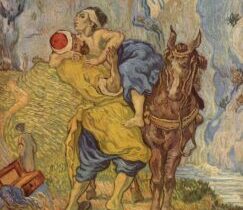
Jesus told a story. There was a man who was traveling from Jerusalem down to Jericho. This was a mountainous area, with lots of bandits along the way. He was attacked, beaten, robbed, and left half-dead beside the road.

Two men passed by the wounded traveler, but moved to the opposite side of the road as they walked by him. Neither stopped. One was a priest, the other a Levite.

(Time out of the story for a bit of explanation. Priests were descendants of Aaron, brother of Moses, who offered sacrifice in the temple. They were subject to strict rules of purity and behavior because they entered the most holy places. Levites were members of the tribe of Levi, descendants of the third son of Jacob and Leah. Levites assisted with services and worship at the temple, but were not priests. They filled roles that we would call musicians, song-leaders, acolytes, lectors, greeters, administrators, guards/guides, artists, designers, and so forth. They were held to higher standards of purity in obedience to the Law, but not as high as those for priests.)

So a priest and a Levite passed the man. The story doesn’t say whether they were on the way to Jerusalem or on the way back, but it really didn’t matter to Jesus. The point was that they were people who had higher than average position and responsibility in society and in worship, and they did not stop to help.

Another traveler came along the road. This person was from Samaria. Samaritans were hated by Jews. They were descended from some of the people who had been left behind during the Babylonian exile. Their land had been conquered earlier and the survivors had adapted their religious beliefs and practices to include some of what came from the conquerors. They worshiped on mountaintops rather than in Jerusalem. Folks traveling between Judea in the south and Galilee in the north tried to go around Samaria or spend as little time as possible there. These were not folks one would expect to find as heroes in a story told by a good Jew.

Yet this is exactly the person Jesus presents as the hero of the story. The Samaritan sees the injured man and takes pity on him. He gives first aid, loads him on his own donkey, and takes him to an inn. He cares for him there overnight, then leaves money for the innkeeper to continue caring for him, with a promise to reimburse any additional costs as he (the Samaritan) returns along the way.

Jesus asks a simple question, “Which one of these three … was neighbor to the robbers’ victim?” The answer is clear – the Samaritan who was merciful. Jesus agrees and adds, “Go and do likewise.”

The command of the Law was closer to the heart of the Samaritan in this case than to the other two travelers. Care for the one in need of help, whoever that is, trumps ritual purity and practice or other societal norms.

Would it be closer for you or me? Hmmm.

How can all of this be possible?

A hymn from the early church, shared by St. Paul in his letter to the Colossians, gives a hint of how this can be possible. (Col 1:15-20) “Christ Jesus is the image of the invisible God, the firstborn of all creation.” All things were created through him and for him, even the great principalities and powers of the spirit world. Everything is held together because of him. He’s the head of the church, his body. The fullness (God) dwelt in him, the human man, and reconciled all things through him. Peace between God and creation was achieved through Jesus’ sacrifice on the cross.

We are the body of Christ. We, the human members of the community. Jesus lives in us and we in and through him. Because of this, we have a real chance of living the law of love that he taught. The law that Moses says is “something very near to you” and Jesus presents as the foundation of loving a neighbor as ourselves.

Is living the law of love always easy? No. Is it always the popular thing to do? No. Is it always totally clear how to live? Not always, but there are hints if we keep our eyes and hearts open. Do our cultures and societies make this very easy? Not really. It’s much easier to love those who are like ourselves and with whom we share experiences, language, and culture. Do we have to love other folks anyway, even if we don’t like what we see? Yes. Can it just be an intellectual, “My heart goes out to you?” No. It must be practical.

“Go and do likewise.” “It is something very near to you … you have only to carry it out.”

Lord, help me to listen to your voice speaking through my heart. Help us to come together in loving service.

Read More

Posted by on Mar 13, 2022

Seeing the Glory of God – Deeper than at First Glance

Seeing the Glory of God – Deeper than at First Glance

A couple of years ago, a painting came home from school. It was a watercolor, folded in half, then in half again, and then yet again, until only 1/8 of the picture showed. The young artist was not happy with it and didn’t want even to talk about it. I looked at it and found it puzzling. There were blues and whites, with maybe a bit of yellow.   The colors had clearly run more than the artist had hoped. It looked like salt had been sprinkled on parts of the painting, resulting in irregular starburst-type shapes. There was a bit of red, some very light and some more streaked.

I didn’t understand what the picture was supposed to represent and he wouldn’t tell me. It was totally unclear to me which end was even supposed to be up! I put it on the side table with other things from school. There it lay for at least a week, probably longer, and I was still no closer to recognizing its theme.

I picked it up and turned it around once or twice to see if that made more sense. It still didn’t identify itself.


Finally, one day in early spring, I turned it one more time. And the image jumped out at me. My eyes, in a sense, had been opened to see its subject and its beauty. It was a snowman! I wondered how I could have not seen it all the other times I looked at it. It was so clear when my eyes looked at it from the right perspective.

It now proudly adorns our freezer.

The readings for the Second Sunday of Lent remind me of this experience with the snowman. In the first reading Abram and God have been talking. (Gn 15:5-12, 17-18) God has told Abram that he will have many descendants, even though both he and his wife are old and she has been unable to have children. Then God also promised that Abram’s descendants would possess the land into which they had traveled, following the Lord’s instructions. Abram and his extended family were not a lot of people. He questioned how they would ever possess a land belonging to so many other peoples.

There was a tradition among the peoples of the time to make covenants (legal agreements) in very visual ways. Animals were taken and sacrificed. The bodies were split in two and laid across from each other, making a pathway between them. Then the parties to the covenant would walk through the pathway. In this way they pledged that if they broke the covenant, the same thing might be done to them. It was not something to be taken lightly.

The Lord God told Abram to bring five animals – a heifer, a she-goat, a ram, a turtle dove, and a pigeon – and sacrifice them. He was to place their carcasses in such as way as to create the ritual pathway. As the sun set, Abram entered into a deep trance and saw the Lord, represented by a fire pot and flaming torch, pass through, entering into the pathway between the sacrificed animals. In this way, the Lord pledged himself to a covenant with Abram and his descendants. Abram did not have to pass through the pathway for the covenant to be established. Only the Lord passed through. The land from Egypt to Mesopotamia (current Iraq) was to belong to the descendants of Abram. (Today these lands are still peopled by his descendants – both Arabs and Jews.)

Abram saw the glory of the Lord that night, entering into a sacred covenant.

The psalmist sings today of the deep presence of the Lord. “The Lord is my light and my salvation.” (Ps 27:1, 7-8, 8-9, 13-14) Don’t hide from me, but hear the sound of my call. The Lord is a refuge, so there’s nothing to fear. “I shall see the bounty of the Lord in the land of the living…” All is focused on the presence and light of the Lord. All wait to see that goodness.

St. Paul writes to the community at Philippi (Ph 3:17-4:1) to encourage them to continue living in the way he taught them when he was with them in person. Controversies regarding whether it was necessary for Gentiles to become Jews in order to be Christians had reached them as well. Paul reassures them that all that is necessary is to believe and live in faith as they have first learned from him. As Christians, their citizenship, their loyalty, is in heaven. As such, all hope is in the saving power of Jesus, who will change our earthly bodies into heavenly, glorified ones, bringing all things to himself. At this point in time, all that is needed is to stand firm in faith and live as his followers.

The final reading, from St. Luke, tells of a very special experience of seeing. (Lk 9:28b-36)

Jesus went up on a mountain to pray. He took Peter, James, and John with him. As he prayed, his appearance changed, becoming filled with dazzling brightness. He was speaking with Moses (representing the Law and covenant) and Elijah (representing the prophets) when his friends woke up. They had fallen asleep as he was praying. They saw the glory that enveloped Jesus as he spoke with Moses and Elijah. Peter, ever the practical and impulsive one, offered to put up three tents, one each for Jesus, Moses, and Elijah. As he spoke, a cloud appeared and a voice spoke from the cloud. “This is my chosen Son; listen to him.” Then the vision passed and Jesus was there alone. As they went back down the mountain, they were silent.

What was there to say? Who would ever believe it? Did they even see it? Imagine if you were witness to this kind of transformation of someone you thought you knew! You too might be at a loss for words or uncertain whether anyone would ever believe your words if you spoke of it.

We call this experience of Jesus the Transfiguration. A transfiguration is a complete change of form or appearance from the ordinary to something quite beautiful and extraordinary. In many ways, it’s a question of what is seen. On certain days, or in certain lights, or under certain conditions, we perceive quite ordinary things differently. Somewhat like the painting of the snowman.

How does Jesus’ transfiguration speak to me today? How does it speak to you? What wonderful things are there in life that are just waiting for me to see in all their splendor? Where does the glory of God peek through into my days and my world? How about yours?

May our eyes be opened today to see deeper than first glance – to see the glory of God present in our world.

Readings for the Second Sunday of Lent – Cycle C

Here’s an activity you can do with children to celebrate the Transfiguration.

Read More

Posted by on Jan 2, 2022

Epiphany – The Glory of the Lord is Revealed

Epiphany – The Glory of the Lord is Revealed

The Solemnity of the Epiphany of the Lord was traditionally celebrated on January 6. However, since 1969, we have celebrated this feast on the Sunday following the celebration of Mary, Mother of God. This celebration is part of the Christmas season, which officially ends with the Baptism of the Lord on the Sunday after January 6.

The word Epiphany tells us what the celebration is all about. Epiphany means manifestation or appearance, particularly of a deity. It also refers to a sudden realization. The reading from St. Matthew’s Gospel (2:1-12) tells of the visit of wise men, astronomers and astrologers from the east, who saw a star rising in the heavens signaling the birth of a king in the land of Judah. These men traveled to the capital city and asked about the birth of the child who would be King of the Jews. Herod was not thrilled to hear of a potential rival. He found out where such a child might have been born and instructed the wise men to go to Bethlehem in search of the child, then return with the information to him. He planned to have the child killed, to eliminate his rival.

The wise men found Jesus and his family. They offered gifts of gold, frankincense, and myrrh, then returned to their own land by a different way, having been warned in a dream not to return to Herod. Joseph was also warned of Herod’s plan in a dream. He took the family and fled to Egypt until after Herod’s death, but that part of the story is not part of today’s reading.

These were the first non-Jews, the first Gentiles, who learned of the coming of Jesus. It was an Epiphany.

St. Paul speaks of this great news in his letter to the Ephesians (3:2-3a, 5-6). He proclaims that God has revealed to him an amazing mystery which had been unknown to those of earlier generations – The Gentiles are members of the same body and promise in Christ Jesus. The Good News proclaimed by Jesus was not just for Jews. It was for all people. Salvation has come for all. Another epiphany!

The light of Jerusalem has come and the glory of the Lord shines forth. Just as Isaiah (60:1-6) wrote to the exiles returning from Babylon, the Lord shines on his people. Sons and daughters return from afar. The riches of the sea are emptied out for all and the wealth of nations comes to Jerusalem, to God’s people. It is a time of great rejoicing. Out of a time of darkness, the Lord’s light has shone forth – an epiphany.

What does all of this mean for us? As we remember and rejoice in the coming of the wise men in search of the Lord, revealing the promise of salvation to all the world, may we too be open to the ways God’s presence is seen in cultures and peoples around the world, particularly those on the margins of society.

We hope and pray for the gift of openness to the rising of new generations of leaders as we get older. Can we rejoice in the wisdom and insights that come from our children and grandchildren as they experience life in a world very different from the one in which we grew to adulthood? Or will we be like Herod, clinging to power and fearful of the future?

Will we share the many blessings we have received with those who need a hand to meet the daily necessities of life? What gifts of gold, frankincense, and myrrh do we have to offer? The gold of respect and encouragement? The incense of loving support and prayerful accompaniment? The myrrh of compassion and understanding during difficult times?

The Lord has come. The wise ones traveled far in search for him and they found him. Now it’s our turn to look for him in the days and weeks to come. Where will we find him?

Read More

Posted by on Oct 24, 2021

Seeing Hope as Darkness Surrounds Us

Seeing Hope as Darkness Surrounds Us

Have you ever seen a snail’s tongue? They are very tiny. How do I know? I saw one last night, as a very small snail made its way across the glass of the aquarium in which it lives. Its job is to keep the glass free of algae. That’s a big task for a very small creature, but this snail was moving along, bit by bit, licking the glass clean. My sister-in-law and I watched it moving and she noticed the tiny little tongue darting in and out, cleaning the glass. The light was just right and we could see the tracks of where it had already cleaned, in lovely curves, with space between them where the snail was holding on with its great foot.

The snail spoke to me of the gift of hope in the face of what might otherwise seem like a hopeless task or future.

The readings for the Thirtieth Sunday in Ordinary Time are instructional in this regard. We begin with the prophet, Jeremiah (Jer 31:7-9). The people are still being taken into exile, nearing the final end of the kingdom of Judah in northern Palestine. They are facing the possible extinction of their nation and historical line. Yet Jeremiah proclaims, “Shout with joy for Jacob, exult at the head of the nations, proclaim your praise and say: The Lord has delivered his people, the remnant of Israel.” All seems lost, but the prophet speaks the Lord’s promise that they will be gathered from among the nations and return as a newly recreated people. They themselves can never do that alone, but the Lord will do it. The new kingdom is beginning to be understood as something more than a nation-state with a king. It’s to be much greater because not limited to control of territory on land by an individual ruler and family.

They will return on level ground, rest beside brooks of water, and know that their father is the Lord. The reference to Ephraim is also noteworthy. Ephraim was the second son of Joseph, making him a grandson of Jacob. But Ephraim’s mother was Egyptian. She was not one of the relatives of Jacob or a descendant of Abraham and Sarah. Yet he and his brother, Manasseh, were accepted into the family as adopted sons of Jacob. Their descendants became the fathers of two of the twelve tribes of Israel. When Jacob was nearing the end of his life, he gave the blessing due the firstborn of sibling sons to Ephraim, though Mannaseh was actually the older son. Jacob assured Joseph, who noticed what was happening, that he knew what he was doing, that selecting Ephraim for the firstborn’s blessing was the right thing to do. The children of Ephraim became a large tribe in the far north of Palestine. It was these people who were being taken into exile.

Now, we hear the Lord saying, through his prophet Jeremiah, that Ephraim is also the first-born son of the Lord. All will be new in relationships and in creation through the Lord’s actions. Good news of hope for those being driven from their homes and into exile in the lands of their enemies.

The Psalm speaks of the return from exile (Ps 126:1-6). “When the Lord brought back the captives of Zion, we were like men dreaming … our mouth was filled with laughter and our tongue with rejoicing.” The long period of suffering had passed. The Lord had kept the promise made so long ago. “We are filled with joy.”

In the letter to the Hebrews (Heb 5:1-6), the author speaks again of the high priest and his role. Historically the high priest was selected from among his peers, selected by God, just as Aaron had been selected to make the sacrifice of atonement for all the people so many generations earlier. But this time things have changed, we have a new high priest, also selected by God. This new high priest is the Christ. He did not select himself. When Jesus died, he was truly dead as a human being. But God glorified him, saying, “You are my son: this day I have begotten you … You are a priest forever according to the order of Melchizedek.”

Melchizedek was King of Salem and a priest who lived in the time of Abram, long before the Jewish priesthood was established among the Israelites after the Exodus. He was known as a wise, righteous, and kingly man. Jesus, the new high priest, takes this role, now and forever, chosen by God for this role because he is the Son of God. He knows both the difficulties of being human and the mercy and patience of God, so he is the best intercessor humanity could ever have.

The healing of Bartimaeus is the final event in Jesus’ life before he enters Jerusalem on his final journey there for the Passover. This section of Mark’s gospel began with the healing of a blind man in Bethsaida, on the north shore of the Sea of Galilee. Now Jesus is near Jericho, just north of the Dead Sea and next to the Jordan River. It has been a long and eventful journey, and  finally they are nearing their destination.

Bartimaeus (whose name means Son of Timaeus as Mark informs us) is sitting beside the roadside begging. He hears the crowd going by, learns that it is Jesus, and calls out to Jesus for pity. “Son of David, have pity on me. (Son of David was a title given to the expected Messiah, because the Messiah was to come from among the descendants of King David.)

Those around Bartimaeus try to silence him. But Jesus hears him and calls Bartimaeus to him. “What do you want me to do for you?” Bartimaeus comes quickly and responds immediately, “Master, I want to see.” Jesus heals his blindness, saying “Go your way; your faith has saved you.” His sight was returned immediately and rather than going home, he began to follow Jesus “on the way.”

This story comes at the end of a series of stories we have heard over the past weeks, in which Jesus has tried to let his friends know that he is not a conquering Messiah but rather the one described by Isaiah who is the Suffering Servant. His followers have not been able to see what he has been telling them. It just simply makes no sense. They are still more blind than Bartimaeus or the man healed in Bethsaida.

Mark tells us that Bartimaeus followed Jesus “on the way.” The way is not just the road to Jerusalem. After the Resurrection, Jesus’ followers were known as followers of “the way.” It was not until later that they came to be known as Christians (oil heads). Bartimaeus followed “the way” immediately after he was healed. His faith had saved him.

What are the areas of blindness in my life? Where do I lack hope? What feels like it’s crashing in my life? Where are the signs of hope? How do I hold on to the promises of God? Can I just keep doing what I’m supposed to do each day, like the little snail that makes her way around the aquarium, licking clean the glass? I pray for that gift today.

Read More

Posted by on Jul 7, 2021

God Calls “Ordinary” People

God Calls “Ordinary” People

The readings for the Fourteenth Sunday of Ordinary Time speak to us of the experiences of three “ordinary” people. These three men were seen by their families and communities as just regular folks. No one expected them to be any different than the rest of their group. They would grow up, have a trade or role in the community, marry, have children, grow old, and die – just like everyone else!

But that was not to be. God had different plans for them. Blessedly, these men listened and responded to the call they received.

Ezekiel

Ezekiel (Ez 2:2-5) lived at a time when Israel was conquered by the Babylonians – a people who lived to the east in an area we now know as Iraq. He was a priest in Jerusalem and was captured early in the war. He was taken to Babylonia and no one would have expected anything good to come of that. Yet that misfortune was the start of something special. In Babylonia, the Spirit came to Ezekiel, setting him on his feet and sending him on a mission. The mission? To tell the people of Israel in exile there that God was still their God, despite their refusal while still in Israel to live by the ancient covenant and rules of their faith. He was to speak using very specific language, “Thus says the Lord God!” These words identified him as a prophet – one who spoke the word of God.

A prophet in the Bible is not one who foretells the future. The prophet is the one who speaks the word received from God. Typically, that word proclaimed by the prophet is not one the people want to hear. It calls them back to a life that might seem to be more restricted and controlled. Often the prophet meets great resistance. But for those communities who respond and obey the word proclaimed by the prophet, it can become a life leading to inner peace and to justice in the community and among the nations.

The Psalmist

Does this mean all is well for the prophet or for those who try to follow the Lord’s call? Not at all. The psalmist speaks  in Psalm 123 for those who have had their fill of the mockery and contempt heaped on them by people who have rejected the Lord’s ways. “Have pity on us, O Lord, have pity on us.” Show us your mercy and end this suffering! Enough already!

Saul of Tarsus – Paul

The second ordinary man is Saul of Tarsus. Saul was originally trained as a tent maker, but he had studied the Law and was a teacher in Jerusalem. He sincerely believed the followers of Jesus were unfaithful to their Jewish roots and traditions. They were the kind of folks who got everyone else in trouble – the kind of trouble that led to them being conquered by neighboring nations. Saul set out to arrest Jesus’ followers and root out this dangerous group. But Jesus met him on the road to Damascus and called him personally to go out and tell the world the good news of the Resurrection and the Kingdom of God.

Saul, now known by his Latin name as Paul, set out to do just that. He traveled all over the Middle East and Greece. Eventually he ended up in Rome and died as a martyr there. His letters are some of the first documents we have from the early Church, earlier even than the Gospels.

In today’s reading from his second letter to the people of Corinth (2 Cor 12:7-10), Paul speaks of his weakness. He has received a tremendous gift in the experience of his calling, but he is still an ordinary guy. He battles physical and spiritual weaknesses just like everyone else does. He has asked to be relieved of these weaknesses, but that is not how grace works. The Lord’s gift of life and love works through the weakness of those who witness to him. Paul declares to the people of Corinth and to us, “When I am weak, then I am strong.” The same deal applies to us.

Jesus of Nazareth

Finally, we hear what happened when Jesus went home to Nazareth (Mk 6:1-6). He has had a tremendous experience of being called at his baptism in the Jordan River and the time in the desert. He has seen people healed of physical and psychological ailments at his touch. Yet when he goes home to his family and religious community, no one is willing to believe he should have anything to say to them. He is not a trained, certified religious teacher. He is a carpenter and the son of a carpenter. An “everyday Joe.”

In response, Jesus quotes a traditional saying: “A prophet is not without honor except in his native place and among his own kin and in his own house.” He was unable to work wonders or heal people at home, because they were not open to receive the gift he had to offer.

Prophets in our midst?

We look back on these men and their experience. How easy it would be to say, “I would never do that to a prophet that came to me!” Yet it is all too easy to overlook the gifts of those we love – the ordinary people who come to us with a word or insight that might well help us on our way to holiness.

Let’s pray today that we be open to the prophets in our midst. The ordinary folks who speak God’s word to us.

Photo: Michael and Marjorie Brewer – Two ordinary people of faith

Read More

Posted by on Jun 27, 2021

“God did not make death…”

“God did not make death…”

“God did not make death, nor does he rejoice in the destruction of the living.” The readings for the Thirteenth Sunday of Ordinary Time begin with this surprising statement from the book of Wisdom (Wis 1:13). Furthermore, the world and its creatures are “wholesome” and justice (God’s design of the right order of things) “is undying.” Physical death is merely the result of the envy of the devil, not something that can stop God’s gift of life.

The Lord rescues his faithful ones, brings them up from the netherworld, changes mourning into dancing. We respond by giving thanks, in the words of the psalmist (Psalm 30).

St. Paul asks the community at Corinth and us as well, to share what we have with those in need. We the community respond to the gift of our Lord by sharing what we have received, just as Jesus, the Word of God, entered into our human experience and shared fully in it. As was the case of the Israelites in the desert, those who have much aren’t to have more than their share and those who have only a little ought not to end up with less than their fair share of the manna (or other gifts) needed for life.

Finally, St. Mark tells of two healings. Jairus, an official from the synagogue, asks Jesus to heal his child. Jesus goes immediately with him.

On the way to the child, in the hustle and bustle of the crowd, a woman who has suffered with a hemorrhage for twelve years touches his cloak. She is hoping for healing. Immediately power goes from him and she is healed. Jesus notices this and asks who touched him. The others are amazed. In such a crowd, lots of people were touching and bumping into him. But the woman comes to him, in great fear because she has broken several rules by touching him, and confesses what she has done. Jesus does not scold her. Instead, he tells her that her faith has saved her and that she may go in peace, cured of her affliction.

Jesus then continues to the home of Jairus, where the child now has died before Jesus reaches her. Yet Jesus takes her hand and tells her to get up. The original Greek words distinguish between what Jesus said and what she did. Our English version uses the same word, arise, for both what Jesus told the girl to do and her rising from death. But in the original, Jesus said she should “get up” and the child “arose,” the same term used to describe Jesus’ own Resurrection.

These readings speak of the great hope we share as Christians. It’s particularly relevant for me just now, as I have had to say goodbye to both my mother and father in these past 5 weeks. I find myself remembering another time when both loss and hope were very present in my life.

Birth and Death – Somewhat similar transitions

Almost 40 years ago, when I was pregnant with my second child, my grandfather passed away in December and my father-in-law (who was only one year younger than my grandfather) in January was dying as well. He had cancer and it was a slower, more painful process than my grandfather’s passing. I asked God why death had to be so hard. The response surprised me. I was reminded that birth is not easy, either for the mother or for the child. The child is happy and at peace in the womb. Every need is met, even those unrecognized. Nothing has to be done. It’s warm, peaceful, pleasant. It might be getting a bit tight, but it’s still possible to stretch and move around. Who would want to get squeezed and pushed and forced through a narrow opening into a bright, cold, and unknown world! Yet that is what must happen for life to continue. And, oh what a gift life here on Earth is or can be for us. I don’t think there are very many of us who would willingly return to the womb after tasting the joys of life outside.

Death is not an end, it’s a new birth into a life of even greater beauty and freedom. Our bodies wear out and we move on to new ones. Sometimes it happens after a long life. Sometimes things happen that make it impossible for our bodies to work anymore, and we move on. But, hard as it is for those of us who remain, life continues. We rise to a new way of living. The limitations of our aging or injured bodies are removed and we share in the life of love of our loving parent in the great dance of life.

“God did not make death, nor does he rejoice in the destruction of the living…”

We hold on to this promise.

Read More