Pages Menu
RssFacebook
Categories Menu

Posted by on May 24, 2008

Corpus Christi: The Body of Christ

Corpus Christi: The Body of Christ

Stephen’s bright blue eyes smiled as we said, “Lamb of God, Give us Peace.” According to the rubrics we were now to show each other a sign of peace. Yet with Stephen’s attention deficit disorder, which had already taken him in and out the brief service at least twice, it seemed that a little catechesis might help him be a little more aware of what we were about to do. Stephen is not a little boy. He is a handsome man in his early 30s, with a number of tattoos poking out of the v-neck and short sleeves of his starched jail issued smock.

The readings had been those of Pentecost. The second reading was from First Corinthians 12. “No one can say Jesus is Lord except by the power of the Holy Spirit.” This had struck all four of the men, but had made a special impression on Stephen. “Does that mean that when I pray the Holy Spirit moves my heart?” Stephen had asked. When I answered “Yes” his eyes got wide and he said that since his attention came and went and his thoughts were often jumbled, he thought his prayers were more bothersome and must be irritating. The notion that he is a temple of the Holy Spirit was as novel to him as it was consoling.

Stephen was back now and I shared a few words on the Lamb of God, recounting the Last Supper and the passion, death, and resurrection of the Lord. We do this in His memory as He requested of us. We are invited to the Lord’s table. Stephen and his companions were not new to the faith, but this brief memorial of our Great Memorial brought a renewed awareness to the others and a slack jaw from Stephen. He did not doubt, but could not help but marvel at the wonder of it.

As we shared the wonder of the Blessed Sacrament, our communion was truly a sharing in the Body and Blood of Christ. Bread blessed and broken at the Eucharist, celebrated in the parish, given to all, shared with all, and sent to those in need and to those in prison. The Body of Christ – Corpus Christi – saving us all from our prison of loneliness, our hunger for love, and admitting us to the feast of heaven here and now.

Read More

Posted by on May 20, 2008

Corpus Christi: The Body of Christ

Celebrating the Trinity

Trinity by Andrei Rublev (ca 1410-1420)

The first Sunday after Pentecost is celebrated as Trinity Sunday. God is Father, Son, and Holy Spirit, yet one God. The Trinity is a reality over which Christians have puzzled for centuries. Jesus spoke of His Father. He stated that He and the Father were One. He promised to send their Holy Spirit. But what did it all mean?

We speak of the dogma of the Trinity as being a mystery. The use of the word mystery can be problematic. It can imply that if we just focus our attention and uncover the right clues, we can solve the mystery and get to its core. After all, that’s the way it works in detective novels and television shows! But that’s not the kind of mystery we’ve got in the Trinity. The reality of God is so much more than we can ever imagine, let alone comprehend, that the best we can do is look for threads that give us a small sense of the dimensions and reality of the whole.

Fr. Richard Rohr, OFM and the late Fr. John O’Donohue have both gifted us with meditative reflections on the Trinity in recent years. They speak of the Trinity in terms of rhythms and flow and surpise. Richard Rohr speaks of a “family resemblance” between the Trinity and all of creation, from the depths of the atom to the furthest extent of the universe, there is a similarity of pattern. All are in movement, all are in relationship to each other, the power is in the “in between.” Life is in the movement, the flow.

Fr. Rohr notes that the Greek Fathers of the Church described the Trinity as a relationship of perichoresisa mutual interpenetration and indwelling. He explains that perichoresis can be translated as dance. God is the dance and we come to know God only from within the dance of the Trinity. As long as we remain open and allow ourselves to be pulled into the flow of mutuality, to the perfect giving and perfect receiving that is the life of God, we will experience the communion, intimacy and relationship characteristic of God’s life. Anything that stops the flow of loving – anger, resentment, judgement – cannot be part of who God is. To the extent that we harbor those blocks to love, we block the flow of God’s life/love in ourselves.

John O’Donohue, in a workshop for the Religious Education Congress of the Archdiocese of Los Angeles in 2005, also spoke of the Trinity in terms of rhythm and flow, touching on many of the same themes described above. A poet and storyteller, he looks at the mystery of the Trinity through poetic images – the flow of a river, a dream of the divine, dance, music, between-ness. He speaks of God as the “secret music of the heart and the universe… the primal music and dance of all that is.”

We most often experience the world in terms of dualities such as inside/outside, masculine/feminine, divine/human, light/dark and so forth. Yet O’Donohue points out that in reality we actually find ourselves at the threshold between those dualities most of the time. It’s a threshold that must be permeable if we and our relationships are to be healthy, so that the qualities of each side of the duality can pass between, refreshing, supporting and enlivening the other. As he points out, there’s the one side, the other side and the place in between. For O’Dononue, the place in between is where we find the Holy Spirit, holding “all the between-ness together.”

The insights of these two men are well worth hearing and pondering. There’s far more to what each has said than can be described in a short blog post. But the depth of the wisdom they bring resonates with the insights of the mystics from all the ages. As John O’Donohue notes, “Once you get a taste of God, nothing else tastes the same.” And again, “That’s what it’s about – coming fully alive to the dream of the Divine within you.”

May the dream of the Divine resonate within you and lead you ever more deeply into the life of the Trinity.


Read More

Posted by on May 15, 2008

Corpus Christi: The Body of Christ

Living in the Time of the Holy Spirit

Sunday we celebrated the Feast of Pentecost and the fulfillment of Jesus’ promise to send the Holy Spirit to His followers. Now we enter into a time called “Ordinary Time” — a name which suggests that nothing special is going on and nothing special is to be expected. That perception couldn’t be farther from the truth!

Ordinary Time is the time of the Holy Spirit in the Church. It’s a time for learning, growing, sharing, reaching out to each other and the world. It’s also a time for entering ever more deeply into the life of the Trinity, a reality we’ll celebrate this coming Sunday.

How do we recognize the coming of the Spirit? I’ve been reflecting on the symbols we use for the Spirit and the words of the songs we pray at this season of our liturgical year. There’s the dove, a symbol for gentleness and peace. The Spirit came upon Jesus like a dove when He was baptized (Jn 1:32). Then there are the mighty wind and tongues as of fire that marked the coming of the Spirit to those gathered in the Upper Room (Acts 2:2-3). In the Old Testament, the Lord came to Elijah in a gentle breeze as he waited by a cave on the mountainside (1 Kgs 19:12-13).

Each of those images tells us something important about the Spirit and what the coming of the Spirit into our lives might mean. The idea that the Lord doesn’t come in the form of earthquakes, wind storms, or the raging of nature is important. Destruction is not a characteristic result of the coming of our God. Peace and the time to live, breathe and grow are. And in times of destruction, God comes through the caring hands and presence of those who try to help alleviate the pain and suffering.

The dove is a bird that we associate with gentleness and a soft cooing call. I loved waking up to the sound of doves cooing when I was a child and visited my grandparents who lived in a warmer community, where there were doves. The dove is often a symbol of love and peace.

But then again, at Pentecost there’s wind and fire… Living in California, we’re very much aware of the power of wind and fire. In forested areas, as well as in the hills covered by chaparral (the native vegetation), fire can sweep across the land, driven by winds it creates itself, leaving a swath of seeming destruction behind it. Those who live outside of the cities and towns must be constantly vigilant to keep the underbrush back away from their homes, so there’s a chance of saving the home in a wild fire.

How does fire fit into the whole peace and love scene we associate with the Holy Spirit? The image of a forest full of brush, or the overgrown chaparral on the California hills gives a clue. Brush in a forest can become so dense that it begins to choke the life of the other plants and the animals living there. A healthy forest is one that is cleared out regularly. Nature does this with fire. The chaparral even has plants that ignite spontaneously when the temperature reaches a certain point. The whole area burns off and then new plants can grow. There are plants that depend on fire in order for new seedlings to sprout — in forests and in chaparral.

In a very real way, each of us needs cleansing fire sometimes too.  It’s not fun, but it clears the way for new growth and wondrous surprises.

Then there’s the other side of fire — the creative side. We speak of people being “fired by love” or “going like a house afire” into a new project or calling. Fire is powerful. Fire gives energy. Fire brings light. The Holy Spirit’s coming is to “light a fire” under each of us — to get us going as Christ’s body here on Earth. Hands, feet, voices, arms, legs, minds, hearts.

We sing, “Come, Lord Jesus, send us your Spirit, renew the face of the Earth.” And the Lord grants our request. The Spirit comes. And with the help and fire of the Spirit, we move forward to bring new life, to renew the face of the world around us – in our homes, our worksites, our communities, our world.

Read More

Posted by on May 5, 2008

Corpus Christi: The Body of Christ

Ascension Blahs

water_ripple.JPG

There is only so much joy and sunshine the soul can take. There is a rhythmic moodiness to California’s central coast. Unlike the interior valleys and the Sierra, which have more constant moods in concert with the sun and stars, the ribbon world on the sands and coastal planes changes from delight to gloom overnight — or sometimes within the hour. On our street, the fog, known by its more fluffy image as “the marine layer,” sometimes tiptoes and sometimes billows through the cypresses on Lighthouse Field and blots out the sun, roiling half way down the block before stopping on a whim in an evanescent whirl.

The Resurrection blossoms and the fulgent greens are quickly muted in the filtered gray light of the salty chill. The natives, loath to give up their flip flops and shorts, shiver in their sweatshirts as they pull their hoods over their brows to the bridge of their sunglasses.

So where has the Son gone? Why do we stand here looking up in the chill? Who turned off the party? Just when we found Him, they took him away again. No that would have been easier. It would be renewed grief. He said that it was time for Him to return to the Father and that He would send the Advocate who would teach us all the things that He still had for us to learn. Left behind … our consolation turned to desolation.

… And what to do? According to Father Ignatius, it is time to discern, to prepare for the movements of the soul that eddy from the Paraclete, that ripple from the heart, and echo in the fountain drops of the barely conscious. What now? Be still and know that I am the Lord.

Read More

Posted by on Apr 6, 2008

Corpus Christi: The Body of Christ

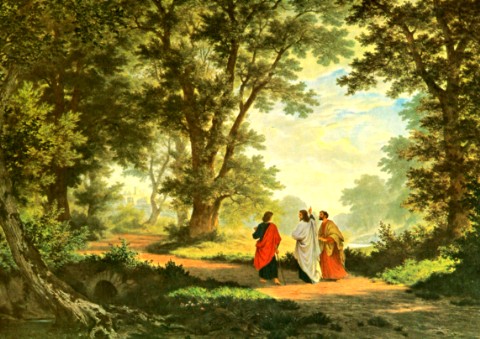
The Encounter at Emmaus

emmaus.jpg

I have been struck by the stories this Resurrection Season because for the first time, they strike me not as eye witness accounts of the Risen Christ, but as the challenge of faith for the disciples and us. The disciples on the way to Emmaus are leaving Jerusalem – returning home, perhaps, – grief stricken, but more importantly, disillusioned. The teacher has failed. The forces of evil have destroyed a very good and wonderful young man.

One way to see this story is to take it as another proof of the Risen Christ as encountered by his disciples. The story does convey this message. However, the story also tells us that we find the Risen Christ when He opens our minds to see the scriptures and when our hearts are opened at the Breaking of the Bread. Look for Him in the scriptures and invite Him in to dinner and your hospitality will be more than repaid.

There is just a glimpse – a flash of recognition and he disappears from our midst. The presence of the Risen Christ is a momentary and ongoing discovery. It is the result of searching, wandering, questing in grief and disillusionment and being open to the challenge of the Stranger.

All of us have moments, years, decades, in which everything we knew and had hoped for is swept away. The disciples had no clue of what was to become of their beloved teacher, but his torture and death threw them into utter grief and confusion. Yet their confusion only increased when they heard that other disciples had found the empty tomb and seen the angels. They were re-grouping, leaving town, trying to get some distance. A Stranger notices their grief and inquires. They listen and reflect on the scriptures and Break Bread.

This is the Christian life – the quest and the encounter in the village of Emmaus – continuing through all generations.

Read More

Posted by on Mar 31, 2008

Corpus Christi: The Body of Christ

Religious Environmentalism – Gottlieb: A Greener Faith

Mt. Fuji

Japan’s Mt. Fuji presents a beautiful backdrop for Tokyo, home to more than 32 million people. The last major eruption of this perfectly symmetrical stratovolcano came in 1707. Image from the Shuttle Radar Topography Mission.

The coming of Spring and all things green, including Earth Day, is a good time to read Roger S. Gottlieb’s book, “A Greener Faith.” Megan Jones, of the Department of History at the University of Delaware, has published a very good review on H-Net Catholic Discussion Network on the history and culture of Catholicism.

Gottlieb’s vision of religion takes in all of the major world religions and all indigenous or native expressions. For someone like myself, who studied environmental biology and social ethics in the 1970’s, it’s deja vu all over again. What strikes me as a card carrying anthropologist, though, is the assumption that since religion reflects culture and society, thinkers and practitioners of religion, from the New Age suburban shaman to the Archbishop, should embrace environmentalism as a way to validate religious experience in the face of the current atheistic onslaught from Dawkins et al.

On the one hand, there is the Christian notion of watching the signs of the times and the injunction to witness to justice. As Gottlieb observes, religion can bring hope to what seems to be a hopeless situation. However, I cannot help but resist the notion of “using” religion, of whatever stripe. As a universal anthropological phenomenon, religion closely mirrors the current situation of its social context. Re-interpreting religious texts and folk traditions does occur at times of crisis – in ways that are in keeping with the group’s social construction of reality.

What gives me pause are the laws of unintended consequences which I have seen first hand as a public health planner. Encouraging people to explore the environmental challenge is a social imperative. However, adopting a public policy agenda draped in the folds of religion appears to play into the criticism that religion is at base a tool of social control, without any transnatural referent that is not delusional.

So… Lead us not into religious environmentalism and deliver us from the temptations of the moment.

Read More

Posted by on Mar 26, 2008

Corpus Christi: The Body of Christ

St. Mary at Easter Tide

rejoice-monica-stewart.jpg

The Blessed Virgin Mary has many beautiful titles. St. Mary at Easter Tide is my very own. Scripture is very silent about the Mother of Jesus after the Resurrection. We know that she is present in the upper room when the Spirit comes upon the Apostles at Pentecost. At the Annunciation, the Angel Gabriel tells her nothing about her future, except that her Son will be destined for the rise and fall of many in Israel. Mary’s first post-partum visit to the Temple portends a life of sorrow. According to Simeon, a sword will pierce her heart seven times. This most beloved young woman is left to ponder these things in her heart.

There are many good years together, until He leaves to find his cousin John at the Jordan. Then things go from bad to worse. Her friends and neighbors toss Him out of Nazareth. Jesus dies a horrible death; His mission a failure; her maiden’s vision becomes a bitter delusion. In his final words, Jesus entrusts St. John and Mary to each other – a final testament that seals the depth of grief.

There is no record of how Mary hears the news; of how she reacts. Who tells her? Jesus Himself? It seems that this duty falls to us. The noonday prayer echoes a wonderful joy – Regina Coeli laetare alleluia! Queen of Heaven Rejoice alleluia! … Resurexit sicut dixit! He has risen as He said (he would)!

Even though the words echo from my childhood at “Mid-century,” how well I remember and still experience the delightful childish skip in our hearts and step that we shared at Easter Tide. These are not the inspired words of the Gospel in the Hail Mary, nor the briefest of summaries of the Mystery of the Incarnation in the Angelus. For a prayer, Regina Coeli seems strangely out of character. There is no formality, no reserve. In our joy, we proclaim the Good News to the Mother of the Word Incarnate. God has turned our mourning into joy, but how could we ever begin to fathom what his news meant to the woman whose faith gave birth to us all?

Read More

Posted by on Mar 25, 2008

Corpus Christi: The Body of Christ

Easter Monday: Whale Watching With Angels

light-house-pt-santa-cruz.gif

I had read in a book way back in grammar school at Holy Cross School in Ventura, CA, in a time that is now referred to as “Mid-Century,” about boys hiking in the Alps on Easter Monday for a traditional lunch at high altitude with the angels. That custom may or may not have been true, but the thought of having lunch with the angels has always intrigued me. Perhaps, because my patron is St. Raphael the Archangel, the thought has always been somewhat appealing. After all, if you were an angel, wouldn’t you want a little break after all the hullabaloo of Holy Week?

Circumstances prevented me from wandering into the Santa Cruz mountains looking for angels to share ham and Easter eggs. The day was perfect, with a mild breeze, as I headed out across Lighthouse Field to Point Santa Cruz. The sky and the water were dazzling as I headed west up the coast along the ocean before it rounds the Point into Monterey Bay. There was excitement in the air. Whales migrating south to the Sea of Cortez around the tip of Baja California were passing by 100 to 300 feet offshore. They showed some interest in a kayak heading in the opposite direction, but continued on in graceful arcs, undulating effortlessly in the current as they coursed through the water.

It was a strange moment. The moment the houses along West Cliff, the roiling waves and sunlight all got stretched onto an impressionist canvas. I could see the brush strokes, the layering of the oil, the weave of the canvas. My neighborhood of almost 20 years became completely magical, serene, and spirit filled. I had pounded this walk many, many times before and it was always striking, even when cares and illness were heaviest on my heart, but today it was literally unreal.

Well, I guess my patron Archangel and his buddies were not waiting for me in the redwoods after all. It wasn’t the picnic with the angels that I had imagined as a boy. Whale watching with the angels on Easter Monday is something else.

Read More

Posted by on Feb 7, 2008

Corpus Christi: The Body of Christ

Christ in the Desert and the County Jail

christ-of-maryknoll.jpg

On Shrove Tuesday, while much of the world was at Mardi Gras, I was praying and sharing scripture with a small group of inmates at the county jail. Our scripture was the Temptation of Christ (Luke 4:1-19). One thing that emerged in our prayer and reflection was Christ’s acceptance of the Father’s way of rejecting power and advantage in the announcement of the Kingdom.

Why take the hard way? God could have redeemed us in many different ways. Why such a horrible death? Why did the Spirit drive Jesus into the wilderness after his baptism by John? Why was the Son of God fasting and praying for 40 days?

One of our group restated a common view that the offenses of humanity had become so severe that God demanded the most severe appeasement. I suggested that maybe the answer was in the persistence of evil in our lives. For so many of the men I was praying with, their lives had been damaged by forces beyond their control – poverty, addiction, and mental illness. (Hardened criminals generally don’t come to a prayer meeting in our jail. The faith of those who do come is something, I am sure that Jesus did not find in Israel and does not find in most respectable Christians.)

Christ, who was like us in all things but sin, chose to identify with the powerless and to put his faith in the Father through non-violence. Utter foolishness – according to St. Paul. In our suffering and defeat how could we be one with a God who was not defeated – a God who was not an utter failure? Did the Father exact this humiliation out of a some perverse pleasure unworthy of a human father?

That community of Divine love – Father, Son, Holy Spirit – Creator, Redeemer, Breath of Life come to the heart as love. Love can never be forced. True love can never come through power, glamour, or glitz. As we reflected and prayed it became more obvious to us that God can only come to us in compassion and that is how we come to him. Yet compassion is not compatible with power, wealth, and success – like a camel passing through the eye of the needle.

God with us. God like us. Powerless in love.

Read More

Posted by on Jan 20, 2008

Corpus Christi: The Body of Christ

“Behold the Lamb of God” — “I did not know him.”

flower-gift.jpg 

The “Book of Signs” in the Gospel of St. John begins with the story of John the Baptist – the Baptist’s statement of his own role in preparing the way of the Lord and his witness to the role of Jesus. John the Baptist saw Jesus coming and told his disciples, “Behold the Lamb of God …” He also admitted to them, “I did not know him … but the one who sent me to baptize with water told me, ‘On whomever you see the Spirit come down and remain, he is the one who will baptize with the holy Spirit.'” (Jn 1: 29, 33) Based on the Baptist’s testimony, Andrew, brother of Simon Peter, and John, son of Zebedee, followed after Jesus and became his first disciples.

How truly even today we do not recognize the Lord came clearly to me about this time seventeen years ago. My husband and I had two wonderful sons, and we had been hoping to have another child. Everything seemed to point to it being the right time and I had become pregnant as we hoped. Then in mid-January, it all fell apart. The baby in my womb died. We found out the news on a Saturday, but there was no need to do anything immediately, so the decision was made to wait until Monday to arrange for further treatment.

We went ahead and took down our Christmas tree. We had the birthday party for our firstborn, with most of his classmates attending, as we had planned. And on Monday morning, as symptoms of the miscarriage appeared, we went to Kaiser and I had the procedure to complete the process.

It was a very difficult time. We had very much wanted that child. And it was not to be.

The previous year, we had received a free overnight stay at a nice hotel up in the California wine country, to be used at a time of our choice. So we decided to go there a week or so later. That evening, I went for a walk through the courtyard by myself. I was praying. It wasn’t easy to pray during those couple of weeks. I asked the Lord, “Where have you been?” And I received his response in a series of images of faces that came into my mind. The couple who had stayed into the evening after the birthday party, so we wouldn’t have to be alone with our sorrow. The nurse who did the preliminary exam and shared that she too had lost a baby, but now had a healthy child. Another nurse who held my hand and told me it was OK to cry, as the procedure began. The doctor who was so kind and gentle. My parents, who sent flowers. They had never sent flowers before that day, but they did when I needed them. The other relatives who sent cards and plant arrangements. My son’s teacher, herself a young widow, who came after school and spent a couple of hours with me, just being there.

As all of these images and memories came to me, I knew where Jesus had been. He was right there, in his body, the People of God, the Mystical Body of Christ, about whom I had learned as a child. He was with me.

Behold the Lamb of God. Like John the Baptist, I did not recognized him when he came in person through all those wonderfully kind and thoughtful people. But the Lord is kind, and, like the Baptist, I got a second chance to recognize him – in the images of their faces that came to me that night.

Where is the Lamb of God in your life today? Keep your eyes and ears open. He is here, hoping you’ll recognize him in those around you. He’s here, too, hoping you’ll be helping him today to reach those who need his touch today.

Behold the Lamb of God!

Read More

Posted by on Jan 4, 2008

Corpus Christi: The Body of Christ

God and Evolution – Divine Design?

tortoises-galapagos.jpgDarwin’s Tortoises on the Galapagos Islands

On January 3, 2008, The National Academy of Sciences issued a new publication Science, Evolution and Creationism advocating the teaching of evolution as the primary scientific understanding underlying contemporary biology. Many religious conservatives advocate the teaching of Creation Science in the public schools as an alternative to evolution. The core of the controversy for those who interpret the Bible literally is the fact that the theory of evolution contradicts the creation account in Genesis, which states that God made all of creation in six days and rested on the seventh.

Many want Creationism, or at least the theory of intelligent design, to be presented to students along with evolution.

Unfortunately, it is a false controversy. If we look at the issue from the standpoint of epistemology – the philosophical study of knowledge and truth – faith and science are looking at entirely different things. Science attempts to explain things in terms of matter and energy, based on experiments which can be repeated to produce the same results. The uses we make of science are called technology. The same methods that cause the light to turn on when we use the wall switch are the methods that indicate a very long history of planetary and biological development.

Holy Scripture is the inspired writing of believers for believers about the meaning and significance of God in our lives. Archaeologists and scripture scholars use the same methods of science that we depend on to design and operate cars, airplanes, and space ships. They use these methods to tell us how people lived at the times these documents were written and when they were probably written. These same scientific methods helps us understand the ancient languages and cultures of the time. Consequently we – as believers – understand the scriptures differently.

Much of the problem, as I see it, is the focus of Calvinism and the Anabaptist movement on “sola scriptura,” using the Scriptures as the sole authority for matters of faith and Christian living. This approach – barely 500 years old – is fairly new and radical in the history of Christianity. In order to re-create a church free of bishops, popes, and patriarchs, and to jettison many of the teachings contained in tradition, the reformers adopted a reformed version of the Bible.

It is interesting to note that from the very beginning, the fathers of the Church had two books: the collection of writings which the church assembled and approved in the fourth century and the book of nature.

I’ve had a radical thought. Why not teach philosophy in the public schools? We could teach the history and philosophy of science. Unfortunately, I give my bright idea slim odds, because many religious conservatives are wary of the liberal arts, including philosophy and theology, for the same reason many scientists are. From the standpoint of the liberal arts, the world is less certain and more open to questioning both scientific and biblical teaching.

Read More

Posted by on Dec 27, 2007

Corpus Christi: The Body of Christ

Saint of the Day – 12/27 St. John the Evangelist

st-john-the-evangelist.jpg

December 27 is the feast day of the beloved disciple, St. John the Evangelist. St. John was one of the 12 apostles. He and his brother James had been followers of St. John the Baptist. They were fisherman who worked with their father Zebedee. Sts. Peter, James, and John have a special place in the Gospels. They are called away by Jesus to hear and witness things in which the other disciples are not included. St. John is presented in the Gospels as a young man and a very close friend of Jesus – the disciple whom he loved. As Jesus was dying on the cross and all of the other male disciples had fled, St. John was there with Mary the mother of Jesus and some other women. Jesus, in his dying words, entrusts His mother to St. John.

Tradition names St. John as the author of the fourth Gospel, the Book of Revelation and the 1st, 2nd, and 3rd letters of John. Some scripture scholars in the last quarter of the 20th century have challenged this traditional notion of St. John as the common author of these works. Some scholars refer to the “Johannine school “- a group or a community of students of St. John – as the source of these works.

The Gospel According to John is unique. It bears very little resemblance to the Gospels of Matthew, Mark, and Luke. These three Gospels are called the Synoptic Gospels because you can line them up side by side in three columns and see that they are parallel documents, with elements from the same source and a great similarity of phrasing and story content. The Gospel According to John sees signs and wonders in the life of Jesus and has layer upon layer of symbolism and meaning. Yes, the basic story line is the same, but there are soaring heights of poetry in sections such as the Prologue – introduction – and the prayers of Jesus after the Last Supper.

Fr. Raymond Brown – one of the great scripture scholars of the 20th century – sees a weaving of the history of the Johannine community of believers within the Gospel. The conflicts and tensions of the early church are mirrored in those of the characters in the Gospel story. This is especially true of the conflict between Jews over the message and meaning of Jesus. As a book written by Jews for Jews, the Fourth Gospel has many very negative things to say about Jews. As family fights go, this one was no exception in its bitterness. Eventually, Jewish authorities saw quite correctly that the followers of Jesus, who proclaimed his resurrection from the dead, had stepped beyond the boundaries of the Jewish religion that they were attempting to preserve after the destruction of the Temple by the Romans and the obliteration of Jewish life in Palestine.

The Second Vatican Council, in its decree on Non-Christian religions – Nostra Aetate, In Our Age – makes it clear that using this and other material to justify attacks on Jews or anti-Jewish hatred is historically incorrect and cannot be justified morally. After the destruction of the Temple and Israel in 70 AD, Rabbinic Judaism came to the fore and those groups that would later be called Christian began to develop a separate identity.

The other theme in the Fourth Gospel is the focus on the Incarnation – that Jesus is both human and divine. There was a very strong movement among some early followers of the Jesus movement who looked on him as a god masquerading as a human. Spirit would never truly be one with something so abject and base as matter in their way of thinking. Some of these early followers saw creation as a cosmic mistake by an errant creator figure. In broad terms, we can call this movement Gnosticism, based on the Greek word for knowledge. This true and secret knowledge came to the elect and enlightened them to the fact that they were spirits trapped in bodies. Granted, this is an over simplification of a very complex topic, but it is important to note that the Fourth Gospel uses many of the themes of light and darkness, of the mystical living word of God in Jesus, to convey a message and understanding of the meaning of Christ which enobled creation and our very humanity.

The letters of John, 1, 2, and 3 are exhortations to the followers of Jesus to live in love, peace, and mutual respect. Again, the theme of the human and divine reality of Jesus comes through loud and clear. “That which was from the beginning, which we have heard, which we have seen with our eyes, which we have looked at and our hands have touched—this we proclaim concerning the Word of life.”(I John 1)

Scholars differ on whether the Apocalypse (Revelation) of John was produced by the author or authors of the Fourth Gospel. We can spend years reviewing the direct and hidden meaning of the Book of Revelation but that will have to be the topic of several other posts.

It is hard to directly link the beloved disciple of the Gospels, the man to whom Jesus entrusted his mother, to the writings which bear his name. However, the voice of tradition cannot be discounted either in the case of such a favored and remarkable young man.

Read More

Posted by on Dec 23, 2007

Corpus Christi: The Body of Christ

Holiday Grace Means Reducing Stress

star.jpg

Christmas and New Years are times for that bane of all good people – temptation in the guise of Good. St. Ignatius Loyola is well known for this insight into the primary way good people fall from grace. One of the fool proof temptations is to get people so wound up in getting everything right, that they get it all wrong.

Here are some ideas:

Budget your time, money, and calories. Becoming exhausted, financially stressed, and sending your blood sugar into outer space are all great ways to make you feel down, miserable, and ready for a fight.

Prioritize you activities. Turn off the Christmas machine! It’s a time for celebration. Select activities you and your family really want to do. Get help. Delegate tasks. Indulge in just relaxing, breathing, praying.

Don’t try and solve family issues over the holidays. It can happen, but usually it only happens in greeting cards and holiday movies. Be peaceful and prayerful. Take care of yourself and avoid toxic people and situations. You have a much better chance of being successful in handling difficult relationships during less stressful times and occasions.

Decorations and “house beautiful” have nothing to do with a manger in Bethlehem. You and your loved ones will remember and cherish the warmth and the love that come from imperfect decor, meals, and people. The greatest gift you can give yourself and your loved ones is relaxation. Banish the junk food devil. Holiness is in simple slow food – nothing elaborate – just healthy and good.

Your daily examination of conscience should include rest, wholesome food, plenty of water, and exercise. Remember it’s supposed to be a holiday, not two weeks on a forced march. Make sacred time for yourself – alone with God or at least a good book.

Remember, the truest sign of grace and holiness is laughter. It is a time to have fun. Laughter brings us closer to our family and friends, boosts the immune system, and relieves stress.

Watch out for impulse anything — eating, spending, drinking, or decision making.

If you feel out of sorts, it is time to watch out for the four horseman of the holiday apocalypse: Hunger, Anger, Loneliness, Fatigue. Be peacefully aware of your moods and feelings. You determine how you will respond to people, situations, moods, and feelings. Live in God’s grace and so will the others around you.

Read More

Posted by on Nov 20, 2007

Corpus Christi: The Body of Christ

Quote of the Day — Meister Eckhart

meister-eckhart-tolle.jpg

“Apprehend God in all things,
for God is in all things.
Every single creature is full of God
and is a book about God.
If I spent enough time
with the tiniest creature —
even a caterpillar —
I would never have to prepare another sermon,
so full of God is every creature.
Meister Eckhart, O.P.

Eckhart von Hochheim, OP  (1260- 1327) was a Dominican philosopher, theologian, and mystic. Although Meister Eckhart’s teaching shaped much of the thinking of the Middle Ages, he was largely forgotten until the end of the 20th century.  The freshness and universality of his insights have created a following for him among Christians and non-Christian seekers alike.

Read More

Posted by on Nov 15, 2007

Corpus Christi: The Body of Christ

Saint of the Day – St. Albert the Great

st-albert-the-great.jpg

November 15 is the feast of St. Albert the Great (c 1206 – 1280), the German Dominican who not only taught St. Thomas Aquinas, but established the basic pattern for uniting faith and reason that became medieval scholasticism. According to Pope John Paul II, of all the doctors of the Church, St. Albert alone bears the title of “the Great.” In his address at Cologne on November 15, 1980, the seven hundredth anniversary of the saint’s death, Pope John Paul II, in his address on “Science and Faith in the Search for Truth,” beautifully summarized St. Albert the Great’s legacy and the current challenge for Christian scholars to confront a transformed world.

Not only did he shape philosophy and theology for centuries to come, St. Albert the Great, along with Roger Bacon, helped to lay the foundations for experimental science. He is still acclaimed in the history of botany, geography, chemistry, and physics. St. Albert the Great demonstrated the sphericity of the earth – a concept that had been lost with the fall of Greco-Roman civilization. He emphasized the importance of experiments in the study of the natural sciences. In fact, he gave us the distinction between the philosophical and natural sciences that we still use today.

Eleventh century Europe was a time of tremendous change. Towns and cities emerged to challenge the feudal order of the previous centuries. Trade and communication spread across Europe once again. The great mendicant orders – the Franciscans and the Dominicans – re-evangelized Europe and set up centers of learning.

Perhaps what is most interesting in St. Albert the Great was his ability to think critically and teach others how to do it as well. He did not accept the teaching of authorities, whether it was Plato, Aristotle, or St. Augustine, without a critical evaluation. St. Albert the Great did accept the broad boundaries of approved Christian teaching or orthodoxy. He also showed that reason and experimental inquiry were not incompatible with faith. St. Albert the Great acknowledged the transcendence of God and that we as humans could go only so far with our gift of reason and observation until we came to the threshold of revelation. He did not challenge the reality of miracles, but he was more interested in what could be learned from the natural order of things, which is the way God works most of the time.

Paradoxically, many legends developed in later centuries about St. Albert as a sorcerer and magician, which were recounted by such a great philosopher as Hegel. In one legend, St. Thomas Aquinas throws a punch at a talking machine that St. Albert has invented. Because of these accounts, St. Albert the Great has been adopted by the New Age movement.

Although St. Albert the Great was one of the greatest theologians, philosophers, and scientists of the Western tradition, he was also a Dominican provincial superior, bishop, diplomat, administrator, and spiritual director. He wrote the first Summa Theologiae and provided the model for a reasoned exposition and defense of the faith. As much as he was a man of faith, St. Albert the Great was a great believer in the importance of reason and observation.

For those of us who have grown up with the official Catholic Thomism of the 20th century, it can be hard to imagine how radical St. Albert the Great and St. Thomas Aquinas were for their time. The critical study of Christian, Islamic, Jewish and ancient non-Christian thinkers was based on the notion that truth can be found everywhere. As basic as this might seem to us, it caused a lot of controversy. St. Albert the Great was criticized for not devoting himself to scripture and theology. “How could God be subject to reason?” What we were to believe and think as Christians had all been laid out in the scriptures, the Church Fathers (and Mothers), and the official pronouncements of the Church. Yet, the exigencies of that time of great change required some way to deal with the re-introduction of knowledge, information, and technology that had been lost for centuries.

There is no doubt that St. Albert the Great would be fascinated with the social, technological, and theological challenges of the early 21st century. Do we have his same bold faith?

There is a wonderful page of resources and links about St. Albert the Great. It is well worth perusing. For a special treat listen to Austeritate Vitae the special chant for the feast of St. Albert.

Read More