Pages Menu
RssFacebook
Categories Menu

Posted by on May 24, 2026

Many Different Gifts from the Same Spirit
Many Different Gifts from the Same Spirit

On the Feast of Pentecost, we pray, “Come Holy Spirit, come! And from your celestial home, shed a ray of light divine!”

Many words have been written, including by yours truly, about Pentecost and all that happened on that day so many years ago. (Acts 2:1-11) Today I want to focus on the gifts which the Holy Spirit pours out into the world through each and every one of us.

None of us has received exactly the same gift. None of us will ever be in exactly the same situation as someone else is or has ever been. For each person, the experience of life is unique – our family histories, the experiences we had as children, teens, or adults, our reactions to those experiences, what we have learned, what hopes we have, what fears we have. Each of us is unique.

Because each of us is unique, our relationship with what is sometimes called in anthropology the “Transnatural” and in more common terms, “the divine,” is also unique. We each bring unique gifts to those with whom we share this journey of human life, gifted to us by God. And this God? Not a towering, vengeful, angry, demanding tyrant. Love. Total, unconditional love. Neither male nor female. Moving freely among all beings. Touching each with the breath of life.

This Holy Spirit, this Holy Breath of Life, comes to each one. At Pentecost, we celebrate the pouring out of this Breath into our lives, into our community, into our world. The Wisdom of God, this holy breath, is seen as feminine in Hebrew scripture. It is the gift requested by King Solomon when the Lord offered him any gift he might request as he became King of Israel.

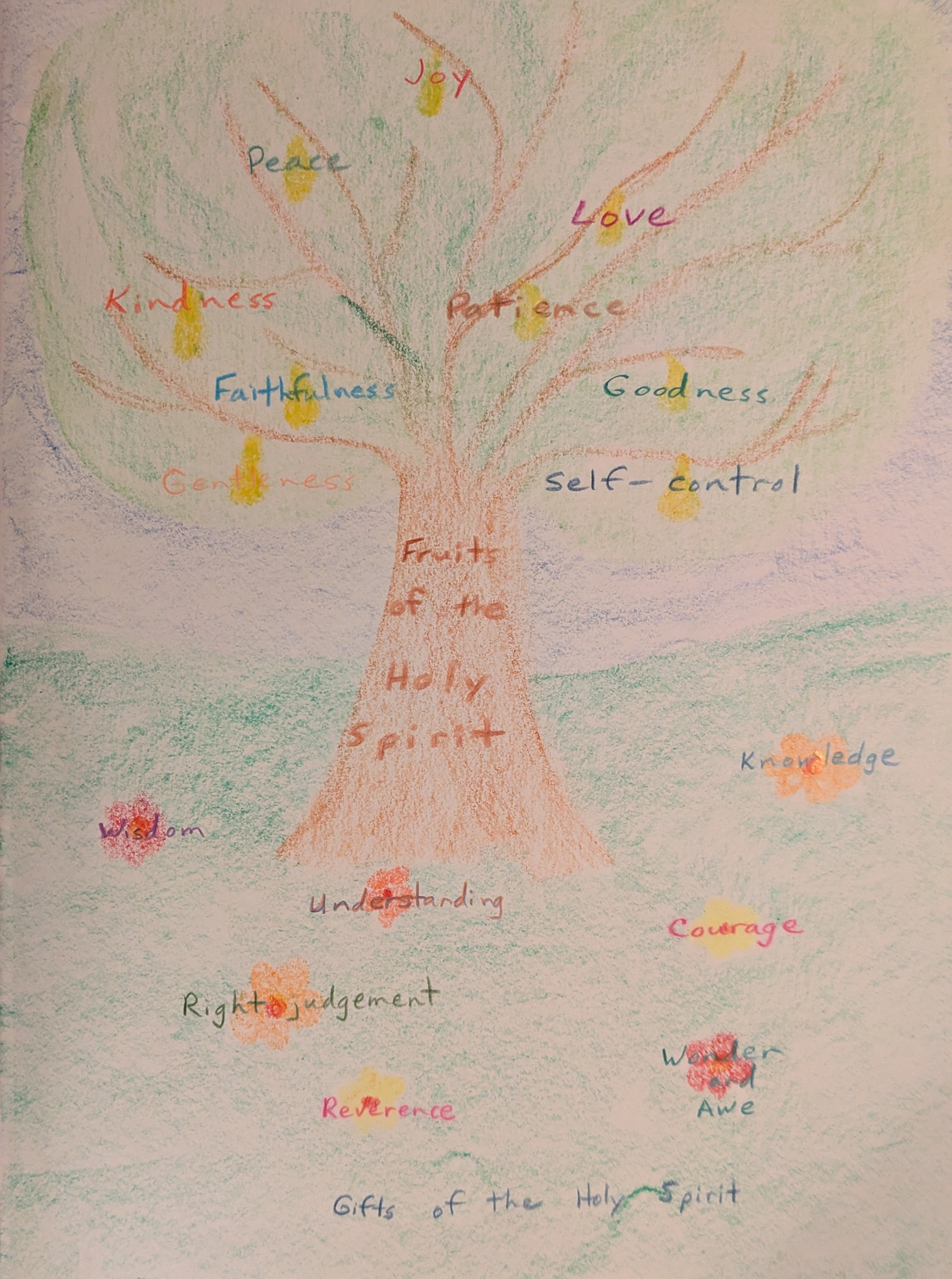
The gifts of the Holy Spirit, as named by the prophet Isaiah in speaking of the coming of the Messiah, are Wisdom, Understanding, Counsel (right judgement), Fortitude (courage), Knowledge, Reverence, and Wonder and Awe for God. Each of these gifts enables us to hear and share the other gifts we receive. Some of those other gifts include leadership, healing, prophecy, discernment, teaching, and interpretation of meanings. In the early church, speaking in tongues and interpreting those words were a more common gift. While not as common today, they are still sometimes received.

One of the key things to understand about the gifts of the Spirit is that they are not received or perceived in exactly the same way for each person. Just as some are good at organizing groups and projects and others are good at telling stories, the gifts of leadership or teaching take different forms with each person who receives them. We all have something to offer, whether originally from the community in which we find ourselves or from somewhere else. Those who come from other parts of the world bring perspectives and experiences that enrich the communities into which they move.

St. Paul reminds us that each of us is part of Christ’s body, so no one is more important or less important than any other one of us. (1 Corinthians 12:3b-7, 12-13) With the Spirit’s gifts in our hearts, the fruit of that presence becomes visible in our lives. Peace, joy, kindness, love, gentleness, faithfulness, patience, goodness, and self-control all characterize those who remain in the Spirit as they walk through life. These fruits of the Spirit make their witness more powerful and subtle at the same time. It’s not necessary to speak words to share the Gospel. Our lives of loving, kind, and patient care for others we meet in our daily lives speak of the presence and love of God.

This is all fine and good within Church communities, but how could it possibly have anything to do with life in the world today? How might the gift of reverence, for example, have any relevance in ordinary life? How would the gift of tongues or interpretation of tongues show up today?

There are many ways in which the gifts and fruits of the Holy Spirit can come into play in our interpersonal interactions, as well as in our interactions with other nations in the world. For example, reverence for the unique experience of another person might show up as respectful attention to what that person is saying and withholding judgement regarding their intentions until they have a chance to explain their point of view. A gift of tongues might include sensitivity to the non-verbal cues we all present to the world in which we move. Those of our own cultural or community group are more likely to interpret them correctly, but some will also be more able to understand the subtle cues from those of another culture or community. This gift is to be shared, so understanding and mutual respect can take root and grow.

When we look at national and international questions and conflicts, openness to the gifts of the Spirit expressed in other people and their customs can and will enrich all of us. When we slam shut doors of communication and interchange, we slam shut our hearts to the workings of the Spirit in all their richness.

Today, as we deal with questions of fairness, justice, human rights, access to the basics needed for human dignity, health care affordability, immigration policy, national defense, and responsibility to care for each other as we would care for Our Lord if we saw him suffering here today, the gifts of the Spirit are the source of our strength and ability to reach out, see the need, and do our part to help alleviate it.

Most of us will never be in a position to change what is happening on the international stage. Most will not have a voice beyond our votes and letters to our elected representatives to change national policy. Nevertheless, we do have the opportunity to make a difference in the communities in which we live. We exercise most of the gifts we receive right here and now in our families, schools, workplaces, and the places where we rest and celebrate together.

As we move through our days, we are called and gifted in many different ways to be part of Christ’s Body, sharing freely in the loving service he gave and wants to continue to offer to all people.

A beautiful hymn in Spanish says it well, “Cristo te necesita para amar” – “Christ needs you to love.”  In order to love or simply to love? The word para carries a rather complex meaning here. The English translation is not so literal, it changes the wording a bit to “Jesus needs you to give the world your love.” The hymn goes on to insist that neither race nor skin color are of any importance, love everyone as brothers and sisters and do the right thing. Love the one who suffers, the one who is sad, the one who lives next door and the one who comes from far away. Love those who speak another language and those who think differently than you do, your close friend and the one who doesn’t ever speak to you.  It doesn’t matter what their race or the color of their skin, love all as brothers and sisters and do good. As his Body, this is what he needs us, calls us, to do.

This is our call, in easy times and in hard. The Holy Spirit is still working among us, bringing many gifts and sharing them with each of them for our own unique role as part of the kingdom of love, the Body of Christ in our world.

Come Holy Spirit, fill the hearts of your faithful and kindle in them the fire of your love. Send forth your Spirit and they shall be created and you shall renew the face of the Earth.

“Cristo Te Necesita Para Amar” – words and music by Cesáreo Gabaráin – in Flor y Canto

Readings for Pentecost – Cycle A


Read More

Posted by on Sep 19, 2012

The First Fruit of the Spirit is Love

The First Fruit of the Spirit is Love

Driftwood Flowers

Writing about LOVE is daunting. What can one say about it that has not already been said? How many songs and poems, plays and stories have been written about it?

But the hesitation about this is based on a false premise. The false premise is that our lives and thoughts are set and not constantly changing. Change scares us but change also frees us and gives us hope.  So, LOVE is always new in us. Everyday we grow and greet life with new thoughts and feelings. These may be negative, but even if they are, we are exploring new ways to reach for love, to know love, to experience love, to be angry at love.

Recently I was wrestling with the tremendous variety in love. From the Greeks forward we know the ancient spectrum of types of love: from pleasure to sacrificial spiritual love — pure altruism.  I have always considered the “ideal love” — the purely altruistic love — the standard against which I judge my feelings and actions. I put myself down for having “Mixed Motives.” I see that I often pursue people for double motives. I may want to help that person or validate that person, but he or she also makes me feel good or important or useful. Does that nullify my help to them? From the point of view of suffering, especially suffering from things such as depression or trauma, the love of things we enjoy, including relationships and sexuality, is rare and to be sought. Many people enjoy very little. If they could get pleasure out of a painting or a meal, it would be a good thing, possibly a very holy thing. So, love should not be interpreted as something free of my concerns or enjoyment. It is possible both to please God and others and also please myself.

Teilhard de Chardin, in The Divine Milieu, speaks of being both attached and detached at the same time. We should love what we do or enjoy but we at the same time must surrender control over the processes or outcomes. Love involves the risk of caring, of getting involved. But if an affinity or pursuit is taking us away from God, we have to detach ourselves from it. So, love includes the maturity of wisdom, of surrendering to what is best, not just to what I want.

Love is said to be generous. Paul in I Corinthians 13 presents a description of extraordinary generosity and lack of ego, patience and kindness. How can love be so generous and still please me? There is a double answer to this. First, we believe that everything is grace. The very ability to love without counting the cost to us, is a sign of God’s work in us. So, being able to do loving actions is a sign that God is close. Secondly, it is a very good thing to see ourselves as loving. We don’t need to feel like failures at life. It is not a prideful thing to know ourselves as happy, as someone who is doing well, or as someone who enjoys giving in appropriate ways.

Love requires discernment. When love is expressed as giving, it can be beneficial but it can also be harmful. Actions that seem to help people may actually be robbing people of their independence or need to do things on their own. Loving actions may be good in themselves, such as cooking a meal for the homeless, but not actually be loving because I may really need to use that time to do something else, such as study for an exam.  As we all know, sometimes the most loving thing is not to do something or not to say something. I cringe at the thought of letting my children make mistakes; but, not trying to control them or lecture them, now that they are grown, is a very loving thing.

Love is often a decision, not a feeling. Putting my mother in a skilled nursing facility was a very painful thing for me. It was the very best thing to do given her level of medical difficulty and my need to work full time. It was a loving thing to do especially since I had visited and researched all the possible facilities and knew my mother’s likes and dislikes. Every step of the way I had to be supportive and creative with my mother’s reactions to her new home, which turned out to be multiple. As she aged and grew more ill, I tried to find the best fit for her in residences. I met a number of people in the same situation who also were making hard decisions that nevertheless were out of love. For the last nine months of her life I drove 40 miles from work to where my mother lived just about every day. She was in pain and often unhappy. I could not fix her or her situation with my love for her. I decided to be there, listen to her and solve whatever problems I could. I wanted to take her off her cross. Oddly enough, that would not have been loving.

Real love always involves some suffering. By its very nature it involves attachment to who or what is loved and when that person or thing leaves, dies or deteriorates we suffer. That is not wrong, but it does hurt.

Love also involves longing. Built into our spirit is the desire to be united to what we love. We feel separation all the time. In developing our own identities we do so in relation to others who are separate from us. It is necessary and good to be our unique selves, but it is also taxing. We sometimes feel that we want to fall back into union with our mothers, or mother images of infancy so that we can get out from under all the responsibilities and worries of life. We also long to be truly known as we really are. We want unconditional love.  These feelings are in all of us and good in themselves. In this life our task is to become our true selves. We travel through a series of experiences which challenge and teach us. One of the things that draws us forward is the desire to be known and loved. God is in the midst of all these experiences — knowing and loving us. The more we see how God loves us into growth, the more we can love this way in our lives. This love can be both sensitive and harsh. If we mediate on the Gospels we can see these two expressions of love in the way that Jesus lived and how he related to people. We can see how he relates to us, to me.

This sense of God’s personal love for me is sustaining. Its gentle and challenging aspects make sense to me. In The Living Flame of  Love, John of the Cross, speaks of God wounding us to get our attention in order to purify and heal us. Love is not always pretty but it is the most important thing in life.

Public Domain image by Christina Spiegeland

Read More

Posted by on Jul 21, 2012

The First Fruit of the Spirit is Love

The Fruit of the Spirit: A way to live a transformed life


In his letter to the Galatians (5:22-23), Paul speaks of the “Fruit” of the Spirit. He uses this term in the singular, implying there is just one fruit, with nine aspects or expressions. In Galatians, Paul rejects a meticulous observance of multiple laws as a way to be righteous before God. In contrast, the “one fruit” is transformation in the Spirit, which blossoms into many virtues. The word “fruit” probably alludes to the image in the Bible of a person of virtue being like a tree which is rooted in living water and bears fruit (Ps. 1) or to trees that are cut down and burned because they do not bear fruit (Luke 13).

The idea of conversion and transformation is intriguing in our 21st century world. We have an increasingly secular society which presses us to talk about God in empirical ways. If we can’t prove that God exists in a mode measurable by our senses, then God is dismissed as a product of the imagination. Another common interpretation of belief in God is that the image of God is the fulfillment of a psychological need. In this world, the idea that God is attractive or that I would allow God to have control of my life is either inconceivable or not of importance. Transformation or change for most 21st  century people means that I change myself. It could also include help by others, such as a therapist or doctor. The only limitation to change in this world is a lack of will or skill, either on my part or on that of my helpers. There is the sense that given enough time, a solution to all problems can be found within the scope of human means.

From a Christian point of view, there are limitations and forms of harm that cannot be remedied by human effort. Transformation in this context presupposes an experiential relationship with God. It is the opposite of fixing myself. Transformation implies that I accept my limitations and let myself hear the voice of God, both inside myself and externally. The fruits are then part of the dance between God and me. I cannot make myself love heroically, but I can approach that kind of love if I am enlightened and empowered by the Spirit. I may naturally approach life in a positive way, but the basis of hope and courage in the face of great difficulty is God, whether I know it or not.

Interestingly enough, this topic came up in a conversation very recently with a sister in a religious community who told me that at the homeless program where she works in Portland, the people speak often about their experience of God. Many of them feel God’s presence and God’s love for them. They pray often to God and recognize God helping them. They do not feel alone. So, those who are the least fortunate and have very few comforts experience God’s power in their lives and can let God help them. It is so often the case that those we usually judge as the most blessed do not report a sense of closeness or awareness of God. In my seminars for professionals in the corporate world, it is rare to have someone tell me of the comfort of closeness to God in the day to day, even in private conversations we have about faith. Jesus asks us to become open like children and to come to him for help with our burdens. How hard that is.

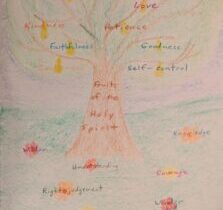
The Fruit of the Spirit – Image by Terri Holaday – Public Domain

Read More