Pages Menu
RssFacebook
Categories Menu

Posted by on Nov 16, 2025

When Scripture Gets Used as a Cudgel

When Scripture Gets Used as a Cudgel

The end of our Liturgical year grows close and we hear prophecies and warnings about how we are to live and how to prepare for the return of the Lord on the last day. Sometimes we read them and are reassured that our trials and sufferings will pass and the Lord will make everything right in the end. Sometimes, however, we read these scripture passages and apply them to social and political challenges we are facing in these particular times. When this happens, it’s all too easy for Scripture to get used as a cudgel, to judge and punish people  whose lives may be more challenging than our own and whose resources are more limited.

The second letter of St. Paul to the Thessalonians provides an example of this. People in the community were anxious for the second coming of Jesus. No one knew when that would be, but the expectation was that it would be soon – before the death of some who were currently living. Living as Christians in the city was not easy. There was a good deal of opposition and misunderstanding among the larger non-Christian community regarding what Christians believed and how they lived.

Making everything more challenging, visitors from other areas had come to the city as well, bringing predictions of the quickly approaching end of the world. If everything was going to end soon, then the most important thing was not to keep on earning a living and making sure everyone in the community had what they needed to live. The important thing in their view was to preach and try to bring more people to Christianity. Those whose ways might not be exactly what the new preachers envisioned were criticized by these newcomers. Some of the new visitors/preachers expected the community to provide food and drink to support them. They didn’t see any reason to get jobs themselves – they were focused on the coming of the end in a very short time!

St. Paul spoke out against this. “You know how one must imitate us. For we did not act in a disorderly way among you, nor did we eat food received free from anyone.” In fact, Paul worked as a tent maker wherever he went. It was his trade and he worked at it quietly to support himself while he spread the Good News and welcomed new Christians into a community of faith. Each person was expected to contribute to the community in some way. Not all would be able to work and bring in money. But all could contribute something and all shared what they had.

His words are all too often quoted out of context: “we instructed you that if anyone was unwilling to work, neither should that one eat.” These words are sometimes used today as justification for cutting food aid to families and children whose income is low, even when all adults are working. They are used to exclude people who are unable to work or unable to find work from receiving health care through the Medicaid program. They are used to justify exclusion from other social services as well. And most distressing of all, these acts are being presented as a justified action based on Christian teaching!

This is not what St. Paul was saying. It is not Christian teaching. St. Paul called on the community, especially those who had been refusing to share in the financial support of the community, to work quietly along with the others and earn the food they were eating. All are called to share the Good News and all contribute in their own way. (2 Th 3:7-12)

The really critical thing in all of this is the ancient scriptural imperative to care for those who need extra help in the community. The Lord sides with the poor, the outcast, immigrants, children, the sick, the elderly. If these folks can’t always support themselves, that’s OK. The community is responsible to help them. They do what they can. For some, such as children or the elderly, that something may be to study or to help care for the children while other adults are working. There are many ways to contribute to the common life of the community.

Jesus spoke of the end times as well. Visiting the great Temple in Jerusalem, filled with riches and offerings, he gave this prophecy: “All that you see here – the days will come when there will not be left a stone upon another stone that will not be thrown down.” This prophecy came to pass in 70 CE when the Romans destroyed the temple and forced the exile of most of the people of the land.

Both before and after the destruction of the temple, believers would be persecuted. Families would turn over their own members to the authorities. Some would be killed. Others would be tossed out of their religious communities.

It was not going to be a pretty thing for those who followed Jesus. Life would be tough.  “But not a hair on your head will be destroyed. By your perseverance you will secure your lives.” (Lk 21:5-19)

Life is more than just the physical experience of our day-to-day activities. It’s ever so much more. It’s life in the Kingdom of God, which starts here and now.

As the prophet Malachi noted in the final book of the Hebrew Scriptures, “The day is coming, blazing like an oven, when all the proud and all evildoers will be stubble, and the day that is coming will set them on fire…” A frightening thing indeed! Yet there is hope for those who follow and love the Lord. “There will arise the sun of justice with its healing rays.” (Mal 3:19-20a)

Moving through our lives in these difficult and uncertain times, we are called once again to work quietly for the Kingdom of God, caring for the vulnerable and gently speaking words of hope. No using Scripture as a cudgel. No excluding people whose income is low, or whose health is poor, or whose minds are not stable, or whose parents have not found high-paying work, or who had to leave their homes in search of safety and opportunity for themselves and their children!

The end of time is coming. The end of the world, not likely right away. Most of us will leave here quietly long before the world meets its end.

This week, may we remember to speak gently, to work humbly, to respect and love the Lord, that the sun of justice will rise on us each day and at the end of our days.

Readings for the Thirty-third Sunday in Ordinary Time – Cycle C

Read more on these topics.


Read More

Posted by on Oct 26, 2025

I Thank You That I Am Not Like The Rest Of Humanity

I Thank You That I Am Not Like The Rest Of Humanity

“I thank you that I am not like the rest of humanity…” These words in the parable of the Pharisee and the tax collector are striking. What came next? “I am a great sinner?” “I am a person who is always looking for answers?” “I am able to foretell the future with absolute accuracy?” “I always try to help everyone I meet?”

I think at one time or another, many of us have probably said something similar. “I grew up in a good family.” “I go to church every Sunday.” “I never miss a Holy Day of Obligation.” “I try to help others when I can.” “I contribute to good causes.” “I’m a good worker.” “I support my family.”

Many of us, including myself, have said things like, “I know how to make my own clothes,” or “We learned how to make soap when we were kids,” or “Buying in bulk really makes money go farther.” We set ourselves up as somehow superior in comparison to others we meet along the journey of life, even those in our own neighborhoods or country. Unless and until we experience the reality of having less income than needed to cover basic expenses, we don’t comprehend that middle class solutions don’t necessarily work when income doesn’t cover the basics. Having 12 cans of tomatoes bought in bulk doesn’t particularly help when there’s nothing else to cook along with a can of tomatoes. Knowing how to make noodles doesn’t help when there’s no way to get an egg and flour to start with. The help received in those situations, often from others who also lack the luxury of having any surplus, is truly treasured.

The Pharisee went on to explain his thinking, noting that he is not “greedy, dishonest, adulterous” or even like the tax collector he sees nearby. The Pharisee notes that he fasts twice a week and pays tithes on his entire income, not just on parts of it. He’s pretty proud of himself.

St. Luke tells us that the Pharisee “spoke this prayer to himself.” It’s an interesting phrase. Was he simply speaking quietly rather than speaking aloud or so others around would hear, or was he literally speaking to himself rather than to God?

Jesus went on to tell of the tax collector, one of the most despised members of the community. Tax collectors had to collect a certain minimum amount of tax to submit to the government in Rome. Beyond that basic minimum, they were allowed to keep whatever extra they could get out of people, their own neighbors in the community. People thought of them as the scum of the earth. Traitors to all in the region.

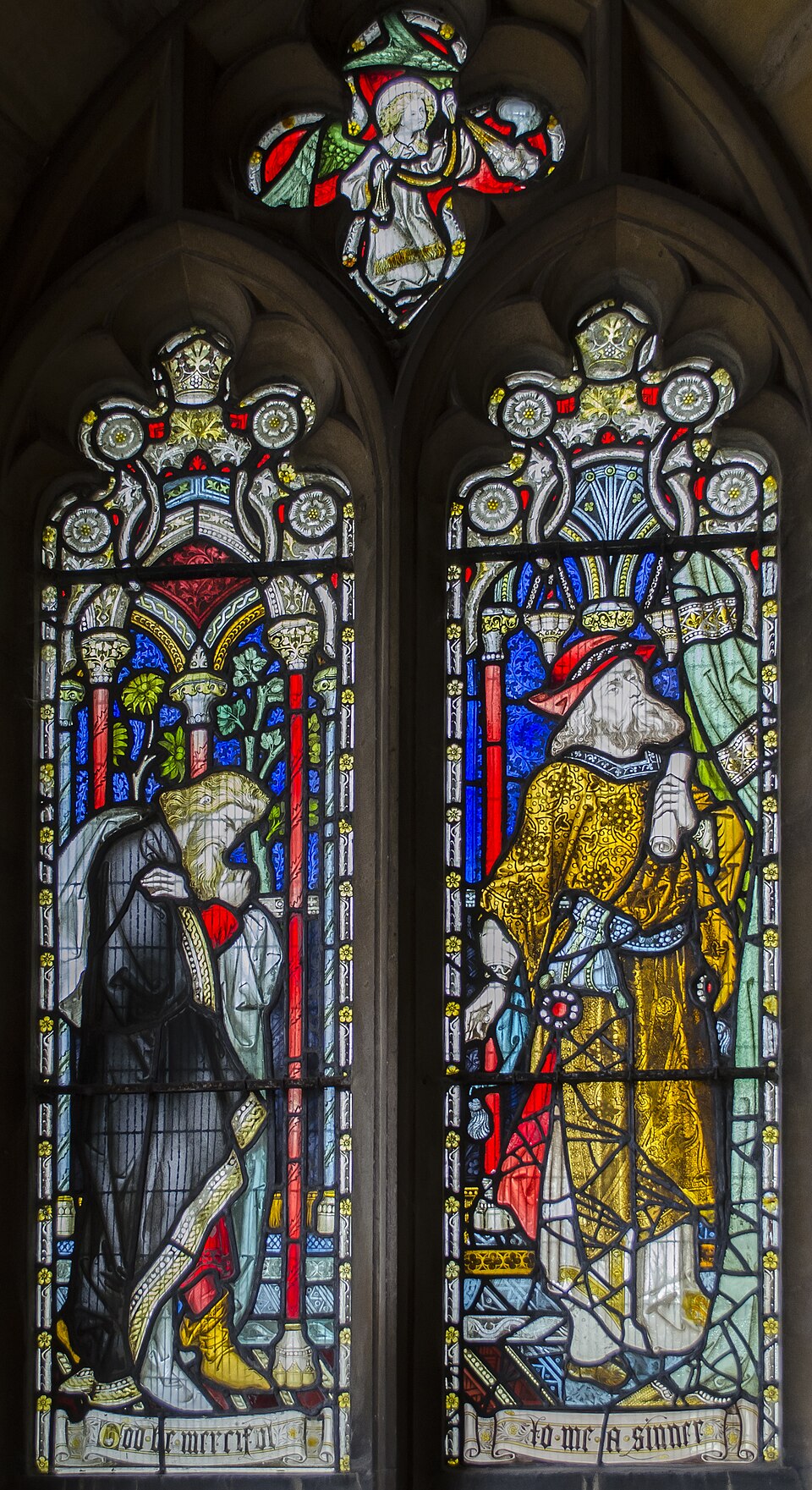
The tax collector stood apart from others. He knew he was not welcome. He didn’t presume to claim innocence or even assume he would be pardoned, He looked down humbly at the ground in front of him, “beat his breast and prayed, “O God, be merciful to me a sinner.”

A simple prayer and totally heartfelt. Jesus praised this prayer. “I tell you, the latter went home justified.” The Pharisee did not. Why not? “Whoever exalts himself will be humbled, and the one who humbles himself will be exalted.” (Lk 18):9-14

Humility is not a loud declaration of unworthiness proclaimed with the hope others will reassure the speaker that they are indeed worthy of praise and respect. Humility is the quiet recognition that in some actions, the individual has truly done wrong and is sorry for having done so. To be humbled is to have that reality made clear through the words and actions of others. Those who have admitted their misdeeds and asked forgiveness, can be exalted through the forgiveness they receive.

A wise man named Sirach lived around 200 years before the coming of Jesus. He wrote down and shared his reflections on community, faith, families, friendships, education, wealth and poverty, worship, and many other topics of importance to both ancient and modern communities. Sirach wrote in Hebrew and his words were translated into Greek by his grandson sometime after 132 BCE.

Sirach stated clearly and firmly, “The Lord is a God of justice, who knows no favorites.” This is important. All people matter to the Lord – rich and poor alike. Yet Sirach notes, “Though not unduly partial toward the weak, yet he hears the cry of the oppressed.” Those who have no social status or protection are heard by the Lord. Widows, orphans, those whose needs and rights are discounted by folks on the margins – the calls for help from all of them are heard. Their cries pierce the clouds of heaven, like an arrow that flies straight to its goal. They do not rest until the Most High hears and responds, affirming what is right and just for the poor and lowly. (Sir 35:12-14, 16-18)

The tax collector would find this both disconcerting and strangely comforting, I suspect. Given the reality that he regularly was expected to cheat his neighbors in order to support himself and probably lived a more lavish lifestyle himself, it would be disconcerting. He knew the Lord would hear the cries of those who were cheated. Yet, he hoped in the mercy of the Lord for himself as well. Would it be possible to serve as a tax collector and still be an honest person? Or what would next steps be for him? Both questions remain unanswered in the Gospel, but we might want to consider them for ourselves.

The reality of the Lord’s attention to the cries of the poor, however, is not in doubt in both Hebrew and Christian Scriptures. The Psalmist sings of it regularly. Psalm 34 is an example of this. “I will bless the Lord at all times; his praise ever in my mouth.” “When the just cry out, the Lord hears them, and from all their distress he rescues them.” “The Lord redeems the lives of his servants; no one incurs guilt who takes refuge in him.” The cries of the poor and the oppressed always reach the Lord. (Ps 34:2-3, 17-18, 19, 23)

Does this mean everything turns out fine if we just have faith – money and respect will come, healing of illness, jobs and happy family life? Wouldn’t that be lovely? But would we really appreciate these gifts? We might well get to thinking that it all happened because we worked hard and did it all ourselves, followed by, “If we/I can do it, so can they …” Easy then to say, “I thank you that I am not like the rest…”

The life of St. Paul shows us differently. A tent maker, citizen of Rome, born in Tarsus, became a scholar of the Law, a Pharisee. He approved of the condemnation of some of the earliest followers of Jesus, including the first martyr, Stephen. By God’s grace, he met the risen Jesus as he was traveling to Damascus to arrest more of those heretics, the Christians. Called by Jesus personally, he became the Apostle to the Gentiles, traveling many miles by foot for many years, sharing the Good News of the coming of the Christ and of salvation for all peoples – Jews and Gentiles alike.

Eventually, he was arrested and exercised his right as a Roman citizen to be tried in Rome. In his second letter to Timothy, a young man he met in his travels who shared in his ministry, he speaks of the approach of the end of his life. His trial did not go well. He knows he will be condemned. But he speaks words of hope and conviction. “I have competed well; I have finished the race; I have kept the faith.” No one spoke on his behalf during his trial. Some friends deserted him. “But the Lord stood by me and gave me strength, so that through me the proclamation might be completed and all the Gentiles might hear it.”

Paul rejoiced that he had been given the opportunity to speak and witness to the risen Lord. He proclaimed confidently, “The Lord will rescue me from every evil threat and will bring me safe to his heavenly kingdom.” He concludes in words we share, “To him be glory forever and ever.” (2 Tim 4:6-8, 16-18)

“I thank you that I am not like the rest of humanity…” or “Have mercy on me a sinner.”

Which will be our approach this week and through the days and weeks to follow? How will we live as children of a just God, who hears the cry of the poor? How will we “see” the needs of those around us? How will we respond?

May we remember that all we have is a gift. We haven’t gotten where we are by ourselves. Our families, our friends, other people we have never met and will never meet. All have given of themselves to make the society in which we live, with the advantages we enjoy.

Now it’s our turn to pass it on. Our turn to reach out with a smile, a helping hand, a kind word, a listening ear, a decision to forgive, a choice not to judge.

May we bless the Lord at all times, remembering that we are not above all others in holiness, nor are we loved more than others by the Lord. We are all loved and together we share this love with all we meet, sharing together on the Lord’s team to care for the poor and the oppressed whose cries are heard by the Lord.

Readings for the Thirtieth Sunday in Ordinary Time – Cycle C


Read More

Posted by on Oct 18, 2025

Keep Trying – Advice for life and prayer

Keep Trying – Advice for life and prayer

“If at first you don’t succeed, try, try again.”  We hear this saying so often as we grow up that we often stop paying attention to it. A roll of the eyes, a shake of the head, a shrug of shoulders – so many ways to tell the one who has spoken these words to us that we don’t really want to try any more. But “keep trying” is generally not bad advice. So many things we need to do or want to do require persistence. Babies have to keep trying to learn to sit up, to crawl, to stand, to walk. We have to practice to learn to speak. Just about everything about being a human being requires some sort of practice. Only a smile or a happy laugh seem to come naturally. They are among the most welcome things any of us ever give or receive.

Trying in an Ancient Conflict

In the years between the Exodus of the Israelites from Egypt and their entry into Palestine, there were forty years of traveling around the Sinai Peninsula and lands east of the Jordan River. There were already people living there and sometimes conflicts arose.

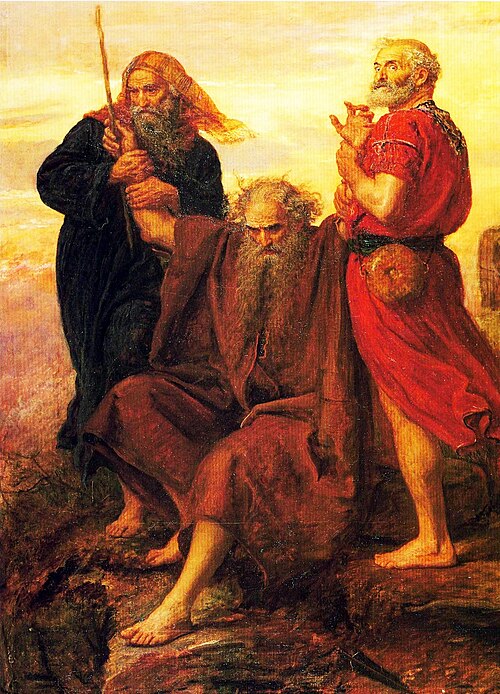
At one point, Amalek led an army against the Israelites. Moses recognized that Joshua was a natural leader in defense of the people against other warring groups, so he had Joshua choose the men who would join in battle against Amalek. Moses went to a hilltop nearby to pray for God’s help and support in the battle. He raised his arms over his head in prayer.

While Moses’ arms were raised, the battle went well for Israel. But he couldn’t keep his arms up in the air unsupported for very long. Whenever he lowered them to rest, the battle shifted and Amalek’s forces gained ground.

Fortunately, two other men were there with Moses. They found a rock on which he could sit and then each stood beside him, helping him hold his arms up in prayer. They did this for  hours, all day long, until at last the battle was won by Joshua and the Israelites. (Ex 17:8-13)

Moses had to keep trying, and his friends helped make that possible. It was a community activity.

A Widow Keeps Trying

Sometimes we wonder if our prayers are heard. In hard times, we may wonder if God cares or if we should keep trying. Jesus gave us a story to help us understand.

Widows in Jesus’ day were among the most vulnerable people. They had no real rights. Women’s identities were based on the men in their family. First their father, then their husband, and eventually, their sons. Once a woman was married, her father was no longer responsible for her. If her husband died and she had no adult sons, she was on her own. But there were no real jobs or careers for women, so poverty and insecurity were their lot.

So, here was Jesus’ story. A widow had a claim for justice and went to the local court to claim her rights. The judge at the court was not an honest man. He ruled against her and in favor of her opponent. She brought the case again, and again he ruled against her. This happened repeatedly. Finally, the judge had had enough. He decided the only way he was going to get this settled was to rule in her favor, lest she eventually find a way to hurt him.

Jesus pointed out that because she kept trying, she eventually prevailed in the case, even against an unjust judge. How much more likely, therefore, was it that God would hear the prayers of his people. God, the just one, would come to help those who call on him. (Lk 18:1-8)

Does this mean that whatever we ask for will be granted? Well … if it’s something that is good for us or for the community, then yes. If not, then something else may be God’s gift of a response to the prayer.

The important thing is to keep praying, to continue to trust that the Father cares and is looking out for us. Keep trying. Keep hoping. Keep loving.

A Worthy Goal

Jesus’ teachings about the importance of prayer and persistence were rooted in Hebrew tradition and Scripture. We Christians sometimes think of Scripture primarily in terms of the writings of the followers of Jesus. But for Jesus and his followers, Scripture was the tradition of the Hebrew people – the stories of how everything came to be as it is now, as well as the history of their nation. The Law, the teachings of the prophets, the wisdom learned through the ages – all were/are part of Scripture.

St. Paul reminded Timothy of the wisdom learned from the Scriptures. This wisdom is the basis for teaching, guiding, even reproving (scolding) those whose actions are not in line with the Father’s hopes and dreams for us.

Paul notes, “Remain faithful to what you have learned and believed, because you know from whom you learned it.”  Point 1 – The validity of sources of teaching and information from humans matters!

He adds, “… from infancy you have known the sacred Scriptures, which are capable of giving you wisdom for salvation…” Point 2 – Scripture becomes a source of wisdom for us from infancy.

Scripture, inspired by God over the centuries, provides the background truths that we now bring to our own ministry of teaching and witnessing to the Good News through our good works and care of others. (2 Tim 3:14-4:2)

What then are we to do with what we have heard and learned from our teachers (such as Paul) and Scripture? We are to “be persistent whether it is convenient or inconvenient” in sharing it with those we meet and with whom we interact.

Keep Trying – Convenient or Inconvenient

Today we too are called to be persistent in our prayer, in our actions, in sharing and living out what we have come to believe. God who is love calls each of us to love and care for all the rest of the people with whom we live. This isn’t just caring for our immediate family, our extended family, or those who share our ethnic, cultural, or national identity.

When our leaders fail to care for or target the vulnerable, we are called to speak out.

When access to housing, education, nutrition, healthcare, safety is restricted to only certain groups of people in our communities, we are called to speak out.

When those with lower incomes are treated with less care or consideration in public places or in businesses or schools, we are called to speak out.

When those whose names sound strange or foreign to us and so we treat them with scorn or dismiss them as illegals, therefore criminals and not worthy of common courtesy or legal human rights, we are called to speak out.

The Psalmist cries out to us in the voice of the poor and the oppressed, “I lift up my eyes toward the mountains; whence shall help come to me? My help is from the Lord, who made heaven and earth.” (Ps 121:1-2, 3-4, 5-6, 7-8)

This week, may we be ones who speak and act on behalf of the poor and the oppressed. May we be among those who count on the help of the Lord and share the gifts we have been given for the good of all.

Keep trying – in life, in faith, and with confidence that the Lord hears the cry of the poor and comes to their aid.

Readings for the Twenty-Ninth Sunday in Ordinary Time

And more thoughts from several years ago.

Read More

Posted by on Oct 13, 2025

Ten Were Cleansed, Were They Not?

Ten Were Cleansed, Were They Not?

Our first lesson in morality is the one we hear as infants. “Say thank you.” 

We say thank you or thanks all the time to recognize someone’s effort to help us, to do us a favor, or to give us a gift. The favor, the gift, or the patient explanation is something that is the personal expression of the giver. This is called reciprocity. It is an exchange. I will give you something and in return you will give me something. It is something that we learn as infants. It is a commonplace experience, and we are reminded to do it as children. If we forget to do it, we hear. “Say thank you.” Even in old age, we can mimic the tone and voice of the speaker of those exact words. 

Those two simple words mean that we acknowledge not only what the person has done for us, but we acknowledge who they are as people. We acknowledge that even though they may be serving us as part of their job, they are extending themselves. If clerks or online businesses treat us rudely our finger immediately hovers over the one-star rating. If we are especially irate, we hit the nuclear launch button and write a flaming review and send it out to the universe via the internet 

We turn a tube of lipstick into a ballistic missile because not only has the other party not fulfilled their part of the social contract – they have not given us what we wanted, they have not acknowledged our dignity and worth as people. At a minimum they don’t even see us as paying customers.  

When I got my first paper route at age 12 – Yes, there was a time before digital media – my father gave me some important advice. The customer is always right. It struck me as strange because I knew that people could not be right all the time. My Mexican Catholic father never explained this Buddhist koan. When I looked up to question him, I got that look of “Don’t ask.” As a novice paper boy, I had the additional pressure of wearing my Catholic school uniform and being evaluated by the all-seeing eyes of my mother’s large extended network of family and friends.  

The life lesson I learned from this is that people want to be seen. They want to be heard. They want to be validated. People would sometimes complain if I left the paper on the top step as opposed to putting it on the welcome mat. Tossing it without the right aim and not enough force could land it on the steps, or God forbid, in the flowers. Too much force and a little too high would slam it against the screen door. With wooden screen doors the sound was muffled. But aluminum screen doors like the one at the convent made quite a crash – like pots and pans battling each other. I discovered this one day when the paper sailed into the door while the sisters were at afternoon prayers. The consensus was that I would grow up to be a nice young man if they didn’t choke me to death first. Needless to say, it only happened once.  

Even though I was never good at math, I did learn the other side of the equation. People said thank you. I was surprised to get cards and candy on holidays. I even got cakes on my birthday. One lady paid me in advance every month since she had a very serious heart condition and she knew that she could die suddenly. One day the house was all closed up and there was dust on the porch. A neighbor came up to me with an envelope. It was a final thank you. 

Most of us observe these social niceties because we know what our mothers would say. More importantly if our mothers have gone to their eternal rest, we can expect a lightning bolt from upstairs if we are rude.  

Even though most of us are not trolls under a bridge, we can often commit serious levels of rudeness and invalidating the other person in our personal lives. We routinely say thank you to our spouses, our children, and our parents as part of social courtesy. Do we really recognize them with a deep appreciation? Do we see them as gifts in our lives or are they just an irritation, an inconvenience? Are they people we take for granted like comfortable recliners? Do we appreciate a clean house or a nice lawn. Do we really think that Harry Potter house elves take care of our most essential needs? 

 On the Road with Jesus

Often, we think of Our Lord Jesus gliding along the roads of Samaria and Galilee. His halo is bright; his clothes have just come back from the dry cleaners. His disciples are gathered around him in glowing adoration.  We get this notion from the beautiful art that is a great part of our legacy over 2,000 years. We see the life of Christ from the standpoint of his resurrection. We are shielded from the horror, the gore, and the blood of the crucifixion when His glory is eclipsed but also revealed. Despite the comfort of the resurrection, we would do well to get a sense of the life of the Jesus of history without the halo and with pushing and shoving followers who weren’t sure of exactly what He was or who He was. We then see followers who later denied Him and deserted Him. They had a profound lack of appreciation and gratitude.  

St. Ignatius tells us to put ourselves in the scene of Jesus healing the lepers. Israel at the time of Jesus was a lot like the East Bay hills. It was dusty and dry. If you have gone hiking you know about the dust, the sun, and being thirsty. They walked with callused feet and sandals and had no boots or gear from REI or Patagonia. Unlike us Jesus and his disciples could not retreat to air-conditioned RV’s and energy drinks. Who are we in this scene? Are we skeptical disciples looking for the next miracle? Lepers? Are we one of the women looking after Him? The women who won’t deny or desert him. Are we, his mother? Do we feel the danger and apprehension of going through Samaria a place hostile to Jews because the Jews had destroyed their temple? Bandits frequent this place.  

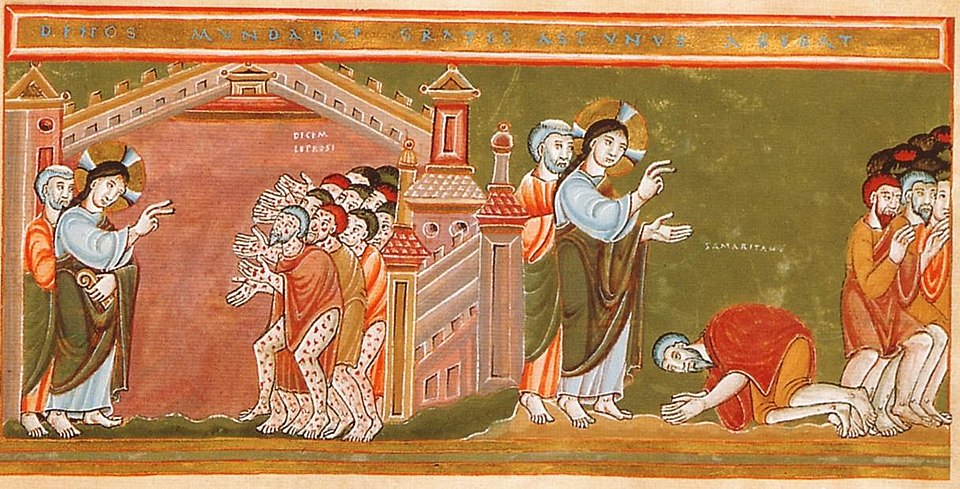
As we approach the safety of Galilee near a village a greater danger comes out of the brush. Burned by sun, with suppurating pustules, driven out of their homes are ten lepers – 9 Jews and one Samaritan. They had to keep their distance and cover their faces. Everyone pulls back and covers their noses from the stench They leave Jesus in front. Occasionally, when people recovered from leprosy, psoriasis, or severe rashes, they could present themselves to the priests who could declare them cleansed and they could re-enter society. We wonder how strange this is. He doesn’t cure them but tells them to do the impossible – because the priests would not receive them unless they were cleansed. They certainly would not receive a Samaritan. From our standpoint in the scene, how do we feel? What do we see? 

We continue our journey and a short time later one of the lepers comes running back. He is barely recognizable. He is healthy and whole and throws himself at the feet of Jesus in profound gratitude. The others never show up. We often think that Jesus was irritated or disgusted, or at least above it all. We never consider that he might have been hurt. He extended himself to his own people and to one outsider. He sacrificed himself. We know that he often was exhausted after a day of healing and that he slept on the ground. 

The scene ends and we resume our daily routines.  Do we take this time with Jesus and lepers with us? Do we give thanks for our blessings? Do we begin our prayers with praise and thanksgiving? In the Eucharist, which means thanksgiving, we offer profound thanks in, with, and through Christ. We are the Samaritan who came back.

Gospel for the Twenty-eighth Sunday in Ordinary Time – Cycle C


Read More

Posted by on Oct 11, 2025

Who is Clean Among Us?

Who is Clean Among Us?

Who is clean among us? What does it mean to be clean? Does it matter? Does it have anything to do with physical cleanliness?

Here’s a somewhat related question – Which bodily organ is the largest? The question is sometimes asked in Biology or Anatomy classes. Typically, people identify one or another internal organ as the largest. However, the correct answer is skin.

Our skin is actually an organ and as such both protects the rest of our body and can be an indicator of overall health or of stress. Our skin can also become infected with/by many different critters, most of whose actions produce a visible change. Sometimes, infections begin at the surface and move inwards – things like an infected pimple. When the protective barrier of the skin is breached, through a cut, scrape, puncture or something similar, infections move inside much more easily.

In ancient times, much less was understood about the cause of infections and the role of the skin. However, it was known that some conditions could be spread by contact. Since there were no treatments for them, those who were infected were often forced to leave the community.

Hansen’s Disease, a.k.a. Leprosy, was one of those conditions. Today we know it is caused by two types of bacteria and it can be treated. In the past, there was no treatment. As the condition progressed, people’s skin became discolored, nerve damage caused loss of feeling in hands or feet, so injuries could lead to loss of fingers or toes, as well as disfigurement of the face or other areas of the body. It was a terrifying disease. Those who contracted any skin condition were assumed to have leprosy and banished from the community. They lived off by themselves in small groups of fellow sufferers and called out a warning to any who approached – “Unclean!” Only a fool would come closer and risk contracting the disease!

The requirement for isolation of people who had skin conditions is encoded in the Mosaic Law. Conditions that caused blotches, itching, sores, or other non-normal appearance of the skin were called leprosy. Not all would have been the disease as we define it today. Some conditions, including eczema, rosacea, vitiligo, or psoriasis, cause changes in the appearance of the skin but are not actually leprosy.  Yet any of them could be sufficient to make the person ritually impure – unclean. Anything outside the norm, as understood by the people of the day, was believed to be unclean and therefore to be shunned.

An Army Commander is Healed

Naaman was a commander in the army of Aram, a neighboring country that was trying to take over parts of Israel in ancient times. An Israelite girl who had been captured and taken as a servant for Naaman’s wife told him that Elisha the prophet in Israel would be able to heal his leprosy. With the permission of his king, Naaman traveled to Israel and asked Elisha for healing. Elisha told him to go to the Jordan River and plunge into it seven times and he would be healed.

Fortunately for Naaman, he accepted Elisha’s word and went to the Jordan where he plunged into the water seven times. When he had done as commanded, his skin was healed completely.

Naaman was so grateful that he and his retinue returned to Elisha to thank him. He recognized that the healing was from God but he wanted to give Elisha a generous gift in thanksgiving as well. Elisha, however, would not accept anything. The healing had not been his doing. It was the work of God.

Then Naaman requested something else – “two mule-loads of earth” that he could take back to his home and spread there. As he explained, “I will no longer offer holocaust or sacrifice to any other god except to the Lord.” (Understanding the Lord as a local god of the Israelites, he believed it necessary to worship on soil from the Lord’s land.) (2 Kings 5:14-17)

Isolation, Healing, Gratitude

The isolation of lepers continued into Jesus’ time and beyond. It’s only been very recently that we have learned its cause and have a way to cure the condition. But for thousands of years, this was not the reality of life.

As Jesus and his friends traveled from Galilee on their way to Jerusalem, they met ten lepers near a village. The lepers called out to him, “Jesus, Master! Have pity on us!” It was known that he could heal many conditions. Maybe he could help them too?

Jesus didn’t have to ask what the request meant. They were hoping for healing. He responded, “Go show yourselves to the priests.” In order to be readmitted to the social community, they had to be certified as Clean by the religious authorities – their skin had to have been returned to normal appearance.

The lepers set off to present themselves to the priests and along the way, they were healed. They were now clean, free of the condition that led them to be unclean.

One of those cleansed, upon realizing what had happened, returned to thank Jesus, praising God for this gift. Jesus was happy to see him but asked, “Where are the other nine?” All ten had been cleansed. Only one returned and that one was not a Jew. He was a Samaritan, a foreigner, one of a people despised by Jews for centuries. The rest had all been Jews, but they didn’t come back. Was it because they considered it a given that they would be healed? We’ll never know, but it’s worth asking. Jesus certainly wondered. (Lk 17:11-19)

Who is clean among us? What does that really mean? Whom do we accept as worthy of respect, kindness, welcome? Whom do we assume belongs and whom do we assume should be shunned and turned away? Who are the lepers of our day?

Does It Matter Who is Clean?

St. Paul reminded Timothy that although he himself was at that point a criminal in chains, “the word of God is not chained.” All that Paul and the followers of Jesus must bear because of their choice to follow Jesus is worthwhile, as a witness that will draw others to salvation through Christ Jesus. Whether his followers are faithful to his call in their lives or not, God is faithful to us, “for he cannot deny himself.” (2 Tim 1:6-8, 13-14)

We are called. We sometimes fail to choose the way he leads. But he remains faithful to all of us and to his call.

Will we continue to care for those deemed unclean by our society, by political leaders with their own agenda, by people who fear newcomers or that those from other lands are the cause of their own difficulties in life? Whom will we accept as clean? Will we be clean ourselves if we reach out in loving service to those deemed unclean? What does it mean to be clean today?

As we reflect on the healing of lepers in Scripture, may we remember that there are both physical and spiritual levels of health and illness. Sometimes we are called to deal with both. Sometimes, our actions should be directed and guided more by the figurative meaning of the words and concepts we use.

This week, may we notice with compassion the sufferings of those around us, many of whom suffer in silence or in fear. May we offer a kind word, the gift of understanding of the complexity of life, the patience to wait and find out what they really need. Is it something practical like a blanket to keep them warm at night? Is it a smile that says, “I see you and treasure your presence?”

May we remember always that Christ is present in the least of the people of the world, from wherever they have come. There is something each brings to us, adding richness to our lives and asking only patience and kindness in return.

Who is clean among us? Are we ourselves clean?

Readings for the Twenty-eighth Sunday in Ordinary Time – Cycle C
(More thoughts on this here.)

And a wonderful song from Miriam Therese Winter of the Medical Mission Sisters – Ten Lepers 


Read More

Posted by on Oct 4, 2025

Guard This Rich Trust

Guard This Rich Trust

What do we treasure in life? Is it something physical – a book, a ring, a coin, a photo? Is it something less tangible – a song, a view, the sound of the waves, the touch of a hand, a smile? How about something even less tangible – a dream, a vision, a hope for the future, a shared set of values, a divine promise? How do we guard the rich trust of the hopes, memories, and dreams we have received.

I suspect most of us treasure many things in life. Our treasure chest is filled with both physical items that remind us of past people and joys as well as the intangible gifts and memories accumulated over the years of our lives, however many those may be. We all have treasures of one sort or another. Treasures we guard and protect, some of which we hope will go with us into eternity.

Some treasures are more difficult to hold onto than others. Probably the most difficult treasures to retain are the ones that are intangible, things like protection of the common good or the rights of all people rather than just the rights of the powerful. How can a people or a nation commit to protecting the rights of all and still be able to command the loyalty of the wealthy and powerful? When those in power refuse to protect the vulnerable, how are the rest of the people to respond?

These kinds of questions are not new to our day. These same kinds of issues are seen again and again in histories of civilizations and in the scriptures of religious communities, including our Judeo-Christian tradition. Are they out of date? Is it foolish to keep hoping? Do God’s promises mean nothing?

Habakkuk – Faith in Troubled Times

Social and political unrest were rampant in the time before the conquest of Israel and Judah by neighboring kingdoms. Habakkuk spoke to the Lord in the days after the northern kingdom had fallen to the Assyrians and before the southern fell to the Babylonians. “How long, O Lord? I cry for help but you do not listen!” Everything is going to pieces – as the contemporary saying goes – to Hell in a handbasket! Destruction, violence, strife, clamorous discord – all are raging in the kingdom.

The Lord answered Habakkuk with words of reassurance, but no promises on the timing of their fulfillment. “The vision still has its time, presses on to fulfillment, and will not disappoint.” It may not happen as soon as you would like, but “it will not be late.” There’s a time when it will flower. Meanwhile the just ones will live because of their faith. Those who wait faithfully will one day be vindicated. (Hb 1:2-3; 2:2-4)

So how long do we have to wait? Why can’t we just receive a huge dollop of faith that lets us go out and convert the world – to create a world of justice and hope for all?

The Mustard Seed – Faith in Bloom

When his apostles asked Jesus to increase their faith, he reminded them of a mustard seed – a potent, spicy seed that is quite small. Yet a mustard seed grows into something much larger. A mustard seed also brings a spicy flavor much larger than its size would suggest to foods into which it is cooked. Jesus told his friends they only needed faith the size of a mustard seed to produce major results.

Faith is powerful. It can move mountains of obstacles to the hopes and dreams of the Lord. It takes the faith and strength of workers who might be about the size of a mustard seed in their faith in order to move those mountains. But mustard seeds are powerful and mountains can be moved.

Faith – Guard this Rich Trust

Jesus encouraged his disciples to remember that just as a servant is expected to keep serving even after a day of work, without the master’s praise or thanks or notice, so the servants of the Most High are to keep working for justice and the coming of God’s kingdom. We keep working, not for praise but because of the promise towards which we aim. (Lk 17:5-10)

In our lives and ministries, we are called like Timothy “to stir into flame the gift of God that you have through the imposition of my hands.” When we receive the Holy Spirit, we receive gifts of “power and love and self-control.” We go out and share what we have seen and learned of the Lord and his promise. We are not broken by threats from those in power or by hardship. Paul wrote to Timothy while he himself was a prisoner, soon to be condemned for his work spreading the Good News of the Resurrection.

Paul’s words are ones that call to us too!  “Take as your norm the sound words that you heard from me, in the faith and love that are in Christ Jesus. Guard this rich trust with the help of the Holy Spirit that dwells within us.” (2 Tim 1:6-8, 13-14)

Guard this rich trust. Hold on to hope. Hold on to love. Hold on to kindness. Hold on to the dream of equality and opportunity in our communities. Hold on to the wonder of many ways of being and living as humans in this big world – the tremendous richness and diversity of human culture and experience.

This week look around you.  See the wonder of creation, the wonder of children, the wonder of older people, the wonder of seasonal change, the wonder of new learning, the wonder of family life at its best, the wonder of nations hoping to work together for the common good of all peoples in the world.

Some of these visions are blurry just now. Some seem in danger of being wiped out.

Hang on. Guard this rich trust – the promise and gift of the Lord. A vision that still has its time and will not disappoint is worth patient trust and confidence.

Readings for the Twenty-seventh Sunday in Ordinary Time – Cycle C

And another story about a mustard seed!

Read More

Posted by on Sep 28, 2025

Whom Do I Choose to See?

Whom Do I Choose to See?

Man sleeping on the streetWhen we leave our homes and go out into the wider world, we encounter a lot of other people, unless we live as hermits alone on a mountain somewhere. People are all over the place – in some locations more densely than others. In response to this density, we often learn to be selective regarding whom we choose to see. Whom do I choose to see?

The ability to feel comfortable and safe varies from person to person and situation to situation. Our sensitivity to the emotional “vibes” of others around us can also vary, but most of us have at least some ability to sense when another person is happy, sad, tense, etc. We call that quality empathy and value it as a positive feature.

Those living in cities have more frequent contact with other people than those living out in the countryside or in small towns. Nevertheless, our ability to befriend and enter into deep relationships with those around us is not unlimited, so we develop smaller circles of friends and family. Those outside these select circles remain basically unseen and unheard. We go about our lives, blithely unaware of the struggles and joys of those whose opportunities and struggles differ from our own. This is true both of those with more wealth and those with less.

Lest we think this reality is something new and unique to the times in which we live, we have the witness of ancient prophets to enlighten us.

The prophet Amos, in the years before Assyria conquered the northern kingdom of Israel, warned those with wealth and power in no uncertain terms that their focus on their own comfort and enjoyment of the good things of life was not acceptable to the Lord. It was totally contrary to the Lord’s demands through the centuries that the needs of the poor and vulnerable members of their communities must be seen and addressed. Their lack of willingness to see the needs of others or even to choose to see those others was fundamentally unacceptable. “Woe to the complacent in Zion! … they shall be the first to go into exile…”

As Amos warned, the enemies to the north eventually invaded and destroyed the homes and comfort of those who had looked only to their own wealth and pleasure. More than just the loss of wealth and privilege, these people were taken into exile far from home and forced into labor for the conquerors. They lost everything. What a hard way to learn about the importance of seeing the hardship of the lives of the poor and doing something to help! The words of Amos warning of the Lord’s displeasure with them must have rung woefully in their ears as they were taken away in chains. (Amos 6:1a, 4-7)

The Lord Sees

Jesus too warned of the dangers of an exclusive focus on the enjoyment of one’s own wealth in life. The wealthy man in his story didn’t notice the presence of a poor, ragged, beggar outside his door. The beggar, named Lazarus in the story, was just part of the scenery. How he got there, where he had come from, who he was, what he might have become in other situations – none of these questions entered the mind of the rich man. He didn’t even see Lazarus. Lazarus was as much a part of the scene as the building across the street, the trees down the road, or a shepherd out in the field nearby. He was not noticed. His plight did not matter. If he did notice, the rich man would have assumed it was the fault of Lazarus or his parents that he was now a beggar on the streets.

But the Lord did see Lazarus. He also saw the rich man. And the Lord noticed. The Lord chose to see. The Lord can’t help but see.

When the rich man died, according to the story, he was surprised to see Lazarus being comforted by Abraham, father of the rich man’s own people. Lazarus was experiencing love, acceptance, consolation, all good things. And the rich man was in torment. He wished for something as simple as a drop of water to quench his thirst, but none was forthcoming. So, he asked Abraham for help. “Send Lazarus to dip the tip of his finger in water to cool my tongue…” He saw Lazarus, but only still as someone who could do something for him personally.

For better or worse, it was impossible for Lazarus to help the rich man. Not that Lazarus would have refused to do so. Quite likely, Lazarus would have given comfort and a drop or more of water to the rich man. As a general rule, folks who have little give much more help to each other than they receive from those with much. But the boundaries that had been set by the rich man in his life were now the reality in which he had to remain.

The rich man still had one hope – maybe Lazarus could help his wealthy brothers to avoid the same suffering after their deaths by returning to warn them of the consequences of not seeing the suffering of others among the living. But Abraham sadly noted that the prophets had spoken of this very issue for centuries, only to be ignored by those with wealth and power. They would not change, they would not be persuaded “even if someone should rise from the dead.” (Lk 16:19-31)

Whom do I choose to see? How am I as a follower of Jesus to walk among the people in the world around me?

Timothy – Pursuing Righteousness

St. Paul reminded his friend and disciple Timothy what it means to follow Jesus. Paul addressed Timothy as a “man of God,” a term used in Hebrew scriptures to refer to Moses and the other prophets. Timothy (and the rest of us) are to “pursue righteousness, devotion, faith, love, patience, and gentleness.” These are all qualities that are a necessary part of life in the Lord’s kingdom. They are to be the signs and trademarks of our relationship with those we meet in our daily lives. They are prophetic signs for our world. (1 Tim 6:11-16)

Whom do I choose to see? The original question remains.

Do I open my eyes to see the person sitting on the sidewalk asking for a handout? Do I smile at the person stocking the shelves at the grocery store? Do I notice and respect the privacy of the child who is very shy and hides behind a parent? Do I smile at the parent, expressing with my smile my understanding and acceptance of them and their child?

The Vision of Peace and Justice

We live in a world filled with strife. Wealth and power, as so often happens, is increasingly concentrated in the hands of a few individuals and families. They are used by people seduced by power to force their will on others. They are a weapon that allows prosecution and persecution of those who oppose them. When wealth and power get concentrated, the needs of those who have limited access to either get trampled. Wars begin as one nation tries to subjugate another. Those seeking more wealth and power take advantage of the conflicts to line their pockets. And basic human rights and needs are trampled as being of little or no importance!

Again the words of Amos ring out. “Woe to the complacent…”

The Lord’s demand that the needs of all people be addressed has not gone away. Saving money on a regional or national level by taking away access to food, education, shelter, healthcare, pathways to asylum and legal status, and the basic freedoms of speech, assembly, religion, voting, and so forth does not turn a people into a nation blessed by the Lord. No ethnic, racial, or national group has an exclusive call on the Lord’s favor. No level of financial success is needed before the Lord cares. Only those who are open to all and provide hope and the help needed for all people to live with dignity and safety meet the call of the Lord.

Whom do I choose to see? It’s a personal challenge. Each of us will meet the Lord, “live and in person,” when the end of our days comes.  Whom will we find already there, embraced by Abraham, embraced by the Lord when that moment comes? Will we be among those who, unburdened by the weight of wealth to which we have clung, can race joyfully into those loving arms? Will we find welcome from those among the vulnerable poor whom we have chosen to see and reach out to help? Who will be there to welcome us?

May this week bring peace, joy, and an increasing openness and courage to see as the Lord sees and then act on behalf of his dearly loved sisters and brothers here and now.

Readings for the Twenty-sixth Sunday in Ordinary Time – Cycle C

See more thoughts on this topic?

Read More

Posted by on Sep 21, 2025

Treasuring Imperfections and Creating Something Wonderful

Treasuring Imperfections and Creating Something Wonderful

Jar of apricot jam with biscuitsFruit harvest time brings an abundance of sweet flavors. Peaches, cherries, plums, pears, apricots – so many varieties, each with its own cycle of life from spring through fall. Each variety has its expected season, with a few short weeks being the prime time for the best of the crop. Even within that time, some of the fruit ripens earlier than the rest. The key to success in home canning lies in treasuring these imperfections and creating something wonderful with them.

When a box of fruit is ripening, it’s not unusual for there to be several cups of fruit that is past its prime when the majority of it is ready to put into jars and process. That overripe fruit is great for making jam. It is typically soft and very sweet. There’s a recipe for each variety and several types of additions to make the final product – pectin, sugar, spices, lemon juice and so forth. Once the jam is cooked, it’s fun to spread a little bit from what is left in the pan after the jars are filled and spread it on crackers. Jokingly, this is called “Quality control testing” as the sweet flavor is enjoyed for the first time in the season.

The prophet Amos spoke boldly about the offenses of those “who trample upon the needy and destroy the poor of the land.” He told all who would listen, “The Lord has sworn by the pride of Jacob: Never will I forget a thing they have done!”  (Amos 8:4-7)

Among humans we also see a variety of responses to the Lord’s call to love each other. Almost like fruit that ripens over a period of time, humans need time to grow and mature. Along the way, we see folks who look out only for themselves and don’t hesitate to take advantage of others.

It’s not all right to trample or essentially throw away those who are not strong or “perfect” like a ripe piece of fruit. Those are the ones specially loved, treasured, protected by the Lord. The kingdom of God is filled with those who recognize their need and their gifts, then reach out and help others whom they meet along the way. 

St. Paul reminded Timothy to pray for everyone, and especially for those in positions of authority. Quiet, tranquil living conditions make it much easier to live with dignity and devotion to God. To the extent that all seek to respect and work with each other, the community will grow and come to know the truth of God’s presence and activity in the world through Jesus. (1 Tim 2:1-8)

Jesus himself once told a story about a steward who was responsible for managing the business affairs of a wealthy man. This steward was not above taking an extra share of everything for himself and eventually, the master realized what was going on. He called the steward and demanded a report of what had been happening. He informed the steward that he was no longer going to be employed as steward, but he didn’t fire him on the spot. He gave the steward time to put the report together.

Interestingly, the steward didn’t despair. He developed a plan – something he could do to ensure his survival once he lost his position. He called those who owed his master money and had them modify the loan documents to reduce the amount they owed the master. In this way, the steward assured there would be people willing to help him survive once he became unemployed.

Of course, this is a totally dishonest thing to do. It’s somewhat like the piece of fruit that is overripe and not fit to be served on its own. Something has to be done and, in the case of the steward, that something was rather like making it into jam or a sweet dessert. The master was impressed by the steward’s creative solution to his dire situation. He didn’t give the guy his job back, but he recognized the creativity.

Jesus did not recommend to his followers that they follow the example of essentially stealing from the employer, but he noted the common sense of the dishonest employee in making connections that would make possible his survival. 

Jesus then took the story a bit farther. He advised his followers to take the resources they have at hand and use them to make friends too. What kind of friends? Friends who are not able to fend for themselves, the ones the Lord historically always called on the Jewish people to protect and help. The wealth that matters is that which comes from God, and it is the wealth that is to be shared. This wealth typically looks different than the money we earn and use for living expenses. This wealth is the goodwill and support given to others. As we give this and practical help for meeting the needs of daily life, we receive more of the “true wealth” of the love of God. (Lk 16:1-13 )

This week, as we move through our daily activities and deal with the conflicts and challenges of our community and world today, may we keep our eyes open for the opportunities to treasure imperfections and create something wonderful in our world. May we reach out in love and respect to those we meet. May we be patient with those who are less able than we to make a way through life. May we keep our words gentle yet strong as we talk with those whose positions are different than our own. May we keep our ears open to hear the concerns underlying the  words and actions of others, allowing the possibility that something wonderful might be able to develop and grow through the imperfections we all bring in our lives.

The Lord is known for treasuring us with all our imperfections and working to create something wonderful through our lives. Here’s to the sweet jams and jellies of lives transformed through love!

Readings for the Twenty-fifth Sunday in Ordinary Time – Cycle C


Read More

Posted by on Sep 7, 2025

Finding the Way – Got a Map?

Finding the Way – Got a Map?

Assorted Map piecesSpatial orientation and keeping track of landmarks, finding the way, while moving from one place to another do not always come naturally, especially when an individual has always been with someone else who has led the way for them. I discovered this to my surprise one day when I went with three guys from my high school class to take part in a program for students from all over town at one of the local colleges. None of us had ever visited that particular campus, so no one knew where we were going.

We managed to find our way to the classroom where the event was to occur and had a good time with the other students. Then it was time to go back to our own campus and return home from there. When we left the building, I assumed all of the others would know the way back to the car in which we had come, but as it turned out, none of the guys remembered which way to go! I was amazed. My father had made sure all of us learned at an early age to pay attention to landmarks and which way we had turned when hiking in the countryside or walking in town. But apparently, the guys had not been so lucky.  I led the way back to the car and we made it home safely. (They were all taken aback that a girl could find the way home, by the way. It was a different time!)

The question of finding the way, however, is not always something as simple as finding one’s way across a small college campus in a city. It’s not even merely a physical feat of geolocation – where am I physically? Finding the way may be a factor in achieving a personal goal – I will learn how to knit this scarf! It might also be something life-changing – what am I called to do with my life? What is my vocation to be? How will I know what God is calling me to do? Got a map?

In each of the readings this Twenty-third Sunday in Ordinary Time, the question of searching for and finding the way or of reaching a goal is part of the story.

Jesus spoke to great crowds of people who followed him through the countryside from village to village and city to city. His words sound harsh to us today. “If anyone comes to me without hating his father and mother, and even his own life, he cannot be my disciple.” How can hating anyone be a goal for the follower of Jesus. Aren’t we supposed to love everyone?

This is a situation in which words in one language do not necessarily mean the same thing as in another. In some languages, there are no words to express concepts found and expressed in another. This is the case with the use of the word “hate” here. There was not a word in Jesus’ language to express preference corresponding to the word “like.” Our usage of “like” as in “prefer” was not a possibility in his language. To say that something is not to be preferred, the word translated as hate in English was used.

So, Jesus is telling his followers that if family traditions or claims on their allegiance from their family would stop them from following the way of living to which he calls his followers, their choice would need to be to prefer Jesus’ way and leave behind the claims of others – to “hate” those claims.

He gives examples of situations in which people make choices in their lives. Do I have the resources to build a tower (add on a room to my house)? Should I settle with an adversary or press my claim legally or on a battlefield? What am I willing to give up to follow this new way of love that Jesus teaches? (Lk 14:25-33)

Where is the map? How will I find the way?

Paul wrote to his friend Philemon from jail near the end of his life. One of Philemon’s slaves had come to stay with Paul and become a Christian. Paul was not required to return Onesimus to Philemon. In fact, Jewish law prohibited the return of a slave to a master. (Deut 23:16) Nevertheless, Paul sent Onesimus back to Philemon with a letter and request – receive him back into your home as a beloved brother in Christ rather than as a slave. “If you regard me as a partner, welcome him as you would me.” (Phil 9-10, 12-17)

This is definitely not the normal map! There’s a new one coming into focus.

How do we find the new map? How will we know where to go, which way to turn as we journey through life?

The author of the book of Wisdom rightly asks, “Who can know God’s counsel, or who can conceive what the Lord intends?” Humans can’t really know. Our bodies are weak, our dreams are limited, our plans are uncertain. Knowledge of how things work and what is right or good in earthly terms is not easy to achieve. We try again and again to understand the physical world and still seem only to glimpse a small part of the bigger picture.

How can humans, with such limited ability to see and understand reality, ever hope to understand the ways of the Lord and the heavenly realm? The answer is clearly stated: “…who ever knew your counsel, except you had given wisdom and sent your holy spirit from on high? And thus were the paths of those on earth made straight.” (Wis 9:13-18b)

Here is the map. The Holy Spirit instructs those who seek wisdom and understanding of the Lord’s ways. The Spirit is our hope, our refuge, our guide.

We too must rely on the Holy Spirit to guide us through each day, keeping our eyes open to see the landmarks as we move along the twists and turns of daily life. Who will we meet on the way to work? What will a fellow student need to hear as reassurance or friendship from us? Is there someone at the grocery store who could use a smile or a bit of patience from the rest of the people in line? What child walking along the sidewalk with parents will be delighted to discover that you too have pockets in your coat?

Most of us don’t have the power to reach out and fix the injustices of national or international policy around us today. But we do have the power to work for justice in our own communities. We can make a difference for the people among whom we live and work. We can help protect our neighbors and co-workers who may be in danger from those who have been led to fear them.  We can share our resources and knowledge of the ways our laws and traditions work with those who have relatively newly arrived. We can be kind to all we meet.

The law of the Lord is love. This week may we use Love as our primary map as we find our way through our daily activities on the way to the blossoming of the kingdom of Love, the kingdom of God.

Readings for the Twenty-third Sunday in Ordinary Time – Cycle C


Read More

Posted by on Aug 31, 2025

God You Are the Source

God You Are the Source

I think Jesus was a first-class people watcher.  One day he was invited to be a guest in the home of a Pharisee.  When it came time for dinner, he began watching closely the other guests’ behavior.  He watched all the jockeying for position to be number 1.  When all were seated, Jesus gave them a piece of his mind.  What he had to say was much more than a lesson about table manners.  In essence Jesus said, “It’s a foolish thing to waste your time and energy trying to look important.”

In thinking about this statement, I believe there are a couple of important considerations to keep in mind:

  1. Jesus never discouraged the desire for greatness . . . He encouraged it. It was never human littleness that Jesus stressed, but human grandeur.  “You are the light of the world; you are the salt of the earth.”
  2. His philosophy was: try hard to achieve. Do something significant with your gifts; be the best person that you can possibly become.

Where then do we get out of focus in this area?  Let me suggest this:

Most of us don’t make a big fuss about the seating arrangements at banquets, but we are still masters in the gentle art of self promotion. We have these neat tricks that we use to elbow our way up to the head table of life.

  • One of them is criticism of others; fault finding in others is almost always an attempt to cover up some weaknesses in ourselves.  If we can’t climb to the top, we can accomplish something of the same result by pulling others down.  We need to remember that we can never promote ourselves by putting down other people.  Invariably the opposite happens.  Life just moves us down to a lower seat and we gain the reputation of a small minded, critical, jealous person.
  • Another common means of self-promotion is boastfulness. What a waste of time.  No person is as boring and unconvincing as the one who continually talks about his or her achievements.  There is something about arrogance that just doesn’t make sense, and we all know it.  Whatever we are and whatever we’ve accomplished, it has required the love and help of God and a lot of people.  Our best posture should be gratitude.  (Sports personality, thank you God)

Let me close with this statement:  If you really want to be important, stop worrying about where you are seated at the Banquet of Life and just get up and start waiting on tables.  God, you are the source of all we have . . . thank you!

Now, that’s where true humility starts!

Readings for the Twenty-second Sunday in Ordinary Time – Cycle C


Read More

Posted by on Aug 31, 2025

Conduct Your Affairs With Humility

Conduct Your Affairs With Humility

“You can catch more flies with honey than with vinegar.” This old saying is as true today as it has ever been. Yet again and again, we see powerful men and women behaving as if only their words or whims matter. All will/must obey quickly or lose position or favor. “I alone will decide …” “I alone can solve this problem.” “I alone, I alone, I alone…”

Is this really the way it works in life and in relationships of people or nations? History and experience say not really. Those who attempt to rule by force or intimidation eventually fail.

On the other hand, does simply saying “yes” to the demands of the powerful bring them to change their ways and seek the good of the community over their personal gain? No, not at all. In fact, they count on people quietly complying with their demands, whether out of fear of losing their own power or position or of having harm done to them and their families.

The powerful wield a wide array of resources and typically don’t hesitate to employ them against those who question their perspective or their actions. Don’t like the quiet opposition of a former government official? Just drop their access to security services funded by the government. Make them pay for their own security to protect from the risk of an unbalanced supporter of the one in power coming with weapons to kill them. We’ve seen this play out frequently in the past few weeks in our own country. It’s no longer the preferred response only of dictators in foreign countries.

How then are we to understand the admonition of Sirach, collector of bits of wisdom, in the book of Proverbs? “Conduct your affairs with humility.” What is humility? How does it show up in real life?

Humility is an attitude of recognition that one does not know everything, nor does one always see the best solution to a difficulty. It’s not a false declaration putting down or seeking to minimize one’s own gifts. We each have gifts we are to use for the benefit of others. But we also must admit that we need to work with and learn from others too.

So, Sirach continues, “… you will be loved more than the giver of gifts.” The greater the gifts received, the more important to be aware of the possibility of learning from others. One never knows when a gem of insight or wisdom will fall from the lips of a child, or a person with less education, or a person who has fulfilled a very humble role in life. “The mind of a sage appreciates proverbs, and an attentive ear is the joy of the wise.” Sir 3:17-18, 20, 28-29)

Honest people, people willing to listen to the experience of others and change their opinions and positions in disagreements will learn and grow. The experience of the lowly can be expressed in many ways and bring about changes in the way services are delivered and evaluated. Those willing to listen to the words of those with “boots on the ground” may find that academic theories or the ideas of those whose only experience is what they read in a book or heard on the radio or television have less to offer. Boots on the ground lead to eyes that can see more clearly the actual lay of the land – what will work, what will help, what is the best approach to resolve today’s issues.

Jesus too cautioned his followers about seeking the place of honor at all times. It’s far better to be in a position of being called to a place of higher honor than told to move down to a place of lesser honor.

But Jesus went a step farther. Typically, when we plan a gathering or a meeting, we make a list of guests based on priority of importance in our lives. We want to be sure the folks who can help our careers are invited, those whose respect we crave. We invite those whom we hope will return a favor sometime, or those we want to influence. However, Jesus says we are not to worry about inviting only those who might invite us in turn or bring some benefit to us. Instead, we are to “invite the poor, the crippled, the lame, the blind…” When we invite God’s “Little ones,” we invite God himself to our table.  When we stand up for those with little or no power, we are standing up for God himself. And Jesus promises, “blessed indeed will you be because of their inability to repay you. For you will be repaid at the resurrection of the righteous.” (Lk 14:1, 7-14)

The resurrection of the righteous. Are we to expect blazing fire and gloom? How about trumpet blasts and storms? Voices so frightening we beg not to hear them ever again?

According to the author of Hebrews, this is not what we await or are to expect. Having approached the city of the living God, the heavenly Jerusalem, we may expect to see angels gathered in joy and those counted as firstborn of the Lord because of the way they live the law of love. God, the father and creator of all will be present, judging with love and understanding, as will Jesus who opened the new covenant to us all through the gift of his death and resurrection. (Heb 12:18-19, 22-24a)

The resurrection of the righteous will be seen in love and joy, as the family of God gathers from all lands – the everyday, ordinary people who live lives of humility and joyful service.

And we today? What are we to do?  How do we live lives of humility, justice and peace? How do we speak and act as witness to the presence of God in our lives? How will we speak to the powerful our words of witness to the requirement of love of neighbor as ourselves? How will our humble care for newcomers, asylum seekers, those who have lived among us for decades as immigrants help protect the human rights of all. How will we reach our representatives and convey our support for those who have no power? How do we share the experience of love and the insights of the powerless who speak to us through their pain and fear as their rights are denied and their very lives are endangered?

We are called to conduct our affairs with humility this week. The kingdom comes into the world one day at a time, one action at a time.

Together let us join as witnesses of the coming of the Lord into our world. Let us speak on behalf of those facing hatred or danger. Let us share what we have with those who have little. Let us contact our representatives with our concerns about the changes occurring nationally that endanger the health and safety of our neighbors, whether in the field of immigration, healthcare, communications, food security, access to education, or so many other topics.

Let us go out into our week filled with courage, strength, and the humility to know we can’t do everything alone, but together, we can help usher in the Kingdom of peace and justice, the Kingdom of God.

Readings for the Twenty-second Sunday in Ordinary Time – Cycle C


Read More

Posted by on Aug 24, 2025

The Narrow Door

The Narrow Door

A young man wrote a letter to a priest.  He told the priest he could use the letter any way he wished.  Except for a few minor changes, here’s what the young man wrote:

“I was one of the top swimmers in my category in Canada.  Then one day I let my friends talk me into experimenting with drugs.  I got hooked, and soon my mental, physical, and spiritual health deteriorated badly… I knew I was all screwed up.  I became lonely and terribly frightened.  There was no one I could talk to.  To make matters worse, I was in debt to drug dealers for over $3,000.  I figured my only way out was suicide, so I went home and wrote this note:

Dear Mom and Dad, I am sorry to cause you this pain…please don’t grieve too much.  If I had stayed alive, I would have caused you a lot more grief than by what I just did…I love you and the whole family.            (signed) Christopher

“I began to drink to overcome fear as I prepared to take my life.  Then at the last minute something made me stop; I grabbed the phone and called a crisis center.  I didn’t know it then, but my mother was praying like mad for me.  A few days later I entered a drug rehabilitation program.  Soon I regained my physical and psychological health.  It was then that I started reading the Bible.  The more I read it, the more peace and joy I felt.  This led me to put all my trust in God.

“Meanwhile, there developed in me this growing desire to learn more about Jesus and to get to know him better.  It’s kind of funny.  I must have prayed on my knees at least ten times – asking Jesus to come into my life – before I realized that he was already in my life…

“All this happened about five years ago.  Since then, God has blessed me greatly.  I teach in a Catholic high school and I’m active in my parish community…I’m also still trying to learn how to open myself more and more to the love and mercy of God.

Sincerely yours,
Chris”

That letter illustrates one of the points in today’s gospel: The door to God’s kingdom is, indeed, narrow.  But that didn’t stop Chris from trying to enter.  He struggled and struggled until he did.  I wonder how many people (like you and me), would have had the courage to struggle as Christopher did.

Someone said there are three kinds of Christians: Tug-boat Christians, sail-boat Christians, and raft Christians.  Tug-boat Christians are people who follow Jesus not only in sunny weather but also in stormy weather.  They are people who follow Jesus not only when the wind and the tide serve them but also when the wind and the tide oppose them.  They are people who go to Mass not because they have to but because Jesus said at the Last Supper, “Do this in memory of me.” (Luke 22:19) They are people who help other people not because they feel like it but because Jesus said, “Love one another as I love you.” (John 15:12)

Sail-boat Christians, on the other hand, are people who follow Jesus when the wind and the tide serve them.  But when the wind and the tide oppose them, they tend to go in the direction they are blown.  They are people who go to Mass when family and friends go.  But left to themselves, they often miss.  They are the people who ask, “How far can I go before I sin?”  Rather than, “How much more can I do because I love?”  They are people who tend to follow the crowd more then they follow the Gospel.

Finally, there are the raft Christians.  They are Christians in name only.  They don’t really follow Jesus, even when the wind and the tide serve them.  If they do go in his direction, it’s only because someone pulls or pushes them.  They are people who do Christian things not because they want to but because they have to.  In short, they are Christians in name but not in deed.

The question set before us is this:  Are we a tug-boat Christian, a sail-boat Christian, or a raft Christian?  Are we tug-boat Christians?  Do we follow Jesus in good times and in bad?  Do we go with him not only through the wide door but also through the narrow door?  Or are we sail-boat Christians?  Do we follow Jesus only in good times?  Or are we raft Christians?  Are we Christians in name only?

These are some of the growth questions today’s readings set before us.  No one can answer them for us.  We must do that ourselves.

21st Sunday in Ordinary Time (Cycle C)

Read More

Posted by on Aug 24, 2025

Coming From the Ends of the Earth

Coming From the Ends of the Earth

Again and again through the history of the world, groups of people have had to leave their homes and travel to other regions in search of a safe place, with resources available for them to use, so they can live and raise their families. We still see in our world today many of the different ways that people have found to gain the resources for their survival and even the thriving of their cultures.

Some peoples have been what anthropologists call hunter/gatherers. These folks may live in a specific region, but their livelihoods depend on having enough animals to hunt or fish and plants that can be harvested and preserved for use throughout most of the year.

Other folks follow their herds of animals from one grazing area to another. Many types of animals make up these herds – sheep, goats, cattle, llamas, alpacas, reindeer, etc. Horses, donkeys, dogs, and camels are among the other kinds of animals used to travel with and manage the herds or serve as pack animals. These animals also offer an advantage when times get hard and the community must move into the lands of other peoples, whether as traders or as invaders.

We’re more familiar with peoples who have both cities and rural lands, with a form of government that places some persons in charge or provides for the people to select representatives to manage the access to resources for living as communities.

The Hebrew people, originally herders but later a settled people with cities and rural areas, found themselves on more than one occasion either as the invaders conquering a new land for themselves or being conquered and displaced from the land. After the conquest by the armies of Babylon and its allies, they spent many years outside their former land. Eventually, however, the armies of Persia conquered Babylon and the people of Israel were allowed to return to Judea. Isaiah the prophet describes their return and the promises of the Lord as they rebuild the city of Jerusalem, the temple, and their way of life.

Near the end of the book of Isaiah, the Lord promises: “I come to gather nations of every language; they shall come and see my glory. … They shall proclaim my glory among the nations. They shall bring all your brothers and sisters from all the nations as an offering to the Lord.” (Is 66:18-21)

The words originally were understood to refer to Jewish/Hebrew exiles who lived throughout the Middle East and North Africa and also to good people from the nations among whom they lived. They would return to offer sacrifice in Jerusalem. The Lord notes that although not all are of the tribe of Levi, some of these who come will also be chosen to serve as priests and teachers. It is not necessary to be of the correct ancestry to serve the Lord.

Jesus also stressed the importance of following the way of the Lord in his teaching. “Strive to enter through the narrow gate, for many, I tell you, will attempt to enter but will not be strong enough.”

Not strong enough?  Yes – not living in the way shown by “Abraham, Isaac, and Jacob and all the prophets in the kingdom of God.” Yet others, he tells us, “from the north and the south will recline at table in the kingdom of God.” Not the powerful or comfortable as would be expected in most societies. “Some are last who will be first, and some are first who will be last.”

Jesus makes clear that our choices matter. The narrow gate does not necessarily refer only to a physical gate into the city of Jerusalem. It is also a way of living: choosing to live according to the Law of love, the Law given by the Lord to guide his people in his ways. Anyone who lives in this way, will be welcomed to the kingdom of God. (Lk 13:22-30)

As might be expected, this kind of life is not easy. There will be successes and failures. When we fail to live by the law of love, to enter through the narrow gate, consequences will not be pleasant. It might seem the easy way at first, but in the long run, things can turn out very differently than first expected. What seemed a great way to live may prove to be a great way to fail to love.

The author of the letter to the Hebrews speaks of the consequences as “discipline” in the sense of the punishment a parent might impose on a wayward child to teach the child the proper way to act. The easy way, the way we are most likely to find attractive, is so often not the narrow way, the way of sacrifice that puts the well-being of others at the forefront of our considerations.

Our author reminds all that such training “brings the peaceful fruit of righteousness to those who are trained by it.” He encourages all: “… strengthen your drooping hands and your weak knees. Make straight paths for your feet, that what is lame may not be disjointed but healed.” In the long run, doing the right thing will bring its own rewards – the rewards of on-going life in the kingdom of the Lord. (Heb 12:5-7, 11-13)

Fine and good. But what does it mean for us today? Most of us live in settled communities. We have our national origin stories and mythic histories of how things came to be. We speak of rugged individuals who settled the lands known as the United States of America. We  ignore the fact too often that these lands were settled long before Europeans, many of them refugees, came here seeking a new start, a way to build a community that is rather like those they left, but with the freedom to worship or govern themselves in a different way. We also ignore the contributions of people from all over the world who came to work and build the communities and institutions we take for granted now.

How do we ourselves fit into the kingdom of God? Would our communities be recognized as followers of the Way of Jesus by the early Church? What is it about us that sets us apart from the larger society? What does it mean today to go through the narrow gate? Who are those coming from the north and south, the east and west, to eat at the table of the Lord? Will we be invited to join them for dinner?

These are important questions to ask ourselves. In what ways do we help and support those with fewer resources who struggle to support themselves and their families? How do we welcome and help those who have had to flee their lands to save their lives and those of their families? How do we help children who struggle in school or who are hungry or un-housed? Do we quietly accept policies that take away help from those in need? Do we act as if all would be well if only everyone did X, Y,or Z?

When I was growing up, we lived in a working-class neighborhood. My parents grew up during the Depression and World War II. They had been to college and we had many skills that our neighbors didn’t have, including our practice of making soap and noodles – not on the same day or using the same equipment, of course! But we felt, or at least I felt, rather smug that we knew how to support ourselves better than some of our neighbors did, because our great-great-grandparents had been pioneers and passed on the skills they used in the late 1800s through the generations to us.

It was only later, as an adult, that I discovered to my shock that due to the cost of flour and eggs, it could be less expensive, more affordable, simply to buy a package of noodles to feed a family for a day than to buy the ingredients in packaging quantities that would be far more than needed for that day. If money is not an issue, it’s fine to buy enough to last for a month. But if money, or lack thereof, is an issue, then our middle-class solution would not work! Flour isn’t usually sold in one or two cup packages and it’s hard to buy just one or two eggs at the grocery store! It’s easier and more affordable simply to buy a bag of noodles.

What then do we do? How do we find the narrow gate?

Maybe we find the narrow gate by opening our eyes to those who have come and are coming from the ends of the earth. What can we learn from those who leave all behind and travel to a new land, with a new language, and new ways? How can we be a welcoming people rather than a people or even just a person who is afraid that sharing what we have will mean we don’t have enough for ourselves?

“Limited Good” or “Enough for All?”

We easily fall back on a notion common around the world that anthropologist George Foster called “limited good.” Limited good is the notion that there is only just so much of what is needed for a good life available in the world. To the extent that my family and I get a larger share of that good, you and your family will get less.

The challenge and limitation of this perspective is that it can be a source of conflict, unless a social method has been developed for sharing the wealth. In many societies, those who have much are expected to share what they have in ritual ways, including giving most of it away in specific ceremonial gatherings. Those who give away the most get the highest honor!

Suppose we could shift the idea a bit and instead of thinking about Good as a limited property or thing, we could conceive of it as being unlimited if we just work together to help each other along the way? In this scenario, I help you when I have something you need and you help me when the tables are turned.

Rather than cutting taxes for the wealthy and taking benefits away from the poor, all could benefit from providing the basic support to allow people to grow up and contribute to the good of all by using the talents they bring to the table. An approach such as this has proven to improve the well-being of most of the people of the country when actually put into practice in each community. To the extent it hasn’t worked, it’s often because the funds have not been redistributed effectively or justly to help those most in need of them.

The problem with this approach, of course, is that it’s hard to remember that having more is not necessarily the goal of life. Social respect and praise go to those who amass fortunes and live large. Having resources and sharing them freely is not valued and often not respected. It is the narrow way, the way of love, the way of the Kingdom of God.

As we go through this coming week, may we be aware of the times we have forgotten to seek and follow the narrow way. May we work to share what we have been given and work to help those with less opportunity to get the resources they need to thrive. May we help newcomers and the vulnerable among us. And most importantly, may we remember that the Lord is present in the young, the old, the poor, the un-housed, the sick, those in prison, and those who are refugees. If we want to meet him, look around. He’s right here among us.

Readings for the Twenty-first Sunday in Ordinary Time – Cycle C


Read More

Posted by on Aug 17, 2025

Division

Division

My initial response to today’s Gospel reading is to resist it.  I find it very difficult to think of Jesus as a divisive person.  It is much easier for me to regard him as a healer of human relationships.  I have seen too many fragmented families and felt their pain.  When fathers and sons cannot even be civil to one another, it is very sad.  And when mothers and daughters stop speaking to each other, it is heartbreaking.  How can we believe that Jesus is the source of such division?

In most cases, it is clear that he is not.  Something else is ripping the family apart.  My sense is that, if given the chance, Jesus would heal the alienation in such a home.  And I am sure that he is not pleased with the division of the people involved.  A little three-year-old girl, who could not yet pronounce her “r” sounds, said to a friend, “My mommy and daddy ah sepawated.”  Do you think our Lord caused that?  Do you think he is pleased with that?  Not a chance in the world.  I have no doubt that he weeps with that child.

Still the words of today’s Reading cannot be denied.  Jesus clearly said: “Do you think I have come to establish peace on earth?  I assure you the contrary is true.  I have come for division.” (Lk 12:49-53)

What then, is the meaning of these strange words about division?

It is obvious that Jesus did not get along with everybody.  He did not walk around with a smile plastered on his face, spreading the good will everywhere.  Otherwise, how did he manage to get himself crucified?  Why did he tell his disciples that the world would hate them, just as it had hated him?

He was often in conflict.  And almost always, the dividing line was the sacredness of human person.  The people of his own home town wanted to kill him.  What was the source of that conflict?  It was his insistence that God cared for Gentiles just as he did for Jews.  He often clashed with the Pharisees about healing on the Sabbath.  The issue that drove them apart was his conviction that helping people was more important than keeping the law.  He came to the rescue of a woman who had been caught in adultery.  The guardians of public morality were ready to stone her to death.  Again, the issue was keeping the law or helping people.  And he always came down on the side of helping people.

Jesus resisted abuse of others with all the intensity of his soul.  He even died for it.  Robert Louis Stevenson put it like this: “It is our cheek that we are to turn.  But when another’s face is struck, perhaps a bit of the lion would become us best.”

You and I have no right to stand by and watch the strong trample on the weak.  We are to take a stand, even if the abuser is a member of our own family.  People have done that.  And it has driven a wedge between them and the ones they love.  A young man was making a determined effort to live out his Christian faith.  His father was a member of the Ku Klux Klan.  The son confronted him and said: “What you are doing is wrong.  And I must resist it.”  His father ordered him out of the house and never spoke to him again.

Something like that is what Jesus had in mind, when he said, “I have come for division.”  The sacredness of the human person is the only issue I can conceive of where it is wrong to compromise.

In closing, it is easy to talk of “Jesus meek and mild,” and to portray the infant in the crib as lovable, and the Crucified One as forgiving.  It is easy to criticize and oppose evildoers on the other side of the world, people like Hitler and Saddam Hussein.  It is by no means so easy to take a stand on moral issues right at home which divide our society.  But we cannot avoid the cutting edge of the gospel or the commitment that goes along with our baptism.  We cannot accept, nor should we live by, a cushioned Christianity, a velvet cross, a vertical expression of faith concerned only with “God and myself.”  Nor can we exclude those neighbors we don’t like.  Christian life and witness is difficult.  In fact, it would be impossible without the example of Jesus, and the grace of God.

Lord, give us the courage to follow you – even though it causes us to struggle – even though it causes us to be persecuted – even though, sometimes, it sets us in opposition to our families and friends and society – let us never forget that there is actually one thing worse than evil itself, and that is indifference to evil.  Amen.

Fr. Ron Shirley
August 17, 2025

Readings for the Twentieth Sunday in Ordinary Time – Cycle C


Read More

Posted by on Aug 17, 2025

One More Time With Feeling

One More Time With Feeling

Activities that require a certain amount of skill to complete successfully typically also require much practice before they are successfully mastered. I’m thinking of things like learning to catch a baseball, or ride a bicycle or a horse, or skate across a frozen pond in the winter. Sometimes the attempt is successful and all are happy and excited. Sometimes the attempt is not. Then several outcomes are possible. One is that the person trying to learn a new skill simply gives up and doesn’t try again. There are times when that might be a good option, especially if the activity in question is very dangerous and could end with a serious injury or death. But most skills or activities don’t fall into that category.

Another possible outcome is for the individual to get back up right away and try again. One expression in such cases is to “get back on the horse.” We like to see this determination when the skill is one that will help the individual or community in the future. It’s how most of what we learn as we grow up happens.

But then there is the in-between situation. The skill is hard or is an activity that doesn’t come naturally to the individual. Others are watching and may laugh at one’s failure. The individual has seriously tried to master the skill (arithmetic anyone?), but it doesn’t come easily. It’s a skill one can go through life without ever mastering. So many reasons not to keep trying.

This is where “One more time with feeling” comes into the picture. If those around us, or those teaching us, or simply those who care about us can encourage another attempt, or as many as it takes, we are more likely to succeed eventually.

I suspect God looks at us often, and with a resigned shake of the head, thinks, “Well, one more time with feeling …” and sends someone once again to remind us all of what our calling is. How many times do we need to be reminded to care for the poor, the little ones, those who have to leave their homes to find safety or a way to support their children? How many times will a messenger need to be sent to remind the leaders of the community of the importance of working for the common good rather than personal power and wealth?

In the time of Jeremiah, before the conquest of Jerusalem and exile of the community in Babylon, the authorities were angry that he, Jeremiah, refused to remain silent as they looked to their own interests rather than those of the community and their common relationship with the Lord. They were so angry that they convinced the King to let them get rid of this troublemaker. He was thrown into a cistern, a place like a well where water was stored in time of rain and used in drier times. Fortunately, there was only mud in the bottom, but that was small consolation to Jeremiah as he prepared to spend the last days of his life being deprived of food and water, sitting or standing in the mud!

Fortunately for Jeremiah, a man who was not from Israel but was an official of the court interceded for him with the king. The man’s name was Ebed-melech and he was from Cush. We don’t know today where Cush was, whether in Africa or Mesopotamia. It doesn’t really matter. He had the courage to speak to the king and ask permission to rescue Jeremiah from the cistern. (Jer 38:4-6, 8-10)

Jeremiah didn’t stop speaking the Lord’s word after his rescue. He continued to warn all who would listen that the Lord was not happy with the way they were acting. Eventually the Babylonians did come. Jerusalem fell. The temple was destroyed. The leaders who survived and much of the population were taken to exile in Babylon.

“One more time with feeling … and they didn’t listen again! Drat! … Well, maybe next time,” says the Lord.

When Jesus first began teaching, not a lot of people knew about him and the amount of controversy surrounding his words and message was relatively limited. However, as he continued teaching during the three years between his baptism in the Jordan and his crucifixion, the controversy grew much louder and stronger. This was especially true as he began teaching that so many things considered to be wise or expected and acceptable in social interactions were actually foolish in God’s eyes. For example, he told of the farmer who had a hugely successful harvest, tore down his barns and built bigger ones so he would have food for years to come. Unfortunately, it was all a waste, because he died that night!

Another time he told of the servant whose master was away and had left him in charge of the household and business/farm. The servant who did what he was expected to do would be rewarded. The one who abused those below him in authority or disobeyed the master’s orders knowingly would be seriously punished. And then the surprise – the one who didn’t know what the master wanted and as a result did the wrong thing, would receive a lesser punishment.

With all of these surprising, unexpected teachings, his followers could be excused for wondering how a person sent by God could cause such conflict among those who heard his words!

Jesus didn’t sidestep the question. “I have come to set the earth on fire… Do you think I have come to establish peace on the earth? No, I tell you but rather division.” (Lk 12:49-53)

Wait, what? Isn’t he supposed to be the Prince of Peace?

But Jesus wasn’t here to tell us all that the way things were being done as a general rule was the way God had intended them to be from all eternity. He came as the Father’s “One more time with feeling” outreach to all of us. Would we get the message this time? Would we have the courage and compassion to listen and act? Would we set the world on fire with love? Would we share the good news of love through our actions rather than just our words?

Jesus was no gullible fool. He knew he faced great opposition and would pay a high price for his integrity in proclaiming the will of the Father. He didn’t want to have to do it. But he was resolved to carry on with the mission. One more time with feeling – Who would respond and join him on the journey?

As it turned out, after the Resurrection, those who had been his friends continued to be his friends. When the Spirit came upon them, they moved forth bravely, carrying the message to those they met in their daily lives – God wants us to love and take care of each other. The poor must be helped. Those from other lands must be welcomed and helped to make a home among us. All people are loved by God, not just one nation or group. People need the basics of food, shelter, clothing, schooling, health care.

In the early years, it was not easy. Followers of Jesus and The Way were tossed out of their worship communities. They were arrested and punished. Some were killed. Many left their homes and traveled to other areas where they could be safer.

This history has continued through the ages, even to the present days. In our own lifetimes, men and women have paid the ultimate price for their lives of witness and service to the Gospel. Those who give their lives are known as martyrs – a word that means witnesses.

The author of the Letter to the Hebrews reminded his readers of this. He spoke of a great “cloud of witnesses” who surround us all. Those who have gone before us. Those who speak out today and encourage the rest of us to act with courage. Jesus is our leader and our model, giving his own life as witness. We have not yet been called to give everything including our lives in witness. Still, God is counting on us to be the ones today who speak out – One more time with feeling. (Heb 12:1-4)

Feed the poor, especially the children and their families. Teach the children. Make sure homes are available for everyone. Help people get healthcare. Welcome immigrants and those who seek asylum. Respect the legal rights and human dignity of all people.

These are the works of the Lord. These are the things he hopes we will eventually understand and put in place, so the kingdom of love and peace can come into being in our world.

May we listen with open hearts and ears to the Lord’s voice this week and keep trying.

“OK, you fell down this time, but get up and try again. One more time with feeling now!”

Readings for the Twentieth Sunday of Ordinary Time – Cycle C


Read More