Pages Menu
RssFacebook
Categories Menu

Posted by on Aug 27, 2023

What’s in a Name?

What’s in a Name?

In our contemporary Western culture, names are given to us at birth and we typically keep them in one form or another for the rest of our lives. One of the first questions we ask when a child is born is, “What is the baby’s name?” Then we wonder how the parents happened to select that particular name. Was it a name belonging to someone else in the family? Was it the name of a friend or respected author, teacher, sports figure? Where did the name come from and what would it tell us about the child?

As we grow up, people ask us our names and we give the name by which we want to be known or by which we are legally known, depending on the circumstance in which the question is asked.

Sometimes people change their names as they grow older. It may be that the name simply doesn’t work well in their profession. A lovely woman I knew was a teacher whose last name was the same as that of a type of fish. She changed the name by which she was called to Sister Grace (her middle name) rather than Sister Iona in the early 1970s when religious women returned to their birth names rather using than their religious names. Her given name would have been too distracting to the children she taught. Others change their names to match their gender identities. Some change their names because they simply never liked the original one. Some change because their cultures expect married women to take their husband’s last name.

This is not the pattern in all cultures. In many cultures, names are not assigned until a child reaches a certain age. Names can be changed as circumstances change. In some cultures, a person’s name is what the other person wants to call them. “What would you like to call me?” is an acceptable response to a question about one’s name. The new name describes a new relationship, a new reality. Our own practice of having special names/titles for parents or other relatives is similar in this regard.

Jesus had a human name, given to him at birth. His family and friends knew him by this name. He was the son of Joseph, a native of Nazareth. His followers also had names given them by their families.

Yet as Jesus moved through the time of his public life, questions arose about who he was. In Nazareth they asked, “How can he be anybody special? We know his parents. He grew up here among us.” In other cities, folks began to wonder if he might be one of the prophets, maybe a new one or maybe Elijah, the one who was to return before the Messiah, the Anointed One, would come to restore the kingdom of Israel.

One day, when traveling with his disciples in northern Israel, Jesus asked them what they were hearing among the people. “Who do the people say that the Son of Man is?” Son of Man was a term used in Hebrew scriptures to name the savior who was to come. The savior was to be one like a Son of Man. It wasn’t a name one typically used to describe oneself, so this was in itself important. The disciples mentioned John the Baptist (Jesus’ recently executed cousin), Elijah, Jeremiah, or one of the prophets as identities that people were speculating might apply to Jesus. There was a tradition that Elijah would return before the Messiah came.

Jesus then asked the disciples, “Who do you say that I am?” Talk about putting them on the spot!

Simon, always the impulsive one, responded, “You are the Christ, the Son of the living God.” This was quite a statement. The Christ, the Anointed One, is much more than an ordinary man. We may speak of Jesus as if Christ were his last name, but Christ is much more than that. The Christ is the Messiah, one sent by God to reconcile the human and the divine. It was not a title to be used lightly. People who claimed that title could be executed as heretics.

Jesus praised Simon for his insight. Then he conferred a new name on his friend, one that was not in common use at that time. “Blessed are you, Simon son of Jonah, for flesh and blood have not revealed this to you, but my heavenly Father. And so I say to you, you are Peter and upon this Rock I will build my church…” (Mt 16:13-20)

Peter  (Petros) is a masculine form of the Greek word for rock, petra. This type of rock was not a rock like a huge boulder. It was more like a small section of a massive ledge. This new name recognized his strength and leadership position among the disciples, as well perhaps as his tendency to go out on a ledge from time to time! It was not a man’s name in use at that time, but it became common in subsequent years because of the faithful life he lived.

Names have meaning. Peter, the rock, was not a perfect follower of Jesus. He made many mistakes. He sank into the waves as he tried to walk across them to Jesus on the stormy lake. He tried to convince Jesus not to go to Jerusalem. He allowed Jesus to wash his feet, rather than refuse and be excluded from the community. He denied his master in the high priest’s courtyard when Jesus was on trial. He was not there as a witness of the crucifixion. But he was still a leader of this small group of men and women whose witness would lead to the spread of the Good News of the resurrection and of God’s great love for all of us. He saw the empty tomb. He met the Lord after the resurrection in the upper room where they had celebrated the last meal together with Jesus. And this imperfect man, this man who kept returning to ask forgiveness, was selected to be the rock-strong leader. The one whose leadership would help ensure the continuation of the mission, he learned from his mistakes and continued to follow his Lord.

What does your name mean? How does it reflect who you are? What would others call you if they could give you a new name? How would you like to be known?

This is a good time to find out a bit more about the meaning of your name. Do you have a patron saint? How about a confirmation saint? Who were they? Why did you choose them?

We grow in faith as we learn about those who came before us. We also grow as we look at our lives and dreams today. Names matter. Names are powerful. May we always use them to support each other and build a community of love and respect.

Readings for the Twenty-first Sunday of Ordinary Time – Cycle A


Read More

Posted by on Aug 20, 2023

Mercy that Excludes No One

Mercy that Excludes No One

Did you ever think about whether Jesus knew that his mission was not limited to the Jewish people? I had not really thought much about it, having grown up as a member of the Church. Then one day, I read the story of what happened when Jesus went across the border into an area which was not historically nor actually at that time a part of the kingdom of Israel. The area in question was around the cities of Tyre and Sidon, on the Mediterranean Sea north of Israel.

Jesus’ reputation as a healer preceded him. A woman from that area came to where he was. She was a Canaanite, one of the traditional enemies of the Israelites. She came to ask him to heal her daughter, who was being tormented by a demon. Today we would say she had a mental illness.

Jesus simply ignored her. He did not even respond negatively. Just silence. As if she didn’t even exist. She was a woman and a foreigner. No concern of his.

His disciples were irritated with her. She kept calling after them, requesting healing for her child. They asked him to send her away. “I was sent only to the lost sheep of the house of Israel,” was his response.

But she was persistent. She bowed before him and begged, “Lord, help me.”

We often think of Jesus as a kind, patient, polite man, but this time he was just plain rude. “It is not right to take the food of the children and throw it to the dogs!” Pretty clear who was being compared to a dog.

This mother did not let that insult stop her. She was desperate for healing for her child. “Please, Lord, for even the dogs eat the scraps that fall from the table of their masters.”

This brought an insight to Jesus. Healing could be for those who had faith. It is not limited to any religious or ethnic group. “O, woman, great is your faith! Let it be done for you as you wish.” The child was healed and Jesus learned an important lesson about God’s mercy and his mission. No one is to be excluded who comes in faith. (Mt 15:21-28)

This was not actually a new idea in Judaism. Isaiah spoke of a similar idea to the folks who had returned from exile in Babylon. Their temple had been rebuilt and now it was possible to offer sacrifice there again. But what about all the time away and the time before the temple was rebuilt? How had it been possible to keep the sabbath holy and to maintain the covenant with the Lord if temple sacrifice could not be offered?

The Lord, through his prophet, told them to take notice of what is right and just. Watch and see how the Lord’s justice is revealed. It is revealed as foreigners join themselves to the Lord and become his servants. All who keep the sabbath and hold on to the covenant will be welcomed to the holy mountain of the Lord. Their sacrifices offered on the altar will be as valid as those of the original community. The Lord’s house is “a house of prayer for all peoples.” No one will be excluded from his mercy. (Is 56:1, 6-7)

St. Paul expresses the community’s understanding of the Lord’s call in his letter to the Romans. He speaks of himself as “the apostle to the Gentiles.” He has been sent to spread the message of God’s love and mercy beyond the Jewish community into the entire world. If the people of Israel had welcomed Jesus with open arms and become his followers, it’s quite possible that the faith would not have expanded out to include everyone. Paul says that in their refusal to believe, their disobedience, his own people had made it possible for Gentiles, all the other peoples of the world, to receive the Lord’s mercy and love. No one is to be excluded. (Rom 11:13-15, 29-32)

As our communities divide into camps with opposing ideas these days, I believe we are again called to ask ourselves if we are truly willing to accept each other and wish each other well. Are we sisters and brothers in the Lord? Are we sisters and brothers, children of one creator. Are we equally loved and forgiven for our small mindedness and smug self-confidence. Too often we say, “I know what is right and you are totally wrong!”

In religious circles, it is especially important to be patient and loving with each other. We may not agree on all topics. Some will be more open to changes in social standards and structures than others. Some may interpret Scripture more literally than others. Some will distrust the findings of social or physical sciences. However, all are children of the same Father, who calls all to mercy and mutual forgiveness.

How do we keep from being a community that turns in on itself when confronted with others who have different experiences of God’s presence and love? How do we remain open and welcoming? Is it by condemning those whose ways are different from ours? Or by setting up rules and regulations to restrict access to the Eucharist and sacraments? Or do we recognize that God is bigger than all of our rules and categories. God loves all of creation and especially all people. He did, after all, according to our very ancient tradition, create us in his own image and likeness,. If that is truly the case, then we are called, like Jesus himself, to be open to those whose ways are different from our own. We are called to offer healing and reconciliation in and between communities. We are called to let the power and unrestricted love of our Father flow out through us to heal those who are suffering, physically, socially, mentally, spiritually.

God’s mercy excludes no one. So we must not exclude others either. Instead, we come together in prayer and Eucharistic thanksgiving to remember and be nourished. Then we go forth into our world and share the graces and blessings received as we allow the love of God to flow out in healing mercy through us.

This week, let’s focus on seeing the goodness and mercy of God in our families, our neighbors, our communities, and our world. All are welcomed in the Kingdom of God and all receive the merciful love of our Father.

Readings for the Twentieth Sunday in Ordinary Time – Cycle A

Read More

Posted by on Aug 13, 2023

Why Did You Doubt?

Why Did You Doubt?

As humans, we like to have things in our lives happen in predictable ways. Babies learn to expect certain patterns of behavior from the people around them. I cry, someone picks me up and feeds me, or changes my diaper, or helps me burp. I can count on getting reassurance and help when I need it. If I don’t, something is terribly wrong and I will tell the world about it at the top of my lungs!

With older children and adults, life is easier if we know what to expect. What time do I need to get up? When do we eat? What do we eat? Where do I have to be at noon? And so on.

When natural disasters hit, or wars, or even unexpected heat or rain that upsets planned or ordinary activities, we want to know why that happened. Historically, people have blamed the natural disasters on divine activity. The gods are angry, with each other or with us. Think of the stories of Zeus or Thor, who used thunderbolts or a great hammer to fight when displeased.

Middle Eastern peoples also interpreted such happenings as being the result of the displeasure of their gods. This form of explanation was simply part of their everyday experience.

The prophet Elijah ran into trouble with the king when he defeated and killed the priests of Baal. Jezebel, wife of King Ahab, was not amused. In fact, she tried to wipe out all of the priests and prophets of the Lord. Elijah escaped into the wilderness, where an angel gave him food and drink, then sent him on his way to the mountain of the Lord, Mount Horeb/Mount Sinai. On the mountain top, there was a cave. Elijah was nervous about being on the Lord’s mountain. It was dangerous. If you saw the Lord, you would die.

But the Lord told him, “Go outside and stand on the mountain before the Lord…” Before Elijah could do as he was told there was an uproar outside. The wind roared around the mountain. Rocks were crushed. There was an earthquake, then a fire. To the ancients, all of these were signs of the presence of the divine.

But God wasn’t in these physical events. After all the uproar, there was a tiny, whispering sound. That was the presence of the Lord and Elijah hid his face in his cloak, then went out to meet the Lord. (1 Kgs 19:9a, 11-13a)

Jesus’ disciples also had a frightening experience. They had just seen Jesus feed a huge crowd of people with just a few loaves of bread and a few small fish – the lunch of a child who offered to help feed the rest. Jesus had sent the disciples to return home with the boat across the Sea of Galilee, a large inland lake. He sent the people home and went up on the mountain by himself for a little while to pray. (Taking time out to pray by himself was a common practice for him.)

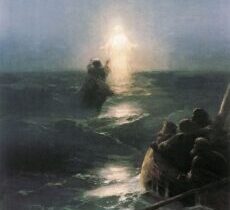
From the mountain he noticed that a great storm had arisen on the lake and the boat was struggling to stay afloat. So he went down from the mountain. Just before dawn, the disciples noticed something coming across the water. They most likely believed there were monsters deep in the lake who caused storms. Ghosts were also easily believable in the middle of a storm. So, when they saw a figure coming across the top of the water, they were terrified.

Jesus called out to them, “Take courage, it is I; do not be afraid.” Well, could that be true? Might that be the kind of thing a ghost would say to lure them into a false sense of security? Peter responded, “Lord, if it is you, command me to come to you on the water.” Jesus said simply, “Come.” And Peter went over the side of the boat and walked towards Jesus.

All was well until Peter stopped to think about what he had just done. He had stepped over the side of the boat, in the middle of a storm, on a deep lake and was now walking towards what was either a ghost or his friend Jesus. Since people don’t walk on water, it might have just been a terrible mistake on his part. As such thoughts entered his mind, he began to sink into the water. He called out, “Lord, save me!” and Jesus reached out a hand and saved him, saying “O you of little faith, why did you doubt?” The waters calmed and they got safely to the boat again.

The use of the term Lord was significant. That was a term used for God. The disciples recognized who their friend was and bowed down to honor him. “Truly, you are the Son of God.”

Once again, the storms raged, the winds blew, disaster was upon ordinary people, and the Lord was there, quietly reassuring them. Elijah on the mountain, and the Lord was in the quiet whisper outside the cave. Peter sinking in the waters of the lake. “Why did you doubt?” I am here in the midst of it all. (Mt 14:22-33)

We can think we’ve got everything under control. We want to share our faith and our experiences with others. We have a good job, or at least a steady one. Our children are healthy. And then something unexpected happens. We lose a job. A friend gets cancer. A pandemic shuts down the world. Forest fires darken the skies with smoke. Hurricanes and tornadoes destroy communities. And we wonder what we did wrong. Why did God let these terrible things happen to us? Did God do all of this to punish us? Are these indicators that the end of time is upon us?

I think it’s important to remember Jesus’ question, “Why did you doubt?”

What is it that you doubt? What do I doubt? Which promise of the Lord do I need to trust more deeply.

In this week, let’s try to remember to trust that we are loved deeply and unconditionally by our Lord. Whatever happens, it’s not that God is angry and out to get me. It may be that there are unexpected consequences to choices we have made, but God doesn’t set out to punish us. We are free to make our choices and they don’t always work out as we had expected.

Sometimes, the hard or unexpected things that happen are the result of the actions of others. In those times, the Lord is with us too, sharing in our pain and offering loving support to help us get through the troubles. He has been through hard times too. He knows our pain and suffering. He wants to help and offer a hand to lift us out of the waters of doubt and despair.

With Peter, we reach out to his offered hand. We return to the boat, having recognized our Lord.

Readings for the Nineteenth Sunday of Ordinary Time – Cycle A

Read More

Posted by on Jul 30, 2023

Wisdom – Thinking with the Heart

Wisdom – Thinking with the Heart

“Use your head!” “Don’t be a fool!” “Don’t waste what you’ve got, use it carefully!” “They wouldn’t be in this position if they’d just been more sensible!”

How many times have we all heard these kinds of statements, sometimes addressed directly to us? It’s a common understanding in Western culture that decision making is best done with the mind, a.k.a. the head. We think of the heart as the center of emotions, and emotions are not regarded as the best sources of good decisions.

In ancient Israel, the heart was seen as both the center for emotions and the center for decision-making. When the Lord came to King Solomon in a dream at night and asked what gift Solomon would like to receive, Solomon gave an unusual answer. He had become king at a young age and had to defeat many enemies, including one of his brothers, to establish control over the kingdom. Once that was settled, still a young man, he began to build his own palace and a Temple for worship of the Lord. Up to that point, the tablets of the Law had been kept in the Ark of the Covenant. Now it was time for a permanent home for them and a center for worship and sacrificial offerings.

Solomon recognized his inexperience and the challenges ahead of him in governing a large group of people. So, he asked for “an understanding heart to judge your people and to distinguish right from wrong.” (1 Kings 3:5, 7-12)

This pleased the Lord, who had expected a request for the usual kinds of things people wanted – long life, riches, conquest of enemies and so forth. But Solomon had asked for an understanding heart. The Lord’s response was heartfelt: “I give you a heart so wise and understanding that there has never been anyone like you up to now…”

Solomon is known to this day as Solomon the Wise. His reputation for wisdom spread throughout the ancient world and people traveled long distances to meet with him. As long as his decisions were based on the wisdom that came from thinking and listening with his heart, they bore good fruit. Later in life, when he forgot some of his earlier experience with the Lord and good decision-making, things didn’t always go so well. But the reputation from his earlier years remains. Solomon the Wise.

St. Paul spoke of something similar in his letter to the Romans. (Rom 8: 28-30) “All things work for good for those who love God.” Paul used a term in his letter that is often misunderstood today. Predestined.

We tend to think the word predestined means that everything is set up firmly and unchangeably ahead of time. Nothing anyone can do will change it. Some will succeed. Some will fail. It’s like a sports activity in which the winner is determined before the match begins and the competitor who may be better will deliberately compete more poorly, to meet the predetermined setup. On the big picture, spiritual side of things, some will go to a heavenly reward and some will go to eternal damnation. This can lead to a belief that we can tell who is going to be rewarded in heaven by how monetarily successful they are here on earth! Entire cultural systems have been set up based on this premise. We do our best and if we are pleasing to God, we will prosper. If we aren’t pleasing, then nothing we can do will help and no matter how hard we are working, we will be eternally punished.

What a terrible way to go through life! Who would want a God who would treat people that way? And yet, if that’s all we’ve ever heard, that’s likely to underlie much of our understanding of life.

Fortunately for all of us, predestined in the sense used by Paul doesn’t mean the same as what we expect. Predestined in this context means that God has decided to call us and help us become like Christ, ready to be in a positive, loving relationship with God both now and into eternity. Paul assures us all that God has chosen us from all eternity to become like his Son, the one firstborn of the many humans who will join together as sisters and brothers in the family of God. This is something worth celebrating and allowing to be a foundation of our lives.

So, what is this family of God, the Kingdom of God to be like? Jesus spent a lot of time trying to explain what the kingdom is. (Mt 13:44-52) “The kingdom of heaven is like a treasure buried in a field.” The kingdom of heaven is like “a pearl of great price.” Those who find the treasure or the pearl put it back where they found it in Jesus’ parables. Then they go and sell everything they have in order to buy the field (and the treasure) or the pearl. They don’t set up a spreadsheet and compare their assets and liabilities and determine whether this new asset will be more beneficial than sticking with their existing plans. No, they simply drop everything and choose the greater prize, the one they have marvelously come upon.

Jesus tells stories of wheat growing alongside weeds and fish, good and bad, swimming in the sea. Life is not set up with only good things happening to the good people and bad things happening to the bad people. There’s a share of good and bad for all. The trick is, how do we respond? And how do we respond to others whose situation may be more difficult than the one in which we find ourselves? Do we use our heads and try to protect what we already have at all cost? Or do we sometimes go out on a limb and saw madly behind us, hoping to help someone who is struggling or in need of a hand?

Wisdom is thinking with our hearts. As our hearts are soft, or softened, they become more pliable, more ready to love as our Lord has loved.

As we move through this week, let’s pray that areas of our hearts that are hardened will be softened, so that we can hear and think with the freedom and abundance of our God.

Readings for the Seventeenth Sunday in Ordinary Time – Cycle A


Read More

Posted by on Jul 23, 2023

To Weed or Not to Weed

To Weed or Not to Weed

When I was a girl, we had a big vegetable garden. The largest crop by far was the green beans. We all liked to eat them and we were a good-size family. Mom liked one particular variety of bush beans. She didn’t like pole beans, so we never grew them. The challenge with growing the beans was that there was a fungus in the soil that killed the beans if it got on the leaves. So, every year, when the soil was ready, we planted the seeds and watched the beans grow. As the beans sprouted, so did the weeds. Every year, just the same. As the bushes grew bigger and the beans began to grow, the weeds kept pace with them. That part of the garden looked a fright! But we never pulled the weeds as the beans were growing.

When the beans got big enough to harvest, we picked the first batch. It filled several washtubs and we all sat around the tubs of them on hot summer afternoons, cutting them to put into the jars for canning. We would eat those beans for the entire next year. A week or so later, a second picking would be ready and we again filled the washtubs with them for canning.  The difference was that after the second picking, we pulled out both the weeds and the bean bushes. There would not be another picking. By that time of the summer, the bushes were becoming infected and were going to die anyway.

I thought of this when I read the story Jesus told about the farmer who planted good wheat seed in his field and went home to a well-deserved rest. During the night, an enemy came and scattered weed seed in the field too. The scenario was not seen as outrageously improbable to Jesus’ audience. Family feuds were a part of life and such things would and could happen. With a grain crop, it can take a while before it becomes obvious that not everything growing in the field is the grain that was planted. An enemy who can ruin the crop would dishonor the farmer in the eyes of his peers. “How could he have planted weeds along with his wheat? Didn’t he know better? He must not be as good as we thought he was!”

When the treachery was discovered, the stalks of wheat and the stalks of the weeds were completely intermixed. The farmer would have had every right to take action against his enemy and the family of his enemy. At the very least, those who worked his fields expected that he would want them to pull the weeds out, so no one would see that they were growing among the good plants.

But the farmer took a different approach. Like Mom with the beans, he let the weeds continue to grow. Pulling them would have damaged the crop, because the stalks of the wheat would be trampled in the process of getting all the weeds out. Instead, he waited until the grain was ripe. Then the weeds could be pulled and destroyed. The wheat could be gathered and stored in the barn for use during the year.

Jesus explained to his disciples later that he himself, the Son of Man, was the farmer. The field is the world and the good seed represents the children of the kingdom. Those children of the kingdom can be led astray by others who are not of the kingdom, who deceive them and lead them to do evil. At the end of time, the children of the kingdom who have remained faithful “will shine like the sun in the kingdom of their Father.” The others will be like the weeds, destroyed as worthless instruments of hatred as were the weed seeds sowed by the farmer’s enemy.

This can be a rather frightening teaching. Would God really judge people so harshly and condemn the wrongdoer? What hope is there for any of us if that’s the way it is?

We get a hint of the answer in the book of Wisdom. This book was written sometime during the last hundred years before Christ. The author was probably Jewish, but Greek-speaking and possibly from Alexandria, Egypt. Alexandria was a great center of power and learning in the ancient world.

The author points out that God does not have to justify to anyone else actions He takes, because there are no other, or superior, gods. God’s own power is the source of justice. But that justice is not harsh. God’s mastery over everything leads to lenience to all. God teaches His people through mercy that they are to be kind and merciful themselves. “You taught your people, by these deeds, that those who are just must be kind…”

Those who choose to turn away from God and refuse to turn back and accept forgiveness, will remain separated, because God has given freedom to each person to choose how to respond. But God is merciful, and at the slightest turn toward the good, God will be waiting with open arms to welcome the one returning.

God is willing to wait, like the farmer with a field full of weeds, until each person, aided by the Spirit, turns to the Father of all, becoming part of the good harvest.

There’s a lesson for each of us here as well. When we are hurt or disappointed or embarrassed by someone else, we too have to decide whether to pull the weeds or patiently wait and hope that the situation will improve with time. Sometimes, things get better on their own. Sometimes they don’t. Sometimes, for our own safety, we have to pull the weeds – moving out of dangerous relationships or situations. But other times, we simply need to wait for someone to grow up or to realize that a change is needed. At that point, it’s better not to pull the weed and cut off the possibility of reconciliation.

Let’s pray this week for wisdom to know when to weed and when to wait as we deal with the good times and the challenging times of our lives.

Readings for the Sixteenth Sunday in Ordinary Time – Cycle A


Read More

Posted by on Jul 16, 2023

Rain, Seed, Harvest – the Word of God

Rain, Seed, Harvest – the Word of God

“My word shall not return to me void.”

One of the great mysteries of life is the way everything grows from a tiny beginning. Even single cell creatures must start somehow. Division of a single cell into two is a common mode of birth for such beings. But they are not fully grown at the time they pop into being. Both the old and new cells are smaller than the original one had become at the time of the division.

For larger creatures, dividing and forming an exact copy of an older one is not an option. The pattern we see is of a very small cell with genetic material that somehow guides it as it grows and changes into increasingly more complex states. Eventually, the organism gets large enough and developed enough to survive on its own and even reproduce.

The prophet Isaiah reminds the people of his time (and all of us) that the rain and snow which fall on the earth are essential for the growth of the plants on which we all depend. They come from the heavens and return only after fulfilling their role on earth. The Lord, through his prophet, says that his word is the same in this regard. The Lord’s word goes forth from heaven and does not return until its purpose has been attained.

Jesus speaks of this same reality and the conditions that affect the way the process unfolds. “A sower went out to sow.” Those who are not close to the land may never have experienced the scenario Jesus presents. Seeds are very small. Traditionally, they were scattered by hand out onto the fields. Later, machines were invented to throw the seeds out in a pattern onto the fields. Today, there are even more precise machines that poke the seeds into the soil one-by-one and add a bit of fertilizer to help the seed grow. There is much more accuracy to today’s planting methods, and presumably, better yields at harvest time. The newer method also allows farmers to care for the soil more effectively, not having to plow under the remaining short stalks and roots of the prior year’s crop and risk having the soil blown away in a windstorm or washed away in the rain.

But when Jesus was speaking, and even today for farmers around the world, seeds were tossed out across the land by the farmers. Fields are not typically surrounded by solid walls. They are bordered by roads or paths. The soil on the path or road is hard. Seeds may sprout, but only with difficulty. Lots of them become food for the birds or other small animals. Then there are the areas where there are lots of rocks. Not a lot of soil to cuddle around the roots of the plants there either. Again, they don’t survive in large numbers. They are easy to pull and dry out quickly. And then the thorns. Have you ever tried to grow a lawn or garden beside a berry patch? The berry plants send out roots far into the area around them. Anything growing inside the berry patch is not going to produce well. The berries pull the nutrients for their own fruit. It’s a continual battle to beat back the berries and let the grass grow. The same goes for wheat and other grain crops growing beside thorny plants.

Fortunately, there are large expanses of land which are not filled with rocks or thorns onto which the seeds also can fall. In a good year, with adequate rain and dry weather as the grain matures and harvest time nears, a good crop will be harvested.

I grew up in a family in which some members were and still are farmers. In Eastern Washington, farmers often grow winter wheat. It is planted in the fall and sprouts before everything gets too cold. Then the snow comes and covers the land. Growth stops, but the plants are protected from the extreme cold that would kill them if they weren’t small and insulated. As the snow melts, the ground is watered and growth resumes. By June, the crop is growing beautifully, forming heads of seeds for the next season. The plants don’t know it, but they are also growing to be food for humans and animals. As the season moves on to August, we all hold our breath. Will the weather hold until the grain can be harvested? Will the storms that inevitably come through go around the family farms?

Lives can be and have been changed dramatically by the luck of the weather. Two harvests-hailed-out in a row sent my grandparents from Montana to Spokane, Washington, where Grandpa worked as a brake mechanic for the city bus lines for the rest of his career. Other relatives had better luck. The harvests were good enough to keep going another year. It’s not surprising that farmers take pictures of their fields as the grain is growing. It’s so beautiful. And then they take pictures of the harvest too!

For Jesus, there was a lesson to be learned from the sowing and harvesting. The word comes forth from the Father. It lands in different ways among the people who hear it. Some simply don’t understand what they are hearing and are easily convinced that it means nothing for them. Some receive it happily, but when opposition arises, they don’t hold on to it. Some hear it and want to grow, but they get worried about the future and how they’ll get along, and they can’t keep going. But there are some who hear the word and it takes deep root within them. These are the ones whose faith sustains them, allows them to share with others, and carries the Father’s word forward in the world. The community grows as the word is shared and lived.

Sometimes we can get to thinking in very abstract ways about questions of faith. How does God do this or that? Who or what is God? Why does God let bad things happen? Why can’t God do bad things? Or can he? Many, many questions and concerns. But the very basic reality is that God is both practical and optimistic. God sends out a word to bring forth all of creation. God’s word is like a tiny seed, that grows and bears fruit, including seeds to continue the cycle. Each time, more are created.

St. Paul tells us that creation itself is waiting, groaning in labor pains, for the triumph of the harvest of the freedom of the children of God. The word of the sower grows in all of creation and in human society, as we learn to care for each other and this home we have in common, our Earth. When we accept the love and forgiveness of God, and become God’s children, the word is fulfilled and returns to the Father.

As we move through this coming week, may we be alert to the ways in which the word has been sown in our lives. Are we open to growing in love? Are we sharing a smile? Are we patiently helping a family member or friend who simply needs a hand now and again? Where are the seeds sown in our lives taking us? Are we ready and willing to go?

Readings for the 15th Sunday in Ordinary Time – Cycle A


Many thanks for this photo to my “cousin” Scott whose uncle and my aunt were married. Scott took this photo of one of his fields a few years ago.

Read More

Posted by on Jul 9, 2023

Easy Yokes and Light Burdens

Easy Yokes and Light Burdens

What do you expect of a ruler? Someone strong and decisive? Someone confident and willing to make decisions? Or someone who asks questions and listens carefully to the answers that come even from the lowest social and economic tier of workers?

Zechariah speaks in prophetic form of the ruler who will come to Jerusalem. “Thus says the Lord …” lets all know that these are not the thoughts or dreams of the one who speaks. They are words received in prophecy, oracles that shed light on the thoughts and plans of the divine.

And what does the oracle foretell? “Rejoice heartily, O daughter Zion, shout for joy, O daughter Jerusalem!” Why should Zion shout for joy? Because a king is coming who will not be a warrior. A ruler who is just and humble, so humble, in fact, that he will ride a young donkey into town. Kings typically arrived with a great retinue of folks – trumpeters, chariots, archers, foot soldiers, and finally, the carriage in which the ruler rode. Servants and courtiers also traveled with the ruler, to make a luxurious camp or set up housekeeping in the home of a local noble. Rulers didn’t ride donkeys, especially not very young donkeys. They rode majestic horses or in fabulous chariots or carriages.

But this ruler foreseen by Zecharia is to come proclaiming peace to the nations. This one will rule over all the land, not just the land of Israel. All the ends of the earth. When Jesus chose to enter the city of Jerusalem riding on a donkey, he was absolutely aware of this oracle and what it would mean to the people of his community. This was a claim to being the one who was to come, the king who would rule the entire world. The people who witnessed his arrival understood clearly what he was saying. So did the rulers of Jerusalem.

What kind of ruler would he be and who would recognize and accept him? Jesus had thought about who would be open to recognizing this long-awaited king. It would not be the wise and learned, the teachers and priests of the temple or the most educated people in each little town. It would be the ordinary folks, the “little ones” who must depend totally on God’s care and help to get by in their lives. These would recognize the Father’s presence in the Son’s love and teaching.

What kind of ruler? That’s the big question. Would this one who knows the Father personally throw his weight around and demand great works of daring and costly sacrifice to elevate his stature?

Jesus answers clearly. “Come to me all you who labor and are burdened, and I will give you rest.” I’m not going to demand that you keep working so hard before I love you. I don’t expect you to give me rich gifts and build up my ego. “I will give you rest.” I am humble and will serve gently those who come to me. “My yoke is easy, and my burden light.” I don’t ask for costly sacrifices, or long, unhappy, pressured hours of work. I will be there helping to make our time together pleasant and to share the carrying of life’s burdens.

As we move through this coming week, let us remember and rejoice with Daughter Zion that the Lord has come. The yoke of servitude has been replaced with a shared journey through life. No one is alone. The Lord is always with us, our partner in the yoke, helping us handle the challenges life throws our way and reminding us to reach out to each other in love and trust, so no one is left with an unbearable burden.

“My yoke is easy and my burden light.”

Readings for the Fourteenth Sunday in Ordinary Time – Cycle A

Read More
Posted by on Jul 2, 2023

What Goes Around Comes Around?

What Goes Around Comes Around?

A very human urge is to try to understand why something happens. If that something was something negative, we want even more to know why and then we ask what the consequences of that something might be. Think of children in the school yard. Some are very good at sports. Others are not. If those who are good at sports begin to pick on those who are not, there is every expectation that the teachers or other adults in charge will step in and stop the bullying. There is an expectation, or at the very least, a hope, that justice will prevail. In the eyes of those on the receiving end of the bullying, the hope may well be that the guilty ones will be punished. That doesn’t always happen. Sometimes, the guilty ones overstep and pick on someone who is stronger. In such instances, the originally bullied ones may take glee in the notion that “what goes around comes around” and the former bullies have gotten their comeuppance!

Now this is not necessarily the way we want to approach the world. If we all keep cheering for bad things to happen to the “bad guys,” things aren’t going to get a lot better. In fact, they will just keep getting worse. We might even discover to our dismay that we are starting to be seen as “bad guys.”

So, what to do?

The Scriptures point to another option. What if we assume that love is a stream of energy that flows continuously through all of creation and through each of us? That love doesn’t try to get even with those who behave badly and hurt others. Instead, that love aims to bring out the best in all it touches.

Elisha experienced that gift of love through the generous hospitality of a woman in Shunem who first invited him to dinner one day. As time went on, she and her husband hosted him often. Eventually, she arranged for a room to be prepared for him to use whenever he was in the area. Elisha was grateful for her hospitality and asked what gift might be given her in thanksgiving. His servant suggested that a son would be the best gift for her, because she had never had a son and so the gift was promised. The story continues beyond the short bit in today’s reading to tell of the birth of a son to her. It’s worth reading, especially remembering that women typically had no say in such matters as to who would be invited to dinner or to stay in a family home. Men made all such decisions. But this woman’s generosity was rewarded abundantly. The gift of loving welcome and hospitality was returned and amplified with the gift of a son. (2 Kings 4:8-11, 14 – 16a)

St. Paul speaks of baptism as an entry into the death and resurrection of Jesus. In entering into the water, a person enters into death. Upon rising out of the water, new life springs forth. The love of God flows like a stream of life, deeper than our physical world would lead us to imagine. With Jesus’ death, the power of sin was broken and the cycle of tit-for-tat was broken. Followers of Jesus live for God in Christ Jesus. (Rom 6:3-4, 8-11)

Jesus spoke strongly about what living in accordance with his teaching would require. The words are as jarring today as they were when he first uttered them. “Whoever loves father or mother more than me is not worthy of me…” Aren’t we supposed to love our families? Yes, but there’s more to what Jesus said than just the literal meaning of the sentence.

Jesus lived in a culture very different from our Western industrial culture of nuclear families with the expectation each will make their own way in life. In Jesus’ culture, the extended, corporate family was the basic unit of society. One was known in terms of the larger family. The head of the family was the oldest man, from whom the rest were descended. Women left their own family upon marriage and became part of their husband’s family. If they did not produce male heirs, they were considered worthless and might even be returned to their original extended family.

In this type of culture, the honor of the family is everything. One’s responsibility is to behave in a way that will not embarrass or otherwise harm the reputation of the family. If one’s family has a dispute with another family, there is no expectation that individuals will step outside their own family and do anything good for a person of the other family. Think of family feuds like that of the Hatfields and McCoys. Or the families of Romeo and Juliet, for that matter. When Jesus speaks of loving father or mother more than loving him, this is what he means. Loyalty to one’s family over loyalty to Jesus and the way he taught is not acceptable for his followers.

Do families take that kind of independent thinking and acting happily? Not usually. Even in our own nuclear families, it’s hard to take a stand that is contrary to the beliefs of parents or even siblings. Yet this is what Jesus expects of his followers – a willingness to take the risk of being misunderstood and even condemned for the refusal to conform to the expectations or the decisions of family or social group. This is taking up the cross, accepting the disapproval, the scolding, the mocking, even the rejection by those one has held dear, rather than conform to expectations that are contrary to the teachings of Jesus.

So what is expected of Jesus’ followers? What will come to them along the way? How will the stream of love show up? “Whoever receives you receives me, and whoever receives me receives the one who sent me.” The rewards for passing love along will correspond to those received by others. If one is receiving a righteous person because that person is righteous, then the reward will be the same as the one received by the righteous person. (Mt 10:37-42)

The actions that flow along in this stream of love may be grand and noteworthy. They may also be small and commonplace. A cup of cold water given to one of God’s little ones will be rewarded abundantly.

We are called to be channels of love and peace in our world. What goes around in a channel of peace may also come around, but it comes around in an ongoing, ever-increasing stream of loving action that will remake our world in God’s image. We don’t have to be perfect. We don’t have to do it all by ourselves. We just need to be open and generous in sharing the gift of love we have received. As we share in love, both the love and the basic requirements of life, we are carried along in the stream ourselves.

May we notice this week the times and ways in which the stream of divine love touches us. May we then open our hearts and hands to let it pour forward to others as well.

Readings for the Thirteenth Sunday in Ordinary Time – Cycle A

Read More

Posted by on Jun 25, 2023

We are Never Forgotten

We are Never Forgotten

Isolation is one of the most damaging factors that impacts our mental and physical health and well-being. It doesn’t need to be as extreme as solitary confinement in a prison or torture center. Isolation socially creates lasting scars. A child who is rejected and teased by peers grows up feeling unworthy of love and respect. An adult whose ideas are regularly mocked begins to think they are just foolish whims, not accurate perceptions of reality. An older person with no family or friends is more likely to die early than one surrounded by both. A people whose customs are different from those of the other people among whom they live can easily become hesitant to continue those customary activities. This is especially true for younger members of the community. Isolation sets in and fears of being forgotten.

As humans, we are social beings. We share this quality with other primates and many, many other types of creatures. We need each other for support, for development of necessary skills, for the basics of survival, and for physical and mental health. Those who are isolated do not survive as long.

In the recent past, we have all had a taste of isolation from family and friends when the COVID-19 pandemic shut down our freedom to venture out without worry into the world outside our homes. The difficulties of being with the same people all the time or of being alone all the time was somewhat mitigated by our access to social media and the internet. Zoom parties, meetings, school classes, and even wedding receptions filled some of the holes in our social lives. Our parish stepped up with Zoom gatherings in which we played actively as household teams in trivia contests and scavenger hunts. We’re still laughing here about the time my daughter-in-law grabbed me and put me in front of the camera as “something in the house older than you are!”  We won that point!

Prophets often find themselves in situations of isolation. Speaking truth to power does not typically go over well. Jeremiah, for example, didn’t want to be a prophet. He often complained to God about what a raw deal he had gotten in being called to prophesy. He tried hard not to speak, but the words burned within him until he simply had no choice but to let them out. And then, “I hear whisperings of many … all those who were my friends are on the watch for any misstep of mine.” (Jer 20:10-13) He was nearly killed for his telling of the truth he heard from the Lord about the coming conquest of Jerusalem by the Babylonians. Yet he remained faithful. “The Lord is with me, like a mighty champion.” He trusted that he was not forgotten and that he would experience vindication. The Lord “has rescued the life of the poor from the power of the wicked!” The Lord is to be praised for supporting those who depend only on him. They will not be on their own to get by. They are not forgotten.

St. Paul reminded the people of Rome that human imperfection (aka sin) has been part of our experience from the very beginning. The story of the sin of Adam is a way of explaining both this imperfection and the death in all its forms that accompanies imperfection. Paul spoke as a teacher of the Law, from within the Jewish tradition, as he proclaimed the wonder of “the gracious gift of the one man Jesus Christ” whose willingness to die rather than deny the truth overcame death for all. When one human being chose not to obey God’s command, all who followed were also separated from God. But when one human being chose to obey and give himself for the truth, all who followed were freed of that separation from God, that death. It was the grace of God, given as a gift from Jesus, that overflows to all. (Rom 5:12-15) No one is forgotten or excluded. No isolation anymore!

Does this mean no one will be in danger anymore? Or that no one will feel alone? Or that everyone will welcome the prophet who comes speaking truth to power? Unfortunately, the answer must be “No.” However, when Jesus was sending out his disciples to witness to what they had seen in their time with him, he reassured them. “Fear no one.” Speak boldly of what you have heard whispered or in the dark. All is to be proclaimed to the world now. It may not be well-received, but don’t worry. Those who can kill the body can’t kill the soul. (Mt 10:26-33)

Jesus used a beautiful image to express the loving care of the Father. “Are not two sparrows sold for a small coin! Yet not one of them falls to the ground without your Father’s knowledge.” For the poor, a sacrifice of small birds rather than of a larger animal allowed for compliance with the requirement to offer sacrifice at such times as the birth of a first son. The sparrows are of little monetary value, but even they are treasured by the Father.

In another homely image, Jesus reminded his hearers that the Father even knows how many hairs are on each person’s head. I’ll guess that most of us have no idea how many that might be, even as our hair gets sparser with age.

“So do not be afraid; you are worth more than many sparrows,” he says. Speak the truth you hear from me. Admit that you are my friend and follower of my teachings. I will support you and acknowledge you when you meet my Father.

Jesus ends these instructions with a rather disturbing image. “Whoever denies me before others, I will deny before my heavenly Father.” That would be pretty awful. However, it might be seen as a reminder that we all have a choice to be in union with God and others or to turn away. The Father never forces anyone to come for a hug of divine love. Neither does Jesus. It is always our choice to join with him or remain in isolation. When and if we turn back and acknowledge the Lord’s love, we will be welcomed. We won’t have been forgotten!

Today and this week, let’s pray that we will be open to see the Lord’s presence in our daily lives – through those we meet and the activities in which we are engaged. We are not alone. Even when we are by ourselves, the Lord is with us. May we always know the love of our family and friends. And may those who have been hurt or abused or otherwise traumatized and those who are suffering isolation and abuse right now, find a bit of healing and relief each day through the love and care of their friends.

Peace be with you. You are never alone or forgotten.

Readings for the Twelfth Sunday in Ordinary Time – Cycle A


Read More
Posted by on Jun 18, 2023

Without Cost You Have Received

Without Cost You Have Received

“Money can’t buy love.” God’s interaction with humanity might be summed up in this simple phrase.  It seems self-evident and we assume our interactions with family, friends, and strangers will start with this premise. However, all too often we forget. We start worrying if the person we are will be attractive enough, if the clothes we wear are of the “right” style, if the things we like to do are “cool” enough, if our economic or social situation will work against us. So many things to burden our hearts and minds.

For better or for worse, God doesn’t work that way. God met Moses on the mountain and reminded him of the way He had treated the Egyptians when He led the Israelites out of slavery. The Lord promises to love and care for this specific people above all others. In return, the Lord asks only that they live in covenant with Him. (Ex 19:2-6a)

Jesus too, in looking around at the people among whom he was living, teaching, and ministering, took pity on them because “they were troubled and abandoned,” like sheep without a shepherd. He envisioned an abundant harvest of hearts waiting for love, but not enough people willing to reach out and work in the harvest. He sent his followers to proclaim the coming of the kingdom by healing the sick, driving out demons, raising the dead. All this was and is to be done without charge, because all has been freely given to them. (Mt 9:36-10:8)

Jesus himself gave everything, including his life, as a free gift of reconciliation between humanity and the Father. The shepherd laid down his life for the sheep. It cost the sheep nothing. (Rom 5:6-11)

Today we too are called to love freely and share love with all we meet. We don’t typically cure illnesses or raise the dead to life again literally. However, a smile, a kind word, a patient willingness to wait our turn in line even when someone else is moving slowly ahead of us, all are gifts of healing we can bring.

The other day, an older man at the grocery store was trying to complete a purchase. At first, he couldn’t find his wallet, so he walked away from the checkout stand. The checker knew him and simply put the goods aside, ready to start on my purchases. Then the man called out the checker’s name and returned in great joy. He had found the wallet, in a different pocket than where he usually kept it. I told the checker I would wait for the man to complete his purchase. It should have been very simple, but it wasn’t. When the final total was reached, the man tried to use his debit card to make the payment. He tried two different PINs, neither of which worked. He didn’t want to try too many times and lock the card, but decided to try one more time. Very carefully, he entered the number, and it worked! He was amazed and delighted. I smiled at him and said simply. “See, third time was a charm,” echoing what he had said just before trying the third PIN. He had been feeling upset and ashamed that it had taken so long to do a simple task, but now his spirits were lifted and his embarrassment ended. As he picked up his purchase to leave, he tipped his hat and bowed to me, with a happy smile. I responded in kind and he went on his way, with a spring in his step. For a short while anyway, something within him was healed.

We are all called to serve our world, our sisters and brothers, in simple, everyday, ordinary ways. When we do, the Kingdom of God is here. We have received without cost. Now we give freely of what we have received.

Readings for the Eleventh Sunday in Ordinary Time – Cycle A

Read More

Posted by on Feb 19, 2023

Be Holy

Be Holy

Be Holy.

Two simple words, but what a challenge to obey them! The Lord instructed Moses to speak to the community of Israelites and tell them, “Be holy, for I, the Lord, your God, am holy.”

What does it mean to be holy? The book of Leviticus is the third book of the Hebrew scriptures. In this book, the many rules and regulations for how the people are to live are laid out. In this particular chapter (19:1-2, 17-18), there is a listing of things (in verses 3 -16) that many of us would recognize as part of the Ten Commandments. We don’t hear that whole list in the selection for our reading today, however, only the command to love our fellow humans as we love ourselves. Hatred, anger, revenge, grudges – all are prohibited because they are not the way of love.

Jesus in the Sermon on the Mount also refers to the law as set forth in the books of Exodus and Leviticus when presenting the instructions for his followers. (Mt 5:38-48) He mentions the injunction that allows taking “an eye for an eye and a tooth for a tooth” from those who harm others. We hear that and are appalled at the thought of such punishment. Nevertheless, this statement from the ancient Law was actually a huge step forward in its time. It limited revenge for injuries inflicted on others to no more than what the one who was guilty had done to another. No more killing an entire village because one member had injured someone from another village or insulted someone more powerful!

Jesus takes it a step further. “Offer no resistance to the one who is evil,” and gives concrete examples from life as experienced in his community and by those to whom he spoke. For example, Roman soldiers were allowed to require people to help transport things for a mile, whether it was convenient for them or not. Jesus says, give them two miles rather than one mile. Some have suggested that in this, he was actually giving people a way to protest the law that required one mile. It put the soldiers into a difficult position, because they were left to explain why the person had carried the burden for two miles! Had they broken the rule themselves and forced the extra service? Whether that was it or not, the idea of giving extra service to the soldiers of a hated conquering nation was quite unheard of.

Then there’s that little bit about loving enemies… What a crazy idea. But Jesus insists. Anyone can love people who are friendly and treat them well. It’s much harder to behave lovingly to those who treat us badly. Still, Jesus points out, God doesn’t treat those who do evil badly. God treats all with the same gifts of sunshine and rain – the things they need to live.

If we love only those who love us, we are like everyone else. But to go that extra step (or mile) and be good and kind and loving to those who hurt us – well that is beyond the norm. That enters into the realm of the divine, the realm to which we are called. The realm of the Holy One.

St. Paul reminds the people of Corinth and the people of the world today that we are the new temple of God, because the Spirit of God lives within us and within our community. (1Cor 3:16-23) As part of that temple, we ourselves are holy too. But how to be holy? It’s not through the ordinary wisdom for getting ahead in life. In the eyes of God, that is foolishness. We are called to embrace God’s foolishness – that of caring for others, loving enemies, helping those in need. Every member of the community has a responsibility to every other member. Each person belongs to us as family, we belong to Christ as family, and Christ to God. Here we find ourselves again, called to be holy, because God is holy and we belong to God.

So as we pass our days this week and enter into the holy season of Lent on Wednesday, let’s remember to look for the ways in which we get to practice the holiness of God by being loving and forgiving, patient and kind to all those we meet each day.

Readings for the Seventh Sunday in Ordinary Time – Cycle A

Read More

Posted by on Feb 12, 2023

Going Deeper with The Law

Going Deeper with The Law

In the Sermon on the Mount in St Matthew’s Gospel, Jesus says several times, “You have heard that it was said … But I say to you…” (Mt 5:17-37) Each of the things Jesus says takes the requirement farther than the original teaching from Mosaic Law seemed to go. It’s not enough to refrain from murdering someone, even getting angry and holding on to the anger is too much. It’s not enough not to be unfaithful to a spouse. Even harboring unfaithful thoughts is too much. It’s not enough not to swear a false oath. Don’t swear oaths at all. You really have no way to back it up.

We so often are tempted to split hairs. Well, she didn’t really say I couldn’t stop for ice cream on the way home, she just said to come home! Well, it’s only a little untruthful, what difference will that make? What right does he have to tell me what to do anyway? It won’t hurt anything to do it my way instead! And so we justify what we want to do, regardless of what is asked of us.

But Jesus wants us to look at the underlying meaning of the commandments. How do we live out the spirit of the law rather than the letter of the law. It’s in the spirit of the law that we learn the wisdom of God and choose life. He was very clear on this. He didn’t come to overturn the Law. He came to fulfill it.

Does that mean that we have to take everything we hear in scripture at face value, even if our culture is very different from Jesus’ culture? No. But we need to understand what the reasoning was for his teachings. For example, when he speaks of divorce, it is about a different social reality than we know today in our Western culture. In his time and culture, a man could divorce a woman, but a woman could not divorce a man. Beyond that, once a woman was married, she was the responsibility of her husband’s family. Her family was no longer responsible to support her in any way. If her husband divorced her, there was no one to look out for her. She had no income, no home, no support. That’s why Jesus spoke of such women as having to commit adultery. It was the only way a lot of them could survive, but their survival method put them in violation of the letter and spirit of the law.

How about that business of gouging out an eye or cutting off a hand that causes us to sin? Not to be taken literally at all. But we need to act definitively sometimes to cut out the things from our lives that lead us to make the wrong choice or to go down the wrong road. If watching TV in the evening leads me to get angry with the baby who interrupts my watching, it’s not the baby’s fault. I need to cut out the TV watching. If having the computer in my bedroom leads me to watch YouTube rather than do my homework, maybe I need to keep and use the computer only in a public area of my home. If being around people who are smoking or drinking makes me want to do it too, or if I can’t resist their offers to join in, maybe I need to hang out with other people.

Sirach (15:15-20), long ago, presented a series of choices the Lord offers that ring true today. Fire or water? Life or death? Hang on to anger and revenge – you’ve chosen a fire that will eat at you and eventually destroy you. Choose water and you can be washed clean of the anger and other negative emotions – you are choosing life. Wisdom comes as we choose the path of life again and again over time. And sometimes, it comes as a result of having to turn from the wrong choices and the messes that have resulted when we made them. Turning from death to life.

God doesn’t force us to do anything we don’t want to do. That is a key reality of love. Freedom to choose. But God also doesn’t shield us from the consequences of our choices. God is simply there to help us pick up the pieces when we realize our mistake and make better choices the next time around. Then God gives us a big hug to let us know how much we are loved, even when we mess things up royally.

So, as we listen to the readings from Sirach, St. Paul (1 Cor 2:6-10), and the Gospel today, with all of these more demanding instructions, let’s remember that we are called to hear a deeper meaning to the rules. We’re to hear the meaning that seeks to call us to be our best selves and choose the path of life and love rather than sinking more deeply into the morass of anger, selfishness, deceit, and all that goes with them, all the while thinking we are keeping the rules as they are literally formulated. We are called to go deeper.

Readings for the Sixth Sunday in Ordinary Time – Cycle A


Read More

Posted by on Feb 5, 2023

Light and Salt – Justice for the Poor

Light and Salt – Justice for the Poor

Salt of the earth, light for the world – the essential calling of the disciple is to live a life that shines with the goodness of the Lord, a light that shines in the darkness, so those who see it understand the glory of the Father in heaven. (Mt 5:13-16) Jesus is very clear on this point. It’s useless to live in a way that hides the light of love from others or that does not season interactions with love and care for others, because then God’s glory can’t shine forth into the world of human social life.

This insight of Jesus was not unique to him. We often think that Jesus thought up most of what he taught, but actually, there is a long tradition in Judeo-Christian thinking that focuses on the interaction between those who have the necessities of life and the power that goes with it and those who do not.

The prophet Isaiah spoke very clearly of this (58:7-10), in words that many of us first heard spoken by Jesus about the final judgement in which the “sheep” would be separated from the “goats.” “Share your bread with the hungry, shelter the oppressed and the homeless, clothe the naked when you see them…” These words of Isaiah were spoken to a people returning from exile in Babylon. To the extent that they created a new society in which justice and care for the poor and oppressed were foundational, the light of that society and its people would break forth like the dawn into the world. The Lord would be present among them and be a source of protection and healing for them. “Light shall rise for you in the darkness…”

This kind of life is not to be a source of pride for Jesus’ followers. It’s certainly not a message that is easily accepted in a world in which those with power don’t easily share resources with those who have nothing to give them in return. But as St. Paul points out (1 Cor 2L1-5), the persuasiveness of the message of the Gospel is the result of the demonstration of Spirit and power that flow from the positive change that the foolishness of the message and lifestyle produces. Doing hurtful things leads to anger and revenge – an intensification of the evil that provokes them. Doing good things for others leads to more goodness being shared.

How does this play out for us today? We have a lot of social safety nets that are intended to help protect and support those who for one reason or another are unable to earn the money needed for food, clothing, shelter, healthcare, and education for themselves and their families. These programs provide essential support to a lot of people that we might not ordinarily realize are struggling.

As an insurance professional specializing in health insurance, I hear a lot of stories from people struggling to keep food on the table and a roof overhead for themselves and their children. I often work with middle-class people who suddenly find their income crashing and discover that what they always took for granted is not guaranteed for all in this country. I explain how the social safety net works, based on my own experience with it, and encourage them that it’s not the end of the world if they need to move to Medicaid (known as Medi-Cal in California) for a period of time. I encourage them to look at the supplemental nutrition programs for their families (aka, food stamps) and to take advantage of the help, so that they have a chance of getting back on their feet. Sometimes I work with people who will never be able to support themselves, due to illness or injury, including mental illness or addiction. It is a great joy to me to be able to offer help to those who are despairing of ever living a “normal life” again. On more than one occasion, I have had people react with tears of joy to know that their prayers have been answered and help is available. Not a common experience in the insurance field.

And yet, there are still folks who have even less and don’t qualify for this governmental help. We think of refugees and asylum seekers in this category. It’s not easy for them to get along and figure out how the very different legal and socio-economic systems here work. Lots of people are involved in helping and offering a welcoming hand to these new arrivals.

Once they have been here for a while, there are still obstacles. I worked with a young person the other day who is a DACA recipient. They can’t get a policy through the Affordable Care Act marketplace because we as a nation have not yet come to terms with the fact that these young people are ours just as surely as if they had been born here. We have raised them and educated them and shared our dreams, visions, and expectations with them. They have jobs and businesses and are giving back to the country which raised them. And yet some of us still want to throw them out because their parents brought them here so they could be safe from the violence or oppression in their native communities. Fortunately, my young client was able to afford insurance outside of the subsidized plans. Not all are so fortunate.

How do we react to the discrepancies in income and opportunity in our country. Do we work to make sure the hungry have enough healthful food to live a decent life? Do we complain that a homeless person has been given a cell phone so they can get medical care and other essential services? Have you tried to find a pay-phone in a telephone booth lately? Without a cell phone, it’s next to impossible to access basic services if one does not have a home.

As you may have guessed by now, these are questions and issues about which I am rather passionate! I see too many folks on a daily basis who are struggling and I know the great blessing that having folks who are willing to share their bread with the hungry, to clothe the naked, and find homes for the homeless can be.

If you ever wonder about the wisdom of the Gospels and of efforts to help those who struggle, I encourage you to volunteer with others from your Church community or other social service programs. Get to know some of the folks who serve and some who are served. There’s a tremendous richness in the encounter and a deep, deep faith among those who have nothing but faith to hold onto.

“Light shall rise for you in the darkness, and the gloom shall become for you like midday,” says Isaiah. “Your light must shine before others, that they may see your good deeds and glorify your heavenly Father,” says Jesus.

Here we go on the journey together.

Readings for the Fifth Sunday in Ordinary Time – Cycle A

Sunday Mass at Resurrection Catholic Community, Aptos, CA

Read More

Posted by on Jan 29, 2023

He Went up the Mountain

He Went up the Mountain

The Beatitudes are front and center in the liturgy today.  Jesus goes up the mountain – just as Moses went up the mountain to receive the original Law, a short part of which are the 10 Commandments. Matthew’s positioning of this teaching as taking place on the mountain makes it clear that this is the new law which Jesus is bringing to all right from the beginning. (Mt 5:1-12a) It’s not given to him by God, as the Law was given to Moses. He is the one teaching them.

Yet what Jesus is teaching is not entirely new. The prophets long before the time of Jesus called the ordinary people, the humble of the earth, to follow God’s law, seeking justice and humility, speaking the truth, living in peace, and taking refuge in the name, the power, of the Lord. Jesus too speaks of the humble, ordinary folks of the earth. It’s not the rich and powerful who will make up the kingdom of heaven or make it a reality on Earth. It’s those who are not ambitious for power and fame but who are hungry for righteousness, for doing what is right and good rather than what might be more profitable. It’s those who are merciful and look at the world with pure hearts, those who work for peace and who mourn the losses caused by greed or ambition.

This is the new law Jesus brings to us, laid out right near the beginning of his public life, shortly after the call of his first disciples. Yet it’s not a law that will be easy to accept or to live by. He speaks clearly of persecution, insults, and evil worked against those who will follow this law. Still, the reward for faithfulness is the kingdom of heaven, a kingdom in which their hunger for justice will be satisfied, they will experience mercy and be comforted. They will be known as children of God. Not a bad outcome, all in all.

Easy to live this way? No. Not at all. Does it make sense in everyday life? No, not really. Yet it’s the foolish who live as he teaches who will show the way to life. It’s only through the grace, the help of God, that we can live this new way.

We have been called and have received an amazing gift, to live in the Lord and by the wisdom he brought to that mountainside. The kingdom begins as we live as he has called us to live, following the instructions he gave so long ago.

The Beatitudes are not the entire teaching from Jesus on that day on the mountain. As was the case with the original Law given on Mt. Sinai, there is much more that Jesus taught his disciples that day. We’ll be hearing more of this right into the beginning of Lent on Ash Wednesday. Here we go on the journey. Much to see and learn as we travel along the way with Jesus.

Readings for the Fourth Sunday in Ordinary Time – Cycle A

Read More

Posted by on Jan 22, 2023

A Voice Calls to You – Do you hear?

A Voice Calls to You – Do you hear?

Have you ever received a phone call, a text, or a letter inviting you to an event or an activity that you would never have considered attending? It might even be an invitation to something that you didn’t know existed, something so totally out of character for you that you are surprised anyone would ever associate you with that!

My initial reaction in these moments is to decline. “No, I can’t possibly do that.” “I don’t have time.” Usually I don’t say, “Are you crazy? Why would you think I would ever be associated with something like that?” I may be thinking that, but I try to be polite as my mother taught me.

Nevertheless, there have been times when I didn’t say no to the invitation. Invariably, I have learned something important in the process.

I was never into rock and much of the contemporary music of my day as a teen and young adult. As a result, the thought of attending a Grateful Dead concert never entered my mind. Yet as an adult in the late 70s and early 80s, I was working with a group, the Seva Foundation, that was trying to combat preventable blindness in Nepal. (I discovered I was not good at fundraising in the process, but that’s another story.)

One of the folks with whom I was working knew someone from the Grateful Dead and was able to instigate the planning of a benefit concert that included some members of the Dead, along with many other folk and rock artists who were well-known musicians and activists. We were invited to attend as well.

That night, as we stood in line at the will-call ticket booth, a young woman ahead of us, clearly rather “spaced-out,” approached the booth. She went up to the window and warmly greeted Jahanara, who was handing out the tickets. Jahanara smiled and greeted her in return. It was clear the young woman was not there to pick up tickets, but it didn’t matter to Jahanara. There was a warm smile and a wish for a happy evening. Then the young woman walked away peacefully.

I have often reflected on that encounter. I don’t know that I would have had the grace that Jahanara exhibited that night. I might instead have been irritated that the young woman had wasted my time and that of the folks in line. But I think Jahanara’s response was the way Jesus would have responded. I have never forgotten that moment of grace.

Liturgically, we are in a time of hearing about the events in Jesus’ life that led to its climax with his passion, death, and resurrection. We have heard about John the Baptist’s testimony. Today we hear about what happened after John had been arrested by Herod but before his execution. (Mt 4:12-23) Jesus moved from Nazareth to Capernaum and began his journey of preaching: “Repent, the kingdom of God is at hand.”

Capernaum is on the shore of the Sea of Galilee. It’s a very big lake and many folks made their living as fishermen. As he walked along the lake, he saw Andrew and Simon throwing their nets into the lake. He called to them, “Come after me, and I will make you fishers of men.” That seems a crazy thing to say and they responded in an even crazier way. They left their nets right there and walked on with him. Then they saw two other brothers, James and John, in the boat with their father Zebedee. Jesus called them as well. They left their father and went off with him.

These were absolutely outrageous things to do. Totally irresponsible and unheard of. Yet because they heard the invitation and responded, they became witnesses to the greatest event of salvation history – the reconciliation of humanity with God.

Most of the time our own encounters with strangers don’t seem to have cosmic implications. Most of the people we meet on the street or in the grocery store are pretty ordinary folks, with ordinary lives and hopes. But I think we make a great mistake if we assume that because they seem ordinary, there is nothing special about them. Each of us is here for a reason. We mostly have no clue what that reason is, but God has a reason for each of us to be here. There is someone we are to greet. Someone with whom we are to share a smile. Someone who just needs to be seen by another person and treasured as one of God’s special ones.

When Jesus comes into our lives, it’s not generally going to be with trumpet blasts and fanfare. Very likely it will come in the form of an invitation to do or try something that we would not ordinarily do. Who would ever have thought the I would go to a concert and enjoy the music of the Grateful Dead? But I did and it was a wonderful experience. And in the process, I saw the Lord reaching out in kindness to a young woman who needed to hear a gentle word that night.

Jesus continues to walk among us, mostly unseen. He is present in each one of us and wants us to reach out to each other and to those we meet, sharing the great love the Father has for each of his children. We too are called to leave our ordinary “nets” and follow along with him. He will make us fishers of men, women, and children too.

A voice is calling. Do you hear him?

Readings for the Third Sunday in Ordinary Time

Read More