Pages Menu
RssFacebook
Categories Menu

Posted by on Jan 8, 2023

Epiphany – The Light Shines Forth

Epiphany – The Light Shines Forth

A great light shining forth in the darkness. A manifestation of something unusual. A new understanding of something. All are included as meanings of the term epiphany and are not mutually exclusive. More than one meaning can apply to any particular situation.

Since ancient times, Christians have referred to various events in the life of Jesus of Nazareth as epiphanies. He was born. He was visited by wise men from the east. He was baptized. He was seen after the resurrection. All of these events have been described by the term Epiphany.

The Epiphany of the Lord, celebrated in the Roman Catholic Church on the first Sunday following January 1, is the day we remember the visit of the sages from the East. These scholars watched the skies for signs that something important was happening somewhere in the world. Each part of the sky, each constellation, carried a meaning. If something changed within that section, it meant something was changing for humans too. Accordingly, when they noticed a new light appearing in a region of the sky related to the land of Israel and to royalty, they went to see who had just been born. (They lived close enough to this event to go for a visit!)

St. Matthew (Mt 2:1-12) tells of their visit and gives us an historical time frame that also tells us approximately when Jesus was born. “In the days of King Herod …” Herod was king from 37 to 4 BC, so Jesus was born during that time. The travelers stopped at the royal palace to inquire for the new child, a reasonable thing to do, given that the child was born to be a king according to the stars.

The wise ones were sent on to Bethlehem, where indeed they found the child and his parents, no longer in a stable, but in a house. Their gifts were shared and they returned home without checking in again with Herod. An angel had warned them in a dream that Herod was not to be trusted.

This event was and is seen as the first time non-Jews were welcomed into the new manifestation of God’s kingdom of love for all humans. In the past, it had been understood that people would come from all over the world to Jerusalem, to the house of the Lord. But the full meaning of the prophecy of Isaiah (60:1-6) was not totally obvious. “Nations shall walk by your light … your sons come from afar and your daughters in the arms of their nursemaids.” These words originally were spoken in terms of the return from Babylon to Israel. But the early followers of Jesus understood them to refer to people of all nations who would become part of the people of God, children of the covenant centered in Jerusalem.

On this day we celebrate that we are included among the many nations that rejoice at the light dawning with the coming of Jesus. We bring the gift of ourselves to the community of faith. Together we offer our gifts and talents along with the bread and wine on the altar. We sing of three kings coming to visit a baby. May we also sing with reference to our own lives. “Star of wonder, star of night … guide us to the perfect light.”

If you have time and are so inclined, it’s fun to make a Kings Cake / Rosca de Reyes to share with family and friends on this day.

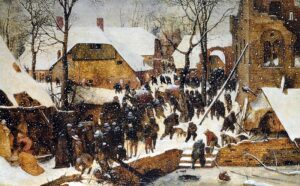
Illustration: The Adoration of the Magi in the Snow – 1563 by Pieter Bruegel the Elder – Look for the magi in the lower left corner of the painting!

Read More

Posted by on Jan 1, 2023

Mary of Nazareth – Mother in Faith

Mary of Nazareth – Mother in Faith

The first day of each new calendar year we celebrate the wonder of God’s blessing in becoming one of us. Without the consent of a young woman, barely past girlhood, it could never have happened. This is not a case of a deity forcing himself on a woman or seducing her. The child is not a demi-god. This child, born of this young woman, is fully human and fully divine. It’s a mystery that we can’t explain and it took many years before it was established as the formal, uncontested, belief of the community of Followers of the Way, the Christians.

We hear the blessing the Lord God instructed Moses to bestow on the people. (Num 6:22-27) “The Lord bless you and keep you! The Lord let his face shine upon you, and be gracious to you! The Lord look upon you kindly and give you peace!” And how does God do that? In the fullness of time, God comes among us as a child, his very own Word made flesh, a son. And because of this great gift, we too share in the reality of being children of God. (Gal 4:4-7)

Was this just for the rich and powerful of the world? No. It was first announced to a teenage girl, who agreed to become the mother of this very special child, then to the man who would be his earthly parent, and when he was born, to shepherds. Shepherds were not admired or particularly respected folks. They lived with their sheep. But they heard the words of the angels and believed. They visited the child and his parents, then returned praising God for this gift. (Lk 2:16-21)

The Gospel today concludes with the statement that on the eighth day after his birth, the child was circumcised (making him a member of the Jewish community) and given the name Jesus, as instructed by the angel before his birth.

“And Mary kept all these things, reflecting on them in her heart.”

We too are called to reflect on them. Mary became Mother of God. She wasn’t protected from the hardships of daily life. She didn’t always understand what was happening. She certainly didn’t expect this baby to grow up to become an itinerant preacher and miracle worker. Her heart was broken as she saw him die. Yet from the beginning, she agreed to be his mother, raising and loving him, reflecting on it all in her heart.

We honor her today and imitate her faith in our daily lives.

Read More

Posted by on Dec 30, 2022

Family In Its Many Facets

Family In Its Many Facets

Families come in many shapes and sizes. It’s something of a cliché to say that, but it’s true. We are each part of a family. Some are born into the family in which they grow up. Others are chosen and adopted into a family. Some are sheltered and loved by a family into which they were not originally born. But families are an essential part of the healthy development of any human being.

And about that many shapes and sizes part – there’s a lot of variation there too.

In some cultures, only one’s father’s side of the family are considered to be relatives. In others, it’s mother’s side. In a few (our own included), both sides of the family are relatives.

Then there are the “fictive kin” – the folks with whom relationships are established by choice of adults in the life of a child, or later by the individuals themselves. Godparents are fictive kin, for example, considered to be sharers in the responsibility of raising the child.

There are folks to whom we give kinship titles simply because they are older adults in our community or the network of friends of our relatives. We had several older women whom we called Grandma when I was growing up. One was the mother of an uncle by marriage. Another was the mother of friends who generously shared her love with us too. In some cultures, adult men and women are addressed as Uncle or Aunt.

And then there are the families that grow together in close friendship through many years spent together. We shared our lives with another family as children. Our parents became very close friends over the years. We traveled to see each other often and spent Thanksgiving together nearly every year. (The roads were too dangerous for regular travel again until February or March after that weekend.) When they moved to our community, we shared meals and time together at least a couple of times a week. We are still fond of each other and enjoy our time together.

These thoughts come to mind as we celebrate the Holy Family. Jesus was born into a family. When Joseph accepted Mary as his wife, he became the legal and social father of Jesus. How the conception of Jesus occurred didn’t matter. Joseph became Jesus’ father, responsible for loving him, teaching him, raising him to be a good man. Joseph did a fantastic job of being a father, just as Mary did a marvelous job of being a mother.

Jesus, Mary, and Joseph were not an isolated family. They lived, loved, and grew together within a community of other people in their village. This foundation prepared Jesus to go out when the time came and share the news that each of us is loved as a child by the Creator of all. We are so loved that we are to call that creator Dad/Daddy/Papa/Father. The term he used is Abba and is used by children to this day to speak to their fathers.

On this Feast of the Holy Family, let us rejoice in the gift of family and pray that in our lives we too will grow in wisdom, age, and grace through our days spent in ordinary activities and the special times that we share. May we each become part of a Holy Family too, dancing our way into eternity.

Readings for the Feast of the Holy Family

Read More

Posted by on Dec 23, 2022

Sometimes things don’t go as expected.

Sometimes things don’t go as expected.

Have you ever had one of those days when you get up in the morning with all sorts of plans and almost immediately they start getting derailed? I think they happen to all of us from time to time. Sometimes the plans can be picked up again the next day. Other times they are simply gone and we have to move on to the next step.

This kind of experience is not unique to people of our time. Ahaz in the eighth century BC was king of Judah. The Assyrians were moving south, conquering any nation that wasn’t willing to be one of their territories. Ahaz had to decide whether to ally his kingdom with that of Israel to the north, which was planning to resist Assyria, or whether to trust God to help and protect his kingdom and its people. The Lord told Ahaz to ask for a sign, anything at all, to indicate that the Lord would be with Judah in the days to come. Ahaz refused to ask for a sign and Isaiah spoke a prophecy of what would be the sign. “The virgin shall conceive, and bear a son, and shall name him Emmanuel.”

Many generations later, a young woman was visited by an angel and agreed to become the mother of a child. The challenge was that she was only engaged, not yet married. The man to whom she was engaged cared about her enough that he didn’t want to denounce her to the authorities as having been unfaithful before she was even married. He decided to end the engagement quietly, so she could go away, have the child, and continue to live. The penalty otherwise could have been stoning.

Joseph went to sleep after making that decision and was visited in a dream by an angel, a messenger of God. The angel reassured him that Mary had not been unfaithful. The child had been conceived by the power of the Holy Spirit. The angel told him the name he was to give the child. It was the same name given to Mary for her child when Gabriel visited her with God’s request. Jesus. The angel quotes the prophecy from Isaiah in which the child is called Emmanuel. The name Emmanuel means “God is with us.”

Joseph believed the words of the angel. He took Mary into his home as his wife. This descendant of David became the father of Jesus by choosing to accept him as his son. The ancient promise made to David that the Messiah would come from among his descendants was to be fulfilled. The sign given to Ahaz was also fulfilled.

Like Ahaz, Joseph, and Mary, we don’t always know what will come of the unexpected in our lives. We can only trust that somehow, God is in charge and will make things right.

Readings for the Fourth Sunday of Advent, Cycle A

Read More

Posted by on Dec 11, 2022

Here is Your God

Here is Your God

Today is the Sunday known as Gaudete Sunday – Rejoice Sunday! The Third Sunday of Advent. The readings all point towards the coming of God’s kingdom.

Isaiah (35:1-6a,10) speaks of the God coming with vindication and recompense to save the people. When that happens, “the eyes of the blind will be opened, the ears of the deaf will be cleared.” The lame will walk freely and those who are unable to speak will sing. Those ransomed by the Lord will return singing to their land. These words were spoken to a people invited to return to exile from captivity in a foreign land. Many needed a lot of convincing. They are in invitation to us as well. Will we need as much convincing?

Here is Your God.

Where? A question asked through the ages.

St. James (5:7-10) encourages the people of his time, “Be patient … until the coming of the Lord.” Farmers must wait for their crops to grow and mature. We too must wait for the kingdom to grow and mature. Don’t complain. The Judge will be here soon. Remember the prophets. The words they spoke reflected a reality that was to come, not a reality they were already experiencing. We too must be patient.

John the Baptist’s disciples asked Jesus point blank, “Are you the one who is to come?” (Mt 11:2-11) John had preached repentance and the coming of one who would judge wrongdoers. Was Jesus this one?

Jesus responded by referring to the words of Isaiah: “The blind regain their sight, the lame walk, lepers are cleansed, … and the poor have the good news proclaimed to them.” This is the sign. These are the things that will happen when the Lord comes to rescue all of us.

Jesus did not repudiate John. He praised his cousin for his faithfulness to his calling – to be the one calling from the wilderness to prepare the way of the Lord.

Jesus concluded his answer to John’s disciples with the words, “Blessed is the one who takes no offense at me.”

How do we recognize the coming of the Lord? Will it be through the advent of great signs and wonders in the sky, or floods and earthquakes, or other frightening things? No. It will be as we see God’s little ones receiving care and attention. Healing, education, shelter, adequate nutrition, and the chance to live with the dignity of the children of God.

Blessed are we when we do not take offense at the efforts of our sisters and brothers who work to bring social justice and peace to our world.

Rejoice! The Kingdom of God is near! The Lord is coming into our midst!

Readings for the Third Sunday of Advent – Cycle A

Read More

Posted by on Dec 4, 2022

“A Shoot Shall Sprout from the Stump of Jesse”

“A Shoot Shall Sprout from the Stump of Jesse”

Redwood trees in California grow to tremendous heights and can live for thousands of years. Their bark is highly fire resistant. Even when fires come, the trees historically have lived on, scorched, but still standing. They have very tiny cones for such large trees. Folks who visit redwood forests sometimes assume that these giant trees must have very deep roots in order to continue to stand tall through the centuries, sometimes supporting other trees and plants that grow high in their crowns. They wonder how such small cones can lead to the sprouting of such massive trees.

In actual fact, redwood trees have shallow roots. Their roots intertwine with those of the surrounding trees and together, they hold each other up. Their cones and tiny seeds are not essential to the continuation of the forest either. Though some trees can grow from seed, most do not. More commonly, new shoots sprout up from trees that have reached the end of their days and fallen to the ground. These new baby trees grow to new heights of their own. The fallen trees are sometimes called nurse trees.

Redwoods came to mind when I read the words of Isaiah (11:1-10) about the coming of the one who will restore peace among all creatures and with the Lord who made them. “On that day, a shoot shall sprout from the stump of Jesse, and from his roots a bud shall blossom.”

Jesse was the father of David, the shepherd who was secretly anointed to become the second King of Israel. Many years had passed and the kings of Israel were not always faithful to the Lord in their role as leaders of the nation. It was as if the tree of Jesse had been cut down or had fallen and died. Nothing remained but the stump – descendants of Jesse and the promise that the messiah would come from his line.

Isaiah reminded the people that the promise still remains. A new leader will arise from Jesse’s line. This new person will not be a corrupt king. No, the spirit of the Lord will rest on this one, bringing gifts that will set him apart from others. Wisdom, understanding, counsel, strength, knowledge, awe in the face of the wonder of the Lord. This person will judge justly, care for the poor, strike down the ruthless, do away with the wicked, and bring peace to the world. Even the world of the animals will become a place of peace in this vision. When this time comes, the Gentiles will see the signal set up from the root of Jesse and seek out the dwelling of the Lord.

It’s a wonderful picture, one which is still in the process of development. Like the growth of a redwood tree sprouting from the root of a fallen mother tree, it takes time and patience. Fortunately for us, the Lord has all the time in the world!

St. Matthew describes the mission of Jesus’ cousin John. (Mt 3:1-12) John was born about six months before Jesus. As an adult, he spent time in the desert. When he emerged from that sojourn, he began to call the people to repent and turn back to God. “The kingdom of heaven is at hand.” He spoke of himself as a voice “crying out in the desert, Prepare the way of the Lord.” People came from far and wide to the Jordan River to hear his message. He baptized people there, symbolically washing away their sins by plunging them into the water of the river.

Religious leaders came out from Jerusalem to see what he was doing, and probably to tell him to stop. But he spoke out against their assumption that because Abraham was the father of the nation, God would not hold them to account for the wrongs they had done. “God can raise up children to Abraham from these stones.” What was really needed was repentance for wrong-doing and a choice to live justly.

John spoke of the coming of his cousin, the one who actually was the promised messiah. “The one who is coming after me is mightier than I … He will baptize with the Holy Spirit and fire.” A new day is coming. A new presence of the divine is coming into the world. Be ready. The shoot has sprouted and the Spirit of the Lord is upon him.

Many years later, St. Paul encouraged the Romans to endure in hope and in harmony as they live as a community of faith. There is to be no distinction between those who are Jewish and those who are Gentiles. Christ welcomes all. He came first to the Jews, in fulfillment of the prophecies and promises made over two thousand years of their history. But that doesn’t make the descendants of the first Israelites better than those who were not the children of Abraham, Isaac and his line. It simply means that the ultimate goal has now been reached. Gentiles are drawn to “glorify God for his mercy.” God’s actions among the Jewish people have borne the long-promised fruit. Humans are unified as one people again and all sing praise to God.

We are in the second week of Advent now. The coming of the Lord among us is both a remembered historical event that we will celebrate at Christmas and a daily event in our lives, as we meet him in the people with whom we interact each day. One day, we will also meet him when the angels lead us into the eternal kingdom.

How are we preparing? Are we taking time to notice the Lord’s presence? Are we rejoicing in the little things? Can we trust that everything that truly needs to be done in the next days and weeks will get done and what doesn’t get done is maybe not all that important?

Let’s promise each other that we will try to stop for a few minutes each day to reflect on the ways in which goodness sprouts from roots hidden deep in the ground, high in the trees, or within each person. May we be blessed with a recognition of the presence of the Lord in each day of our lives.

Readings for the Second Sunday of Advent – Cycle A

Here’s a good article on Redwood trees.

Read More

Posted by on Nov 27, 2022

Time to Wake Up!

Time to Wake Up!

A new year begins today! Much of the world around us is focused on big sales and preparing for Christmas. But with the First Sunday of Advent, we begin a new year. We light the first candle on our Advent Wreath. We turn our focus to preparing for the coming of Christ. We look forward to a new set of liturgical readings as well. This year we will hear from St. Matthew as he shares the story of the coming of the Messiah.

How does the Messiah come into our lives? How do we prepare for his coming? Is there something different we should be doing? Why do we need to do anything differently at all?

The beginning of a new liturgical year is a bit like the beginning of a school year, after a long summer vacation of sleeping late and playing outside long into the evening. It is not always a welcomed thing to have to get up on time to get to school again. And yet, there is an excitement to be back together and to start doing and learning new things.

We have come through a year of hearing St. Luke’s stories, both those told by Jesus and those told by others about him. What new things will we learn this year?

Isaiah tells us about the time when the exile of Israel in Babylon was drawing to an end. (Is 2:1-5) The people had received permission and encouragement to return to their own land again. Folks who had seen Jerusalem destroyed and who had begun life anew in Babylon were not necessarily excited about returning to a ruined city and once again starting over. They had become comfortable in their new homes.

Isaiah calls them back. “In days to come, the mountain of the Lord’s house shall be established as the highest mountain… All nations shall stream toward it…” He foretells a time when people from all over the earth will listen to the Lord’s voice, ruling from Jerusalem, judging the nations, and bringing peace to the world. He calls, “O house of Jacob, come, let us walk in the light of the Lord!”

It’s a new time, a new day, a new hope for the peoples of the world.

The psalmist, in Psalm 122, speaks of Jerusalem as well. “Let us go rejoicing to the house of the Lord.” Jerusalem is the city in which the Lord’s house is located. There the people give thanks. There the judgement seats are set up for the house of David. There the prayers are offered for peace, prosperity, and good things for all peoples. Truly a place for rejoicing.

St. Paul also speaks of waking up in his letter to the Romans (13:11-14). “It is the hour now for you to awake from sleep.” Salvation is at hand. The time of darkness, with all the awful things that can happen in the dark, is passing away. It’s a time for light and life, for conduct reflecting the light of the Lord Jesus. So “put on the Lord Jesus Christ” in this new day and age. Wake up! Let go of the past. Decide each day to live in the light of this new day.

Finally, St. Matthew (24:37-44) relates Jesus’ instructions regarding the final times – the time when the Son of Man will come at last. He begins with an example familiar to all. “In the days of Noah” it was like it will be when the Son of Man comes. Folks lived their daily lives. They ate and drank. They married and gave their children in marriage. They had no clue anything was going to change in their lifetimes. If they noticed Noah’s preparations for a changed reality, they didn’t believe it or change their way of life. The kept on keeping on and enjoying their lives. And then the flood came and they were unprepared.

Similarly, says Jesus, when the Son of Man comes, it will be a surprise. Some will be taken and others will remain behind, living life as they are accustomed to live it. He says, “Stay awake!” Would those left behind have remained behind if they had been paying attention and noticed that the Son of Man had come?

We do not know the day or the hour when we will meet the Son of Man. It doesn’t need to be a great earth-shaking calamity in which the world is destroyed or Jesus comes on a cloud to judge all the people of the world. The day will come on which each of us meets the Lord in person. There are no guarantees when we get up in the morning that we will go to bed at night. And vice versa.

As we begin this new year, it is good to remember that all can change in an instant. So we must remain alert and prepared for meeting the Lord. It may be that we meet him in another person. It may be that we see the Lord’s hand in a beautiful sunrise or sunset or in the smile of a child. It may be that we meet him as we make that final transition into eternal life. Wherever and whenever we meet him, pray with me that our eyes will recognize his loving presence.

Wake up! Get ready! A brand new year of life and growth in love awaits us.

Happy New Year!

Readings for the First Sunday of Advent, Cycle A


Read More

Posted by on Nov 20, 2022

A King with the Common Touch

A King with the Common Touch

Most of the time, we Americans don’t pay a lot of attention to what’s going on in the world of royalty, except for the times there are scandals or public disagreements among the royals. But this year was different. Queen Elizabeth of England passed away and we witnessed the transition of positions among members of her family. Her son Charles is no longer Prince of Wales. He is now King Charles. His own firstborn son is now next in line for the throne, becoming Prince of Wales. There was much pageantry, much emotion, and great interest in the process, not only in Great Britain, but around the world.

Part of the reason for so much interest in the lives of royalty is that most of us have lives that are far from royal. We are fascinated by the power and the privileges of these men and women. We don’t see the day-to-day reality of their lives as human beings behind the scenes of their royal duties. Privacy gets maintained for the most part by those who work in the palaces and for members of the royalty. But the freedom to slip out of the palace and go to the grocery store or down the street to the park on a short walk is not part of the reality and privilege of royal life. What we might call “the common touch” is not a general feature of life for kings, queens, and their families. They are kept in a royal bubble.

As we come to the last Sunday of our liturgical year, the question of kingship arises. This is the Solemnity of Our Lord Jesus Christ, King of the Universe, more commonly known as the Feast of Christ the King. What does it mean for us to say that Christ is King? We don’t have kings and queens whose actions affect our daily lives. The majority of humanity does not. Yet we speak of Jesus as King of the Universe.

This feast celebrates the reunion of the human with the divine. The readings remind us of the ways kingship and down-to-earth relationships with ordinary people go together in God’s world.

We begin with the story of how David, a former shepherd boy, came to be king of all the tribes of Israel. (2 Samuel 5:1-3) David was anointed by the prophet Samuel to be the second king of Israel while Saul was still king. He was the youngest son of his parents and not at all seen as a person who might one day be king. However, the Lord told Samuel that each of the older brothers was not the one He had chosen. Finally, after Samuel had met and rejected each of the older boys, David’s father called him in from tending the sheep. Samuel anointed him immediately and David went back to tend the sheep.

As time went on, David left the sheep to take supplies to his brothers in Saul’s army. There he defeated Goliath, then as time went on, led soldiers against the enemies of Israel, avoided being hunted down and killed by King Saul’s armies and allies, and eventually was asked to be king of some of the tribes. After Saul’s death, the leaders of the tribes joined together and asked him to be king of them all. They noted, “The Lord said to you, ‘You shall shepherd my people Israel and shall be commander of Israel.’” This man, who had literally been a shepherd, was entrusted with the care of all his people. There was no hereditary monarchy yet in Israel. Saul’s sons did not inherit their father’s throne automatically. A man with the common touch, who knew a life of caring for animals and people, became the leader and ruler of the tribes.

St. Paul, in his letter to the Colossians, (1:12-20) reminded his brothers and sisters to thank the Father for making them ready to share in the life of God’s kingdom, for rescuing them from the power of darkness and transferring them to the kingdom of the beloved Son. He quotes a beautiful statement of the role of Jesus in history: the image of the invisible God, firstborn of all creation. Creation came about through him. All things are held together in him. He is the beginning, the firstborn, head of the church, the one who holds all together. And how can this be? “All the fullness was pleased to dwell” in him and “through him to reconcile all things for him.” Jesus, through his death, made peace between heaven and earth once again. This King, this word that brought all into being, didn’t hesitate to become a human being, a “common person.”

As Jesus hung on the cross, a sign was placed above his head. The sign read: “This is the King of the Jews.” It was a mocking notice to all who passed along the road that opposition to Roman rule would not be tolerated. Those passing by saw the sign and taunted Jesus, “If you are King of the Jews, save yourself.”

St. Luke described the scene for us. (Lk 23:35-43) Two men were crucified with Jesus. One of them joined the folks who were taunting him, but the other spoke up. He reproached the other man and then spoke directly to Jesus. “Remember me when you come into your kingdom.” Jesus did not look down on or condemn the man who was being executed for having committed a serious crime. Instead, he promised, “Today you will be with me in Paradise.”

Jesus had the “common touch.” He was an ordinary person, who just happened to be the one in whom the fullness of God was also dwelling. He brought the Almighty and the created ones into union again. He was and is a King in the best sense of the word. He is also one of us, in the best sense of what that means.

Today we celebrate the gift of such a King. We are called to live as he did and help build the kingdom through our daily lives. He led the way. We follow and model our lives on his. And in times of trouble, he reaches out from the place of suffering that he experienced and holds us tight, helping us bear our pain and remain trustingly in his embrace, until we too are raised to new life. He did it for the thief on the cross. He does it for each of us too. We give thanks for this great gift.

Readings for the Solemnity of Our Lord Jesus Christ, King of the Universe – Cycle C

Read More

Posted by on Nov 13, 2022

Little Things Matter

Little Things Matter

Last Friday evening we had a small earthquake. I was with a group of people at a retreat when there was a bit of a jolt and shake of the room. Not a big one, but definitely noticeable. I don’t know how large it was. We have all lived in California long enough not to be bothered by a small earthquake. The speaker didn’t even notice it, because he was moving around a bit.

Little earthquakes are a welcome feature of this coastal land. They release some of the pressure that builds up constantly as plates in the earth move past each other. We had a considerably larger one a couple of weeks ago, though, so I think it’s definitely time to update the “earthquake supplies” and be sure we have enough water and food stored outside the house. Wouldn’t hurt to update the clothing either. A teenager can’t very well wear clothing stored outside for him when he was a small child! When we start getting quakes more frequently that are big enough to notice, it can be an indication that a larger one is coming. We saw that in 1989!

As humans, we like exciting things, things that are pleasantly unexpected, fun to do and out of the ordinary. We remember them and talk about them for years afterwards. The everyday ordinary things of our lives can’t hold a candle to them, though they take up most of our time.

We’re at the next-to-the-last week of Ordinary Time now. Soon a new year will begin. We look to last days and remember how as Christians we are always preparing for the coming of the Kingdom and the return of Christ. We tend to forget that the Kingdom has already begun. It is growing and spreading through our actions here and now. But it’s much more enticing to look for the signs and wonders that might announce major changes that the whole world would notice. Then we could stand up straight and proclaim, “See, I told you so…”

But it doesn’t work like that.

Throughout history, people have tried to live in good and holy ways. The people of ancient Israel were no exception. Yet it always seemed that those who didn’t follow the Law and who didn’t live justly were rewarded with better lives here and now than those who did. How could that be? The prophet Malachi encouraged them to keep trying. (Mal 3:19-20a) He spoke of the day of the Lord that would come “blazing like an oven” and destroy those who do evil. Those who lived good lives would then see the rising of the “sun of justice with its healing rays.” This was a reference to a symbol found throughout the Middle East, a solar disk with wings that hovered over the earth. For the just, the wings provided shelter from the burning heat.

Some of the people of Thessalonica also expected the return of the Lord on a timely basis. No need to work hard and build up savings for the future, or even for today. The Lord was coming soon. No one was going to starve. Someone would make sure the children got food. More important to point out what bad things others might be doing, so they would quit worrying about work or worldly cares and prepare for the last day!

St. Paul did not agree. (2 Thess 3:7-12) In fact, he notes, he and his companions worked at their trades to support themselves during the time they lived in Thessalonica. He was a tent maker and always supported himself – the demand for tents was constant in the ancient world. He also points out that each of us is to mind our own business, not waste our time pointing out the failures of others. Each person is to carry out their own responsibilities and not expect to live on the charity of others.

Of course, this latter instruction can be misinterpreted to imply that absolutely everyone must work to support themselves. That would be incorrect. There are people who are not able to work, whether because of a disability, illness, injury, or other misfortune/limitation. As a community, we are responsible for each other. But we are not to waste our time criticizing others. We are to care for those in need and be bearers of God’s love to all we meet.

The little things matter. Everyday tasks have a purpose. All are to share in the ordinary rather than expect the extraordinary to happen on our own schedule.

Jesus ran into this with his followers as well. (Lk 21:5-19) When they got to Jerusalem, folks were amazed by the beauty of the temple. It was a place of wondrous beauty, adorned with precious metals and jewels. People had given rich gifts to make it a place worthy for their Lord God to dwell among them. In fact, when the temple was destroyed by the Romans in about 70 AD, the riches from the temple were taken to Rome and used to fund the construction of the great Colosseum there!

Jesus warned the people who were marveling at the temple’s wonders that it would one day be destroyed. So they asked, “When will this happen? And what signs will there be when all these things are to happen?”

His response was less than satisfying to them. Rather than giving them a date and time, he cautioned them not to be fooled. Many would come predicting that all was coming to an end. In fact, terrible things would happen again and again. This was and is a long-standing pattern among peoples of the world – both in ancient times and today. Even without considering the battles between peoples, there are earthquakes, fires, floods, famines, and many other disasters. But these do not indicate that the end is near.

Instead of giving a timeline for the end of times, Jesus makes it clear that their lives will not be safe or secure as his followers. There will be times when they face great opposition, perhaps even trials and death. St. Luke includes this as part of his Gospel because by the time it was written, these things were already happening to the community. They have happened through the centuries and continue to happen even in our times.

Nevertheless, Jesus offers reassurance. Don’t waste time worrying about what you will say if ever the time comes that you must testify to your faith or experience of his life and love. Live each day doing what you are called to do by your faith. When the time comes to testify, you will be given the words you need to say. As a result, people who might not otherwise ever hear the Lord’s word and promises, will have a chance to hear them. God will protect you, though you might not survive physically. Your life, the life you have in and through Christ, will be saved.

So we keep on keeping on. We get up in the morning. We do the work that awaits us. Along the way, we meet our family and friends. We see or speak with co-workers. We meet people on the street. We wait patiently in line at the grocery store. We smile at those we meet. We offer a word of greeting or encouragement. We hold our tongues when tempted to speak harshly. We wash the dishes yet again. We make the beds, dust the house, sweep the floors, pull the weeds, make the phone calls, balance the books, teach yet another group of children, repair another set of brakes on a car, and so move through our days and lives. Each of the small things we do in these days is important. It touches others. To the degree that we do it with love and patience, they will know the love of God, because they will have known the love we carry inside us from God.

Little things matter. Little earthquakes. Little acts of kindness. Little acts of forgiveness. And with God’s help, when the time comes for the big ones, we’ll be in practice and ready.

Readings for the Thirty-third Sunday in Ordinary Time, Cycle C

Read More

Posted by on Nov 6, 2022

Playing the Long-Game on God’s Team

Playing the Long-Game on God’s Team

Several things have been on my mind this week. We have just celebrated All Hallows Eve, All Saints, and All Souls. The weather is changing. In the Northern Hemisphere we are settling into our school and colder weather routines. It’s getting darker. We’re beginning to get rain on the Central Coast of California. Other areas are seeing snow already.

While much of the hemisphere settles in for a long winter sleep of the vegetation, here the grass is sprouting after a long, dry summer and early fall. By Christmas, all will be green and beautiful. Wildflowers will be in bloom and it will feel to someone from farther north to be spring already. I must admit, it took me a while to get used to this.

But despite the appearance of spring outside, it is dark earlier and colder. Rain gear is needed and with the humidity, warm coats are a must.

We play the long-game in our lives in the natural world. Nothing happens overnight. Things just begin, grow, and reach their term over an extended period. Sometimes what develops is objectively good. Sometimes not so much.

On the grand stage of international relations and the history of peoples, the long-game of God becomes even more important. We are all called to play our part in it.

In the second century before Jesus was born, Greek warriors, led by Alexander the Great, conquered much of the known world. Palestine was one of the conquered lands. The Greeks were not a people who encouraged the peoples of conquered lands to continue their own religious beliefs and traditions. Conquered people were expected to worship the Greek gods instead of their own. This applied to the people of Israel as well. Some of the Jewish leaders encouraged the people to go along with their new rulers. But not all agreed to that and resistance arose, led initially by Mattathias, son of John, and later by his own son, Judas Maccabeus. It was a time of great turmoil and struggle. Eventually, the Greeks were conquered by the Romans, who allowed Jews to worship as they pleased, as long as they did not contest Roman rule. But that’s a story for another time.

As we near the end of our liturgical year, we listen to the witness of a group of Jewish martyrs during the years of Greek rule of their land. Their story is told in the second book of Maccabees. (2 Mac 7:1-2, 9-14) Seven brothers and their mother had been ordered to eat pork, in direct opposition to Jewish law. All refused. One by one, they were tortured and killed, with their mother being the last to die. Each brother got a turn to speak and each testified of his willingness to die rather than to break God’s law. They spoke of their trust in “the King of the world (who) will raise us up to live again forever.” The Sunday reading only includes the stories of the first, third, and fourth brother, but the story of all is found in the complete text.

The brothers and their mother recognized their place in God’s long-game. They knew that whatever happened to them, God was still in charge and would not abandon them. They might not/would not survive this time of witness/martyrdom, but God would raise them back to life – a life that would not end.

St. Paul recognized by the last months and years of his life that the return of the Lord was going to be part of God’s long-game too. Originally, Christians thought and taught that Jesus would return during their lifetimes. The end of the world was coming soon. But as time went on, it became clear that it was going to take longer.

Paul writes to the people of Thessalonica (2 Thess 2:16-3:5) to encourage them to keep up their hopes and good work, encouraged by the grace and love of the Lord Jesus Christ. He asks God to bless them and strengthen them to live in faith through good deeds and words. They are to carry on Christ’s work in their families and communities. He also asks them to pray for him, for protection from those who have lost faith or never believed. Finally, he prays that the Lord will continue to guard them and guide them in their lives of faith, helping them to carry on their lives of faith with the strength of Christ.

Jesus too speaks today of the reality of life after death. (Lk 20:27-38) A group of students of the Law, the Sadducees, did not believe in life after death. The concept was one that had developed slowly in Jewish thinking and was not accepted by all. Trying to trap Jesus into falling into either the camp that believed or the camp that didn’t, and thereby enter into the religious politics of the day on one side or the other, they presented a case study.

A man was married, but his wife had no children before he died. According to the Law, the man’s brother was to marry his brother’s widow. (It was allowed to have more than one wife at that time.) He too died without her bearing a son. The son would have been considered the child and heir of the first brother. This continued through a total of seven sons and marriages. The woman never had a child. Eventually, all had died. They asked Jesus, “Now at the resurrection, whose wife will that woman be?”

Jesus answered, but from a totally different perspective than consideration of inheritance of family position or heritage. Those who die no longer are bound by traditions such as marriage. They are free like angels. They are children of God and cannot die again.

Jesus knows that God’s approach is to act over time, touching the hearts and minds of people, so that gradually humans come to live as members of the Kingdom of Heaven in their daily lives. It’s a long-game strategy, but it is consistent with the reality that God created us to be free to make up our own minds about what to do and how to act. God doesn’t force anyone to act justly or lovingly. No one is forced to forgive or to accept suffering or criticism rather than act evilly or curse the opponent. Each person must decide personally how to react in good and hard times.

It’s a bit like the struggle sometimes waged in households over what kind of language is acceptable for children and adults to use. If everyone is using foul language at school or at work, is it OK to use it oneself? What alternatives are there? How can one be part of the group and not behave exactly like everyone else? Does it really make any difference in the long run?

Pope Francis, speaking to the Catholic community of Bahrain recently, encouraged them and all of us to do what is good “even when evil is done to us.” He continued, “There will be cases of friction, moments of tension, conflicts and opposing viewpoints, but those who follow the Prince of Peace must always strive for peace. And peace cannot be restored if a harsh word is answered with an even harsher one. No, we need to ‘disarm,’ to shatter the chains of evil, to break the spiral of violence, and to put an end to resentment, complaints, and self-pity.”

This is long-game language and strategy. We are all called to play the long-game on God’s team.

I pray that you and I will have the courage and strength to make decisions that lead to reconciliation and peace in our families, our communities, and our world in the days and weeks to come. We are going into the holidays soon. A new year will begin for our Church community in just a couple of weeks. 2023 will be upon us before we know it. Now is the time to commit ourselves to the long-game of God’s kingdom, to build a world of peace, forgiveness, and mutual care and support.

Go team!

Readings for the Thirty-second Sunday in Ordinary Time – Cycle C

Read More

Posted by on Oct 30, 2022

Recognizing and Responding to the Imperishable Spirit

Recognizing and Responding to the Imperishable Spirit

“Your imperishable spirit is in all things!”

A grain of sand, a drop of dew, a spider’s web, a mighty redwood tree, a blade of grass, a thunder cloud, a little child – all are created by God and all bear within them the Lord’s imperishable spirit. All of creation is poured forth, bursting out through the dance of love that is our God. Everything carries a bit of that energy of love that brought it into being.

We stand in awe of the wonders of the earth as we pause at the edge of the ocean just before a storm, or on the rim of the Grand Canyon, or walk amid the redwoods in California. We marvel at the wonder of a newborn baby, with such tiny fingernails and ears. We rejoice as new life sprouts from the earth when the seasons change and rains come to water the ground. We stand in silence as we contemplate the passing of those we love from this life to the next.

The world is full of mystery and that mystery is filled with the presence of an imperishable spirit.

It’s no wonder, then, that peoples around the world have recognized this presence. Most, if not all, peoples historically have told stories of how things came to be, why things don’t always go right at first, how important it is to respect and care for the life around us. Religious myths and rituals abound, giving expression to this sense of the closeness and immanence of the creating spirit. In some of these, the spirit is benevolent. In some the spirit is spiteful. In some the spirit(s) behave very much like humans do.

In our Judeo-Christian tradition, the One who is our creator is infinitely creative, loving, forgiving, patient, persistent, and inventive. In the Book of Wisdom (Wis 11:22-12:2), we hear of the impressive power and might of the Lord, as well as his unlimited love and compassion. “You have mercy on all, because you can do all things; and you overlook people’s sins that they may repent.” The Lord loves all things – we know this because he would not have created anything he didn’t love. Nothing is hated, all is preserved, because all belong to the Lord.

So, what does the Lord do if part of creation doesn’t want to behave in a loving, responsible manner? How does the Lord deal with all of us humans, who so often have our own ideas of what we want to do and let our emotions rule our actions far too often? Like a patient parent. Little by little. With stories and humor. By letting us experience the consequences of a wrong choice and being there waiting with a big hug when we come racing back to the safety of Mom or Dad’s arms. By playing peek-a-boo with us, popping out around door frames, or into rooms, or out from under a table – figuratively – catching us off guard and helping us laugh as we recognize his presence once again.

As the wise one wrote, “… you rebuke offenders little by little, warn them and remind them of the sins they are committing, that they may abandon their wickedness and believe in you, O Lord!”

It was true in ancient times and remains true today.

St. Luke gives us an example of the way God works with all of us. (Lk 19:1-10) Jesus was traveling up to Jerusalem. (Jerusalem is on a mountain, so no matter from which geographic direction one approaches, one must go up to Jerusalem.) This time, he was coming through lands we now know as the West Bank of the Jordan River, east of Jerusalem, passing through the city of Jericho. The road was part of an important trade route that was well-traveled – not always in complete safety.

Jesus planned to continue his journey through Jericho and stop at another place closer to Jerusalem. Crowds of people gathered to see him. His reputation as a healer and worker of miracles preceded him.

One of the residents of Jericho was named Zacchaeus. Zacchaeus was the chief tax collector in the region. He supervised the other tax collectors who worked in the city and surrounding regions. As was the common rule, he was allowed to demand as much as he could get over and above the quota of taxes he had to send to his superiors in Jerusalem. Accordingly, he demanded that those under his leadership send more than he was required to collect. They too were allowed to collect more than they had to send to him. It was what we would see as a totally corrupt system. They took it for granted as just the way things were done. For the Romans, it was a way to get revenue collected by local people without having to send folks out from the comfort of Rome.

Zacchaeus was a short man. He wanted to see Jesus too, but you can be pretty sure that no one willingly moved aside so he could get to the front of the crowd and watch. He was stuck back behind, where he hadn’t a chance of seeing this famous man who was passing through town.

Then he noticed a sycamore tree along the road up ahead. Sycamores were common trees in the area, providing fruit and shade in a hot land. Racing ahead of the crowd, he climbed the tree, so he could have a good view.

When Jesus got to the tree, he called out, “Zacchaeus, come down quickly, for today I must stay at your house.” This was totally unexpected. Zacchaeus quickly came out of the tree and greeted Jesus with joy. Bystanders were totally upset by Jesus’ action. “He has gone to stay at the house of a sinner.” This was the worst kind of accusation. Staying in the home of a sinner tainted the guest with the guilt of the sinner. How could Jesus do such a thing? Didn’t he know better? Did he really know who this man was?

But Zacchaeus responded in a way no one in the crowd expected. He stood before the Lord and made a promise of restoration and justice – “Half of my possessions, Lord, I shall give to the poor, and if I have extorted anything from anyone I shall repay it four times over.” This was more than anyone might ever have expected. Four times more returned than stolen? Half of his considerable wealth given away?

Zacchaeus had become a wealthy man because of the extortion of extra tax money from his neighbors. He certainly had invested it again and again as he grew in wealth. To give away even more than he had taken was a recognition that the harm he had done was not measured only in the money taken. It also had to be measured in the suffering inflicted.

Jesus responded, “Today salvation has come to this house… the Son of Man has come to seek and to save what was lost.” The Lord doesn’t give up on anyone. He keeps reaching out until we respond in love too.

St. Paul reminds the people of Thessalonica and us that he always prays for us, that we may be worthy of the Lord’s calling and faithful in all our endeavors, so that Jesus may be glorified in us and we in him. This is the will and gift of Jesus for us. (2 Thes 1:11-2:2)

Rumors of the coming of the last days were spreading (as they sometimes do today as well) and upsetting the community there. Paul told all of us that we are not to worry about when and whether the end of days is upon us. We are not to fret about rumors of terrible things to come. We are instead to focus on living in faith.

“Before the Lord, the whole universe is as a grain from a balance or a drop of morning dew…” Wisdom again.

We are important because we are part of this wonderful creation that is filled with the imperishable spirit that is in all things and brings all into being. We are conscious of our existence and able to choose how we respond. Recognizing this special quality shared with us, the Lord comes in great patience and love, teaching us bit by bit, and leading us to believe and follow him in love.

We are so blessed to be part of this wonderful world. May our eyes be opened each day to see the beauty of God peeking forth from all around us, embracing us and healing us, so we will be ready when it comes time to meet face to face, to run into the loving arms that await us.

Readings for the Thirty-first Sunday in Ordinary Time

Read More

Posted by on Oct 23, 2022

Hearing the Cry of the Oppressed

Hearing the Cry of the Oppressed

There is an old apocryphal story about a man who went to work one day and was treated harshly by his employer. The mistreatment was totally unwarranted and he rightly felt upset, angry, and short-tempered. When he returned home, he was still feeling very upset.

Something his wife said upset him further. It wasn’t anything aimed at him. He actually misunderstood what she was trying to tell him, because he was feeling so angry and hurt by what had happened earlier. So he yelled at his wife and accused her of incompetence in her homemaking and love for him because dinner was not ready when he arrived. The poor woman was justifiably upset by all of this. It was totally unexpected and unwarranted.

As she tried to refocus and get back to dinner preparations for the family, their child burst through the door, knocking over the water jug that was ready to be carried outside to water the plants. (Shall we say this was all taking place during a drought in California?) The water spilled over the floor and carpet. She was now going to have to pause the dinner preparations to get the mess cleaned up. This on top of her husband’s anger that dinner was going to be a few minutes late… She shouted angrily at the child for knocking over the water.

The child was stunned. The rapid entrance had been prompted by the excitement of seeing a beautiful bird in the yard and hurry to share this delight with Mom! Now it was all spoiled. The child felt stupid for knocking over the jug and unloved because of having done something clumsy.

The child retreated back outside where the dog was happily waiting to play. Instead of picking up the ball dropped at his feet by the dog, the child kicked the dog out of his way as he raced to his special calm-down hideaway.

All this upset resulted from the harsh treatment received at work from the hands of one person. The boss yelled at Dad and the dog got kicked, with lots of relationships harmed along the way.

Now, I hope nothing like this has ever happened to you. But I know that there have been times in my life when I was upset about something and passed that upset on to innocent people around me. What can be done to heal the harm done? Sometimes it’s possible to apologize or to catch and hold the child close letting them know how loved they are and how unfairly they have just been treated. But other times, the opportunity to apologize never comes. The person who was hurt never comes around again, to avoid the chance it will happen another time. Or the person moves or dies and the opportunity is lost.

I thought of this story as I read a commentary on Jesus’ story of the two men who went up to the temple to pray. (Lk 18:9-14) The first of the men was a religious leader and was proud of all his efforts and success in following the laws and traditions of his community. “O God, I thank you that I am not like the rest of humanity …” Luke includes a brief statement just before this quotation, telling us that the man “spoke this prayer to himself.” That little phrase, “to himself,” offers two possible meanings: 1) He spoke in a quiet voice, without the intention that anyone else would hear his words, or 2) he spoke these words in essence as a prayer to himself, rather than to God. Neither option is exactly praiseworthy, though the first is better than the second.

The other man was a tax collector. Tax collectors were not honest, respectable people who only insisted that people pay what they rightly owed to support their local community and the services they received as taxpayers – police, fire protection, schools, etc. In those times, tax collectors had a quota of money they had to collect from their fellow citizens to send to those at higher levels of government. Anything they collected above and beyond that base, they got to keep for themselves. The same was true at each level up the hierarchy, all the way to the Roman Emperor’s court! Everyday ordinary folks paid far higher taxes than what the Emperor demanded of them in tribute.

The tax collector stood off to the side, beating his breast and praying, “O God, be merciful to me a sinner.” The term he used for merciful was not the one that we usually see translated as merciful. There is another word in Greek that means, to expiate or make atonement for what has been done by someone. This man recognized that he had done great harm in his life, harm which he would never be able to repair. Lives and hopes of ordinary people had been damaged or destroyed by his actions in ways he could never, ever undo. Only God can begin to repair the harm, and this is what he requested.

Jesus concluded, only the tax collector went home justified, on good terms with God. The tax collector recognized the cries of the oppressed that had arisen due to his actions. He begged and received forgiveness and he “went home justified.”

Sirach, a teacher of wisdom who wrote between 200 and 175 BCE, lived in Jerusalem. His actual name was Jesus, Son of Eleazar, son of Sirach, but the text’s original title appears to have been, Wisdom of the Son of Sirach. This title was later shortened to The Book of Sirach. Sirach includes many insights into how people should live with each other and with God, as well as praise of many of the great ancestors of Israel.

This wise teacher speaks of God’s justice and attentiveness to the cries of the oppressed (Sir 35:12-14, 16-18). He notes that the Lord does not play favorites. It doesn’t matter whether the person asking for help is rich or poor, well-born or from the lowest social class. The Lord hears all people’s voices and does not unduly favor anyone. Nevertheless, the Lord is neither deaf nor charmed by the social prestige of the petitioner. The one whose prayers are heard is the one who serves God willingly. The widow, the orphan, the oppressed are all heard. Their cries travel like arrows piercing the clouds and reaching to the ears of the Most High. The Lord “judges justly and affirms the right.”

The Lord hears the just when they cry out “and from all their distress he rescues them,” says the Psalmist (Ps 34)

As St. Paul neared his execution, he reflected on the life he had led since that fateful day when he met the Risen Jesus on the road to Damascus. (2 Tim 4:6-8, 16-18) He speaks of his life as if it were a drink from a sacrificial ritual that would be poured out as part of the prayer at the end of the ritual. The sacrifice he has offered has been his life of faithful witness to what he learned. He has kept the faith that was entrusted to him and passed it on to all who were open to receive it. He does not blame those who didn’t turn up to serve as witnesses on his behalf during his trial. Rather, he asks the Lord to forgive them and gives thanks that he had a chance once again to witness to the resurrection before one more group of people who might not ever have heard the good news otherwise. His shepherd, Jesus, rescued him from “the lion’s mouth” of fear that might have held him back from testifying to what he had experienced. The Lord has been faithful in the past and Paul believes and trusts that His faithfulness will never fail.

Our daily lives bring many surprises. Some are wonderful. Some are awful. Sometimes we start the chain of events that lead to the poor dog getting kicked. Sometimes we are a part of the chain along the way to the poor dog. Sometimes we might even be in the position of that unfortunate animal. But like the tax collector, we can count on the Lord to help make things right again. The Lord hears the cries of all, without favoring any because of social status or ability to make contributions for beautiful monuments or other displays. He is present with those who are least able to protect themselves. He chases after the “lion” to snatch the “lamb” from its jaws, as King David boasted he had literally done as a shepherd boy.

Let us pray today that we too will have the courage to ask for the Lord’s help in difficult times, as well as when things seem to be going well. We need help in either situation, so that when ultimately we approach the Lord, we can have the courage to recognize our failings and ask his help to straighten up the messes we’ve made and heal the hurts we’ve inflicted on others. And if we are the one who has been hurt, we also pray for healing rather than vengeance or passing on injury to others. The poor dog in the story needs a break!

Readings for the Thirtieth Sunday in Ordinary Time – Cycle C

Read More

Posted by on Oct 16, 2022

For the Glory of God, or the Good of my Soul

For the Glory of God, or the Good of my Soul

God answers all prayers:
Sometimes He says Yes,
Sometimes He says No,
And sometimes He says …
You’ve got to be kidding!

These words graced a placard in my mother’s kitchen for many years.  I’ve always liked it, though it arrived in the kitchen long after I had grown up, so was by no means a constant presence during my childhood and adolescence.

We hear often that we are to pray in good times and in bad. We are to ask God confidently for what we need. We are to believe with mustard-seed hope and move mountains through our faith.

Many examples of prayer and faith are before us in Scripture. One memorable case occurred not too long after the Israelites had crossed the Red Sea and begun their travels through the Arabian Peninsula. (Ex 17:8-13) Amalek, king of one of the peoples living there, led his soldiers in battle against the Israelites. Moses sent a younger man, Joshua, to lead a group of men out to battle against the Amalekites. He himself went up to the top of the hill, taking the staff of God with him. This was the staff which had been used before the Exodus to show God’s might to Pharaoh and convince him to let the people leave Egypt. It was the staff used to part the Red Sea as well. It was a sign of the presence of God with the people long before the tablets of the Law and the Ark of the Covenant came on the scene.

Moses took two men with him up to the hilltop, Aaron and Hur. He raised his hands in prayer to the Lord on behalf of the Israelite defenders. As long as his hands were raised in prayer, the Israelites were winning. When he tired and lowered his arms, the battle went against them.

As the hours dragged on, Moses got very tired and finally sat on a rock, with Aaron and Hur helping him hold up his arms in prayer. This made it possible for the physical manifestation of the prayer to continue. With this backing of faith and God’s help, Joshua and his men defeated Amalek and his people by sundown.

In this example of Moses in the desert, the physical action of raising hands in prayer is presented as essential to its efficacy. Does this mean that unless prayer is accompanied by physical action it will not work? Not at all. Prayer is any communication with God. It can be silent, still, and very personal. It can also be expressed physically and in groups through lifting up one’s hands, kneeling, dancing, singing, or other forms of movement.

Jesus was well aware that not all prayers are answered immediately or necessarily in the way the petitioner hopes or expects. Yet he encouraged his followers to continue praying and not give up or get tired of doing so. He told the story of a widow who had to deal with an unjust judge.  (Lk 18:1-8) Widows had no real social standing and no one to support or advocate for them. Women had to have a man to protect and speak for them. This woman had no one.

The judge to whom she appealed for help in a case was not interested in anything but his own benefit. He had no interest in helping the powerless widow. After all, it could put him at a disadvantage in dealing with the powerful adversary she was facing. This would not be the first time something like this had happened, nor would it be the last.

But Jesus put a new twist to the story. The woman did not give up. She kept going before the judge and demanding justice. Finally, the judge got tired of her constant demands and appearances before him. He gave her what she wanted.

Jesus noted that God is not like that unjust judge. God cares about people and will pay attention to those who seek help. God will answer their prayers.

Then Jesus wonders, will the Son of Man actually find faith on earth when he returns? Son of Man is a title referring to the Chosen One of God. He used it in reference to himself and wonders if there will still be people who are following his teaching and work for justice when he returns again. Will people like you and me still be filled with faith and trying to live as he taught?

St. Paul touches on the same theme in the letter he sent from prison to Timothy. (2 Tim 3:14-4:2) He reminds Timothy and all of us of the examples and stories of faith and prayer passed down to us through the Hebrew Scriptures, as well as through the teachings of the apostles. We turn to Scripture for understanding of God’s presence in our lives and world and what that means for each of us. We learn from the stories of our ancestors in faith so we are ready to carry on the good work begun by those who came before us. Their example also helps us to persist in our beliefs and behavior, so that the kingdom will continue to grow and spread in our world. The work does not/did not end with the death of the apostles or even of the rest of the first believers. It continued through centuries and millennia, reaching even to our times.

So how do we deal with the reality that it doesn’t always seem that God hears or answers our prayers? A child might say, “I asked God to help me on the test, but I still couldn’t remember the answer!” An adult might pray for a child to return to church again. A person might pray for a better job or for the healing of the illness of a loved one. Many prayers are not answered the way we who offer them are hoping and/or expecting.

Yet there are times when after a great disappointment, and the seeming refusal of God to answer a prayer, something much better happens – something that is totally unexpected.  A window opens when a door has slammed shut in our faces.

I go back to a key experience of my growing up years. We always attended a novena to St. Francis Xavier in March. My grandparents had shared this tradition with my parents when they were children and my own parents’ first date was to attend the Novena of Grace. Nearly every year we spent nine days celebrating the Novena. There were two prayers that were offered each day. The first is a prayer that includes mention (silently) of whatever the individual’s petition/request is. In the prayer, petitioners ask St. Francis to go to God and request a particular favor on their behalf. This is not a request for the saint to grant the request. It’s more like asking a big brother or sister to go talk to Mom or Dad on my behalf!

The prayer ends with a statement that I try to remember and encourage you to remember too. “But if what I ask is not for the glory of God, or the good of my soul, obtain for me what is most conducive for both.”

God answers all prayers. Sometimes the answer is yes. Sometimes the answer is no. Sometimes the answer is “You’ve got to be kidding!” And to this I would add, sometimes it’s, “Try this instead, I think it will work out better for all.”

I think this is the mustard-seed faith we must have. We don’t always know what is best. God does. And even when we mess things up, God is still there, loving us and bringing something good to birth. And eventually, mountains move. We can count on it.

Readings for the Twenty-ninth Sunday in Ordinary Time, Cycle C

Read More

Posted by on Oct 9, 2022

Two simple words that open new worlds

Two simple words that open new worlds

Thank you.

These two simple words are among the most powerful in any language. As parents, we teach them to our children from the time they first begin to use words, along with “please” and “you’re welcome.” Even before they can speak the words, children who learn baby sign language can begin to use the signs for them correctly.

“Thank you” establishes a mutual relationship between two people. A gift has been given and received. In the acknowledgement of the giving and receiving, a relationship is established that with time becomes mutual. Sometimes I am the giver. Sometimes I am the receiver.

There are many ways to express gratitude. When in person, a big smile and the spoken words are very appropriate and common. When the giver and recipient are not together, it’s a bit more challenging. Phone calls, letters, texts, and so forth are all ways of conveying gratitude.

I think one of the big challenges we face as people who live in larger communities and not in small family villages is the best way to express our gratitude. The moment in which a gift is received is not always the one in which it is possible to offer a personal response of gratitude. Gifts are placed in the mail and sent around the country and the world. When they arrive, they are opened in the privacy of home. It’s not always possible to call the sender immediately. Then a day or two pass, then a week or two, then it gets embarrassing that so much time has passed and nothing sent to the one who has given us the gift. Sometimes we’re so overwhelmed by the generosity of the gift, that we don’t have the words to express our amazement and gratitude, so we delay until it seems too late to say anything. It’s not, but it feels that way and so we don’t.

Naaman finds healing

This challenge is not new to our lives and times. In the time of Elisha the prophet, Naaman, a military commander in the army of King Aram, suffered from a skin condition that was called leprosy. It may or may not have been the condition we now know as Hansen’s disease. Any condition that made the skin splotchy in color or with flaking or scaly texture was called leprosy. Lepers among Israelites had to live away from the community until their skin returned to a normal condition.

Naaman was not an Israelite. He was from a neighboring country. But one of the servants of his wife was a child who had been captured from an Israelite village during a raid. The child noticed his skin condition and suggested that Naaman might be healed by the Israelite holy man and prophet. Naaman traveled with his own king’s permission to visit the king of Israel and ask for healing. Eventually, he was directed to Elisha, whom he and his large retinue visited in the desert. Elisha did not come out to meet Naaman. Instead, he sent instructions that Naaman should go to the Jordan River and plunge into it seven times in order to be healed.

The Jordan River was not a pristinely clean waterway. It was muddy and not at all appealing. Naaman was used to beautiful, clean rivers. He felt quite insulted and was inclined to turn around and go directly home. Fortunately for him and for us, his advisers suggested that he give it a try. After all, if Elisha had asked him to do something hard, he would do it. Why not try the easy thing? So Naaman went to the Jordan and plunged into it seven times. When he emerged after the seventh plunge, his skin had been restored to the condition of a child. The lesions were all healed and the skin looked young again.

Naaman returned to Elisha to give his thanks and offer payment for the great gift he had received. Elisha refused to accept any payment. The healing was a free gift from the God of Israel. Elisha had simply been the channel through which the instruction had passed.

Naaman was blown away by this notion of God’s care and healing with no price attached. He asked Elisha to allow him to take two mule-loads of soil from Israel back to his home country. He intended to place the soil over the ground there and build an altar on top of it. In this way, he would be able to worship the God of Israel who had saved him. Elisha granted his request.

Why did he need to take soil with him, you ask? Well … it’s because in those days people believed that gods were local. They only ruled in certain areas. When you left that territory, the god you had worshipped was no longer going to be able to protect you. This was one of the amazing discoveries that Abram had made centuries earlier when he traveled from Ur of the Chaldees to Palestine and found that God was there too! Naaman had not had this experience of a God who was present everywhere. He took some soil home so he could worship the Lord to whom he now gave his allegiance. He had received the gift of faith in the Lord. (2 Kings 5:14-17).

A Samaritan finds healing

Lepers continued to be isolated from the community in Israel into the time of Jesus. We may shake our heads with amazement at this practice today, but the past two years of experience with COVID-19 around the world make this ancient reaction to contagious disease more understandable. When there is no known cure for a disease that is easily transmissible and for which no one understands the transmission process, isolation of the ill person is the fastest and most certain defense for the larger community. In ancient times, skin conditions, including Hansen’s Disease, were difficult or impossible to treat and could lead to serious deformities and death. Until all the skin looked the same again (either with no lesions or completely covered with lesions), the individual could not rejoin the community. Priests had to certify that the person was once again whole before they could return to their families and normal community life.

Jesus was traveling on his way to Jerusalem, according to St. Luke, when ten lepers met him at the edge of a village. (Lk 17:11-19) They called out to him, “Jesus, Master! Have pity on us!” They had heard of his power to heal and hoped for this gift themselves. Jesus didn’t touch them or approach them directly. Instead, he called out to them, “Go show yourselves to the priests.” Without any evidence of healing having been received, they headed off to find the priests. It was only as they traveled forward that they realized they had been healed. With great amazement and joy, nine of them continued on the journey. But one of them stopped, turned around, and went back to find Jesus. The man spoke of the goodness of God for healing him, fell at Jesus’ feet, and thanked him.

At this point, Luke tells us that the one who returned was a Samaritan. As you will remember, Samaritans and Jews did not get along with each other. They avoided each other as much as possible. Jews sometimes even traveled far out of their way to go around Samaria when they traveled between the Galilee and Judea. Yet the one who returned was from Samaria and was grateful. Jesus spoke and asked, “Where are the other nine? Has none but this foreigner returned to give thanks to God?” He told the man, “Stand up and go; your faith has saved you.” This non-Jew, this man who was not one of the Chosen People, had received the gift of faith and gratitude because he said, “Thank you.”

Paul continues in faith

Several decades later, St. Paul was nearing the end of his life. He had become a Christian a few years after the Resurrection of Jesus, and after being one of the leaders of the first persecution of Christians. He had spent nearly thirty years traveling through the Middle East/Asia Minor, preaching the Good News of Jesus’ coming and of the Resurrection. Now he was in chains in Rome, awaiting trial as a Roman citizen for treason. He was facing death. He wrote to his friend Timothy, who was one of the many men and women who became Christians due to his teaching and ministry. “Remember Jesus Christ, raised from the dead, a descendent of David…” (2 Tim 2:8-13)

We too speak in our liturgies of remembering the Lord. Part of what we do at each Eucharist is to remember and enter again into the mystery of this coming of Jesus into our world and the reuniting of our humanity with the God who loved us into being.

Paul notes that the gospel, the good news, for which he is suffering as if he were a dangerous criminal, cannot be chained. Nothing can stop it. It has been passed on to others, who will themselves continue to pass it on to more people. His continued witness will help strengthen them in faithfulness and trust. “If we have died with him we shall also live with him; if we persevere we shall also reign with him…”

It’s our turn to be grateful

Jesus has come. Salvation is here. Our response of gratitude and service to others will pass it forward to those we meet. Whether we respond in love and service or not does not change the reality of the coming of salvation to those who will receive it.

May we be found among those who have accepted gratefully the gift of salvation, of becoming one of God’s children, a sister or brother of Jesus and of all those created by our Father.

Today, I send my thanks to you who read these words for the time you spend reading them, to those whose vision made possible this means of sharing the good news, and to those who have encouraged me to write.

I thank those who have supported me from childhood into later adulthood: my parents, grandparents, aunts, uncles, siblings, cousins, husband, children, grandchildren, extended family, teachers, friends, and others – and all those who formed and loved them. We are all part of a great web of being, sustained in love.

Thank you. Two simple words that open new worlds of connection. May they be our common entry into a life of deep joy and inner peace.

Readings for the Twenty-eighth Sunday in Ordinary Time – Cycle C

Read More

Posted by on Sep 25, 2022

Habits and What We See – What Do I Notice?

Habits and What We See – What Do I Notice?

Walking or driving down the road, on a route I’ve been taking regularly for over thirty years, once in a while I’ll notice something out of the ordinary. It may be only a quick glimpse as I go by or it may be something I see up ahead and take a moment to observe as I approach and move past it. Yesterday it was a red-tail hawk that flew from the bluff up onto a lamp post. Tomorrow it may be something else. When this happens, I find myself wondering how many other things I might have missed seeing as I’ve gone along my way.

Researchers say that most of what we see never consciously registers. We get used to seeing things that haven’t changed from day to day. It’s only when something changes that we notice it.

The same can be all too true of our relationships with other people, whether family members, friends, or strangers. We come to expect certain behaviors and reactions from those we know. Our interactions are pre-established and based on a long history of encounters. We think we know the other person and nothing will be any different this time around, so we don’t notice the sometimes subtle cues that a change has occurred. Similarly, when we are always with people who have known us for a long time, we don’t get a lot of chances to become different persons with them. That’s one of the great advantages of moving to a different area for college or work, especially for young people. There’s a chance to discover new things about themselves and experiment with new activities and lifestyles.

This continuity of expectations with a family or community is a common human experience. It’s part of the formation and maintenance of cultures and traditions. As a general rule, it works pretty well. But not always… Social class, societal expectations, peer pressure, fear – all can lead to a certain amount of blindness to the presence and needs of those around us.

The land of Israel in ancient times was divided into areas populated by the descendants of Jacob and his son Joseph. Those who lived in one geographic and territorial area did not always pay much attention to what was happening in another one. As a result, when the northern lands were conquered by Assyria in around 721 BC, wealthy folks in the southern territories didn’t pay much attention. The wealthy continued their lives of luxury and ease. They ate food that was normally only used for sacrificial offerings, made music, used costly oils and perfumes, and generally lived the “good life.” Not much attention was wasted with concern for the fate of folks in the northern territories or the poor of their own land. Amos, a prophet in the southland, called to them with a serious warning that this was not going to last. “They shall be the first to go into exile, and their wanton revelry shall be done away with.” (Am 6:1a, 4-7) Needless to say, this is exactly what happened to the southern kingdom as well, on more than one occasion.

Those who saw only what they expected to see, missed the signs of coming disaster. Those who did not care for the less fortunate, found themselves joining the latter in suffering. Those who fancied themselves to be singers and composers of great songs, like David, didn’t notice the themes of David’s psalms: justice for the poor, food for the hungry, sight for the blind, freedom for captives, protection for strangers …

Another person who didn’t see what was around him was the rich man in the story Jesus told to a group of Pharisees with whom he was speaking one day. This rich man was extremely wealthy. He wore purple linen clothing. Linen is a fine fabric and was not commonly used by ordinary folk for clothing. Purple is such a hard color to produce as a dye that typically only rulers wore it. It’s commonly used today, but not in those days. This mega-millionaire/billionaire ate lavishly each day and had everything he could ever want.

Another man, named Lazarus, is also featured in the story. Lazarus, whose name means “my God helps,” is extraordinarily poor. He lies beside the door of the rich man and would happily eat the scraps that fell on the floor from the table of the rich man, but even those are never offered to him. In fact, the only ones who seem to notice him are the dogs who come and lick his sores!

The rich man does not see Lazarus in any meaningful way. To the extent that he does notice him, he doesn’t care. Lazarus is just a regular feature of the world outside his door. Nothing worth notice here …

The position of the two changes upon their deaths. Abraham welcomes Lazarus, carried to him in the arms of angels. The rich man ends up in the netherworld, suffering greatly. Adding insult to injury, the rich man can see Lazarus with Abraham. Ever the practical man, and accustomed to getting what he wants, the rich man calls out to Abraham, asking that Lazarus be sent with a drop of water to ease his sufferings.

Notice that the rich man never noticed Lazarus in life, but he sees him in death. Abraham and Lazarus can see the rich man too. They could always see him. However, there’s a chasm between the two experiences of the afterlife. No matter how much they might want to help the rich man, they cannot do so. The rich man is still thinking primarily of his own comfort. He doesn’t apologize for mistreating Lazarus in life. He just asks for help for himself and assumes Lazarus is the one to provide it.

When Abraham explains that such help is not available to the rich man, the next request is that Lazarus be sent to the five brothers of the rich man, so they can be warned and avoid the same terrible fate. This is a bit of a step forward, at least he’s thinking of someone else. However, this is not to be. Abraham reminds him that Moses and the prophets already had spoken such words of warning. The brothers should listen to those words. Still not seeing his own relationship with Lazarus as one of brotherhood in God’s family, the rich man argues that surely his brothers would change their behavior if one who returned from the dead brought them a warning. Abraham responds, “If they will not listen to Moses and the prophets, neither will the be persuaded if someone should rise from the dead.” (Lk 16:19-31)

This story speaks to us too. Do we believe the words of the one who rose from the dead? How do our habits of seeing and not seeing impact our relationships with those around us?

We, like Timothy of old, are called to “pursue righteousness, devotion, faith, love, patience, and gentleness.” (1 Tim 6:11-16) St. Paul reminds his friend and us that this is not an easy pursuit. It will take time and commitment to live this way. Opposition will arise along the way. But the Lord Jesus will return as ruler when the time is right. The way we see others and the way we live our calling will depend at least in part on the habits we form as we live out our calling as followers of Jesus.

There is much to ponder here. Is the chasm really so deep that those who do not live lives of service and compassion cannot ever cross or that those like Abraham who can see across the chasm cannot reach out and help (which would likely be their normal response)? What about God’s willingness to forgive everything? Is it possible to be excluded from that forgiveness? Do we have to do anything to get that forgiveness? It can’t be demanded as a right or bought. What hope is there?

I read a book last spring that offers an intriguing peek at some of the issues raised by these bits of Scripture. The Book of Boy, by Catherine Gilbert Murdock, takes place in medieval times. It’s easy to read, geared towards middle school level readers. A boy whose origins are unknown, accompanies a ragtag traveler through Europe to Rome, searching for and stealing relics of St. Peter along the way. The actual identity of the traveler and the boy are revealed in hints and only very gradually as they travel. Not until the very end does the complete picture come together. I highly recommend it to any who are ready to open their eyes and ears to a glimpse of a complex truth as revealed in what seem like very ordinary, somewhat disreputable, earthly actors and their interaction.

For now, let’s be careful to keep our eyes open, to notice what’s around us all the time, not just new and different things. Smile at the folks you meet on the street. You may be the only one who does all day. Give a hand when you can. Even small things can make a big difference. Welcome newcomers. Help refugees. Notice the un-housed on the street and treat them with respect. Be patient with each other at home. Play with children. Laugh with those who laugh. Be present and quiet with those who mourn.

Habits take time to establish. Here’s hoping the ones we have at the end of our lives eliminate the great chasm between us and the bosom of Abraham. Let’s open our eyes and see the Lord’s presence here with us, today and always.

Readings for the Twenty-sixth Sunday in Ordinary Time, Cycle C

Read More