Pages Menu
RssFacebook
Categories Menu

Posted by on Feb 13, 2022

Like a Tree Planted Beside the Waters

Like a Tree Planted Beside the Waters

The readings for the Sixth Sunday in Ordinary Time lay out a series of contrasting images. Jeremiah (17:5-8) speaks of the contrast between those who trust in human beings and those who trust in the Lord. Those who trust in human strength and turn from the Lord are like plants in the desert wasteland that bear no fruit and never see the coming of fertile soil and springtime. On the other hand, those who trust in the Lord are like trees planted beside streams of water. These are not harmed when the heat of summer comes or times of drought. They are still able to bear fruit.

As I read these words, I remember the orchards in the Okanogan Valley of Washington State where family friends lived. We spent many days there with our friends throughout my childhood. I worked in the orchard of a neighbor, thinning apples in early summer, to earn the money for a Girl Scout trip to San Francisco when I was in high school. The Okanogan Valley is on the eastern side of the Cascade Mountains. It’s a dry land, with sage brush covered hills. Yet beside the river, the orchards grow. Along the tops of the hills, there were channels built through which water from the river was diverted and flowed. We called them flumes. The orchardists opened the flumes to allow the water to flow down and irrigate their trees. Those trees produced abundant crops year after year. It didn’t matter that the weather was hot and dry in summer or cold and snowy in winter. The trees nearest the river didn’t need the irrigation water. The others got their water from the river too, but with help from the orchardists.

Jeremiah reminds us that the Lord is like the water that nourishes the trees, so long as we stay close in both good times and hard times.

Jesus too speaks of contrasting realities to a large crowd of disciples who gathered on a plain to hear his teaching (Lk 6:17, 20-26). His focus is particularly direct. “Blessed are you who are poor, for the kingdom of God is yours.” In Luke’s gospel, the words are not softened. He’s not saying poor in spirit here. He’s saying poor. Similarly, he says hungry and weeping in describing those who are blessed. In each case, they are blessed because they will receive what is needed. Even those who are persecuted, hated, and insulted are to rejoice, because the Son of Man (Jesus) was treated the same way.

These are hard words, especially for those of us who are not poor, hungry, weeping, or being insulted for our actions and beliefs. The next section, in which Jesus speaks of those who are rich and have all they need for “the good life” now compounds the discomfort. Those who have it easy right now will find that hard times will come to them. This certainly doesn’t seem to be the case when we look around our world today.

Yet Jesus is speaking of the Kingdom of God. In this Kingdom, everything is turned on its head, because God cares as much for the poor as for the rich, for children as for adults, for peasants as for kings. In many ways, those who are least able to fend for themselves are more precious, because they are more aware of their need for help. They can be more open to receiving the gifts that really satisfy our deepest human needs and bring joy.

Those who work for social justice, sharing what they have and living more simply are less likely to receive praise and honor from those who have much and wield power in our world. Jesus cautions against seeking or becoming comfortable with the praise of others, because all too often it was the false prophets who led the nation astray, away from their covenant with the Lord. The Kingdom is not about pleasing the rich and powerful. It’s about caring for each other, especially for those who cannot care for themselves.

St. Paul too speaks of contrasting groups of people (1 Cor 15:12, 16-20). For him, the issue is the resurrection of the dead. Some people were arguing that ordinary people would not rise from the dead. Only Jesus did that. But Paul is firm on the issue. If there is no resurrection, Christ could not have been raised either. If Christ is not raised, then their baptism meant nothing. They are still bound by sin and death. If that is the case, then it’s foolish to live as a Christian. Why not just live like everybody else? Why be fools?

Paul states very clearly his belief and that of the Christian community, “Christ has been raised from the dead, the firstfruits of those who have fallen asleep” in death. Firstfruits are the best and first products of the land. These were the gifts offered to God in thanksgiving for the harvest. The Risen Christ is the first, and we are the rest of the harvest, rising with him in turn.

So, paraphrasing the psalmist, blessed are they who hope in the Lord, who delight in the law of the Lord and meditate on his law day and night. Those who stick close to the Lord, like a tree growing near the river, will bear fruit for the Lord. And the Lord will watch over them and the Kingdom of God will be theirs.

Today let’s pray that we have the courage to be among the blessed, to sink our roots deep into the water of the Lord’s love and support as we reach out in service to those in need of love, acceptance, and help in our families, communities, and world. It’s all too easy to look at others who have less than we do and judge them unworthy of our respect and help. As we reach out in service, we discover the depth of faith and trust in the Lord that comes from truly depending on him for the basics of life.

How is the Lord calling me to service today? Will I go forward without worrying what others will think of me? Will I see the blessed among us and be part of the Kingdom with them? Will I let my roots go deep?

Read More

Posted by on Feb 6, 2022

With God It’s All Personal!

With God It’s All Personal!

“Nothing personal, but …” These few words so often come before a comment criticizing an action or an idea just expressed that it’s hard not to take them personally. “Nothing personal, but I just don’t see how anyone could (insert your pet peeve).” If I’ve just expressed even a willingness to consider the notion or action named in the pet peeve, I find it difficult not to take it personally when I hear those first words. How about you?

When I looked at the readings for the Fifth Sunday in Ordinary Time, it struck me that God doesn’t work this way. God speaks to each of us personally. With God everything is a part of a personal relationship. This includes waking up in the morning, our reactions to the events of our day, the gifts and challenges we experience along the way, and our going to sleep again at night. The entire day is part of God’s personal gift to each of us.

Isaiah lived in the time of King Uzziah. King Uzziah ruled over Israel for more than 50 years. He was a powerful ruler and military leader who, by the time of his death, had become overly proud and at least once even took the role of the high priest in offering sacrifice in the temple. King Uzziah died in 792 BCE.

Isaiah tells the story of his call to prophecy by situating it in a specific time-period (Is 6:1-2a, 3-8). “In the year King Uzziah died…” The heavens opened and Isaiah saw the Lord seated on his throne, his garments filling the temple of the skies, and Seraphim guarding the entire temple. The angels cried out “Holy is the Lord of hosts, all the earth is filled with his glory!” At these words, the house shook and filled with smoke.

Shaking of the earth is a sign of the presence of the Lord – one of the physical manifestations that ancient peoples took as indicators of divine action in the world. Isaiah believed he was about to die – no one could see the face of the Lord and live. He cried out in fear, knowing that he was a person with human limitations and unworthy to see or speak to/for the Lord.

One of the seraphim cleansed Isaiah’s lips with an ember from the altar, purifying him to be in the Lord’s presence. When the Lord then asked, “Whom shall I send?” Isaiah was ready and willing to volunteer. This was his call to serve as a prophet – a personal invitation from the Lord and a ready response to serve.

St. Paul also received a personal invitation to serve as an apostle of the Lord. Many people were disciples of Jesus. Many people shared their faith with family, friends, neighbors, and others. But not all were called apostles. Apostle means “one who is sent.” Very few of Jesus’ early followers were called apostles. There were the original twelve, one of whom betrayed him. There was one, Matthias, elected after the resurrection to replace Judas Iscariot. Mary Magdalene was known as the Apostle to the Apostles, because Jesus sent her on Easter morning with a message to the eleven remaining members of that close circle of the twelve followers. And then there was Paul, who became known as the Apostle to the Gentiles.

Paul today reminds us of Jesus’ Resurrection and the promise of life for all of us that comes because of Jesus’ passion, death and resurrection. He speaks of the witnesses of the resurrection and reminds the people of Corinth that many of those witnesses are still alive. Then he speaks of his own calling to be an apostle.

Remember that Paul (then called Saul) was one of those who persecuted the Followers of the Way (Christians before they got that name). He was a Pharisee and a teacher of the Law. He wanted to root out this false teaching, to get rid of all who professed these beliefs. He was on his way to Damascus in Syria to arrest people there and return them to Jerusalem for trial and execution if they refused to renounce their faith in Jesus.

Along the way, he met the Risen Christ. It changed his life. A light flashed from the sky and a voice boomed out, “Saul, Saul, why do you persecute me?” Saul asked the one whose voice he heard, “Who are you, sir?” and was told, “I am Jesus, the one you are persecuting.” Jesus instructed him to continue on into the city and wait to be told what to do. Blind and disoriented, he did as he was told. In Damascus, a Christian leader named Ananais received instructions in a vision telling him to go to Saul to heal and teach him. (Acts 9:1-19)

Paul became one of the best known Apostles in history and we read from his letters during most of the year in our Sunday liturgies. Yet his call was personal. Jesus spoke personally to him. Saul/Paul responded to a personal invitation.

And then there was the call of the first of Jesus’ twelve closest friends, the ones who came to be called Apostles. (L5:1-11)

Simon was a fisherman in Capernaum. He worked nights, fishing in the Sea of Galilee. He and other fishermen were washing their nets and preparing to go home. They hadn’t caught anything all night. They were tired and discouraged. Then along came Jesus and their lives were changed.

Jesus was teaching and healing in Capernaum. A large crowd was pressing around him and he found himself at the shore. He asked Simon to take him on his boat out into the water a little ways, so he could teach without people pushing against him. He sat down in the boat and began to teach. When he finished, he asked Simon to take the boat out a bit more and drop the nets again.

Simon knew it was a fool’s errand. Fish didn’t bite during the day, nor did they swim in groups where they would get caught in nets. But he took the boat out a bit anyway and did as Jesus asked. To his surprise the net was filled to bursting with fish. There were so many they couldn’t load all of them into the boat. They had to call for help from other boats.

Simon realized Jesus had to be someone special. His fishing partners, James and John, were also there and had the same astonished reaction that he did. He fell down on his knees in front of Jesus and asked him to leave in peace – ordinary folks had no business dealing with the Lord or the Lord’s messengers! Instead, Jesus reassured him, “Do not be afraid; from now on you will be catching men.”

Simon, James, and John took their boat back to the shore and left everything right there. They followed Jesus for the rest of his days, from Galilee all the way to Jerusalem. After the Resurrection, these three men, called by a personal invitation, continued as Apostles to the rest of their community and the world.

In each of these readings, we see the Lord personally calling an individual. In each case, the individual responded and followed in witness to what they had experienced and known of the Lord.

These calls of individuals have continued throughout history, even into our times. Sometimes we think they are only for the very holy or the remarkable, or the very brave, or…. But actually, they come to each one of us. Some are called to do great and very public things. Some are called to live what seem like very ordinary lives. For some the call is dramatic. For others the call comes gently and over time. But each of us is called. Each of us is known personally by our God. Each of us is deeply, deeply loved and cherished, just as we are, by our God. And each of us is called to share that love with our world.

Today let’s reflect on the call we have received from our God. When have we heard the voice of the Lord? When have we seen the Lord’s actions in our own lives or those of our family and friends? When have we known the consolation of the Lord’s presence in tough times? When have we heard the Lord’s chuckle as we realize once again that he has just been waiting for us to notice something important? When have we known the deep consolation of receiving forgiveness for times we’ve really messed up and done something wrong?

We are all called. It’s always personal with God. And it always involves our community and our world. God cares personally about each and every one of us. With God it’s all personal!

Read More

Posted by on Jan 30, 2022

Called to Action by Love

Called to Action by Love

One theory regarding the universe is that God created everything, set it in motion, and then sat back to watch how history would unfold. In this scenario, God is simply a character like a watchmaker who has a master vision of how all the gears will work together and accomplish the desired outcome – keeping time in a regular rhythm.

God, as we know God, is not a glorified watchmaker. Though there is much we do not know about God and much we only surmise, we do know from the Gospels and from the letters of St. John that God is love. St. Paul goes so far as to say that the most important thing for any of us is love. Underlying all the wonderful gifts God gives to the community are faith, hope, and love. These three gifts from God are all that remain when everything else is taken away. Of these three gifts, “the greatest of these is love.” (1 Cor 13:13)

Since love is so fundamental, it’s important to understand what is meant by the word love. Greek, the language in which the Christian scriptures are written, distinguishes among different forms of love. One is the sensual, bodily love that we see so often on television and in movies – romantic love or passionate love for something or someone. It is known as eros. Another is the affectionate caring between equals, including friends and family. This form of love is called philia. A third is agape, the word used by St. Paul in his first letter to the community in Corinth. The love God has for us is called agape. Agape is also the love of parents for children, or spouses for each other. It assumes a willing of good for the other.

In the readings for the Fourth Sunday in Ordinary Time, we see examples of love as a call to action. The story of Jeremiah the prophet begins with his call by God to become a prophet. Jeremiah was a young man, probably in his early 20s, when he heard the Lord’s call to become a prophet. (Jer 1:4-5,17-19) Called even before his birth, the Lord chose him to call the people of Israel to faithfulness to the covenant, away from worship of foreign gods. He lived and worked through the rule of three kings and the conquest of Jerusalem by Babylonian forces. He remained in Jerusalem when it was destroyed, still calling the people to worship only the Lord.

Like other prophets, Jeremiah faced much opposition. In fact, he objected to becoming a prophet when he was first called by the Lord because he knew prophets were never well-received. However, the Lord didn’t back down. After telling him about the coming defeat of Israel by Assyria, the Lord promised he would never abandon Jeremiah.

At times it certainly seemed as if the Lord might have abandoned him, but always the Lord supported him in his faithful and courageous witness as he continued to speak out. Though the text doesn’t spell out this thought, it seems that God’s love and care for His people is seen through the call of Jeremiah to remind them of their mutual relationship. God, through Jeremiah, calls them back again and again. Jeremiah’s actions reflect that love for God and for his own nation during times of war and catastrophic defeat.

Jesus too faced opposition as he began his ministry (Lk 4:21-30). Having been awakened to his calling at the Jordan River, he began to preach of God’s love and to heal the sick. In his own village, he read the words of Isaiah regarding the coming of the kingdom of God. When he shared with those who had known him from childhood that he was the one of whom Isaiah spoke, some expressed doubt that it could be true. “Haven’t we known him all his life? Isn’t he the son of Joseph the carpenter?” Jesus did not back down. Instead, he reminded them that prophets are often not appreciated by their own people. In fact, even foreigners sometimes benefited from the help of prophets while the Jewish people were left unaided. Faith is a necessary foundation before help and healing can be received.

Jesus did not back down when challenged. He continued to move forward in his ministry, healing those open to receive it and teaching those open to hear and accept God’s love for them. His response to God’s call was one of loving service to those he met as he traveled through Galilee, Samaria, Judea, and even outside Israel to Tyre and Sidon to the north.

St. Paul makes clear to the people of Corinth that although spiritual gifts are wonderful and can build up the community, the most important things are those that underlie gifts such as tongues, prophecy, and healing. (1 Cor 12:31-13:13) Without love to ground them, all the other gifts are worthless. Love, agape, gives meaning to all. Paul uses verbs in Greek to express what love is and is not. For us, love is the noun and adjectives describe its varied expressions. Nevertheless, it’s useful to think of each as part of an action founded in love. Love is not something that just sits around observing the world. Love must be active. God is love and that love overflows into all of creation. God is active love. As the Body of Christ, we are also called to active love. As we live in this love day by day, we will see ever more clearly God’s presence and God’s presence will be ever more visible in us.

Where will I bring love today? Into what hidden corner will I help God’s love to shine? Will a child smile because I reached out? Will an immigrant find legal help? Will someone hungry get a good meal? Will someone who needs a friendly ear find mine ready to listen? Will a widow receive a note letting her know she is not alone and forgotten? Will someone hear a word of encouragement from me?

Love is a not a static object that can be put on a shelf and admired. Love is active and we are called to action. Together we will move mountains and with God’s help, we’ll remake the earth, beginning with our own little corner of it!

Read More

Posted by on Jan 23, 2022

Anointed to Bring Glad Tidings to the Poor!

Anointed to Bring Glad Tidings to the Poor!

Glad tidings, new beginnings, a year acceptable to the Lord… The readings for the Third Sunday in Ordinary Time are rich in hope and new beginnings. They are also practical in their orientation – not the dreams of what could never be. These are focused on how to be part of bringing a new order into being.

The land of Judah had been conquered and its cities and temple destroyed. The people had been taken into exile in a great land to the east, Babylon. All seemed lost forever. How could they ever return and become a nation again? Yet by the time today’s first reading opens, a new ruler, Cyrus the Great, King of Persia, has conquered Babylon and ordered that the people of Judah be allowed to return to their ancestral lands. Furthermore, the peoples among whom they were living were to give them precious metals, jewels, and other valuable objects to help them on their journey – to pay their way and establish new homes. The items taken from the temple were to be returned to their priests, so the ancient form of temple sacrifice and worship might be restored.

As the first of the people reach Jerusalem, Ezra, the priest who accompanies them, and Nehemiah, the administrator who has come with them to help them rebuild a city, the temple, and a government, call all the people together. Ezra stands on a high platform, so all can see and hear him. All adults and children old enough to understand are present. Ezra reads the Law to them – the Torah.

The Torah is more than just the Ten Commandments. The Torah contains all the rules and expectations for life in Jewish families and communities. The story of creation and the history of their community through the Exodus to the end of their time in the desert before crossing the Jordan River into Palestine, all are included in the Torah. It is a foundational collection and sets up the standards by which this new community, just returned to the homeland of their ancestors, will live and govern themselves. The reading of the Law begins at dawn and continues to midday. It is overwhelming to hear the entire story. Many people cry in response.

Nehemiah and Ezra encourage the people to rejoice. It’s a time of new beginnings. A time of recommitment to an ancient way of life. A time to celebrate a day holy to the Lord, the One who accompanies them always and will be their strength as they rebuild their community. (Neh 8:2-4a, 5-6,8-10)

St. Luke also writes of beginnings in the Gospel reading today. (Lk 1:1-4, 4:14-21) This reading is a bit confusing because it includes two different sections of the Gospel, the formal introduction to the work and an early event in Jesus’ public ministry. Luke writes to Theophilus and addresses him as “most excellent.” He writes in the form and style of Greek used by the educated and upper classes. He wants Theophilus to know what has happened and that the events narrated are based on eye-witness reports.

We have already heard the stories told in the first three chapters of this Gospel – the announcement of the birth of John, the annunciation, Mary’s visit to Elizabeth, the births of John and Jesus, and all the things that accompanied these events. Jesus’ baptism and the time he spent in prayer in the desert are also skipped over in today’s readings, though we hear of them on other Sundays.

Today we hear that “Jesus returned to Galilee in the power of the Spirit” and began teaching. News about him spread like wildfire through the region. When he returned to his hometown, Nazareth, everyone was excited to see and hear him. All gathered at the Synagogue that Sabbath to see and hear him. It was common for visitors to be invited to do one of the readings and share thoughts about it (as in, give a little homily). Jesus was invited to do just this.

The reading Jesus chose was from the writings of the prophet Isaiah. It immediately follows the description of the one the Lord declares will be his servant, one of the Servant of the Lord oracles. Jesus read the scripture: “The Spirit of the Lord is upon me, because he has anointed me…” Anointed for what? To bring glad tidings to the poor, liberty to captives, sight to the blind, freedom for the oppressed. The Servant of the Lord proclaims through words and actions a year acceptable to the Lord – a year of forgiveness and new beginnings.

Jesus was only one individual person and his message not always happily received. In order for the poor to be helped, captives to be freed, and all the other promises of the year of the Lord, it would take more help and more time. His teachings attracted followers, some of whom he selected to take his teachings out to the world after his time on Earth ended. The Good News spread farther than just the people who walked with him through Galilee, Samaria, and Judea.

St. Paul took the Gospel to Corinth, a Greek seaport, and a community of followers of The Way grew there. It was not a community of people who always got along well with each other. As a result, some of the more important writings about living in community came from letters Paul sent to the folks in Corinth when the battles among them became too disruptive.

The image of the body as a metaphor for the Christian community comes from St. Paul. (1 Cor 12:12-30) He reminds us that our bodies have many parts and all are necessary. Then he goes a step further and speaks of the Body of Christ. We are all part of Jesus’ body here and now. Each of us has a role to play. Some are more highly respected, perhaps, but all are equally essential. In fact, we take extra care of the less respectable parts of our bodies, and we should do the same with those less respected members of Christ’s body. And just as no part of our body chooses which part it is to be, so too we don’t decide which gifts we will receive. The Spirit gives the gifts and each of us is called to use the one(s) received.

How does this tie in? Jesus, the Servant of the Lord, came to proclaim a year of the Lord’s favor. This year is not a calendar year. It’s the beginning of a new way of being, a new age in human history and the relationship between God and humans. Each part of Jesus’ body has a role in this. No part is unnecessary.

The relationship between God and humans, celebrated in the Torah, announced to the people upon their return from exile in Babylon, and brought to its fullness in Jesus, the anointed one of God, is our relationship too. We are the sisters and brothers of Jesus, children of God. We too are anointed to bring glad tidings to the poor, release to prisoners, sight to the blind, freedom to the oppressed, and a year acceptable, treasured, valued by the Lord.

How do we live out this call? Do we hear this call in the small details of our lives? Is there a smile for others waiting in line at the grocery store? Do we patiently answer a young child’s “why” yet one more time? Do we share what we have with others? Can we wait a bit for something we want but don’t really need if that will allow giving help to another? Can we still our tongues and patiently work with folks who might not see the same solutions to problems that we see? Are we willing to be bearers of glad tidings?

Let’s help each other along the way. We are the Body of Christ, anointed to bring good news to our world.

Read More

Posted by on Jan 16, 2022

Scarcity or Abundance – The Transforming Presence of God

Scarcity or Abundance – The Transforming Presence of God

Exile, triumphant return, wine run out, empty water jars filled,  water changed into wine, brides and bridegrooms, a variety of gifts – many images are presented in the readings for the Second Sunday of Ordinary Time.

The readings begin as the exile of the Jewish people in Babylon is drawing to a close. People are beginning to return to Jerusalem and Isaiah speaks the Lord’s words of joyful triumph: “I will not be silent, for Jerusalem’s sake I will not be quiet, her vindication shines forth like the dawn…” (Is 62:1-5) Jerusalem, the remnant of those exiled to Babylon, will shine again before all the nations. The Lord will bless her with a new name – My Delight. She will be a beautiful crown held by her God. The Lord is as delighted with her as a bridegroom is with his bride. This is all fantastic news to a people who have felt abandoned by God in bitter defeat and exile from their homes and homeland. From the depths of loss to the triumph of the abundant love of God, their return home is filled with reasons for rejoicing. God is again present with the people of Israel and they are home.

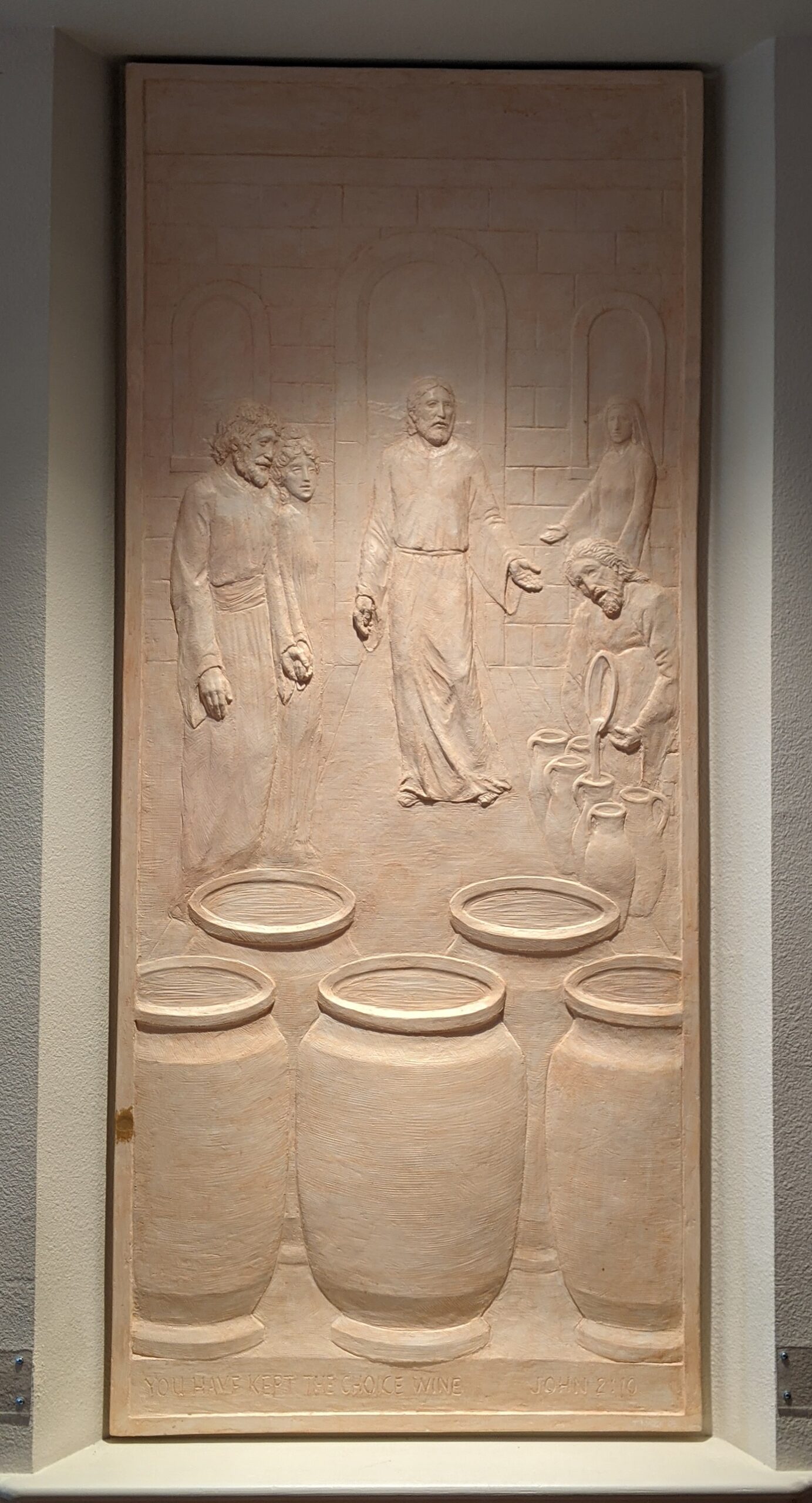
We see another case of scarcity transformed to abundance in the story of Jesus at the wedding in Cana of Galilee, not too far from Nazareth (Jn 2:1-11). Jesus and his friends have been invited to a wedding feast. His mother is there too. It’s a wonderful party and all are having a great time. All, that is, except the hosts. The wine is running out. Someone miscalculated how much people would drink or how many people would be there, or something. It really didn’t matter. Running out of food or drink at a wedding feast is a terrible issue, a shameful thing, even today.

Jesus’ mother notices the problem. She’s probably been involved in planning many weddings and other parties with family and friends through the years. The families of the couple are friends or relatives. What can anyone do to help in such a situation?

In St. John’s telling of the incident, there is something important that she can do. She can tell her son and in so doing, she nudges him to begin his public life. Jesus essentially asks her, “What am I supposed to do about that?” Yet in John’s Gospel, Jesus is presented as one who is in control of what is happening in his life. He is God become human and very much actively in charge of events. He adds, “My hour has not yet come.” It’s not the point in his teaching and ministry to begin doing extraordinary things and showing forth the glory of God, at least he doesn’t think so. But Mary is not deterred. These people need help and they need it right now. “Do whatever he tells you,” she says to the servers.

And so, what to do? Jesus looks around and there are six water jugs in the room. These jugs were used for ritual washing ceremonies when people gathered. Jesus, using what was available, directs that the jars be refilled with water. When this has been accomplished, he instructs the servers to take some to the headwaiter. It was now wine. Not just any everyday, watered down wine, but really good wine. Better than what had been served earlier. The headwaiter even sort of scolds the bridegroom for not serving the best wine first. Folks who have been drinking for a while won’t fully appreciate how good this stuff is!

John ends this story with the comment that in this first of the signs of his coming (as the Messiah), Jesus revealed his glory to his disciples and they “began to believe in him.” He became more than someone John the Baptist thought was important. Maybe he really was someone different and important. Maybe the Promised One had come.

Scarcity had been replaced with an abundance of wine, an abundance of life. God’s presence is revealed.

St. Paul presents another image of abundance (1 Cor 12:4-11). He’s dealing with a community in Corinth that was very diverse and whose members didn’t think of themselves as all being equals. There were many divisions in their society and those divisions didn’t go away when they gathered as a community.

Paul reminds them firmly that there are many kinds of gifts, many kinds of service. All come from God. There is only one Lord. There is no need to argue over which gift or which service is more important. None is more important or more valuable than any other. All are important and all are distributed by God. The Spirit’s presence is seen in each person’s gifts as that person uses the gift for the benefit of all.

A list of different gifts is found here. Wisdom, knowledge, faith, healing, mighty deeds, prophecy, discernment of spirits, tongues, interpretation of tongues. All of these are important, but only if they are used on behalf of the community. No one gets a gift because it is earned or deserved. Gifts are only given as they are needed and they are given to the person who will best be able to use them in service. Yet, there is an abundance of gifts within the community when they are all shared.

The key to each of these stories of scarcity and later abundance is the presence of God. We each have known times that are hard. Times when it seems like nothing will ever get easier. Little or no hope is visible, even on the horizon. Yet when we let the Lord into our hearts in those times, hope begins to blossom like a small flame. As we move forward in trust, serving the Lord and our fellow people with the gifts we’ve been given, however small they may seem, that scarcity falls behind us. We begin to see the abundance of love that fills the world, even when it is masked by “ordinariness” in our days.

Today let’s ask ourselves where the Lord is present, transforming the difficulties and challenges of our ordinary human lives into the beauty of new life, of diadems in the hands of God, of new love between bride and bridegroom, of joyful celebrations of love and new beginnings, and of the growth in wisdom, age, and grace to which we are all called in life.

The Lord has come. Where will we meet him today?

Read More

Posted by on Jan 9, 2022

The Baptism of the Lord – Beginning with Prayer

The Baptism of the Lord – Beginning with Prayer

Baptism of ChristThe Sunday after the Epiphany is celebrated as The Baptism of the Lord. On this day we transition from the first two special seasons of the Church year (Advent and Christmas) to the counted weeks of the year, Ordinary (meaning Counted) Time. Our focus shifts from readings preparing us for the coming of the Lord and those telling of the fulfillment of the prophecies of his coming with his birth, to those that detail just what he did when he came. What he taught and how people responded will be the focus of our readings in Ordinary Time.

Through the years, I have often heard it said that Jesus “submitted” to John’s baptism as a model for all of us. Jesus was without sin, so there was really no need for him to enter into the Jordan River and receive the baptism of repentance that John preached. As we look back on these events, it’s tempting to see them with 20/20 hindsight. We believe that Jesus is sinless, an unblemished human, who gave himself as the perfect model of fidelity to God’s will. Christian writers through the centuries have reflected on the image of Jesus as the perfect and final lamb offered in sacrifice to God, for the “expiation of sin,” an offering in blood to make up for Adam and Eve’s disobedience in the Garden of Eden.

Yet I find myself thinking there might be something else here to notice. Jesus grew up in a family in a small village. His father was a tradesman. His mother was a homemaker. These were both full-time jobs. Both worked to support their life as a family and Jesus would have been part of that working community, doing his share of the chores along with his parents. As a child he learned of his faith and celebrated Bar Mitzvah, becoming a man in his community. He learned a trade and began working as a carpenter, a tradesman like his father. His life was so completely unremarkable that when he came home to Nazareth later to teach the members of his community of faith, they were not able to see past the normality of his life as they had known it and recognize the gift he was bringing to them.

Then when he was about 30, his cousin John came out of the desert and began preaching up and down the Jordan River. John spoke of the coming of the Messiah, the one so long ago promised. He taught about caring for each other and living justly. People went out to see him. John spoke of repentance, a long-time theme among prophets. Return to living as the people of the covenant! Make straight the way of the Lord! Many wondered if he might not be the Promised One himself.

Now, wander in your imagination with me for a moment.  Let’s assume that Jesus was an ordinary man. He didn’t know the full implications of anything he did in the course of his life. He didn’t know he was God become human. He didn’t know that he had never sinned, never deliberately hurt anyone or broken the Law. But I wonder if there might not have been times when he was uncertain whether his actions had been the right ones or not. Might he have thought that there were things he would have done differently if he had been given a chance? A sort of “do-over” that we humans often could use? If this was indeed true, then it makes sense that Jesus, a good and just man who was trying to be the best person he could, always faithful to his God and the covenant, would go to the Jordan to hear John preach and enter the water to be baptized, to be renewed in his life of faith.

We know that Jesus was baptized in the Jordan River and we celebrate that today. When he came out of the river, dripping wet, he stopped to pray, to reflect on what he had experienced there in the water, and maybe to recommit himself to God and his life of faith. St. Luke tells us that as Jesus was praying, “heaven was opened and the Holy Spirit descended upon him in bodily form like a dove.” The coming of God’s Holy Spirit was palpable. It was like a dove gently landing on his shoulder might have felt. It was physically noticeable. It could be felt. Then Jesus heard a voice from heaven, “You are my beloved Son, with you I am well pleased.” The coming of God could be heard too. (Lk 3:15-16, 21-22)

This experience changed the course of Jesus’ life. It was a kind of conversion experience, though he was not a person who had lived a life of great sin or disobedience to God’s commands. He left the Jordan River a different person than when he had come. His consciousness had changed. He still didn’t know that he was the second person of the Trinity. He didn’t know that he was God become human. He didn’t know that his life would change much of the human history that followed. But he knew something had happened. He was praying and he experienced God’s presence and touch in his life in a very special way. His response was to pray some more. He went to the desert to reflect and pray. When he returned, he began to preach, teach, and heal. We’ll hear much more about that as the year goes on. The point today is that his life was forever changed when he entered into a time of reflection and symbolic washing. He emerged as the one who would baptize with the Holy Spirit and fire, foretold by John and the prophets who had come before.

The first and second readings also speak of the role of the Spirit in the life of the Messiah. Isaiah quotes the Lord as saying he has put his spirit upon the chosen one, the one in whom he is pleased. This chosen one will bring justice to the nations, but peacefully, without shouting or crushing anything that is less than perfect and healthy (bruised reeds or smoldering wicks, for example). (Is 42:1-4,6-7) There is an alternate first reading as well, also from Isaiah. In this one, the Lord speaks words of comfort to those in exile, promising they will return to their own land, with the Lord himself leading them. A voice cries out in the desert, “prepare the way of the Lord.” (Is 40:1-5, 9-11)

St. Paul, in his letter to Titus, remarks that when “God our savior appeared…he saved us through the bath of rebirth and renewal by the Holy Spirit.” (Ti 2:11-14; 3:4-7) This bath of rebirth is our baptism with water. It’s not the same as John’s baptism of repentance, but something even better. It brings an entirely new life, a sharing in God’s divine life through the Holy Spirit.

In another optional reading from the Acts of the Apostles (10:34-38), Luke tells us about Peter’s experience with the household of Cornelius, a Roman centurion who was instructed in a dream to send to Peter and have him come to his home. Peter was hesitant, but when he arrived, he discovered that the Holy Spirit had been poured out upon Cornelius and his family. This confirmed for Peter that the Gospel was for all people, not just for Jews. And the rebirth of baptism was opened to all of us.

In each of these readings, we see the importance of prayer and the gift of the Holy Spirit pouring out on the one who prays, opening up new vistas for life. If even Jesus, the Son of God, needed to pray and open himself to God’s gifts, how much more important is it for us to do the same? We won’t all have dramatic experiences of God’s coming into our lives more deeply. For some it will be a much more gradual, silent, gentle deepening of awareness of the Presence. For others it will be more dramatic. (Those dramatic moments and encounters still happen in our day, sometimes during experiences of prayer or meditation.) The important thing is to remember to pray.

So, let’s take this as our plan for Ordinary time this year. Make time for prayer. There are lots of times and ways to pray. Need to wash your hands for 20 seconds for COVID prevention? A “Hail Mary” and a “Glory Be” will take about 20 seconds. The Angelus is traditionally prayed at in the morning, at noon and at 6 pm. Keep a copy of it inside a cupboard door in the kitchen and pray it as you fix dinner. Eventually you’ll remember it and can pray it in the morning and at noon too! The rosary can be prayed any time, even without a set of beads. Our five fingers on each hand make a great decade counter. Having trouble going to sleep at night, pray the rosary and don’t worry if you fall asleep as you pray (a.k.a. “praying with Jesus in the boat”). Mass is celebrated every day except Good Friday and Holy Saturday. Visit a church once in a while for Mass on a weekday if you are able to fit it into your schedule. Liturgy of the Hours was developed a long time ago for people who couldn’t gather with the Christian community on a daily basis to celebrate the Lord’s Supper. It’s available on-line now or in books such as Christian Prayer. Download Liturgy of the Hours to your phone and it’s ready whenever and wherever you are.

As we celebrate The Baptism of the Lord and the beginning of Ordinary Time, let’s dedicate the same attention to prayer as we do during the special seasons of the year. God is here now, just waiting eagerly to hear from us.

Read More

Posted by on Jan 2, 2022

Epiphany – The Glory of the Lord is Revealed

Epiphany – The Glory of the Lord is Revealed

The Solemnity of the Epiphany of the Lord was traditionally celebrated on January 6. However, since 1969, we have celebrated this feast on the Sunday following the celebration of Mary, Mother of God. This celebration is part of the Christmas season, which officially ends with the Baptism of the Lord on the Sunday after January 6.

The word Epiphany tells us what the celebration is all about. Epiphany means manifestation or appearance, particularly of a deity. It also refers to a sudden realization. The reading from St. Matthew’s Gospel (2:1-12) tells of the visit of wise men, astronomers and astrologers from the east, who saw a star rising in the heavens signaling the birth of a king in the land of Judah. These men traveled to the capital city and asked about the birth of the child who would be King of the Jews. Herod was not thrilled to hear of a potential rival. He found out where such a child might have been born and instructed the wise men to go to Bethlehem in search of the child, then return with the information to him. He planned to have the child killed, to eliminate his rival.

The wise men found Jesus and his family. They offered gifts of gold, frankincense, and myrrh, then returned to their own land by a different way, having been warned in a dream not to return to Herod. Joseph was also warned of Herod’s plan in a dream. He took the family and fled to Egypt until after Herod’s death, but that part of the story is not part of today’s reading.

These were the first non-Jews, the first Gentiles, who learned of the coming of Jesus. It was an Epiphany.

St. Paul speaks of this great news in his letter to the Ephesians (3:2-3a, 5-6). He proclaims that God has revealed to him an amazing mystery which had been unknown to those of earlier generations – The Gentiles are members of the same body and promise in Christ Jesus. The Good News proclaimed by Jesus was not just for Jews. It was for all people. Salvation has come for all. Another epiphany!

The light of Jerusalem has come and the glory of the Lord shines forth. Just as Isaiah (60:1-6) wrote to the exiles returning from Babylon, the Lord shines on his people. Sons and daughters return from afar. The riches of the sea are emptied out for all and the wealth of nations comes to Jerusalem, to God’s people. It is a time of great rejoicing. Out of a time of darkness, the Lord’s light has shone forth – an epiphany.

What does all of this mean for us? As we remember and rejoice in the coming of the wise men in search of the Lord, revealing the promise of salvation to all the world, may we too be open to the ways God’s presence is seen in cultures and peoples around the world, particularly those on the margins of society.

We hope and pray for the gift of openness to the rising of new generations of leaders as we get older. Can we rejoice in the wisdom and insights that come from our children and grandchildren as they experience life in a world very different from the one in which we grew to adulthood? Or will we be like Herod, clinging to power and fearful of the future?

Will we share the many blessings we have received with those who need a hand to meet the daily necessities of life? What gifts of gold, frankincense, and myrrh do we have to offer? The gold of respect and encouragement? The incense of loving support and prayerful accompaniment? The myrrh of compassion and understanding during difficult times?

The Lord has come. The wise ones traveled far in search for him and they found him. Now it’s our turn to look for him in the days and weeks to come. Where will we find him?

Read More

Posted by on Jan 1, 2022

A Day for Celebration – January 1, 2022

A Day for Celebration – January 1, 2022

January 1 is a day for celebration and hope. Of course, we celebrate the beginning of a new calendar year that we share world-wide. We hope for health, friendship, peace, prosperity, good fortune, love, and so on. We know that challenges will arise and losses will occur. But we look forward with hope.

After two years of global pandemic, with a new and more contagious variant of COVID-19 spreading quickly, we face another year of uncertainty and challenges. Still, we are cautiously optimistic. Vaccines have been developed. They seem to be working. Human immune systems, in those vaccinated, are going beyond just forming anti-bodies against the virus and are now awakening the T-cells that provide longer lasting protection. We know much about the virus, including preventive measures and treatments that help. We’ve come a long way.

On the religious front, we also have many things to celebrate. It’s the Solemnity of Mary, Mother of God. This is what we celebrate in our liturgies for January 1. Mary, a simple young Jewish woman, became the mother of the child who grew up to be the long-awaited Messiah, the one who gave himself totally to the will of God and in so doing restored the family ties between God and humans. Jesus, the Word of God, was fully human and fully divine. Mary was his mother, the woman who taught him and nurtured his relationship with their God. She and Joseph, her husband, did not understand all that was happening through them. They were ordinary people called to do something truly extraordinary. We hear in the gospel (Lk 2:16-21) that after the visit of the shepherds, Mary reflected on all the things she had seen and heard there in Bethlehem where her son was born.

At the end of the reading from St. Luke’s gospel, we hear that on the eighth day after his birth, Jesus was circumcised and given his name, “the one given him by the angel before he was conceived in the womb.” The circumcision of the Lord is another thing traditionally celebrated on this day. Jesus became one of God’s chosen people, a member of the Jewish community on this day. He received his name, Yeshua (in Hebrew and Aramaic), which means God saves.

As a child, Jesus grew up as a member of the Hebrew people, with all the traditions of his people. He lived under the law given to Moses and was blessed with the same words of blessing that God gave to the people through Aaron and the priests who followed him down through the centuries. “The Lord bless you and keep you!” (Num 6:22-27)

When he was grown, he was called at his baptism in the Jordan River from his career as a tradesman in Nazareth to preach the good news of the coming of the kingdom of God. As St. Paul explains (Gal 4:4-7), he was born under the law, yet he was the one who would move beyond the restrictions of the law that kept humans and God separated. He was the one whose coming set free those born under the law, ransomed them to become children of God and heirs of the kingdom. This kingdom expanded to include all peoples, because God created and loves all peoples.

The final thing we celebrate today is World Day of Peace, a day to celebrate and work towards a culture of care and tolerance for each other. As children of one heavenly Father, we are called to reach out to each other, both in our own communities and around the world. We are to see each other as members of the same family. We can have our differences of opinion and do things differently, but we are still all God’s children. We must love each other and care for each other.

Pope Francis shares his vision for the 55th annual celebration of World Day of Peace in his message: Dialogue Between Generations, Education and Work: Tools for Building Lasting Peace.

On this day of many celebrations, may we continue to receive the blessing offered by Aaron for the people of God. May the Lord’s face shine upon us. May he be gracious to us and grant us peace!

Happy New Year!

Read More

Posted by on Dec 25, 2021

God’s Recipe for Change: Step Two – Get Personally Involved!

God’s Recipe for Change: Step Two – Get Personally Involved!

Christmas is upon us. The word itself tells us much. This is the day and season during which the Mass we celebrate, our Eucharist, is specifically a celebration of thanksgiving for the coming of the Christ, God’s Chosen and Anointed One. Christ’s Mass!

Usually, I would look at the readings for the Mass of the day and talk about them. Who is featured? What is the message for us? Are there any common themes? How do the themes of the readings speak to me (and to us) today?

However, there are many Masses for Christmas Eve and Christmas Day. Many parishes only choose one set of them, because it’s easier to prepare just one homily, worship aid, set of hymns, etc. But which one will my parish choose? Which one will your parish choose? Will your parish celebrate each of them in turn?

The first set of readings is for Christmas vigil – Christmas Eve – and features Matthew’s listing of the genealogy of Jesus from Abraham, through David, to St. Joseph (Mt 1:1-25). This is followed by the narration of the decision of Joseph to accept Mary as his wife, even though she was pregnant before they were living together as man and wife. He believed and accepted the word of the angel who came to him in a dream with the message that this was God’s child.

The second set of readings is for Christmas night (midnight Mass). In these readings, St. Luke (2:1-14) picks up the story with the decree of Caesar Augustus that all must return to the town of their ancestors for a census and taxation. There are very specific names of officials in various regions of Palestine given, which tells us historically the timeframe of the events which follow. Luke tells us of Jesus’ birth in the stable and of the message to the shepherds carried by the angels. “Glory to God in the highest and on earth peace to those on whom his favor rests.”

The Mass at Dawn has Luke (2:15-20) telling of the decision of the shepherds to go and find the child. They find him in Bethlehem, lying in a manger, just as the angels had described. When they leave the stable, they tell everyone they meet about what they have heard and seen, “glorifying and praising God.”

The final Mass for Christmas is for Christmas Day. This one gives us the Prologue from the Gospel of St. John (1:1-18). This gospel was written many years after the Resurrection. It reflects a long period of theological reflection on the mystery of what has happened in history. In John’s Gospel, the focus is more on the divinity of Jesus. What he does is done deliberately and because God is in charge of the whole process.

The Prologue begins: “In the beginning was the Word, and the Word was with God, and the Word was God.” It goes on to say that “He was in the world, and the world came to be through him, but the world did not know him… And the Word became flesh and made his dwelling among us…”

The combined readings of all the Masses of Christmas tell the story of Salvation History from the beginning of creation through the birth of Jesus. The first and second readings of each of these Masses also differ – but the themes are similar in their focus on Salvation History. In the first readings, we see in great joy the coming of the Lord, or a return from exile, a rebirth of the community. In the second readings we hear of the early Church’s proclamation of the good news to the Jewish community (Acts 13:16-17, 22-25) and also their reflection on the effects of the coming of “our great God and savior Jesus Christ” (Ti 2:13) in the letters to Titus and the Hebrews.

In the weeks and months to come, we will learn more about the continued unfolding of that history in the life of Jesus and the birth of the Church, but for today, we stop and celebrate a wondrous reality. God cares enough about us that God chose to become one of us. This is the crux of the matter that we celebrate today. God’s plan for change included getting personally involved. God became a human being, with a name, a family history, a life story. In doing this, God shows a total commitment to making things better for all of us. We are not condemned to everlasting battles, unhappiness, struggles for justice. God got involved personally to lead the way into a new way of being human.

Let us take time today to rejoice and be glad. The Lord has come!

God’s Recipe for Change: Step Two – Get Personally Involved!

Merry Christmas!

Read More

Posted by on Dec 19, 2021

God’s Recipe for Change: Start Small

God’s Recipe for Change: Start Small

Imagine with me for a moment what might happen in a world in which the rich and powerful controlled all the resources and took advantage of those who were weak or in a position of less power on a regular basis. In this world, maybe no one thought twice about whether this was the right thing to do or not. There was a sense that those who had the power and wealth had earned it through their own hard work and those who had little were in that situation because they didn’t work hard enough.

Now suppose a group of folks who have lived lives of privilege in this world began for one reason or another to think that maybe with a little help, those who had barely enough to survive would have a better chance of earning enough to live a more secure life if they had just a little bit more money for food, or maybe got to attend better schools, or had a roof over their heads. So they declare a War on Poverty and begin spending money to make big changes in availability of food, housing, and education. And things begin to get better for those at the bottom of the ladder. Poverty doesn’t go away. Those at the bottom still have little chance of jumping clear up into the top ranks of their society, but their lives get easier and more secure.

Often we think that change has to come through formal programs, with large amounts of money being spent. In fact, for that kind of broad economic and societal change, large amounts of money are necessary in a big society. But what leads those who can put such sums together to take such steps to help?

We get a hint in the readings for the Fourth Sunday of Advent. In these readings we see what might be described as God’s recipe for change. The Lord God often wants to see big changes in the way we interact with each other and with God. But God doesn’t come riding onto the scene like some sort of hero in a movie, with guns blazing and large numbers of soldiers on either side. God works very quietly through ordinary people.

Micah was a prophet around the same time as Isaiah and Jeremiah. He came from the hill country and called the people of Judah back to faithfulness to the covenant. This was during the time when the Assyrians were conquering the kingdoms to the north. Micah warned the people and their leaders that God was not happy with their worship of idols and failure to take care of the poor and unprotected of their world. He warned that Judah would also be conquered and the people sent into exile. Jerusalem and the temple would be destroyed as punishment for their unfaithfulness.

But Micah didn’t stop with the prophecy of destruction of the nation, he spoke God’s promise to restore the land and its people (Mi 5:1-4a). A new ruler would come, born of an ancient family, and lead the people to true peace and prosperity. The family of the new ruler would be from Bethlehem, a very small town close to Jerusalem, but so small that conquering kings wouldn’t bother with it. Bethlehem was the hometown of David, the second king of Israel. The Lord had promised that the Messiah would come from David’s line.

Jeremiah, another prophet from about the same period, mentioned that Micah’s teaching influenced King Hezekiah to begin some reforms. The early Christians remembered Micah’s words promising the coming of the Messiah and recognized Jesus as the one whose coming had been predicted so long ago.

The author of Hebrews (Heb 10:5-10) also speaks of the work of one who comes with little fanfare or wealth, but is responsible for bringing about major changes. Jesus comes not with an army of angels, but rather with only his own human body and the willingness to obey the will of the father. Jesus speaks the words of the Father so faithfully that it leads to the cross. He continues to obey, faithful even in the face of a terrible public execution. “Sacrifice and offering you did not desire,” he says, quoting the prophets. But he gives his own body, his own life, in fulfillment of his Father’s will. This sacrifice replaces the old tradition of animal sacrifice. Doing God’s will is what matters in the end, not how many animals are sacrificed.

Again, we see one person responding to God’s call and spreading the news of God’s care for all people. The faithfulness of that one person has been multiplied countless times in the centuries that followed his life.

Finally, today we hear the story of Elizabeth and Mary (Lk 1:39-45). Two cousins. One an older woman who had never been able to conceive and bear a child. The other a girl barely old enough to have a child. A girl who is not even married or making a home with her husband yet. The girl, having received news of her cousin’s pregnancy, hurries to visit her cousin and rejoice with her. When Elizabeth sees Mary approaching, she calls out a beautiful greeting, inspired by the Holy Spirit. “Blessed are you among women and blessed is the fruit of your womb.” Mary is blessed because she believed the promise delivered by God’s angel and consented to be part of God’s recipe for change in the world. She would bear and raise a son who would grow up to be the long-awaited one through whom God would change the world. Elizabeth, pregnant with the final prophet, the one who would introduce Jesus to the world through his own followers, salutes her cousin as the child in her womb leaps for joy.

Each of these stories tells of individuals whose response to God’s call set in motion changes that have affected millions of people. Much of what we take for granted today did not exist before people received God’s message of love and care for the least protected or powerful among us. Schools for all. Hospitals that care for all who come in need of help. Public libraries. Women’s rights. Representative government. Health care for the poor and middle class, as well as the rich. So many, many blessings we all take for granted.

Is it all done yet? No. Is there more that needs to be done to make this world more in line with God’s vision? Absolutely. Do we need to have armies or major financial backing to begin to make a difference? No. We just need to keep our eyes and ears open to hear the messages sent to each of us by our God. We each have a role to play in God’s plan. Like a good recipe for bread or stew, many things come together to make a rich and satisfying dish. The work of many individuals alone and together also bears fruit.

In this final week of Advent, let’s take a little time to listen for the call of God. What is it that God is calling us to do? What gifts and talents do we have that we can share? What are we already doing?

Few of us will ever be famous or recognized for major changes to the structure of society or to the sum total of human knowledge. But each of us is called to do something. It may be something very small. That’s OK. Just be open and do what the Lord sends that needs your touch. And together we can begin to bridge the chasms of disagreement, anger, distrust, and even hatred that so afflict our world today.

God’s recipe for change: Start small.

Read More

Posted by on Dec 12, 2021

Our God Rejoices and Renews Us in His Love

Our God Rejoices and Renews Us in His Love

Gaudete Sunday is another name for the Third Sunday of Advent. The name comes from the first words in Latin of the Introit, the psalm or hymn at the beginning of the Mass. Today’s Introit begins with words from St. Paul’s letter to the Philippians (4:4-7), “Rejoice in the Lord always.” The passage in this letter is filled with hope and joy. Rejoice! The Lord is near. The Lord cares about us. So don’t be afraid of anything. Ask God with confident thanksgiving for what is needed. And our hearts and minds will be filled with God’s peace. This is truly wonderful news.

We can see a similar theme in the reading from the prophecy of Zephaniah (3:14-18a). Zephaniah was another of the prophets who lived during the time of King Josiah (640 – 609 BC). This was a time when the kingdom of Judah was allied with the Assyrians and had adopted many of the gods and practices of their allies. Zephaniah’s prophecy came during the first 10 years of Josiah’s reign. It’s a short piece, just three chapters. The unfaithfulness of the people of Judah and some of their leaders is set forth. The statement that the unfaithfulness would be punished follows. Yet there is hope after all, because a small remnant of those faithful to the Lord remain. In the end, those faithful ones will survive. Zephaniah cries out, “Shout for joy, O daughter Zion! Sing joyfully, O Israel!” Why? Because the King of Israel (who is the Lord) is present among them. This Lord “will rejoice over you with gladness and renew you in his love.”

What a wonderful image! How hopeful for us all – Our Lord God rejoices over us and sings joyfully because of us.

This theme is repeated in the Responsorial Psalm, which today is actually a passage from the prophet Isaiah. “Cry out with joy and gladness: for among you is the great and Holy One of Israel.”

With such a long history of faithfulness on God’s part and varying periods of being faithful and falling away among the people, the appearance of a new prophet in Israel was always of interest. This is especially true when the nation has been conquered and the people are ruled by foreign powers. Who will come to lead the nation to freedom this time? Will this be the time that a new kingdom begins and Israel again becomes a powerful nation? Who is the chosen of the Lord this time?

When John the Baptist arrived on the scene, people were ready for a change. They hated paying taxes to Rome. The riches of their nation were being taken for the use of others in the empire. Foreign rulers were making sure no dissent could safely be voiced. Those who opposed their rule were executed. Who would come to save the people?

John came speaking of repentance and paving the way of the Lord who is coming. He quoted the ancient prophets who spoke of the Chosen One coming to restore the glory of Israel. “What should we do?” the people ask. How do we prepare for the coming of the Chosen One? How do we make straight the path?

John gives very practical answers. If you have two cloaks, give one to a person who has none. If you have extra food, share it. If your job is to collect taxes, only collect the amount owed. Don’t take extra for yourself (a legal and common practice that made tax collectors particularly unpopular). If you are a soldier, don’t use threats to make people pay you. Don’t accuse anyone falsely. Be content with what you are paid, don’t go around making people pay extra to be left in peace.

These are all things that most of us would say make perfect sense. In fact, much of our social contract is based on these types of behaviors as the rule for all. However, then as now, there are always those whose approach is different – those who want to see how much they can get for themselves. John’s words gave great hope to his listeners. Could this be the promised one? Could he be the Christ?

Again, we might not phrase this question in terms of promised ones or messiahs. We live in different times. Our challenge is to evaluate the latest fads, the celebrity of the day, the newest consumer goods or leisure activities. Is any of these going to prepare us for the coming of the Lord in our midst? Is any of these what will make clear that the Lord is already in our midst?

John told the people that one mightier than he was coming. This one would fill them with the Holy Spirit of God and gather them safely like a farmer bringing the harvest into a barn at harvest time. St. Luke tells us, “Exhorting them in many other ways, he preached good news to the people.” (Lk 3:10-18)

Words of encouragement. The Lord is coming. The Lord rejoices with us. The Lord takes delight in us. Truly good news for all.

Today let us rejoice. The Lord has come and is joyfully among us. Let’s open our eyes and our hearts to see and share this joy.

Read More
Posted by on Dec 5, 2021

The Lord Comes in Historical Times

The Lord Comes in Historical Times

Once upon a time …  Many stories we tell begin with a reference to a time long ago and far away. These stories relate important truths, but the actual facts of what happened may or may not be true. As storyteller and theologian Megan McKenna likes to say, “All stories are true and some of them actually happened.”

The readings for the Second Sunday of Advent differ from many of the stories we encounter in the first books of the Bible. The first books were written hundreds if not thousands of years after the events they describe. Some of them are clearly not historical – “In the beginning …” Others present a picture of how things came to be, somewhat like fables we learn as children. Some tell stories of the first families from whom all are descended. Details of these stories are hard to document in terms of our modern understanding of history. But in the readings today we have historical details that support the narrative, the story being told.

The first reading comes from Baruch (5:1-9). Baruch was an aristocrat, a member of the court of King Zedekiah just before the Babylonian conquest of Jerusalem. He was also a scribe for Jeremiah the prophet. We know this from a history written by Josephus, a Jewish historian in the first century. In the book of Baruch, Jerusalem is described as a woman mourning the death of a loved one – sitting in clothes that indicate she is mourning during the first seven days after the death. A woman “sitting shiva.” Baruch speaks words of hope. “Take off your robe of mourning and misery, put on the splendor of glory from God forever.” She is to put on a cloak of justice and wear a mitre (a special turban or hat) proclaiming the glory of God’s name, like that worn by Aaron when the Israelites traveled with Moses through the desert.

Jerusalem will see her children returning from exile, being led back by God. As they come, the mountains will be leveled and the gorges will be filled ahead of them, so the road back will be smooth and secure. Fragrant trees will protect the way and welcome the travelers, as Israel is led by God in glory, with mercy and justice personified as their companion.

What a glorious hope for a people suffering exile in the land of their enemies! This book was probably written long after that time described, but the person whose name it bears is known to have lived during the time just before and during the exile. It is a book of prayers, poems, and prophecies filled with hope.

Psalm 126 repeats the refrain of the joy of exiles returning from foreign lands. Those who watch them return marvel, “The Lord has done great things for them.” They return carrying the fruits of the harvest that has grown during their time of exile. They have not remained helplessly suffering and stagnating. During their time of exile, they have grown.

The Gospel of Luke begins before the birth of either Jesus or his cousin John, but today we hear some of the story of the prophetic travels and activities of John (Lk 3:1-6). This section begins with a long list of political rulers, the timeframe in which it occurs, the regions they governed, and their leadership positions. We get a very real sense of what was going on in the Roman empire, Palestine, and Jerusalem as John and Jesus come onto the scene – two cousins who will unexpectedly become influential in their world. Both men are from families that would not ordinarily have attracted any attention at all. John’s father was a priest at the temple. Jesus’ father was a tradesman in the town of Nazareth in the north of the country near the sea of Galilee. Yet both men played critical roles in the drama of reconciliation between God and humans – salvation history.

“In the fifteenth year of the reign of Tiberius Caesar, when Pontius Pilate was governor of Judea … the word of the Lord came to John the son of Zechariah in the desert.” John had been living as a hermit in the desert for many years, but the Lord called him to action. He began to call people to repentance, to change their way of behaving towards each other and move towards the freedom of living in God’s forgiveness and justice. As a symbol of this transition, he used baptism, a ritual of purification with water that was deeply rooted in his Jewish tradition. He spoke of the words of the prophet Isaiah, “Prepare the way of the Lord, make straight his paths.” Valleys are to be filled and mountains leveled. Everything that can get in the way of those who seek the Lord is to be leveled. “All flesh shall see the salvation of God.”

Many years after John the Baptist announced the coming of the Lord, St. Paul sends a letter to the community of believers in Philippi (Phil 1:4-6, 8-11). This is a community to which Paul has brought the message of Jesus’ life, death, and resurrection. They are people he knows and loves. They are also people whom he is not likely ever to see again. He writes while he is a prisoner in Rome, awaiting the judgement that will result in his release or his execution. He shares the joy he feels in their faith and commitment to the life of the gospel. He expresses his deep-seated love for them and prays that their love will grow and deepen each day, so they will be pure and blameless at Christ’s return. Love in the sense of the word he uses is love with no limits and no strings attached. Love in the best and deepest sense of the word, a love that leads to purity of heart.

Paul’s words speak to us too. We too are called to this deep love and to growth in love throughout our lives. Hearing the word of the Lord is only the first step on the road to salvation, the road to the fullness of life in God’s kingdom. We grow each day as we practice loving and caring for each other and those whom the Lord sends our way. The child who bumps into us in the grocery store. The stranger who doesn’t know the roads in our town and makes sudden moves to get into the lane just ahead of us to make a turn. The family member who will never (insert your pet peeve here). The man on the street who cries out in madness, unable to find release from the illness that torments his mind. The uneducated woman who travels from another country with her young daughter, seeking a safe place to live and protection from those who would kill them both because her husband is a police officer.

Many opportunities open up each day, calling for us to reach out in love. God is coming. God has come. God lives among us. How do I make the ways straight for others to experience his presence? Do I notice the valleys that have been filled and the mountains leveled to help us to pass? Will I continue to grow in love? How will you and I spend our Advent time? Will we be bearers of peace and hope in our world?

Read More

Posted by on Nov 28, 2021

A Time for Hope and Expectation – The Lord is Coming

A Time for Hope and Expectation – The Lord is Coming

One of the wonderful things about being a mother and grandmother is the chance to read stories to children. So many wonderful stories I have read to children at bedtime and in the car as we were traveling – stories that I would never have even known existed had I remained always in the adult world. Just last night I sat up and re-read the final chapters of The Lightning Thief, by Rick Riordan. It is a story I read with my daughter when it was new. Now my grandson has just finished reading it and I re-read it so I could talk with him about it as he enjoyed it for the first time. (Besides that, it’s a really good story with a lot of unexpected twists and turns that I had long ago forgotten.)

The Lightning Thief is the first of several series of stories that take as their inspiration Greek, Roman, Norse, and Egyptian mythologies – the stories of the gods and their interactions among themselves and with humans. This particular story is about a boy who discovers he is a demi-god whose father is Poseidon, god of the seas. A favorite tool of one of the gods has been stolen and a war is about to break out among them if the tool is not found and returned. Among the gods, it is widely believed that our hero has stolen the tool. The story goes from there as he discovers who he is, what has been stolen, who is believed to have it, where it actually is, and whether it can be recovered in time to prevent the war. A marvelously impossible and improbable quest for a group of children in middle school to engage upon, it is an engrossing story for the reader to share.

This story came to mind this morning as I was thinking about the readings for the First Sunday of Advent. It’s a brand new year for us as Church and once again we hear apocalyptic writings of things that are to come at the end of time. We’ve had a lot of these readings lately. One year ends with them and the new year begins with them.

Why do we have this kind of writing anyway? Why not just state clearly that at some future date the universe will end. At some date each of us will end our lives here. At some point we will meet the Lord. Earthquakes happen. Climate fluctuates over time. Storms come and go, both literally and figuratively. And so forth…

We have these kinds of stories because our understanding of the world is incomplete. Humans have existed for thousands of years, but much of what we know of how the geology, chemistry, physics, psychology, and inter-personal relations behind our daily experience operate has only been uncovered in the last few hundred years. There is still much we don’t know or understand.

As an anthropologist, I turn to a concept that I find helps explain our human use of stories to make sense of what we don’t understand or can’t find words to express. Anthropologists speak of “explanatory systems” that take a physical or social reality and place it within a larger context.

Humans wonder “why” things happen the way they do. Why do we have earthquakes? Why do we have storms? Why is the weather good some days and terrible other days? Why do people care for each other? Why do we have enemies? Why do some people die young? Why do old people spend so much time telling the same stories over and over? In the words of a song originally written by Woody Guthrie and adapted for children by Anne Murray, Why Oh Why, we ask again and again “Why does… Why can’t… Why won’t…” Eventually, the question becomes, “Why won’t you answer my question?” and the response is, “Because I don’t know the answer, Good night, good night.”

We don’t know the answers, so we humans tell stories and sing songs.

In our Judeo-Christian tradition, there is only one God. There are no demi-gods as there are in so many other traditions. Our God speaks through humans. Our God speaks directly to humans. God acts in human history. God loves humans and all of creation so much that God enters into creation as a human being. As a human being, God experiences a complete human life, including the joys and sorrows of life and death with family and friends, unexpected happy surprises, hope, love, suffering, fear, and death.

Yet there are things that happen in our lives and history that are hard to explain. For our ancestors in faith, the answer was clear. God intervened. In times of war, God acted to protect the armies of God’s people. When the people were not faithful to their agreement (the Covenant), God punished them by allowing their enemies to conquer and send them into exile. Yet always, God was there, ready to forgive and bring them back to a good relationship between humans and their God.

The apocalyptic literature read today tells symbolically of this relationship. Jeremiah (33:14-16) recalls the promise God made to King David that a savior would rise from his descendants and do what was right in the land. The country would be secure and the capital city, Jerusalem, site of the temple in which God dwelt in a special way among the people, would become known as “The Lord is our justice.” The people are in exile in Babylon, but the promise is made yet again. There is a reason for hope and expectation of a better future.

Our Gospel story is told by St. Luke, a man who was not part of Jesus’ original circle of friends. Yet Luke (21:25-28, 34-36) has heard and tells the story of Jesus’ description of the coming end of time, when the Son of Man will come on the clouds of heaven. We heard this story from St. Mark two weeks ago. Luke encourages his readers to be awake, vigilant at all times, prayerful for the strength to remain faithful when things are going badly around us. Nations and peoples, and even the physical world itself, will be in disarray, but we can be assured that redemption is at hand. It’s a time for hope and expectation of the coming of the Son of Man – the one who saves us.

The early Christian community expected the second coming of Jesus very soon after the Resurrection. After all, the final reconciliation between humans and God had been achieved through Jesus’ death and resurrection. St. Paul (1 Thes 3:12-4:2) also expected the second coming to be imminent, but in the meanwhile, it was important to live a life of loving care as a community. He reminds the people of Thessalonica to behave themselves! He asks the Lord to increase the love they have for each other and strengthen their hearts, so they will be holy and ready when God comes with all his holy ones.

We too live in difficult times. Our world is filled with strife. We argue over immigration, vaccinations, mask mandates, borders, national sovereignty, taxation, the role of government, and on and on. How do we as a Christian community live in love for and with each other? How do we deal with our brothers and sisters with whom we find ourselves in serious disagreement? How do we find ways to address problems that threaten us all, when we can’t even agree on what has caused them?

I don’t have any easy answers. I’m not sure there are any easy answers. But I know in the depths of my heart that we must continue to respect and love each other. We must care for each other and work to find common ground. We are called as members of Christ’s Body to be one with all the rest of our sisters and brothers, working together to bring the peace of Christ to this world.

Happy New Year. May the Lord’s Peace dwell deep within each of us and shine forth in our lives today and through the year we are just beginning.

Readings for the First Sunday of Advent – Cycle C

Read More

Posted by on Nov 21, 2021

King of the Universe!

King of the Universe!

Sometimes when children are playing, one or another will exclaim, “I’m King of Everything!” Today we celebrate the final Sunday of our liturgical year, The Solemnity of Our Lord Jesus Christ, King of the Universe. In this case, it’s not a question of the exuberant, excited cry of a child in a game. The Christian community, through the centuries, has proclaimed this truth, both in direct statements and in apocalyptic images.

Predictions of the coming of a savior often appear in the Hebrew Scriptures during times of exile and persecution. This savior comes and acts as the agent of God in opening the final age of salvation history, the time in which God will become the ruler over all things. The human (Son of Man) who is the instrument of God in all this upheaval and transition is to be raised to a heavenly level, implying a divine status of some sort.

Our reading from the Book of Daniel (7:13-14) describes a vision received in the night. Someone like a Son of man is coming, but not with a human army or traveling in a normal human way. This individual is coming on the clouds of heaven. The destination of this Son of man (human) is not a standard one either. The Son of man comes to the Ancient One. Who is the Ancient One? This is a title for God. This human, who has served as agent to open the new age, comes before God. God gives him dominion (authority as a ruler), glory (renown, magnificence, splendor), and kingship over all times and peoples. This new status and role will continue for all eternity.

In Psalm 93, the term Lord is used. In this context Lord is the word used to speak of God. Jews do not use God’s actual name, because if a person knows the name of another, there is some power over the other individual. Call that individual’s name and the individual will respond. God made clear from the beginning that no one else will be in charge. This is the reason for the prohibition on using God’s actual name and substituting the word Lord.

The Lord is king, dressed in strength, making the world firm and ruling from everlasting to everlasting. The decrees/statements/commands of the Lord are worthy of trust. This is a hymn of great trust and joy.

The early Christians had to figure out where their friend and teacher, Jesus of Nazareth, fit into the whole picture. The book of Revelation was probably written sometime in the years 81-96 CE, during the persecution of Christians under the reign of the emperor Domitian. The identity of the author is unknown, though the name John is assigned to this person.

Today’s reading is from the very beginning of the book (Rev 1:5-8). John sends greetings to the seven major Christian communities (the churches) of Asia. The greeting is also extended in the name of Jesus, faithful witness and firstborn of the dead. Jesus is identified as ruler of the kings of the earth. It is through the death of Jesus that the new kingdom has been brought into existence. Jesus is coming and all will see him. His sisters and brothers will be raised through him, conquering sin and death, triumphing over persecution and unbelief. The Lord is the beginning and the end, just as the Greek letters Alpha and Omega represent the beginning and end of the alphabet. (The Christian scriptures were written in Greek, making this a relevant note.) God’s life-giving power now operates in the world through Jesus, the Christ.

On this feast of Christ the King, we leave the Gospel of Matthew and instead hear from the Gospel of John (Jn 18:33b-37). Jesus stands as a prisoner in front of the Roman governor of Palestine, a man named Pilate. Pilate was responsible for keeping the territory free of revolutionaries and imposing Roman law. He asked the leaders of the Jewish court why they had brought Jesus to him for judgement. They responded that they could not legally condemn him to death.

Pilate is not interested in religious arguments between Jesus and the Jewish authorities. Their reason for the death penalty was blasphemy – the claim to be God. However, the most important issue for Pilate is whether this man standing before him has committed treason by claiming to be a king. Only Caesar in Rome gets that title. Anyone else will be executed. So Pilate asks Jesus directly, “Are you the King of the Jews?” He is expecting a simple Yes or No, but Jesus instead asks Pilate a question, essentially, why are you asking me this? If Pilate is interested in Jesus’ teaching, the conversation has potential. If not, then other issues arise. Pilate makes clear that he is not asking because he has heard of Jesus and his teaching and wants to know more. What he wants to know is: “What have you done” that the authorities of your country have turned you over to their enemies for execution?

Jesus does not answer the way Pilate expects. He explains, “My kingdom does not belong to this world.” He points out that if he were a king in the worldly sense, he would not be standing there alone. Others would be fighting for him. But his kingdom is elsewhere. Pilate takes this answer as a statement that Jesus is claiming to be a king and asks for confirmation of that interpretation. Legally it matters. “Then you are a king?” But Jesus still refuses to claim an earthly kingdom. “You say I am a king.” He doesn’t deny being a king, but he is king in a very different way. He explains that his mission is to present the truth of God’s love for humans. Any who accept that truth will be members of his kingdom. God’s gift to humanity, the self-giving love leading to God’s becoming one of us, is the source and power of this kingdom. Those who belong to the truth, listen to Jesus.

Here’s a person who really is King of Everything! Do I listen to his voice? Do I hear the truth of God’s love and the Kingdom of Love? When he comes, will I be ready?

Today let’s not get bogged down in worries about how we are doing in following our Lord. Let’s take some time and simply celebrate the wonder of this gift from our Father. He loves us so totally that he became one of us. Jesus brings this love to each one of us each day of our lives and with every breath of our bodies. Long live Christ, the King of the Universe!

Readings for the Solemnity of Our Lord Jesus Christ, King of the Universe – Cycle B – Christ the King

Read More

Posted by on Nov 14, 2021

The End Draws Near

The End Draws Near

There is a saying, “All good things come to an end.” In our daily lives, we experience this again and again. But sometimes, the end turns out to be a transition to something better. Sometimes, it’s just the end of a cycle and things begin anew.

This is the case with the readings for the Thirty-third Sunday in Ordinary Time, the next to the last Sunday of the Church year. We have traveled through the life of Jesus, from the time shortly before his birth through his Passion, Death, and Resurrection. We have heard the stories he told and met the people he met along his way from Galilee to Jerusalem during the three years of his public ministry. Now the end of the cycle draws near and we hear from both Hebrew and Christian scriptures of what will happen in the final days of salvation history. What will happen at the end of time?

The Book of Daniel tells the story of the Hebrew people during their time of exile in Babylon, but it was not written during that time. It was written much later and is an example of apocalyptic literature – literature that deals with end times. This type of literature often arises during times of persecution and suffering. The story of Daniel, a prophet, was probably written during the time the Jews were being persecuted under the reign of King Antiochus IV, just over 150 years before the birth of Jesus. The prophet hears and proclaims the word of the Lord. “At that time there shall arise Michael, the great prince, guardian of your people.” Michael is an archangel, the one who is God’s defender of the people. Michael protects the good people during a time of great distress. These people escape and will shine brightly, leading the multitudes to justice and eternal life. (Dn 12:1-3) It is noteworthy that by this time in Jewish history, the idea of life after death is seen as a reality for the righteous. It was an idea still being debated during Jesus’ lifetime, but it was accepted by large numbers of people and their leaders.

Stones Thrown to the Ground        by Roman Soldiers

Jesus was familiar with the apocalyptic literature of his people and spoke of the coming end of time during his final days in Jerusalem. The Romans were known to tolerate no dissent and no rebellions among the people they governed. Yet there was a continual undercurrent of discontent among the Jews and an absolute refusal to tolerate worship of the gods of other peoples. The coming of a Messiah to overthrow the foreign conquerors and re-establish a Jewish kingdom was eagerly anticipated. People wondered whether Jesus might be that hero and welcomed him to Jerusalem with all the fanfare they would give to a conquering hero returning home. Jesus knew that military might was not the way the kingdom of God was going to come to the world. He continually reminded his followers that this was not the path he would take. One day, after teaching in the temple, someone commented on the size of the stones that formed the building. Jesus responded that the stones would soon be demolished and not one left upon the other. (Around the time this gospel was written, the temple in Jerusalem was destroyed by the Romans following a rebellion by a group of Jews known as Zealots. The people had  been scattered into exile.)

Later that day, Jesus spoke with his friends and warned them that hard times were coming. They personally would suffer because of their loyalty to him. The entire nation would suffer because many others would come later and try to overthrow the Romans. Many would claim to be the long-awaited Messiah, but they would be false prophets and false messiahs. All would suffer as a result.

It is at this point that our reading today picks up (Mk 13:24-32). Jesus speaks of the last days of the world and his return to gather the faithful to the kingdom. He speaks of himself as the Son of Man, a title from the book of Daniel used to name and describe the Messiah.

No one knows when that last day and the return of the Son of Man will occur. Even the Son does not know. But all are to live their lives prepared for that last day to arrive. We are all to keep our eyes open and notice the signs of the times, just as we notice the changing of the seasons

It’s been a long time since these prophecies were first spoken. Many generations have passed, and likely many more will come and go before the end of the world. But the sacrifice made by our High Priest, Jesus, does not ever need to be offered again, according to the author of Hebrews (10:11-14, 18). The reconciliation between God and all of creation has been accomplished. No matter what happens, a new age has dawned. Salvation has come.

We sing with the psalmist, “You are my inheritance, O Lord! … my heart is glad and my soul rejoices … You will show me the path to life … the delights at your right hand forever.” (Ps 16)

Our liturgical year is drawing to a close. The end of days has not yet come. We face many difficulties, misunderstandings, deliberate lies, political divisions, pandemics, and other trials in our daily lives. But this is really nothing new. It has happened again and again in history. May we cling to the promises of our Lord and live in the way he taught us, being peace-makers and healers of division in our world. Very soon we begin a new year as a community. Let us take the remaining days of this year to celebrate  the protection and love of our God and prepare for the coming of the Lord into our lives today and in the days to come.

Read More