Pages Menu
RssFacebook
Categories Menu

Posted by on Apr 26, 2011

Violence and Atonement: A Necessary Link?

Violence and Atonement: A Necessary Link?

Fireweed by Joseph N. Hall

The relationship between violence and atonement is closely woven in scripture and theology but it seems inimical to me. As a life long Catholic, anthropologist, and amateur theologian, I grew up with the notion of the Mass as the unbloody sacrifice of Calvary. Things changed after Vatican II to a focus on the Paschal mystery. Despite all of the language we have about the Father requiring satisfaction, it does seem contrary to Jesus’ own teaching about the fact that human fathers, “evil as you are,” would not give your son a stone when he asks for bread. (Matt 7:11)

Clearly, there is patriarchal and tribal language in the concept of satisfaction. This is still prevalent, as seen in a recent gang rape case in Pakistan. A young woman was brutally gang raped by men of another sub-tribe because her 13 year old brother had apparently flirted with a young girl of the other group. To settle the conflict and avoid greater reprisals, the elders of the young woman’s group offered her as a settlement. http://articles.latimes.com/2011/apr/22/world/la-fg-pakistan-rape-20110422

This is not only revolting to our current sensibilities, but it challenges the notion of sacrifice in the tribal sense. My own existentialist take on redemption has to do with authenticity. God took upon Himself our human condition and brought mercy, healing, and peace. For this he was publicly tortured to death.

My own post-modern sense is that the Father is not so much offended by our sin as appalled by it, as an act of vandalism or destruction of works of great beauty conceived in boundless love. The freedom that is required for the reciprocation of love can also be used to reject it. I personally cannot conceive of an infinite God who is somehow diminished or “offended.” To continue to anthropomorphize the Father as a post-modern, post-Freudian human father leads us to a Father, Son, and Spirit caught up in the continuing ongoing creation of bonum diffusivum sibi – good diffusive of itself. The Incarnation and Christ event are the result of an unlimited and unconditional love.

Clearly, this post-modern language flies in the face of Old Testament pastoral society and the cult of Temple sacrifice in the New Testament. Early Christians had to find a way to explain the Christ event in their own cultural and historical context. However, there is no denying that a post-modern Father is less monstrous to the secular humanist ethics and sensibilities that derive from the Christian tradition of the West.

As terrible as the death of Jesus was, it was completely overshadowed by the fact that no evil can come between us and the Love of God in Christ Jesus. (Romans 8:39)

The great peril of a tribal metaphor is not its irrelevance nor its systemic violence, but rather the chasm it creates between God and us that continues to be the original and fundamental blasphemy alienating us from God and ourselves. The preface to the Eucharistic prayer at the Mass of the Easter Vigil and Easter Sunday begins in astonishment “Father, you love us still and sent us the Christ.” Yes, what amazement there is, that in spite of our rejection, God never stopped loving us.

The demand for violence attributed to the Father elevates evil to the level of the divine. The unrelenting intrusion of the divine in the human train wreck, of necessity, requires God to confront violence; which he does with non-violence – even to death on a cross. (Philippians 2:8)

Read More

Posted by on Apr 11, 2011

Violence and Atonement: A Necessary Link?

St.Thomas: The Post-Modern Realist

Sun Shining Through Clouds

St Thomas the Apostle is often known as Doubting Thomas because he refused initially to believe the reports of the resurrection of the Lord. In today’s gospel reading from St. John (Jn 11:1-45), the raising of Lazarus from the dead, I saw something for the first time about St. Thomas that changed my view of him.

Jesus receives word that his fried Lazarus is seriously ill and prepares to head back to Bethany near Jerusalem. The apostles don’t think this is a good idea because they had just left the area after threats against the Master’s life. Jesus tells his uncomprehending followers that Lazarus is dead, but they are returning to Bethany so that his followers can see Him for who He is. This doesn’t appear to make any sense. It is a pointless suicide mission. Thomas doesn’t doubt. He is quite certain, but he is loyal and will not leave his master. His statement, “Let us go and die with Him,” is not skeptical. It is very certain. It is almost absurd in a 20th century style worthy of an an existentialist play.

In fact, Thomas is the grown up we are supposed to be. Look at the facts. Be reasonable, sensible. You may be willing, out of love, to sacrifice yourself for a great cause or a great love, but you approach it with knowledge, with courage, stoically.

This scene actually creates a set of book ends. The matching scene is the encounter with Jesus after the Resurrection, after Thomas had declared that he wouldn’t believe the reports until he saw Jesus personally. None of the apostles died with Jesus. In fact, at the time of his arrest Jesus told the authorities to take Him but to leave them alone. We all know the story of how they – and all of us – scattered in the night when the Shepherd was struck. Peter follows at some distance only to deny Him three times. John is the only man at the foot of the cross. In His time of need Jesus can count on His mother and a handful of women. All too true – real enough for the followers then and now.

Somehow it is easier to “to go and die with Him.” It sounds noble, altruistic. It is easier to believe in the finality of death than the open endedness that is resurrection. El sentido trágico de la vida – the famous Spanish existentialist manifesto – The meaning of life is tragedy. Yes, I know that is not the more literal translation – the tragic sense of life. The death of Jesus would indeed be the Great Tragedy another one of his great disappointments, another cosmic joke perpetrated on an accidentally occurring Homo sapiens.

As post modern people and followers, we are so overcome with the senseless suffering and death of millions that we claim that we believe. Yet our faith is more of an adolescent, impotent tantrum of defiance, because, in the end the facts are the facts. So, let us go and die with Him.

This is an interesting set up for Palm Sunday and Easter. Of course, this is just what St. John’s Gospel does. Jesus is the Resurrection and the Life. The challenge to us and to Thomas is to believe in a life beyond tragedy, absurdity, meaninglessness.

Yeah, well, heard that, been there… but it can’t work. It’s foolish. We are all dying. Just be brave about it. It is what it is. Resignation to the inevitable makes sense. Resurrection by our Best Friend who cries in grief and loss for us doesn’t make any sense at all. Or does it?

Image by Robert & Mihaela Vicol – Released to the Public Domain

Read More

Posted by on Mar 9, 2011

Violence and Atonement: A Necessary Link?

Ash Wednesday: Spiritual R & R – Reconciliation and Renewal

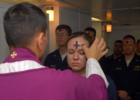
Receiving the Ashes in the Sign of the Cross


Ash Wednesday begins the season of Lent. It tends to be a day when people think about what they are going to give up in preparation for Easter. Fasting can be seen as a convenient type of dieting. Almsgiving can be reduced to cleaning out the closets.

However, prayer, fasting, and almsgiving are ancient practices in societies and religions all across the world. They are ways to produce altered states of consciousness and encounters with the divine. In the Christian tradition they are part of the “via negativa” or negative way. Generally, we tend to see this type of deprivation against the historical backdrop of hermits in the desert rejecting the “flesh” of worldly temptation and indulgence. Of course this conflicts with our consumer culture of comfort and instant gratification. It also conflicts with a more positive psychological model in which the focus on human weakness is replaced with a focus on human self-fulfillment and actualization.

In the secular model of well being, human and social limitations can be overcome by refocusing our attention and modifying our behavior. Hammering down our feeling and emotions – especially sexual ones – is sometimes seen as harming mental health. By denying our interior tensions and conflicts, we can fail to confront the real challenges we should be facing in our psychological development.

Lent itself is an old word for Spring – that time when the world comes to life again. The “via negativa,” the more traditional model of asceticism (an interesting Greek word for athletic training), and the contemporary model of self affirmation are not really opposed. They can actually be healthy correctives. If we focus exclusively on restraining ourselves we not only ignore opportunities for growth, we can also ignore what God is calling us to do. Focusing only on my needs and self-fulfillment can also lead to such an inward narcissistic self-absorbed focus that we cut ourselves off from true happiness.

In subsequent posts, as we journey through Lent, I will share with you some more reflections on being happy, holy, and healthy. This is a wonderful season for reconciliation with ourselves and others and a time of renewal for our call to serve and to engage in the coming of the Kingdom – the age of justice.

So.. what am I going to get for Lent?

Read More

Posted by on Dec 24, 2010

A Pilgrimage on the Pathway of Peace

In Advent we journey with our sisters and brothers around the world, all children of the same God, to the Kingdom of Peace and Justice. Christ, as Key of Knowledge is our guide along the pathway of peace.

O Key of Knowledge, guide us in our pilgrimage,
we ever seek, yet unfulfilled remain,
open to us the pathway of your peace.

For you, O Lord, my soul in stillness waits,
truly my hope is in you.

My Soul in Stillness Waits by Marty Haugen, 1982

Read More

Posted by on Dec 23, 2010

Advent – The Coming or Arrival of Something Extremely Important

Advent is a liturgical season for Christians. It’s also a term that means arrival or the coming of something extremely important. One of the O antiphons refers to Christ as the Root of Life who draws all to Himself, giving birth again to hope through His dying and rising. May we welcome His advent in our lives.

O Root of Life, implant your seed within us,
and in your advent, draw us all to you,
our hope reborn in dying and in rising.

For you, O Lord, my soul in stillness waits,
truly my hope is in you.

My Soul in Stillness Waits, by Marty Haugen, 1982

Read More

Posted by on Dec 21, 2010

Waiting in Stillness

The final days of Advent are often filled with activity and anxiety. Where will I find the perfect gift for Uncle Joe? Will Aunt Susie be bringing her “famous” casserole (that no one really likes)? How will I be able to smile and seem merry when I’m still grieving the loss of my husband/child/friend?

There are so many cares and worries in each of our lives that it can be hard to set them aside and be at peace as we approach the feast of Christmas. Yet what we are celebrating is the coming of the Prince of Peace into our world – into our personal lives.

The hymn by Marty Haugen, My Soul in Stillness Waits, based on the O Antiphons and Psalm 95 is a special reminder of what really matters in these final few days before Christmas. Today I share the first verse and refrain as a point for meditation and peace.

O Lord of Light, our only hope of glory,
your radiance shines in all who look to you,
come light the hearts of all in dark and shadow.

For you, O Lord, my soul in stillness waits,
truly my hope is in you.

Read More

Posted by on Dec 17, 2010

Advent – A Time to Be At Peace

We’re now approaching the fourth Sunday of Advent and the number days until Christmas grows shorter. We’ve heard readings of Hope/Expectation for the Coming of Christ in our days and at the end of days. We’ve heard readings of Peace, with images of children playing safely beside the adder’s lair and lambs being safe with lions. Readings of Joy were proclaimed last week, with the promise of the Lord coming to set things right and signs of the coming of the Kingdom of God already present in the life and work of Jesus. Next Sunday we’ll hear of the Lord’s promise and reassurance to St. Joseph that Mary’s pregnancy was divinely blessed and of Joseph’s acceptance of that gift.

As I’ve moved through these days and weeks, I’ve been reflecting on what peace means in daily life. It seems to me that peace is more than the absence of armed conflict between nations. Peace is a way of living. It springs from a place of openness and gratitude.

Peace means being gracious when another person fails to notice, even in passing, that you have gone out of your way to do something just for him or her. Peace means accepting an apology without needing to shame the one offering it. Peace means choosing to be kind rather than insisting on being right. Peace means looking beyond the gift one has received to see the love with which it was given.

Peace flows out of a place of gratitude for gifts received and shared. It giggles with a small child discovering the joys of a puddle. It smiles with the fond memories of a grandparent who is watching another’s child. It holds hands and spends quiet time with the person nearing the end of this life.

Advent is about hope, peace, joy and the coming of the light of the world. May each of us remember this truth as we hear the enticements of the mall and feel the pressure to “make Christmas memorable” by doing many things and buying lots of merchandise. Advent is a time for hope, peace, joy, and sharing with Christ the wonder of being a bringer of hope, peace and joy to others.

Come, Lord Jesus, Come!

Read More

Posted by on Nov 27, 2010

In the Beginning – A Gift for the New Year from Deep Space Astronomy

Once again we are at a beginning time. The First Sunday of Advent begins the liturgical year. It is New Year’s Day in our Catholic community.

The readings in Advent begin by speaking of things to come – specifically the coming of the Lord of Hosts, the coming of the Son of Man. We are reminded to be ready, to move away from acts of evil and put on the armour of light, to walk in the light of the Lord. It’s a time of anticipation as well as a time to take stock of our lives and change the things that keep us from being ready for the Lord’s coming into our lives.

This year our Gospel readings will be primarily from the Gospel of St. Matthew, Cycle A. The readings we’ll hear will be those from a community that saw Jesus as the Mercy of God and the church as the kingdom of God coming into being here and now, in this life we share on Earth. For those who’d like to know more about the Gospel of St. Matthew, I recommend Megan McKenna’s, Matthew: The Book of Mercy. She has also written a set of commentaries on the Sunday and daily readings from all three Cycles of liturgical readings used in Roman Catholic liturgies —  Tasting the Word of God, Vol. 1 (Sunday) and Vol 2 (Daily).

As we begin this new year, with all the uncertainty, challenges, joys and blessings it will bring, I’d like to share a gift from the Lord with you. These pictures were taken with the Hubble telescope of places in the universe where normally nothing can be seen. May they be a reminder that although we may not be able to see what God has in mind for us, or all the beauty that surrounds us, or all the wonders that flow through God’s creation (including each of us), there are marvelous surprises waiting for us to be ready and able to perceive them.

Hubble Telescope Ultra Deep Field

Happy New Year!

Read More

Posted by on Nov 24, 2010

A Time for Gratitude as a Year Ends

As we approach the end of one liturgical year and the beginning of a new one, it’s good to stop and be grateful for the gifts we have received.  As it happens, in the United States we do just that on the 4th Thursday of November, our Thanksgiving Day.

Tomorrow, as we share meals, prayer, board games, football games, outdoor fun and indoor visiting, may we remember the wonders we have seen. The sunrises and sunsets. The sunny days and the rainy, stormy ones. The days of gentle breezes and the days of gale force winds. If we have been through great storms, may we be grateful for having come through them to safer days. If this has been a peaceful year, may we be grateful for the gift of peace and pray for strength to continue to trust the Lord when next we face challenges and hard times.

In this year, people have been born and people have moved on to the next stage of their lives with the Lord, the one we don’t yet share with them. We have seen children growing and parents aging. We hope to be growing ourselves in wisdom, age and grace – always growing in grace and graciousness, a sign of God’s presence in our lives overflowing into our dealings with other people.

We thank our readers for spending time with us here at Theologika.net. It is truly a blessing to be a part of a worldwide community and to share hopes, dreams and visions with all of you.

This song by Mary Chapin Carpenter from “Come Darkness, Come Light: Twelve Songs of Christmas” is a reminder of the gift of community we share.

Happy Thanksgiving.

Read More

Posted by on Jun 6, 2010

Corpus Christi: Who’s Feeding on Whom?

Today is the feast of Corpus Christi, the Body and Blood of Christ. We celebrate the great gift of the Eucharist – a feast of thanksgiving. We celebrate that the Lord has given His very being to us to be food for our journey through our lives here and now – from this day to the day of our birth into eternal life in the next here and now.

I’m struck today by the contrast between the Lord’s gift of allowing us to eat of His body and blood, soul and divinity and the way in which those spirits not in union with God, the evil ones, feed on our energies when we choose to welcome them into our lives even for a moment.

It became very clear to me again yesterday how quickly and subtly they will move in and start draining energy away from individuals and families. I received a notice in the mail regarding a challenge we’ve been facing as a result of the problems in the global financial markets hitting “Main Street.” I don’t know what the notice means, but it’s not a great situation and it could be the first step of more challenges coming. On the other hand, it might not mean anything negative at all.

But I was tired and a bit stressed and I found myself fretting about it. Then other things started popping up with their “… and did you remember that he …” and “… can you believe the nerve of …” Nothing huge involved. Nothing to which I would not have agreed. Just that quiet, insidious little voice encouraging me to feel upset, tired, a little resentful, or whatever.

As I got more out of sorts, others in the family also got edgy, including the resident baby.

Finally, my children sent me for a walk with the baby and fixed dinner themselves. On the walk, a relatively quiet activity with a very young child in a stroller, I realized what was happening. I closed the feeding trough to the spirits who had crept in and I asked my Guardian Angel and the Holy Spirit to protect me and us from their influence.

One thing I’ve learned – that kind of prayer is never ignored. I was better immediately and we had a lovely dinner and pleasant evening.

So, how does this relate to Corpus Christi? We can choose to allow the evil spirits to invade. We can feed them. The expression, “What’s eating you?” is absolutely an accurate description of an unseen reality. Or we can keep closing that restaurant when they come around and instead feed on the love of God, the body and blood of our Lord.

The neat thing is this. To the extent we feed on the Lord, we can then help feed those around us in positive ways. Everything becomes manageable again. Problems can be solved. Joy returns.

I still don’t know what that notice means, but whatever it means, all will be well as long as I/we remember Who should feed whom.

Happy Feast of Corpus Christi.

Read More

Posted by on May 26, 2010

Violence and Atonement: A Necessary Link?

Pentecost Insights on Laundry Day

Dove of Peace by Pablo Picasso

We celebrated the feast of Pentecost this past Sunday. It’s the Birthday of the Church and one of my favorite celebrations. Without the coming of the Holy Spirit on Pentecost, we would most likely never have heard the Good News of Jesus’ life, death and resurrection. His followers were just plain too scared to tell what they had witnessed.

At Pentecost, the Lord’s promise that He would ask the Father to send an Advocate to us, one who would continue to teach us what we need to know, was fulfilled. We entered the age of the Holy Spirit, an age that continues to our day.

I was musing on the wonders of the coming of the Spirit and the importance of the event yesterday while doing laundry and caring for my 14 month old grandson. (Yes, he’s a beautiful child and a rare delight!) I’d had a conversation on Sunday with a non-Catholic friend who had really never heard of Pentecost in her religious experience. We had talked about the coming of the Holy Spirit, the timing of the feast in relation to Easter and the effect of the Spirit’s coming on the early Christian community. I’m always surprised to find again that people are not aware of the story of the Church and the many twists and turns of its history. There is so often a sense that all was clear and settled from the start. The Acts of the Apostles makes it clear that the first followers of The Way were feeling their way and responding to the promptings of the Holy Spirit just as we must today.

My grandson loves to fold clothes. Up until a week ago, he simply stood by the davenport (sofa, couch) and pulled the clothes off as fast as he could. Once they were all on the floor, he’d hand them to me as fast as he could. Then I’d pick all of them up and we’d repeat the process, with a few more actually getting folded at each repetition! Last week he discovered that he no longer needs to hold a big person’s hand to walk or even run. So now he grabs an article of clothing from the stack and takes off racing across the room with it, dropping it at some point along his way.

He was laughing happily and carrying a handkerchief when suddenly he stopped. Several of us, including the child, have had colds, including runny noses. He’s been fascinated by the blowing of noses that has been occurring around the household. He put the handkerchief to his nose and made a loud blowing sound through his lips. He was so proud of himself. He was certain he’d figured out how to make that amazing noise that all of us had been making. In fact, he was so delighted, that he raced back to the davenport, grabbed a shirt and repeated the feat. Then a sock… Then a pair of pants…  Each time he simply beamed with delight and laughed uproariously.

It struck me, as I watched and laughed with him, that we are blessed that the gifts of the Holy Spirit continue to be poured out among us, with the Spirit continuing to teach us in our day too. As we learn so much more in the worlds of science, math, psychology, anthropology and all the other realms of human knowledge, it is truly a blessing that the Holy Spirit is with us, enlightening our hearts so we can see the Lord’s hand in all of creation in ever more wondrous ways. Imagine how sad it would be if we were forever condemned to the level of understanding of a small child who believes that blowing his nose requires use of his mouth! It’s a fine step on the way to understanding of the real way to perform the task, but only a step. With the grace of the Holy Spirit, we too move forward in our journey, growing up a little more each day and each generation, to see the wonders the Lord has wrought for us.

Happy Birthday, Church.

Read More

Posted by on Apr 9, 2010

Violence and Atonement: A Necessary Link?

Great Love or Great Suffering – Two Paths to Non-duality

Richard Rohr, OFM

Recently I’ve been listening to Fr. Richard Rohr’s three CD set, Exploring and Experiencing The Naked Now, a recording of two webcasts in which he talks about his work on non-dual thinking and the insights of the contemplative/mystic tradition of Christianity. Rohr’s work provides a fine background for the last couple of weeks of Lent and moving into Easter.

A central insight of Rohr’s work is that non-dualistic thinking is central to experiencing the mystery of Christ and the Trinity. God is One, yet we know God as Father, Son and Holy Spirit. The contrast boggles the mind when we try to explain, define or otherwise pin down the mystery. Our minds, trained to make logical distinctions and put all we experience into categories of “this/not that,” find it hard to deal with the “yes/and”  of combining such seemingly irreconcilable statements. Nevertheless, Jesus calls us into the mystery and teaches through example, images and stories that seem to contradict each other. In one place, for example, he says that his followers are to turn the other cheek when someone strikes them. In another, he counsels that it’s time to take swords along to the place where he and is friends planned to spend the night. At yet another, he turns over the tables of the money-changers in the temple and drives them out. Then when the chips are down, he heals the ear of the servant of the High Priest in the Garden of Gethsemane and goes to his death without offering resistance. So which is it? Non-violent always or Violent sometimes? Do we simply choose one meaning – the one that suits what we want to do – or are we supposed to try to make some logical sense of the contrasting statements/actions or must we somehow live in the mystery, without needing to explain it logically. And if we do that, won’t we be seen as somehow immature and childish?

Rohr suggests that a return to the contemplative mindset is essential in the long-run. It is the ultimate goal of the spiritual life. Union with God, a return to the non-duality of the Garden of Eden, is the final goal of our lives and quest. We start non-dualistically as infants and small children. We move away from non-dualism around the age of reason and begin to be able to separate from God, make wrong choices, and, dare I say it, to sin. We learn what is right and what is wrong. We learn to make distinctions. Then we think we’ve got it all set for the rest of our lives. But we’re right smack dab in the middle of a dualistic world and mindset. So everything gets phrased in terms of win/lose or “limited good” (a concept from anthropology) — what is good for you will take something from me. We forget, or perhaps haven’t consciously experienced, that God’s love comes to us like water flowing through a pipeline or electricity flowing down a wire. As long as there’s no blockage, it just keeps coming. The critical thing is to keep the pipe open, the transmission line unbroken. But that gets scary. The “what ifs” start raising their ugly heads. And we fight against anyone or anything that seems to threaten the way things are now, even if it’s not ideal. And so we block the flow, partially or totally.

Rohr argues that the only way we can move beyond dualism in our thinking and again enter non-dualistic reality is through the path of great love or the path of great suffering.  In both situations, the normal ways of coping or experiencing reality fall away.  We don’t have the energy to block the flow. We’re too deeply in the joy or sorrow. “Everything’s coming up roses …” as the song says. Or, alternatively, we cry out, “My God, my God, why have you abandoned me?” Where are you when I need you God? In either condition, we are open to experience the wonder of God’s love and compassion without trying to (or even being capable of) splitting it into dualistic compartments or categories. The experiences are too overwhelming, too all encompasing, too intense to allow for separation and dualism. And then we can grow in wisdom. And we experience redemption – a return to union with our God – set free from the normal ties that hold us bound in worry of losing our “secure” duality.

Meanwhile, “back at the farm,” the troubles and tragedies of world events continue through Holy Week.  A small group of people are arrested for plotting to kill a police officer and then kill more officers at his funeral, all in the name of Christ. What madness is this? Bombs explode in crowded places around the world, in the name of God. What madness is that? How can religious people believe that the creator of all of us and of all of the wonders of the universe could want us to be killing each other? And how could we dare to think we do it in his name, by his authorization? How can Christians be terrorists, as Leonard Pitts notes in a recent column? Is our God really so helpless or so impotent that he could condone such action, such dualistic us/them action?

Jesus went to the cross rather than try to force God’s hand to free his nation from the Romans by inciting a rebellion, as some would have liked. He went to the cross rather than deny the truth that God is more interested in the way we treat each other than in the sacrifices we bring to the altar. He went to the cross rather than run away and deny that he had experienced a very special relationship with his Father, one that the Father wants to share with the rest of us too. And redemption came out of that great passionate love and suffering. Easter came to all the world and our separation from God came to a resounding end.

May each of us move forward in this Easter season in joy and trust, building on the faith of our younger years and beginning to enter into the world of contemplation, of not dividing the “real” from the “ideal,” of really believing the Good News, that love is all that really matters, and love will make all the suffering lead to the peace and deep, deep joy of the children of God.

Read More

Posted by on Mar 29, 2010

Violence and Atonement: A Necessary Link?

God to the Rescue

The Resurrection of Lazarus - Byzantine icon - 14th-15th century

As we move more deeply into Holy Week, I find myself still reflecting on the reading from the Gospel of John that is used in the liturgies for the Scrutinies as part of the Rite of Christian Initiation of Adults — the story of the raising of Lazarus. In our parish, we celebrate the Scrutinies as a community, with all invited to examine our own lives for areas of thirst, blindness, and death within us. Generally during the week following the third scrutiny, area parishes schedule Reconcilation services in preparation for Holy Week and Easter. The three weeks of RCIA celebrations are a good preparation for Reconciliation.

But back to the story of Lazarus. Our celebrant and  homilist on the third Sunday this year was a visitor who had been pastor of our parish many years earlier. I always look forward to hearing new insights from him and I often remember homilies from those earlier years as well. This year he explained that the name Lazarus could be roughly translated as “God to the Rescue.” It comes from the Hebrew name, Eleazar, which is translated “God has helped.” In both the story of the raising of Lazarus and the parable of Lazarus and the Rich Man, God comes to the rescue of an individual in great need. The raising of Lazarus is one of the great signs in John’s telling of the Good News to lead us to faith in Jesus.

Another point that always strikes me in the story of the raising of Lazarus is the order Jesus gives the bystanders when Lazarus comes out of the tomb. He tells them, “Unbind him and set him free.” Lazarus can’t do it himself. And we can’t do it for ourselves.

We are each tied up by so many expectations, fears, patterns of behavior, traditions, and so forth that it can be next to impossible to try something new or to discover deeper levels of meaning or being in our lives. Going away to another community or to college can be a way that an individual becomes freed to experiment and learn who he or she is or wants to become. But not everyone has that opportunity. And for the majority of our lives, we live in communities where we are known, with people/family/friends who know us and expect certain behaviors and responses from us. Because of this each of us needs our family and friends to unbind us and set us free, just as Lazarus needed his community to set him free to live again.

In the Gospel of John, Lazarus is a “type” of the Christian disciple. He is the “everyman” character who represents all of us. We are all the ones whom God has rescued. We are all the ones freed and instructed to set the other free.

During this Holy Week, as we prepare for the Easter mysteries, plumbing the depths of sadness and rising to the peaks of joy in our liturgies, may we all be ready, like Lazarus, for God to come to our rescue, for our family and friends to set us free, and in turn to be the ones ready and willing to give that same gift to those with whom we share our lives.

Read More

Posted by on Mar 4, 2010

Violence and Atonement: A Necessary Link?

Divided by the Bonds of a Common Religion

When I was growing up, one of the questions always asked when two people began dating  was, “Is she/he Catholic?” It was quite rightly assumed that differences in religion within a marriage could be a major source of stress and potentially lead to break-up of the marriage. In those days, we were just barely past the time that “mixed marriages” took place at the rectory or in the vestibule, and the non-Catholic partner had to promise to raise the children Catholic before a marriage could be blessed. Presumably, sharing the bonds of a common religion would serve to strengthen the marriage.

Imagine my surprise, then, when I married a Catholic man of Mexican ancestry and discovered that we were divided by the bonds of a common religion. Many aspects of his cultural experience of Catholicism were different from the Irish-German Catholic experience of my childhood. (And no, the German Catholic side were not converts.  They had been Catholic for centuries.)

Things we found that differed ranged from the relative importance of certain feast days (those of Our Lady were never to be missed) to questions as “serious” as Friday abstinence (could one eat gravy served on potatoes at a restaurant on a Lenten Friday?).

Fortunately, we were both graduate students in Anthropology and had a vocabulary with which to discuss and appreciate the cultural differences over which we were tripping. Feasts of Our Lady are extremely important in Hispanic culture and, as Our Lady of Guadalupe, she is trusted to handle any and all problems that arise. Friday abstinence from meat has been somewhat optional within Spanish speaking culture since the time of the Crusades. The male head of household had the prerogative to excuse the family from following the rule of abstinence. So the question of gravy on potatoes was moot! Simply a minor cultural difference in the experience of faith and definitely not something requiring confession. (Further research done in the course of writing this post indicates that meat based gravy was never actually prohibited, but general understanding of the rules within my culture of origin excluded it.)

This all came to mind again in the past couple of weeks. One of our daughter’s classmates is also Catholic, from a somewhat more traditional family than ours. On Ash Wednesday, the friend ruefully confessed that she had already forgotten and had a piece of candy that day. She had intended to give up candy for Lent. As it turned out, she had also forgotten (or perhaps never realized) that Ash Wednesday is a day of abstinence. She had packed a wonderful turkey sandwich for lunch that day. When apprised of the fact, she looked at the sandwich, declared, “Well, it would be a shame to waste it,” and ate her entire lunch.

When I was their age, the poor sandwich would have been returned to its wrapper and taken home for another day, or perhaps even thrown away. Some might have chastised the young woman for breaking a Church rule and eating the sandwich. She probably would have felt the need to confess her sin. Blessedly, she does not seem to have such worries today.

So a few questions arise.  How do rules fit into our experience of faith? Why even have rules of fast and abstinence if they aren’t going to be taken extremely seriously? How can religious rules be applied to one group of people and not another? That’s not fair! Aren’t there more important things to worry about than what people eat and when? Should religions have rules at all?

In looking at religion and behaviors associated with religion, Clifford Geertz‘ insight, in “Religion as a Cultural System,” that religion serves both as a model of society and a model for society provides a useful platform for analysis. Religions all around the world have codes of behavior — expectations of how people will act and for what reasons they will act as they do. These codes are normally posited to be the will of the deity. Generally, they uphold the social structure of the society and provide the rationale for the way social interactions occur. The song, “Tradition,” from the musical, Fiddler on the Roof, is an excellent example of the structuring of such social expectations and the recourse to God as their source.

This works pretty well when the religion in question is a small, localized one with a limited number of adherents. With groups that are larger and spread out over a larger geographic area, modifications begin to be seen. As Christianity spread out through the Roman Empire, accomodations were made to make it more understandable to peoples with different geographical, economic and cultural realities. If evergreen boughs are a symbol of everlasting life in a culture, for example, it’s a short jump to include them as symbols in Christian settings as well. But if evergreens mean nothing in a culture, they will often mean nothing in liturgical settings either. For this reason we are careful what we include in liturgy that must of its nature be open to be experienced cross-culturally.

The underlying reason for a practice is also important in analysis of how that practice plays out in the lived experience of a people. If the underlying reason is that there must be atonement for one’s failings, a penitential reason, then denying oneself something good but not necessary for life is often valued. If growth in self discipline is an underlying reason, again, denying oneself something makes sense. If one’s salvation from a nearly eternal cycle of birth and rebirth requires attaining perfection or enlightenment in this life, such practices again make sense. If the reason is that we choose to enter into a time and process of transformation of who we are so that we can be more open to meet our God when He comes, then it again makes sense.

Most religions and “spiritual” movements or quests require their adherents to make sacrifices during certain seasons or as part of their daily life. There is a recognition that we are not perfect and we do not live in a perfect world. It takes work to make things better and to become better persons. We only grow through difficult experiences, not when all is easy. So times of prayer and fasting and  giving alms are commonly found.

The trick in all of this is to keep things in perspective. What is a more serious offense, eating meat on Friday, for example, or betraying a friend? Is it more offensive to God and the community to miss Mass on Sunday because guests arrived unexpectedly or to turn away the guests because one has to get to church? Should we look to larger issues of how we use resources locally and globally in planning the forms our fasting and almsgiving will take? How do our religious beliefs lead us to act in our communities and countries? How do we weigh the relative importance of the wide variety of issues that must be addressed by our representatives when we decide who will represent us in government? Can people of good will take different positions and still be part of our community?

It seems to me that all of these questions and more are reflected in the simple decisions we make about things like abstaining from meat on Friday or wasting the food that has been prepared for us. Some things are simply matters of traditional practice and can vary from place to place or family to family. Others are fundamental issues that go to the heart of our relationship with God and creation. Nevertheless, we must be gentle with each other in addressing them. God does not go around bashing people over the head and we must not either. If our religious beliefs and practices do act as models of the societies in which we live and models for what those societies should be like, and in my experience they do, then let’s be careful to use them to shape a society in which God’s “little ones” are protected and supported, people are free to ask questions, think for themselves, and grow in wisdom, age and grace,  and the resources we have been given can be used wisely to benefit all of God’s creatures, human as well as non-human.

Just as my husband and I found we were divided by the bonds of a common religion, humans are divided by the bonds of our common human habit of designing social systems to meet the environment in which we find ourselves and the perception of reality that goes with and shapes those systems that we design. Only by accepting each other in love, giving up the attempt to change the other into our own image and culture, and laughing a lot as we go along can we be transformed so we are ready to meet the Lord who comes to us telling stories and trusting in His Father’s bounty and love to sustain Him.

Read More