Pages Menu
RssFacebook
Categories Menu

Posted by on Nov 20, 2014

New Chicago Archbishop Blase Cupich
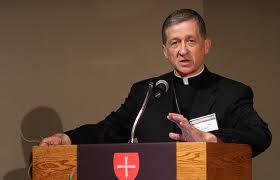
New Chicago Archbishop Blase Cupich

Chicago has new archbishop

Archbishop Blase Cupich

The Chicago Archdiocese officially has a new archbishop, Blase Cupich (soo–pitch) as of November 18. Cupich became the bishop of Spokane, WA in 2010. He has graduate training in Liturgy and has studied at the Pontifical Gregorian University in Rome. Originally from Omaha, Nebraska he was the third of nine children born to Blasé and Mary Cupich.

The Chicago Tribune calls him a charismatic clergyman, the grandson of Croatian immigrants, with a strong emphasis on social justice and a pastoral approach that involves listening and dialog. The same newspaper quotes him as saying, “The church can challenge society, but society also challenges the church.”

Cupich has become known for his more moderate approach for dealing with controversial issues such as abortion and gay marriage. As the bishop of Rapid City, South Dakota, Cupich was one of the bishops in 2004 who was not in favor of denying communion to candidates who supported abortion rights.  He said that we cannot cherry-pick particular issues. We have to be willing to talk about all issues. He emphasized that, while the Catholic position begins with protecting the unborn,  it doesn’t end there.

In 2011 Cupich headed the US Catholic Conference of Bishops Committee for Protection of Children and Young People. At that time there was a Grand Jury finding that the Archdiocese of Philadelphia had allowed 37 priests accused of abuse or inappropriate behavior to remain in active ministry. Cupich’s response to this failure to comply with the reforms listed in the Dallas Charter of 2002 was to express frustration and disappointment since so many people were working hard to implement the reforms. He later said that the Philadelphia situation was unusual.

As bishop of Spokane, Cupich lived in simple suite of rooms in the seminary. In Chicago he has announced that he will be living in the cathedral rectory and not in the opulent Gold Coast mansion with is the Archbishop’s official residence. Many have pointed out a similar tone and style in Archbishop Cupich and Pope Francis. Their simplicity, cordiality, and focus on engagement as opposed to separation or denunciation of those who disagree with the church are attributes they share.

Cupich gave a talk in June 2014 at the Catholic University of America in Washington, DC on the contradiction between Catholic social teaching and libertarianism in the United States. He supported the position of Pope Francis which focuses on encounter and accompaniment in society and the economy. In other words, Catholic social teaching focuses on our obligations to each other. This contrasts with the Libertarian view that the one’s interests as an individual come first.

Cupich is the first major appointment in the United States by Pope Francis. Additional appointments by the Pope will likely bring significant change to the church in the United States.


Read More

Posted by on Nov 15, 2014

New Chicago Archbishop Blase Cupich

Showers for the Homeless at the Vatican

OLYMPUS DIGITAL CAMERA

A significant part of our faith journey is growing and being ministered to by the people we serve.  Bishop Konrad Krajewski is the Pope’s Almoner, which means that he is responsible for raising money for the poor and distributing it. When he took a homeless man to dinner at a Chinese restaurant for the man’s 50th birthday, Bishop Krajewski discovered an unmet need.The homeless get by with handouts of food but they have almost no bathing facilities.

Beginning with the public restrooms in St. Peter’s Square and parishes in Rome with large concentrations of the homeless, Pope Francis is paying for the construction and operation of showers. In addition to sanitation and promoting human dignity, Bishop Krajewski cites a deeper element of faith: “The Basilica exists in order to keep the Body of Christ, and we serve Jesus’ suffering body by serving the poor.”

Read more about this new apostolate.

Read More

Posted by on Nov 15, 2014

New Chicago Archbishop Blase Cupich

Discurso del Papa Francisco

800px-Petersdom_von_Engelsburg_gesehen - public domain

La conclusión del Sínodo Extraordinario termina la primera etapa del proceso de los obispos a reflexionar sobre cuestiones y necesidades pastorales de familias y los del sacramento de matrimonio. En su discurso al concluir el Sínodo, el Papa Francisco les agradeció a los participantes y al Espíritu Santo por el  éxito del sínodo. Tambíen el Papa recomienda a todos que sigan madurando las reflexiones y las ideas propuestas en sus conferencias episcopales como  segunda etapa del proceso. Luego, regresarán los obispos de nuevo para la tercera etapa del proceso, El Sínodo Ordinario sobre la Familia que empezará in Octubre de 2015.

Para el texto entero del discurso, haga clic abajo.

Discurso del Papa Francisco al concluir Sínodo Extraordinario de los Obispos sobre la Familia

Read More

Posted by on Sep 5, 2014

A Church for the Poor – The Vision of Pope Francis

A Church for the Poor – The Vision of Pope Francis


What of kind of church does Pope Francis envision? Jorge Bergoglio, in his initial public statements and even in the choice of his Papal name, Francis, has made it clear that the church needs to be a servant of the poor and the herald of the gospel. These terms come from Cardinal Avery Dulles’ Models of the Church and are based on the documents of the Second Vatican Council (1961-1965). While most of us tend to see the church as an institution and perhaps as a sacrament, Pope Francis is highlighting the notion of the church as a community, a school of disciples, which is the servant of the poor in its role as herald of the gospel.

This emphasis began before Vatican II but it became especially pronounced after the council in a movement called liberation theology. For St. John Paul II, this approach was more reminiscent of Marxism than the gospel, so he took certain steps to curtail it. Pope Benedict XVI, his successor, took a more measured view and focused on aspects of this theology that started from a pastoral and community viewpoint as opposed to a political one. At an important conference to promote this view in Aparecida, Brazil in 2007, Pope Benedict XVI chose Jorge Bergoglio, Archbishop of Buenos Aires to formulate this renewed expression of a church for the poor.

In a recent opinion column in the New York Times, Paul Vallely, Director of The Tablet, an international Catholic weekly publication based in London, outlines the history of Liberation theology and the Pope’s restoration and enhancement of it. The pope welcomed Fr. Gustavo Gutierrez to the Vatican earlier this year. Fr. Gutierrez began the movement with his 1971 book A Theology of Liberation. Pope Francis has also removed the block placed by St. John Paul II to the canonization process of Archbishop Oscar Romero of El Salvador who because of his opposition to political repression was shot while saying Mass. An even more telling sign is the Pope’s treatment of Nicaragua’s former foreign minister, Fr. Miguel D’Escoto Brockman. Fr. D’Escoto had been suspended from the priesthood by St. John Paul II and Pope Francis has lifted the suspension.

A pope who lives in a guest house and stands in the cafeteria line with his own tray has taken hold of the attention and imagination of the Catholic and non-Catholic world alike by being a voice for the voiceless. Pope Francis is leading us to be a different kind of church, one that is closer to the gospel, less secure, less majestic, ready to serve the suffering Christ in the destitute of the world.

Read More

Posted by on Jun 23, 2014

Preaching and the Liturgy: Notes from Pope Francis

Preaching and the Liturgy: Notes from Pope Francis


The Joy of the Gospel, Pope Francis’ most recent Apostolic Exhortation, contains many wonderful and important topics for Christian living. One of the great advantages of the Pope’s exhortation is that it is easy to read and understand by the average reader. It is written in a clear, friendly, and non-technical manner. The only word that might need some explanation is “exhortation”. In Latin this is a type of speech given at a pep rally. It is a pep talk.

In The Joy of the Gospel, Pope Francis takes thoughts and ideas that can be complex and presents them in a clear way without watering them down. This review is the first in a series. We begin with the homily because it’s role is one of the least understood aspects of Catholic Christian life and liturgy.

The Homily

In sections 135 to 139 of The Joy of the Gospel, the Pope focuses on the homily. Technically, the homily is given by those to whom the Church has given the ministry of preaching — bishops, priests, and deacons. However, many lay people today give reflections on the scripture at prayer, scripture, and communion services in hospitals, jails, and labor camps. Some parishes have lay presiders for authorized communion services if priests are not available for Mass. Consequently, proclaiming the Gospel and preaching can happen, with the approval of the local bishop, in different situations outside the Mass by a wide variety of men and women who have been trained and approved. Sometimes, reflecting on the scriptures also happens in faith sharing groups and individual families.

So what does the Pope encourage us to do about homilies at Mass?

 137. It is worth remembering that “the liturgical proclamation of the word of God, especially in the eucharistic assembly, is not so much a time for meditation and catechesis as a dialogue between God and his people, a dialogue in which the great deeds of salvation are proclaimed and the demands of the covenant are continually restated”.[112] The homily has special importance due to its eucharistic context: it surpasses all forms of catechesis as the supreme moment in the dialogue between God and his people which leads up to sacramental communion.

 Pope Francis underscores the sacred sacramental nature of the homily as a “dialog between God and his people.” The homily is not entertainment, but it needs to give life and meaning to the celebration. In the context of the Mass the homily has to be short, according to Pope Francis, since it’s length can upset the “balance and rhythm” of the Eucharist. Preaching in the context of the liturgy becomes part of the offering to the Father and mediates the grace Christ pours out in the Mass. “This context demands that preaching should guide the assembly, and the preacher, to a life-changing communion with Christ in the Eucharist. This means that the words of the preacher must be measured, so that the Lord, more than his minister, will be the center of attention.”

“A life-changing communion with Christ in the Eucharist” seems like an impossible challenge. While the Pope makes it clear that this “life-changing communion” happens through the grace of God, how do we prepare ourselves to be open to such an experience as preachers and members of the assembly? Pope Francis recommends that preachers take a loving and maternal tone. Mothers are keenly aware of their children’s challenges, their strengths and weaknesses. The Pope assumes the ideal mother-child relationship of trust, happiness, and deep mutual love. Pope Francis characterizes the Lord’s teaching as a dialog. He defines dialog as “much more than the communication of a truth”. Dialog arises from the enjoyment of speaking and enriches people by the sharing of love for each other through conversation. In dialog persons share themselves. Talking with his people is something that the Lord enjoys. The Pope reminds preachers that their words and interaction should be focused on leading them to this same enjoyment of God’s people.

These few points do not even begin to scratch the surface of the Pope’s complete pep talk on preaching. What is remarkable are the themes of joy, enjoyment, and dialog. Very often the popular connotation of “preaching” is a negative, judgmental, and humiliating experience. Many times in the context of the Mass people are looking for a well articulated lesson about morality or Christian doctrine. The Pope and the Church, from the time of the Apostles, are calling us to something deeper, more radical, and very challenging. We are being called to enter the Divine conversation of the life of the Trinity, to hear the Divine Word and to be transformed both as speaker and recipient in the Holy Spirit’s dialog. Pope Francis urges us to take God at His Word.


The Joy of the Gospel – Apostolic Exhortation by Pope Francis,
United States Catholic Conference of Bishops, Washington, DC,
December 2013, also available at the Vatican web site.
Photo by CNS/Paul Haring

Read More