Driven into the Desert
Here’s another puzzle – this one mostly drawn from St. Mark’s Gospel account of Jesus’ time in the desert after his baptism. Click here for the solution once you’ve tried it. Click here for a version you can print.


Here’s another puzzle – this one mostly drawn from St. Mark’s Gospel account of Jesus’ time in the desert after his baptism. Click here for the solution once you’ve tried it. Click here for a version you can print.
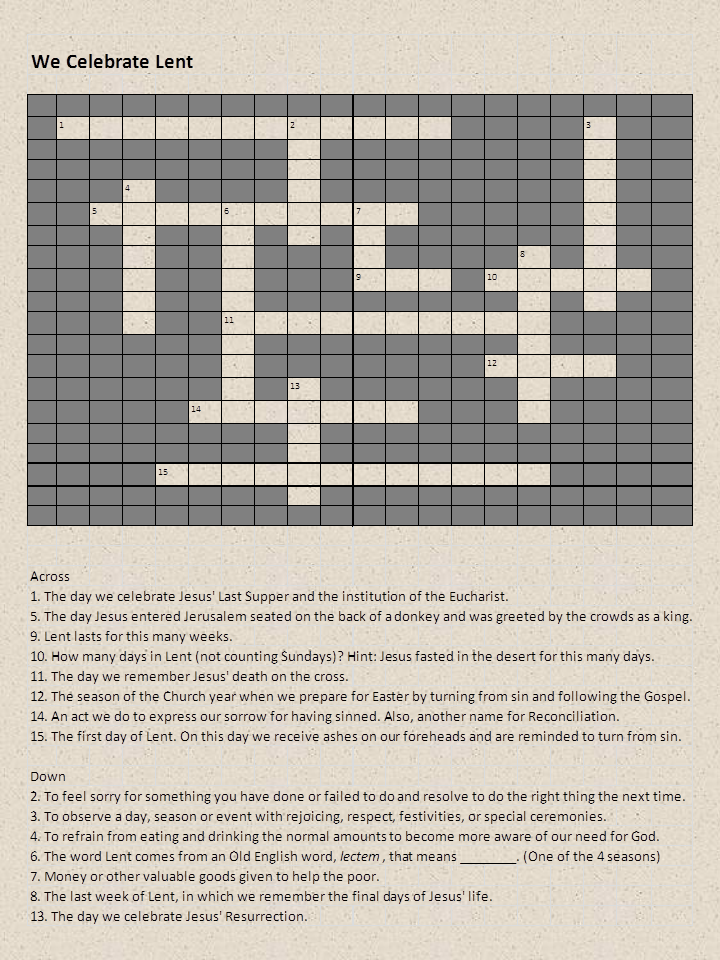
As Lent begins this coming week, we are called to turn from activities or things that separate us from God and instead do something positive to clear our way to return to friendship and union with the Trinity. It is a time to celebrate God’s love for us, trusting that God is in charge and even hard lessons help us become closer to the One who loves us unconditionally.
In the spirit of celebration, then, let’s start with a puzzle. Click here for the solution once you’ve tried it. Click here for a version you can print.
Read More
Try your hand at a puzzle for a change of pace. For the solution, click here. For a version you can print, click here.


St. Peter Canisius, S.J.
“If you have too much to do, with God’s help you will find time to do it all.”
St. Peter Canisius, an early Jesuit, lived during the Reformation. He was active in teaching, ministering to the sick and the poor, in addition to being entrusted with implementation of the decrees of the Council of Trent. He was assigned to work in Germany following the Council, teaching and establishing colleges and seminaries. He developed a catechism for ordinary people, one of the first of its kind. He was a popular preacher and prolific writer, who was not afraid to write to Church leaders to encourage them to live up to their calling.
As we approach Christmas, with all the busyness of the season, we could do worse than to remember St. Peter Canisius’ words and ask God to help us do the things we need to do, and to let go those that really don’t matter.
Image in the Public Domain – painted in 1699.
Read More
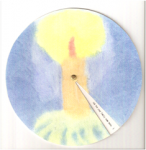
Advent Activities calendar
Advent calendars are a traditional way to mark the passage of days in December leading to Christmas Day. Unlike Advent itself, which varies in number of days, Advent calendars only count the 24 days of December before Christmas. Some have a candy or other treat for each day. Some have a picture of a toy or tell a bit of the Christmas story. Each day, one door is opened. As the month progresses, it becomes quite clear how close Christmas is coming.
Advent calendars are a wonderful way to help children experience Advent as a season unto itself. They also help children to experience in both tactile and visual form the passage of time.
I developed this Advent calendar for the children in grades 3-5 when I was teaching in our parish religious education program. It’s an easy project to do in an hour or two and offers a daily reminder of things to do together or individually to prepare for the coming of Christ in our daily lives, on the Last Day, and as he came historically – the day we celebrate at Christmas.
Advent Calendar
You will need:
2 – sheets of white card stock or construction paper – 8 1/2 by 11
1 – small brad
1 – 5 inch ribbon (wrapping paper type is fine)
Crayons, watercolor paint, colored pencils, pastels or other “coloring” medium of your choice
Adhesive tape
Scissors
Needle
To make your Advent calendar:

Advent Calendar Cover Page Template

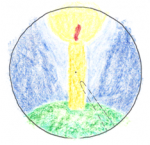
Advent Activities Picture
Happy Advent!
Read More

Icon of St. Catherine of Alexandria
St. Catherine of Alexandria was born towards the end of the 3rd century. According to legend, she became a Christian at the age of 14 following a vision. She was known for her wisdom and is said to have successfully debated 50 non-Christian philosophers when she was only 18. Responsible for the conversion of hundreds of people, she was eventually martyred (around 310 AD). Condemned to death on the wheel, instead she was beheaded because the wheel broke at her touch. Catherine is remembered since the 14th century as one of the Fourteen Holy Helpers saints to whom people prayed especially for healing and protection from diseases.
In the middle ages, a tradition arose of celebrating her feast by visiting neighbors, singing songs requesting food and drink (cakes and breads or apples and beer). I came across this recipe for Catherine’s Cake (Kattern Cakes or Catterning Cakes). It is simple to make and would make a great project to do with children to help make it fun to be Catholic Christians. The detailed recipe on the web is written in metric system, however, there’s a basic description with quantities in the old English system we still use in the United States.
Catherine’s Cake
2 pounds yeast bread dough
2 oz (1/4 cup) butter
2 oz (1/4 cup) sugar
1 egg, beaten
A few caraway seeds
Frozen bread dough may be used, or make your own. Soften the butter and mix with sugar, egg, and caraway seeds, then knead into the dough. Allow to rise in a warm place for approximately 2 hours.
Once the dough has risen, either divide it into tennis ball sized loaves or form it into a larger loaf and place on/in a floured baking pan. Allow to rise another 30 minutes. If you have made the smaller loaves, flatten them slightly to make “cakes” for individual servings.
Bake in a moderate oven (350 degrees) for two hours. (Smaller cakes may require a shorter baking time.)
Invite in the neighbors and enjoy with sparkling cider or other festive drink!
Image in the Public domain –
From St. Catherine’s Monastery, Mount Sinai, Egypt
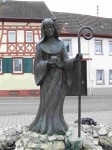
St. Lioba of Tauberbishofsheim - by Kandschwar
Saint Lioba (aka Leoba) was born in Wessex, England in approximately 710. Her given name was Thrutgeba and her surname was Lioba, a name meaning Beloved. According to her biographer, Rudolf of Fulda, her birth to aged and formerly barren parents was foretold to her mother in a dream. Her mother promised that her child would be dedicated to the service of God and so Lioba entered the abbey at Wimborne as a child. In a delightful biography, Rudolf provides details about the abbess Tetta who was responsible for the monastery and the women who lived within its walls, as well as of the sources for his narrative of Lioba’s life. He then goes on to tell of Lioba: her life and accomplishments.
Lioba took full advantage of the opportunity to study and learn within the monastery. Girls were not generally given the opportunity to study in the 8th Century. Nevertheless, within the monastery, Lioba learned to read and study Scripture, as well as learning through observation and practice how to get along with others and manage a large enterprise/household such as an abbey.
A relative of St. Boniface, Apostle to the Germans, as a young woman, Lioba wrote to him, expressing interest in his missionary work in Germany: “To the most reverend Boniface, bearer of the highest dignity and well-beloved in Christ, Lioba, to whom he is related by blood, the least of Christ’s handmaids, sends greetings for eternal salvation.”
Lioba and Boniface corresponded with each other for twenty years before he invited her to come to Germany and establish monasteries for women there. She became abbess of the monastery at Bischofsheim, leading a large number of women in the spiritual life as well as the practical details of earning a living as a community. She never stopped studying and deepening her knowledge of Scripture and the faith. According to Rudolf, “She read with attention all the books of the Old and New Testaments and learned by heart all the commandments of God. To these she added by way of completion the writings of the church Fathers, the decrees of the Councils and the whole of ecclesiastical law.” In addition to her education, she was known for her wisdom and kindness, moderation and compassion, hospitality and humility; she welcomed and gave advice to visitors including bishops who came to seek her counsel. In turn, she was the only woman allowed to enter the monasteries for men to participate in consultations with church leaders on issues related to the rule of monasteries.
Under the advice and guidance of Lioba, nuns from her abbey became leaders of other monasteries as well, continuing the work of evangelization begun by Boniface. Lioba was a friend of Charlemagne’s wife, Hildegard, and a welcome visitor in the court of Pippin III. She was known for her learning and for the depth of her faith. Miracles were attributed to her during her lifetime and following her death. In fact, her remains were moved at least twice to protect them when miracles were reported at the grave sites. Eventually, they were buried in a church in Fulda.
Lioba lived approximately 72 years. She died September 28, 782, so her feast is celebrated to this day on September 28. While not one of the more broadly known saints in today’s church, she is certainly a woman worthy of note and imitation. She was not afraid to read, study, and learn of “holy” topics, nor to share her insights with powerful men (not all of whom would have appreciated her position of leadership and equality in terms of education and influence). Yet she did not neglect the practical necessities of life in community or of the administration of large enterprises. She was well-loved by the women whom she led and respected by both ordinary folks and the powerful leaders of her time. Not a bad role model for us today.
Image by Kandschwar – GNU Free Documentation License
Read More

Los Angeles Religious Education Congress 2011
Tonight and through the weekend, thousands of Catholics and members of other faiths will be converging on the Anaheim, California Convention Center for the largest annual gathering of Catholics in the United States. The Los Angeles Religious Education Congress begins with Youth Day on March 17. The theme for Youth Day is “Godbook: Everyone Invited.” Speakers address topics of interest to teens, including prayer, sharing faith, social justice, and interpersonal relations. Youth Day includes workshops, liturgies at three locations within the Convention Center and and concerts with artists including Jesse Manibusan and Pedro Rubalcava. Several of the workshops also feature music.
Congress for adults begins with Opening Prayer on March 18 and continues through a final liturgy on Sunday afternoon. This year’s theme is “Hold Firm … Trust.” Like Youth Day, the days are filled with opportunities for prayer and learning. Speakers from around the world come to Congress, many with large groups of fans who look forward to hearing them each year. Workshops are offered in English, Spanish and Vietnamese. Opportunities abound for prayer, reconciliation, learning, sharing, enjoying contemporary music, and just generally enjoying the presence of the Lord in the community of the faithful.
Knowing that many people would like to be among the approximately 40,000 present at Congress but must instead attend to family and work responsibilities elsewhere, Congress planners have arranged for live internet streaming of events on Youth Day and during the rest of the weekend. Naturally, the majority of events will not be available live, but recordings of many presentations can be purchased through the Congress website.
I hope many of you will join in the fun and inspiration of Congress through the internet. I’ll be there too!
Read More
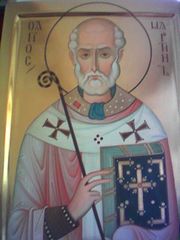
St. Martin as a bishop: modern icon in the chapel of the Eastern Orthodox Monastery of the Theotokos and St Martin, Cantauque, Provence.
The feast of St. Martin of Tours, sometimes known as Martinmas, falls on November 11. In the United States, we celebrate November 11 as Veterans Day – a day we honor those who have served in the military of the country. It is a national holiday, though many businesses are open and retailers offer sales in the hope of luring people who are enjoing a day off!
As a child, I remember hearing people from my grandparents’ generation speak of the day as Armistice Day. This was the day, in 1918, on which World War I stopped. The Armistice was declared and hostilities were set to end at the 11th hour of the 11th day of the 11th month – and so they did. That was a war called “The War to End All Wars,” but unfortunately, it didn’t. So, when World War II followed all too soon afterwards, the name of the day was changed to Veterans Day, in honor of all veterans.
It seems appropriate that the feast of St. Martin of Tours coincides with this day of honoring those who have served their countries militarily, as he too served in the army. His life and contributions to the Christian community are discussed in greater detail in an earlier post, and they were impressive. Nevertheless, he is most commonly known for the legend told about him, in which he is approached by a begger and asked for help. Martin is said to have cut his military cape in half and given half of it to the beggar. Later, in a dream, he saw Christ in the form of the beggar, wearing the cape.
Martin was not a Christian at the time he served in the Roman cavalry, but had entered the Catechumenate before entering the military. Before he left the army, he had been baptized. As his faith grew and deepened, he became convinced that as a Christian, he could not kill, even as a member of the military. He accepted arrest and imprisonment rather than fight. He volunteered to go to the front of the troops, unarmed, but a peaceful solution was reached before the battle, so he did not have to prove his courage and commitment to non-violence in that way.
It seems to me that Martin’s insight that killing is not the calling of Christians is one that has been shared by many men and women who have served or refused to serve in military forces through the centuries. Certainly, there have been times when Christians have turned their backs on this belief, even claiming that killing was done on behalf of God. For those times we must beg God’s forgiveness and that of those harmed. However, the veterans I have known generally will say that war is never the best answer to human disputes. Terrible things happen in war. It does not really resolve the problem between nations. Sometimes it seems to be the only way to stop a terrible evil, but it’s never the best option. (Stopping the Holocaust is often given as an example of a good reason to go to war, but it must be acknowledged that even World War II was fought not to stop the Holocaust – of which there was very little awareness outside of Europe – but rather to stop the military aggression of certain nations.) Martin of Tours would agree that war is never to be the first response of nations or their people to conflicts with others.
But what, you ask, is Martinmas? Martinmas is the name of the celebration of Martin’s feast in Europe. I first experienced the celebration of Martinmas when my sons were little and attending Waldorf school. (Waldorf schools celebrate many European Christian holidays.) It is a harvest festival. It is a festival that marks the end of Autumn weather and the beginning of Winter weather in many nations. The thing that was most fun about the feast was the custom of making lanterns and going out after dark to walk with the lanterns.
For a week or more before the feast, the children would make lanterns of paper. Some were simply construction paper colored by the children and rolled into a cylinder with a bottom and a wire handle. Others were more elaborate. Sometimes a balloon was inflated as a base and tissue paper layers glued over the balloon to form the lantern. Once a wooden frame was built in the form of a star. Then layers of tissue paper were applied to form the walls. Leaves and glitter were included on that lantern. That one hangs in our living room to this day, a beautiful reminder of a school festival and a saint’s feast day.
(In some schools, glass jars are decorated for lanterns. They are also beautiful, but tripping in the dark can result in dangerously broken glass. Plastic peanut butter jars might be a reasonable solution to that problem!)
Once completed, the lanterns are hung by wire from a stick, a candle placed in the bottom, and children and parents sally forth in a procession around the school or neighborhood. In some countries, children visit neighbors and receive candy or other treats – much like Halloween in the US.

Martinmas Lantern Walk – From Today in Faerie School
If you decide to celebrate Martinmas with a lantern walk, be very careful with lighted candles. There are now battery-operated “candles” that you might consider using, especially for very young children. We never had any serious accidents, but I’m sure Martin wouldn’t mind opting for safety on his feast.
After you go out for a little lantern walk, follow up with a warm dinner and/or dessert, lots of laughter and fellowship and a happy night’s sleep.
Happy Martinmas! Happy Veterans Day! And may the Lord help us all to find better ways to resolve our differences.
Read More
In the Spanish speaking world, it is customary to prepare for Christmas through nine days of celebration known as “las Posadas,” literally, “the inns” or “the lodgings.” As part of this celebration, a girl and a boy, dressed as Mary and Joseph, go with family and friends from house to house for nine days in a row, singing and asking for shelter. At each house, they are turned away, until on the last night, at the last house, they are welcomed inside and all share in a party.
The song for Las Posadas is sung back and forth by those outside and those inside. Those outside speak as Joseph, asking for lodging for himself and his pregnant wife. Those inside refuse entry to the pilgrims, citing lack of room and the fact that it is late and these are unknown strangers at the door. The final plea, the one that gains them entrance, is the one asking shelter for Mary, the Queen of Heaven and soon to be Mother of the Divine Word. On hearing this introduction, those inside apologize for not understanding who it was that was seeking entrance. They welcome the outsiders into the house, singing, “Enter, holy pilgrims, receive this corner, for though this dwelling is poor, I offer it with all my heart.” The song continues with the offer of the singer’s soul as a place of lodging for Jesus, Mary and Joseph.
I have seen several versions of the words and the tune for the Posada, but the theme is the same. The Holy Family is traveling, needing shelter, appearing as the stranger. No one is willing to help them. The house is full; strangers can be a danger to the household; it’s late; the claims of those asking for help seem pretty wild. (She’s a queen? Yeah, right! Why’s she out so late at night and alone?) Then comes the moment of recognition – the visitors are Heaven-sent – and welcome follows, both physically and spiritually, as the visitors enter into our homes and our hearts.
In these last few days before Christmas, whether we celebrate them with a Posada, or a novena, or simply by lighting the candles on our Advent Wreath, it is a time to remember to smile at the stranger, wait our turn patiently in the long lines at the stores, and offer a prayer for peace for ourselves and those around us. After all, who knows when the stranger we encounter will be a visitor from God who will touch our heart and who awaits our loving response.
Read MoreYour subscription gift helps make this ministry possible. Thank you!


The Synod has ended. Bishops, priests, nuns, and lay persons from around the world have again gathered in Rome to pray, listen, and reflect on where the Holy Spirit is leading us as a community in this new era. As their reflections and recommendations are offered to us, we are invited to join them in prayer as we move forward, always open to the guidance and inspiration of the Spirit.