Pages Menu
RssFacebook
Categories Menu

Posted by on Jan 29, 2016

Entering into the Mystery

Entering into the Mystery

people-walking-on-streetAs the Church’s New Year began in Advent, in communities around the world, men and women took a huge step into  a special journey: a journey that will take them deeply into the mystery of God’s relationship with humans. These people stepped forward with their sponsors and were introduced to the people of the communities they will join. Welcomed with blessings and prayer, they entered a time of study and reflection through which they will become increasingly aware of God’s call to journey on The Way.

The Way?

Christian life in earliest times was known as The Way: the way to the Kingdom of God, begun here and now with the life, death and resurrection of Jesus and unfolding through time to its ultimate fulfillment when Jesus returns and all are reunited in the mystery of God’s life. This way of living differs from the ways of others who have not chosen to follow it. It requires loving and forgiving enemies, caring for the most vulnerable in the world, acting with justice and mercy, being stewards/caretakers of the environment, and trusting that God will bring good out of all that happens, even if what happens is not what God would have wanted to see.

That doesn’t sound easy. It might even be dangerous!

Following the Way has never been a safe or easy option. Jesus, who called Himself the way, the truth, and the life (Jn 14:6), was tortured to death, hanging naked on a cross, reviled and mocked by passers-by and abandoned by most of his friends and followers. Many of those who have followed Him have witnessed with their lives to His resurrection over the past 2000 years. The martyrs (witnesses) we remember from those early centuries are still being joined by Christians around the world today who choose death rather than renounce their Lord.

Whether called to witness with our blood or not, each of us will face times when we must speak out, saying unpopular things to people we know and whose respect we treasure. Our choice of lifestyle, leisure activities, business/work behavior, sexual ethics, and treatment of the poor and ill will all be shaped by our faith. Not all of those choices will be understood or endorsed by our peers.

Then why do it?

Despite the counter-cultural nature of a life of faith, the call to enter into the mystery is profound. The joy, peace, mercy, love, and comfort of a hug from God surpass anything of human origin. Some doors open while others shut. Funds materialize just in time to keep a project going, or they don’t come at all and something else must be done to move forward in service. Prejudices get overturned as we meet and get to know folks from other social or ethnic groups in communities of worship and service. We are continually challenged and helped to grow in wisdom and grace as we grow in age.

A life of faith is not for the faint of heart. It’s a great adventure into realms not often noticed through everyday eyes. As poet Elizabeth Barrett Browning said, “All of Earth is crammed with heaven, and every common bush aflame with God; but only those who see take off their shoes.”  The glory of God shines forth in all of creaton. Those called to enter into this mystery are truly blessed. We journey forward together — those just beginning and those who’ve travelled long. Difficulties, doubts, second thoughts, and times of desolation will arise, but the promise and faithfulness of God, the overwhelming power of love and mercy, will accompany us and welcome us to an even richer life when we reach our journey’s end.

Away we go together — on The Way!

Read More

Posted by on Nov 15, 2015

Entering into the Mystery

Families and Faith: Helping Your Children to be Faith-Filled

woman-and-child-RenoirFamilies today are struggling with the challenge to fit in a day all the things they need to do. School, childcare, meals, commute, work, marriage, parenting, pets, athletics, extended family, finances, church, house, local and broader civic issues, friends, medical needs, and recreation all require thought and planning. Everyone wants their children to be happy and, for parents with faith, this includes wanting their children to be close to God, part of a community of believers, and to have a faith-filled life.

Parenting Styles

Usually families adopt some form of three parenting styles: Authoritarian, Permissive or Dialogue. The style used may vary based on situation and/or age of the child.

Some rules, such as “No running into the street,” start out as authoritarian with a very young child but with older children there can be a dialogue about the reasons. Brushing a two-year-old’s teeth is a decision from the top down (authoritarian). Later on there can be conversations about it. Permissive parenting, in which the children run the house and are allowed to break the rules or to not do the chores is usually never helpful. At times, when a child has exams, she can skip her chores or go to bed late, but that can be decided in a negotiation about the special situation. Going to church for parents with faith will be at the top of the hierarchy of choices about the family schedule. Hopefully the parents know that they need to be there — to hear the Scriptures, the preaching, or to receive the Eucharist. There may be exceptions, but being consistent will make the liturgy a natural and essential part of the rhythm of life. Church can also be a place for other involvements for children, such as religious education, roles in the liturgy, youth group, outreach, or choir. Making the liturgy more meaningful for children by providing a book to read or color can also help them engage in the Mass and enjoy it more.

But all of this will not necessarily help children to have a relationship with God or stay in the Church. A big help in this direction is if the parents have a living relationship with God, can naturally talk about it, and enjoy spending time with their children. The best approach is both organic to the parents’ entire orientation and planned strategies. Parents who know and experience God and the saints in their lives think, feel and do everything out of a spiritual orientation and discernment. In their adult relationships, home/family, work, and the world, everything hopefully is referred to God and what God is loving for them to love (even learning to trust him in little things like losing your keys). Feelings and actions that come from fear can be recognized and given to God (Discernment). If a parent grows in discernment and asks for wisdom and courage, God will give it and everything goes much better. Planning, conversations, and family problems — all are more productive. Everyone in the family can grow in peace, understanding, generosity and trust in God.

Stress and worry are a part of family life. Painful things will happen. Feeling loved by God will not prevent or remove all suffering. It will reduce anxiety and even anger. For the faith-filled family, unavoidable forms of suffering can be understood as a sharing in Jesus’ redemptive work in the world. (Mk. 10:44 ff.) We also know that he never leaves us. He asks us to lean on him and ask him for the grace to bear the heavier loads. Daily prayer — both talking to God and listening to God — can help parents to keep perspective and not take personally the problems that will come. (For work and faith ideas, see: Heroic Leadership by Chris Lowney, Loyola Press: Chicago, 2005. Excellent, well written.)

Protecting Children, then Letting Them Go

One of the biggest issues that comes up in child-raising is that of control. Parents are responsible for working through the process of protecting their children and then letting go of them. Parents pour love, energy, resources, and sacrifices into family life but do not “own” their children, who in fact are gifts from God. At some point, offspring will start making their own decisions and these may not reflect the values of the parents. They may have abilities and desires that are foreign to the parents. There will be a period of time when children are learning who they are and trying out many experiences available to them. If the child has been exposed to a healthy and holy way of dealing with decisions (e.g. trust in God and discernment) in the family from infancy, they have a very good chance of seeking what God wants for them.

Adults and children can develop an interior life with God in which they recognize when they are doing actions from fear, insecurity, laziness, and/or to impress others. Children encounter many negative things in their lives both in themselves and others. Bullying, cheating, and lying are all around them. There is no harm is letting them know about the influence of the Evil Spirit too when they are older. In middle school they will encounter many forms of social climbing and meanness right next to kindness and generosity. Parents can spend time by both listening to the child and talking about the fact that God will be with them as they make the choice to be friendly to an outcast or to own up to a bad choice.

Understanding the developmental stage of your child is important for both their moral understanding and experience of faith. The work of the religious psychologist Dr. James Fowler is very helpful. His work is summarized in an article entitled “How God Invites Us to Grow: the Six Stages of Faith Development” by Richard J. Sweeney, Franciscan Media, Catholic Update, No. CU1087.

Discernment as Part of Family Life

God dwells within us and will help us sort out destructive feelings from those of courage, strength, hope, and self-worth. If parents are doing this themselves day after day and sharing this at times with their family, the children will share their successes in being strong and discerning too. Listening to our kids, wanting to know their interests and worries, will help them to feel understood. The goal is not control. The goal is that we surrender to God our desires, worries, and problems and let him tell us how best to work with them. The prayer of St. Ignatius of Loyola called The Examen is very helpful in going over each day what is working and not working in my thoughts and behaviors and what I can ask God to help me with. There are many modern versions of this prayer available. Children can be taught to do this little review without dwelling on the mistakes but simply asking Jesus to be there when I am feeling pressure.

It is not by accident that our present Pope Francis speaks constantly of dialogue and seeking understanding. According to Francis, we should never be frightened of being open to understanding those who disagreed with us. (Pope Francis, homily October 4 in the Mass opening the Synod on the family, St. Peter’s Basilica) To the pope that does not mean that we cannot condemn certain philosophies and behaviors, but it does mean that we must understand and love others no matter what. Once we surrender our lives and our children’s lives to God, we can expect and ask God to help us. (E.g. blind Bartimaeus, Mk. 10:46-52) In his encyclical, Laudato Si, Pope Francis points out that in creating a new human ecology ​​in which we all nurture the Earth, marriage ​and family are a natural base for this kind of universal solidarity. The self-giving of marriage can be taught to children, who can learn to care for the Earth and share its resources with others. Parents and children can forge a strong bond while living these values together. Parents can communicate the ways in which God reveals his love in the beauty, mystery and rhythms of Creation.

Practical Suggestions

Some practical suggestions for family life are to selectively sprinkle in your talk how you react to problems or make decisions out of your relationship with God, find times for family prayer, and ask your kids individually how things are going. One time for prayer is before dinner. Take a little time to ask people at the table if there is someone or something they would like everyone to prayer for. This can also be a bedtime ritual. It is great if parents purchase appropriate lives of the saints and read parts to younger children each night, etc. Acknowledging to a child that you know they have a concern: an exam, tryouts for a sport, a difficult subject at school, a dance coming up and saying, “I’ll pray for you,” is a good thing if it is not constant. Children are very perceptive. If you are sincere and are seeking God, they will be too. But, if God is abstract for you, children will sense this. You might consider seeing if there is a spiritual director in your parish to talk to or a retreat center in the area where you can go on a retreat, spend a few hours, or see a spiritual director. There are also wonderful websites to visit regularly, even for just 10 minutes, that have articles, mini-retreats and music. A wonderful article on prayer,  “Never Lose Heart” by Robert P. Maloney, CM, for example, is found on the America Magazine website.

Discussion (or Reflection) Questions

1. Have I experienced God or the saints ?  In what ways?

2. Do I pray? What kinds of prayer am I familiar with? Speaking and listening?

3. Can I share my faith or thoughts about spiritual things in a natural way or is this difficult?

Image: “Woman and Child” – Renoir – public domain

Read More

Posted by on Mar 24, 2015

Entering into the Mystery

The Alpha Course — Presenting and Encountering Christ

Alpha Course logoA fundamental theme of Pope Francis’ papacy has been the Church’s call to missionary activity. This activity is not simply the call of a few who will travel to distant lands. It is the call of every Christian: the call to participate in evangelization. Yet in our communities,workplaces, and homes, we often feel uncomfortable in this role, whether because the Christian message and lifestyle are counter-cultural or because we don’t really know or understand what we believe, why we believe it, or why we do what we do.

The Alpha Course is a relatively new program that is focused on reaching out to those who have never really heard the Gospel or experienced life as Christians. One of the side-effects of the program, however, is to re-vitalize parish life as new people are touched by the love of the Risen Christ and enter the community of faith. Long-time members of Christian communities, including Roman Catholics, also experience a revitalization of their faith as they see it anew through the eyes of the newcomers.

Fr. Riccardo, pastor of Our Lady of Good Counsel Parish in Plymouth, Michigan and a regular contributor on Eternal Word Television Network (EWTN), talks about the fact that we as Catholics tend to focus on sacramentalizing: introducing our parishioners to the sacraments and helping them grow in their sacramental life.  According to Fr. Riccardo, if we teach the people about the faith and the sacraments without introducing them to the person of Christ, it is like throwing seeds on concrete. Nothing will grow. Fr. Riccardo gives a comprehensive presentation of the Alpha Course, a program for evangelization, in a series of YouTube podcasts.

The Alpha Course has a simple method. People gather for a meal and a discussion, not just in a church setting but wherever people gather. The attendees are primarily people who are currently outside the Church. Over a ten week period the participants come to an experience of the Risen Christ as their loving friend and savior.

The Alpha Course began in a Church of England parish in London and is now widely used by many denominations. It is opening doors to ecumenical cooperation and discussion about the centrality of Christ in our faith. Over 1 million Catholics in Canada have been through the course. Fr. Rainero Cantalamessa, preacher to the papal household, Cardinal Rino Fisichella, President of the Pontifical Council for Promoting the New Evangelization, and other Catholic leaders have praised the Alpha Course.

Rev. Mr. Steve Mitchell, a deacon of the Archdiocese of Detroit, is the national director for Alpha USA. According to Deacon Mitchell’s statement on the AlphaUSA.org website “Alpha provides a safe, non-threatening environment where no question is too dumb and no perception is criticized. Barriers are broken down as we share a meal together and build relationships without regard to what someone believes.”

Alpha’s video includes examples from Catholic parishes around the world.

Read More

Posted by on Feb 24, 2015

Entering into the Mystery

Catholics and Cultures: A new online resource

Plaza-centro Catholics & Cultures is a new program developed by the  Rev. Michael C. McFarland, S.J. Center for Religion, Ethics and Culture of the College of the Holy Cross. Its goal is to encourage comparative study of Catholic life as it is being lived around the world today. In addition to comparative studies of Catholic culture, this site aims to provide resources for teaching about the richness and uniqueness of Catholic life in our world. How do ordinary Catholics live their faith through their daily lives? How is a Catholic life different in Ireland, or Indonesia, or Brazil, or China, or India? What local customs, foods, and activities are enjoyed by Catholics in cultures around the world?

We often think that Catholicism as we experience it in our own community is the way it is everywhere and from all times. Any Catholic who has married another Catholic from a different cultural community, however, will have noticed that sometimes it seems as if the two of them are divided rather than united by the bonds of a common religion. Part of the adventure of such marriages is learning to enjoy the differences and enter into the experience of the divine from another direction or perspective.

As part of Catholics & Culture, a new journal will be produced, the Journal of Global Catholicism. The primary focus of the journal will be “lived Catholicism,” whether examined as comparative studies or specific case studies.

The site already offers wonderful resources. I’m looking forward to checking it out often and hope you will too. We’re a great big community with much to celebrate and share together!

Image by Wesisnay of a Catholic festival sand painting in Tenerife
– GNU Free Documentation License


Read More

Posted by on Feb 24, 2015

Entering into the Mystery

The Vocation and Mission of the Family in the Church and Contemporary World

800px-Petersdom_von_Engelsburg_gesehen - public domainThe Synod of Bishops and Pope Francis have asked members of the Catholic community, from both the Western and Eastern churches, to read the draft document prepared at the Extraordinary Synod on the Family last October in Rome and to respond with comments and insights drawn from their own experience of the Vocation and Mission of the Family in the Church and the Contemporary World.

Generally, members of the hierarchy do not consult ordinary members of the community regarding establishment of policies for dealing with pastoral issues such as how to help people prepare for marriage, how to support married couples in their life commitment, how to care for families that are wounded or broken apart, how to help members who are not heterosexual in their orientation, how and when to welcome children into the lives of a family, and how to pass on our faith within our families.

Nevertheless, all of us have some experience in this regard, since all have lived as members of a family. The bishops are asking us to share our experiences and the wisdom we have gained through the  practical challenges of living in families as people of faith.

The document prepared in October 2014 has been published. Each diocese has been asked to distribute the draft document and a questionnaire regarding the information included in the document. The dioceses are to collect responses, and prepare a summary of the thoughts of those who live with its geographic region.

The time frame is short. Responses are needed by the end of the first week of March so there will be enough time to summarize them and return them to Rome before the bishops assemble again in October 2015.

Please read the document carefully and respond to the questionnaire honestly and prayerfully, based on your own experience. Pope Francis and the bishops really want to know what the thinking of the People of God (the Church) is on these matters, because the Holy Spirit speaks through the everyday experiences of ordinary people.

Links to the document in several European languages are included in the sidebar to the right. For readers in other countries, check with your local diocese for the document in other languages.

Surveys for the Diocese of Monterey, California are available at the diocesan website.

Read More

Posted by on Jan 20, 2015

Why Do Children Suffer? Pope Francis Speaks to Filipino Youth

Why Do Children Suffer? Pope Francis Speaks to Filipino Youth


The video and the text are largely in Spanish, though a simultaneous translation into English is included. This is a summary of a small part of the Pope’s extemporaneous speech.

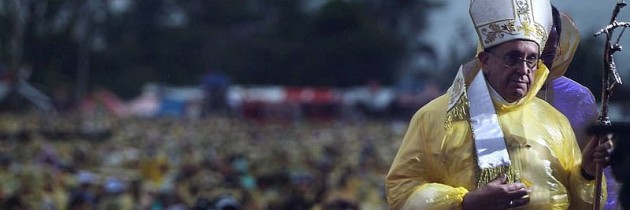
During a presentation to young people in the Philippines, the Holy Father set aside his prepared text to answer a question that had been raised by a 12 year old girl who had been rescued from the street. Tearfully weeping, Glyzelle Palomar, recounted the miseries of her life in a few words and asked, “Many children are abandoned by their own parents, many are victims of many terrible things such as drugs and prostitution. Why does God permit these things even though the children are not at fault.Why do so few people come forward to help?” In this video we can view the scene and the Pope’s compassionate embrace of the child.

What response is possible to the perennial problem of evil? Pope Francis did not try to evade the question with platitudes. He took the question head-on, educating about 30,000 of the faithful and challenging them. First, he noted the shortage of women among those making presentations and he emphasized the importance of the point of view of women. The Pope said that women pose questions which men could never stop trying to understand, that is, never grasp.

We can understand something, added the Holy Father, “when the heart reaches the place in which it can ask the questions and cry. Only through tears do we arrive at a true compassion which can transform the world.” Pope Francis described a common, worldly type of compassion as one in which we just take a coin out of our pocket. He added that if Christ had shown this type of compassion, he would simply have spent a little time with a few people and gone back to the Father. Jesus could comprehend our lives, the Pope said, when He was able to cry and did cry.

He notes, “In today’s world, there is a lack of crying. Although the marginalized, the poor, and the outcasts cry, those of us who do not lack anything essential do not cry. Only those eyes that have been cleansed by tears are able to so see things as they are.”

The Pope challenged the faithful. “Let us not forget (this young woman’s) testimony. She asked the great question ‘why do children suffer?’ crying. And the great answer all of us can give is to learn how to cry.”


Read More

Posted by on Jan 20, 2015

¿Por qué Sufren los Niños? Papa Francisco a Los Jóvenes en Filipinas

¿Por qué Sufren los Niños? Papa Francisco a Los Jóvenes en Filipinas


El Santo Papa dejó su texto preparado para contestar la pregunta que le había puesto una niña rescatada de la calle.  Con lágrimas, gemiendo, Glyzelle Palomar contó en pocas palabras las miserias que había padecido y preguntó, “Hay muchos niños abandonados por sus propios padres, muchas víctimas de muchas cosas terribles como las drogas o la prostitución. ¿Por qué Dios permite estas cosas, aunque no es culpa de los niños? ¿Y por qué tan poca gente nos viene a ayudar?” En este video podemos ver el escenario y la compasión del abrazo del Santo Padre.

¿Qué respuesta es possible al perenne problema de la maldad? El Papa Francisco no trataba de evadir la cuestión con palabras blandas y dulces. Enfrentó la cuestión enseñándoles a unos 30 mil de los fieles y desafíandoles. Primero notó la escasez de mujeres en las presentaciones y la importancia del punto de vista feminino. Dijo el Pontífice que la mujer se puede hacer preguntas que los hombres “no terminamos de entender.”

Podemos entender algo añadió El Santo Papa “cuando el corazón alcanza a hacerse la pregunta y a llorar.” Solamente por lágrimas llegamos a la verdadera compasión que se puede transformar al mundo. El Papa Francisco describió una compasión mundana por lo cual solamente sacamos una moneda del bolsillo. Añadió que si hubiera Cristo demonstraba esa compasión, hubiera pasado unos momentos con algunas personas, y se hubiera vuelto al Padre. Jesucristo entendió nuestros dramas, dijo El Papa, cuando fue capaz de llorar y lloró.

Declaró, “Al mundo de hoy le falta llorar, lloran los marginados, lloran los que son dejados de lado, lloran los despreciados, pero aquellos que llevamos una vida más o menos sin necesidades no sabemos llorar. Solo ciertas realidades de la vida se ven con los ojos limpiados por las lágrimas.”

El Papa desafió a los fieles “No olvidemos este testimonio. La gran pregunta ‘por qué sufren los niños’ la hizo llorando. Y la gran respuesta que podemos hacer todos nosotros es aprender a llorar.”


Read More

Posted by on Jun 13, 2014

Entering into the Mystery

Crepe Paper and Sticks Become a Bird for Pentecost


Feathers all ready for flying

Feathers all ready for flying

The primary image of Pentecost is that of tongues of fire that accompanied the sound of a rushing wind and settled over the heads of the disciples, both men and women, gathered in the upper room of the home in Jerusalem where Jesus had celebrated the Last Supper with his friends and then appeared to them on several occasions after the Resurrection. In this unforgettable moment, the Holy Spirit came upon the disciples and empowered them to witness to what they had seen and heard of the love of God and the coming of God’s Kingdom to the world. The Church was born on that day nearly 2,000 years ago and the Holy Spirit continues to breathe life and love into God’s world through ordinary men, women, and children.

Many ways of celebrating Pentecost exist around the world, beginning with the gathering of the community to celebrate the Lord’s Supper. For children, other activities can make this a special day as well.

Common symbols of the Holy Spirit include a dove, the wind, and a flame. A craft I learned many years ago makes an enjoyable activity for children to celebrate during Easter Season and Pentecost.

Crepe Paper & Stick Birds

Supplies:

2 thin sticks or branches – about 1 1/2 to 2 feet long
String or yarn – 1 foot length
Cellophane tape
Crepe paper – white, yellow, red, orange
Orange ribbon (optional)

Making your bird

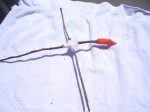
Take two sticks of unequal length and tie them together in the form of a cross. Use string or yarn to tie them securely and help hold them in the cross shape.

2012-04-17 17.02.28

Next take a bit of the crepe paper and wrap it around the yarn to help stabilize the bird’s body.

Take the orange ribbon or a bit of orange crepe paper and wrap it around the tip of the shortest end of the sticks. Go around the stick enough times to make a beak and a head for your bird. If you use ribbon, you can use crepe paper to cover the body-end of the beak and build up a head.

2012-04-17 17.07.17

Once the head has been formed and the center stabilized, take a long strip of crepe paper, tape it to the stick or to itself, and begin wrapping it around the sticks.

2012-04-17 17.14.49

Cover both sticks completely with crepe paper. Leave only a little of the beak showing.

Close-up of head

Close-up of bird’s head

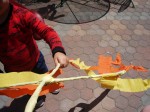
Take strips of whatever color of crepe paper you are using and tape them to the bird’s wings and tail. Some will want to tape them all along the wings. Others will put them only at the tips. Either way works just fine.

Feathers all ready for flying

Feathers all ready for flying

When the feathers have all been attached, the bird will be ready to fly.

Away we go!

Away we go!


This bird can be constructed to celebrate Easter, the Resurrection (as a phoenix), or Pentecost (as a reminder of the Holy Spirit who comes igniting the fires of love and settles like a bird on those called to God’s family).

Come Holy Spirit. Fill our hearts with the fire of your love. Blow where you will in our lives. Strengthen us to respond with the freedom of a bird flying in your love.

Read More

Posted by on Nov 2, 2013

Soul Cakes in November

Soul Cakes in November


Pope Francis reminds us that the Feast of All Saints (November 1) is a day to celebrate peacemakers. Pope Francis also tell us to remember on the Feast of All Souls (November 2) that when we die what matters most is how we have treated the poor and those at the margins of society. Many traditions for celebrating these feasts are found around the world. El dia de los Muertos – the Day of the Dead in Mexican culture is an elaborate remembrance of the dead. A northern European tradition is making, giving, and eating of Soul Cakes.

Soul Cakes are small cake-like pastries. Typically they are made with spices including ginger, nutmeg, allspice, cinnamon, and/or cloves. They may have raisins or currents baked into them. They may be frosted or sprinkled with powdered sugar. They may also be made of sweet dough like a sweet roll.

During the Middle Ages, especially in northern Europe, England and Ireland, soul cakes were baked and shared as part of the celebration of All Hallow’s Eve, All Saints Day and All Souls Day. Each cake was marked with a cross. People called “soulers” went from house to house, offering songs and prayers for the dead. They received these cakes as gifts and ate them. Each cake eaten was believed to represent a soul released from Purgatory.

Today, the custom of giving and receiving soul cakes, especially as a way of freeing souls from Purgatory, has fallen by the way. Nevertheless, making and eating soul cakes is an enjoyable way to mark these feasts and celebrate them in family or community.

The recipe for Soul Cakes here is one I have developed from several basic cookie recipes. I like it because it is easy to make and includes pumpkin, for a special seasonal flavor. It doesn’t include raisins or currants, but a handful of either could be added to the dough if you like. Nuts could also be added, but they are not essential.

Pumpkin Soul Cakes

Ingredients:

Wet:
1 C Shortening (Butter or margarine)
1 C Sugar or 3/4 C Honey
1 Egg
1 C Pumpkin (cooked and pureed)

Dry:
3 1/3 C Flour (either white or whole wheat will work – I used whole wheat.)
1 t Salt
1 1/4 t Cinnamon
3/4 t Ginger
1/2 t Baking powder
1/4 – 1/2 t Cloves, Nutmeg and/or Allspice (to taste)

Cream shortening and sugar. Add pumpkin and egg and mix together well. Combine dry ingredients then add gradually to the wet ones, stirring well.

This dough can be chilled and rolled out for cut cookies or it can be baked as drop-cookies. I make them as drop cookies using a teaspoon to scoop about a tablespoon of the dough from the pan and drop it onto a greased baking sheet. Flatten them slightly before baking if you want to put a cross on the top of them.

Bake at 350º for 10-12 minutes.

When cool, frost with a powdered sugar or other icing in the shape of a cross. A little bit of vanilla in the icing adds a nice flavor.

(If not planning to use the cookies as soul cakes, swirl the frosting over the top with a knife or leave them unfrosted. They’re good either way.)

Enjoy with friends and family — and remember to offer a prayer for those who have gone before us.


Read More

Posted by on May 31, 2013

Entering into the Mystery

Feast of the Visitation – Celebrating Blessings Hidden Within

The Visitation - Mary and Elizabeth meet - Luke 1:39-45

The Feast of the Visitation is a celebration of the meeting of Mary with her cousin Elizabeth when both women are expecting their firstborn children. Mary, a very young woman, has given her consent to become the mother of Jesus in response to God’s request. Elizabeth, a much older woman who has never been able to have a child, has conceived a son miraculously in her old age following the visit of an angel to her husband while he was serving in the temple. Word of Elizabeth’s pregnancy has been offered to Mary as a sign that “nothing is impossible with God.” Knowing how difficult the last months of pregnancy can be, especially for an older mother, Mary hurried to help her cousin.  The joy of their meeting and the song of praise Mary offers to God for the wonders they are experiencing have resonated through history. In fact, Mary’s prayer, known as the Magnificat from its first word in Latin, is part of the daily prayer of the Church, included as part of Evening Prayer in the Liturgy of the Hours.

Celebrating the Feast

This feast is remembered among the Joyful mysteries of the Rosary. Readings and prayers for the Mass celebrated on this feast are all focused on the great joy of the gift of these two improbable pregnancies and of the women themselves, as well as our joy with and for them. The prayers of the Liturgy of the Hours also remind us of the event.

The Magnificat has been set to music by many gifted men and women through the ages. David Haas, John Michael Talbot, and Rory Cooney have composed some of my favorite versions.

One way to celebrate this feast is to make cream puffs and share them with family and friends. Praise God for coming to share life with us through the Incarnation of his son. Give thanks for all the women who have courageously born and raised children, treasuring the wonder of sweetness and life hidden within their wombs.


 JESUS MAFA. The Visitation – Mary and Elizabeth meet, from Art in the Christian Tradition, a project of the Vanderbilt Divinity Library, Nashville, TN. http://diglib.library.vanderbilt.edu/act-imagelink.pl?RC=48279 [retrieved May 31, 2013].


Read More

Posted by on Mar 24, 2013

Entering into the Mystery

Singing Leaves Time and Palm Sunday


Palm Sunday Fronds

Palm Sunday– “Singing Leaves”

Faith is passed from generation to generation through simple gestures, songs, foods, and activities. As children live the activities of daily life in the cycles of the year, they notice more than we realize. Life, especially for the little ones, is heavily focused on the present moment, but they too become aware of the changing seasons in our church life and come to look forward to the next celebration.

I was reminded of this yesterday when a sweet four-year-old boy asked me if it were time for the “singing leaves” yet. It took me a moment to realize that he was referring to Palm Sunday. In our parish, as Catholics do in parishes around the world, we all gather in a courtyard outside the church on Palm Sunday. Each person has a palm frond and members of our parish youth group wave large palm branches, leading the congregation out of the church building to hear the story of Jesus’ triumphal entry into Jerusalem on that Sunday morning so long ago. Then, singing “The King of Glory Comes,” we all process back into the church for the Passion Sunday liturgy. (Palm Sunday and Passion Sunday occur on the same day.) This little boy remembered waving the palms last year and the singing as we re-entered the church. He was quite excited when I responded that this was the Sunday for the singing leaves.

As parents, grandparents, aunts, uncles, cousins, godparents, or simply friends, we share our faith best through the examples of our lives. Do we pause to thank God and ask a blessing before we eat? Do we greet the morning with a prayer? Do we remember to give thanks for our day and ask God’s blessing on our families, friends, and activities before we go to sleep at night? Do we gather regularly as a community of faith to celebrate Eucharist? Is Reconciliation (sacramental or simply interpersonal) a part of our lives? Do we pause in times of joy and times of sorrow to call the Lord into our midst? Do we time our holy day activities to match the liturgical timetable, not jumping to celebrate major feasts before their time but rather savoring the periods of anticipation and preparation for the feasts as well? Do we do these things with the children in our lives?

Children learn by observing and imitating. Only in later childhood and early adolescence do children begin to hunger for the meatier reasons for why we believe and do certain things. For a young child, “because that’s what we do now” can explain quite acceptably the timing of an activity. An older child will want to know that we do it “because that’s what Jesus told his friends to do before he died.” As adults, we too have opportunities to learn and grow more deeply in our faith and understanding of it — through both intellectual and spiritual practices. However, to reach our children, we do well to rely on activities, stories, songs, and celebrations.

As we move into this Holy Week and then on into Easter-tide, let’s remember to celebrate each in its own time. Holy Week is a good time to make and enjoy traditional Lenten dishes including Hot Cross Buns. It’s not time yet for Easter eggs or chocolate bunnies!

Mass on Holy Thursday can be a special time to celebrate caring for each other and the gifts of the Eucharist and the priesthood. Have a special meal, enjoy time together on this day, then join with your community to celebrate Eucharist and enter into the mystery of Jesus’ Passion — His great love for us.

Good Friday brings many opportunities to share faith with children. Little ones don’t need to know in great detail of the tortures inflicted on Jesus. They just need to know that Jesus loves them totally. So as we fast and reflect on the events of the day, let’s remember to be patient and peaceful. If the Solemn celebration for Good Friday is going to be too late or too “heavy” for the little children, then do something peaceful and loving at home with them. As they get older, take them with you to enter more deeply into the mystery.

Holy Saturday is a quiet day of preparation and anticipation. Coloring eggs, baking special breads or desserts, getting the house in order for the Easter celebration — all will become part of the faith tradition for our children. Happy memories or sad ones will remain with them based on the love they see through our bustle of activities and the times we stop for reflection or story-telling.

Easter Vigil brings the story of salvation history and its culmination in the Resurrection alive. Children from 3rd or 4th grade and older can appreciate this celebration, particularly if the passages from Scripture are proclaimed in an engaging fashion.

If we remember to celebrate each of these mysteries of Jesus’ Passion, Death, and  Resurrection during this week each year, our children will learn to treasure them as well. They may not always celebrate them as they move through adolescence and into adulthood. There may be times in their lives when they move away from the community and travel their own road to God, but the foundations will be there, always calling them to the Lord.

May this week, from the Singing Leaves to the Alleluias of Easter Vigil be a time of rich blessing for you and for your families and communities.


Read More

Posted by on Dec 20, 2012

Las Posadas: Food, Fiesta and Community

Singing echoes through the softly lit streets of the towns, cities, and neighborhoods of Mexico as residents prepare for Christmas, through the para-liturgical tradition of Las Posadas. Processions of townspeople, led by a couple dressed as Mary and Joseph, wind their way through the streets, going from home to home asking for “posada” (shelter). Finally, the procession is welcomed into a home, and the people pray together as the “fiesta” commences.

Las Posadas is a Mexican Catholic Advent tradition that marks the beginning of the Christmas season. Taking place from the 16th-24th of December every year, Las Posadas is a nine day community celebration in preparation for the birthday of Christ; a novena that is a mix of religious devotion and relaxation. Ultimately, Las Posadas is about accepting Christ, the Bread of Life, into one’s home and heart. It functions as an extension of the Eucharist, catalyzed by the fiesta culture. Food, both physical and spiritual, is an important element of the fiesta, because it is nearly impossible to have a Christian festival without food.

Las Posadas is a fiesta; a religious fiesta in the sense that it provides sacred time and space to show a sacred event.  The fiestas of Las Posadas reenact Mary and Joseph’s journey to Bethlehem, a journey that is considered sacred because it directly led to the birth of Christ in Bethlehem. Also, the fiestas gather the community in a ritual that parallels the structure of a Mass, emphasizing two more sacred elements of Las Posadas: the community and the Eucharist.

Evangelization in a New World

Las Posadas began in 1578 in Mexico in the village of San Agustín Acolman. Augustinian missionaries received permission from Pope Sixtus V to celebrate special Masses in order to make Christianity more attractive and  to evangelize the Aztecs. Because of the syncretism that occurred when the missionaries introduced Catholicism to indigenous Americans, Las Posadas resembles the Aztec celebration of the birth of the sun and war god, Huitzilopochitli. The missionaries wanted a way to teach the gospel and extend the Eucharist to a large, illiterate population and needed a way that the Aztecs would accept, so they took advantage of the timing of the birth of Huitzilopochitli to introduce the birthday of their own important, sacred figure, Jesus Christ. In las misas del Aguinaldo (special Masses for the Advent season), they included nativity scenes and lights, sang villancicos (Christmas carols), and broke a piñata. The celebration of Las Posadas grew from these original Masses. Mary and Joseph’s journey to Bethlehem, as told in Luke 2:1-7, is featured in Las Posadas, a celebration that includes elements similar to those of the celebration for Huitzilopochitli. (All night and during the day after Huitzilopochitli’s birthday, people customarily had parties in many houses throughout the town, at which guests delighted in foods and statues of their gods made from blue corn dough.)

Days of Prayer and Celebration

Las Posadas begins on the evening of December 16th and ends on Christmas Eve. These nine days dedicated to prayer are called a “Novena.” Originally, a novena referred to the nine days of prayer before the Feast of Pentecost, but in Las Posadas it also represents the nine months of Mary’s pregnancy. Each night, a young woman and a young man – usually teenagers – dress as Mary and Joseph and go to three different, predetermined houses, asking for posada (shelter). They are accompanied by a candle-lit procession that includes musicians, children dressed as angels and shepherds, and anyone else who would like to join. At the first two houses, the procession of peregrinos (pilgrims) is turned away by groups of people inside the houses, who play the part of the innkeepers who denied Mary and Joseph shelter. The interactions between the peregrinos and the “innkeepers” happen in the form of call-and-response songs. Through several verses, the peregrinos ask for shelter and are denied entry by the innkeepers. The last verse is sung only when the procession is welcomed into the last house.

At the last house, the peregrinos are welcomed and the whole community gathers for prayers and a party. Once all the peregrinos have entered, everyone prays the Act of Contrition, asking for forgiveness for their sins. Often, they will also pray the rosary, and/or hold a short prayer service. This part of the fiesta mirrors the Liturgy of the Word (the first part of a Mass). Soon the prayerful ritual gives way to food, games, and dancing. Nevertheless, ritual that promotes spiritual communion is still present in the fiestas, and parallels the Liturgy of the Eucharist (the second part of a Mass) — sharing a meal and celebrating the forgiveness of sin in the Eucharist. The fiestas grow in excitement with each passing night, but at each are ritual elements, including food and drink, candles, Nativity scenes, and piñatas filled with fruits, nuts, and candies.

Piñatas, Sin and Forgiveness

Traditional piñatas are shaped like stars and have seven points, each point representing a cardinal sin. People swing at the piñata with their eyes covered by blindfolds to signify their true faith in God and His mercy. Thus, when they break the piñata and are showered with sweet candies, the people act out the experience of conquering sin and receiving forgiveness and blessing from God. This is also a dramatization of how everyone’s sins are forgiven during the Eucharist, when Catholics remember how Christ died so that the sins of the world would be forgiven and confess their own sin through the Confiteor. Although perhaps not broken every night, the piñata nevertheless demonstrates the way food is used to teach religion, extend the message of the Eucharist into the home, and catalyze the fiesta spirit.

Sharing Food and Creating Communitas

The fiesta spirit continues through each of the nine days, never seeming to lag. On Christmas Eve, the final stop for the peregrinos is the church, where they celebrate La Misa de Gallo, a Midnight Mass, in which they share in the Body and Blood of Christ – a shorter but still powerful religious fiesta in which a sacred meal is re-enacted. After the Mass, the longest fiesta of Las Posadas commences. Along with a piñata and the small dessert items served at the fiestas on each of the previous nights, people prepare and share their favorite foods at the reception after Mass. Typical foods include tamales, pozole (pork soup), sopa de albóndigas (meat-ball soup), pollo con mole (chicken in mole sauce), bacalao (codfish stew), natillas (a type of thick custard), and buñelos (deep-fried pancakes sprinkled with sugar). Champurado (spiced hot chocolate), atole (a corn based drink), and ponche (punch) are also served. Although these are some of the more traditional foods consumed during the Advent and Christmas seasons, there are no foods that are specifically reserved for Las Posadas. Therefore, it does not matter what food is served, since the sharing of food itself symbolizes and strengthens the community.

Las Posadas makes the Gospel come alive in a cultural experience of spiritual communion in which the people welcome Christ into their homes and lives. This spiritual communion results from the transformation of Jesus’ body, “…the living bread that came down from heaven” (John 6:51), in the Eucharist into spiritual food. The ritual of Las Posadas reflects the mystery of the Eucharist because the people of the community act as living bread through their acts of hospitality and generosity in caring for others. Additionally, the fact that Las Posadas is a religious fiesta, and thus directly tied to Catholic Hispanic fiesta culture, draws the community together and builds the spirit of communitas. Communitas is a deep spirit of community – a spiritual communion where all the members are united in the same consciousness, usually through a ritual. Las Posadas is a way in which Mexican Catholics realize communitas through the Eucharist and fiesta. Thus, the fiesta catalyzes, yet also results from, the ritual of Las Posadas and is thoroughly intertwined with food, both spiritual and physical; physical food is the visceral symbol that gathers the community and provides the base for rituals, in which it is transformed into spiritual food. Therefore, it nourishes the body and the spirit.

Although there are traditions around the world in many different religions that fulfill the same functions, Las Posadas is one of the best examples of the way Mexican Catholics have taken the Eucharist and made it part of their cultural experience through the fiesta. Today, the fiesta spirit is spreading beyond Mexicans and Latinos. In some cases non-Latinos are attracted to the religious and spiritual aspects of Las Posadas. For others, Latinos and non-Latinos, a more secularized version of Las Posadas, in which the prayerful aspects are downplayed or ignored and the focus is on family and community, is more comfortable and attractive. Nevertheless, although those who celebrate a secular version of Las Posadas think that they are leaving Catholicism behind, they cannot escape the fact that even in any secular form, Las Posadas is still a religious fiesta celebrating and strengthening the spiritual connection between community members. Despite dropping all of the prayers, they are living the communitas of the Eucharist in their celebration, since even the secularized ritual parallels the structure of a Mass. Thus, without realizing it, many people are attracted to the religious and spiritual aspect of Las Posadas. What they experience is a community dimension of the Eucharist as seen in the transformation of profane (non-sacred) food into sacred nourishment for the spirit and community. Through that shared experience of celebrating a religious fiesta, people of all cultures strengthen their bond with their communities, uniting community, religion, and food.

Read More

Posted by on Mar 25, 2012

The Church: LA Religious Education Congress

Hello from Los Angeles!

The Religious Education Congress has been excellent — energizing and enlightening.  There has been a decided focus on some basic topics and themes that have been unpopular with most Catholic progressives — things like sin and the Sacrament of Reconciliation.  It’s all been integrated in a very interesting way.  I believe it may be in reaction to the accusations of the Catholic Right that everyone else in the Church has fallen off the deep end into perdition.  It is also probably in response to the reality of the need for evangelization regarding the need for God in the first place.

Religion is very un-PC at the moment.  “Sin” as a topic is a “no-no.”  Taking responsibility for hurtful acts is very difficult for most people.  The connection between sin and evangelization is that one cannot be a credible witness to the need for faith if one is living a chaotic or destructive life.  Many of the speakers pointed to the need for good decisions, being able to hear God’s voice in the midst of all the competing voices in our culture — security, money, appearances, status etc. —  and having a spiritual director or a personal spiritual coach in the person to whom one goes for the Sacrament of Reconciliation.

Matthew Kelly noted, “Holiness is attractive.”  We have so many Catholics outside the Church who have been hurt by someone in the Church that we have to look at how committed we are to our own faith — does it really matter?  We are attracted to a Mother Teresa.  She was only one person — a small one at that.  So, Kelly rightly asked — “What’s with the rest of us?”

It’s a good question — one that we would all do well to take as our focus during these final days of Lent and as we go into Easter.


Read More

Posted by on Mar 16, 2012

Entering into the Mystery

Celebrating St. Patrick’s Day with Irish Soda Bread

Irish Soda Bread "Cookies"

One of the great things about being Catholic is getting to celebrate the feasts of those who have gone ahead of us – the saints. There are so many saints to celebrate that every new day could bring with it a reason for a party! Some saints, however, are associated with certain nations or ethnic groups and their feasts get celebrated more widely, even by those who don’t share their faith or ethnicity.

Saint Patrick is one of those whose feast has become identified with the people of a nation. St. Patrick is remembered for bringing Christianity to Ireland. Though born in Wales, his feast is marked with great celebration of Irish identity in the United States, not just by those of Irish origin. In typical immigrant fashion, St. Patrick’s Day is celebrated with greater enthusiasm by the Irish in America than in Ireland. Music speaks of loves lost, homes left behind, and dreams of returning someday. Foods are not necessarily those that were eaten in the homeland, but rather those eaten by immigrants to a new land, with touches of the old ways for comfort.

With all this in mind, making Irish Soda Bread can be a good way to celebrate the life of a man who was taken to another land as a slave, escaped some years later, and then returned to bring the Good News of Jesus to the people of that land.

Here’s a recipe we’ve enjoyed.

Irish Soda Bread

2 cups all-purpose flour *
2 cups white whole wheat flour
2 tbsp baking powder
4 tablespoons sugar
1 teaspoon baking soda
1 teaspoon salt
4 tablespoons (1/2 stick) cold butter, cut into 1/2-inch pieces
1 3/4 cups cold buttermilk, shaken **
1 large or extra-large egg, lightly beaten
Zest of one orange
2 tbsp caraway seeds
1 cup dried currants

Preheat the oven to 375 degrees F. Line a sheet pan with parchment paper or lightly grease a baking pan.

Combine the flour, sugar, baking soda, and salt in the bowl of an electric mixer fitted with the paddle attachment. Add the butter and mix on low speed until the butter is mixed into the flour.

With a fork, lightly beat the buttermilk, egg, and orange zest together in a measuring cup. With the mixer on low speed, slowly add the buttermilk mixture to the flour mixture. Combine the currants with 1 tablespoon of flour and mix into the dough. It will be very wet.

Dump the dough onto a well-floured board and knead it a few times into a round loaf. Place the loaf on the prepared sheet pan and lightly cut an X into the top of the bread with a serrated knife. Bake for 50 – 60  minutes, or until a cake tester comes out clean. When you tap the loaf, it will have a hollow sound.

Cool on a baking rack for at least 10 minutes. Serve warm or at room temperature.

* You can use 4 cups of all-purpose flour in lieu of white whole wheat. Just omit the baking powder

** No buttermilk? No problem. Measure out 1 2/3 cups of milk and add a couple of tablespoons of lemon juice to bring the mixture to 1 ¾ cups.

Alternate Idea for Shaping:

After kneading the dough, roll it out to about ½ inch thickness. Cut with a shamrock shaped cookie cutter. Bake at 375º for 18-20 minutes or until a cake tester comes out clean. The biscuits will be lightly browned.

Cool on baking rack. Serve warm or at room temperature.


Read More