Pages Menu
RssFacebook
Categories Menu

Posted by on Sep 5, 2007

Mother Teresa – “Love is Left Alone”
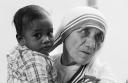
Mother Teresa – “Love is Left Alone”

Mother Teresa 1979

Jesus has a very special love for you. As for me, the silence and the emptiness is so great that I look and do not see, listen and do not hear.
— Mother Teresa to the Rev. Michael Van Der Peet, September 1979

The Time cover story was not really news to me. I had read about Mother Teresa’s time of spiritual dryness in My Life With the Saints, by Fr. James Martin, S.J. Like most people, I never suspected that Mother Teresa’s spiritual silence and emptiness had lasted so long.

In the secular science of the soul – psychology – the current ideal of human development is one of balance. There is supposed to be an apportioning of time and energy for your internal, personal, and professional life. We are supposed to pay attention to our own personal space, our spouses, families, colleagues, communities, and the environment.

Like most ideals, it is unattainable. If we could achieve a balance in all of these relationships, we would implode under the disappearance of our own uniquely unbalanced personalities. If personal fulfillment and psychological health is not balance, it would seem that some portion of our efforts should be focused on many of these areas. What happens if your life is comprised only of ministry?

Mother Teresa of Kolkata (Calcutta) led a life beyond balance. She had no secular career, no family, no apparent hobbies. She had an all consuming ministry to those completely abandoned by society. Founding and leading a religious order and expanding the work of the Missionaries of Charity, left little time for sleep, let alone rest and relaxation.

Mother Teresa’s hyper-focus and zeal appears to go against most of the consensus about the development of the spiritual life. Spiritual directors and teachers prescribe adequate sleep, relaxation, and attention to personal and community relationships. The Rule of St. Benedict of Nursia (c. 530) comes to mind, since it has been the de facto standard in monastic living. There is a large body of Christian literature, from the earliest times, advising prudence and temperance in the spiritual life.

St. Ignatius Loyola referred to dark periods, when there is little feeling of the presence of God, as periods of desolation or aridity. Early hermits in the Egyptian desert referred to this state as the “noonday devil.

My first thought was that Mother Teresa’s lack of prudence and temperance had gotten the better of her. Yet, how could I make such an observation without knowing Mother Teresa? So, I decided to talk with someone whose home in Madras Mother Teresa had visited several times. Paul D’Souza is an old friend of ours who met her when he was 3 years old. What struck Paul was that, although the house was full, she always first sought him out and the other small children, before paying attention to any one else. Paul has had his own thoughts on harmony and balance for some time. As a management consultant and healer, Paul has his own theory of Beyond Balance.

When I asked him what he thought might have been the cause of Mother Teresa’s very long dark night of the soul, the reply was unusually sharp for someone with a master’s degree in social work. Paul remembered that Mother Teresa continually reminded her Missionaries that the face of Christ was to be found in every child, in every human person. The arduous work of caring for disabled orphans is a direct service to Christ. “What about balance?” I asked. In tones of not so patient exasperation, Paul said that in his study of leaders, “No one whoever accomplished anything was balanced.” When I pressed him on Mother Teresa as a person, he told me to talk with his mother who had met Mother Teresa several times.

I had a pleasant talk with Christine D’Souza, who is also an old friend. (Our children call her Grandma Christine.) She and her late husband, John, met Mother Teresa in 1968 in Madras, now known as Chenai. As many have recounted elsewhere, Mother Teresa was not demanding or seemingly driven. According to Mrs. D’Souza, she normally sat quietly and spoke in a soft voice while looking at her hands. Mother Teresa “put her cards on the table,” according to Mrs. D’Souza, and allowed her listeners “to pick up what ones they would,” without asking them to make any choice. Mrs. D’Souza recalls, “She had such humility, but with a strength and dignity. She reminded me of the beatitude, ‘Blessed are the meek.'” The only time Mrs. D’Souza recalls her making a request was when they first met and Mother Teresa asked her directly if she and the lay co-workers could meet at the D’Souza’s home.

When I asked Mrs. D’Souza what she thought about Mother Teresa’s decades of spiritual dryness, she responded with the wisdom of age and grace. Mrs. D’Souza said that she couldn’t speak for anyone else. She recounted that in her youth she experienced a closeness to Christ but that this emotional awareness and feeling waned over time. This absence did not keep her from raising a family, being a music educator, and engaging in many other activities in a spirit of faith.

Mrs. D’Souza recalled a few lines of a poem in a pamphlet her husband had given her:

God gives us love.

Something to love He lends to us.

Love reaches ripeness,

and of that on which it throve,

Love is left alone.

Read More

Posted by on Sep 4, 2007

Mother Teresa – “Love is Left Alone”

The Triumph of the Lowly – St. Thérèse of Lisieux and The Little Way

Not too long after Pope John Paul II named St. Thérèse of Lisieux a Doctor of the Church in 1997, I overheard someone commenting to one of her friends that a specialist in the spirituality of St. Teresa of Avila, was upset by his action. This specialist was very clear about the reasons that Teresa of Avila had received that honor, based on her years of spiritual growth, her reformation of the Carmelite order, and her writings. By contrast, Thérèse of Lisieux, in her short 24 years, had really not contributed anything of substance, certainly not enough to merit such a grand title as Doctor of the Church, a status shared by only 32 other people. Only two other women, Teresa of Avila (1515-1582) and Catherine of Siena (1347-1380) were Doctors of the Church. They had only received this recognition in 1970. (The New Catholic Encyclopedia, in 1967, ventured that women were unlikely to receive this honor because it is linked to the teaching office of the church,”which is limited to males.”)

Marie Françoise Thérèse Martin (1873-1897) became Sr. Thérèse of the Child Jesus and the Holy Face when she took her vows at the Carmelite convent in Lisieux in Normandy, France in 1888. I have been a fan of hers since I was in second grade. I read a children’s biography, Saint Thérèse and the Roses. It was really too hard for me to read easily, but I plowed my way through it and fell in love with her. I returned to the story many times as I grew up and continued to find her attractive. In fact, I chose her as my Confirmation patroness at age 13, long before she was so grand.

When Randy and I were newly-weds, we went to Guadalajara, Mexico to meet his cousins on his father’s side of the family. Randy’s aunt, Tía Dorotea, gave me a copy of Thérèse’s autobiography, The Story of a Soul, in Spanish. Thérèse was also Tía Dorotea’s favorite saint and I learned that in Mexico she is sometimes known as Santa Teresita (St. Little Teresa). I have thought of her as Teresita since that time.

However, I was in graduate school and then had young children and a business to operate with Randy, and I never found time to read my precious gift.

I’d like to say that I have now found and read it, but that would not be true. I know it is in our house somewhere, but like the beads for repairing my favorite moccasins, it is hiding in our resident Black Hole. I’m confident that it will someday escape and I plan to read it with a smile when it does, as I remember Tía Dorotea fondly.

So, I found myself wondering, what was it that made her as important in the life and history of the Church as Teresa of Avila and Catherine of Siena? I found the answer recently while shopping for a birthday gift at my favorite bookstore. On the shelf was a small book by Patrick Ahern, Auxiliary Bishop of New York, Maurice and Thérèse: The Story of a Love.

In this little book, Bishop Ahern offers a brief biography of Thérèse of Lisieux and an explanation of the general spiritual ambience of the late 19th Century. He then presents a series of letters written by Maurice Bellière to Thérèse of Lisieux and her responses. Maurice Bellière was a seminarian who had written to the Prioress of Carmel in Lisieux requesting that a Sister be chosen to pray especially for his vocation and with whom he could correspond. Thérèse’s sister Pauline was prioress at the time and she chose Thérèse to be the one who would respond to him.

Thérèse was passing through the last 18 months of her life, dying of tuberculosis. She was holding on by sheer force of will to her belief in God and her trust that her life of faith had not been that of a fool. It was a time of deep spiritual darkness for her, yet she offered sound advice, great encouragement and deep love to Maurice in her letters.

I couldn’t send the book to its new owner until I read it all myself! And through this book, I came to understand the great gift my Teresita gave to the Church, a path out of the darkness of Jansenism back into the light of trust in a loving God.

During the late 19th Century, an heretical approach to spirituality called Jansenism was still widely influential in popular spirituality, especially in France. The fundamental idea of Jansenism, which began in the mid-1600s, was that humans are not able to resisting any deep longing of the soul or any pleasure, whether towards good or evil. The only hope of salvation rested on God’s intervention in a person’s life, steering the person directly to choose the good. This understanding denied the existence and role of free will as a foundation of the relationship between God and humans. It was a system of predestination in which no one could have any certainty that he or she had been chosen (predestined) for salvation.

As a result, it tended to be a spirituality leading to uncompromising firmness or rigidity regarding beliefs and stern, strict religious practices. There was no role allowed for the heart or for feelings in worship. The infallibility of Church teachings was denied. Humans were seen as inherently bad and unworthy of God’s love or forgiveness. Frequent reception of Communion was discouraged because people are so unworthy to receive such a great gift.

Jansenism persisted for the next several centuries, especially in France. It was formally outlawed in 1712, but many Jansenist ideas and practices continued. St. Pius X, who had read Thérèse’s autobiography, was elected Pope in 1903. He tried to counter Jansenism by lowering the age for First Communion to 7 and by encouraging frequent Communion. Yet even into the mid-20th century when I was a girl, the remnants of Jansenism popped up in popular spirituality and even in the pulpit.

The “Little Way” of Thérèse of Lisieux, again opened the door to the Good News of Jesus, that God is a loving Father (a Parent) to us. While it is true that we are weak and we sin all too easily and frequently, God’s Love still reaches out to us and forgives.

The essence of the Little Way is the idea that most of us are not called to heroic degrees of self giving and sacrifice in our lives. Most of us are not called to leadership roles in the community. Few are called to celibacy. Even fewer are called to the heroic witness of martyrdom. But all of us are called to holiness (sainthood).

In her own words, “Love proves itself by deeds, so how am I to show my love? Great deeds are forbidden me. The only way I can prove my love is by scattering flowers and these flowers are every little sacrifice, every glance and word, and the doing of the least actions for love.”

Teresita understood, as did the great St. Teresa of Avila, that God is found even in the cooking pots of the kitchen — in the daily routines of cooking, cleaning, sewing, gardening and praying of her community.

Bishop Ahern notes that her greatest fear in facing death was that death might truly be the end of everything. That her life might go out like an extinguished candle and all have been in vain. Her second greatest fear was the death by suffocation that tuberculosis often causes. However, when the time came, she simply stopped breathing, with a smile of peaceful delight on her face, and moved into her new life, all fear and doubt obviously left behind her. Her final words were, “My God, I love you.”

John Paul II, in Divini Amoris Scientia (The Science of Divine Love), the decree that gave Marie Françoise Thérèse Martin the title, Doctor of the Church, noted that she gave us a foundation for spirituality that was innocent, open, hopeful, and trusting. Church authorities also noted that Thérèse was ahead of her time. Thérèse stressed the importance of reading Scripture and using it as a basis for prayer and meditation. She promoted the importance of studying the Scriptures in their original languages. These views would set theology and spirituality on a whole new course when they were advocated in 1943 by Pope Pius XII, in Divino Afflante Spiritu (Inspired by the Divine Spirit).

Thérèse Martin’s little book and her Little Way also influenced Pope John XXIII who convened the Second Vatican Council. Her autobiography influenced most of the movers and shakers of the early 20th Century in the Church and those insights shine through the Council documents and reforms.

Thank you, Bishop Ahern for your wonderful little book.

Read More

Posted by on Aug 29, 2007

Mother Teresa – “Love is Left Alone”

St. Augustine: The Once and Future Giant


St. Augustine of Hippo by Sandro Botticelli

August 28th. is the feast day of Aurelius Augustinus Bishop of Hippo.

St. Augustine (354 to 430) was one of my boyhood heroes. I read Louis de Wohl’s biography of the saint, The Restless Flame. As a German writer in the 1920’s and 1930’s, de Wohl was immensely successful as a writer of thrillers and he brought this sense of action to his religious historical novels written in English after World War II. I was introduced to Augustine as a man of great learning and action, a man who moved mountains and changed the course of oceans of thought and action.

Later, when I read his Confessions and the City of God in Latin, I met a more complex man, very much at odds with mid-twentieth century psychology. Yes, Augustine was a giant of Western thought, but he was also a major force for movements and institutions that had been blown apart with the end of the modern era when World War II left Christendom in smoke and ashes.

The alliance of empire and church, the oneness of truth that allowed for state violence to save those in rebellious error, the primacy of celibacy, and the utterly fallen nature of humans conceived in original sin are significant positions which post-modern thinkers judge to have been more harmful than helpful.

The development of history as a critical discipline in the 19th century blossomed in the 20th with the tools of science, linguistics, and anthropology. The political, human, and moral catastrophes of saturation bombing, genocide, and nuclear weapons have led to a profound soul searching about what brought us to this point. Needless to say, many of Augustine’s positions came under fire by revisionists.

John J. O’Donnell, in Augustine: A New Biography, presents Augustine as a man of his time, with more warts and wrinkles than a halo. The dreaded heresies Augustine defeated, Donatism and Pelagianism, come in for a revisionist appraisal of their good points. David Hunter, in his review of O’Donnell’s book in America magazine, takes the author to task.

“This Augustine will surprise many readers. The following section headings, although taken from a single chapter, characterize the tone that prevails throughout the whole book: “Augustine the Self-Promoter,” “Augustine the Social Climber,” “Augustine the Troublemaker.” O’Donnell’s Augustine never seems to have outgrown his youthful aggressions and ambitions: “When writing about his first book in the Confessions, he reproached himself for his worldly ambition, even as, with the Confessions, he was carrying out an ecclesiastical version of the same social climbing.” O’Donnell duly documents Augustine’s later associations with powerful Roman generals as evidence of his subject’s lifelong attraction to power.”

O’Donnell has tremendous crediblity as the author of a three volume commentary on the Confessions of St. Augustine. However, his critics excoriate his portrayal of Augustine as less than saintly.

St. Augustine will rise again after this bout of historical criticism because the positive aspects of his legacy, his passionate devotion to Christ, his attempts to build a theology on scripture, the constitution of the human being as being body and soul, and the power of love, will, and memory will all come to the fore once again. From time to time St. Augustine may suffer from our ambivalence, but he is the pivotal ancestor that believers and non-believers in the post-modern world cannot deny.

Take a look at O’Donnell’s profile on the Georgetown University website and select some of the reviews. It’s an eye opener.

Read More

Posted by on Jul 30, 2007

Mother Teresa – “Love is Left Alone”

The Spiritual Theology of St. Ignatius Loyola

“Man is created to praise, reverence and serve God our Lord, and by this means to save his soul… Our one desire and choice should be what is more conducive to the end for which we are created.” – The Spiritual Exercises


Ignatius Loyola, by Francisco Zurbaran


July 31 is the feast day of one of the most influential people in the history of Christianity, Inigo de Loyola. Born in 1491, he was baptized Inigo and, almost 40 years later, added Ignacio. According to Hugo Rahner, S.J. in Ignatius the Theologian, the choice of the name Ignatius was based on Inigo’s understanding of the Bishop and martyr of Antioch as a model of selfless love and an advocate for the apostolic teaching authority. A substantial library has developed over five centuries about his conversion, spiritual teaching, and prudent practicality. Ignatius founded the Society of Jesus, a religious order of men also known as the Jesuits. As one of the Catholic Church’s largest and most influential orders, the Society has spread Ignatian influence throughout Christianity in its world wide network of schools and missions.

Although he was born on the eve of the Renaissance and the modern era, Ignatius was a product of the late Middle Ages. Surprisingly, his approach to the following of Christ was to propel Catholic Christianity into an amazing revival and laid the foundations for many Protestants and Catholics to confront the secular challenges of the Post Modern era.

Examination of Consciousness

Perhaps the best way to begin to understand the life and legacy of Ignatius Loyola is his distinctive method of prayer – his way of relating to God – the Examen.

It is not an examination of conscience in the sense of finding fault with oneself. Rather it is a method of heightening one’s consciousness about the ways we encounter God and freeing ourselves to move more deeply and consciously into that encounter.

The key themes of Ignatian spirituality are contained in The Examen: (1) finding God in all things, (2) “indifference”- in terms of a Zen-like detachment and trusting openness, (3) discernment – am I truly being led by the Spirit and, if so, where? (4) being “actively available” to serve God in others, to be a “contemplative in action.”

The Examen consists of five points, moments, or movements of the soul, mind, and heart:

1. Recall that you are in the Presence of God.

Much is said about Ignatius’ military background as a young minor Spanish noble and the orderly mentality he is supposed to have brought to the founding and development of the Society of Jesus. As an experienced man who came to conversion after a serious battle injury, however, Ignatius, in his path as a pilgrim to the Holy Land and to life, became more and more imbued with the overwhelming presence of God.

2. Look at your day with Gratitude.

The God of Ignatius is a loving God of gifts. God is not an aloof military officer or stern judge. In the imagination of Ignatius, God is somewhat analogous to a liege lord in the medieval sense, but without the human limitations. All that is good and wondrous about us and around us is only a veiled manifestation of the overflowing of that Ultimate Goodness. The response to this goodness is a profound gratitude.

3. Ask for help from the Holy Spirit

In keeping with ancient Christian tradition and belief, all true knowledge of God, and even faith, is the work of the Holy Spirit. What nature hints at, the Spirit reveals. Ignatius’ trust in God is shown in terms of his openness to the Spirit which drives out all fear.

4. Review your Day

The Examen was recommended as a midday activity, although it can be done a second time at the end of the day. The review is not an mental or written checklist. The aim is to be open to what the Spirit reveals about the occurrences of our daily lives and their deeper meaning. If you are in the process of reforming your life, the awareness may focus on basic do’s and don’ts of avoiding sin and acting out of love alone. For those further along the path, the challenge is more subtle. What have I seen? What have I heard? What have I touched? What did I miss? What did I encounter?

5. Reconcile and Resolve

This an act of renewed consciousness. If I messed up, now is the time to understand why and to make amends. Maybe an apology is in order. Maybe reducing stress or increasing awareness is in order. This is not a time to beat up on yourself. Ignatius commands gentleness and compassion. On the other hand, if I responded in a good or better way, it is important to feel how it came about so that I can continue to be open to the Spirit the next time as well.

Conclude with the Lord’s Prayer

We seldom realize that the mode of relating to God, as given to his followers by Christ, is his own prayer. This identification with the actual physical and mystical person of Jesus is central to the spirituality of St. Ignatius. Jesus came to do the will of the Father and that is our calling as well.

So how much time are we supposed to take with this beautiful method of prayer?

A. One hour. B. 30 minutes. C. 15 minutes. D. As Long As it Takes.

The answer: C. 15 minutes. You are supposed to be out and about doing God’s work which the Spirit is pointing out to you. Time’s a wasting! Then again, St. Ignatius would allow you some leeway, as long you worked it out with your spiritual director and weren’t dodging your responsibilities.

A Guided Meditation

Phyllis Zagano leads the everyday person on a beautifully guided walk through The Examen for everyday people at “American Catholic.”

For More Information

For a good overview of the life of St. Ignatius Loyola, with an excellent bibliography, see, “The World of Ignatius of Loyola”. The Ignatian Spirituality Center in the Seattle, Washington area presents a very contemporary and brief description on its home page. A summary of Ignatian Spirituality from the 1930’s by Fr. Pinard De La Boullaye, S.J. is concise and reasonably accessible.

Read More