Pages Menu
RssFacebook
Categories Menu

Posted by on Feb 25, 2012

The Eternal Present –  Living in the Now

The Eternal Present – Living in the Now

Blooming daffodils

Summer-like weather had kissed the coastal city in mid-winter. The warm sun shone brightly, not a cloud in the sky. Birds sang happily, chattering away noisily with their peers while enjoying their southern sojourn. Flowers bloomed merrily in every garden and by the wayside paths. It was the kind of day when no one should be stuck inside. But that was where she had been all day. There were dishes to wash, groceries to purchase, documents to proof-read, checkbooks to be balanced. That was all on top of caring for a small child and keeping him safe as he explored the many nooks and crannies of his world. By the time all was done and they could go outside, it was already time for her to begin dinner preparations, so someone else got to go out with him!

By late evening, as bedtime approached, dinner now having been completed, dishes done, beds ready for their occupants, the little guy decided he didn’t want to stop playing and get ready for bed. She was frustrated and tired — not at all in a mood to be patient and gentle. Fortunately, she recognized the need for a quick break and walked into another room long enough to regain a bit of peace. When she came out, the child ran towards her, his face one big smile from ear to ear. All memory of the battle waged a few moments earlier long gone from his mind. He had a story for bedtime. Could they read it?  Of course, they could, and the rest of the evening ritual proceeded pleasantly. She even got a few minutes of quiet before retiring herself.

The experience of our “heroine” is, I think, all too common for many of us today. There is so much to be done. So many expectations of how quickly we must respond, so many opportunities to be “busy about many things,” that we end up over-stressed and missing the wonders of the present moment. Yet we would be well advised to notice the child’s way of living in each moment. After all, Jesus told his followers that the Kingdom is made of child-like people — people who can be present in the moment.

God exists in the Eternal Present. Every moment is new in that Eternal Present. Nothing carries over except God’s ever outpouring love. God does not hold on to the past — all is new and everything is possible. “Your sins I remember no more.” (Isaiah 43:25)

We, on the other hand, get stuck in the upsets, angers, resentments and disappointments of the past. Our ability to see and respond to love gets paralyzed. We become separated from our loving, ever present God and the wonder of ever new life flowing out as the present moment.

Jesus comes to lead us from that separation, that paralysis of living and re-living the past (aka, our sinfulness). Once we accept that healing, we can once again rise from our mats as did  the paralyzed man in the Gospel (Mark 2:1-12), dancing in the joy of new life in God’s NOW.

Daffodils Bloom – from public-domain-image.com

Read More

Posted by on Feb 22, 2012

The Eternal Present –  Living in the Now

Almsgiving, Prayer and Fasting – Lenten Practices in Our Lives Today

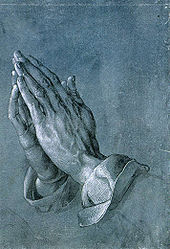
Praying Hands - Albrecht Durer

Ash Wednesday, the first day of Lent, brings with it a reminder from Jesus of the importance of 1) caring for each other, especially those in need, 2) staying in close communication with God, and 3) strengthening our physical, mental, and spiritual lives through actions that help us develop more control over the urges that don’t lead us to God. The traditional names for such activities are almsgiving, prayer, and fasting.

Catholics who grew up before and during the years of Vatican II often think first of fasting or giving up something as the activity of choice for Lent. This practice was generally phrased in terms of “What are you giving up for Lent?” There were (and still are) days in which fasting from normal amounts of food was required of adults between the ages of 21 and 59. However, there were other days in the year which were also set aside for fasting, so that was not unique to Lent. What was unique to Lent was giving up something: candy, television, movies, cigarettes, drinking, etc.

Ash Wednesday’s reading from Matthew 6:1-18 is a reminder that all three practices are important and even interdependent. They are also to be done quietly, without great fanfare, and without even congratulating ourselves on how well we’re managing to do them! So, how can we — citizens of a busy, busy world — find time to pray, identify and organize resources to share with others, and make fasting somehow different than dieting?

A few thoughts come to mind.

1) Almsgiving: The sharing of worldly treasures has been a mark of the Christian community since its earliest years. Christians recognized from at least the time of St. John’s Gospel, and before, that Jesus is present in the community.  To the extent that anyone is suffering from lack of basic necessities, those who do not lack them have failed to meet the needs of Jesus. This is a hard teaching sometimes, especially when times are tough and there is little left over to share. Remember: we are called to share our time, talents, and treasures. If what you have is time, then give of that. If what you have is talent (maybe for telephoning or organizing a bake sale), offer that talent to help provide for those who need food or shelter. If you have enough money (treasure) to support yourself and your family, then share from what you have; maybe eating more simply for a few meals or waiting an extra month before buying that new pair of jeans, and giving the savings to feed those who don’t have enough.

The important thing is to be open to sharing what you have and creatively listening for the opportunities to do so.

2) Prayer: Time for prayer is not easy to find —  if you think you have to set aside an hour a day to pray. On the other hand, if you remember to intersperse prayer into your entire day, then it becomes easier. A quick thank you for the morning as you open your eyes, a blessing over breakfast, a smiled expression of gratitude for a pretty sight on the way to work or the joy of a child exploring her world, a few moments of reflection on how the day is going at lunchtime, a quick prayer for the right words to say in conversation with a friend or co-worker, a blessing at the end of the day, a few moments of reading scripture while supervising a child’s bathing — all are ways to pray in a busy life. God is present in all of these moments and in the unpleasant, difficult moments as well. But God generally doesn’t burst into our lives and shout, “Do This Now!” God is much more subtle, inviting us to notice the presence of the divine in the everyday creation in which we live, and always leaving us free to respond to that presence as we choose.

3) Fasting: Limiting the amount of food eaten, or not eating at all, is the generally understood meaning of fasting. Going hungry on occasion is a good thing to do. It helps develop a greater appreciation of the gift of food. It also helps strengthen the will, so when other things must be declined, the will is strong enough to do so. However, fasting from food is only one way to fast. The practice of “giving up something” was a form of fasting. When we turned off the television on weekdays during Lent during my childhood, we broke its spell and no longer felt we had to watch any programs. We had time to do things together as a family that we didn’t do when the television was on: board games, music, conversation, outdoor play, cooking together, etc.

Fasting today may mean limiting our consumption of: consumer goods, recreational activities, social media including Facebook, television, text messages, tweets, online games, lunches or dinners out, or (insert your own time-consuming activity).  It creates a space for other things – for God to be noticed and heard.

Perhaps, out of fasting in this broader sense will come opportunities for prayer and resources for almsgiving as well. Then the circle of activities that quietly draw us closer to God will have become complete.

Praying Hands by Albrecht Durer – Public domain image

Read More

Posted by on Feb 20, 2012

The Eternal Present –  Living in the Now

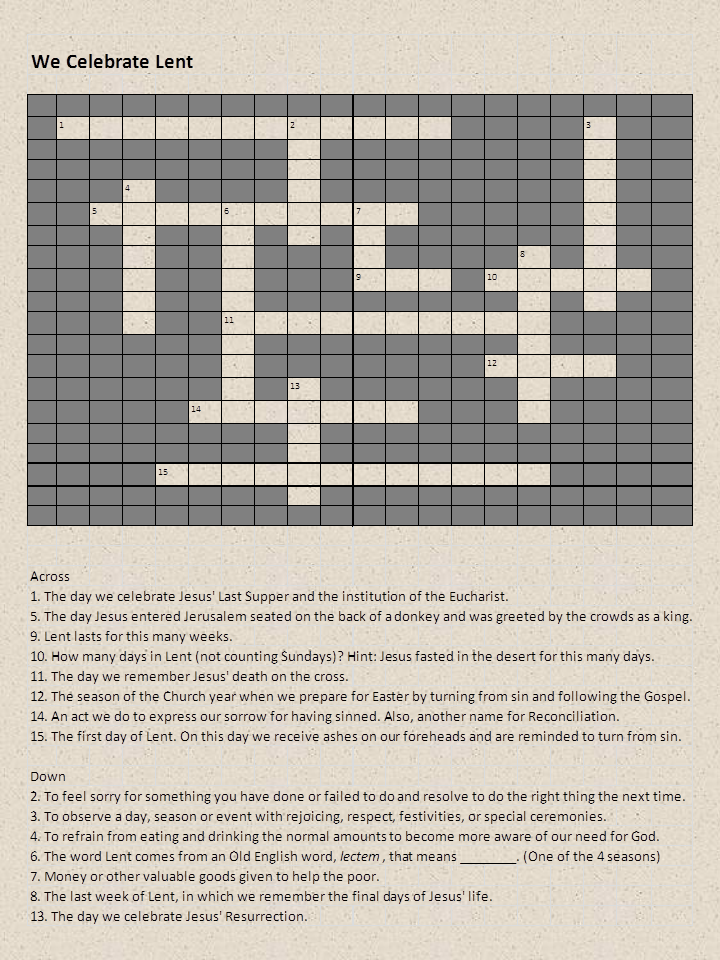
Celebrating Lent – A Puzzle to Get Started

As Lent begins this coming week, we are called to turn from activities or things that separate us from God and instead do something positive to clear our way to return to friendship and union with the Trinity. It is a time to celebrate God’s love for us, trusting that God is in charge and even hard lessons help us become closer to the One who loves us unconditionally.

In the spirit of celebration, then, let’s start with a puzzle. Click here for the solution once you’ve tried it. Click here for a version you can print.


Read More

Posted by on Dec 18, 2011

Waiting and Listening for the Coming of the Lord

On this last Sunday of Advent, as excitement for Christmas builds, it’s time to listen carefully for the ways God speaks to us as we go about our daily activities. Christmas is coming, but not here yet. It’s still Advent, with the Advent imperative to wait in quite wonder as our God transforms human existence and all of creation through the Incarnation. We heard the story of the Annunciation as told by St. Luke (1:26-38) in our liturgies today. A song I learned as a teen echoed in my heart through the rest of the day. “Our Lord has come today, let us rejoice now. Our Lord has come today, let us rejoice. The whispered ‘Yes’ of a lowly maid brought life to dying world, so rejoice now, my friend, rejoice now.”

This week, as we go about our work, whether in offices, factories, fields, homes, or other locations, let us keep our ears open to hear the voice of God speaking through our family members, co-workers, friends, children, senior citizens, and strangers we meet  along the way. Each person we meet can be God’s messenger to us, reminding us of who we are as God’s beloved children and calling us to be greater than we ever dreamed possible. In our dealings with other people, may we be patient, kind, thoughtful and understanding, so they too may receive the gift of peace at this time of preparation and be able to wait and listen to hear the Lord coming through all the excitement and hubbub. As we give and receive this gift of peace, our world can be transformed again, as the Lord lives through us, continuing to bring life to the world.

Read More

Posted by on Nov 6, 2011

Wise or Foolish – Time Moves On and Our Response is Required

The readings for this Sunday, the 32nd in Ordinary Time, Cycle A, speak of Wisdom, the end of time and return of the Lord, and the parable of the Wise and Foolish Virgins. Wisdom is seen as ever wandering in search of those who will love her and seek her guidance. Paul’s letter to the Thessalonians reassures the Christians of Thessalonica that even those who have died will be reunited with Jesus when He returns in glory. There was a sense of urgency among early Christians because they believed that the final coming of Jesus would occur very soon: even within their lifetimes. (Most of us don’t have that sense of urgency any more. It’s been too many years and we forget that for each of us that final coming could occur at any instant.) The wise and foolish virgins were all waiting together for a marriage contract to be completed between two families, so the ceremony and celebration could begin. Those in one group were ready, with plenty of oil to keep their lamps burning into the night and those in the other were not. The story is seen as a warning to be ready for the coming of the Lord at any time.

Father Ron Shirley’s homily offers a perspective on these themes for our times. With his permission, I share it with you.

Ya Buts

This gospel reminds me of two special stories.

The first story:
There is a town that has four separate neighborhoods. The first neighborhood is called, “Yabuts.” The people who live there think they know what needs to be done. As a matter of fact, they talk about it quite convincingly – up to a point. When told they have an opportunity for something, the conversation goes something like this: “Ya, but…” The “Yabuts” have the answer. It just happens to be the wrong answer.

The next neighborhood is known as the “Gunnados.” Now they are some of the best-intentioned folks you could ever meet. They really understand what needs to be done, and they would have done it, if they had only followed through. They study everything that is required very carefully, and just as an opportunity drifts past them, they realize what they were “gunnado.” If only they had done what they were “gunnado.”

Another neighborhood is known as the “Wishawoodas.” These people have an excellent perspective on life – hindsight. They say, “I ‘wishawooda’ this, or ‘wishawooda’ that…” They know everything that should be done, only it’s after the fact.

The last neighborhood is known as the “Gladidids.” They are a truly special group of people. The “Wishawoodas” drive by the “Gladidids” homes and admire them. The “Gunnados” want to join them, but just cannot quite get around to it. The “Yabuts” could have been “Gladidids,” but destiny just did not smile on them. The “Gladidids” are pleased that they are disciplined enough to do what they know they should do instead of always doing what they wanted to do.

These are the four neighborhoods. In which neighborhood do you live? In which one would you rather live? 1) Yabuts 2) Gunnados 3) Wishawoodas 4) Gladidids.

The second story:
There is an ancient story about three demons who were arguing over the best way to destroy the Christian mission in the world. The first demon says, “Let’s tell all the Christians there is no heaven. Take away the reward incentive and the mission will collapse.” The second demon says, “Let’s tell all the Christians there is no hell. Take away the fear of punishment and the mission will collapse.” The third demon says, “There is one better way. Let’s tell all the Christians that there is no hurry” and all three immediately say, “That’s it! All we have to do is tell them there’s no hurry and the whole Christian enterprise will collapse.”

Some things can’t be put off to the last minute- the foolish bridesmaids needed to be reminded of this. We are reminded – happy is the person who takes to heart this message and does something about it today.


Read More

Posted by on Sep 5, 2011

The Eternal Present –  Living in the Now

Laboring in Love – Blessed Mother Teresa of Calcutta

Blessed Mother Teresa, photo by Túrelio

Blessed Mother Teresa of Calcutta (feast day September 5)  worked for decades in India, first as a teacher in schools run by the Sisters of Loreto and later caring for the homeless and dying on the streets of Calcutta. Though controversies exist regarding her work and her legacy, men and women around the world now share in her mission of care for the poor as Missionaries of Charity, not just the dying but also assisting those living in poverty.

Today, as we celebrate Labor Day in the United States, it is worthwhile to remember Mother Teresa’s perspective on the work we do.

“To show great love for God and our neighbor we need not do great things. It is how much love we put in the doing that makes our offering something beautiful for God.”

May we remember her words as we go about our daily lives; that we may touch those around us with love and God’s presence.


Read More

Posted by on Aug 28, 2011

The Eternal Present –  Living in the Now

“I’m on my own now, why should I go to Church?”

Mass aboard the USS Enterprise


A new school year is beginning in the Northern Hemisphere and many students who have always gone to Church with their families now find themselves addressing the question, “Why should I go to Church?”  Some will have been asking it for many years. Others will ask it for the first time in the next few weeks, as other activities and concerns vie for their attention and time.

For those who began questioning their family’s practice early, the answers they received as children may have ranged from “Because” to “That’s what our family does” to “No, God doesn’t need us to go to Church, but we need to go to Church,” to “When you’re grown up, you can decide, but until then, we go to Church on Sunday.” None of these answers satisfies the questioner. If truth be told, they don’t really satisfy the one answering the question either.

So really, why should anyone go to Church? Sometimes Mass is boring. In some parishes liturgy feels rushed; in others it seems to take far too long. Sometimes it seems only to be a matter of completing a ritual in the expectation that then God will have to pay attention to those who perform it. Sermons are sometimes dull and not at all related to questions children and teens face in their daily lives. The same old songs are sung every week.  Young people don’t feel welcomed in the music group – only the “old” people who’ve been singing forever decide what to sing and how to sing it. Pastors sometimes seem more interested in getting everyone to contribute to the collection than to getting everyone involved in parish activities or ministry. The idea of contributing from “Time, Talent, and Treasure” seems to undervalue the Time and Talent of teens and young adults in favor of the Treasure they are perceived to have. In short, there are lots of perfectly justifiable reasons not to go to Mass on Sunday.

As a mother, daughter, aunt, catechist, godmother, grandmother, and friend, I watch family and friends struggle with this issue. I was blessed to grow up during Vatican II and to have had wonderful experiences of liturgy and community as a child, teen, and young adult. It was never an issue for me. I loved it all. Yet many of my siblings, their spouses, and their children have had different experiences and find membership in a worshipping community less essential as part of their daily lives. So I ask myself as well, “Why should anyone go to Church?”

The answers I find range from selfishly pragmatic to possibly theologically justifiable. They are certainly not the only reasons. They are simply reasons I can suggest from my own experience and studies.

1.  Church communities are made up of good people who will generally try to help when problems arise in people’s lives. It’s a good idea to get involved with good people and form mutually supportive relationships before you need them. Things may be going well now, but that won’t last forever. When everything starts crashing down around you, it’s good to have someone who’ll try to help you hold the umbrella to deflect the debris, pick up the pieces to start over again, or simply be with you to hold your hand in support and love when nothing else can be done.

2.  Members of church communities may become lifelong friends who share a culture of belief and values. This doesn’t always happen and sometimes those same friends may break apart for a time over nuances of belief, changing values, or practical questions such as where their children will attend school. Nevertheless, with time, love, patience, and forgiveness, members of a community will find that reconciliation occurs and the bonds deepen in subtle ways. The friendship may not be the same as it was originally, but when the chips are down, the bond remains.

3.  God is Trinity – Three in One yet Undivided Unity. Without each of the members of the Trinity, God would be lacking. Together, God is complete. Jesus counted on His Father for support during His life on Earth. He must have listened to the Spirit in His healing ministry – how else to know which of the many people he met would be open to receive healing? The Father was glorified through Jesus’ teaching and life. The Holy Spirit is our advocate, cheerleader, and helper – the way God is with us in this time following the Resurrection.

If God is, in a sense, a community, who are we to turn our backs on community?

4.  Jesus developed and relied on a community of friends during his lifetime. Some were closer confidants than others, but each played an important role in his life. They worshipped together. They ate together. They traveled together. They laughed and cried together. They did all the kinds of things that Christians have done with each other through the ages. They even fought with each other sometimes and were rebuked by Jesus when they got out of line or totally missed the point of what He was trying to teach them. Some betrayed Him. Some denied him. Some ran away when He was arrested. But He never turned any of them away or refused to forgive and be reconciled with them.

It was out of this experience of community that the Church grew – many different people, from many different lands, languages, and traditions, coming together to encourage and support each other as followers of The Way.

5.  The Church is the Mystical Body of Christ. Jesus is not physically present here today in the same way He was before His death and resurrection. St. Paul explained the early understanding of the Christian community, that each person has a specific role to play within the Church, just as each part of a physical body has its own function. If any member of the body is missing, the entire body is weakened. That includes everyone who has been baptized into the community – of all ages, sexes, genders, races, interests, gifts, and talents. If anyone is missing, we are all diminished.

6.   We meet Jesus through each other. This draws from the concept of the Mystical Body. It’s not something about which we generally speak. Many times we don’t recognize this reality. However, when a group of tradesmen comes together to add rooms to the home of a member of their parish who has many children and not enough space for them, Jesus has come. When a death occurs in a family, and the ladies of the parish host a reception following the funeral, Jesus has come to that family. When a friend gives an afternoon to help build a cabinet for a family’s new bathroom, Jesus has come. When a much desired pregnancy ends unexpectedly and a child’s teacher stops to visit the grieving mother after school, Jesus has come. When a family gathers to celebrate a wedding or an anniversary and friends come from miles around to join them, Jesus has come, blessing them all.

7.  Christianity is not an easy path to follow. Christians are called to take unpopular positions. To feed the hungry. To clothe the naked. To care for the poor and strangers in the community. To visit those in prison. To care for the sick. To “speak truth to power.”  Following Jesus will inevitably lead to experiences of the cross. It’s not easy to take a stand contrary to that of people who are powerful. It’s not easy to express an opinion that is contrary to that of one’s family and friends. At home, at work, at school, in public life, times will arise when an individual will have to stand firm, refuse to go along with what everyone else is doing or saying, and experience the pain of being unpopular, ridiculed, censured, isolated, or passed over for a promotion. Some have even had to pay the ultimate price in their witness. We call them martyrs, a word that means witnesses.

8.  In gathering for liturgy (Mass or other celebrations), we share in giving thanks for God’s great gifts and we eat the food that Jesus has given to transform us and give us the strength to continue His work in our world. We meet and get to know each other through our companionship at church. Out of this gathering, all the other benefits already mentioned can and will grow, including the neat side-effect of having a community to support us when we need help too!


Read More

Posted by on Jul 29, 2011

The Eternal Present –  Living in the Now

Novena to St. Ignatius Loyola – Applying the Senses – Eighth Day – July 30

With Christ in Real Time

For St. Ignatius, the spiritual journey is a pilgrimage to the Holy Land and into the very life of Christ. The application of the sense is a type of prayer that is just the opposite of a “mind trip.” Here are some excerpts from Fr. Bob Gilroy, SJ, a Jesuit priest who is an artist, art therapist, hospital and jail chaplain and his beautiful site Prayer Windows.

Becoming Free for God’s Sake

In many ways, Ignatius helps retreatants paint a picture with the mind and senses. The aim of his manual was to inspire people, so that they could enflesh the Gospel of Jesus Christ and live their lives for God and others. This methodology heightened one’s awareness of personal weaknesses and strengths in order to know how best to serve others. The object is to undergo conversion in order to be free for God’s sake.

Composition of Place: An Example

For example, let us look at a selection from the second phase of the Spiritual Exercises, called “The Blind Beggar.” (Fig.15) As I prayed with Mk 10:46-52, which is the story of Bartimaeus, a blind man, I began to imagine the landscape of the setting. It was dry, hot and dusty as I found myself being Bartimaeus, sitting by the roadside. I can smell the animals as they pass by and hear people’s voices in the background. Then I realize from the conversation that Jesus is near, so I cry out to him. I hear the footsteps of someone I believe to be Jesus approach me. I become filled with eager anticipation. Jesus is so close I feel his breath on my face and I hear him say, “I trust you. If there is anything you want to tell me I will listen to you.”

At this point in my life I was wondering whether to consider other job opportunities. As I revealed my fears and hopes in prayer, I felt more freedom to continue looking for confirmation to remain in my present situation. I was asking to see how I could grow spiritually in order to help others by encountering Jesus in a deeper way. This was one example of Jesus restoring my sight in order to follow him.

The revelation of God through the stories of Jesus is made present through imaginative participation. The mind engages the heart. As Hugo Rahner comments, “… the aim of this mode of prayer is to make the events of salvation ‘present’ in the mind, and thus to attain that direct experience.” Ignatian Prayer Windows

Humanitarian Aid

Exercise

What scene in the life of Christ is your favorite. Spend some time there, in the moment, with the sights, sounds, smells, and feelings of the instant. What does Christ say and do to you and for you. How do you respond?

Concluding Prayer

St. Ignatius, you signed your letters “pobre de bondad,” poor in goodness, and called yourself a pilgrim. Please pray for me to be open to what God is calling me to do to announce and build up the kingdom. Transform my petitions into questions of discernment and pray for us to remember that all of our true needs and desires are already known to God. Pray that I be taken beyond my wants, beyond my fears, from death into life.

In your writings and by your example we are reminded to pray for the Church and the Holy Father, for all who dwell in darkness, and for the millions lacking food, water, and other necessities. We join our prayer with yours for true openness so that we can contemplate the Divine presence in all things and praise, reverence, and serve God Our Lord in action.Pray for us to have the courage to meet and to serve the Lord Jesus in the poor and the suffering.

Praise be to the Father, the Son, and the Holy Spirit
Now and Forever. Amen.

Read More

Posted by on Jul 28, 2011

The Eternal Present –  Living in the Now

Novena to St. Ignatius Loyola – Discernment – Seventh Day – July 29th

Roland Joffe’s 1986 Movie “The Mission” traces and telescopes the Jesuit missionary efforts in Paraguay. In 1995, the Vatican Film List singled out “The Mission” as one of 15 films of special religious significance. In this scene Fr. Gabriel (Jeremy Irons) plays his oboe to make contact with the Guarani after several of his brothers had been killed in similar attempts. The song is the now famous “Gabriel’s Oboe” by Morricone. Right click on this link to open it in another tab for a symphonic and choral arrangement as a background for your own meditation on this day of the novena.

The Invitation of Christ

St. Ignatius is very clear in his distinction between the Call of Christ and that of Satan. Like Gabriel’s Oboe, the call of Christ is peaceful, inviting, encouraging. The snares of Satan are fear, anxiety, and compulsion. These are the primary ways in which we can begin to discern the source of motions and movements within our soul. The banner of Satan has been called the path of least resistance while the banner of Christ is that of consciousness.

The banner of Christ requires openness, humility, and real courage, as we see in the scene from the movie. In fact, the Jesuit missionary experience in Paraguay would follow the path of the cross as the Portuguese killed the missionaries and enslaved the Guarani. This in turn was only the prelude to the suppression of the Society of Jesus in 1767 because of its opposition to the absolute power given to kings and emperors during the Enlightenment. The Society was restored in 1814.

A Growing Sensitivity

Wholeheartedness in the service of God demands a constant effort of discernment, a growing sensitivity to the will of God. Without this, generosity can lead only to ‘the expense of spirit in a waste of shame’…

At all events, Ignatius characterizes Lucifer as a tyrant who drives and compels his subjects (he uses a vocabulary of compulsion and trickery), whereas when describing Christ his vocabulary is one of friendship, persuasion, gentleness…

What I have to see is that my personal option must be made in the light of this universal vision. My choice must integrate me into the great movement of salvation already accomplished in Christ and now being worked out on earth. My choice will be a reproduction in me of the option of Christ who chose the cross, despising its shame. We may note that this idea finds its first development with Origen but is already contained in germ in the phrase of Ignatius of Antioch – ‘Let me be an imitator of the passion of my God’. – William Yeomans (emphasis not in the original)

Mother Teresa

Exercise:

Placing myself in God’s presence, I ask these questions of myself and the Holy Spirit. What is my path of consciousness? What is my path of least resistance?

Concluding Prayer

St. Ignatius, you signed your letters “pobre de bondad,” poor in goodness, and called yourself a pilgrim. Please pray for me to be open to what God is calling me to do to announce and build up the kingdom. Transform my petitions into questions of discernment and pray for us to remember that all of our true needs and desires are already known to God. Pray that I be taken beyond my wants, beyond my fears, from death into life.

In your writings and by your example we are reminded to pray for the Church and the Holy Father, for all who dwell in darkness, and for the millions lacking food, water, and other necessities. We join our prayer with yours for true openness so that we can contemplate the Divine presence in all things and praise, reverence, and serve God Our Lord in action.Pray for us to have the courage to meet and to serve the Lord Jesus in the poor and the suffering.

Praise be to the Father, the Son, and the Holy Spirit
Now and Forever. Amen.

Read More

Posted by on Jun 25, 2011

Realities and Wonders Beyond Our Comprehension – The Feasts of The Holy Trinity and Corpus Christi

The mystery of the Holy Trinity is at the core of our faith as Christians. God is one undivided unity. Yet God is also Father (Mother/Parent), the incarnate Son (Jesus) and the Holy Spirit – all united as one in being and each separate in identity.

Early Church writers spoke of the Trinity in terms of perichoresis, a mutual indwelling and interpenetration of being shared by the members of the Trinity. The word itself comes from Greek roots meaning around and to contain. In some ways it’s akin to a dance in which the dancers and the dance are one. None can be separated from each other because their essence is one, yet each has an individual role and part in the whole.

We experience God as Trinity in our lives. God as parent brings all things into being through love overflowing and keeps us safely in existence – never forgetting us. God our brother Jesus who has shared the joys and sorrows, hopes and fears of human life is truly one of us – 100% human. God the Holy Spirit of love gives us courage to live in love and words to speak of what we have experienced of divine life and love. God as Father, Son and Holy Spirit is the greatest fan each of us will ever have – always hopeful and encouraging us as we forge ahead through life’s challenges.

Following Trinity Sunday, we celebrate the Feast of Corpus Christi – the Body and Blood of Christ. One mystery following on another. How can simple bread and wine be the body and blood of the Lord? Yet that is what Jesus told us he was giving us – his own flesh and blood to eat, as divine food to strengthen us on our journey as we travel back to union with the Trinity. One of our prayers tells us that we become what we eat. As we share in the divine meal, we share in the life of the Trinity and are drawn ever closer into it.

What a gift!

The wonder of all this struck me as I reflected on an experience I had with my young grandson last week. We were at Disneyland on the last day of a trip with my Girl Scout troop. The girls graduated from high school this year and this was our last major outing.

The park was closing early in preparation for a “Grad Night” for local high school seniors, so despite having a young child along, we were there for the fireworks and final show. It was a show with light, water and music telling of a dream Mikey Mouse was having, complete with ominous music and threatening villains. Could Mickey triumph over the evil that threatened by using the power of imagination? Of course he could and did. The show ended with great joy and happy, triumphant music.

What fascinated me was watching our little boy. He quickly lost interest in watching the story and we moved off into a nearby area where there was a short wrought iron fence (about 36 inches tall). As the music, lights and story blared around us, he quite happily climbed up on the bottom cross-piece of the fence and made his way sideways, holding on to the top rail, from one end of the fence to the other. Then he jumped down, clapped his hands, climbed back up onto the fence and went back to his original starting place. He did this through the entire performance – at least four or five trips back and forth along the fence. He’d have continued doing it all night had we allowed it!

I had been concerned that the ominous, scary music, the tone of voice of the villains, the colors of the threatening sections of the show would frighten him. Had he been a few years older, they would have. However, at his young age, he had no negative associations with any of those cues. What we considered scary music was the same to him as the triumphal music or a sweet ballad. The lights that flickered and changed from peaceful pastels to discordant, multi-colored, dark or flaring reddish-orange bursts of color meant nothing to him.  It was all just background to what he was exploring. He was having a wonderful time on the fence.

In thinking about his reaction, I find myself wondering how much we are like this young child – totally enthralled with our own activities in our own little worlds and totally missing the wonder of the dance going on all around us. We live and move and have our being within the loving presence and reality of God, yet we don’t notice most of the time.

I pray that as the coming weeks unfold, I will be ever more aware of the divine presence – Father, Son and Holy Spirit – enveloping me and all of us in the great dance of being. In the words of Jesse Manibusan’s song, “Open my eyes, Lord. Help me to see your face … Help me to hear your voice … Help me to love like you… Help me to love.”

I send the same wish to all who read these words. May the blessings of God who is Father, Son and Holy Spirit descend on you and remain with you forever. Amen.


Read More

Posted by on Apr 11, 2011

The Eternal Present –  Living in the Now

St.Thomas: The Post-Modern Realist

Sun Shining Through Clouds

St Thomas the Apostle is often known as Doubting Thomas because he refused initially to believe the reports of the resurrection of the Lord. In today’s gospel reading from St. John (Jn 11:1-45), the raising of Lazarus from the dead, I saw something for the first time about St. Thomas that changed my view of him.

Jesus receives word that his fried Lazarus is seriously ill and prepares to head back to Bethany near Jerusalem. The apostles don’t think this is a good idea because they had just left the area after threats against the Master’s life. Jesus tells his uncomprehending followers that Lazarus is dead, but they are returning to Bethany so that his followers can see Him for who He is. This doesn’t appear to make any sense. It is a pointless suicide mission. Thomas doesn’t doubt. He is quite certain, but he is loyal and will not leave his master. His statement, “Let us go and die with Him,” is not skeptical. It is very certain. It is almost absurd in a 20th century style worthy of an an existentialist play.

In fact, Thomas is the grown up we are supposed to be. Look at the facts. Be reasonable, sensible. You may be willing, out of love, to sacrifice yourself for a great cause or a great love, but you approach it with knowledge, with courage, stoically.

This scene actually creates a set of book ends. The matching scene is the encounter with Jesus after the Resurrection, after Thomas had declared that he wouldn’t believe the reports until he saw Jesus personally. None of the apostles died with Jesus. In fact, at the time of his arrest Jesus told the authorities to take Him but to leave them alone. We all know the story of how they – and all of us – scattered in the night when the Shepherd was struck. Peter follows at some distance only to deny Him three times. John is the only man at the foot of the cross. In His time of need Jesus can count on His mother and a handful of women. All too true – real enough for the followers then and now.

Somehow it is easier to “to go and die with Him.” It sounds noble, altruistic. It is easier to believe in the finality of death than the open endedness that is resurrection. El sentido trágico de la vida – the famous Spanish existentialist manifesto – The meaning of life is tragedy. Yes, I know that is not the more literal translation – the tragic sense of life. The death of Jesus would indeed be the Great Tragedy another one of his great disappointments, another cosmic joke perpetrated on an accidentally occurring Homo sapiens.

As post modern people and followers, we are so overcome with the senseless suffering and death of millions that we claim that we believe. Yet our faith is more of an adolescent, impotent tantrum of defiance, because, in the end the facts are the facts. So, let us go and die with Him.

This is an interesting set up for Palm Sunday and Easter. Of course, this is just what St. John’s Gospel does. Jesus is the Resurrection and the Life. The challenge to us and to Thomas is to believe in a life beyond tragedy, absurdity, meaninglessness.

Yeah, well, heard that, been there… but it can’t work. It’s foolish. We are all dying. Just be brave about it. It is what it is. Resignation to the inevitable makes sense. Resurrection by our Best Friend who cries in grief and loss for us doesn’t make any sense at all. Or does it?

Image by Robert & Mihaela Vicol – Released to the Public Domain

Read More

Posted by on Mar 16, 2011

The Eternal Present –  Living in the Now

Where Two or More Are Gathered … Los Angeles Religious Education Congress

Los Angeles Religious Education Congress 2011

Tonight and through the weekend, thousands of Catholics and members of other faiths will be converging on the Anaheim, California Convention Center for the largest annual gathering of Catholics in the United States. The Los Angeles Religious Education Congress begins with Youth Day on March 17. The theme for Youth Day is “Godbook: Everyone Invited.” Speakers address topics of interest to teens, including prayer, sharing faith, social justice, and interpersonal relations. Youth Day includes workshops, liturgies at three locations within the Convention Center and and concerts with artists including Jesse Manibusan and Pedro Rubalcava. Several of the workshops also feature music.

Congress for adults begins with Opening Prayer on March 18 and continues through a final liturgy on Sunday afternoon. This year’s theme is “Hold Firm … Trust.” Like Youth Day, the days are filled with opportunities for prayer and learning. Speakers from around the world come to Congress, many with  large groups of fans who look forward to hearing them each year. Workshops are offered in English, Spanish and Vietnamese. Opportunities abound for prayer, reconciliation, learning, sharing, enjoying contemporary music, and just generally enjoying the presence of the Lord in the community of the faithful.

Knowing that many people would like to be among the approximately 40,000 present at Congress but must instead attend to family and work responsibilities elsewhere, Congress planners have arranged for live internet streaming of events on Youth Day and during the rest of the weekend. Naturally, the majority of events will not be available live, but recordings of many presentations can be purchased through the Congress website.

I hope many of you will join in the fun and inspiration of Congress through the internet. I’ll be there too!


Read More

Posted by on Mar 9, 2011

The Eternal Present –  Living in the Now

Ash Wednesday: Spiritual R & R – Reconciliation and Renewal

Receiving the Ashes in the Sign of the Cross


Ash Wednesday begins the season of Lent. It tends to be a day when people think about what they are going to give up in preparation for Easter. Fasting can be seen as a convenient type of dieting. Almsgiving can be reduced to cleaning out the closets.

However, prayer, fasting, and almsgiving are ancient practices in societies and religions all across the world. They are ways to produce altered states of consciousness and encounters with the divine. In the Christian tradition they are part of the “via negativa” or negative way. Generally, we tend to see this type of deprivation against the historical backdrop of hermits in the desert rejecting the “flesh” of worldly temptation and indulgence. Of course this conflicts with our consumer culture of comfort and instant gratification. It also conflicts with a more positive psychological model in which the focus on human weakness is replaced with a focus on human self-fulfillment and actualization.

In the secular model of well being, human and social limitations can be overcome by refocusing our attention and modifying our behavior. Hammering down our feeling and emotions – especially sexual ones – is sometimes seen as harming mental health. By denying our interior tensions and conflicts, we can fail to confront the real challenges we should be facing in our psychological development.

Lent itself is an old word for Spring – that time when the world comes to life again. The “via negativa,” the more traditional model of asceticism (an interesting Greek word for athletic training), and the contemporary model of self affirmation are not really opposed. They can actually be healthy correctives. If we focus exclusively on restraining ourselves we not only ignore opportunities for growth, we can also ignore what God is calling us to do. Focusing only on my needs and self-fulfillment can also lead to such an inward narcissistic self-absorbed focus that we cut ourselves off from true happiness.

In subsequent posts, as we journey through Lent, I will share with you some more reflections on being happy, holy, and healthy. This is a wonderful season for reconciliation with ourselves and others and a time of renewal for our call to serve and to engage in the coming of the Kingdom – the age of justice.

So.. what am I going to get for Lent?

Read More

Posted by on Feb 25, 2011

“Be Perfect, Just as Your Heavenly Father is Perfect.”

“Be perfect, just as your heavenly Father is perfect.” (Mt 5:48)

Every three years, this line from Matthew’s account of the Sermon on the Mount comes around to us. And every three years, it is a reminder of the high standards to which followers of Jesus are called.

The line is from the section in which we are told that Jesus expects us to love our enemies, do good to those who persecute us, turn the other cheek, go the extra mile and give to anyone who asks of us. These will be the behaviors that distinguish us from nonbelievers.

Some have suggested that these are simply ideals, not instructions to be taken seriously. Others have suggested that there were hidden meanings in these instructions – ways to resist evil without actually doing so physically.

Fr. Ken Laverone, OFM suggested in his homily this past Sunday that these are not only to be taken seriously, but that it is within the realm of possibility for each of us to move towards this holiness, this perfection. He pointed to a young child who had been happily dancing in the pew beside her father during the sung Gloria, noting that most likely she learned to dance and be free in loving response from her parents. They had not discouraged or stifled her openness to joy and beauty or insisted that she sit or stand stiffly rather than expressing the happiness she felt in the moment.

This is the way we are to be as well. Our Father is loving, forgiving, patient, accepting of our limitations, always wanting the best for us and for all humans. As we grow in these characteristics, we too become reflections of the perfection of our Father. We’ll not make it to perfection in our lifetimes, but with God’s help, we’ll become sons and daughters of whom God will be proud.

Read More

Posted by on Feb 15, 2011

More than Just the Minimum to Get By – The Beatitudes

This past Sunday the readings for the 6th Sunday of Ordinary Time, Cycle A, included the section from Matthew’s version of the Beatitudes (Mt 5:17-37) in which Jesus makes clear that simple compliance with the Law is not the way to the profound holiness of the Kingdom of Heaven. It’s a troubling section of a difficult teaching – one we often dismiss as just an idea or “He didn’t really mean this literally.”

Fr. Ron Shirley, in his reflection on the Gospel, tackled the challenge of the reading directly, phrasing it as a question of respect. It bears sharing.

Respect

Not very long ago, I was having dinner at some friend’s house, and got a chance to sit next to….Billy. Billy is somewhere between one and two, probably closer to two, and has strong opinions about what he likes and what he doesn’t like. No matter if mamma is telling him in a sweet voice how nummy-nummy the mashed peas are, no matter if dad ends up eating half of the loathsome vegetables himself in order to show him how mmm-mmm good they are—if he doesn’t like them, he starts throwing. He threw the spoon, he threw the cup, he threw the bow…and finally, in an unguarded moment, he threw the Gerber’s jar and the peas…right at me.

Billy is young. He hasn’t had a chance to learn yet how to respect things. He doesn’t know that when you throw things, they sometimes get dinged or cracked or broken. He’ll learn. In fact, that is one of life’s great accomplishments…learning respect. It’s a life-long process. I remember comparing how my cousins and I used to do dishes, compared to the way my grandmother did, for instance. As teenagers we tore into those dishes as quickly as we could, they went flying. There was always at least one fatality, quite often an old cup or plate. We were a little better than Billy, but we had a way to go. Things still got dinged and cracked and broken.

And then there was Grandma. Perhaps she was like most old people. She handled the dishes slowly, with a sort of reverence. Her wrinkled old hands took hold of each platter and glass as if it were a special old friend. I don’t remember her ever breaking anything. She had learned respect. She knew how easily things can get dinged and cracked and broken. She knew how to respect food and clothes, and pencils and pens….and people.

Because if unimportant things get dinged and cracked and broken when they are not respected enough, so can people. If people are abused or roughed up or overlooked and banged around often enough…they get dinged and cracked and broken.

It isn’t enough, Jesus says, not to murder. You have to show respect to everyone. Not harbor anger against them. Not use abusive language against them or hold them in contempt.

It isn’t enough, Jesus says, to avoid the actual act of adultery with someone. What is needed, is respect for someone else and their relationship, and respect for yourself, that you don’t even entertain the thought.

It isn’t enough, Jesus says, to avoid swearing to things that are false. What is needed is so much respect for the people around you that you don’t swear at all, you just say yes when its yes and no when its no.

We Americans are just now learning how important it is to respect things instead of wasting them; respecting the environment, the rivers and streams, the soil and air, instead of abusing them.

And we need to grow in respect for ourselves and for each other. This means, not having to dominate every conversation. Not having our own way. Not inflicting our moods so freely on each other. Respect is one of the most basic types of love.

And why should we show ourselves and each other so much respect? Because God has shown complete respect to us!

1. Do I show respect to myself?
2. Is there someone close to me that I am disrespecting?

Read More