Pages Menu
RssFacebook
Categories Menu

Posted by on Aug 5, 2008

Saint of the Day – St. John Vianney: August 4

Saint of the Day – St. John Vianney: August 4


St. Jean Baptiste Marie Vianney (1786-1859) was the parish priest of the village of Ars and is known primarily by that title even in English, “The Cure d’Ars”. Canonized in 1925 St. John Vianney is the patron of parish priests. In many respects he is a thoroughly modern saint.

He was born into the midst of the French Revolution and into a devout rural family who worshiped in secret with outlaw priests who refused to become state functionaries. The upheaval of the revolution closed schools, hospitals, and other institutions. For the first time in human history, the state asserted itself without religion as it destroyed the old Catholic order – the Ancien Regime. The “Goddess of Reason” was enthroned in the Cathedral of Notre Dame in Paris. Priests, nuns, and the Catholic nobility were killed, forced into hiding or exiled.

After the revolution subsided, Napoleon attempted to gain complete control of the Church in France and even took control of the Papal States, removing the Pope from Rome and bringing most of the Cardinals to Paris. In 1812 Napoleon’s fall began with the disastrous retreat from Russia in winter. The Industrial Revolution would follow, ending forever the cultural matrix of European Christianity.

St. John Vianney’s 73 years of life would span the trauma of the ending of the Divine Right of Kings to the rise of the rights of the common man. He would become emblematic of a Catholicism redefining itself, as it was torn from the 1,500 years of prerogatives and burdens of its affiliation with the state dating from the reign of the Emperor Constantine.

St. John Vianney began by re-asserting the centrality of God in his own life and supporting those in the parish who still practiced the faith. It is important to note that his vocation was in itself something of a miracle. Due to the upheaval of the times, he had no formal education until he was 20 and had great difficulty with Latin. To make matters worse, he got drafted by Napoleon and ended up as a deserter in hiding. An unlikely amnesty made it possible for him to return to his studies. If there hadn’t been such a severe shortage of priests, it is possible that he would never have been ordained.

His personal example of holiness in terms of his prayer and his charity to all made a deep impression. Sunday had become just another workday. Taverns were places of dissolution and much of the social order had broken down. “Dances” were part of a wild party scene involving promiscuity and adultery. Orphans and the disabled were exploited and left to fend for themselves. Over several decades, he led a movement to remedy these problems and to encourage religious devotion, while promoting service to others.

When the bishop attempted to assign St. John Vianney to other parishes, the community protested until the bishop relented. By our standards, his personal acts of penance and mortification, his meager diet, and short hours of sleep, appear to be excessive and even harsh. Reports that he was assaulted by the Devil at night strike us as bizarre, maybe even pathological. Yet they were witnessed by men in the parish who came when they heard the commotion.

Interestingly, he was not severe with his parishoners or penitents in the confessional. In fact, he was known for having won over a prominent woman who was a Jansenist and led her from a severe and demanding conception of God.

Not all of his fellow priests agreed with his approach or pastoral style. In fact, we might say that his special gifts in his historical circumstances may have created the ideal of the parish priest as a solitary super hero, like the desert fathers or the anchorites of the early Church. This calling is something one can respond to, but it cannot be fabricated and put on like a suit. Fr. John Cihak, in “St. John Vianney’s Pastoral Plan”, helps us understand how his example can guide parish priests today.

There is one major factor that is alluded to in the wonder of St. John Vianney’s life and ministry, but it is especially important for all of us who are parishioners today. God worked extensively in the life and ministry of St. John Vianney through his family, those who sheltered him as a deserter, and the people of Ars. Whether the pastor is single or married, the position is one of the most exposed and the most lonely. In denominations with a married clergy, and in the case of Eastern Rite Catholic priests and Latin Rite Catholic deacons, the spouses and children of clergy have a special opportunity and burden that only we can support by our prayers, understanding, and kindness toward them.

Read More

Posted by on Jul 22, 2008

Saint of the Day – St. John Vianney: August 4

Saint of the Day: St. Mary of Magdala – July 22

Icon of St. Mary Magdalene with a red egg.

One of the most striking sayings of Jesus is perhaps His simplest. It is one word, “Mary.” He is not referring to His mother or Mary of Bethany or any of the several other Marys of the Gospels.

Mary of Magdala is utterly distraught. She has come with other women to anoint the body of Jesus. The stone has been rolled away. The tomb is empty. She sees a man whom she mistakes as a gardener or caretaker and wants to know where the body of Jesus has been taken. (John: 20). Jesus utters her name, and through her, the Apostles and all of us learn of the unthinkable. Christ is risen.

This is Mary of Magdala, a woman that many of us don’t recognize because of a movement set in motion by Pope St. Gregory the Great, making Mary into the repentant prostitute whom Jesus forgives. In fairness to Gregory the Great, he was probably voicing a earlier tradition confusing Mary of Magdala with the penitent who washed the feet of Jesus with her tears and dried them with her hair.

The restoration of the historical position of Mary of Magdala is recent. In 1969 the Vatican officially corrected the traditional misconception of her as a prostitute. This also coincided with the rise of the women’s movement. More recent scholarship on the gnostic Gospel of Mary shows that Mary of Magdala appeared to have played a more central role in the immediate circle of the Apostles. This is also part of a trend in historical scholarship of the early church indicating that women played a more prominent role in leadership and teaching and were supplanted by men as the church became established under the emperor Constantine.

Mary the Apostle? Mary the penitent prostitute? These questions are an uncomfortable reminder that male dominated societies place women on a pedestal while also exploiting them at the same time. This is not only a tragic double bind; it also contradicts what Jesus was about in His relations with women.

Read More

Posted by on Jul 11, 2008

Saint of the Day – St. John Vianney: August 4

Saint Benedict – July 11 – Solitude and Community

Benedict of Nursia is called the founder of Western Monasticism. He was born at Nursia around 480 AD to a noble family. According to tradition, his had a twin sister, Scholastica, who became the founder of a similar form of monasticism for women. As the son of a noble family, he was educated well and lived a comfortable life. The world and all its opportunities were open to him. Presumably he sampled some of its treats as a young man.

Around 500 AD, he decided to leave Rome for a quieter life in the country. He took his childhood nurse along as a servant and moved to a smaller town about 40 miles away. According to St. Gregory, who wrote the first biography of Benedict, his intention was to live a life more in tune with the Gospel than that of a typical young noble in Rome. He didn’t plan to become a hermit or to organize groups of men to live in religious communities or to develop a “Rule” for monastic orders. He simply wanted to have time for prayer and work and a life with a friends who shared the goal of living a Gospel centered life.

From a distance of hundreds of years, we see choices like the one he made as signs of holiness. Up close in our own lives, we often see them as somehow irresponsible or “crazy” – a judgement generally shared by the families of those, including Benedict, who made those choices in the past.

It’s easy to forget/overlook the fact that Benedict never set out to start a religious community. The rules he eventually developed and wrote down were ones that developed out of his experiences in living with other men and by himself. They were developed for lay people. Only later did his followers become priests.

So what were these rules about? They were about how to live a holy life in the world, as a person sharing life with other people. They were written not just for those who left family and jobs to live a life of prayer, but for anyone seeking holiness. They assumed that people would work. That a life of prayer without work is not healthy. And both work and prayer need to be undertaken with the support of other people in a community. We need friends and family to keep us going and to challenge us to continue when it would be easy to cut corners or take the easy way out of a tough situation. And – surprise – there must be time for fun and play in life!

For Benedict, balance was important. Work, prayer, play — all within the framework of a community/family. 

There is a saying from Buddhist tradition, “Before Enlightenment, chop wood, carry water. After Enlightenment, chop wood, carry water.”  Benedict’s example and the rule he developed are very much in alignment with this wisdom. Prayer includes deep awareness of the presence of God in all things. So as we work, we pray if we are “present”  in what we are doing and aware of God’s presence in it. When we come together in community to pray, as monks do at regular times in the day and night, or as families do over meals or at bedtime, we pray most deeply when we are again “present” in the moment of prayer. When we have time by ourselves for personal, quiet prayer, and we find ourselves in the presence of God, we are to stay rooted in that experience too. The trick is to stay aware and present to the reality of what we are doing. “Chop wood, carry water.” And when we play, we are to play wholeheartedly as well – like happy children. Not worrying about how we look or who will win or what else we should be doing that would be “holier.”

Benedict’s life was not easy. The lessons he learned came through many twists and turns. He spent time living alone and time living in communities. He started some communities. Lived within others. Was rejected by some. One community even tried to poison him! But through it all he kept his eyes and ears open to God’s presence and call. And the witness of his life drew other people, men and women, who passed on what he learned down through the generations to us. How to find holiness in the balance of a life of work, prayer and play as individuals and as members of families and communities.

Read More

Posted by on Jun 30, 2008

Saint of the Day – St. John Vianney: August 4

The Feast of Sts. Peter and Paul – June 29

It’s the time of year when we remember and celebrate the witness of two men who played foundational roles in the community of believers that has grown to include well over 1 billion people – St. Peter and St. Paul.

Peter was a fisherman from Galilee. He was known as Simon. He was brash and decisive and protective of his friends. He didn’t hesitate to argue if he thought a request was unreasonable (but we’ve been fishing all night and haven’t caught anything!) or a plan was unwise (they want to kill you in Jerusalem!). Yet when Jesus came into his life, he was open enough to the Spirit that he left everything and followed when he was called. Jesus named him Peter, calling him the Rock on which the community would be built. (Jn 1:42)

Peter became the leader of Jesus’ followers, at least in part because he spoke his mind and looked out for the safety of them all. He was the one who answered Jesus’ question, “Who do you say that I am?” with the profession of faith, “You are the Messiah, the Son of the living God.” (Mt 16:15-16)

Peter was not perfect. He expressed his doubts about Jesus’ plans to go to Jerusalem, trying to dissuade him from that plan, and was rebuked as “Satan” for his efforts. He walked on water towards the Lord, and sank into the waves when he stopped to think about what he was doing. He promised undying support for Jesus at the Last Supper, and denied him 3 times before the sun came up.

No, Peter was not perfect. But he was a perfect leader for the new community because he knew he was imperfect and still loved, chosen, and trusted to do his best. It was a big job for a big person. Figuring out who this Jesus was and is, how to live as a community who follow His ways, how it all fit into the faith in which he was born and raised, what to do about all those non-Jews who also received the Spirit and wanted to be part of the community. A big job.

Paul was from Tarsus, a Roman city. So he was a Roman citizen. He had been trained as a tent maker, but he had also been educated. He was a Pharisee, the son of a Pharisee, and a student of the great teacher Gamaliel. He was not a follower of Jesus before the Crucifixion and Resurrection. In fact, he was one of those who saw the new Way of living as a huge threat to the larger Jewish community and to their faith. The Romans were not gentle with those who opposed them or to those who upset the day-to-day routine of life in the provinces. And certainly, the Jews had seen time after time through history what happened to the whole people if groups of them stopped worshipping according to the traditional ways of their people. War, exile, persecution by conquerors. It was not something to risk.

The first time we hear of Paul is at the trial and stoning of St. Stephen, the first martyr. He was called Saul at the time and he consented to Stephen’s death. Saul was an enthusiatic participant in the persecution of Jesus’ followers that followed. He saw that the new teachings were doctrinally quite different from those of traditional Jewish Law and worship at the temple. He was determined to crush the new movement. (Acts 8:3)

When the persecution began in Jerusalem, followers of the Way (as Christians called themselves at that time) had scattered throughout the surrounding area. So Saul got letters from the authorities and traveled north to Damascus, to arrest them there too and bring them back to Jerusalem for trial. It was on the road to Damascus that he met the Lord. A bright light flashed around him. He fell down. A voice called to him, “Saul, Saul, why are you persecuting me?” He asked who was speaking and was told, “I am Jesus, whom you are persecuting. …” Acts 9:1-30 tells the story of his conversion, his first preaching, the reactions of his fellow Christians and of his fellow Jews, and his return to Tarsus (where he would be safe from those who wanted to kill him). And then in Acts 9:31 we read, “The church throughout all Judea, Galilee and Samaria was at peace.”

Peace. A lovely thought. But peace is a state that seems never to last very long – perhaps because growth so often brings unexpected changes, stresses, and strains in its wake. Perhaps because some growth can’t happen except in times of difficulty, when new ideas and new solutions must be discovered. Perhaps because God is too unlimited, too expansive, too inclusive, TOO BIG to be kept in any of our human boxes.

And so the Fisherman baptized a Gentile, Cornelius, and his family. And the community adjusted its thinking about who could be called to the new Way. (Acts 10:1-49, 11:1-18)

Those who had been scattered from Jerusalem shared their faith in new communities in Phoenicia, Cyprus and Antioch. They spoke not just to Jews, but also to Greeks and many believed. The community in Jerusalem sent Barnabas to meet them. Barnabas was so impressed that he went down to Tarsus, collected Saul, and went back to Antioch for a year, teaching the growing community there – where followers of Jesus were first called Christians.

Saul and Barnabas were sent forth from the community at Antioch, to proclaim the word of God in Cyprus. It was the first of Saul’s many missionary trips. (From this point on, he is called Paul in the Acts of the Apostles.)

And things would never again be the same. The Fisherman and the Pharisee didn’t always see eye to eye. They argued. They tussled. They sent letters and messengers back and forth to each other. They had meetings. And through it all, they (and the community) worked things out. And the Christian community became more and more a separate community and faith from the Jewish one into which they had been born.

It was not a time of perpetual peace and smiles. But at the end of their lives, both Peter and Paul, in Rome, died as witnesses to their faith in the Lord – Peter upside down on a cross and Paul, the Roman citizen, by the sword. And the tensions and struggles within the growing community, as well as the growth in understanding of the Good News, and of who Jesus was/is, and of how we are to relate to the Father, and of many, many other things, continued.

In future posts, I’ll talk about some of those “other things” that came along, and use some of the tools of anthropology to look at them. For now, it’s enough to say that Peter and Paul can be seen as representing two essential roles within our community of faith. Their passion and courage in hearing the Lord’s call and stepping out faithfully to spread the Good News is a gift to us all.


Read More

Posted by on Jun 24, 2008

Saint of the Day – St. John Vianney: August 4

Saint of the Day: St. John the Baptist – June 24


St. John the Baptist is the last of the prophets and the first of those to approach the Kingdom. He occupies a place of transition. Christ acknowledges him in a strange way in Luke 7:24-28:

When the messengers of John had left, Jesus began to speak to the crowds about John. “What did you go out to the desert to see – a reed swayed by the wind?
Then what did you go out to see? Someone dressed in fine garments? Those who dress luxuriously and live sumptuously are found in royal palaces.
Then what did you go out to see? A prophet? Yes, I tell you, and more than a prophet.
This is the one about whom scripture says: ‘Behold, I am sending my messenger ahead of you, he will prepare your way before you.’
I tell you, among those born of women, no one is greater than John; yet the least in the kingdom of God is greater than he.”

Somehow the least in the Kingdom of God is greater than John. The least are greater than this courageous prophet who spoke truth to power and was beheaded for his efforts. Aren’t those of the Kingdom not born of women? Isn’t John’s courage and faithfulness a model for all Christians? Christians are born again of water and the Holy Spirit. John announces the coming of the Lord and for all of the wonder and importance of this role, it is not as privileged as the least in the Kingdom of God.

The feast of St. John the Baptist is a time to reflect on the privilege and grace of our invitation to the Kindgom. In the earlier verses of this chapter, Jesus tells the the messengers of St. John to report to him what the signs of the Kingdom are: the blind see, the lame walk, the sick are cured.

Maybe it’s time to see where we are in the Kingdom.

Read More

Posted by on Jun 13, 2008

Saint of the Day – St. John Vianney: August 4

Saint of the Day: St Anthony of Padua – June 13

Doctor Evangelicus

FRIAR MINOR
MINISTER PROVINCIAL OF ROMAGNA
CANON REGULAR OF ST. AUGUSTINE
DOCTOR OF THE CHURCH
PATRON OF PREACHERS

St. Anthony has always been a special family patron. I suppose my paternal grandfather, Doroteo Pozos, is to blame. My father was born on August 26 and, according to custom, was supposed to have been named Seferino after the Saint of the Day, Pope St. Zephyrinus (pontificate 198 -217). My grandfather didn’t like the name and instead named his only son Antonio. This started a chain of Antonian events. My oldest brother was name Anthony, and my sister Antoinette. To drive the point home, Providence sent my brother Arnold to us on June 13. Kathy and I did not help things either by naming our second son Antonio.

So who was St. Anthony / San Antonio? Actually St. Anthony (ca. 1195 – 1231) was Portuguese and is sometimes referred to as St. Anthony of Lisbon, where he was born and baptized Fernando Martin de Bulhoes. His parents were wealthy and powerful nobles. How his life took him from Lisbon as a member of the Canons Regular of St. Augustine to become the Franciscan St. Anthony of Padua in northern Italy is a story with many twists and turns.

When he was 15, the young Fernando entered St. Vincent, the monastery of the Canons Regular of St. Augustine. This group served as pastors and were not monks. After a couple of years Fernando asked to be transferred to the group’s Abbey of the Holy Cross in Coimbra, which was the capital of Portugal at the time. Apparently, he had not been happy with the visits and interruptions of family and friends in Lisbon and felt that his studies and his vocation were suffering as a result.

After he completed his studies and was ordained in Coimbra, Fr. Fernando was placed in charge of hospitality for the abbey, which meant that he was responsible for taking care of guests. A group of Franciscans, who were a new an dynamic movement at the time, were his guests as they traveled to Islamic Spain and Morocco as missionaries. They moved him deeply and when their martyred remains returned to Coimbra, Fr. Fernando managed to get the permission of his superiors to join the Franciscans. He received the Franciscan habit, took the name Antonio, and was intent on going to Morocco to die for the faith.

When St. Anthony landed in Morocco, along with another Franciscan, he was so ill that he had to return to Portugal. On his premature return trip, his ship was blown off course by a huge storm which swept him all the way to Sicily. He made his way to Assisi and was in very poor health. He ended up in a small hospice in the countryside, where he lived as a hermit and helped out in the kitchen.

St. Anthony’s marvelous gifts as a preacher and scriptural theologian were discovered when he was asked to preach at an ordination. Although it is unlikely that St. Anthony ever met St. Francis, the Poverello appointed St. Anthony to teach theology to his brothers. This was an unusual endorsement, since St. Francis had many reservations about the ego of scholars and theologians. He did not want to foster this type of unfortunate self-centeredness in his own group.

St. Anthony not only spent time as a teacher but also traveled extensively, preaching in the countryside and serving in administrative offices of the order. He took on various groups which had deviated from orthodoxy. Although St. Anthony is called the “Hammer of the Heretics,” he has a more pastoral legacy which underscores his genuine concern for people. There are many stories of miracles which seem to strain our post-modern credulity. Although many may be legends or devotional fabrications, St. Anthony was known to have transformed many lives and had a definite impact on a long line of Franciscan scholars and saints who would come after him.

He was to set an ideal for Franciscan intellectuals, who were great preachers, mystics, ascetics, and competent administrators. St. Bonaventure is one of the more famous examples of this cluster of gifts, as is Blessed Junipero Serra the Apostle of California.

Most often, St. Anthony is depicted holding the Christ Child. Except for the Blessed Mother and St. Joseph, no other saint is presented this way. Apparently, this depiction began in the 17th century, based on a legend from the saint’s life. Symbolically though, this image presents much of Franciscan spirituality in terms of encountering, modeling and presenting Christ – poor, vulnerable, and welcoming.

St. Anthony died near Padua at the age of 36. This was not an unusual lifespan for the 13th century and yet it is amazing what he gave to us in such a brief span of years.

Read More

Posted by on May 28, 2008

Saint of the Day – St. John Vianney: August 4

What Keeps Me From Seeing?


I like to take a walk in late morning each day. It helps clear my mind and stretch my muscles before I plunge into the work and activities of afternoon and evening. Living beside Monterey Bay, I never know what I’ll see on my outing.

Today, when I arrived at the water’s edge (actually at the cliff beside the water!), I got a wonderful surprise. I could see all of Monterey Bay – from the Lighthouse at Point Santa Cruz, around past Santa Cruz, Capitola, Aptos, Moss Landing, to the flatter lands where the Salinas River enters the Bay. Then the Big Sur mountains rise up behind Monterey and go out all the way to the ocean.  The water was calm – very few waves for the surfers. The kelp beds were spreading out to enjoy the sunshine. The sea lions on the rock were chatting among themselves. Sea gulls soared over the water. I could see it all.

In “the olden days,” when I was a girl, I would never have thought that seeing all the way around a bay was anything special. I grew up in Eastern Washington state. We had clouds or sunshine. Sometimes we had fog. But you could always see across the river! And normally, you could see the surrounding mountains too.

Living on the coast, we never know from day to day whether the fog will be in or not. Even on a sunny day, the fog often sits in the middle of the Bay, blocking the view of the other towns and the mountains. But today it is clear. The smoke from the Summit fire is gone from the sky. The clouds we have are high and moving inland. The fog is sitting way off the coast, barely visible from land. And the view is stunning.

It occurs to me that the spiritual life is something like our views of Monterey Bay. Like the Bay, God is always present here – within us, among us, around us. I exist only because God has imagined me, given me breath, breathes through me, loves me continually into being. Yet all too often I don’t notice. I don’t see the beauty all around me. I miss the “love notes” scattered all around me – the flowers, the birds, the native bees in the weeds, the smiles of young mothers and their babies, the laughter of teens and the comfortable togetherness of retired couples out for a walk. I don’t see them for what they are, or worse, I don’t see them at all. I move through my life’s conversation doing all the talking, forgetting to look and listen for the presence of the Divine.

Today I pray that I’ll remember to open my eyes, ears, heart, mind to notice God’s presence. I’ll remember to ask myself, “What keeps me from seeing today?” I’ll remember to be grateful. I invite you to do the same. And maybe while we’re at it, we could also stop gratefully for a moment and ask, “What keeps us as a people from seeing today?”

Read More

Posted by on May 24, 2008

Saint of the Day – St. John Vianney: August 4

Corpus Christi: The Body of Christ

Stephen’s bright blue eyes smiled as we said, “Lamb of God, Give us Peace.” According to the rubrics we were now to show each other a sign of peace. Yet with Stephen’s attention deficit disorder, which had already taken him in and out the brief service at least twice, it seemed that a little catechesis might help him be a little more aware of what we were about to do. Stephen is not a little boy. He is a handsome man in his early 30s, with a number of tattoos poking out of the v-neck and short sleeves of his starched jail issued smock.

The readings had been those of Pentecost. The second reading was from First Corinthians 12. “No one can say Jesus is Lord except by the power of the Holy Spirit.” This had struck all four of the men, but had made a special impression on Stephen. “Does that mean that when I pray the Holy Spirit moves my heart?” Stephen had asked. When I answered “Yes” his eyes got wide and he said that since his attention came and went and his thoughts were often jumbled, he thought his prayers were more bothersome and must be irritating. The notion that he is a temple of the Holy Spirit was as novel to him as it was consoling.

Stephen was back now and I shared a few words on the Lamb of God, recounting the Last Supper and the passion, death, and resurrection of the Lord. We do this in His memory as He requested of us. We are invited to the Lord’s table. Stephen and his companions were not new to the faith, but this brief memorial of our Great Memorial brought a renewed awareness to the others and a slack jaw from Stephen. He did not doubt, but could not help but marvel at the wonder of it.

As we shared the wonder of the Blessed Sacrament, our communion was truly a sharing in the Body and Blood of Christ. Bread blessed and broken at the Eucharist, celebrated in the parish, given to all, shared with all, and sent to those in need and to those in prison. The Body of Christ – Corpus Christi – saving us all from our prison of loneliness, our hunger for love, and admitting us to the feast of heaven here and now.

Read More

Posted by on May 5, 2008

Saint of the Day – St. John Vianney: August 4

Ascension Blahs

water_ripple.JPG

There is only so much joy and sunshine the soul can take. There is a rhythmic moodiness to California’s central coast. Unlike the interior valleys and the Sierra, which have more constant moods in concert with the sun and stars, the ribbon world on the sands and coastal planes changes from delight to gloom overnight — or sometimes within the hour. On our street, the fog, known by its more fluffy image as “the marine layer,” sometimes tiptoes and sometimes billows through the cypresses on Lighthouse Field and blots out the sun, roiling half way down the block before stopping on a whim in an evanescent whirl.

The Resurrection blossoms and the fulgent greens are quickly muted in the filtered gray light of the salty chill. The natives, loath to give up their flip flops and shorts, shiver in their sweatshirts as they pull their hoods over their brows to the bridge of their sunglasses.

So where has the Son gone? Why do we stand here looking up in the chill? Who turned off the party? Just when we found Him, they took him away again. No that would have been easier. It would be renewed grief. He said that it was time for Him to return to the Father and that He would send the Advocate who would teach us all the things that He still had for us to learn. Left behind … our consolation turned to desolation.

… And what to do? According to Father Ignatius, it is time to discern, to prepare for the movements of the soul that eddy from the Paraclete, that ripple from the heart, and echo in the fountain drops of the barely conscious. What now? Be still and know that I am the Lord.

Read More

Posted by on Apr 25, 2008

Saint of the Day – St. John Vianney: August 4

A Theologian’s Reflections on Mark’s Gospel

on-your-mark.jpg

Theologian and storyteller Megan McKenna’s book, On Your Mark: Reading Mark in the Shadow of the Cross, is a powerful example of the contribution of theology and biblical research to our understanding of the Good News. When the gospels were written, nearly 2000 years ago, they were written for a specific audience, with certain shared beliefs and experiences. Each was written for a different audience, but each audience had much in common. They were written as teaching materials, to help new believers come to know about Jesus, become His faithful followers, and live according to His Way.

We live in a dramatically different world. Many things the ancients took for granted or understood to be significant, we don’t even notice in passing when reading Scripture.

In the past century, thanks to the work of theologians, biblical scholars, anthropologists, archeologists, linguists and many other professional researchers, we have gained a tremendous amount of knowledge about the world in which Christianity began and of the beliefs and life of the early Christian community. The Holy Spirit has worked through these people to bring the Word to us as excitingly fresh teaching. 

Megan McKenna’s presentation of Mark’s Gospel lays out the requirements of Christian discipleship through exploration of the meaning of the texts. She shows what their meaning might have been for the disciples and the early community – how they served as a roadmap for discipleship. Because she is also master storyteller, Megan presents other stories  as well that serve to reinforce the Gospel. And always, for Megan, the bottom line is, what this means for us today.

Take a look at her work. You won’t regret it!

Read More

Posted by on Apr 24, 2008

Saint of the Day – St. John Vianney: August 4

St. Mark the Evangelist – Following the Lord’s Call Doesn’t Always Happen the Way Others Expect

stmarkcoptic.jpg

St. Mark was a young man in the earliest days of the church and by the end of his life had played an important role in spreading the Good News of Jesus in Asia and North Africa. He even touches us as well, through the Gospel which bears his name.

We first hear of Mark in the Acts of the Apostles on the day Peter was released miraculously from prison. Peter returned in the night to the home of Mark’s mother, a gathering place of the community in Jerusalem (Acts 12:12).

Mark may have been the young man in the Garden of Gethsemane who ran away naked when Jesus was arrested, but the young man is not named, so we don’t know for sure (Mark 14:50-52).

Later we hear of Mark traveling with Paul and Barnabas on their first missionary journey. Early in that journey, Mark left them and returned to Jerusalem (Acts 13:13). No explanation is given for his departure from the mission. Paul was very unhappy about it and later refused to take Mark along on his second journey. As a result, Barnabas did not travel with Paul on the second trip, going instead with Mark to Cyprus (Acts 15:37-39).

Mark spent many years with Peter. He is mentioned in various contexts in later chapters of Acts and in the first letter of Peter, always in terms of his faithfulness in proclaiming the Good News of Jesus.

The thing that really strikes me about Mark, though, is that he didn’t follow the path that had originally been set for him – that first journey with Paul and Barnabas. Something was not right. He left, despite the knowledge that the older adults in the community might not understand and be angry with him, thinking him a failure or a quitter. He returned home to Jerusalem.

If he had not followed that sense (or quiet voice) that told him that going with Paul and Barnabas might be the wrong thing for him to do, it’s entirely possible that Mark would not have been the one to accompany Peter in his work and journeys. The Gospel According to Mark might never have been written. It is generally understood to be the one that tells the story of Jesus based more on the memories of St. Peter. It was most probably the first of the Gospels written, maybe even before 70 A.D. Our understanding of how the early Christians had experienced the life, death and resurrection of Jesus would be different.

As an older adult now, seeing young people struggling to find their way in faith, to find the Lord’s path for them (regardless of how they phrase it), I find great comfort in the story of Mark. It’s OK to change course on one’s life journey, to try one path, find it’s not quite the right one, and move to another one. It’s OK not to follow the career for which one studied – or the one chosen by someone else. It’s OK to ask embarassing questions of leaders in our community. It’s OK to insist on justice and compassion. It’s not only OK, it’s essential to listen to the quiet voice and follow the Lord as He calls each one of us. We are all richer for it.

Read More

Posted by on Apr 6, 2008

Saint of the Day – St. John Vianney: August 4

The Encounter at Emmaus

emmaus.jpg

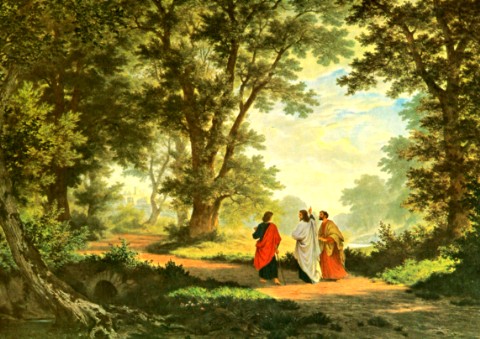
I have been struck by the stories this Resurrection Season because for the first time, they strike me not as eye witness accounts of the Risen Christ, but as the challenge of faith for the disciples and us. The disciples on the way to Emmaus are leaving Jerusalem – returning home, perhaps, – grief stricken, but more importantly, disillusioned. The teacher has failed. The forces of evil have destroyed a very good and wonderful young man.

One way to see this story is to take it as another proof of the Risen Christ as encountered by his disciples. The story does convey this message. However, the story also tells us that we find the Risen Christ when He opens our minds to see the scriptures and when our hearts are opened at the Breaking of the Bread. Look for Him in the scriptures and invite Him in to dinner and your hospitality will be more than repaid.

There is just a glimpse – a flash of recognition and he disappears from our midst. The presence of the Risen Christ is a momentary and ongoing discovery. It is the result of searching, wandering, questing in grief and disillusionment and being open to the challenge of the Stranger.

All of us have moments, years, decades, in which everything we knew and had hoped for is swept away. The disciples had no clue of what was to become of their beloved teacher, but his torture and death threw them into utter grief and confusion. Yet their confusion only increased when they heard that other disciples had found the empty tomb and seen the angels. They were re-grouping, leaving town, trying to get some distance. A Stranger notices their grief and inquires. They listen and reflect on the scriptures and Break Bread.

This is the Christian life – the quest and the encounter in the village of Emmaus – continuing through all generations.

Read More

Posted by on Mar 25, 2008

Saint of the Day – St. John Vianney: August 4

Easter Monday: Whale Watching With Angels

light-house-pt-santa-cruz.gif

I had read in a book way back in grammar school at Holy Cross School in Ventura, CA, in a time that is now referred to as “Mid-Century,” about boys hiking in the Alps on Easter Monday for a traditional lunch at high altitude with the angels. That custom may or may not have been true, but the thought of having lunch with the angels has always intrigued me. Perhaps, because my patron is St. Raphael the Archangel, the thought has always been somewhat appealing. After all, if you were an angel, wouldn’t you want a little break after all the hullabaloo of Holy Week?

Circumstances prevented me from wandering into the Santa Cruz mountains looking for angels to share ham and Easter eggs. The day was perfect, with a mild breeze, as I headed out across Lighthouse Field to Point Santa Cruz. The sky and the water were dazzling as I headed west up the coast along the ocean before it rounds the Point into Monterey Bay. There was excitement in the air. Whales migrating south to the Sea of Cortez around the tip of Baja California were passing by 100 to 300 feet offshore. They showed some interest in a kayak heading in the opposite direction, but continued on in graceful arcs, undulating effortlessly in the current as they coursed through the water.

It was a strange moment. The moment the houses along West Cliff, the roiling waves and sunlight all got stretched onto an impressionist canvas. I could see the brush strokes, the layering of the oil, the weave of the canvas. My neighborhood of almost 20 years became completely magical, serene, and spirit filled. I had pounded this walk many, many times before and it was always striking, even when cares and illness were heaviest on my heart, but today it was literally unreal.

Well, I guess my patron Archangel and his buddies were not waiting for me in the redwoods after all. It wasn’t the picnic with the angels that I had imagined as a boy. Whale watching with the angels on Easter Monday is something else.

Read More

Posted by on Mar 24, 2008

Saint of the Day – St. John Vianney: August 4

Easter: Not Recognizing the Risen Christ

mary-magdalene.jpg

The very core of Christianity is the amazing tenacity of the believers to assert the impossible – a man publicly tortured to death rose from the dead. What is even more surprising is that they did not recognize Him.

Seeing loved ones after they are dead is not that uncommon among those stricken with grief. According to psychologists, this delusion always produces an immediately recognizable image of the dead person.

One of the most affecting scenes in the Gospel is the encounter between that most faithful of disciples, Mary of Magdala, and the Gardener in the Gospel According to St. John, Chapter 20: 10-18.

Then the disciples went back to their homes, but Mary stood outside the tomb crying. As she wept, she bent over to look into the tomb and saw two angels in white, seated where Jesus’ body had been, one at the head and the other at the foot.

They asked her, “Woman, why are you crying?”

“They have taken my Lord away,” she said, “and I don’t know where they have put him.” At this, she turned around and saw Jesus standing there, but she did not realize that it was Jesus.

“Woman,” he said, “why are you crying? Who is it you are looking for?”
Thinking he was the gardener, she said, “Sir, if you have carried him away, tell me where you have put him, and I will get him.”

Jesus said to her, “Mary.”
She turned toward him and cried out in Aramaic, “Rabboni!” (which means Teacher).

Jesus said, “Do not hold on to me, for I have not yet returned to the Father. Go instead to my brothers and tell them, ‘I am returning to my Father and your Father, to my God and your God.’ “

Mary Magdalene went to the disciples with the news: “I have seen the Lord!” And she told them that he had said these things to her.

In the the other encounters of the disciples with the Risen Christ, there is a similar pattern. The very people who lived with Him on a daily basis, shared His travels, and even argued with Him, didn’t recognize Him. The reality was so much beyond a delusion of grieving friends and followers, so much beyond irrational expectation, that we only get a glimpse of how preposterous it was in the expressed doubts of Thomas. (John, chapter 20)

More than any other event in the Gospels, the stories of the empty tomb, the encounters, the general chaos that occurred is hard for us to fathom, let alone appreciate, since we have heard the story so many times. The story of the suffering and death of Christ is always muted for us because we know how the story ends. The men and women who followed Jesus were more bewildered and confused on that first Easter because what they heard was so outlandish.

The term for Easter in Romance languages drives from Passover – “Pascua” in Spanish and Italian, and “Paques” in French. Since the English term doesn’t bear this heavy direct reference to Passover – the Passover of the Lord – we can miss a key fact of experiencing the Resurrection – being led out of bondage is a tumultuous, confusing, and fearful process. We can cope with grief, disillusionment, and grinding oppression, finding comfort in cynicism, skepticism, or addiction. Resurrection for us is only a painful beginning, an inconvenient surprise, getting stretched on a rack of hope.

Having seen the worst, Mary of Madgala, like us, could conceive of only the worst when she saw the empty tomb. These glorious “men” in white must have taken the only memento left of the Teacher whom she so desperately loved. Where was his body? She had come to do the courageous and loving act allowed to women of her time. But there was no body.

Everything shattered when she heard her name, in a voice that no other could have uttered. Her love would only cause more problems. Are we ready for that?

Read More

Posted by on Mar 22, 2008

Saint of the Day – St. John Vianney: August 4

Good Friday: Identifying with Christ or Christ Identifying With Us?

christ-of-maryknoll.jpg

For those who love Christ, remembering His passion and death is always an occasion for sorrow. However, such human acts as compassion are never simple. The pain of the impending loss of a loved one – anticipatory grief – can be worse than the actual loss. In fact, when death finally comes, we often feel guilty about experiencing relief. My friend Jim lost his father when Jim was in eighth grade, after a protracted two year battle with cancer. When we talked about it a couple of years later, Jim confessed that he still felt more relief than grief.

Of course, we couldn’t experience compassion without a close identification with the other. This becomes very complex in the person of the Christ. He did not fight his enemies. He did not curse. He did not condemn. He forgave. He blessed. This human-divine reaction to an injustice that is almost as inconceivable as it is enraging provides no adequate psychological outlet for the post-Freudian soul. How can we proclaim and fight for justice if God Himself did not? Tragically, the consolation in the Gospels and the wider testimony of the New Testament – that no evil, no matter how overwhelming, how senseless, can ever separate us from the love of God in Christ Jesus – escapes us. (Romans 8:38-39) Instead of experiencing this Passover of the Lord – the Blood of the Lamb on the door posts and lintel of our home that spares us from the Angel of Death – we run out into that night of despair by focusing on the ways we have been complicit with that evil.

When we hear that we are saved from a life defined by suffering and pain without meaning and no exit, we can think that we were saved from something we deserved. “Evil as you are … who among you would give his son a scorpion when he asked for bread?” (Loosely taken from Luke 11: 11-13) is a stark reminder to the disciples that Jesus could not conceive of His Father wanting anything less than we ourselves would want for our own children. Just as our children are all too much in our own image and likeness, we are in God’s. The teaching and life of Jesus in this regard is at odds with the vengeful patriarch of the Old Testament who punishes and chastises. (Lest we be tempted to think that Jews hold or held onto to this concept, we should remember that Jesus was not the only Jew who presented a view that had grown beyond it. The are interesting similarities between Jesus and his contemporary, Hillel the Elder.)

Enter God’s protectors:

“Ah hah! Now he has said it on his very own blog! Your own words condemn you. God doesn’t care about sin, you say. There are no consequences, no punishment, no reckoning. You present a God who is merciful, but not just. If Christ did not die for our sins how was the Father appeased? How is he the sacrificial victim?”

The Blogger Offers a Parable:

Once upon a time, there was a wonderful teacher who healed by word and touch and saved people from all kinds of physical, psychological, and social maladies. He made the mistake of speaking truth to power and telling religious and civil leaders that outward observance only made them into whitened sepulchers. They waited for the right time and got a close friend to betray him, and they took him off to Guantanamo, and then transferred him to a third world country, where he was tortured to death by specialists trained at the School of the Americas. Like so many thousands of his time, he was supposed to have become one of the disappeared. Fortunately for us, He didn’t stay dead and he didn’t stay hidden. Strangely though, he left again, said he would return, and in the meantime the were supposed to wait for a Holy Wind to make everything clear.

Yet His disciples wanted an explanation. If He was truly God’s Son, how could this have happened to Him? If he really was the Messiah, how could he have failed? He was just as maddening as those parables he used to tell them. Where are the answers? It was like one of those Eastern religions. “The question is the answer.” And that other junk the Beatles found in India, under the influence of something other than the great American mystic, Jack Daniels.

God finally sent them someone they could understand – sort of. “Like, well, yuh see, dude- God don’t need sacafices, ” The voice of the aging surfer was hoarse with too many years of funny cigarettes, his faced etched with too much salt and sun, his eyes opaque while he waited for the waves to rise. “It’s like, all ’bout love. All God wants is love. The torture and sufferin’ part, that’s what we do to us and each other. Man, like the Teacher Dude, the Guru Guy, like he couldn’t hang out forever. ‘Cause like, you guys were all brain dead on a kind a gnarly bad trip. Like he let it happen. The tube was closin’. Like there was just the wipeout; like really bad at Mavericks. He did it to show y’all that if yah stay in the water and go for it, sooner or later it’s gonna happen if ya stay true to the search for the Big One.  Dude, got some extra change? My old lady’s on me for the rent, like ya know.”

The words of reproach, as the seeker turned away, were familiar. “That sucks man. What a waste. I came to hear some guy explain some @$#%?! blogger’s crappy parable. I could’a been watchin’ the game on my big screen.” So he zipped up his jacket and marched straight home, out of the saving mystery, ignoring the glory of the sky, the dazzle of the water, and the carpet of color and bird song all about him.

Read More