Pages Menu
RssFacebook
Categories Menu

Posted by on Jul 22, 2011

Novena for the Feast of St. Ignatius – Take Lord, Receive – Day 1 – July 23

Novena for the Feast of St. Ignatius – Take Lord, Receive – Day 1 – July 23

Opening Prayer

Take Lord, receive
all my liberty,
my memory,
my understanding, and
my entire will,
all that I have and possess.
You have given all to me.

Now I return it to you.
All is Yours, dispose of it wholly according to your will.
Give me only your love and your grace,
That’s enough for me.

Your love and your grace are enough for me.
– Ignatius Loyola

Placing Ourselves in God’s Presence

Inhale slowly and deeply. Exhale slowly and mindfully.
Relax. Be at peace. Be aware that you are in God’s loving presence wherever you are.

Reviewing Our Lives With Gratitude

Focus on the small and wonderful things in your life this day: the quality of the light, our children at play, the soothing touch of those who love us.

Reflecting on Our Feelings and Spiritual Movements

What am I going through? What feelings and experiences do I encounter? What is good and not so good in my life? Did I reach out in love and consideration? Did I perform my duties well? What do I feel good about? What causes me regret?

Focusing on What Comes to Us

Let your feelings and images well up within you. What strikes you the most about this day? What feeling or images come to you more clearly and peacefully?

Talking With Jesus Our Friend

Converse with Jesus as He is right now, right here – your friend. Share what comes from your heart – in a look, a few words, a smile. Ask for help on this journey; to see Him in all things; to be more in love everyday.

Your love and your grace are enough for me.

IgnatiusConcluding Prayer

St. Ignatius, you signed your letters “pobre de bondad” poor in goodness and called yourself a pilgrim. Please pray for me to be open to what God is calling me to do to announce and build up the kingdom. Transform my petitions into questions of discernment and pray for us to remember that all of our true needs and desires are already known to God. Pray that I be taken beyond my wants, beyond my fears, from death into life.

In your writings and by your example we are reminded to pray for the Church and the Holy Father, for all who dwell in darkness and for the millions lacking food, water, and other necessities. We join our prayer with yours for true openness so that we can contemplate the Divine presence in all things and praise, reverence and serve God Our Lord in action.Pray for us to have the courage to meet and to serve the Lord Jesus in the poor and the suffering.

Praise be to the Father, the Son, and the Holy Spirit
Now and forever. Amen.

Read More

Posted by on Jul 31, 2009

Novena for the Feast of St. Ignatius – Take Lord, Receive – Day 1 – July 23

Following in the Footsteps of St. Ignatius Loyola

Company - Summer 2009 Cover

Company - Summer 2009 Cover

On the feast of St. Ignatius Loyola, founder of the Society of Jesus, AKA “The Jesuits,” it seems fitting to look at one of the many ways the men (and women) who have come after him and his first group of followers have continued to serve God’s people – bringing the fruits of their experience of God’s presence in our world (a contemplative experience) into the messiness of everyday active life. This approach has been called “contemplation in action” and is a fundamental of Ignatian spirituality.

Ignatius and his friends, like many young men of his day, thought it would be a great idea to go to the Holy Land and convert all to Christianity. They had taken the standard vows of poverty, chastity and obedience that are common in religious orders. But they also took a vow to do whatever the Pope needed them to do. They suggested to the him that they go to the Holy Land on this mission and he turned down the offer. Instead, he asked them to preach and teach in Europe. It was a time of much upheaval in the Church. The Reformation/Protestant Revolution was in full swing. The Church was divided. Much of what we would call faith education was needed, along with basic education in reading, writing, mathematics and the other classical subjects. So the Jesuits got started in the education business and have continued their schools and universities to this day!

Then as now, people with money can afford excellent schooling for their children. People with fewer resources have fewer choices. Recently, members of various provinces of the Society in the United States have embarked on a program to provide high quality Catholic education for children of families whose income is under 75 percent of the median per-capita income of their city. These children would not ordinarily have the option of attending a private high school or even dreaming of attending college. Yet in 22 schools around the country, the dream is being realized.

The schools started in 1996 with Cristo Rey Jesuit High School in Chicago. The great challenge for any private school is how to fund the costs of providing the educational program. How can the faculty be paid? Where will classes be offered? How can the rent be paid? At Cristo Rey, a unique solution was proposed. Corporate sponsors would provide entry level pay for students that would cover about 70% of tuition. Four students would share each job – each working one day per week. The other days the student would attend classes. Class days would be a bit longer than normal and the students would have a longer school year, but they would get a full year of education that way. Families that could afford to pay some tuition would do so. Others would receive additional financial aid to make their education possible. Students would also receive intensive training in the basics of functioning in the corporate world during the summer before their first year in the school, so they could be successful in their work. The combination of academics and real-world work experience in meaningful jobs has proven to be a key to the success of the school. It has been so successful, in fact, that other schools have been opened in other cities.

In 2008-09 the Cristo Rey Network  included 22 schools. Another two are opening this fall. In cities across the country, young men and women who would not have had much of a chance even to finish high school, are not only graduating from high school, but most of them are going on to colleges and universities. From there they are going out into the corporate world and entering successful careers in business, science, education, etc. The Ignatian charism (vision) of education of all students, both rich and poor, continues to bear fruit in our day.

Cristo Rey’s story has been told in a new book, More than a Dream: How One School’s Vision is Changing the World. 

Cristo Rey and other schools in the network are also featured in the Summer 2009 issue of the Jesuit magazine, Company, the world of Jesuits and their friends. The Summer issue is not online as of this date, but it should be there within a few weeks.

A.M.D.G.

Read More

Posted by on Jun 21, 2008

Novena for the Feast of St. Ignatius – Take Lord, Receive – Day 1 – July 23

St. Aloysius Gonzaga – June 21

St. Aloysius Gonzaga (1568-1591) is often portrayed as a weak dreamy sort of figure. Worse, he has been presented to young people as a patron and role model who rejected all of the fun, adventure, and rebellion of youth. The real story is far more compelling.

How St. Luigi Gonzaga became St. Aloysius in English is not clear. The Latin for Luigi would be Ludovicus. Alois would be the German equivalent.

The “spin” of 17th and 18th century writers on his life was more a pietist anti-intellectual critique of the secularist Enlightenment. To be impolitic, he comes across as some sort of bloodless, lily toting wimp with upward cast eyes. Although it is not uncommon for saints to be “martyred” posthumously and their lives used to advance a contemporary cause, the Renaissance Luigi Gonzaga, Marquis of Castiglione is more relevant to us as post-modern Christians.

The overall sketch of his life is a simple as it is dramatic. Luigi was the oldest son of Ferrante, the Marquis of Castiglione, and named for the founder of the Gonzaga family Luigi, Lord of Mantua (1328). He was a pious youth, despised the things of this world, joined the Jesuits, and died of the plague after contracting it from nursing its abandoned victims in the streets of Rome when he was barely 23.

The context of his life and his status as an imperial prince give us a fuller understanding of who he was. According to John Coulson, the editor of The Saints: A Concise Biographical Dictionary:

It is impossible to estimate Aloysius’ (Luigi’s) career without some idea of his appalling heredity and environment. The Gonzaga tyrants rank with the Visconti, the Sforza, and the D’Este. They entered history about 1100; the first Gonzaga, lord of Mantua, was Luigi (1328), whose third marriage took place on the same day as his son’s and grandson’s: the three brides entered Mantua together in triumph. Already their cliff-like fortress was looming over the city. These despots displayed an amazing mixture of qualities. The Gonzaga clan survived one assassination after another and became allied to most of the reigning houses; but Luigi Gonzaga (141), grimly surnamed ‘The Turk,’ kept up three printing-presses and had for clients men like Platina, or Mantegna, who painted the scenery–now at Hampton Court–for the plays to which the Gonzaga were devoted. The French Parliament petitioned against the introduction of these plays into France–they were a ‘high school of adultery’–and no one would now dare paint the pictures with which some of the Gonzaga palaces were adorned. Yet these princes could care for agriculture, irrigation, checks on usury; and their insane debaucheries alternated with explosions of a genuine underlying faith. Their subjects, bled white by taxation, thrilled by their exotic pageantries, worshipped them till they broke into bloody but useless revolution.

The life of a Renaissance prince was far from any story book. St. Aloysius’ primary schooling was at the Medici Court in Florence. While he received the best academic training of the day, there was a bigger focus on swordsmanship, riding, and intrigue. He also spent significant time at the Spanish Court of King Philip II. His mother was a Valois and a relative of the Queen and his father had turned down a position of Master of the Horse in the English Court of Henry VIII in favor of Spain. At the time, the Spanish Empire was at its height of power and global dominance. Philip II also became king of Portugal as Philip I and ruled the Portuguese Empire as well.

As the oldest son, Luigi was trained to fulfill the duties of a prince and to prepare to succeed his father in the wealth, power, and literal back stabbing of the Gonzagas. As a child, though, he was appalled at what he saw and experienced, including the murder of close relatives. Fortunately, he came under the influence of St. Robert Bellarmine, who gave him his First Communion as a teenager. His rebellion was to reject it all and to enter the Church. His mother was not opposed to the idea, since it was not uncommon for powerful families to place prominent younger sons in key church positions that controlled considerable wealth and property. Luigi’s desire to join the Society of Jesus (Jesuits) was another matter. It would mean that he would forgo any type of service that could make him a powerful or wealthy cleric. Ironically, it was a wealthy and powerful churchman – Luigi’s cousin Cardinal Scipione Gonzaga – who prevailed on Ferrante to permit his son to join the Jesuits.

However, even as a Jesuit scholastic (student for the priesthood), he was still a celebrity who received celebrity treatment by those outside the order. Luigi probably over-compensated for this and his spiritual director and personal mentor, St. Robert Bellarmine, told him to ease up on prayer and penance and live a more moderate life. If we look between the lines, fitting a Renaissance prince into a religious house was not the easiest task for Luigi or his fellow religious. In fact, St. Ignatius’ famous letter on obedience was motivated in part to try to redirect the religious enthusiasm of these men to the ultimate in penance – to do what you are told whether you like it or not.

One can only imagine what it was to see a Gonzaga nursing victims of the plague on the streets of Rome.

There is a wonderful statue of St. Luigi outside St. Aloysius parish on the grounds of Gonzaga University in Spokane, Washington which shows a vital, caring, young man tending to a plague victim.

For some time when Gonzaga University was at the height of its fame as a basketball champion, there was a slogan which the University ran on national TV – Gonzaga: a Way of Life. The possibility of taking a brand like “Gonzaga” and making it stand for an impassioned life of faith inspired service is due to a young man caught up in grace. Isn’t that what we want for all young men and women?

Read More

Posted by on Jul 30, 2007

Novena for the Feast of St. Ignatius – Take Lord, Receive – Day 1 – July 23

The Spiritual Theology of St. Ignatius Loyola

“Man is created to praise, reverence and serve God our Lord, and by this means to save his soul… Our one desire and choice should be what is more conducive to the end for which we are created.” – The Spiritual Exercises


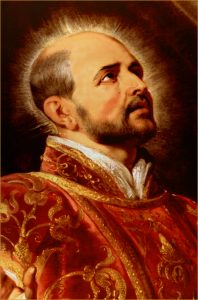
Ignatius Loyola, by Francisco Zurbaran


July 31 is the feast day of one of the most influential people in the history of Christianity, Inigo de Loyola. Born in 1491, he was baptized Inigo and, almost 40 years later, added Ignacio. According to Hugo Rahner, S.J. in Ignatius the Theologian, the choice of the name Ignatius was based on Inigo’s understanding of the Bishop and martyr of Antioch as a model of selfless love and an advocate for the apostolic teaching authority. A substantial library has developed over five centuries about his conversion, spiritual teaching, and prudent practicality. Ignatius founded the Society of Jesus, a religious order of men also known as the Jesuits. As one of the Catholic Church’s largest and most influential orders, the Society has spread Ignatian influence throughout Christianity in its world wide network of schools and missions.

Although he was born on the eve of the Renaissance and the modern era, Ignatius was a product of the late Middle Ages. Surprisingly, his approach to the following of Christ was to propel Catholic Christianity into an amazing revival and laid the foundations for many Protestants and Catholics to confront the secular challenges of the Post Modern era.

Examination of Consciousness

Perhaps the best way to begin to understand the life and legacy of Ignatius Loyola is his distinctive method of prayer – his way of relating to God – the Examen.

It is not an examination of conscience in the sense of finding fault with oneself. Rather it is a method of heightening one’s consciousness about the ways we encounter God and freeing ourselves to move more deeply and consciously into that encounter.

The key themes of Ignatian spirituality are contained in The Examen: (1) finding God in all things, (2) “indifference”- in terms of a Zen-like detachment and trusting openness, (3) discernment – am I truly being led by the Spirit and, if so, where? (4) being “actively available” to serve God in others, to be a “contemplative in action.”

The Examen consists of five points, moments, or movements of the soul, mind, and heart:

1. Recall that you are in the Presence of God.

Much is said about Ignatius’ military background as a young minor Spanish noble and the orderly mentality he is supposed to have brought to the founding and development of the Society of Jesus. As an experienced man who came to conversion after a serious battle injury, however, Ignatius, in his path as a pilgrim to the Holy Land and to life, became more and more imbued with the overwhelming presence of God.

2. Look at your day with Gratitude.

The God of Ignatius is a loving God of gifts. God is not an aloof military officer or stern judge. In the imagination of Ignatius, God is somewhat analogous to a liege lord in the medieval sense, but without the human limitations. All that is good and wondrous about us and around us is only a veiled manifestation of the overflowing of that Ultimate Goodness. The response to this goodness is a profound gratitude.

3. Ask for help from the Holy Spirit

In keeping with ancient Christian tradition and belief, all true knowledge of God, and even faith, is the work of the Holy Spirit. What nature hints at, the Spirit reveals. Ignatius’ trust in God is shown in terms of his openness to the Spirit which drives out all fear.

4. Review your Day

The Examen was recommended as a midday activity, although it can be done a second time at the end of the day. The review is not an mental or written checklist. The aim is to be open to what the Spirit reveals about the occurrences of our daily lives and their deeper meaning. If you are in the process of reforming your life, the awareness may focus on basic do’s and don’ts of avoiding sin and acting out of love alone. For those further along the path, the challenge is more subtle. What have I seen? What have I heard? What have I touched? What did I miss? What did I encounter?

5. Reconcile and Resolve

This an act of renewed consciousness. If I messed up, now is the time to understand why and to make amends. Maybe an apology is in order. Maybe reducing stress or increasing awareness is in order. This is not a time to beat up on yourself. Ignatius commands gentleness and compassion. On the other hand, if I responded in a good or better way, it is important to feel how it came about so that I can continue to be open to the Spirit the next time as well.

Conclude with the Lord’s Prayer

We seldom realize that the mode of relating to God, as given to his followers by Christ, is his own prayer. This identification with the actual physical and mystical person of Jesus is central to the spirituality of St. Ignatius. Jesus came to do the will of the Father and that is our calling as well.

So how much time are we supposed to take with this beautiful method of prayer?

A. One hour. B. 30 minutes. C. 15 minutes. D. As Long As it Takes.

The answer: C. 15 minutes. You are supposed to be out and about doing God’s work which the Spirit is pointing out to you. Time’s a wasting! Then again, St. Ignatius would allow you some leeway, as long you worked it out with your spiritual director and weren’t dodging your responsibilities.

A Guided Meditation

Phyllis Zagano leads the everyday person on a beautifully guided walk through The Examen for everyday people at “American Catholic.”

For More Information

For a good overview of the life of St. Ignatius Loyola, with an excellent bibliography, see, “The World of Ignatius of Loyola”. The Ignatian Spirituality Center in the Seattle, Washington area presents a very contemporary and brief description on its home page. A summary of Ignatian Spirituality from the 1930’s by Fr. Pinard De La Boullaye, S.J. is concise and reasonably accessible.

Read More