Christ the King is Coming – Wait, He’s a Shepherd?
Separation of Sheep and Goats
For thousands of years in human history, groups of people who claim a common ancestry and traditions have been governed by strongmen or women claiming ultimate authority and privilege in their societies. These people are commonly called kings, monarchs, or emperors. In some languages the term Czar or Kaiser or Shah name the ruler by position as ruler. In others the name is King, Queen, Emperor, or Empress, to name a but a few.
Many years ago, I read a series of novels by Raymond Feist that were set in nations similar to medieval ones in our world. Two worlds were involved in the stories, one (Midkemia) was much like Medieval Europe and the other (Kelewan) was more like a medieval nation from another part of the world. The stories began with an orphaned boy who was apprenticed to a magician, but happened upon a wreck from the other world. Warriors from that other world invaded Midkemia, captives were taken, and some from Midkemia, including our orphan boy, ended up in Kelewan.
I very much enjoyed the stories, especially as they expanded to include other ancient empires. However, one of the things I particularly enjoyed was the way the author told the society of Kelewan as it transitioned from an organizational system of families with strong leaders who were rivals for power and wealth to something more akin to a nation state with a strong leader, an Emperor or King. I often found myself explaining to one of my growing and maturing children the ways in which world affairs they were seeing followed a pattern about which they had first heard in these stories by Raymond Feist when they were a few years younger.
Today, when we hear the title King, we think of a powerful ruler – one who controls lands and wealth, governing all with unquestioned authority. The modern world has changed enough that in some cases, the monarch is not the ultimate source of laws nor do rulers have power of life and death over their subjects as most did in the past. Nevertheless, the monarch leads a very public life and has certain privileges not held by most citizens of their nation.
All this comes to mind as we celebrate the Solemnity of Our Lord Jesus Christ, King of the Universe, the last Sunday of our liturgical year. Who is this King? What does it mean in God’s terms to be King? What does this King expect of citizens of the kingdom?
Long before any kingdoms existed among the Jewish people, they were pastoralists, shepherds who went with their sheep and goats from place to place, finding food and water for their animals. They lived in tents and family groups, working together to protect their animals and their families. There were other groups who lived in the region as well, and some of them had organized governments and rulers. But the early descendants of Abraham, father of both Jewish and Arabic nations, did not.
When, hundreds of years after the Covenant between Abraham and the Lord was established, the people, now a very large group, decided they needed a King, the prophets who had been advising and leading them cautioned against the idea. However, eventually kings were chosen to serve. First Saul and then David and his descendants ruled the nation – sometimes wisely, sometimes foolishly. Eventually, the people were caught up in territorial wars with neighboring kingdoms and even taken into exile in Babylon. But the historical roots of the nation was still that of a pastoralist group who tended their sheep and goats. Many still earned their living that way, though it was no longer the norm or one of the higher status occupations.
From these roots, the image of the Lord as a shepherd arose. David was a shepherd before he became king. Kings were responsible for caring for the people as if they were sheep – valued and protected from harm. The people still belonged to the Lord. When their shepherds failed in their mission to protect and guide the people, keeping faith with the Lord, everything crashed. They were defeated in war and suffering ensued.
This is important to remember. It’s not the power, the wealth, the greed of the ruler that led to greatness and a positive, fruitful, secure future for the nation. It was fidelity to the Covenant, to the commands of the Lord. When that fidelity was abandoned, all was lost. Except – except for one thing: the promise of the Lord to be faithful to the people.
Ezekiel was a priest who was taken to Babylon early in the exile. He was called to the role of prophet there. He had the difficult task of being the one who spoke the Lord’s words reproaching Israel for being unfaithful to the Covenant. The temple in Jerusalem had not yet been destroyed when he began to speak, warning the exiles and preparing them for its destruction. Once the deed had been done, his words shifted and became words of hope. The Lord was still faithful. When the time would come, the people would return to their homeland, because the Lord was still their shepherd.
Ezekiel’s words were filled with hope. “For thus says the Lord God: I myself will look after and tend my sheep.” The Lord promised to gather those who remained faithful once again from all the lands to which they had been scattered and return with them to their own land. The image is one of sheep happily grazing in peaceful pastures, with their shepherd vigilant in protecting them from all dangers. (Ez 34:11-12, 15-17)
The next section of the prophesy is one we don’t often hear, but it’s worth noting. Ezekiel continues, “As for you, my sheep, says the Lord God, I will judge between one sheep and another, between rams and goats.” Those who treat the rest badly will be driven away from the Lord’s flock. And one shepherd will be appointed to care for and lead the sheep, “my servant, David.” (Ez 34:17-24) The Lord will provide for his people until all know that “I, the Lord, am their God, and they are my people, the house of Israel… You, my sheep, you are the sheep of my pasture, and I am your God…” (Ez 34:30-31)
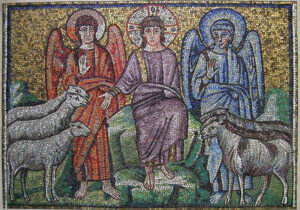
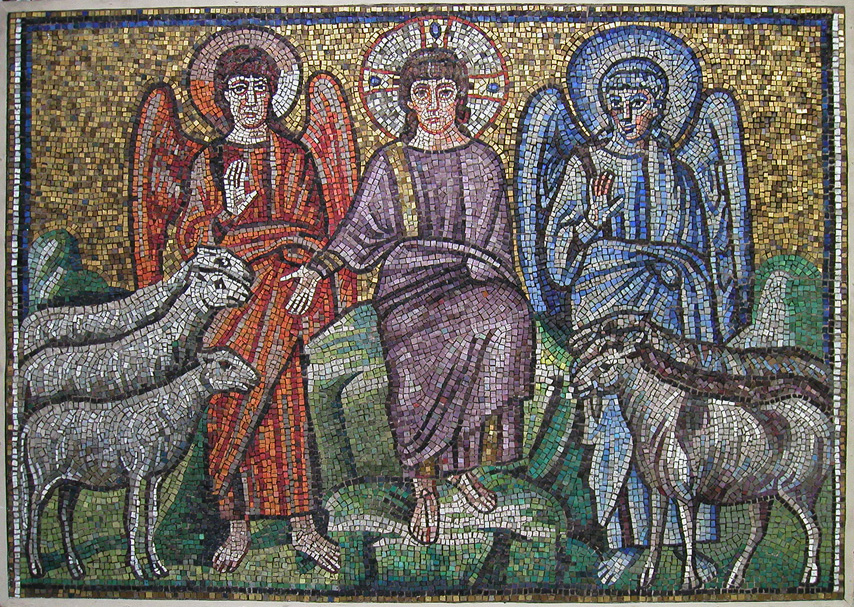
As Jesus neared the end of his ministry, he spoke of the judgement coming at the end of time. “When the Son of Man comes in his glory… all the nations will be assembled before him.” Son of Man is a term first used by Ezekiel and echoed here by Jesus. But this Son of Man will assemble ALL people, not just the Hebrew people. Once again, the image is of a shepherd, separating the sheep from the goats in the flock.
And what will the shepherd select as the categories for continued inclusion in the community, the sheep of the flock? Jesus was very clear on this.
“I was hungry and you gave me food. I was thirsty and you gave me drink, a stranger and you welcomed me, naked and you clothed me, ill and you cared for me, in prison and you visited me.”
The people in this group were confused. “When did we see you hungry… thirsty…” And the Son of Man will assure them, “Whatever you did for one of the least brothers of mine, you did for me.”
Those identified as goats would be sent away by the Son of Man to eternal punishment, because they did not feed the hungry, give drink to the thirsty, clothing to those who had none, welcome to newcomers, comfort and care to the ill and imprisoned. They too are surprised. When did we see you and not care for you? But again, the Son of Man is very clear about it. When you did not do it to the least person among you, you did not do it for me. (Mt 25:31-46)
The Lord God is faithful. Even when humans are not.
Jesus, the Son of Man, cares about such things and warns us all not to assume that all will be well as long as things are going well for us here. The critical question will be, how did we treat those most vulnerable among us, in our neighborhoods and around the world? Did we help them or simply judge them not worth our time and concern, or even our notice?
Jesus, the one already raised from the dead, “the firstfruits of those who have fallen asleep,” will bring those who belong to him to the Father at the end of time. Even death will be defeated and all will be reunited with God. (1 Cor 15:20-26, 28)
In the end, the shepherd of Israel, the Son of Man, will rescue and pasture his sheep.
This image of King is far from the image of King common in human societies or in stories such as those of Midkemia and Kelewan which are patterned on historical human social experience, fascinating and entertaining as they are. Yet it is the reality to which we are called. The hope for all creation. To be reunited in the love that overflowed and so brought all things into being. The great dance of love. So very, very much better than the wars and anger, and pain that result when we reject that love and seek only to dominate others or get what pleases us and makes our lives materially easier.
As we move through this final week of our liturgical year, may we remember to whom we belong, who it is that is looking out for us and caring for us, and the promise of community and mutual love and support to which we are called.
May we reach out with a smile, a kind word, a gift, a welcome, and when needed, forgiveness, to all we meet along our way through the week.
Christ is our King, and yes, he is a shepherd!
Peace be with you.
Readings for The Solemnity of Our Lord Jesus Christ, King of the Universe – Cycle A