Thoughtful Reflections on Religious Experience

Archive for October, 2008

Marriage and Matrimony - Aren’t they the same thing? by KathyPozos on Friday 31 October 2008 1:46 pm PDT
Todd Alan Studio Designs

Todd Alan Studio Designs

In California this election year, we’re asked to vote on a proposed constitutional amendment that claims to be for the “protection of marriage.” The proposition, in fact, is one that would take away the legal right of homosexual men and women to enter into the legal contract of marriage. The right was established earlier this year when the California Supreme Court ruled that laws to the contrary were un-Constitutional because they deprived same sex couples of equal protection under the law. (The Court found that domestic partnerships and civil unions did not provide all of the protections of legal marriage.) Proposition 8 is a constitutional amendment that would require a vote of 3/4 of the Legislature to overturn if at some later date we realize that it was a mistake to enact.

There have been a lot of arguments raised on both sides of the issue. Supporters of the proposition claim that marriage was established by God at the time of Adam and Eve, when they were instructed, in the second story of creation, to cling to each other and become one body. (Gen 2:24) In the first story of creation, the un-named humans were instructed to “Be fertile and multiply …” (Gen 1:28) The fact that the creation stories (two of them) in the book of Genesis were culturally based explanations of how things “came to be,” rather than historical or scientific accounts as we know them today, seems to be beside the point. Somehow, granting a legal right to share a life of committed love - with the rights, responsibilities and protections of marriage - to non-heterosexual couples is seen as a threat to the lives of commited love of heterosexual couples who have married.

I attended a wedding last weekend. It was a lovely ceremony that united a young man, of whom I am extremely fond and proud, with a young woman who has become dear to me as well. One of the things that really struck me about the wedding was the degree to which the legal, contractual nature of the marriage was obvious. As soon as the couple arrived before the sanctuary, the celebrant welcomed the assembled guests and quizzed them regarding potential reasons why the couple might not be legally married. He charged each of the two persons seeking to marry to speak out if either of them knew of any reason why they might not legally do so. Then he asked each individually if they had come freely and of their own will to be joined in marriage. Only once these requirements for entering into a legal contract had been established did he move into the prayers and readings of the service.

The ceremony included prayers and blessings for the couple and promises from the families and friends to help and support them in the life they were choosing to enter. The young man and his bride promised to love and care for each other, through all the ups and downs of life, for as long as they both should live. Only then were they allowed to enter into the sanctuary, offer each other their right hands in symbolic handshake on the contract, and pronounce their vows. They exchanged rings as a sign of their promises to each other. The celebrant blessed them and sent them forth out into the world and a new life together.

For this couple, the marriage ceremony included two elements: the legal, civil contract and the blessing of the church community. For many couples, the ceremony includes only the legal, civil contract. In many countries, couples who seek to marry do so in civil ceremonies. If they wish to receive the blessing of the Church, they then go to the parish and enter into the sacrament of Matrimony in another ceremony.

In the United States, we have allowed the combination of the civil and religious ceremonies into one. That, I believe, is a fundamental part of the confusion that has resulted in such controversy. We call both the legal, civil union of the two individuals and the sacrament of Matrimony by the same name - marriage.

Marriage, from the perspective of a social scientist, is a social arrangement developed by members of a culture to cement alliances between families, establish economic units, and provide for the procreation and nurturing of children. In corporate families (see my explanation of this term in another blog post), the head of the family makes the decision about who will marry whom. Those to be married do not necessarily have any choice in the matter. It is a legal contract between heads of families, not between the individuals to be married.

Christians have traditionally taken a somewhat different approach to the matter. Christian marriage, or Matrimony, is a sacrament of the physical love between a man and woman, the union of their hearts and lives and the image of the relationship between God and humans. It was not a rite that required the blessing of a priest as witness until sometime in the twelfth century. The man and woman are ministers of the sacrament to each other. Because men and women are understood to be equals in the sight of God, women have had more rights within Christian communities, at least in theory. The sacrament of Matrimony cannot be valid unless both parties consent to enter into the union. If there’s any lack of freedom or consent, the sacrament does not happen. The legal contractual aspect is null and void. The parties are free to enter into the sacrament with other parties. If the sacrament is judged to have been valid, the contract is upheld and regardless of what civil authorities might rule, the couple is not free to enter into the sacrament with other parties.

One argument against allowing homosexual marriages is that existing civil arrangements, such as “domestic partnerships” or “civil unions” confer the same protection under the law. In fact, since American law is based on precedents from cases dating back hundreds of years, there is no equivalent body of law supporting and/or establishing the legal protections for these unions that are part and parcel of the laws regarding marriage. Domestic partnerships and civil unions are not legally the same as marriages.

(On a related note - Many Catholics have been married in civil ceremonies when their first marriage, blessed by the Church, ended in legal divorce. Do we deny them the legal protections that come with civil marriage contracts when they again wish to enter a committed, loving life together? Should we offer them domestic partnerships or civil unions as their only option?)

Our American legal system is based on the English laws brought by the first colonists. The fact that so many of them were members of Calvinist religious faiths is also of importance in understanding the conflict surrounding homosexual marriage. John Calvin and his followers dropped most of the sacraments of the Church when they separated from the Roman Catholic Church. They kept only Baptism. Matrimony ceased to exist as a sacrament for them. Marriage became a matter of civil law only. That was the way it came to the United States and was enshrined into the law of the land. As an accommodation to those of other religious traditions, ministers of those faiths are legally allowed to serve as witnesses to the legal, civil contract. However, no one is required to have a minister bless his or her marriage. And equally important, no minister of any religious faith is required to bless, or even serve as witness to, the marriage of someone who does not qualify to marry under the laws of his or her faith tradition. That’s why we have a Justice of the Peace for civil ceremonies.  Yet religious communities rightly feel a responsibility to monitor, support and encourage couples who choose to enter into a married relationship. So even when they don’t recognize the sacrament of Matrimony, they want to establish rules to regulate marriage - mixing theology with legal protections.

The issues surrounding this question are complex. They go far beyond the questions of whether people choose their sexual orientation, whether certain behaviors are inherently sinful and whether the majority of adults are comfortable with sexual behaviors that differ from their own.

Legal systems are developed to protect the members of a society. Ideally they protect those with the least power, the minorities among us, those who are different or who cannot protect themselves - the Biblical “widows and orphans” or “God’s little ones.” As our understanding of human psychology and biology has developed and changed and as we’ve learned more about our universe and our place within it, Church teachings have changed. We no longer believe that slavery is OK. We insist that women and children are not the property of their families. We agree with Galileo that the Sun does not revolve around the Earth. And we are finding more and more evidence that sexual orientation is not a choice but rather is established before birth. If God created people not just as Adam and Eve, but also as Adam and Steve and Anna and Eve, who are we to deny them the same legal protections for their relationships and lives together as we grant to ourselves?

Jim Wallis

Jim Wallis

This article is quoted in full from Jim Wallis’ blog, God’s Politics. Wallis is editor-in-chief of Sojourners Magazine and a Theologika.net trusted authority. I received it October 23, 2008 in my email. I present it for your consideration.

My Personal ‘Faith Priorities’ for this Election 

In 2004, several conservative Catholic bishops and a few megachurch pastors like Rick Warren issued their list of “non-negotiables,” which were intended to be a voter guide for their followers. All of them were relatively the same list of issues: abortion, gay marriage, stem cell research, etc. None of them even included the word “poverty,” only one example of the missing issues which are found quite clearly in the Bible. All of them were also relatively the same as official Republican Party Web sites of “non-negotiables.” The political connections and commitments of the religious non-negotiable writers were quite clear.

I want to suggest a different approach this year and share my personal list of “faith priorities” that will guide me in making the imperfect choices that always confront us in any election year — and suggest that each of you come up with your own list of “faith” or “moral” priorities for this election year and take them into the voting booth with you.

After the last election, I wrote a book titled God’s Politics. I was criticized by some for presuming to speak for God, but that wasn’t the point. I was trying to explore what issues might be closest to the heart of God and how they may be quite different from what many strident religious voices were then saying. I was also saying that “God’s Politics” will often turn our partisan politics upside down, transcend our ideological categories of Left and Right, and challenge the core values and priorities of our political culture. I was also trying to say that there is certainly no easy jump from God’s politics to either the Republicans or Democrats. God is neither. In any election we face imperfect choices, but our choices should reflect the things we believe God cares about if we are people of faith, and our own moral sensibilities if we are not people of faith. Therefore, people of faith, and all of us, should be “values voters” but vote all our values, not just a few that can be easily manipulated for the benefit of one party or another.

In 2008, the kingdom of God is not on the ballot in any of the 50 states as far as I can see. So we can’t vote for that this year. But there are important choices in this year’s election — very important choices — which will dramatically impact what many in the religious community and outside of it call “the common good,” and the outcome could be very important, perhaps even more so than in many recent electoral contests.

I am in no position to tell anyone what is “non-negotiable,” and neither is any bishop or megachurch pastor, but let me tell you the “faith priorities” and values I will be voting on this year:

1.  With more than 2,000 verses in the Bible about how we treat the poor and oppressed, I will examine the record, plans, policies, and promises made by the candidates on what they will do to overcome the scandal of extreme global poverty and the shame of such unnecessary domestic poverty in the richest nation in the world. Such a central theme of the Bible simply cannot be ignored at election time, as too many Christians have done for years. And any solution to the economic crisis that simply bails out the rich, and even the middle class, but ignores those at the bottom should simply be unacceptable to people of faith.

2.  From the biblical prophets to Jesus, there is, at least, a biblical presumption against war and the hope of beating our swords into instruments of peace. So I will choose the candidates who will be least likely to lead us into more disastrous wars and find better ways to resolve the inevitable conflicts in the world and make us all safer. I will choose the candidates who seem to best understand that our security depends upon other people’s security (everyone having “their own vine and fig tree, so no one can make them afraid,” as the prophets say) more than upon how high we can build walls or a stockpile of weapons. Christians should never expect a pacifist president, but we can insist on one who views military force only as a very last resort, when all other diplomatic and economic measures have failed, and never as a preferred or habitual response to conflict.

3.  “Choosing life” is a constant biblical theme, so I will choose candidates who have the most consistent ethic of life, addressing all the threats to human life and dignity that we face — not just one. Thirty-thousand children dying globally each day of preventable hunger and disease is a life issue. The genocide in Darfur is a life issue. Health care is a life issue. War is a life issue. The death penalty is a life issue. And on abortion, I will choose candidates who have the best chance to pursue the practical and proven policies which could dramatically reduce the number of abortions in America and therefore save precious unborn lives, rather than those who simply repeat the polarized legal debates and “pro-choice” and “pro-life” mantras from either side.

4.  God’s fragile creation is clearly under assault, and I will choose the candidates who will likely be most faithful in our care of the environment. In particular, I will choose the candidates who will most clearly take on the growing threat of climate change, and who have the strongest commitment to the conversion of our economy and way of life to a cleaner, safer, and more renewable energy future. And that choice could accomplish other key moral priorities like the redemption of a dangerous foreign policy built on Middle East oil dependence, and the great prospects of job creation and economic renewal from a new “green” economy built on more spiritual values of conservation, stewardship, sustainability, respect, responsibility, co-dependence, modesty, and even humility.

5.  Every human being is made in the image of God, so I will choose the candidates who are most likely to protect human rights and human dignity. Sexual and economic slavery is on the rise around the world, and an end to human trafficking must become a top priority. As many religious leaders have now said, torture is completely morally unacceptable, under any circumstances, and I will choose the candidates who are most committed to reversing American policy on the treatment of prisoners. And I will choose the candidates who understand that the immigration system is totally broken and needs comprehensive reform, but must be changed in ways that are compassionate, fair, just, and consistent with the biblical command to “welcome the stranger.”

6.  Healthy families are the foundation of our community life, and nothing is more important than how we are raising up the next generation. As the father of two young boys, I am deeply concerned about the values our leaders model in the midst of the cultural degeneracy assaulting our children. Which candidates will best exemplify and articulate strong family values, using the White House and other offices as bully pulpits to speak of sexual restraint and integrity, marital fidelity, strong parenting, and putting family values over economic values? And I will choose the candidates who promise to really deal with the enormous economic and cultural pressures that have made parenting such a “countercultural activity” in America today, rather than those who merely scapegoat gay people for the serious problems of heterosexual family breakdown.

That is my list of personal “faith priorities” for the election year of 2008, but they are not “non-negotiables” for anyone else. It’s time for each of us to make up our own list in these next 12 days. Make your list and send this on to your friends and family members, inviting them to do the same thing.

For another article presenting Wallis’ views on issues facing American voters, see http://www.sojo.net/index.cfm?action=magazine.article&issue=soj0811&article=what-s-at-stake.

Trusted Authority - Megan McKenna - On Voting by KathyPozos on Tuesday 28 October 2008 4:15 pm PDT


Theologian/Storyteller, Megan McKenna

Theologian/Storyteller, Megan McKenna

Today - one week before voting day for President of the United States - I’d like to offer a note I received in June from theologian, storyteller Megan McKenna. A friend had asked what her “rules” for choosing a candidate for political office would be. This was her response.

Dear folks,

Here is something I wrote in response to a question. It’s a place to start. Enjoy and feel free to comment and send me any of your thoughts. I’m sure I’ll be using it more and more as time goes on. Blessings, Shalom, Megan

Here are my rules (so to speak) for voting … rough form. They are more developed when I speak them.

I. Vote for the person you think will do the least amount of harm (war, nuclear weapons, new weapons, death penalty, economics, housing, health insurance, etc.).

2. Vote for the person you think will allow you and others with you to do the most amount of good (correcting and undoing the gutting of the Constitution, rights, freedoms in the US, etc. from the last 8 years), as well as work for legistation against the death penalty, for housing, decent wages, immigration (welcoming the stranger since we were all in that group once unless we are native Americans), universal health care, dialogue with other nations (trying to pull our international reputation out of where it is today because of Iraq/Afghanistan/torture, aggression, pre-emptive strikes, alliance with Israel, refusal to dialog with Iran/Sudan/Cuba/Palestine, etc.).

3. Remember - none of them [candidates and political parties] is interested in the kingdom of justice for all and peace (the peace of Christ - nonviolent resistance to evil) and life ever more abundantly for all.

4. Do not vote one issue … no matter what it is. There are 6.8 billion people in the world, nearly 2/3 of them living at subsistence level, in need of clean water, basic food, shelter, medicine, education, dignity, freedom from violence, the freedom to migrate and a hope for their children. There is also the destruction of the earth and the greed of the few/major nations like us and the G8 over-using natural resources and thinking only in terms of profit, nationalism/and a war that in the last 8 years has, on an average wasted over $800 billion a year on wanton destruction of Iraq (a country the size of New Jersey) and Afghanistan (already in the 11 century when we started bombing). Yet we do nothing in regards to Burma (Myanmar) the Sudan, Zimbabawe or any other country that is beset by dictators/military regimes, etc.

5. VOTE… If you don’t, then you are even more responsible for what happens. Not to choose is to choose - we are all accountable for what happens in this country.

6. Vote for the person who will think long term - Supreme Court justices, economics, and especially in regards to other countries, internationally. We have little or no respect around the world - because of torture, lies, Guantanamo, immigration practices, arrogance towards others, rendition of citizens, the ignoring of our own Constitution and laws and our inordinate living (consumption of oil, resources, food, etc.). At home - the housing, mortgage crisis - people need their homes back, they need universal medical insurance and education that is not tiered according to race/economics.

7. Pray, read the scriptures. Who would Jesus, in the power of the Spirit who calls God Our Father (all of us the beloved children of God, blessed and loved, no exceptions), vote for? And get involved with others. Make your choice. Look at and know what needs to be confronted and dealt with - the Middle East question of Jerusalem/Israel/Palestine, 2 states, the wall; the ongoing wars and how to get troops out and how to dialog so that war is not considered an option ever - no matter what. And look for integrity, honesty, truthfulness.

That’s it … in a nutshell. Each “rule” or thing to remember could be elaborated on with the principles of justice, social teaching and the gospel.

Blessings,

Megan

Happy Birthday to our Trusted Authority, Jesse Manibusan! by KathyPozos on Thursday 23 October 2008 9:31 am PDT
Jesse Manibusan

Jesse Manibusan

Jesse Manibusan is a singer, songwriter, comedian, and guerilla evangelist who works primarily with youth and young adults, but is also loved by many of us “older” folks as well. We first met when my oldest son was 5 years old. (He’s 29 now - you can do the math!)

Jesse includes a wide variety of styles of music in his work, from the sweetly lyric poetry and tone of Have you seen my God? or Until I Return to the rapper style MC God and I’m Coming Home’s cha-cha rhythm. I’ll never forget the day he sang for the first commencement ceremony of The National Hispanic University. He didn’t speak Spanish, but he had listened to tapes of traditional songs and played them for about 15 minutes before the ceremony started, to the delight of the assembled families and friends of the graduates. When he led us in The Star Spangled Banner to begin the ceremony, his voice filled the auditorium. He later took this great talent for music and language and wrote his Misa del Mundo, liturgical music with phrases and refrains from languages and cultures all over the world - uniting all into the one prayer we all share, our liturgy.

Early in his career, Jesse wrote a song that I’ve always thought was a good reminder of what’s important - God is Bigger. In these days leading up to the election in the US, when financial markets are on a roller coaster, jobs are in flux, the housing market continues to fall and everything is uncertain, it’s important that we remember that truly, God is Bigger than all that stuff. As Jesse says, “God is good … all the time and All the time … God is good.”

Jesse is probably best known for another of his early songs, Open My Eyes. The words of the song include, “Open my eyes, Lord, help me to see your face …. Open my ears, Lord, help me to hear your voice … Open my heart, Lord, help me to love like you…” A wonderful prayer for beginning each day.

Jesse has a website, http://jessemanibusan.com. Go there and check it out. His blog tells of his travels, adventures and reflections. His CDs and Videos are available for purchase, along with songbooks for those who’d like to have the music to play themselves. And you can find out where his next performance will be, so you can be there! You won’t regret it.

I’ll close with wishes for Jesse of a very Happy Birthday, many more years of joy with your wonderful family, and continued faithfulness to your calling which has enriched all of us and brought such delight to so many.

Fidelius and Diabolus: The Not So Gay Marriage Dialog by RandyPozos on Monday 20 October 2008 5:24 pm PDT
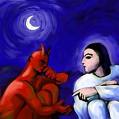
Image taken from oneyearbibleimages.com

Image taken from oneyearbibleimages.com

Diabolus: How’s it going?

Fidelius: You know we can’t talk - why do you persist?

Diabolus: That might be true if I were the Devil, but what if I’m your conscience?

Fidelius: There are no views but those of the Church.

Diabolus: True, but what about Church teaching, which acknowledges the “Sensus Fidelium” or Sense of the Faithful?

Fidelius: Stop bugging me Diabolus.

Diabolus: How do you know that’s my name?

Fidelius: You’re tempting me to think for myself. You’re torturing me.

Diabolus: No one can control your mind and heart. What’s bothering you?

Fidelius: I will take my counsel from my confessor, not from a post-Pepperoni heartburn!

Diabolus: “Pepperoni.” What a great name! Why don’t you call me that?

Fidelius: You are what you are.

Diabolus: And what is that?

Fidelius: The Tempter, the Evil One.

Diabolus: Have I ever suggested that you do anything wrong? Did I set your eye to wandering or encourage you to blow up when the Angels didn’t make the pennant?

Fidelius: Good people are tempted under the guise of good.

Diabolus: So, you’re a good person?

Fidelius: Yes. Generally, that is.

Diabolus: So then, why are you thinking about “it” again.

Fidelius: What “it”?

Diabolus: You know. Your conflict about gays.

Fidelius: They’re disgusting, you know that.

Diabolus: That’s not an uncommon opinion.

Fidelius: They make me squirm - and now they want to get married!

Diabolus: So, you think that it would be better to encourage them to stay with promiscuity as opposed to having a life of fidelity?

Fidelius: There can be nothing good in an act that is “intrinsically evil”.

Diabolus: So, you mean that you and Cynthia have never done anything “kinky”?

Fidelius: Shut up. We’re married.

Diabolus: My point exactly. You know, pleasure in marriage used to be called concupiscence.

Fidelius: What’s that?

Diabolus: You know - messed up like everything else after the fall of Adam and Eve.

Fidelius: So now you presume to teach me moral theology!

Diabolus: No. You learned it at that expensive Catholic college. Remember - the one you drank your way through?

Fidelius: Yeah, but it was after Vatican II. They weren’t Catholic anyway.

Diabolus: You mean like old Father Sullivan, who came to class in his cassock with the old yellowed pages on St. Thomas Aquinas?

Fidelius: He was different.

Diabolus: Yeah - he made you sweat to get a “C”. Not like the easy liberal that you gave you a “B+” for some beer can “sculpture” you threw together at the last minute.

Fidelius: Yeah, he was real.

Diabolus: Wasn’t he the guy that told you to have a happy sex life when you got married?

Fidelius: How do you know that? That was in confession!

Diabolus: Remember? I was there.

Fidelius: All I felt was so dirty.

Diabolus: You thought that he was going to throw the book at you.

Fidelius: Yeah, but he didn’t.

Diabolus: But there was a sin you didn’t confess.

Fidelius: What do you mean?

Diabolus: You remember. The time you stopped your fraternity brothers from beating up David Farnsworth, the fag?

Fidelius: He wasn’t gay - besides, “fag” isn’t politically correct.

Diabolus: Yeah. That’s why you found him dying in the AIDS ward a few years later at St. Mary’s, when you were helping the administration get their finances in order! A young guy out of business school and you go through the wrong door!

Fidelius: He never had a chance.

Diabolus: What do you mean? We all have free will. We all make choices.

Fidelius: His only moral choice was not to have sex.

Diabolus: He could have had a partner. You know - spend their lives together and all that? Maybe adopt a kid?

Fidelius: It would have been one mortal sin piled on another. He’d be deeper in Hell than he is now.

Diabolus: You don’t believe that.

Fidelius: Well, I heard Fr. Sullivan got to him before it was too late. But Purgatory’s no picnic.

Diabolus: So why did you pay for the Plenary Indulgence for him?

Fidelius: I didn’t pay for it. I just made an offering.

Diabolus: Strange. All this good will. Did you have a thing for this guy?

Fidelius: He was a guy. Got it? Like anybody. He deserved some decency, some respect.

Diabolus: But not a home.

Fidelius: He wasn’t homeless. He was making good money as an attorney.

Diabolus: No one to come home to; just work, parties, the bars …

Fidelius: He knew marriage was for straights. He was a good Catholic.

Diabolus: Yeah right. A gay can be a good Catholic; as likely as the Good Samaritan.

Fidelius: The Samaritan was real.

Diabolus: Maybe - or was he just a way for Jesus to show up the “good” people who had no compassion?

Fidelius: We can’t encourage gay culture. We’d be undermining the family; the basis of society.

Diabolus: Right. We can’t encourage a culture of life and fidelity.

Fidelius: It’s wrong. Remember, God made Adam and Eve - not Adam and Steve.

Diabolus: An interesting piece of demagoguery, but it doesn’t seem very compassionate.

Fidelius: The kids’ll get the wrong idea. They’ll think it’s okay.

Diabolus: Is that why so many gay people hate themselves?

Fidelius: It’s not my problem.

Diabolus: David became your problem when you saved him from that pack of apes.

Fidelius: I would have done it for anybody. Nobody deserves that kind of hate.

Diabolus: So where do you stop on this slippery slope?

Fidelius: It’s easy. The Church says, don’t beat ‘em up but don’t let ‘em get married.

Diabolus: That’s why you and Cynthia have only 3 kids - after 20 years?

Fidelius: We couldn’t have afforded more kids. You know that. With Cynthia’s problems it probably would have killed her.

Diabolus: So you love your wife more than God?

Fidelius: There’s a difference between God and the Church.

Diabolus: So who’s being the Devil now?

Fidelius: It’s in the Apostles Creed… “I believe in God, the Father Almighty.” Toward the end it says “I believe in one, holy, catholic, and apostolic church.”

Diabolus: Conscience. That weasel thing you picked up from those liberal priests!

Fidelius: It was a Vatican II thing. I had to write a paper on it.

Diabolus: So you did learn something!

Fidelius: Only because Fr. Sullivan made me re-write it 3 times.

Diablolus: I can’t imagine St. Thomas being on the side of conscience. He was a real theologian - and a saint.

Fidelius: Yeah. It’s a big thing for him - like it was for those Moslems philosophers he studied.

Diabolus: They only blow up stuff.

Fidelius: Conscience. You know - ”formed according to the teaching of the Church.”

Diabolus: So why did Aquinas end up on the list of forbidden books so long?

Fidelius: He was accused of subjecting God to human reason.

Diabolus: Well I gotta go. Time “to prowl about seeking the ruin of souls”.

Fidelius: What about me?

Diabolus: You’re hopeless!

Fidelius: Hopeless?

Diabolus: Just the opposite, I’m afraid. No sale here today.

Fidelius: What about gay marriage?

Diabolus: Deciding that by a crowd? I like lynchings. Remember? But you know, it’s not my thing. You should look at that WMD “weapons of mass destruction” bracelet you wear.

Fidelius: It’s WWJD! What would Jesus do?

Diabolus: Yeah. I wonder. Later dude.. out’a here..

Saint of the Day - St. Teresa of Avila - October 15 by KathyPozos on Wednesday 15 October 2008 6:00 am PDT
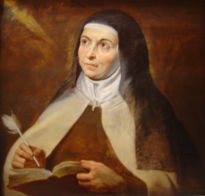
St. Teresa of Avila - by Peter Paul Rubens

St. Teresa of Avila - by Peter Paul Rubens

St. Teresa of Avila, also known as St. Teresa of Jesus, was a Carmelite nun, reformer of her order, mystic, and writer.  She is one of only three women who have been named “Doctor of the Church.” She had a lively intellect and loved people and parties. She wasn’t afraid to argue with the Lord or to oppose those of her time who believed her reforms unnecessary and even dangerous. She experienced many years of illness, including three of paralysis. She found prayer difficult for many years and even refused to try. It wasn’t until she was middle-aged that she began her great work of prayer, reform and teaching.

Many books and articles have been written about St. Teresa of Avila. I refer you to them and to her own writings for details about her life and contributions.

I also invited Mother Marija of Holy Annunciation Monastery in Sugarloaf, Pennsylvania to share a thought with us about St. Teresa. Her response:

The invitation: “What is one thing you would like people to know about St. Teresa of Avila?”  To be true to Teresa one must be faithful to Teresa’s own thought, at least as well as another can understand and convey it. Our Holy Mother St. Teresa, is a Doctor of the Church, so she needs no other “recommendation” in her teaching capacity. Her own mystical life is self-described in her writings: Life, The Way of Perfection (written for her daughters the Carmelite nuns), and the Interior Castle,  which book describes – even maps out - the journey of a soul through seven stages of the inner life to union with God. Again, Teresa had the Carmelite nuns in mind when writing this book, as the epilog expressly tells us. So what would I like people to know about Teresa? Simply that she is a true guide for a life of prayer – a “life”, meaning that prayer for Teresa is the WAY to God. Our Lord is, of course, the WAY and Teresa’s way of prayer is friendship with Jesus. The Way of Perfection, a life of Prayer and finding Jesus as the Way for each of us seems for Teresa  to be identical. After all, she is Teresa of Jesus.

Thank you, Mother, for your contribution. May God bless you and all who seek to serve Him through a life of prayer and friendship with Jesus.

The books of St. Teresa of Avila are still in print today. You can find them listed in our discovery engine at http://www.theologika.net/search. Just enter her name and you’ll get links to her works.

Photo by Chuck Welch of Lakeland, FL

Over the past 12-18 months I’ve received a number of emails forwarded from friends and family that were related to the current Presidential election in the US. The majority of the emails purported to be sincere efforts to raise questions about the ability of a candidate to serve as leader of this country. However, in general, they were filled with statements that were phrased to sound alarm bells in the minds of “Middle America” about the candidacy of Senator Barak Obama.  Many make a big deal of Senator Obama’s name. Others raise questions about the validity of his decision to become a Christian as an adult. One, featuring a cute picture of a bear seated at a picnic table, raised again the old Republican campaign claim that the Democratic party would give money to people who didn’t really need it or were too lazy to work for it - a “socialist state” type of idea, with all the negative baggage such terms carry in this country.

I haven’t received emails of this nature from the other side. I did hear of a You-Tube video featuring a formal Navy officer who was also a POW during the Vietnam War. In that one the speaker explained his concerns about Senator McCain. But that’s the only one I’ve seen. There may be others, but my “liberal” friends tend not to send that kind of stuff to me.

I write about this because as we come into the final weeks of the campaign, the tenor of the rallies and the statements being made are becoming more worrisome. Some of the rhetoric is deliberately arousing negative reactions from the crowds. Use of Senator Obama’s middle name in speaking of him is leading crowds to “boo” and shout out threats against him. While the presidential candidates themselves do not endorse this kind of activity, at least one of their running mates has not stopped it at campaign rallies when it occurred. This is dangerous and un-American. It is also un-Christian. So I believe it is something that must be addressed in Theologika’s forum.

Accordingly, I offer reflections I sent to a friend who had forwarded one of those “hate” emails to me. It should be noted that my friend was sincerely asking for my input on the content of the email. (He sent my reply back to his correspondent with his statement that he agreed with what I had said.)

The piece in question asked specifically if Muslims could be good Americans and would go to fight for America if the need arose. The implication of the article was that they could not and by extension that Senator Obama, because of his name and family of origin, would not be a safe choice for President. My response was as follows:

How to begin!?!
 
I guess the place I begin is remembering when Kennedy ran for President when I was a child. The big question on many people’s minds was whether electing him meant accepting the Pope as leader of the US. Catholics were not trusted in the US for the most part up until that time. I remember having someone spit on me as I walked home from school for lunch, wearing my Catholic school uniform. I was about 7-8 years old. I’d hate to think that now that it’s become understood that we are not ruled by the Pope, we’d become bigots ourselves about those of another of the great faiths ‘of the Book.’
 
A second thought is of my Muslim ’sons,’ two now middle aged men who lived with us as our children in 1978 and early 1979. They and their family are honest people, whose religious beliefs guide them to be caring, respectful, thoughtful members of the communities in which they live. One of them told me one day, that the Christian teaching to forgive one’s enemies was something that Islam also taught, as a quality of the holiest of people. I would not hesitate to see them in public service in this country. They are very grateful for the US and for the refuge, welcome, education and opportunities they received as teenagers from an ‘enemy country’ (Iran) when they were young.
 
A third thought - Obama is Christian. This nonsense of saying that his Muslim name means he’s Muslim is just that - nonsense.  It’s like saying that any woman named Mary or man named Joseph is Jewish because those were names of Jews in the Bible! He’s named after his father. So’s my son. So what! Names are not destiny and do not equal religious faith, unless chosen as a religious name by someone entering religious community life.
 
Fourth - As Catholic Christians, we are members of a universal community, with first allegiance to the Kingdom of Heaven. The Pope and bishops continually remind us that we are not first and foremost Americans. Our decisions must be made in the light of broader, more universal concerns. What will this policy do to the least among us? The ‘preferential option for the poor’ that is rarely mentioned in American political discourse is the fundamental principle for us. Does that make us unfit for American office or citizenship? Some would argue that it would. I argue that as Christians, our call is to work for change within our society, not legislating it or criminalizing actions that are contrary to my beliefs, but to create support systems and encourage development of values on a broader scale that align American society and values with Kingdom values. We must keep this as a secular society, refusing to allow people of any faith to impose their own religious rules. A theocracy (society governed by religious law and leaders) is dangerous for all of us. As Christians, we’ve accomplished the most in bettering life for ‘the least among us’ when we began working as individuals and small groups to take care of the poor, the women and children, the disabled, etc. Those beginnings grew into larger movements and institutions, like the proverbial yeast of the Gospels. (Think St. Vincent de Paul, Mother Teresa, St. Camillus de Lellis, and many, many more. See http://blog.theologika.net for more examples.)

Fifth - I was raised in a family that more often than not votes Republican. I was always proud of the Republican belief that individuals can solve problems much more effectively in their own local communities than some ‘politician’ in the “East” could solve it for them. (We were from a western state.) But I’ve learned through the years that there are some things that can’t be handled or resolved effectively on a local level. And people who don’t have even flip flops can’t pull themselves up by their bootstraps. We’re in this together, as the melt-down on Wall Street has made abundantly clear recently. If a party can’t present its ideas and win the hearts of voters by presenting the issues and their best ideas about how to solve the problems of our nation without resorting to lies, fear-mongering and innuendo, then I’m not at all sure that party is worth supporting. I’m ashamed to see people of good will passing this garbage around and giving it credibility in the process.
 
As you can see, I’m a bit passionate about all of this. We’ve come so far. We can go so much farther. But we keep diving back down into bigotry and hatred. The saints and angels, as well as the one God and Father of us all, must be in tears.

I offer these thoughts to you, my readers, as well. In choosing our leaders, we must move beyond the politics of fear and of creating barriers where they don’t really exist. We must look at the issues before us, evaluate them based on our values and understanding of our faith, and then make our decisions responsibly and prayerfully, remembering that God has given us the gift of our minds so that we can use them to make this a more compassionate, just, and secure world for all who share it.

For more on the idea of secular societies vs theocracies, see http://blog.theologika.net/2008/09/11/theocracy-or-secular-society-reflections/.

For information on Islam, a classic from the field of anthropology is Islam Observed, by Clifford Geertz. There are also good pieces in Wikipedia on Islam and the many forms it takes.

The following are works I cited in another blog post, but in case you missed them, they’re well worth reading, so here they are again!

God’s Crucible: Islam and the Making of Europe, 570-1215, by David Levering Lewis 

The Voice, The Word, The Books: The Sacred Scripture of the Jews, Christians, and Muslims, by F.E. Peters

A Peace to End All Peace: The Fall of the Ottoman Empire and the Creation of the Modern Middle East, by David Fromkin

Secularity and the Gospel: Being Missionaries to our Children, by Ronald Rolheiser, OMI

Three Cups of Tea: One Man’s Mission to Promote Peace … One School at a Time, by Greg Mortensen

Eulalie Durocher was born on October 6, 1811, in San Antoine sur Richelieu near Montreal. Her life can be summarized very briefly. She was the tenth of eleven children and one of her older brothers was a priest.  When she was 18, her mother passed away and Eulalie and her father went to live with her brother, Theophile, at his parish in Boleil. The young Eulalie took charge of the priest’s home as housekeeper, hostess, and parish assistant. Although she was reputed to be lively and something of a tomboy, her health was never really robust.

At the request of Bishop Ignace Bourget, Eulalie, at 32, in 1842 became the reluctant co-founder, with the bishop, of the Sisters of the Holy Names of Jesus and Mary. (Bishop Bourget also founded 3 other religious orders to help meet the needs of his diocese, which was the vastness of Canada.) At her profession of vows, she took the name Sr. Marie-Rose. Two of her friends joined her in this new work, focusing on the religious education of children, especially girls.  Blessed Marie Rose led her group for 6 difficult years until she died on her birthday October 6, 1849.

We know that her spiritual formation under Fr. Telmon was strict and that she set a very high standard for the members of her community. However, her service to the poor and her efforts to deal with the social ills of her time set the order on a trajectory of education, nursing, social work, and spiritual direction.

The Sisters of the Holy Names have been leaders in the education of women and pastoral care and service of the most disadvantaged. Kathy and I are both indebted to the Sisters of the Holy Names. Kathy was educated by Holy Names Sisters for 10 years, first in her parish grammar school and later at Holy Names Academy in Spokane, WA. My first full time teaching position was in the Education Department of Holy Names University in Oakland, CA some 30 years ago. We send our greetings, thanks and prayers to the Sisters of the Holy Names on this the feast of their foundress.

Saint of the Day - St. Francis of Assisi - October 4 by KathyPozos on Saturday 4 October 2008 6:00 am PDT


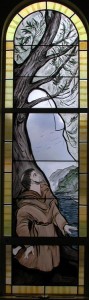
St. Francis of Assisi window - St. Joseph’s Monastery in Aptos, CA - Artist: Susan Wagner

October 4 is the feast of St. Francis of Assisi. Francis was born in Assisi, Italy in about 1182 and died at the Porziuncola, a chapel outside Assisi’s walls, in 1226. He is one of the best known saints, founder of the Order of Friars Minor or Franciscans, the Poor Ladies or Order of St. Clare  (Poor Clares - founded with St. Clare of Assisi) and the Third Order Franciscans, including lay men and women who also wanted to live in accordance with the Gospels in a Franciscan manner. There are many sub-groups of Franciscans.

Brother Bill Short, OFM  of the Franciscan School of Theology, Berkeley, CA has developed an excellent series of lectures on the life and times of St. Francis. I listened to it recently and was fascinated with the richness of detail he included about the culture and history of the times, as well as the people who each played a part in the story of St. Francis.

I asked Brother Bill and a few others for reflections on St. Francis for his feast - one thing they would like people to know about him. I received these responses.

From Brother Bill:

Something (one thing) I would like people to know about St. Francis – hmmmm, there’s an embarrassment of riches.  Let me try this:
 
Francis was rather alarmed by the notion that people might think he was some kind of saint.  In a fairly reliable account from companions who travelled with him, recounted some fifteen years after his death, they remember that on travelling through a town in Tuscany, a man pleaded with Francis to pray that his wife would be freed from an evil spirit that was making her cry out, disturbing the neighbors.  Francis seemed pretty skeptical, but finally agreed to go to the house, along with three companions.  He stationed them in three corners of the room where the woman was ranting, while he took one corner for himself.  They all prayed, and the woman stopped shrieking, apparently healed.  The husband thanked Francis profusely, but Francis seemed in a hurry to move along.  Some time later he passed through the same town with Brother Elias (his vicar) and the woman came rushing out to thank him.  He still seemed reluctant to accept her story, but finally agreed that she had been freed from her problem – but he was very clear that four brothers had prayed for her (including him) and who knew which prayer God had answered?  That’s good, practical humility, I think.
 
I like the story because it shows Francis as someone with a pretty shrewd sense of “phonies,” and a cautious approach to anyone (including himself!) being considered a saint during their own lifetime.

From Sr. Krista Aitkin of St. Joseph’s Monastery in Aptos, CA

St. Francis of Assisi is a spirit and a way of life.  His spirit and his way of living are reality lived,  not an idea or ideal, or even a formula.  Everything about St. Francis is an invitation to practice.  He is not locked into “a system.”  He lives reality through devotion toward others,  respect for the poor and for all of God’s creation.  In short,  St. Francis lives in and through the Word of God.  His charism is not linked to a particular apostolate,  but is focused on “becoming” rather than “producing,”  on one spirituality - putting on Christ,  who called himself the way,  the truth,  and our life.

Thank you to Brother Bill and Sr. Krista for your responses to my question and for sharing your love of St. Francis with me. May the Lord continue to bless you richly.

Saint of the Day - St. Therese of Lisieux - October 1 by KathyPozos on Wednesday 1 October 2008 7:00 am PDT

St. Therese - Original icon by Sr. Marie-Celeste Fadden, Carmel of Reno - Used with permission

St. Therese of Lisieux is known as “The Little Flower” because before she died she promised that after her death she would send down a shower of roses on the earth. She is known for her “little way” to God - a way that everyone can follow, doing the smallest everyday things in love as a way to God.

I asked the sisters at several Carmelite monasteries to share their reflections on St. Therese for her feast day and received these gracious responses.

Mother Marija, 0cd of Holy Annunciation Monastery , a Byzantine Carmelite monastery, in Sugarloaf, PA, sent this note:

The invitation: “What is one thing you would like people to know about St. Therese?”  This in turn, led me to ask: “what did Therese want us to know about her life and spirituality?  What did she say?” Before she died Therese spoke  of her desire  to make known to all “little souls” (everyone)  her way of confidence and love.  Therese wanted us to know how much, how very much, we are loved by God and have nothing to fear from Him.  This being true, we might also say that God gave Therese to the Church and world as a “new” expression of the Gospel message: God is Love.
 
When praying the Novena of Grace in 1897, the very year of her death, Therese asked God to grant her unique request: That her mission to save souls would last until the end of time” So as we honor Therese,  we should  recognize that God wants our love and has sent Therese to us, raised her up in the Church, as a new “invitation” to know Him as Love.

The Sisters at Carmel of Reno were unable to offer a reflection on St. Therese or Carmelite spirituality at this time, but they graciously gave permission to use the icon of St. Therese doing the laundry created by the late Sr. Marie-Celeste, as illustration for this post. They also offered their best wishes and this comment.

We deeply appreciate your interest in Carmelite spirituality and  sharing the riches of theology and religious experience with the broad community on line.

St. Therese is one of my personal favorite saints, as I’ve mentioned in earlier posts. For more about her life and influence, here are some options:

Maurice and Therese: The Story of a Love by Patrick Ahern

Saint Therese and the Roses by Helen Walker Homan

St. Therese of Lisieux - Saint of the Day 

The Triumph of the Lowly - St. Therese of Lisieux and the Little Way


Categories

  • Angels (3)
  • atonement (13)
  • Christian Unity/Ecumenism (3)
  • Communion of Saints (7)
  • Conversion (25)
  • Doctor of the Church (19)
  • Edith Stein (2)
  • Eucharist (6)
  • Ever Ancient / New (46)
  • everyday revelation (69)
  • Faith and Reason (51)
  • Faith in Action (98)
  • Fathers of the Church (8)
  • Feasts - liturgical (54)
  • Festive recipes (3)
  • Forgiveness (12)
  • God in All Things (36)
  • Gratitude (16)
  • Holocaust (3)
  • Incarnation (21)
  • It's to laugh (1)
  • Jewish / Christian Relations (3)
  • Korean Martyrs (1)
  • Liturgical year (42)
  • love (35)
  • Marriage (5)
  • Ministry (1)
  • Miracles (13)
  • Missions (10)
  • Mother Teresa (3)
  • Mystics (11)
  • Pagan/Christian Relations (1)
  • Pope John Paul II (3)
  • Pope John XXIII (2)
  • Pope Paul VI (1)
  • problem of evil (9)
  • Sacraments (9)
  • Saints (107)
  • Salvation (24)
  • Second Vatican Council (5)
  • Site logistics (4)
  • Social Justice (31)
  • spiritual growth (67)
  • spirituality (53)
  • St. Augustine (1)
  • St. Faustina Kowalska (1)
  • St. Francis of Assisi (2)
  • St. Ignatius Loyola (2)
  • St. Jerome (1)
  • St. John Chrysostom (1)
  • St. Joseph of Cupertino (1)
  • St. Matthew (1)
  • St. Robert Bellarmine (3)
  • St. Therese of Lisieux (3)
  • St. Vincent De Paul (1)
  • St.Thomas of Villanova (1)
  • Theodicy (2)
  • Thomas Merton (1)
  • Uncategorized (10)
  • Virgin Mary (6)
  • Vocation (2)
  • Yom Kippur (1)
  • Youth Ministry (1)
  • Monthly Archives

  • January 2009
  • December 2008
  • November 2008
  • October 2008
  • September 2008
  • August 2008
  • July 2008
  • June 2008
  • May 2008
  • April 2008
  • March 2008
  • February 2008
  • January 2008
  • December 2007
  • November 2007
  • October 2007
  • September 2007
  • August 2007
  • July 2007
  • Recent Posts

    Recent Comments

    RSS Subscription

    Subscribe by Email

    Enter your Email


    Preview | Powered by FeedBlitz

    Visitors

    Locations of visitors to this page

    Creative Commons LICENSE

    This work is licensed under a Creative Commons License.