Thoughtful Reflections on Religious Experience
Marriage and Matrimony - Aren’t they the same thing? by KathyPozos on Friday 31 October 2008 1:46 pm PDT
Todd Alan Studio Designs

Todd Alan Studio Designs

In California this election year, we’re asked to vote on a proposed constitutional amendment that claims to be for the “protection of marriage.” The proposition, in fact, is one that would take away the legal right of homosexual men and women to enter into the legal contract of marriage. The right was established earlier this year when the California Supreme Court ruled that laws to the contrary were un-Constitutional because they deprived same sex couples of equal protection under the law. (The Court found that domestic partnerships and civil unions did not provide all of the protections of legal marriage.) Proposition 8 is a constitutional amendment that would require a vote of 3/4 of the Legislature to overturn if at some later date we realize that it was a mistake to enact.

There have been a lot of arguments raised on both sides of the issue. Supporters of the proposition claim that marriage was established by God at the time of Adam and Eve, when they were instructed, in the second story of creation, to cling to each other and become one body. (Gen 2:24) In the first story of creation, the un-named humans were instructed to “Be fertile and multiply …” (Gen 1:28) The fact that the creation stories (two of them) in the book of Genesis were culturally based explanations of how things “came to be,” rather than historical or scientific accounts as we know them today, seems to be beside the point. Somehow, granting a legal right to share a life of committed love - with the rights, responsibilities and protections of marriage - to non-heterosexual couples is seen as a threat to the lives of commited love of heterosexual couples who have married.

I attended a wedding last weekend. It was a lovely ceremony that united a young man, of whom I am extremely fond and proud, with a young woman who has become dear to me as well. One of the things that really struck me about the wedding was the degree to which the legal, contractual nature of the marriage was obvious. As soon as the couple arrived before the sanctuary, the celebrant welcomed the assembled guests and quizzed them regarding potential reasons why the couple might not be legally married. He charged each of the two persons seeking to marry to speak out if either of them knew of any reason why they might not legally do so. Then he asked each individually if they had come freely and of their own will to be joined in marriage. Only once these requirements for entering into a legal contract had been established did he move into the prayers and readings of the service.

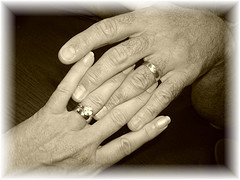
The ceremony included prayers and blessings for the couple and promises from the families and friends to help and support them in the life they were choosing to enter. The young man and his bride promised to love and care for each other, through all the ups and downs of life, for as long as they both should live. Only then were they allowed to enter into the sanctuary, offer each other their right hands in symbolic handshake on the contract, and pronounce their vows. They exchanged rings as a sign of their promises to each other. The celebrant blessed them and sent them forth out into the world and a new life together.

For this couple, the marriage ceremony included two elements: the legal, civil contract and the blessing of the church community. For many couples, the ceremony includes only the legal, civil contract. In many countries, couples who seek to marry do so in civil ceremonies. If they wish to receive the blessing of the Church, they then go to the parish and enter into the sacrament of Matrimony in another ceremony.

In the United States, we have allowed the combination of the civil and religious ceremonies into one. That, I believe, is a fundamental part of the confusion that has resulted in such controversy. We call both the legal, civil union of the two individuals and the sacrament of Matrimony by the same name - marriage.

Marriage, from the perspective of a social scientist, is a social arrangement developed by members of a culture to cement alliances between families, establish economic units, and provide for the procreation and nurturing of children. In corporate families (see my explanation of this term in another blog post), the head of the family makes the decision about who will marry whom. Those to be married do not necessarily have any choice in the matter. It is a legal contract between heads of families, not between the individuals to be married.

Christians have traditionally taken a somewhat different approach to the matter. Christian marriage, or Matrimony, is a sacrament of the physical love between a man and woman, the union of their hearts and lives and the image of the relationship between God and humans. It was not a rite that required the blessing of a priest as witness until sometime in the twelfth century. The man and woman are ministers of the sacrament to each other. Because men and women are understood to be equals in the sight of God, women have had more rights within Christian communities, at least in theory. The sacrament of Matrimony cannot be valid unless both parties consent to enter into the union. If there’s any lack of freedom or consent, the sacrament does not happen. The legal contractual aspect is null and void. The parties are free to enter into the sacrament with other parties. If the sacrament is judged to have been valid, the contract is upheld and regardless of what civil authorities might rule, the couple is not free to enter into the sacrament with other parties.

One argument against allowing homosexual marriages is that existing civil arrangements, such as “domestic partnerships” or “civil unions” confer the same protection under the law. In fact, since American law is based on precedents from cases dating back hundreds of years, there is no equivalent body of law supporting and/or establishing the legal protections for these unions that are part and parcel of the laws regarding marriage. Domestic partnerships and civil unions are not legally the same as marriages.

(On a related note - Many Catholics have been married in civil ceremonies when their first marriage, blessed by the Church, ended in legal divorce. Do we deny them the legal protections that come with civil marriage contracts when they again wish to enter a committed, loving life together? Should we offer them domestic partnerships or civil unions as their only option?)

Our American legal system is based on the English laws brought by the first colonists. The fact that so many of them were members of Calvinist religious faiths is also of importance in understanding the conflict surrounding homosexual marriage. John Calvin and his followers dropped most of the sacraments of the Church when they separated from the Roman Catholic Church. They kept only Baptism. Matrimony ceased to exist as a sacrament for them. Marriage became a matter of civil law only. That was the way it came to the United States and was enshrined into the law of the land. As an accommodation to those of other religious traditions, ministers of those faiths are legally allowed to serve as witnesses to the legal, civil contract. However, no one is required to have a minister bless his or her marriage. And equally important, no minister of any religious faith is required to bless, or even serve as witness to, the marriage of someone who does not qualify to marry under the laws of his or her faith tradition. That’s why we have a Justice of the Peace for civil ceremonies.  Yet religious communities rightly feel a responsibility to monitor, support and encourage couples who choose to enter into a married relationship. So even when they don’t recognize the sacrament of Matrimony, they want to establish rules to regulate marriage - mixing theology with legal protections.

The issues surrounding this question are complex. They go far beyond the questions of whether people choose their sexual orientation, whether certain behaviors are inherently sinful and whether the majority of adults are comfortable with sexual behaviors that differ from their own.

Legal systems are developed to protect the members of a society. Ideally they protect those with the least power, the minorities among us, those who are different or who cannot protect themselves - the Biblical “widows and orphans” or “God’s little ones.” As our understanding of human psychology and biology has developed and changed and as we’ve learned more about our universe and our place within it, Church teachings have changed. We no longer believe that slavery is OK. We insist that women and children are not the property of their families. We agree with Galileo that the Sun does not revolve around the Earth. And we are finding more and more evidence that sexual orientation is not a choice but rather is established before birth. If God created people not just as Adam and Eve, but also as Adam and Steve and Anna and Eve, who are we to deny them the same legal protections for their relationships and lives together as we grant to ourselves?

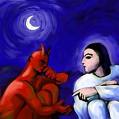
Fidelius and Diabolus: The Not So Gay Marriage Dialog by RandyPozos on Monday 20 October 2008 5:24 pm PDT
Image taken from oneyearbibleimages.com

Image taken from oneyearbibleimages.com

Diabolus: How’s it going?

Fidelius: You know we can’t talk - why do you persist?

Diabolus: That might be true if I were the Devil, but what if I’m your conscience?

Fidelius: There are no views but those of the Church.

Diabolus: True, but what about Church teaching, which acknowledges the “Sensus Fidelium” or Sense of the Faithful?

Fidelius: Stop bugging me Diabolus.

Diabolus: How do you know that’s my name?

Fidelius: You’re tempting me to think for myself. You’re torturing me.

Diabolus: No one can control your mind and heart. What’s bothering you?

Fidelius: I will take my counsel from my confessor, not from a post-Pepperoni heartburn!

Diabolus: “Pepperoni.” What a great name! Why don’t you call me that?

Fidelius: You are what you are.

Diabolus: And what is that?

Fidelius: The Tempter, the Evil One.

Diabolus: Have I ever suggested that you do anything wrong? Did I set your eye to wandering or encourage you to blow up when the Angels didn’t make the pennant?

Fidelius: Good people are tempted under the guise of good.

Diabolus: So, you’re a good person?

Fidelius: Yes. Generally, that is.

Diabolus: So then, why are you thinking about “it” again.

Fidelius: What “it”?

Diabolus: You know. Your conflict about gays.

Fidelius: They’re disgusting, you know that.

Diabolus: That’s not an uncommon opinion.

Fidelius: They make me squirm - and now they want to get married!

Diabolus: So, you think that it would be better to encourage them to stay with promiscuity as opposed to having a life of fidelity?

Fidelius: There can be nothing good in an act that is “intrinsically evil”.

Diabolus: So, you mean that you and Cynthia have never done anything “kinky”?

Fidelius: Shut up. We’re married.

Diabolus: My point exactly. You know, pleasure in marriage used to be called concupiscence.

Fidelius: What’s that?

Diabolus: You know - messed up like everything else after the fall of Adam and Eve.

Fidelius: So now you presume to teach me moral theology!

Diabolus: No. You learned it at that expensive Catholic college. Remember - the one you drank your way through?

Fidelius: Yeah, but it was after Vatican II. They weren’t Catholic anyway.

Diabolus: You mean like old Father Sullivan, who came to class in his cassock with the old yellowed pages on St. Thomas Aquinas?

Fidelius: He was different.

Diabolus: Yeah - he made you sweat to get a “C”. Not like the easy liberal that you gave you a “B+” for some beer can “sculpture” you threw together at the last minute.

Fidelius: Yeah, he was real.

Diabolus: Wasn’t he the guy that told you to have a happy sex life when you got married?

Fidelius: How do you know that? That was in confession!

Diabolus: Remember? I was there.

Fidelius: All I felt was so dirty.

Diabolus: You thought that he was going to throw the book at you.

Fidelius: Yeah, but he didn’t.

Diabolus: But there was a sin you didn’t confess.

Fidelius: What do you mean?

Diabolus: You remember. The time you stopped your fraternity brothers from beating up David Farnsworth, the fag?

Fidelius: He wasn’t gay - besides, “fag” isn’t politically correct.

Diabolus: Yeah. That’s why you found him dying in the AIDS ward a few years later at St. Mary’s, when you were helping the administration get their finances in order! A young guy out of business school and you go through the wrong door!

Fidelius: He never had a chance.

Diabolus: What do you mean? We all have free will. We all make choices.

Fidelius: His only moral choice was not to have sex.

Diabolus: He could have had a partner. You know - spend their lives together and all that? Maybe adopt a kid?

Fidelius: It would have been one mortal sin piled on another. He’d be deeper in Hell than he is now.

Diabolus: You don’t believe that.

Fidelius: Well, I heard Fr. Sullivan got to him before it was too late. But Purgatory’s no picnic.

Diabolus: So why did you pay for the Plenary Indulgence for him?

Fidelius: I didn’t pay for it. I just made an offering.

Diabolus: Strange. All this good will. Did you have a thing for this guy?

Fidelius: He was a guy. Got it? Like anybody. He deserved some decency, some respect.

Diabolus: But not a home.

Fidelius: He wasn’t homeless. He was making good money as an attorney.

Diabolus: No one to come home to; just work, parties, the bars …

Fidelius: He knew marriage was for straights. He was a good Catholic.

Diabolus: Yeah right. A gay can be a good Catholic; as likely as the Good Samaritan.

Fidelius: The Samaritan was real.

Diabolus: Maybe - or was he just a way for Jesus to show up the “good” people who had no compassion?

Fidelius: We can’t encourage gay culture. We’d be undermining the family; the basis of society.

Diabolus: Right. We can’t encourage a culture of life and fidelity.

Fidelius: It’s wrong. Remember, God made Adam and Eve - not Adam and Steve.

Diabolus: An interesting piece of demagoguery, but it doesn’t seem very compassionate.

Fidelius: The kids’ll get the wrong idea. They’ll think it’s okay.

Diabolus: Is that why so many gay people hate themselves?

Fidelius: It’s not my problem.

Diabolus: David became your problem when you saved him from that pack of apes.

Fidelius: I would have done it for anybody. Nobody deserves that kind of hate.

Diabolus: So where do you stop on this slippery slope?

Fidelius: It’s easy. The Church says, don’t beat ‘em up but don’t let ‘em get married.

Diabolus: That’s why you and Cynthia have only 3 kids - after 20 years?

Fidelius: We couldn’t have afforded more kids. You know that. With Cynthia’s problems it probably would have killed her.

Diabolus: So you love your wife more than God?

Fidelius: There’s a difference between God and the Church.

Diabolus: So who’s being the Devil now?

Fidelius: It’s in the Apostles Creed… “I believe in God, the Father Almighty.” Toward the end it says “I believe in one, holy, catholic, and apostolic church.”

Diabolus: Conscience. That weasel thing you picked up from those liberal priests!

Fidelius: It was a Vatican II thing. I had to write a paper on it.

Diabolus: So you did learn something!

Fidelius: Only because Fr. Sullivan made me re-write it 3 times.

Diablolus: I can’t imagine St. Thomas being on the side of conscience. He was a real theologian - and a saint.

Fidelius: Yeah. It’s a big thing for him - like it was for those Moslems philosophers he studied.

Diabolus: They only blow up stuff.

Fidelius: Conscience. You know - ”formed according to the teaching of the Church.”

Diabolus: So why did Aquinas end up on the list of forbidden books so long?

Fidelius: He was accused of subjecting God to human reason.

Diabolus: Well I gotta go. Time “to prowl about seeking the ruin of souls”.

Fidelius: What about me?

Diabolus: You’re hopeless!

Fidelius: Hopeless?

Diabolus: Just the opposite, I’m afraid. No sale here today.

Fidelius: What about gay marriage?

Diabolus: Deciding that by a crowd? I like lynchings. Remember? But you know, it’s not my thing. You should look at that WMD “weapons of mass destruction” bracelet you wear.

Fidelius: It’s WWJD! What would Jesus do?

Diabolus: Yeah. I wonder. Later dude.. out’a here..

Valentine’s Day Reflections 2008 by KathyPozos on Thursday 14 February 2008 2:05 pm PDT

 love.bmp

February 14 is Valentine’s Day, a day focused on love. Marketers have been promoting their products for several weeks now - trying to convince us that their particular product is the best possible way to say “I love you” to that special someone in our lives. And lots of us will buy something to express our love for those special people with whom we share our lives.

I remember one year when I received a waffle iron for Valentine’s Day. The women at the shop where my husband was getting his hair cut were horrified that he would get a small kitchen appliance for me. But he was right - I was thrilled. I love waffles and the old waffle iron I’d gotten 10 years earlier at a garage sale had finally broken - metal fatigue. It was a wonderful gift. We had waffles for dinner that night!

Valentine’s Day is a feast whose origins are found in legends about holy men who lived long ago. We don’t know much about St. Valentine, or even which man he actually was - there were several Valentines who were martyred in ancient days. The name means worthy and was popular in Roman times.

Many of the traditions related to Valentine’s day had their origins in the Middle Ages. It was believed then that birds began to choose their mates in mid-February, so the day seemed appropriate for celebrating romantic love. Fr. James McSweeney, on his website, www.todayismygifttoyou.com has a couple of lovely pieces about St. Valentine and love today.

Another essay I found this morning is by Timothy Chambers, a philosophy teacher at the University of Hartford in Connecticut. He talks about love potions mentioned in old legends and about what is really necessary for love - the stuff that can’t come out of a bottle. Of course, physical attraction is important in human love (and it might conceivably be produced by a “love potion”), but even more important are memories of happy times together, trust and faith in the beloved and the free choice to love in bad times as well as in the good times.

My wish for you today is that you know love. A love deeper than the sea and higher than the sky. The love that fills your being with the unshakeable certainty that nothing can ever come between you and the Lover, between you and your Creator. You are loved and loveable because you were loved into existence and are held in existence by that same love. Just as you are. With all your gifts and faults. You are loved.

Peace be with you. Now and always. Happy Valentine’s Day.

The Feast of the Holy Family by KathyPozos on Monday 31 December 2007 1:50 pm PDT

flight-to-egypt.jpg

The Feast of the Holy Family falls on the Sunday between Christmas and the Feast of Mary, Mother of God, January 1. The readings for the day focus on qualities that make for happy relationships between people, including members of families.

Sometimes when we focus on the Holy Family as the model for family life, we get bogged down with the perfection of Jesus and Mary, the holiness of St. Joseph, and the impossibility of actually living a perfect life ourselves. Then we write off their example as just another bit of pious nonsense that has nothing to do with the reality of crying babies, mortgage payments, difficult bosses, and all the other stresses that come with marriage and family. For those who are not married and/or don’t have children, the feast can seem irrelevant or even be a painful reminder of unfulfilled hopes.

So, I find myself wondering, what is it that makes a family, any family, “holy?” It seems to me that if the Holy Family is to be a model for the rest of us, that must mean that we are also to be “holy.” What made them holy?

Being holy does not mean having no problems or challenges in life. Holiness, it seems to me, lies in how we handle those difficulties that come in every life. After all, without the problems, difficulties, challenges, “crashes,” struggles, “hitting bottom,” or whatever we call it, we would never need to turn to God for help. We could just continue blithely on our way, assuming everything is fine, and in the best American cultural sense, be “rugged individuals” who can make it on our own.

But that isn’t what the spiritual life and journey are all about. Our spiritual lives are about learning from our mistakes, growing in wisdom, reaching out for help and community, being purified in God’s love, so that we can run joyfully to the Lord at the end of our days.

When we look at the lives of Mary, Joseph and Jesus, we find that they were filled from the beginning with many of the same challenges faced by other families. An unexpected, unplanned pregnancy, one outside the marriage; governmental demands that upset a family’s plans; taxes; inconvenient timing of a birth; the necessity to leave home and become refugees in another land; a child who feels grown up enough to go off on his own at the age of 12 without telling anyone where he’ll be; the death of a spouse or parent; a child whose life choices and career don’t meet the expectations of the family or community; the untimely death of a child. All these things were part of the lives of the Holy Family, as they can be part of our own lives. What made Joseph, Mary and Jesus holy as a family was their response to these challenges and their loving support of each other through them.

Joseph’s first recorded response to Mary’s pregnancy was compassion. He did not want to expose her to the penalties of the Law. He loved her and wanted her to be safe. When the angel told him in a dream that Mary had not been unfaithful, he accepted her as his wife. He made a home with her and supported her through the pregnancy and birth. He took her and Jesus to safety in Egypt, again following the instructions received in a dream. When it was safe, he took them back to their home in Nazareth cared for them and made a home for them.

Both Mary and Joseph must have “pondered” many things along the way. Many things did not make sense at the time. They really didn’t know what God had in mind. Jesus was a normal child. He had to learn how to be a man and how to respect and love the people around him. Mary and Joseph taught him by their actions as well as their words, just as we teach our children more by the way we act than by our words. It’s no surprise that people in families tend to share many gestures, facial expressions, attitudes and beliefs. The Holy Family would not have been different in this. So the characteristics we seen recorded about Jesus were probably in great part those he learned from his parents.

So in this week following the Feast of the Holy Family, as we enter a new calendar year tomorrow, I hope we can take their example as one that exemplifies the kind of relationships that result from heartfelt compassion, kindness, humility, gentleness, patience, forgiveness, and love (Col 3:12-17). These qualities are not ones that stem primarily from feelings, but rather they are attitudes and behavioral choices to which we are all called.

What’s in A Word? - To Divorce and Forgive? by RandyPozos on Wednesday 14 November 2007 6:00 am PDT

forgiveness-day.jpg

R. Rafael Pozos - my oldest son, string bassist, web programmer, and linguist - had an interesting comment on my post about Evangelicals rethinking divorce.

“Interestingly enough, Greek uses the same verb ‘aphiami’ for divorce and to forgive. It implies a very forceful leaving or remission. It’s what the apostles do to their boats and to their families when they go to follow Jesus, as well as what happens when a man dismisses his woman (no term for wife in antiquity really) , and also when an obligation is dismissed. Therefore, it is one loaded word.”

Categories

  • Angels (3)
  • atonement (13)
  • Christian Unity/Ecumenism (3)
  • Communion of Saints (7)
  • Conversion (25)
  • Doctor of the Church (19)
  • Edith Stein (2)
  • Eucharist (6)
  • Ever Ancient / New (46)
  • everyday revelation (69)
  • Faith and Reason (51)
  • Faith in Action (98)
  • Fathers of the Church (8)
  • Feasts - liturgical (54)
  • Festive recipes (3)
  • Forgiveness (12)
  • God in All Things (36)
  • Gratitude (16)
  • Holocaust (3)
  • Incarnation (21)
  • It's to laugh (1)
  • Jewish / Christian Relations (3)
  • Korean Martyrs (1)
  • Liturgical year (42)
  • love (35)
  • Marriage (5)
  • Ministry (1)
  • Miracles (13)
  • Missions (10)
  • Mother Teresa (3)
  • Mystics (11)
  • Pagan/Christian Relations (1)
  • Pope John Paul II (3)
  • Pope John XXIII (2)
  • Pope Paul VI (1)
  • problem of evil (9)
  • Sacraments (9)
  • Saints (107)
  • Salvation (24)
  • Second Vatican Council (5)
  • Site logistics (4)
  • Social Justice (31)
  • spiritual growth (67)
  • spirituality (53)
  • St. Augustine (1)
  • St. Faustina Kowalska (1)
  • St. Francis of Assisi (2)
  • St. Ignatius Loyola (2)
  • St. Jerome (1)
  • St. John Chrysostom (1)
  • St. Joseph of Cupertino (1)
  • St. Matthew (1)
  • St. Robert Bellarmine (3)
  • St. Therese of Lisieux (3)
  • St. Vincent De Paul (1)
  • St.Thomas of Villanova (1)
  • Theodicy (2)
  • Thomas Merton (1)
  • Uncategorized (10)
  • Virgin Mary (6)
  • Vocation (2)
  • Yom Kippur (1)
  • Youth Ministry (1)
  • Monthly Archives

  • January 2009
  • December 2008
  • November 2008
  • October 2008
  • September 2008
  • August 2008
  • July 2008
  • June 2008
  • May 2008
  • April 2008
  • March 2008
  • February 2008
  • January 2008
  • December 2007
  • November 2007
  • October 2007
  • September 2007
  • August 2007
  • July 2007
  • Recent Posts

    Recent Comments

    RSS Subscription

    Subscribe by Email

    Enter your Email


    Preview | Powered by FeedBlitz

    Visitors

    Locations of visitors to this page

    Creative Commons LICENSE

    This work is licensed under a Creative Commons License.