Thoughtful Reflections on Religious Experience
Saint of the Day - St. John Vianney: August 4 by RandyPozos on Tuesday 5 August 2008 12:42 pm PDT


St. Jean Baptiste Marie Vianney (1786-1859) was the parish priest of the village of Ars and is known primarily by that title even in English, “The Cure d’Ars”. Canonized in 1925 St. John Vianney is the patron of parish priests. In many respects he is a thoroughly modern saint.

He was born into the midst of the French Revolution and into a devout rural family who worshiped in secret with outlaw priests who refused to become state functionaries. The upheaval of the revolution closed schools, hospitals, and other institutions. For the first time in human history, the state asserted itself without religion as it destroyed the old Catholic order - the Ancien Regime. The “Goddess of Reason” was enthroned in the Cathedral of Notre Dame in Paris. Priests, nuns, and the Catholic nobility were killed, forced into hiding or exiled.

After the revolution subsided, Napoleon attempted to gain complete control of the Church in France and even took control of the Papal States, removing the Pope from Rome and bringing most of the Cardinals to Paris. In 1812 Napoleon’s fall began with the disastrous retreat from Russia in winter. The Industrial Revolution would follow, ending forever the cultural matrix of European Christianity.

St. John Vianney’s 73 years of life would span the trauma of the ending of the Divine Right of Kings to the rise of the rights of the common man. He would become emblematic of a Catholicism redefining itself, as it was torn from the 1,500 years of prerogatives and burdens of its affiliation with the state dating from the reign of the Emperor Constantine.

St. John Vianney began by re-asserting the centrality of God in his own life and supporting those in the parish who still practiced the faith. It is important to note that his vocation was in itself something of a miracle. Due to the upheaval of the times, he had no formal education until he was 20 and had great difficulty with Latin. To make matters worse, he got drafted by Napoleon and ended up as a deserter in hiding. An unlikely amnesty made it possible for him to return to his studies. If there hadn’t been such a severe shortage of priests, it is possible that he would never have been ordained.

His personal example of holiness in terms of his prayer and his charity to all made a deep impression. Sunday had become just another workday. Taverns were places of dissolution and much of the social order had broken down. “Dances” were part of a wild party scene involving promiscuity and adultery. Orphans and the disabled were exploited and left to fend for themselves. Over several decades, he led a movement to remedy these problems and to encourage religious devotion, while promoting service to others.

When the bishop attempted to assign St. John Vianney to other parishes, the community protested until the bishop relented. By our standards, his personal acts of penance and mortification, his meager diet, and short hours of sleep, appear to be excessive and even harsh. Reports that he was assaulted by the Devil at night strike us as bizarre, maybe even pathological. Yet they were witnessed by men in the parish who came when they heard the commotion.

Interestingly, he was not severe with his parishoners or penitents in the confessional. In fact, he was known for having won over a prominent woman who was a Jansenist and led her from a severe and demanding conception of God.

Not all of his fellow priests agreed with his approach or pastoral style. In fact, we might say that his special gifts in his historical circumstances may have created the ideal of the parish priest as a solitary super hero, like the desert fathers or the anchorites of the early Church. This calling is something one can respond to, but it cannot be fabricated and put on like a suit. Fr. John Cihak, in “St. John Vianney’s Pastoral Plan”, helps us understand how his example can guide parish priests today.

There is one major factor that is alluded to in the wonder of St. John Vianney’s life and ministry, but it is especially important for all of us who are parishioners today. God worked extensively in the life and ministry of St. John Vianney through his family, those who sheltered him as a deserter, and the people of Ars. Whether the pastor is single or married, the position is one of the most exposed and the most lonely. In denominations with a married clergy, and in the case of Eastern Rite Catholic priests and Latin Rite Catholic deacons, the spouses and children of clergy have a special opportunity and burden that only we can support by our prayers, understanding, and kindness toward them.

Each Little Light … by KathyPozos on Thursday 20 March 2008 11:23 pm PDT

western-electric-lantern.jpg

Dr. Megan McKenna uses many stories in her teaching, claiming that all stories are true and some actually happened. She tells this story, one that actually happened, about a community she visited in India. It was a very small village, with an even smaller Catholic community. The community generally gathered in the evening. As dusk fell, her hosts invited her to go outside and look around. In the gathering darkness, she saw the hills around the village come to life with little twinkling lights. The lights began to move across the hills and gradually to converge on the small building which served as their church.

In the middle of the church, there was a large iron contraption, with many arms jutting out from the center. As the people arrived, they hung their family’s lantern on one of the arms. When it became clear that no more people were coming, the contraption, now a chandelier, was hoisted up over the gathered people. It shone over the altar, giving light to the entire community as they celebrated Mass together. Then, when the time came to leave, the chandelier was again lowered and each family took its own lantern. But rather than go home, they went out from their celebration to visit the homes of the members of the community who had not been able to join them that night. They knew exactly who was missing because those lanterns had not been on the chandelier giving light to the community!

A lesson Megan drew from this experience and shared with my parish community is that we aren’t really a community until we know who is missing when we gather to worship.

I thought of this story when, along with many thousands of others, I attended Sunday afternoon liturgy in the Anaheim Arena as part of the Los Angeles Religious Education Congress 2008. The arena was beautifully decorated. The music was outstanding. Cardinal Mahoney was presiding, along with many bishops and priests of the archdiocese. The deacons were there with their wives, entering and leaving in the processions together. It was altogether a wonderful time and place to be.

It happened to be the Sunday when the Gospel is the story of the healing of the man born blind. This is one of the three Sundays when we celebrate “The Scrutinies” as part of the Rite of Christian Initiation for Adults (RCIA). The focus of the second Scrutiny is the ways in which we are blind. The prayer of those preparing for Baptism, Confirmation and/or Eucharist at Easter, as well as of the larger community, is for deliverance from those forms of blindness.

After the homily, when the time came for the Scrutiny, those preparing for the “Easter sacraments” (Baptism, Confirmation and Eucharist), were invited to kneel around the altar in the center of the Arena. Their sponsors stood before them as they knelt there. And we were all invited to pray with them, then raise our hands in prayer over them, asking the Lord’s blessing on them as they left with their catechists to continue reflecting on the Scriptures and preparing for Easter. Then they all rose and left the Arena.

I was sitting in the third tier of seats, so I had a great view of the floor and all the proceedings. It was an impressive sight, because approximately 5 rows of people on both sides of the aisle on the main floor left the room together. There was a huge hole in the middle of the community gathered there for worship. Although I didn’t know any of those people personally, I knew who was missing from that community! Those who will bring their own light of insights and God’s unique presence to our/their communities when they are welcomed into full participation in the Church at the Easter Vigil.

I remembered Megan’s story and also her statement that the gospels were written by the Christian community for those who were becoming new members of the community. They are for the instruction of new Christians, and the gift of the RCIA, and of those preparing to join the community, is the opportunity to see these stories anew and to experience their power to change lives - the lives of new followers of The Way and of those who maybe have begun to take it for granted.

As we celebrate the many liturgies of the next few days, I invite you to look around and see who is missing. Who needs us to reach out in love and ease a burden, or offer a word of hope and consolation? Who is homebound? Who is discouraged? Who has been hurt by our institution or our community? Who have we ourselves hurt? As we reach out in love to those missing, we will experience the Resurrection of Jesus in a deeper way and we will become a sign of love to the world, just as those little lights coming down the hillside were a sign of a loving community in one small Indian village.

wedding-band.jpg

For all of us who have ever felt guilty about stressing the importance of grammar, the absence of quotation marks in the Greek New Testament shows that we have not been overly obsessive. David Instone-Brewer, a British evangelical scripture scholar, in the October 5, 2007 cover article of Christianity Today, says that if we place quotation marks in Jesus’ answer regarding divorce (Matthew 19: 13-15), there are more justifications than adultery alone. In “When to Separate What God Has Joined: What Does the Bible Really Teach About Divorce?” Instone-Brewer makes the case that in Matthew’s Gospel, Jesus is being asked if he supports an “any-cause” approach to divorce. According to Instone-Brewer, Jesus’ response is to quote Moses and reaffirm the limited justifications for divorce. Instone-Brewer is a specialist in Jewish thought during the time of Christ and he concludes that there are four reasons for permissible divorce in the Old and New Testaments: adultery, abuse, sexual or emotional abandonment, and neglect.

David Van Biema, in Time (November 6, 2007), reports on Instone-Brewer’s article and also cites the fact that divorce rates are the same or higher for Evangelicals in the United States compared to the national average, this according to the Barna Research Group poll taken in 2001. Van Biema speculates that the reason for publishing Instone-Brewer’s article was to provide Evangelicals with some way to deal with the conflict between the literal words of Jesus and St. Paul in the New Testament and their everyday experience.

This is an interesting example of how the way one approaches scripture affects the understandings gained from its study. A strictly literal approach, without a broader understanding of the culture and thinking of the time, can create unnecessary tensions with our everyday experience. There is an interesting commentary, “Grounds for Divorce in God’s Law,” at BibleGateway.com on Matthew 19: 13-15. Jesus’ teaching on marital commitment should be seen in its relationship to forgiveness - our ability to live in proper relationships with others. According to this commentary, Jesus’ teaching follows his teaching on forgiveness. One who refuses to forgive will tend to look down on weaker people - women and children. This approach is refreshing because it challenges us to see marriage in the context of proper or just relationships with others. What is often seen as an issue of “private” morality occurs in a much broader social matrix of justice.

In many respects, Evangelicals, who are often seen as focusing too narrowly on scripture, may help all of us go beyond the question of whether divorce is permissible for Christians. The broader challenge Jesus puts to us is whether we can live the deeper meaning of marriage as a living witness of peace, justice, and love.

Today, an unconsummated marriage would probably not be considered advisable by the Church and mental health experts. St. Elzear and Blessed Delphina were a couple who were married and lived together chastely. They are saints because of their care of the poor and the suffering. This couple is also known for their conscientious exercise of their duties as members of the nobility. Interestingly, they were known and remembered as a happy couple.

Personally, I don’t think that I would have responded by taking a vow of chastity on my wedding night the way St. Elzear did when he found out the Delphina had already made one. We have a contemporary theology of marriage that stresses and endows love making and sex within marriage as sacramental.

Certainly the late Middle Ages (St. Elzear 1286 -1323, Bl. Delphina 1283- 1358) was not a “puritanical” time. In fact, Puritanism would not happen for another 200 years and would never take root in the Mediterranean.

St. Elzear was born at the family castle in Ansouis, Provence, in the south of France. At 23, he became lord of Ansouis and Count of Ariano in the Kingdom of Naples. The Count and Contessa became influential in the court of King Robert of Naples and Elzear was the tutor to the King’s son Charles. He was also the “justiciar” or head of law enforcement and justice for southern Abruzzi under King Robert. St. Elzear died on September 27, 1323 while on a diplomatic mission to Paris to arrange the marriage of Charles to Mary of Valois. Blessed Delphina would survive him for another 35 years and spend the time in continued acts of charity.

As nobles, producing children was a serious responsibility. Even when having children was precluded due to medical reasons, noblemen usually had some illegitimate sons at hand. William the Conqueror was one such son. Since the marriage of the Count and Contessa of Ariano (St. Elzear and Blessed Delphina) was so atypical by the standards of their day and ours, how do we relate to it?

Perhaps it was a marriage of convenience, in the sense that due to their social station they were obliged to marry but would have really preferred monastic vocations. Since their state in life was determined when they were young children of a noble family, they simply found a way around it.

Young children at the ages of 5 -7 were sent as oblates to monasteries and convents. Hildegard of Bingen and St. Thomas Aquinas are two examples. We also know, of course, that many people who found themselves in “enforced” monastic vocations would do their best to bend or break the rules.

Then as now, marriages - especially those among the rich and powerful -were not happy affairs. Eleanor of Aquitaine (1122-1204) and her Church sanctioned marriages to King Louis VII of France and King Henry II of England demonstrates the far from Romantic character of such marriages. In fact, Eleanor of Aquitaine was a major promoter of the troubadour movement. The origins of what we today experience as romantic love originally began as songs of chaste love for the unattainable woman. As we know, the reality of courtly love was far from chaste, but it seemed to provide some fluidity in a tight social structure. That doesn’t mean that it didn’t cause feelings of betrayal and rejection resulting in duels, beatings, and death. The case of King Henry VIII in the early modern period (1491 -1547) provides a window onto the complexity of marriage in Europe in previous centuries.

The Count and Contessa feeding the poor, living as lay Franciscans, and in the case of St. Elzear healing lepers were definitely unusual for the time. What was probably most striking about them is that they were known as a happy couple. Their marriage - even if its lack of consummation might not adhere to the Church’s definition of one - was a partnership for a radical living of the Gospel.

In our own culture and time, can we say as much about our marriages and the joy, happiness and moral guidance they bring to others?

There are two slightly different accounts of these saints, with some inconsistencies. Please see Saint of the Day at AmericanCatholic.org and Catholic Online.

Yom Kippur - The Day of Atonement 2007 by RandyPozos on Friday 21 September 2007 3:00 pm PDT

Sunset September 21, to Sunset September 22, 2007 is the Jewish Day of Atonement.

This is the day set aside for asking for forgiveness of God and those against whom we have sinned. The “virtual” Talmud - an adaptation of the Jewish tradition of teaching and commentary has an excellent post for today. A key point is that one’s individual wrongdoings are more than a personal matter. They have consequences for our loved ones, communities, and society overall.

Confession of sins, repentance, and turning around appear to the theme of the day not only for Jews.  They also appear to be making a comeback among Catholics, Protestants and Evangelicals. The Wall Street Journal today has an interesting feature on the return of repentance - specifically confessing one’s sins. “Confession Makes a Comeback” (page W1).

Even some Lutherans, whose founder Martin Luther opposed the sale of indulgences (the ability to get one’s time in Purgatory reduced or eliminated), are restoring a sacrament that they say they neglected for too long.

Take some time, tune up your conscience, make that phone call, send that card, forgive and ask to be forgiven. You might get a dose of your own medicine - we all do. Get straight with God and your neighbor. Find peace.

To Trust the Incarnation: An Interview with Sara Miles by RandyPozos on Friday 7 September 2007 10:00 am PDT

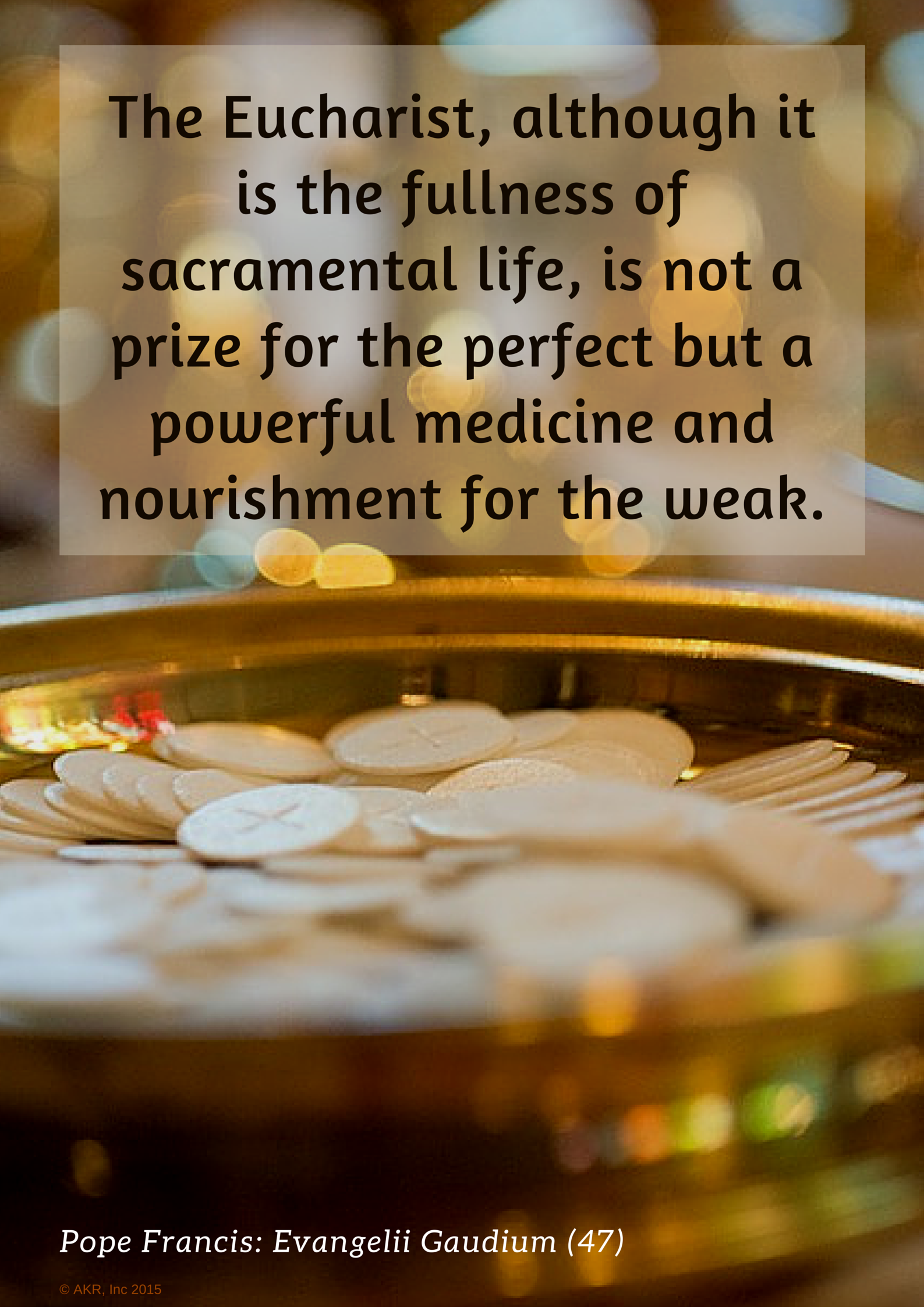
Editor’s Note: Sara Miles, author of Take This Bread: A Radical Conversion took the time to answer three questions which I felt might be useful to our readers. Very often the organized structures of “religion” are put at odds with those of our personal religious experience or “spirituality.” Many church goers are secure in their routine and not really open to the uncontrollable God. Many spiritual people rejoice in a the delights of a life lived far from the annoying humanity of our neighbors and the concerns of those struggling to get by on the margins. Sara Miles’ spiritual memoir challenges us to go beyond religion and spirituality and to live the Divine Mystery.

Randy Pozos: How would you advise parents and godparents to prepare their children for First Communion?

Sarah Miles: I’m probably not the best person to answer this, as I took my own first communion as an unbaptized adult, at the age of 46. My church, St. Gregory of Nyssa Episcopal Church (www.saintgregorys.org) offers communion to everyone, without exception, believing that Jesus welcomes everyone to his Table — and that his chosen sign was eating with outcasts, sinners, the unclean and the unprepared.

I believe that churches can prepare people to be members of churches; they can catechize children and adults to understand church doctrine and practices. But nobody can be “prepared” for the experience of God, because God is here, right now, making all things new: whether you are ready or not.

Randy Pozos: It seems that in your experience there is a direct, almost tangible, relationship between communion and your food pantry ministry of feeding and being fed by others. How would you encourage others to find and celebrate that transcendent experience of Eucharist in other ministries and occupations?

Sara Miles: Eucharist is a Great Thanksgiving: whenever we pour ourselves out, giving not only to our friends and loved ones but to our enemies and to strangers, we participate in Jesus’ feast, and share a “foretaste of the Kingdom” where all will be united in a heavenly banquet.

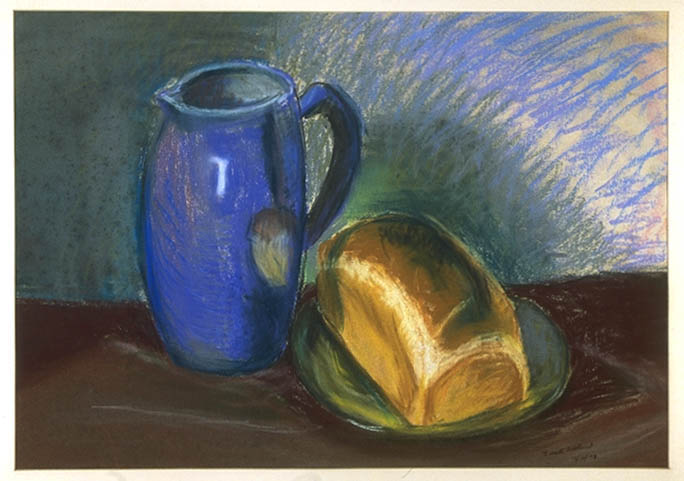
The connection between Eucharist and daily life is not mysterious: in fact, the liturgy is a reminder that it is precisely the most ordinary things of our lives (eating, drinking, kissing) that are suffused with God’s presence.

Randy Pozos: As a journalist and author, it seemed that you brought a poetic vision of a reality beyond the common sense experience of bread and wine. How can we engender this sensibility in ourselves and others and be ready for this experience of surprise and wonder?

Sara Miles: There’s a wonderful quote from Rowan Williams, now Archbishop of Canterbury, who says, in an essay on the martyr Etty Hillesum, “A religious life is a material life. Forget for a moment the arguments we might have about the definition of the ’spiritual’; living religiously is a way of conducting a bodily life.”

To trust the Incarnation is to open yourself to God in the “common sense” experiences of human life. This means inevitably opening yourself to more pain, more suffering– and more joy.

Not too long after Pope John Paul II named St. Thérèse of Lisieux a Doctor of the Church in 1997, I overheard someone commenting to one of her friends that a specialist in the spirituality of St. Teresa of Avila, was upset by his action. This specialist was very clear about the reasons that Teresa of Avila had received that honor, based on her years of spiritual growth, her reformation of the Carmelite order, and her writings. By contrast, Thérèse of Lisieux, in her short 24 years, had really not contributed anything of substance, certainly not enough to merit such a grand title as Doctor of the Church, a status shared by only 32 other people. Only two other women, Teresa of Avila (1515-1582) and Catherine of Siena (1347-1380) were Doctors of the Church. They had only received this recognition in 1970. (The New Catholic Encyclopedia, in 1967, ventured that women were unlikely to receive this honor because it is linked to the teaching office of the church,”which is limited to males.”)

Marie Françoise Thérèse Martin (1873-1897) became Sr. Thérèse of the Child Jesus and the Holy Face when she took her vows at the Carmelite convent in Lisieux in Normandy, France in 1888. I have been a fan of hers since I was in second grade. I read a children’s biography, Saint Thérèse and the Roses. It was really too hard for me to read easily, but I plowed my way through it and fell in love with her. I returned to the story many times as I grew up and continued to find her attractive. In fact, I chose her as my Confirmation patroness at age 13, long before she was so grand.

When Randy and I were newly-weds, we went to Guadalajara, Mexico to meet his cousins on his father’s side of the family. Randy’s aunt, Tía Dorotea, gave me a copy of Thérèse’s autobiography, The Story of a Soul, in Spanish. Thérèse was also Tía Dorotea’s favorite saint and I learned that in Mexico she is sometimes known as Santa Teresita (St. Little Teresa). I have thought of her as Teresita since that time.

However, I was in graduate school and then had young children and a business to operate with Randy, and I never found time to read my precious gift.

I’d like to say that I have now found and read it, but that would not be true. I know it is in our house somewhere, but like the beads for repairing my favorite moccasins, it is hiding in our resident Black Hole. I’m confident that it will someday escape and I plan to read it with a smile when it does, as I remember Tía Dorotea fondly.

So, I found myself wondering, what was it that made her as important in the life and history of the Church as Teresa of Avila and Catherine of Siena? I found the answer recently while shopping for a birthday gift at my favorite bookstore. On the shelf was a small book by Patrick Ahern, Auxiliary Bishop of New York, Maurice and Thérèse: The Story of a Love.

In this little book, Bishop Ahern offers a brief biography of Thérèse of Lisieux and an explanation of the general spiritual ambience of the late 19th Century. He then presents a series of letters written by Maurice Bellière to Thérèse of Lisieux and her responses. Maurice Bellière was a seminarian who had written to the Prioress of Carmel in Lisieux requesting that a Sister be chosen to pray especially for his vocation and with whom he could correspond. Thérèse’s sister Pauline was prioress at the time and she chose Thérèse to be the one who would respond to him.

Thérèse was passing through the last 18 months of her life, dying of tuberculosis. She was holding on by sheer force of will to her belief in God and her trust that her life of faith had not been that of a fool. It was a time of deep spiritual darkness for her, yet she offered sound advice, great encouragement and deep love to Maurice in her letters.

I couldn’t send the book to its new owner until I read it all myself! And through this book, I came to understand the great gift my Teresita gave to the Church, a path out of the darkness of Jansenism back into the light of trust in a loving God.

During the late 19th Century, an heretical approach to spirituality called Jansenism was still widely influential in popular spirituality, especially in France. The fundamental idea of Jansenism, which began in the mid-1600s, was that humans are not able to resisting any deep longing of the soul or any pleasure, whether towards good or evil. The only hope of salvation rested on God’s intervention in a person’s life, steering the person directly to choose the good. This understanding denied the existence and role of free will as a foundation of the relationship between God and humans. It was a system of predestination in which no one could have any certainty that he or she had been chosen (predestined) for salvation.

As a result, it tended to be a spirituality leading to uncompromising firmness or rigidity regarding beliefs and stern, strict religious practices. There was no role allowed for the heart or for feelings in worship. The infallibility of Church teachings was denied. Humans were seen as inherently bad and unworthy of God’s love or forgiveness. Frequent reception of Communion was discouraged because people are so unworthy to receive such a great gift.

Jansenism persisted for the next several centuries, especially in France. It was formally outlawed in 1712, but many Jansenist ideas and practices continued. St. Pius X, who had read Thérèse’s autobiography, was elected Pope in 1903. He tried to counter Jansenism by lowering the age for First Communion to 7 and by encouraging frequent Communion. Yet even into the mid-20th century when I was a girl, the remnants of Jansenism popped up in popular spirituality and even in the pulpit.

The “Little Way” of Thérèse of Lisieux, again opened the door to the Good News of Jesus, that God is a loving Father (a Parent) to us. While it is true that we are weak and we sin all too easily and frequently, God’s Love still reaches out to us and forgives.

The essence of the Little Way is the idea that most of us are not called to heroic degrees of self giving and sacrifice in our lives. Most of us are not called to leadership roles in the community. Few are called to celibacy. Even fewer are called to the heroic witness of martyrdom. But all of us are called to holiness (sainthood).

In her own words, “Love proves itself by deeds, so how am I to show my love? Great deeds are forbidden me. The only way I can prove my love is by scattering flowers and these flowers are every little sacrifice, every glance and word, and the doing of the least actions for love.”

Teresita understood, as did the great St. Teresa of Avila, that God is found even in the cooking pots of the kitchen — in the daily routines of cooking, cleaning, sewing, gardening and praying of her community.

Bishop Ahern notes that her greatest fear in facing death was that death might truly be the end of everything. That her life might go out like an extinguished candle and all have been in vain. Her second greatest fear was the death by suffocation that tuberculosis often causes. However, when the time came, she simply stopped breathing, with a smile of peaceful delight on her face, and moved into her new life, all fear and doubt obviously left behind her. Her final words were, “My God, I love you.”

John Paul II, in Divini Amoris Scientia (The Science of Divine Love), the decree that gave Marie Françoise Thérèse Martin the title, Doctor of the Church, noted that she gave us a foundation for spirituality that was innocent, open, hopeful, and trusting. Church authorities also noted that Thérèse was ahead of her time. Thérèse stressed the importance of reading Scripture and using it as a basis for prayer and meditation. She promoted the importance of studying the Scriptures in their original languages. These views would set theology and spirituality on a whole new course when they were advocated in 1943 by Pope Pius XII, in Divino Afflante Spiritu (Inspired by the Divine Spirit).

Thérèse Martin’s little book and her Little Way also influenced Pope John XXIII who convened the Second Vatican Council. Her autobiography influenced most of the movers and shakers of the early 20th Century in the Church and those insights shine through the Council documents and reforms.

Thank you, Bishop Ahern for your wonderful little book.

Harden Not Your Heart by KathyPozos on Thursday 23 August 2007 9:50 pm PDT

Many years ago I was teaching a 5th and 6th grade religious education class (otherwise known as CCD in Catholic circles). It was a lively group of children, many of whom were quite outspoken. We gathered weekly in a church hall after their regular school day. I always let them move around a bit, talk with each other and work on a cross stitch project while I was getting the space ready for our class. It helped them transition into the time we would spend together. It also helped them get to know each other, because they came from four or five different schools.

One particular day, a very lively, expressive girl, I’ll call her Marcie, decided that she didn’t like something I had said in greeting or in calling the group together. I don’t remember now what it was, but none of the other children thought anything of it.

When I called the children to gather in a circle for our opening prayer verse and song, Marcie joined the circle but faced away from the rest of us, towards the outside, saying she wasn’t going to be part of the group because she didn’t like what I had said.

It’s not often that a teacher gets such a perfect example handed her on a platter, so I shamelessly moved ahead and used it! We were, after all, studying the sacraments, including Reconciliation, that year. I asked the other children to look at Marcie and notice what she was doing. She had chosen not to be part of the group and had turned away from us. We had not turned from her. None of us had rejected her in any way. It was her choice to turn away and would be her choice to turn back to join the group. That is the way it is between us and God. God never turns away from us. We may choose to turn from God — and we are the ones who can choose to turn back at any time. God will never force us to act in either direction. It’s entirely up to each of us.

And what did Marcie do while I was speaking? Before I finished the first sentence, she had turned back to the group and was apologizing to all of them for giving me the chance to make a “religion” lesson out of what she had done. They were quick to make her feel at ease again.

I remembered Marcie and that day today as we prayed the Psalm at Mass. “If today you hear God’s voice, harden not your heart.” (Ps 95:7-8) God’s voice calls us. I hope we can respond as quickly as Marcie and the other children did to join the circle listening to His voice.

Categories

  • Angels (2)
  • atonement (13)
  • Christian Unity/Ecumenism (2)
  • Communion of Saints (6)
  • Conversion (25)
  • Doctor of the Church (14)
  • Edith Stein (2)
  • Eucharist (6)
  • Ever Ancient / New (44)
  • everyday revelation (59)
  • Faith and Reason (44)
  • Faith in Action (79)
  • Fathers of the Church (5)
  • Feasts - liturgical (48)
  • Festive recipes (2)
  • Forgiveness (11)
  • God in All Things (31)
  • Gratitude (14)
  • Holocaust (3)
  • Incarnation (19)
  • It's to laugh (1)
  • Jewish / Christian Relations (3)
  • Korean Martyrs (1)
  • Liturgical year (38)
  • love (32)
  • Marriage (3)
  • Miracles (13)
  • Missions (7)
  • Mother Teresa (2)
  • Mystics (10)
  • Pagan/Christian Relations (1)
  • Pope John Paul II (3)
  • Pope John XXIII (2)
  • Pope Paul VI (1)
  • problem of evil (8)
  • Sacraments (8)
  • Saints (91)
  • Salvation (23)
  • Second Vatican Council (5)
  • Site logistics (4)
  • Social Justice (21)
  • spiritual growth (63)
  • spirituality (50)
  • St. Augustine (1)
  • St. Faustina Kowalska (1)
  • St. Francis of Assisi (1)
  • St. Ignatius Loyola (2)
  • St. Jerome (1)
  • St. John Chrysostom (1)
  • St. Joseph of Cupertino (1)
  • St. Matthew (1)
  • St. Robert Bellarmine (2)
  • St. Therese of Lisieux (2)
  • St. Vincent De Paul (1)
  • St.Thomas of Villanova (1)
  • Theodicy (2)
  • Thomas Merton (1)
  • Uncategorized (10)
  • Virgin Mary (4)
  • Vocation (2)
  • Yom Kippur (1)
  • Monthly Archives

  • August 2008
  • July 2008
  • June 2008
  • May 2008
  • April 2008
  • March 2008
  • February 2008
  • January 2008
  • December 2007
  • November 2007
  • October 2007
  • September 2007
  • August 2007
  • July 2007
  • Recent Posts

    Recent Comments

    RSS Subscription

    Subscribe by Email

    Enter your Email


    Preview | Powered by FeedBlitz

    Visitors

    Locations of visitors to this page

    Creative Commons LICENSE

    This work is licensed under a Creative Commons License.