Thoughtful Reflections on Religious Experience
A Prayer for America At Election Time and Beyond by KathyPozos on Sunday 2 November 2008 5:22 pm PDT
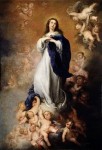
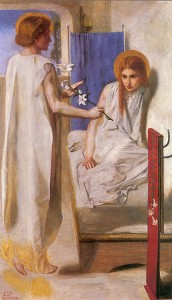
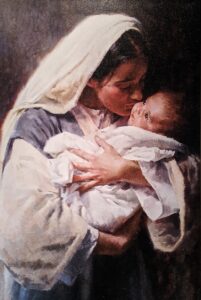
Immaculate Heart of Mary - Artist unknown - U. Dayton

Immaculate Heart of Mary - Artist unknown - U. Dayton

In the days and weeks leading up to the 2008 election in the United States, we’ve seen tons of ink, forests of paper and kilobytes of words on the internet used to address issues of life and freedom that we face as a nation. We at Theologika.net and sister site, 21stcenturycatholic.net offer our prayer for America at this time of the election and as we move into the challenges of the days, weeks and years to come. It is a prayer to Our Lady because she is the patroness of our country.

Most Blessed Virgin, Mary,

Our country is at its most critical crossroads in its history. We entrust it to your loving care.

Most Holy Mother, we beg you and your Son to be with us as we face this crossroads.

Overwhelmed by our problems and sins, we cry from the depths of our pain for your motherly protection and guidance.

Look with mercy on us and touch the hearts of your imperfect people.

Open our minds to the broader responsibilities of caring for your human family, which comes from our divine gift of freedom.

Guide and inform us so we can best deal with the issues of life and death, which have so grievously divided us.

Pray for us that we may receive the wisdom, clarity and openness of thinking we need to make the best choices we can on behalf of our human family, for our common good.

Oh Merciful Mother, intercede for us with your Son, who through the power of the Holy Spirit has entrusted to us the care of your people and creation and is the true source of our cherished rights of life, liberty and the pursuit of happiness.

We ask for this grace in the Name of Your  Son, our Lord Jesus Christ, who lives and reigns with the Father in the Unity of the Holy Spirit forever and ever. Amen.

May the Lord bless and guide each of us as we vote in accordance with our own individual consciences.

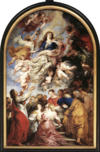
The Assumption by Murillo

The Assumption by Murillo

August 15th, the Feast of the Assumption, dates to the 6th and 7th centuries. The official proclamation of the Assumption by Pope Pius XII in Munificentisimus Deus as an article of faith for Catholics occurred recently, on November 1, 1950. Objections to this teaching cite the absence of support for it in Scripture and in the Fathers of the Church. These same arguments are also made against the doctrine of the Immaculate Conception, which states that Mary received the benefit of the redemption in advance from the moment of her conception. However, since the theological significance of Mary is intertwined with that of Christ, as mother and son, much of what we say about Mary (Mariology) derives from what we say about the identity and meaning of Christ (Christology).

For most Catholics, Orthodox, Coptics, and Anglicans, images and veneration of Mary, the Mother of Jesus, are part of the very fabric of their faith. This emotional and doctrinal emphasis on Miriam of Nazareth gives many in the Anabaptist and Calvinist traditions emotional and doctrinal heartburn. Some evangelicals are strident in their belief that Marian devotion - at best - detracts from the key act of salvation, which they formulate as “accepting Jesus as your personal Lord and Savior.”

The notion of salvation in the apostolic churches is centered on the church community. Christ’s death and resurrection has saved all and we enter into this paschal mystery embodied in the church. Our salvation is entering the faith community, the Body of Christ. From the earliest days, the Fathers of the Church identified Mary as the model of the Church. The following excerpt, taken from Wikipedia’s article on Roman Catholic Mariology, summarizes the position and importance of the Blessed Mother. Please note that the words in parentheses are my own.

Pope Benedict XVI addresses the issue, why Mariology is related to ecclesiology (the theology of the Church). On first sight, he argues, it may seem accidental, that the (Second Vatican) Council moved Mariology into ecclesiology. This relation helps to understand what “Church” really is. The theologian Hugo Rahner showed that Mariology was originally ecclesiology. The Church is like Mary.[96]

The Church is virgin and mother, she is immaculate and carries the burdens of history. She suffers and she is assumed into heaven. Slowly she learns, that Mary is her mirror, that she is a person in Mary. Mary on the other hand is not an isolated individual, who rests in herself. She is carrying the mystery of the Church.[97]

Pope Benedict XVI lamented that this unity of Church and Mary was overshadowed in later centuries, which overburdened Mary with privileges and removed her into a far away distance. Both Mariology and ecclesiology suffered under this. A Marian view of the Church and an ecclesiological view of Mary in salvation history lead directly to Christ. It brings to light what is meant by holiness and by God being human.[98]

It is interesting to note that Pope Benedict XVI laments the removal of Mary “overburdened … with privileges.” This is also the image of Mary lamented by the reformation. However, the close identification of Mary with the Church, in the sense that “Mary is carrying the mystery of the Church,” represents a notion of church that many of the reformers rejected. Consequently, they rejected the image and role of Mary, and with it, the redemptive grace and power of the feminine.

St. Mary at Easter Tide by RandyPozos on Wednesday 26 March 2008 11:08 pm PDT

rejoice-monica-stewart.jpg

The Blessed Virgin Mary has many beautiful titles. St. Mary at Easter Tide is my very own. Scripture is very silent about the Mother of Jesus after the Resurrection. We know that she is present in the upper room when the Spirit comes upon the Apostles at Pentecost. At the Annunciation, the Angel Gabriel tells her nothing about her future, except that her Son will be destined for the rise and fall of many in Israel. Mary’s first post-partum visit to the Temple portends a life of sorrow. According to Simeon, a sword will pierce her heart seven times. This most beloved young woman is left to ponder these things in her heart.

There are many good years together, until He leaves to find his cousin John at the Jordan. Then things go from bad to worse. Her friends and neighbors toss Him out of Nazareth. Jesus dies a horrible death; His mission a failure; her maiden’s vision becomes a bitter delusion. In his final words, Jesus entrusts St. John and Mary to each other - a final testament that seals the depth of grief.

There is no record of how Mary hears the news; of how she reacts. Who tells her? Jesus Himself? It seems that this duty falls to us. The noonday prayer echoes a wonderful joy - Regina Coeli laetare alleluia! Queen of Heaven Rejoice alleluia! … Resurexit sicut dixit! He has risen as He said (he would)!

Even though the words echo from my childhood at “Mid-century,” how well I remember and still experience the delightful childish skip in our hearts and step that we shared at Easter Tide. These are not the inspired words of the Gospel in the Hail Mary, nor the briefest of summaries of the Mystery of the Incarnation in the Angelus. For a prayer, Regina Coeli seems strangely out of character. There is no formality, no reserve. In our joy, we proclaim the Good News to the Mother of the Word Incarnate. God has turned our mourning into joy, but how could we ever begin to fathom what his news meant to the woman whose faith gave birth to us all?

Saint of the Day - Our Lady of Guadalupe by RandyPozos on Tuesday 11 December 2007 8:00 pm PDT

guadalupe-roses.jpg

On December 12, 1531, a middle aged Indian convert, St. Juan Diego opened his “tilma” where he had placed the roses that the Lady on the Hill had told him to take to the bishop, Fray Juan de Zumarraga. His earlier attempts to tell the bishop of the Lady’s request to build a shrine on the hill of Tepeyac in her honor had met with polite skepticism. The bishop had wanted a sign, and roses in December in the high altitude and cold temperature of Mexico City would have been enough of a sign. However, when St. Juan Diego let down the poncho-like cold weather garment, made of century plant cactus fiber, maguey, the roses tumbled down on the floor and the reluctant messenger followed the eyes of the astonished bishop as he gazed on the Indian’s tilma and fell to his knees. Unique among all of the apparitions of the Virgin Mary, this one produced a physical artifact. On the tilma was the image of the Lady who would come to symbolize a new mixed-race people, a nation, and the aspirations of Catholics throughout the Americas.

Like most Mexicans and Mexican-Americans, my earliest memories are of this miraculous image. Our Lady of Guadalupe is so much a part of the culture, and so pervasive, that the miraculous image is a symbol with multiple layers of meaning. The words of Psalm 147 in Latin “Non Fecit Taliter Omni Nationi” - “He has not done so with any other nation” - are often associated with the image. More idiomatically, they are taken to mean, “He hasn’t done this for anyone else.” While the Psalmist originally applied these words to God’s unique relationship with his chosen people, the meaning has been appropriated by Mexicans and the Latin peoples of the Americas.

From the first days of the apparition to the present, the miraculous image has symbolized a heavenly acceptance of the indigenous and mixed native and European inhabitants. The Virgin does not have blond hair and blue eyes like the Virgen de las Mercedes ( Our Lady of Mercy) of the Spanish conquerors. She is dark complected, with brown eyes and black hair, this Lady of Tepeyac. However, she does not have the pronounced Moorish features of the black Madonna of Guadalupe found in Extremadura in southern Spain.

guadalupe-extremadura.jpg

The devotion to the Spanish Madonna of Guadalupe reached its height in Spain in the 1400s and 1500s, since she was the patroness of the global explorers who set sail from Extremadura and also the patroness of all the Spanish lands of the New World. Many years before the apparition in Mexico City, Columbus named an island in the Caribbean Guadalupe (now Guadaloupe) in her honor. Historians can probably fill us in on the details of how the Lady of Tepeyac became identified with Guadalupe. Perhaps the Spanish preferred to believe that their explorer patroness had made an appearance in the Americas. Nevertheless, the secret password of identity for Mexicans and those of Mexican descent is Tepeyac. For those who have been conquered, scorned, and rejected and yet have built a vibrant and dynamic civilization, what greater recognition could there be? Non Fecit Taliter Omni Nationi.

Saint of the Day - St. Juan Diego Cuauhtlatoatzin by RandyPozos on Saturday 8 December 2007 10:23 pm PDT

st-juan-diego.jpg

December 9 is the feast day of St. Juan Diego (1474-1548), who was born Cuauhtlatoatzin (kwah-oot-laht-oh-ahtzin) - Talking Eagle. St. Juan Diego was the first Native American to be declared a saint - on July 31, 2002, - by Pope John Paul II on his visit to Mexico City. The Pope declared him protector of the indigenous peoples of the Americas and reminded the thousands who gathered of their responsibility to promote social justice and equality for their oppressed and marginalized brothers and sisters.

Juan Diego was a member of the Chichimeca nation, in the Anahuac Valley, near Tenochitlán - present day Mexico City. He was a landowner, farmer and weaver of mats, and a married man. He was 47 when he witnessed the conquest of Tenochitlán by Hernán Cortez in 1521. He and his wife were baptized in 1524 or 1525 by the first missionaries, who were Franciscans. He took the baptismal name of Juan Diego and his wife’s baptismal name was María Lucía. A few years later, María Lucía became ill and died.

On Sunday, December 9, 1531, while he was walking to Mass, he saw an apparition of the Virgin Mary on the hill of Tepeyac. Our Lady of Tepeyac would become known more widely as Our Lady of Guadalupe, because of the similarity of the dark complexioned Virgins in both Tepeyac and Guadalupe in Spain.

St. Juan Diego spent the rest of his life as a hermit and caretaker of the chapel which had been built on the hill of Tepeyac after the apparition, at the request of the Lady. The Virgin Mary appeared as a Native American to a Native American Christian. The impact on the vast indigenous population and the Spanish conquerors was stunning. Not only did this apparition mark the beginning of massive conversions, it was also the beginning of the Great Mixing - El Gran Mestizaje - the creation of a new uniquely Mexican ethnic group, blending Europeans and the indigenous peoples.

While it would be nice to give this post a Hollywood ending by enlarging the camera angle from the Indian kneeling before the Virgin Mary and panning to a sweeping vista of sunrise over the great volcanoes surrounding Mexico City, we really should not. St. Juan Diego’s life was a very gritty reality. The death of his wife and millions of other native people from European conquest and disease was another layer of bitter sadness laid on top of the hardships of being subject to the Aztecs. St. Juan Diego saw everything he knew and understood swept away before his eyes - something that later generations of Mexicans would also experience more than once.

He appears to be one of the few saints who tried to avoid The Lady he knew was waiting for him, because his uncle was very ill and he needed to get a priest for his uncle before he died. Instead, she met him as he tried to get around the hill of Tepeyac. The Lady reassured him that his uncle would be okay and that he should just trust in her. He did, and as they say, the rest is history - the history of a new day for a vanquished people.

Categories

  • Angels (3)
  • atonement (13)
  • Christian Unity/Ecumenism (2)
  • Communion of Saints (7)
  • Conversion (25)
  • Doctor of the Church (19)
  • Edith Stein (2)
  • Eucharist (6)
  • Ever Ancient / New (44)
  • everyday revelation (65)
  • Faith and Reason (49)
  • Faith in Action (95)
  • Fathers of the Church (7)
  • Feasts - liturgical (50)
  • Festive recipes (2)
  • Forgiveness (12)
  • God in All Things (33)
  • Gratitude (14)
  • Holocaust (3)
  • Incarnation (19)
  • It's to laugh (1)
  • Jewish / Christian Relations (3)
  • Korean Martyrs (1)
  • Liturgical year (39)
  • love (35)
  • Marriage (5)
  • Miracles (13)
  • Missions (10)
  • Mother Teresa (3)
  • Mystics (11)
  • Pagan/Christian Relations (1)
  • Pope John Paul II (3)
  • Pope John XXIII (2)
  • Pope Paul VI (1)
  • problem of evil (8)
  • Sacraments (9)
  • Saints (104)
  • Salvation (23)
  • Second Vatican Council (5)
  • Site logistics (4)
  • Social Justice (29)
  • spiritual growth (66)
  • spirituality (53)
  • St. Augustine (1)
  • St. Faustina Kowalska (1)
  • St. Francis of Assisi (2)
  • St. Ignatius Loyola (2)
  • St. Jerome (1)
  • St. John Chrysostom (1)
  • St. Joseph of Cupertino (1)
  • St. Matthew (1)
  • St. Robert Bellarmine (3)
  • St. Therese of Lisieux (3)
  • St. Vincent De Paul (1)
  • St.Thomas of Villanova (1)
  • Theodicy (2)
  • Thomas Merton (1)
  • Uncategorized (10)
  • Virgin Mary (5)
  • Vocation (2)
  • Yom Kippur (1)
  • Monthly Archives

  • November 2008
  • October 2008
  • September 2008
  • August 2008
  • July 2008
  • June 2008
  • May 2008
  • April 2008
  • March 2008
  • February 2008
  • January 2008
  • December 2007
  • November 2007
  • October 2007
  • September 2007
  • August 2007
  • July 2007
  • Recent Posts

    Recent Comments

    RSS Subscription

    Subscribe by Email

    Enter your Email


    Preview | Powered by FeedBlitz

    Visitors

    Locations of visitors to this page

    Creative Commons LICENSE

    This work is licensed under a Creative Commons License.