Breaking the Bread of Peace
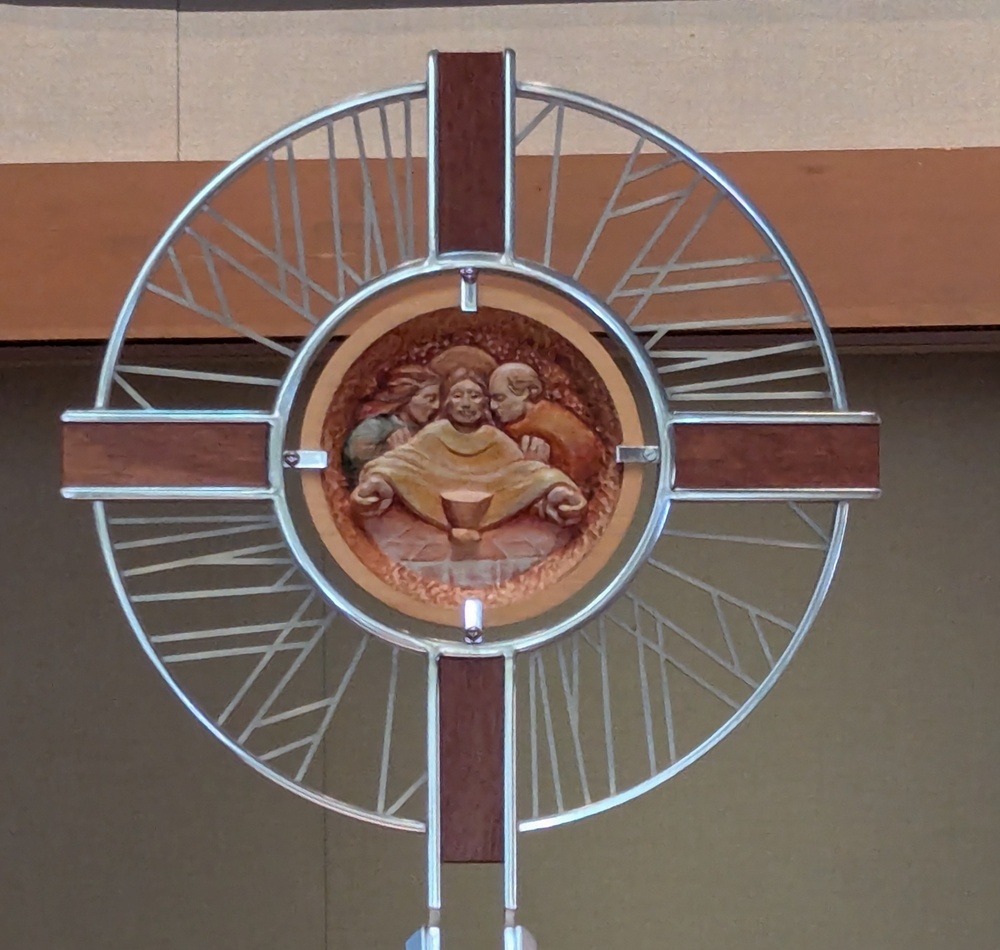 The story of the disciples on the way to Emmaus is one of my favorite passages in the Bible. The disciples are shattered. Their messiah has been killed. A stranger accompanies them and opens the scriptures to them, showing them why the Master had to suffer and die. They feel better and are consoled but they are joyous when they recognize him in the breaking of the bread. (Lk 24:13-35)
This is how we as disciples encounter the Risen Christ. The disciples didn’t recognize who the stranger was. Many of Jesus’ other disciples did not recognize Him after his Resurrection. Mary of Magdala thought that he was the gardener and asked him where they had taken the body of Jesus. Later, Peter and the apostles saw a man on the beach when they were fishing. He had started a fire and was grilling some fish for them. Only then did Peter recognize him.
The Risen Christ is seen only through Faith in his death and Resurrection. We find him in the scriptures even when our lives have fallen apart. We know that Christ identifies with us in our suffering and the difficulties of everyday life. God was supposed to save us from this suffering, we thought, and we lose heart. However, in the scriptures we see how the Christ had to suffer and die and come into the glory of his resurrection. But we still don’t see Him.
The Emmaus story gives us the outline of our own journey to the Risen Christ. It is the Mass, the Eucharist. We hear God’s word and we respond by inviting him into our homes, into our hearts. As we enter the Mystery of the breaking of the bread we are overcome with peace. It is the Lord’s Easter greeting. “Peace be with you.” When we hear the word of God in our hearts, a peace overcomes us if this is what we want. We cannot recognize him in the Breaking of the Bread unless we have united with each other and say the prayer that He himself gave us. “Our Father who art in heaven.” We celebrate that oneness, that unity, by being in a state of peace and sharing that with each other.
“Lord Jesus Christ, who said to Your Apostles: Peace, I leave you, my peace I give you; look not on our sins, but on the faith of Your Church, and graciously grant her peace and unity in accordance with Your will. Who lives and reigns for ever and ever.”
Let us now give each other the sign of peace. Now our hearts and souls are ready to recognize him. We cannot have peace without faith and without faith we cannot see the Risen Christ. We often think that peace is something that is personal. And so, it is. We often think that peace is for those of us gathered around the Lord’s table. And so, it is.
Yet, Christ did not just die for us or those at Mass, but for all of humanity. So, peace is just not an ideal or a feeling. We find peace when we embody it and when we base our social systems on it.
Pope Leo and other Popes and theologians throughout history have had the same teaching on peace as being something that is real and tangible. It is a holiness within us. Whether we are involved in family disputes such as divorce and child custody, backstabbing at work, or discrimination, we can embody a peaceful grace-filled presence in our thoughts, in our words, and in our deeds. In our community and nation, we stand in the peace-filled presence of the Risen Christ. Our goal is dialog and reconciliation. It is not more fighting, slogan throwing, or name calling.
Recently, Pope Leo XIV restated the message of Popes throughout the centuries, “Peace cannot be reduced to a slogan: it must be embodied in a way of life that renounces all forms of violence, both personally and institutionally.”
In our lives, peace is an action word, and we make it a daily practice to foster justice and dialog. Whether it is free or low-cost housing, health insurance for all, or programs that provide help for mothers and children and for those at risk, for those who live by the side of the road and at the margins of society. Justice is always the first step to peace in our hearts, in our streets, and in our world.
Currently, a few men have great power in the world and can wage war on a massive scale at the press of a button. On a more regional level there are war lords, drug lords, and those who traffic in drugs and human lives who bring about great harm and evil.
This week Pope Leo has been visiting four countries in Africa in which conflict is currently raging or has recently come to an end. During this tour, he declared: “The world is being ravaged by a handful of tyrants, yet it is held together by a multitude of supportive brothers and sisters!”
Most of us are aware of negative comments President Trump and Vice President Vance have made about the Pope’s position on the Israel-Iranian war as an unjust preemptive strike against a country that posed no immediate threat. St. Pope John Paul II admonished President Bush not to pre-emptively attack Iraq. Similar papal statements about Afghanistan were ignored.
Pope Leo had previously called Mr. Trump’s threat to destroy Iranian civilization “truly unacceptable,” and encouraged people to “contact the authorities — political leaders, congressmen — to ask them, tell them to work for peace and to reject war, always.”
The challenge for those of us who are privileged to live in a democratic society is to use our votes and our voices to embody justice. Much has been said about our moral ability to wage a just war. In a few words, this teaching states that a defensive war is only a last resort when all other efforts have failed. Pre-emptive/preventive wars are never allowed under the Church’s just war teaching.
Vice President Vance admonished the Pope earlier this week that he should be careful about making theological pronouncements. The US Catholic Conference of Bishops, in response, admonished the Vice President, who has been a Catholic for six years:
“When Pope Leo XIV speaks as supreme pastor of the universal Church, he is not merely offering opinions on theology, he is preaching the Gospel and exercising his ministry as the Vicar of Christ.”
Moral teaching is not an issue of politics in the sense of advocating the right, left, or center. The Gospel of Jesus Christ is amazingly pacifist. His teachings and actions show the power of good over evil, of justice over oppression, and the power of life over death, even when life is crucified. Lest we think that working for peace is just wearing sandals and singing guitar songs, there was a moment when a peacemaker saved the world from nuclear annihilation.
In one of our most dangerous moments as a country and as a planet, St. Pope John XXIII played a key role in preventing nuclear war during the Cuban missile crisis. From October 16 to 28 in 1962, the United States and The Soviet Union threatened to use nuclear weapons over the placement of nuclear missiles in Cuba. The United States had escalated the threat to its highest-level, Def Con 3.
At the time, there was no red phone. There was no direct communication between Kennedy and Kruschev. Convoluted cables and diplomatic protocols meant that it could take 12 hours for both leaders to communicate. To improve communication, the United States made back-channel connections to the Soviet Union through St. Pope John XXIII. Using the phone, he became the intermediary and was able to convince both leaders to de-escalate the crisis and to come to an acceptable settlement.
Pope Paul VI also spoke of peace and the absolute imperative to end war as a solution to conflicting perspectives and goals on the international stage when he visited the United Nations and addressed the representatives of the nations assembled there. “No more war. Never again war!” He repeated this admonition frequently during his time as Pope.
St. Pope John Paul II, talking about the Iraq War, declared “No to War!” War is “never inevitable” and is “always a defeat for humanity.” That defeat is not inevitable and can be avoided by “international law, honest dialogue, solidarity between States, the noble exercise of diplomacy.”
At the same time, Cardinal Joseph Ratzinger, who later became Pope Benedict XVI, added his voice. He said that these circumstances (of a just war) were not met with Iraq, in part because preemptive war is not a justification for war. Cardinal Ratzinger explained that supporters of the war would find that “the concept of preventive war does not appear in the Catechism of the Catholic Church.” The Vatican’s response was clear. “No to War” included preventive war precisely because preventive war is not just. An example of a defensive just war would be World War II. Attacking another country because we think that they will do something is not justified.
In Pope Leo’s homily for the Mass for Peace in Bamenda, Cameroon, prepared two weeks before his trip began, he declared,
“Woe to those who manipulate religion and the very name of God for their own military, economic and political gain, dragging that which is sacred into darkness and filth.”
Let us, then, draw near to the table of the Lord in justice and peace. Through faith let us see Him in the breaking of the bread.
“Deliver us, Lord, we pray, from every evil, graciously grant peace in our days, that, by the help of Your mercy, we may be always free from sin and safe from all distress, as we await the blessed hope and the coming of our Savior, Jesus Christ.”
Readings for the Third Sunday of Easter – Cycle A