Pages Menu
RssFacebook
Categories Menu

Posted by on Aug 14, 2008

Saint of the Day: St. Maximilian Kolbe – August 14

Saint of the Day: St. Maximilian Kolbe – August 14

St. Maximilian Kolbe, a Conventual Franciscan, is widely known as the saint of the Nazi death camp Auschwitz, where he voluntered to take the place of a young husband and father who was one of ten innocent men condemned to death by starvation as a reprisal. As courageous as this was, he is also considered a martyr because of the abuse and torture he endured when he affirmed his faith in Christ.

Born Rajmund Kolbe (1894 – 1941), to a working class family in what is now Poland, he took the name of Maximilian when he entered the Conventual Franciscans. He had doctorates in philosophy and theology and founded a thriving monastery at Niepokalanow near Warsaw. St. Maximilian Kolbe was also a missionary to Japan and is remembered for his respect for Japanese culture and tradition as he created a thriving center near Nagasaki.

He lived a life of true Franciscan poverty, often living in very difficult circumstances, but always depending on God for the resources he needed for his apostolate. St. Maximilian Kolbe used publishing and radio to promote the Gospel and to defend the Church. He landed in Japan with a couple of companions and no money. They began their work sleeping on the ground in an improvised hut. Within a month he had a press and was publishing a weekly newspaper. He ventured into India where he wanted to create another foundation, but his superiors recalled him to Poland because of his ill health.

In 1939 the Nazis invaded Poland. St. Maximilian Kolbe and his fellow Franciscans sheltered 3,000 refugees at Niepokalanow including 2,000 Jews. On February 17, 1941 he was arrested by the Gestapo after publishing a defense of truth in the face of Nazi propaganda. In May he was transferred to Auschwitz, where he continued his ministry despite inhuman conditions and beatings. It was in late July that a prisoner from his cell block disappeared and he volunteered to take the place of one of the ten men selected to be executed as a reprisal for the missing prisoner. After three weeks of hunger and thirst, during which he encouraged the other men and led them in prayer, he was murdered by a lethal injection on August 14.

St. Maximilian Kolbe had a powerful effect on a young Polish man, Carol Wotyla, who as Pope John Paul II would declare him a saint.

St. Maximilian Kolbe has also inspired Operation Kolbe, a group in Colombia, to offer themselves in exchange for those who have been kidnapped by rebels. They can be reached at: operacionkolbe@hotmail.com.

Read More

Posted by on Aug 9, 2008

Saint of the Day: St. Maximilian Kolbe – August 14

Saint of the Day: St. Edith Stein – August 9

Sr. Teresa Benedicta of the Cross, a Carmelite nun, was born Edith Stein in 1891in Poland and was killed in Auschwitz on August 9, 1942. Edith and her sister Rosa, along with other Jews who had become Catholics, were arrested by the Nazis occupying the Netherlands in retaliation for the denunciation by the Dutch bishops of Nazi anti-Semitism.

There has often been criticism of the silence of the Church with regard to the Nazi extermination of the Jews. Before he became Pope Pius XII, Cardinal Eugenio Pacelli had been the papal nuncio to Germany during the 1930’s and negotiated a treaty, or concordat, between the Vatican and Nazi Germany. Gerard Noel has published a new book, Pius XII: The Hound of Hitler, which focuses on the crushing conflict the Pope experienced within himself and the deep personal toll it took on him.

Pius XII’s fears for the Church were only increased by the Nazi extermination of Jewish converts to Catholicism in the Netherlands. A broader analysis of the Pope’s situation makes it seem almost impossible. Events were beyond the ability of any one person to change or control. Mary Doria Russell, in A Thread of Grace, portrays the complexity of the Italian resistance to the Holocaust. The sheer caprice of war annihilates and spares individuals and communities at random. Most Italian Jews were saved by their neighbors and complete strangers. Unfortunately, this was not the pattern in the rest of Europe.

St. Edith Stein could not justify the horrendous evil that was to be visited on her people in any theological sense but that of the cross. In her final few days at Auschwitz, Edith and her sister Rosa made an indelible impression on some of the children. As the survivors tell it, many mothers were so traumatized that they collapsed emotionally. Edith and Rosa comforted and held the children and did what they could to meet their needs. Edith Stein’s contribution to the philosophy of experience was the notion that our identity is created not through an Ego that apprehends others. Rather, the Ego arises out of our identification with the needs, desires, and feelings of others. We come to be, as self-conscious beings, through compassion.

In her final days, St. Teresa Benedicta of the Cross showed that her philosophy of compassion was not just an intellectual construct but the framework of her life and legacy to us.

Read More

Posted by on Aug 5, 2008

Saint of the Day: St. Maximilian Kolbe – August 14

Saint of the Day – St. John Vianney: August 4


St. Jean Baptiste Marie Vianney (1786-1859) was the parish priest of the village of Ars and is known primarily by that title even in English, “The Cure d’Ars”. Canonized in 1925 St. John Vianney is the patron of parish priests. In many respects he is a thoroughly modern saint.

He was born into the midst of the French Revolution and into a devout rural family who worshiped in secret with outlaw priests who refused to become state functionaries. The upheaval of the revolution closed schools, hospitals, and other institutions. For the first time in human history, the state asserted itself without religion as it destroyed the old Catholic order – the Ancien Regime. The “Goddess of Reason” was enthroned in the Cathedral of Notre Dame in Paris. Priests, nuns, and the Catholic nobility were killed, forced into hiding or exiled.

After the revolution subsided, Napoleon attempted to gain complete control of the Church in France and even took control of the Papal States, removing the Pope from Rome and bringing most of the Cardinals to Paris. In 1812 Napoleon’s fall began with the disastrous retreat from Russia in winter. The Industrial Revolution would follow, ending forever the cultural matrix of European Christianity.

St. John Vianney’s 73 years of life would span the trauma of the ending of the Divine Right of Kings to the rise of the rights of the common man. He would become emblematic of a Catholicism redefining itself, as it was torn from the 1,500 years of prerogatives and burdens of its affiliation with the state dating from the reign of the Emperor Constantine.

St. John Vianney began by re-asserting the centrality of God in his own life and supporting those in the parish who still practiced the faith. It is important to note that his vocation was in itself something of a miracle. Due to the upheaval of the times, he had no formal education until he was 20 and had great difficulty with Latin. To make matters worse, he got drafted by Napoleon and ended up as a deserter in hiding. An unlikely amnesty made it possible for him to return to his studies. If there hadn’t been such a severe shortage of priests, it is possible that he would never have been ordained.

His personal example of holiness in terms of his prayer and his charity to all made a deep impression. Sunday had become just another workday. Taverns were places of dissolution and much of the social order had broken down. “Dances” were part of a wild party scene involving promiscuity and adultery. Orphans and the disabled were exploited and left to fend for themselves. Over several decades, he led a movement to remedy these problems and to encourage religious devotion, while promoting service to others.

When the bishop attempted to assign St. John Vianney to other parishes, the community protested until the bishop relented. By our standards, his personal acts of penance and mortification, his meager diet, and short hours of sleep, appear to be excessive and even harsh. Reports that he was assaulted by the Devil at night strike us as bizarre, maybe even pathological. Yet they were witnessed by men in the parish who came when they heard the commotion.

Interestingly, he was not severe with his parishoners or penitents in the confessional. In fact, he was known for having won over a prominent woman who was a Jansenist and led her from a severe and demanding conception of God.

Not all of his fellow priests agreed with his approach or pastoral style. In fact, we might say that his special gifts in his historical circumstances may have created the ideal of the parish priest as a solitary super hero, like the desert fathers or the anchorites of the early Church. This calling is something one can respond to, but it cannot be fabricated and put on like a suit. Fr. John Cihak, in “St. John Vianney’s Pastoral Plan”, helps us understand how his example can guide parish priests today.

There is one major factor that is alluded to in the wonder of St. John Vianney’s life and ministry, but it is especially important for all of us who are parishioners today. God worked extensively in the life and ministry of St. John Vianney through his family, those who sheltered him as a deserter, and the people of Ars. Whether the pastor is single or married, the position is one of the most exposed and the most lonely. In denominations with a married clergy, and in the case of Eastern Rite Catholic priests and Latin Rite Catholic deacons, the spouses and children of clergy have a special opportunity and burden that only we can support by our prayers, understanding, and kindness toward them.

Read More

Posted by on Jul 31, 2008

Saint of the Day: St. Maximilian Kolbe – August 14

St. Ignatius Loyola – In the Presence

St. Ignatius of Loyola by Peter Paul Rubens

Take Lord, and receive all my liberty,
my memory, understanding, my entire will and
all that I possess.
You have given all to me.
To You, O Lord, I return it.
All is yours; dispose of it wholly
according to your will.
Give me only your love and your grace,
for this is enough for me.

Every year, July 31 is a special day for me. St. Ignatius continues to play a very pivotal role in my life. What most captivated me as a young man, and still amazes me today, is his vision. His personal, intense love of God and a sense of the Divine Presence that is acutely close, warm, and reassuring all came to me in my journey through the Spiritual Exercises as a Jesuit novice.

I will never forget one of my first meetings with John D. McAnulty, my Master of Novices. He simply began by saying, “Let us place ourselves in the presence of God.” I had not been a stranger to priests or to spiritual direction, but this experience was completely different. The room and the atmosphere changed in an instant. There was a looming presence, an awesome profound silence, and a great peace.

I guess, that is why I tend to chuckle when people refer to the great learning of the Jesuits. It is not what they are about. I also laugh because that is what I thought until that first invitation to enter into the Presence. It was far from intellectual. It was very intense, very real, very soothing. St. Ignatius would say that our prayer can be marked by times of consolation and desolation. What has struck me over the years is that sometimes there are joyful fireworks when entering into the Mystery and sometimes there is a great zen of nothingness – but the Presence remains.

Happy Feast Day Fr. Ignatius.

For more background on the life St. Ignatius and his spirituality see my previous entry.

Read More

Posted by on Jul 22, 2008

Saint of the Day: St. Maximilian Kolbe – August 14

Saint of the Day: St. Mary of Magdala – July 22

Icon of St. Mary Magdalene with a red egg.

One of the most striking sayings of Jesus is perhaps His simplest. It is one word, “Mary.” He is not referring to His mother or Mary of Bethany or any of the several other Marys of the Gospels.

Mary of Magdala is utterly distraught. She has come with other women to anoint the body of Jesus. The stone has been rolled away. The tomb is empty. She sees a man whom she mistakes as a gardener or caretaker and wants to know where the body of Jesus has been taken. (John: 20). Jesus utters her name, and through her, the Apostles and all of us learn of the unthinkable. Christ is risen.

This is Mary of Magdala, a woman that many of us don’t recognize because of a movement set in motion by Pope St. Gregory the Great, making Mary into the repentant prostitute whom Jesus forgives. In fairness to Gregory the Great, he was probably voicing a earlier tradition confusing Mary of Magdala with the penitent who washed the feet of Jesus with her tears and dried them with her hair.

The restoration of the historical position of Mary of Magdala is recent. In 1969 the Vatican officially corrected the traditional misconception of her as a prostitute. This also coincided with the rise of the women’s movement. More recent scholarship on the gnostic Gospel of Mary shows that Mary of Magdala appeared to have played a more central role in the immediate circle of the Apostles. This is also part of a trend in historical scholarship of the early church indicating that women played a more prominent role in leadership and teaching and were supplanted by men as the church became established under the emperor Constantine.

Mary the Apostle? Mary the penitent prostitute? These questions are an uncomfortable reminder that male dominated societies place women on a pedestal while also exploiting them at the same time. This is not only a tragic double bind; it also contradicts what Jesus was about in His relations with women.

Read More

Posted by on Jul 15, 2008

Saint of the Day: St. Maximilian Kolbe – August 14

Saint of the Day: St. Bonaventure – July 15

Faith and reason are often seen as opposites in today’s controversies. Some people say that faith has to be subject to reason and others say that there can be no reason if one has faith. St. Bonaventure shows not only how faith and reason are reconciled but how they are fulfilled in each other and lead us to that transcendent mystical encounter beyond words and comprehension for which we were all created.

The Stanford Encyclopedia of Philosophy clearly summarizes the life and teaching of St. Bonaventure:

Bonaventure of Bagnoregio (ca. 1217 to 15 July 1274), the religious name of Giovanni di Fidanza, was a Franciscan friar, Master of Theology at the University of Paris, Minister General of the Franciscan Order, and Cardinal of the Catholic Church. During his lifetime he rose to become one of the most prominent men in Latin Christianity. His academic career as a theologian was cut short when in 1257 he was put in charge of the Order of Friars Minor (O.F.M.). He steered the Franciscans on a moderate and intellectual course that made them the most prominent order in the Catholic Church until the coming of the Jesuits. His theology was marked by an attempt completely to integrate faith and reason. He thought of Christ as the “one true master” who offers humans knowledge that begins in faith, is developed through rational understanding, and is perfected by mystical union with God.

St. Bonaventure was a man of passionate intensity. In the Prologue to his famous Itinerarium Mentis Ad Deum – The Mind’s Journey to GodDr. Ambrosio’s translation conveys the Saint’s great feeling and vision:

To begin with, the first principle from Whom all illumination descends as from the Father of Light, by Whom are given all the best and perfect gifts [James, 1,17], the eternal Father do I call upon through His Son, Our Lord Jesus Christ, that by the intercession of the most holy Virgin Mary, mother of God Himself and of our Lord, Jesus Christ, and of the blessed Francis, our father and leader, He may enlighten the eyes of our mind to guide our feet into the way of that peace “which surpasses all understanding, [Eph., 1,17; Luke, 1,79; Phil., 4,7], which peace our Lord Jesus Christ has announced and given to us; which lesson our father Francis always taught, in all of whose preaching was the annunciation of peace both in the beginning and in the end, wishing for peace in every greeting, yearning for ecstatic peace in every moment of contemplation, as a citizen of that Jerusalem of which that man of peace said, with those that hated peace he was peaceable [Ps., 119,7].  

Although the Itinerarium Mentis Ad Deum is a classic of Western philosophy, its brevity and poetic beauty sweeps the reader up into a vision and a search for the Divine while synthesizing major questions about the nature of God, the universe and our existence.

St. Bonaventure has always played a special role in my life, since I grew up in the parish of Mission San Buenaventura in Ventura, California. Mission San Buenaventura was the ninth and last mission founded by Blessed Junipero Serra, who taught philosophy in Majorca, Spain before coming to the new world. These are some pictures of the mission and its gardens.


Read More

Posted by on Jun 24, 2008

Saint of the Day: St. Maximilian Kolbe – August 14

Saint of the Day: St. John the Baptist – June 24


St. John the Baptist is the last of the prophets and the first of those to approach the Kingdom. He occupies a place of transition. Christ acknowledges him in a strange way in Luke 7:24-28:

When the messengers of John had left, Jesus began to speak to the crowds about John. “What did you go out to the desert to see – a reed swayed by the wind?
Then what did you go out to see? Someone dressed in fine garments? Those who dress luxuriously and live sumptuously are found in royal palaces.
Then what did you go out to see? A prophet? Yes, I tell you, and more than a prophet.
This is the one about whom scripture says: ‘Behold, I am sending my messenger ahead of you, he will prepare your way before you.’
I tell you, among those born of women, no one is greater than John; yet the least in the kingdom of God is greater than he.”

Somehow the least in the Kingdom of God is greater than John. The least are greater than this courageous prophet who spoke truth to power and was beheaded for his efforts. Aren’t those of the Kingdom not born of women? Isn’t John’s courage and faithfulness a model for all Christians? Christians are born again of water and the Holy Spirit. John announces the coming of the Lord and for all of the wonder and importance of this role, it is not as privileged as the least in the Kingdom of God.

The feast of St. John the Baptist is a time to reflect on the privilege and grace of our invitation to the Kindgom. In the earlier verses of this chapter, Jesus tells the the messengers of St. John to report to him what the signs of the Kingdom are: the blind see, the lame walk, the sick are cured.

Maybe it’s time to see where we are in the Kingdom.

Read More

Posted by on Jun 21, 2008

Saint of the Day: St. Maximilian Kolbe – August 14

St. Aloysius Gonzaga – June 21

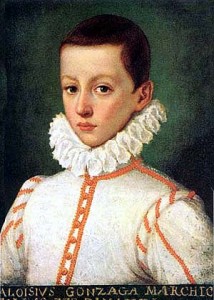
St. Aloysius Gonzaga (1568-1591) is often portrayed as a weak dreamy sort of figure. Worse, he has been presented to young people as a patron and role model who rejected all of the fun, adventure, and rebellion of youth. The real story is far more compelling.

How St. Luigi Gonzaga became St. Aloysius in English is not clear. The Latin for Luigi would be Ludovicus. Alois would be the German equivalent.

The “spin” of 17th and 18th century writers on his life was more a pietist anti-intellectual critique of the secularist Enlightenment. To be impolitic, he comes across as some sort of bloodless, lily toting wimp with upward cast eyes. Although it is not uncommon for saints to be “martyred” posthumously and their lives used to advance a contemporary cause, the Renaissance Luigi Gonzaga, Marquis of Castiglione is more relevant to us as post-modern Christians.

The overall sketch of his life is a simple as it is dramatic. Luigi was the oldest son of Ferrante, the Marquis of Castiglione, and named for the founder of the Gonzaga family Luigi, Lord of Mantua (1328). He was a pious youth, despised the things of this world, joined the Jesuits, and died of the plague after contracting it from nursing its abandoned victims in the streets of Rome when he was barely 23.

The context of his life and his status as an imperial prince give us a fuller understanding of who he was. According to John Coulson, the editor of The Saints: A Concise Biographical Dictionary:

It is impossible to estimate Aloysius’ (Luigi’s) career without some idea of his appalling heredity and environment. The Gonzaga tyrants rank with the Visconti, the Sforza, and the D’Este. They entered history about 1100; the first Gonzaga, lord of Mantua, was Luigi (1328), whose third marriage took place on the same day as his son’s and grandson’s: the three brides entered Mantua together in triumph. Already their cliff-like fortress was looming over the city. These despots displayed an amazing mixture of qualities. The Gonzaga clan survived one assassination after another and became allied to most of the reigning houses; but Luigi Gonzaga (141), grimly surnamed ‘The Turk,’ kept up three printing-presses and had for clients men like Platina, or Mantegna, who painted the scenery–now at Hampton Court–for the plays to which the Gonzaga were devoted. The French Parliament petitioned against the introduction of these plays into France–they were a ‘high school of adultery’–and no one would now dare paint the pictures with which some of the Gonzaga palaces were adorned. Yet these princes could care for agriculture, irrigation, checks on usury; and their insane debaucheries alternated with explosions of a genuine underlying faith. Their subjects, bled white by taxation, thrilled by their exotic pageantries, worshipped them till they broke into bloody but useless revolution.

The life of a Renaissance prince was far from any story book. St. Aloysius’ primary schooling was at the Medici Court in Florence. While he received the best academic training of the day, there was a bigger focus on swordsmanship, riding, and intrigue. He also spent significant time at the Spanish Court of King Philip II. His mother was a Valois and a relative of the Queen and his father had turned down a position of Master of the Horse in the English Court of Henry VIII in favor of Spain. At the time, the Spanish Empire was at its height of power and global dominance. Philip II also became king of Portugal as Philip I and ruled the Portuguese Empire as well.

As the oldest son, Luigi was trained to fulfill the duties of a prince and to prepare to succeed his father in the wealth, power, and literal back stabbing of the Gonzagas. As a child, though, he was appalled at what he saw and experienced, including the murder of close relatives. Fortunately, he came under the influence of St. Robert Bellarmine, who gave him his First Communion as a teenager. His rebellion was to reject it all and to enter the Church. His mother was not opposed to the idea, since it was not uncommon for powerful families to place prominent younger sons in key church positions that controlled considerable wealth and property. Luigi’s desire to join the Society of Jesus (Jesuits) was another matter. It would mean that he would forgo any type of service that could make him a powerful or wealthy cleric. Ironically, it was a wealthy and powerful churchman – Luigi’s cousin Cardinal Scipione Gonzaga – who prevailed on Ferrante to permit his son to join the Jesuits.

However, even as a Jesuit scholastic (student for the priesthood), he was still a celebrity who received celebrity treatment by those outside the order. Luigi probably over-compensated for this and his spiritual director and personal mentor, St. Robert Bellarmine, told him to ease up on prayer and penance and live a more moderate life. If we look between the lines, fitting a Renaissance prince into a religious house was not the easiest task for Luigi or his fellow religious. In fact, St. Ignatius’ famous letter on obedience was motivated in part to try to redirect the religious enthusiasm of these men to the ultimate in penance – to do what you are told whether you like it or not.

One can only imagine what it was to see a Gonzaga nursing victims of the plague on the streets of Rome.

There is a wonderful statue of St. Luigi outside St. Aloysius parish on the grounds of Gonzaga University in Spokane, Washington which shows a vital, caring, young man tending to a plague victim.

For some time when Gonzaga University was at the height of its fame as a basketball champion, there was a slogan which the University ran on national TV – Gonzaga: a Way of Life. The possibility of taking a brand like “Gonzaga” and making it stand for an impassioned life of faith inspired service is due to a young man caught up in grace. Isn’t that what we want for all young men and women?

Read More

Posted by on Jun 20, 2008

Saint of the Day: St. Maximilian Kolbe – August 14

Your Own Directory at Theologika.net

NEWS FLASH!

Theologika.net will begin offering workshops and classes in collaboration with our trustees and other theologians, philosophers and social scientists in early 2011. As part of this new development, the ways you will search for information and create tags will change.

Check out these two posts for details about the upcoming changes and how to save your own personal directory materials.

2011 Brings Classes and Big Improvements to Theologika.net

We’re Moving: Time to Pack Up Your Data

More information about the changes will be posted on our blog at https://blog.theologika.net as they develop .

If you yourself have a website yourself, please put our site, www.theologika.net, into your links and recommendations.  We’ve even got a neat logo you can put with it if you’d like. You may copy it from this post.

We hope Theologika.net will be helpful in your work and spiritual journey. Looking forward to hearing from you.

Randy and Kathy

Read More

Posted by on Jun 13, 2008

Saint of the Day: St. Maximilian Kolbe – August 14

Saint of the Day: St Anthony of Padua – June 13

Doctor Evangelicus

FRIAR MINOR
MINISTER PROVINCIAL OF ROMAGNA
CANON REGULAR OF ST. AUGUSTINE
DOCTOR OF THE CHURCH
PATRON OF PREACHERS

St. Anthony has always been a special family patron. I suppose my paternal grandfather, Doroteo Pozos, is to blame. My father was born on August 26 and, according to custom, was supposed to have been named Seferino after the Saint of the Day, Pope St. Zephyrinus (pontificate 198 -217). My grandfather didn’t like the name and instead named his only son Antonio. This started a chain of Antonian events. My oldest brother was name Anthony, and my sister Antoinette. To drive the point home, Providence sent my brother Arnold to us on June 13. Kathy and I did not help things either by naming our second son Antonio.

So who was St. Anthony / San Antonio? Actually St. Anthony (ca. 1195 – 1231) was Portuguese and is sometimes referred to as St. Anthony of Lisbon, where he was born and baptized Fernando Martin de Bulhoes. His parents were wealthy and powerful nobles. How his life took him from Lisbon as a member of the Canons Regular of St. Augustine to become the Franciscan St. Anthony of Padua in northern Italy is a story with many twists and turns.

When he was 15, the young Fernando entered St. Vincent, the monastery of the Canons Regular of St. Augustine. This group served as pastors and were not monks. After a couple of years Fernando asked to be transferred to the group’s Abbey of the Holy Cross in Coimbra, which was the capital of Portugal at the time. Apparently, he had not been happy with the visits and interruptions of family and friends in Lisbon and felt that his studies and his vocation were suffering as a result.

After he completed his studies and was ordained in Coimbra, Fr. Fernando was placed in charge of hospitality for the abbey, which meant that he was responsible for taking care of guests. A group of Franciscans, who were a new an dynamic movement at the time, were his guests as they traveled to Islamic Spain and Morocco as missionaries. They moved him deeply and when their martyred remains returned to Coimbra, Fr. Fernando managed to get the permission of his superiors to join the Franciscans. He received the Franciscan habit, took the name Antonio, and was intent on going to Morocco to die for the faith.

When St. Anthony landed in Morocco, along with another Franciscan, he was so ill that he had to return to Portugal. On his premature return trip, his ship was blown off course by a huge storm which swept him all the way to Sicily. He made his way to Assisi and was in very poor health. He ended up in a small hospice in the countryside, where he lived as a hermit and helped out in the kitchen.

St. Anthony’s marvelous gifts as a preacher and scriptural theologian were discovered when he was asked to preach at an ordination. Although it is unlikely that St. Anthony ever met St. Francis, the Poverello appointed St. Anthony to teach theology to his brothers. This was an unusual endorsement, since St. Francis had many reservations about the ego of scholars and theologians. He did not want to foster this type of unfortunate self-centeredness in his own group.

St. Anthony not only spent time as a teacher but also traveled extensively, preaching in the countryside and serving in administrative offices of the order. He took on various groups which had deviated from orthodoxy. Although St. Anthony is called the “Hammer of the Heretics,” he has a more pastoral legacy which underscores his genuine concern for people. There are many stories of miracles which seem to strain our post-modern credulity. Although many may be legends or devotional fabrications, St. Anthony was known to have transformed many lives and had a definite impact on a long line of Franciscan scholars and saints who would come after him.

He was to set an ideal for Franciscan intellectuals, who were great preachers, mystics, ascetics, and competent administrators. St. Bonaventure is one of the more famous examples of this cluster of gifts, as is Blessed Junipero Serra the Apostle of California.

Most often, St. Anthony is depicted holding the Christ Child. Except for the Blessed Mother and St. Joseph, no other saint is presented this way. Apparently, this depiction began in the 17th century, based on a legend from the saint’s life. Symbolically though, this image presents much of Franciscan spirituality in terms of encountering, modeling and presenting Christ – poor, vulnerable, and welcoming.

St. Anthony died near Padua at the age of 36. This was not an unusual lifespan for the 13th century and yet it is amazing what he gave to us in such a brief span of years.

Read More